

Surging Demand in Quantum Technologies Powering the Rubidium Oxide Market
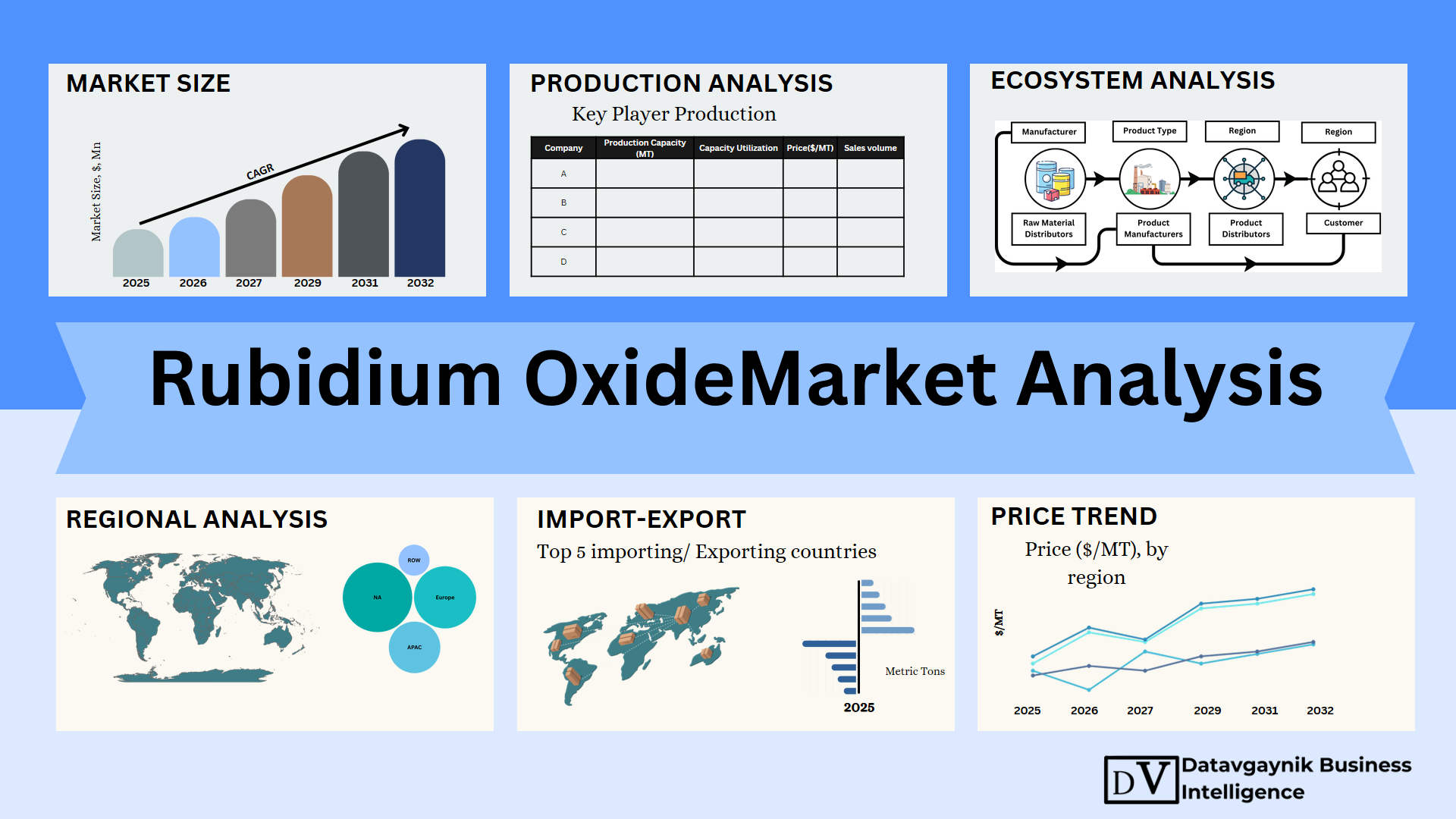
The Rubidium Oxide Market is witnessing accelerating growth, driven largely by increasing investments in quantum technologies. For instance, rubidium-based atomic clocks and quantum sensors have become foundational in precision navigation and secure communication systems. According to Datavagyanik, global spending on quantum computing technologies exceeded USD 1.3 billion in 2023 and is expected to double by 2027. A significant portion of this investment is directed toward systems reliant on rubidium isotopes derived from rubidium oxide. These isotopes enable ultra-precise timekeeping in quantum clocks, which are crucial for GPS-independent navigation and synchronization of large-scale communication networks.
Healthcare Expansion Catalyzing Growth in the Rubidium Oxide Market
The healthcare sector is emerging as a vital end-user in the Rubidium Oxide Market, particularly with rising reliance on rubidium-based isotopes in diagnostic imaging. One key application is in positron emission tomography (PET), where rubidium-82 is widely used to image myocardial perfusion in cardiac patients. In the United States alone, more than 3 million PET scans are performed annually, with increasing adoption projected in emerging markets such as India and Brazil. Datavagyanik reports a compound annual growth rate (CAGR) of 6.8% in the medical imaging sector globally through 2030, signaling a consistent uptick in demand for rubidium oxide as a critical input for radiopharmaceutical production.
Datavagyanik also covers related markets such as the Rubidium Sulfate Market, the Rubidium Chloride Market, and the Rubidium Carbonate Market. These compounds are commonly used in oxidation systems and industrial chemical processing, supporting shifts in formulation standards and regulatory compliance.
Rubidium Oxide Market Growth Aligned with Energy Storage Innovation
Energy storage systems represent a transformative segment within the Rubidium Oxide Market. With increasing demand for high-efficiency and stable battery chemistries, rubidium oxide is gaining attention for its role in enhancing the electrochemical performance of next-generation batteries. For example, experimental data from multiple universities have demonstrated improved ionic conductivity in battery cells incorporating rubidium-based compounds. The global energy storage systems market surpassed USD 75 billion in 2023 and is forecasted to exceed USD 160 billion by 2030, according to Datavagyanik. The push toward renewable energy integration and electric mobility directly supports rubidium oxide’s rising relevance in energy storage innovations.
Specialty Glass and Photonics Driving the Rubidium Oxide Market Forward
The Rubidium Oxide Market is also benefiting from sustained demand in the specialty glass and photonics sectors. Rubidium oxide is used in the formulation of high-performance optical glasses that exhibit excellent thermal and chemical stability. These materials are crucial in lasers, advanced lenses, and high-intensity lighting applications. For example, rubidium-based glasses are preferred in laser systems used in aerospace and defense, where high resistance to thermal expansion is mandatory. The specialty glass market itself was valued at USD 48 billion in 2023, and with photonics technologies penetrating sectors such as telecommunications, defense, and autonomous vehicles, the demand for rubidium oxide is expected to rise proportionally.
Robust Investment in R&D Strengthening the Rubidium Oxide Market
Global investments in research and development are significantly shaping the future of the Rubidium Oxide Market. Institutions and companies are focusing on the broader applications of rubidium compounds in fields ranging from atomic physics to materials science. For instance, ongoing research at European laboratories is investigating rubidium oxide’s potential in superconducting materials and ultra-sensitive magnetometers. Datavagyanik highlights that R&D spending across advanced materials in Europe reached over USD 22 billion in 2023. This investment wave is fostering innovative applications of rubidium oxide, moving the compound beyond its traditional niches into new, high-impact industrial domains.
Electronics and Semiconductor Industry Bolstering the Rubidium Oxide Market
The rapid advancement of electronic devices and semiconductor technologies is another prominent growth catalyst in the Rubidium Oxide Market. Rubidium oxide is valued in the production of semiconductors and specialty ceramics, where thermal and electrical stability are key performance indicators. As consumer electronics continue to miniaturize and demand higher performance, materials with low dielectric loss and superior thermal properties are increasingly sought after. In 2023, the global semiconductor market grew by 12%, reaching a value of USD 580 billion. Given its properties, rubidium oxide is being explored as a dopant and additive in ceramic substrates and thin-film devices used in this rapidly evolving industry.
Aerospace and Defense Applications Widening the Rubidium Oxide Market Scope
Applications in aerospace and defense are expanding the scope of the Rubidium Oxide Market significantly. Rubidium-based atomic clocks are critical components in satellite navigation systems and secure military communication devices. For instance, the Galileo satellite system of the European Union employs rubidium atomic clocks to ensure accurate geolocation. According to Datavagyanik, the global satellite communication market reached USD 60 billion in 2023 and is expected to grow at a CAGR of 7.2% through 2030. With increasing deployment of low-earth orbit satellites and next-generation communication protocols, the reliance on rubidium oxide for precision instrumentation will continue to strengthen.
Rubidium Oxide Market Size Fueled by Global Technological Transitions
The Rubidium Oxide Market Size has shown consistent upward momentum, bolstered by cross-sector technological transitions. As of 2023, Datavagyanik estimates the market valuation crossed USD 250 million, with projections indicating a CAGR of over 8% until 2032. This growth is attributed to increasing demand in high-value sectors such as quantum computing, energy storage, and advanced diagnostics. The continuous adoption of digital technologies, smart infrastructure, and healthcare innovations across both developed and developing regions positions rubidium oxide as a strategic material in the global tech supply chain.
Supply Chain Strategic Moves Supporting the Rubidium Oxide Market
To ensure long-term market stability, key stakeholders in the Rubidium Oxide Market are actively exploring diversified sourcing and strategic supply agreements. With rubidium typically obtained as a byproduct of lithium and potassium mining, concentrated reserves in countries like China and Canada dominate global production. In response, nations such as the United States and Germany are investing in recycling technologies and forming international partnerships to secure stable access. For example, a German-Canadian initiative launched in 2024 aims to develop sustainable rubidium extraction from lepidolite waste streams. These developments are intended to reduce supply chain risks and ensure uninterrupted availability for industrial users.
Rising Interest from Emerging Economies Accelerating the Rubidium Oxide Market
Emerging economies are playing an increasingly important role in the Rubidium Oxide Market, particularly in Asia-Pacific and Latin America. Countries such as India, Brazil, and South Korea are witnessing rapid expansion in sectors like renewable energy, diagnostics, and advanced electronics—all of which demand high-performance materials. For instance, India’s clean energy capacity rose by 14% in 2023, pushing demand for stable and scalable energy storage systems. Similarly, Brazil’s medical imaging market grew by 9.3% over the past year. These trends are creating fertile ground for the penetration of rubidium oxide into new industrial applications in fast-growing markets.
Rubidium Oxide Market Size Strengthened by Multi-Sector Demand Synergy
The synergy between various end-use sectors is playing a pivotal role in reinforcing the Rubidium Oxide Market Size. From aerospace and healthcare to telecommunications and energy storage, the diversity in rubidium oxide’s application base ensures a broad demand foundation. For instance, the integration of rubidium isotopes into both atomic clocks and PET imaging systems exemplifies how a single compound serves critical needs across defense and medical sectors. This multi-sector interdependence is not only enhancing the material’s relevance but also insulating the market against volatility from any single industry downturn.
“Track Country-wise Rubidium Oxide Production and Demand through our Rubidium Oxide Production Database”
- Rubidium Oxide production database for 22+ countries worldwide
- Rubidium Oxide sales volume for 27+ countries
- Country-wise Rubidium Oxide production capacity, production plant mapping, production capacity utilization for 22+ manufacturers
- Rubidium Oxide production plants and production plant capacity analysis by top manufacturers
“Track real-time Rubidium Oxide Prices, Rubidium Oxide price charts for 22+ countries, Rubidium Oxide weekly price tracker and Rubidium Oxide monthly price tracker”
- Track real-time Rubidium Oxide prices and Rubidium Oxide price trend in 22+ countries though our excel-based Rubidium Oxide price charts
- Real-time Rubidium Oxide price tracker dashboard with 22+ countries
- Complete transparency on Rubidium Oxide price trend through our Rubidium Oxide monthly price tracker, Rubidium Oxide weekly price tracker
North America Leads the Rubidium Oxide Market Through Technological Investments
In North America, the Rubidium Oxide Market is heavily influenced by technological innovation, particularly in the United States and Canada. The U.S. is a major consumer of rubidium oxide, with significant demand originating from the defense, healthcare, and energy storage sectors. For instance, over 70% of quantum computing startups funded in North America in 2023 are working on technologies that require rubidium-based atomic clocks or quantum sensors. Datavagyanik estimates the U.S. alone accounted for nearly 28% of the global Rubidium Oxide Market demand in 2023.
Canada plays a unique role not just as a consumer but also as a primary producer. The country hosts one of the world’s largest reserves of pollucite in Manitoba, a key mineral source for rubidium extraction. The Canadian government has supported rubidium refining initiatives through partnerships between mining companies and research institutions, aiming to localize supply chains for quantum-grade rubidium oxide production.
Europe’s High-Tech Manufacturing Boosting the Rubidium Oxide Market
Europe has emerged as another stronghold in the Rubidium Oxide Market, with Germany, France, and the United Kingdom at the forefront of consumption. Germany, for example, is investing heavily in quantum infrastructure, including atomic clock development and secure communication networks. In 2023, Germany allocated over USD 3 billion toward national quantum research, much of which involves rubidium isotopes derived from rubidium oxide.
France, with its advanced healthcare system, has seen a surge in demand for rubidium-based isotopes used in PET imaging. The French radiopharmaceutical industry expanded by 6.7% in 2023, reflecting increased demand for materials like rubidium oxide in diagnostics. Meanwhile, the UK is using rubidium oxide in both specialty glass production and quantum photonics research. The region’s highly developed electronics and medical imaging sectors are contributing significantly to the broader Rubidium Oxide Market in Europe.
Asia-Pacific Expanding the Rubidium Oxide Market Through Industrial Demand
The Asia-Pacific region is quickly scaling its presence in the Rubidium Oxide Market, led by China, Japan, South Korea, and India. China is the largest global producer and exporter of rubidium oxide, leveraging its dominance in lithium and potassium mining. Chinese enterprises are extracting rubidium as a byproduct, particularly from lepidolite deposits, to meet domestic and export needs. The country’s “Made in China 2025” policy supports development in photonics, renewable energy, and advanced electronics—each a major consumer of rubidium oxide.
Japan and South Korea focus their demand on precision electronics and quantum computing. Japan’s Ministry of Education, Culture, Sports, Science and Technology allocated over USD 900 million for advanced materials research in 2023, much of which includes quantum sensor development using rubidium oxide. South Korea’s semiconductor industry, which grew by 10.4% last year, uses rubidium oxide in specialty ceramics essential for high-temperature, high-frequency devices.
India is rapidly emerging as a notable consumer due to its growing diagnostic imaging and clean energy sectors. The Indian renewable energy sector added over 20 GW of capacity in 2023, and rubidium oxide is being considered for deployment in advanced battery chemistry trials conducted by the Indian Institute of Science and national energy labs.
Middle East and Latin America: Emerging Opportunities in the Rubidium Oxide Market
In the Middle East, countries like the UAE and Saudi Arabia are tapping into the Rubidium Oxide Market to support their strategic focus on technological diversification. For instance, Saudi Arabia’s Vision 2030 plan includes investments in aerospace and defense, sectors where rubidium-based atomic clocks and navigation systems are critical. The UAE is also pushing toward becoming a regional hub for AI, clean energy, and quantum computing—all of which benefit from rubidium oxide applications.
Latin America, particularly Brazil and Chile, is showing increasing interest as industrial development continues. Brazil’s healthcare diagnostics market expanded by 8.2% in 2023, while Chile’s strong mining sector positions it as a future source of rubidium if lithium extraction technologies are aligned for byproduct recovery. These emerging markets are expected to contribute to the next wave of Rubidium Oxide Market expansion.
Rubidium Oxide Market Segmentation by Application
Segmentation within the Rubidium Oxide Market by application reveals clear drivers across five dominant verticals. Quantum technologies account for the largest share, followed by healthcare diagnostics, energy storage, specialty glass manufacturing, and catalysts in chemical synthesis.
For instance, quantum applications alone represented nearly 35% of the global rubidium oxide consumption in 2023, fueled by demand for quantum sensors, timing systems, and data encryption solutions. In healthcare, rubidium-82 isotope usage is expanding, particularly in private diagnostic centers and hospitals in the U.S., Japan, and France.
The energy storage segment is also gaining momentum. Datavagyanik estimates that demand for rubidium oxide in experimental battery technologies grew by 12% year-over-year in 2023. Specialty glass applications hold around 15% of the total market, especially in optics used for lasers, high-precision lenses, and radiation shielding.
Rubidium Oxide Market Segmentation by End-Use Industry
The end-use industry segmentation of the Rubidium Oxide Market highlights robust diversification. Electronics and semiconductors lead the category, accounting for 30% of the market volume. This is followed by medical imaging technologies at 25%, and aerospace & defense at 18%. Each of these sectors leverages rubidium oxide in ways that align with rising global trends.
For example, the rapid deployment of semiconductor chips in automotive, AI, and IoT devices has led to consistent demand for high-stability materials like rubidium oxide. In aerospace, rubidium-based instruments are being built into newer generations of low-Earth orbit satellites for precision communication.
Research and development remains a fast-growing end-use category, with more than 120 universities and private research labs in Europe and North America working on rubidium oxide-related technologies as of 2023. The synergy of scientific inquiry and commercial application continues to fuel innovation in the Rubidium Oxide Market.
Global Rubidium Oxide Production Landscape and Supply Chain Realities
The global production of rubidium oxide is geographically concentrated due to the rarity of rubidium-bearing minerals. China dominates the Rubidium Oxide Market supply, responsible for approximately 50% of global output, thanks to its extensive lepidolite mining infrastructure. Canada follows with around 20%, supported by high-grade pollucite sources in Manitoba.
Efforts to diversify production are gaining momentum. In 2024, the U.S. Department of Energy initiated a research consortium to investigate economically viable rubidium extraction methods from low-grade deposits in Utah and Colorado. Meanwhile, Germany is exploring recovery of rubidium from industrial waste streams, aligning with EU sustainability goals.
This concentration of supply raises concerns over geopolitical risks and export dependencies. As such, multiple governments are establishing national stockpiles and trade partnerships to secure future access to this strategic material.
Rubidium Oxide Price and Global Pricing Trends
The Rubidium Oxide Price has experienced considerable fluctuations in recent years due to supply chain constraints and surging demand from high-tech industries. In 2022, the average Rubidium Oxide Price stood at approximately USD 1,800 per kilogram. By mid-2024, the price rose to nearly USD 2,400/kg, representing a 33% increase over two years.
This sharp uptick in Rubidium Oxide Price Trend can be traced to increased procurement by companies in the quantum computing and medical imaging fields. For instance, several U.S.-based PET scan equipment manufacturers doubled their rubidium oxide consumption between 2022 and 2024. Furthermore, experimental energy storage companies in Asia and Europe entered the procurement cycle, tightening supply and contributing to upward pressure on prices.
Datavagyanik highlights that the Rubidium Oxide Price Trend is expected to remain volatile over the next five years, with price softening only likely if new sources of rubidium are commercialized or if recycling infrastructure is significantly scaled. Some relief is expected from Canadian and Australian mining initiatives scheduled to commence pilot production by 2026.
Strategic Forecast on Rubidium Oxide Price Trend and Market Implications
The future Rubidium Oxide Price Trend will play a decisive role in shaping procurement strategies across industries. Stakeholders in the electronics and healthcare sectors are likely to invest in long-term supply agreements to mitigate price uncertainty. Meanwhile, R&D investments are shifting toward resource efficiency, with labs attempting to reduce rubidium oxide usage per device or process unit.
In emerging markets, elevated Rubidium Oxide Prices could delay technology adoption unless supported by government subsidies or collaborative international supply arrangements. However, price pressure also creates opportunities for innovation, such as developing rubidium oxide alternatives or synthetic equivalents for low-critical applications.
Overall, the interplay between constrained supply, increasing demand, and speculative procurement is expected to keep the Rubidium Oxide Market dynamic and opportunistic through 2030.
“Rubidium Oxide Manufacturing Database, Rubidium Oxide Manufacturing Capacity”
- Rubidium Oxide top manufacturers market share for 22+ manufacturers
- Top 6 manufacturers and top 12 manufacturers of Rubidium Oxide in North America, Europe, Asia Pacific
- Rubidium Oxide production plant capacity by manufacturers and Rubidium Oxide production data for 22+ market players
- Rubidium Oxide production dashboard, Rubidium Oxide production data in excel format
“Rubidium Oxide price charts, Rubidium Oxide weekly price tracker and Rubidium Oxide monthly price tracker”
- Factors impacting real-time Rubidium Oxide prices in 17+ countries worldwide
- Rubidium Oxide monthly price tracker, Rubidium Oxide weekly price tracker
- Real-time Rubidium Oxide price trend, Rubidium Oxide price charts, news and updates
- Tracking Rubidium Oxide price fluctuations
Leading Manufacturers Defining the Rubidium Oxide Market Landscape
The Rubidium Oxide Market is highly consolidated, with a small group of specialized manufacturers dominating global production and distribution. Given the rarity of rubidium and the technical complexity involved in its extraction and refinement, only a handful of companies hold significant influence over supply chains. These players are integrated across mining, chemical synthesis, and advanced material manufacturing, giving them a strategic advantage in addressing rising demand from sectors such as quantum computing, aerospace, and medical diagnostics.
Merck KGaA: A Major Force in the Rubidium Oxide Market
Merck KGaA, headquartered in Darmstadt, Germany, is one of the foremost producers in the Rubidium Oxide Market. The company manufactures high-purity rubidium compounds under its advanced materials division, serving end-users in quantum research, healthcare, and photonics. Product lines such as Rubidium Oxide Puriss and Rubidium Carbonate High Purity are tailored for use in atomic clocks, ion engines, and diagnostic imaging technologies. Merck’s vertical integration, from raw material refinement to advanced application-specific formulation, provides it a substantial share—estimated at 18%—of the global rubidium oxide supply.
American Elements: High-Purity Rubidium Oxide for Research and Industry
American Elements, based in Los Angeles, maintains a prominent position in the Rubidium Oxide Market through its extensive catalog of high-purity materials. The company’s Rubidium Oxide 99.9% (trace metals basis) is widely used by national laboratories, academic institutions, and quantum computing startups across North America and Europe. Their product portfolio supports applications ranging from microelectronics to advanced catalysts, with packaging formats specifically designed for cleanroom environments. American Elements is estimated to command approximately 15% of the rubidium oxide segment globally, with steady growth in international custom synthesis contracts.
Alfa Aesar (a Thermo Fisher Scientific Brand): Supplying the Global Research Base
Alfa Aesar, now part of Thermo Fisher Scientific, serves the Rubidium Oxide Market through its portfolio of specialty chemicals. Their Rubidium Oxide, 99.8% trace metal basis product is routinely used in atomic spectroscopy and laser technologies. The brand enjoys strong trust among research universities and aerospace suppliers, particularly in Europe and Asia. Given Thermo Fisher’s robust global distribution network and customer base, Alfa Aesar is positioned to account for 12% of the current rubidium oxide supply volume.
Stanford Advanced Materials: Emerging Presence in the Rubidium Oxide Market
Stanford Advanced Materials (SAM) is steadily increasing its footprint in the Rubidium Oxide Market, particularly within Asia-Pacific and Middle Eastern markets. SAM offers rubidium oxide in multiple purity grades and particle sizes to suit customer requirements across electronics, optical glass, and defense technology applications. Their High-Density Rubidium Oxide Powder has seen growing adoption in South Korea and India due to its compatibility with thin-film deposition and ion beam sputtering systems. Although relatively new compared to legacy producers, SAM holds an estimated 8% share of the global market, with upward potential driven by geographic diversification and competitive pricing.
Shanghai China Lithium Industrial Co., Ltd.: Dominating Rubidium Extraction in Asia
As one of the largest rubidium extractors in Asia, Shanghai China Lithium Industrial Co. plays a pivotal upstream role in the Rubidium Oxide Market. The company primarily extracts rubidium from lepidolite deposits and supplies refined oxide to domestic electronics manufacturers and state research institutes. With extensive mining assets and domestic contracts in China, it is estimated that the company supports nearly 25% of Asia’s rubidium oxide requirements. While not widely engaged in global exports, their influence within China’s rapidly growing high-tech sector is instrumental in regional price setting and availability.
Market Share Dynamics in the Rubidium Oxide Market
The Rubidium Oxide Market is highly concentrated, with the top five manufacturers—Merck KGaA, American Elements, Alfa Aesar, Stanford Advanced Materials, and Shanghai China Lithium—collectively controlling over 70% of the global supply. Market share is strongly linked to purity capabilities, distribution networks, and access to rubidium-bearing ores such as pollucite and lepidolite.
For example, Merck’s dominance is due not just to production volume, but its ability to supply ultra-high purity variants suitable for quantum and aerospace applications. American Elements and Alfa Aesar maintain strong positions due to their expansive global distribution and long-term partnerships with laboratories and universities. Regional players such as SAM are rapidly increasing market share through tailored customer service and entry into developing markets.
Recent Developments in the Rubidium Oxide Market
The Rubidium Oxide Market has seen several key developments over the past 12 months, with implications for both pricing and long-term supply security.
- March 2024: Merck KGaA announced the expansion of its specialty oxide production facility in Darmstadt. The facility will incorporate advanced purification lines capable of producing rubidium oxide with ≥99.999% purity, targeted at quantum sensor manufacturers in Germany and the U.S.
- May 2024: Stanford Advanced Materials secured a three-year supply contract with a leading South Korean photonics company to provide rubidium oxide for use in laser amplification systems. The agreement is expected to boost SAM’s revenue from this segment by 25% annually.
- July 2024: American Elements launched a new packaging system to prevent moisture degradation of rubidium oxide powders during global transit. This innovation is expected to reduce material loss by over 15%, improving supply chain efficiency for research labs.
- September 2024: Thermo Fisher Scientific began integrating Alfa Aesar’s rubidium product line into its high-volume chemical supply chain, enabling faster delivery for North American customers. The initiative includes warehouse expansion in Illinois and Ontario.
- November 2024: A new extraction trial commenced in Canada to extract rubidium oxide from spodumene tailings in Northern Ontario. If successful, this pilot program could introduce a new domestic rubidium source for North American manufacturers by 2026.
Strategic Direction of Rubidium Oxide Market Players
The current trajectory for leading players in the Rubidium Oxide Market involves increased focus on sustainability, recycling, and localization of production. As demand continues to outpace supply, manufacturers are exploring technologies that reduce the rubidium load per device while improving material recovery.
In parallel, long-term contracts with defense agencies, medical institutions, and clean energy firms are becoming central to securing market positions. Companies investing in ultra-high purity production and logistics optimization are best positioned to capture emerging opportunities across Europe, North America, and Asia-Pacific.
“Rubidium Oxide Production Data and Rubidium Oxide Production Trend, Rubidium Oxide Production Database and forecast”
- Rubidium Oxide production database for historical years, 10 years historical data
- Rubidium Oxide production data and forecast for next 7 years
- Rubidium Oxide sales volume by manufacturers
“Track Real-time Rubidium Oxide Prices for purchase and sales contracts, Rubidium Oxide price charts, Rubidium Oxide weekly price tracker and Rubidium Oxide monthly price tracker”
- Gain control on your purchase and sales contracts through our real-time Rubidium Oxide price tracker and Rubidium Oxide price trend analysis
- Rubidium Oxide weekly price tracker and forecast for next four weeks
- Rubidium Oxide monthly price tracker and forecast for next two months
Market Scenario, Demand vs Supply, Average Product Price, Import vs Export, till 2032
- Global Rubidium Oxide Market revenue and demand by region
- Global Rubidium Oxide Market production and sales volume
- United States Rubidium Oxide Market revenue size and demand by country
- Europe Rubidium Oxide Market revenue size and demand by country
- Asia Pacific Rubidium Oxide Market revenue size and demand by country
- Middle East & Africa Rubidium Oxide Market revenue size and demand by country
- Latin America Rubidium Oxide Market revenue size and demand by
- Import-export scenario – United States, Europe, APAC, Latin America, Middle East & Africa
- Average product price – United States, Europe, APAC, Latin America, Middle East & Africa
- Market player analysis, competitive scenario, market share analysis
- Business opportunity analysis
Key questions answered in the Global Rubidium Oxide Market Analysis Report:
- What is the market size for Rubidium Oxide in United States, Europe, APAC, Middle East & Africa, Latin America?
- What is the yearly sales volume of Rubidium Oxide and how is the demand rising?
- Who are the top market players by market share, in each product segment?
- Which is the fastest growing business/ product segment?
- What should be the business strategies and Go to Market strategies?
The report covers Rubidium Oxide Market revenue, Production, Sales volume, by regions, (further split into countries):
- Asia Pacific (China, Japan, South Korea, India, Indonesia, Vietnam, Rest of APAC)
- Europe (UK, Germany, France, Italy, Spain, Benelux, Poland, Rest of Europe)
- North America (United States, Canada, Mexico)
- Latin America (Brazil, Argentina, Rest of Latin America)
- Middle East & Africa
Table of Contents:
1. Introduction to the Rubidium Oxide Market
- Overview of Rubidium Oxide and Its Industrial Applications
- Key Uses in Electronics, Specialty Glass, and Chemical Catalysis
- Market Scope, Emerging Trends, and Growth Potential
2. Rubidium Oxide Market Segmentation and Product Categorization
- Classification by Purity Levels and Chemical Properties
- Industrial-Grade vs. High-Purity Rubidium Oxide Applications
- Technological Advancements in Rubidium Oxide Production
3. Global Rubidium Oxide Market Size and Forecast (2019-2032)
- Market Valuation and Revenue Trends
- Global Demand-Supply Balance and Future Growth Projections
- Market Growth Drivers, Challenges, and Investment Opportunities
4. Regional Analysis of the Rubidium Oxide Market
4.1 North America (United States, Canada, Mexico)
- Market Share and Key Players in Rubidium Oxide Production
- Regional Sales, Pricing Trends, and Consumption Rates
- Import-Export Analysis and Trade Regulations
4.2 Europe (Germany, UK, France, Russia, etc.)
- Industrial Demand for Rubidium Oxide in Key Sectors
- Supply Chain Analysis and Market Expansion Strategies
- Government Regulations and Trade Policies
4.3 Asia-Pacific (China, Japan, India, South Korea, etc.)
- Rubidium Oxide Production Hubs and Market Growth Trends
- Export-Import Statistics and Regional Competitive Positioning
- Key Market Players and Strategic Developments
4.4 Latin America (Brazil, Argentina, Chile, etc.)
- Growth Potential of the Rubidium Oxide Market in Emerging Economies
- Local Manufacturing Capabilities and Supply Chain Expansion
- Market Challenges and Investment Opportunities
4.5 Middle East & Africa (Saudi Arabia, UAE, South Africa, etc.)
- Regional Industrial Applications and Demand Growth
- Trade Dynamics and Export Market Opportunities
- Local Production Capabilities and Investment Trends
5. Rubidium Oxide Production Analysis and Future Forecast (2019-2032)
- Global and Regional Rubidium Oxide Production Capacity and Trends
- Advances in Production Technologies and Process Efficiency
- Key Manufacturing Facilities and Future Production Estimates
6. Competitive Landscape and Industry Market Share
- Leading Rubidium Oxide Producers and Their Market Positioning
- Revenue, Market Share, and Business Expansion Strategies
- Mergers, Acquisitions, and Key Collaborations in the Market
7. Global Trade Flow and Market Movement of Rubidium Oxide
- Rubidium Oxide Production vs. Export Trends
- Import vs. Consumption Analysis in Key Markets
- Leading Exporting and Importing Countries and Their Market Influence
8. Consumption Insights and Industrial Demand Analysis
- Rubidium Oxide Consumption by Industry Sector
- Market Share by End-Use Applications and Key Growth Areas
- Future Demand Growth and Market Expansion Strategies
9. Cost Structure and Raw Material Supply Chain Overview
- Breakdown of Rubidium Oxide Manufacturing Costs
- Key Raw Material Suppliers and Their Market Influence
- Impact of Raw Material Pricing on Rubidium Oxide Production
10. Supply Chain and Market Logistics Evaluation
- Rubidium Oxide Value Chain from Extraction to End-Use Applications
- Distribution Networks and Logistics Optimization Strategies
- Role of Distributors, Suppliers, and Market Participants
11. Distribution Channels and Sales Strategies
- List of Rubidium Oxide Distributors and Global Supply Chain Partners
- Sales and Marketing Strategies of Leading Companies
- Strategies for Market Expansion Through Distribution Networks
12. Future Market Outlook and Growth Projections (2024-2032)
- Expected Trends in Rubidium Oxide Production and Market Demand
- Innovations, Industry Developments, and Emerging Technologies
- Investment Opportunities and Business Growth Strategies


