

Rising Demand for NdFeB Magnets Driving the Praseodymium Oxide Market
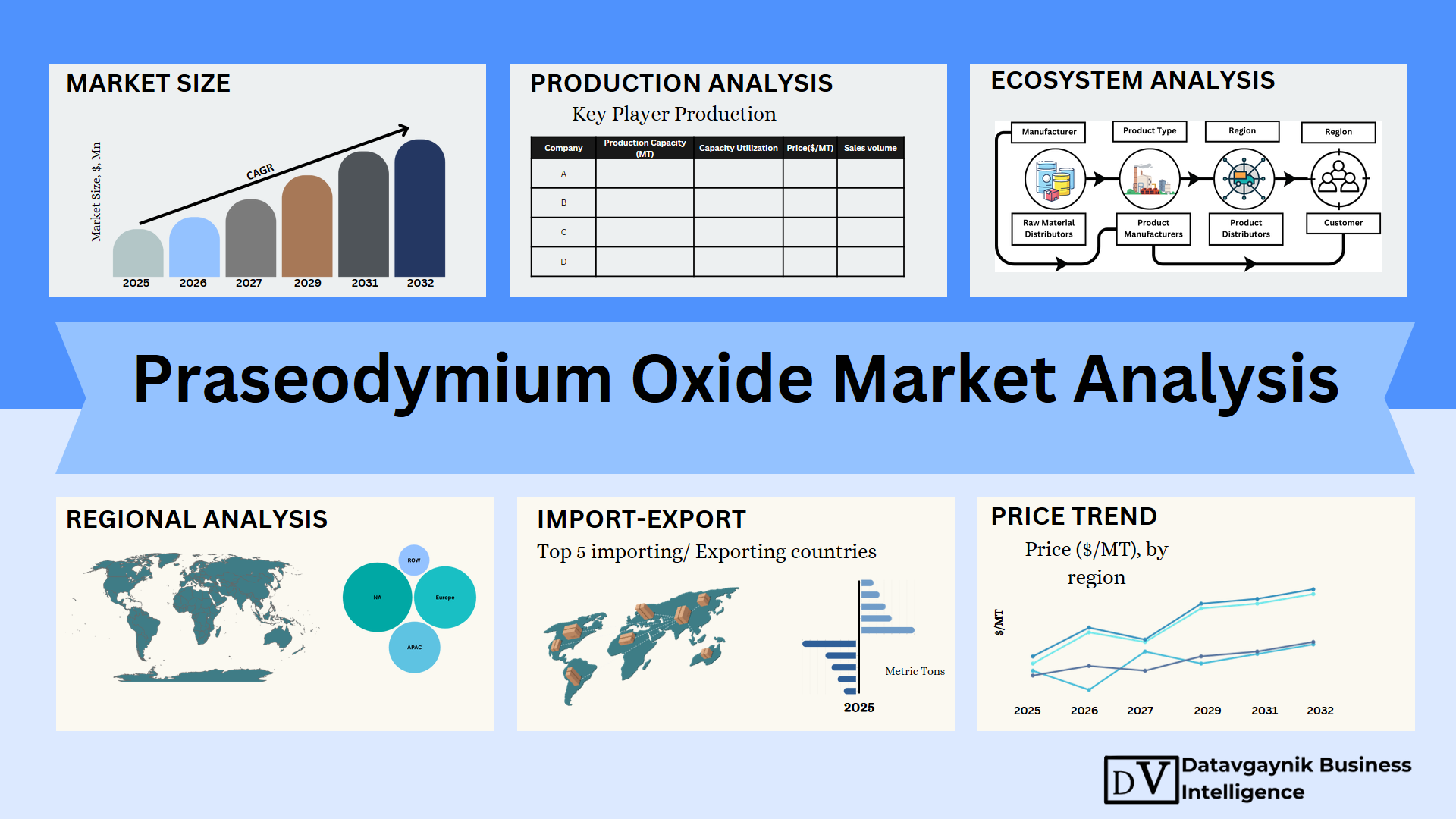
The Praseodymium Oxide Market is witnessing substantial momentum due to the accelerating global adoption of neodymium-iron-boron (NdFeB) magnets. These magnets, critical for high-efficiency electric motors, are composed of praseodymium and neodymium—materials that significantly boost magnetic strength and thermal resistance. The global production of NdFeB magnets has surpassed 160,000 metric tons annually, and this volume is forecasted to grow at over 7% CAGR through 2032, according to Datavagyanik. This upward trend directly translates into robust growth prospects for the Praseodymium Oxide Market.
Expansion of the Electric Vehicle Industry Propelling the Praseodymium Oxide Market
Electric vehicle (EV) adoption is emerging as a powerful catalyst for the Praseodymium Oxide Market. For instance, global EV sales crossed 14 million units in 2023, reflecting a growth rate of 35% compared to the previous year. Each EV motor typically requires around 500 grams of NdFeB magnets, creating immense demand for rare earth oxides, especially praseodymium oxide. As governments enforce stricter emissions targets and offer incentives for EV adoption, the demand for rare earth-based magnets—and by extension, praseodymium oxide—continues to surge. Countries such as China, the United States, and Germany have all witnessed double-digit annual growth in EV production, sustaining the Praseodymium Oxide Market’s expansion.
Datavagyanik also covers related markets such as the Praseodymium Sulfate Market and the Praseodymium Carbonate Market. These compounds are commonly used in oxidation systems and industrial chemical processing, supporting shifts in formulation standards and regulatory compliance.
Renewable Energy Development Enhancing Praseodymium Oxide Market Prospects
Wind energy, especially direct-drive wind turbines, has become another critical demand generator for the Praseodymium Oxide Market. Direct-drive turbines eliminate the need for gearboxes and rely on powerful rare earth magnets for higher energy conversion efficiency. As of 2023, global wind power capacity stood at over 1000 GW, with more than 25% of new installations utilizing direct-drive systems. Each of these turbines requires between 200–600 kg of NdFeB magnets. With praseodymium oxide being a core ingredient, this shift is resulting in growing material consumption. Europe and Asia Pacific lead the charge, with countries like Germany and China investing heavily in new wind projects to meet net-zero targets by 2050.
Aerospace and Defense Applications Bolstering the Praseodymium Oxide Market
The Praseodymium Oxide Market is further supported by demand from the aerospace and defense sectors. Praseodymium is used in high-strength alloys and thermal-resistant materials essential for jet engines, satellites, and missile guidance systems. For example, the global aerospace materials market reached USD 18 billion in 2023, and the rising demand for lightweight, high-performance components is fostering the adoption of rare earth compounds. The use of praseodymium oxide in alloy formulations improves heat tolerance and structural strength, which is critical in extreme flight and combat conditions. As global defense budgets increase, particularly in the United States, India, and the Middle East, the consumption of specialized rare earth materials is expected to intensify.
Technological Advancements Fueling the Praseodymium Oxide Market Growth
The Praseodymium Oxide Market is also benefiting from its integral role in cutting-edge technologies. For instance, praseodymium oxide is utilized in phosphors for display panels, energy-efficient lighting, and precision lasers. The global phosphor materials market is projected to grow at over 6.5% CAGR till 2032, reinforcing the rising application of praseodymium-based compounds. In addition, with smart devices and high-resolution screens becoming ubiquitous, demand for rare earth phosphors continues to accelerate. As OLED and quantum dot technologies gain mainstream adoption, praseodymium oxide stands at the forefront of materials required for performance enhancement.
Advanced Ceramics and Glass Applications Elevating the Praseodymium Oxide Market
Ceramic and glass applications form another dynamic segment within the Praseodymium Oxide Market. This compound is used as a colorant and thermal stabilizer in specialty glasses and ceramic glazes. For example, praseodymium oxide imparts a distinct yellow-green hue, which is used in architectural glass, automotive windshields, and industrial ceramics. The global market for technical ceramics alone is valued at over USD 10 billion, growing at a CAGR of 6.8%. As industries push for advanced thermal-resistant materials for use in aerospace, construction, and medical equipment, the consumption of praseodymium-based additives is steadily increasing.
Praseodymium Oxide Market Size Fueled by Global Decarbonization Goals
The Praseodymium Oxide Market Size has been significantly influenced by global decarbonization policies. As per Datavagyanik, nations representing over 75% of global GDP have committed to achieving net-zero emissions by mid-century. These policies have accelerated investments in green technologies such as electric mobility, wind energy, and energy-efficient infrastructure—all of which rely heavily on praseodymium oxide. The global rare earth market reached USD 6.8 billion in 2023, with praseodymium oxide accounting for a growing share due to its diverse applications in sustainability-focused technologies. The expansion of clean energy infrastructure is a cornerstone for long-term Praseodymium Oxide Market growth.
Government Incentives Reshaping the Praseodymium Oxide Market Dynamics
Government initiatives across major economies are playing a pivotal role in reshaping the Praseodymium Oxide Market. For example, the U.S. Inflation Reduction Act allocates over USD 369 billion toward clean energy projects, including domestic rare earth production. Similarly, the European Union’s Critical Raw Materials Act aims to reduce reliance on Chinese rare earth imports by investing in domestic mining and recycling projects. These policy shifts are driving investments into localized supply chains, thereby increasing demand for praseodymium oxide from domestic and regional sources. This shift not only enhances security of supply but also creates long-term value opportunities for producers and refiners.
Supply Chain Localization Strengthening the Praseodymium Oxide Market Framework
The focus on establishing resilient supply chains is accelerating production activities in the Praseodymium Oxide Market. For instance, MP Materials in the United States and Lynas Rare Earths in Australia have expanded their operations to reduce global dependency on Chinese supply. The Mountain Pass mine in California currently produces 15% of global rare earth concentrates, and plans are underway to establish refining capacity for oxides, including praseodymium. In parallel, countries like India and Canada are exploring untapped rare earth reserves to build competitive capabilities. These strategic investments are not only stabilizing the Praseodymium Oxide Market but also diversifying global production.
Rising Imports and Export Trends Influencing the Praseodymium Oxide Market
The Praseodymium Oxide Market is also shaped by international trade flows. For example, Japan remains a leading importer, securing supplies through long-term contracts with Australian and Southeast Asian producers. South Korea and India are also increasing their imports to fuel their growing electronics and EV industries. Meanwhile, China continues to dominate exports, supplying over 80% of global praseodymium oxide despite rising geopolitical tensions and export controls. These dynamics underscore the strategic nature of praseodymium oxide in global industrial growth and energy transition efforts.
Emerging Applications Contributing to the Praseodymium Oxide Market Size
Emerging application areas such as hydrogen storage, sensor technologies, and smart materials are adding new dimensions to the Praseodymium Oxide Market Size. For instance, researchers are developing praseodymium-doped materials for advanced catalysis and hydrogen fuel cell membranes. As green hydrogen production accelerates, materials that enhance catalytic efficiency are gaining prominence. Although still at an early stage, these experimental and next-gen applications have the potential to unlock new revenue streams and expand market size significantly by 2032.
“Track Country-wise Praseodymium Oxide Production and Demand through our Praseodymium Oxide Production Database”
- Praseodymium Oxide production database for 22+ countries worldwide
- Praseodymium Oxide sales volume for 27+ countries
- Country-wise Praseodymium Oxide production capacity, production plant mapping, production capacity utilization for 22+ manufacturers
- Praseodymium Oxide production plants and production plant capacity analysis by top manufacturers
“Track real-time Praseodymium Oxide Prices, Praseodymium Oxide price charts for 22+ countries, Praseodymium Oxide weekly price tracker and Praseodymium Oxide monthly price tracker”
- Track real-time Praseodymium Oxide prices and Praseodymium Oxide price trend in 22+ countries though our excel-based Praseodymium Oxide price charts
- Real-time Praseodymium Oxide price tracker dashboard with 22+ countries
- Complete transparency on Praseodymium Oxide price trend through our Praseodymium Oxide monthly price tracker, Praseodymium Oxide weekly price tracker
Asia Pacific Dominance in Praseodymium Oxide Market Driven by Manufacturing and EV Expansion
The Asia Pacific region commands a significant share of the Praseodymium Oxide Market, led by China’s massive rare earth mining and magnet manufacturing capabilities. As per Datavagyanik, China contributes over 85% of global praseodymium oxide production, making it the linchpin of the global supply chain. For example, the Bayan Obo mine in Inner Mongolia alone produces over 120,000 metric tons of rare earth concentrates annually, with praseodymium-rich ores forming a substantial portion.
China’s dominance is reinforced by its aggressive push in electric vehicles (EVs), wind energy, and electronics manufacturing. In 2023, China’s EV output surpassed 8 million units, and more than 70% of these vehicles employed NdFeB motors reliant on praseodymium oxide. Simultaneously, the country added 75 GW of wind capacity, with most new installations relying on rare earth magnets. These developments continue to bolster the Praseodymium Oxide Market across Asia.
Japan and South Korea also remain critical markets due to their advanced electronics and EV component industries. Japanese firms such as Hitachi Metals and Shin-Etsu Chemical have secured long-term supply contracts with producers in Australia and Vietnam to ensure a consistent flow of praseodymium oxide for magnet production. South Korea, with conglomerates like LG and Hyundai scaling their EV output, is also increasing its imports to support demand.
North America’s Strategic Push Strengthening the Praseodymium Oxide Market
In North America, the Praseodymium Oxide Market is gaining traction due to government-backed initiatives aimed at securing rare earth supplies and reducing dependency on Chinese imports. For instance, the U.S. Department of Energy has funded over USD 150 million in rare earth mining and magnet production projects since 2022. MP Materials’ Mountain Pass facility in California, which currently supplies about 15% of global rare earth concentrate, is undergoing an expansion to refine praseodymium oxide domestically.
The rising demand from electric vehicle manufacturers in the U.S., such as Tesla and General Motors, is contributing to a more localized demand-supply ecosystem. Tesla’s Model 3, for instance, uses over 1 kg of NdFeB magnets per vehicle, directly impacting rare earth oxide demand. Moreover, wind energy development in the U.S. Midwest and offshore projects along the East Coast are creating robust procurement channels for rare earths.
Canada is also exploring rare earth mining in regions like Saskatchewan and Quebec. With increasing investments and exploration activities, the Praseodymium Oxide Market in North America is transitioning from being import-dependent to becoming a future production hub.
Europe’s Green Policies Fueling Regional Praseodymium Oxide Market Growth
The European Praseodymium Oxide Market is expanding rapidly, fueled by the European Union’s ambitious climate targets and its designation of rare earths as critical raw materials. Germany, France, and Scandinavia are emerging as significant demand centers due to their combined push for electric mobility, renewable energy, and high-tech manufacturing.
Germany’s automotive sector is a key contributor to the regional Praseodymium Oxide Market. Companies like Volkswagen and BMW are scaling EV production, with plans to electrify 50% of their fleets by 2030. In 2023 alone, Germany produced 1.4 million EVs, most of which use praseodymium-based magnets. Additionally, the country installed over 10 GW of new wind capacity, further enhancing demand for permanent magnet generators.
France is also scaling up wind and solar investments under its National Low Carbon Strategy. Wind energy now represents 9% of the national grid, and many new installations are incorporating direct-drive turbines. Scandinavian countries, particularly Norway and Sweden, are leading in EV adoption per capita and are investing in rare earth recycling and magnet reprocessing to reduce dependency on imports. These dynamics are shaping a robust Praseodymium Oxide Market in Europe.
Middle East and Africa Emerging in the Praseodymium Oxide Market
While traditionally not a stronghold, the Middle East and Africa are slowly integrating into the Praseodymium Oxide Market through renewable energy development and rare earth exploration. Saudi Arabia’s Vision 2030 includes targets to install 58 GW of renewable energy, including substantial wind projects. The reliance on NdFeB-based turbine technology opens a new frontier for praseodymium oxide demand in the region.
The United Arab Emirates is also investing heavily in solar and wind infrastructure, such as the Al Dhafra wind project, which will utilize rare earth magnets in turbine systems. Moreover, countries like South Africa and Tanzania are under exploration for rare earth deposits, signaling long-term potential for production. Although current consumption remains limited, policy direction and infrastructure investments are positioning the region as an emerging Praseodymium Oxide Market over the next decade.
Latin America’s Role in Global Praseodymium Oxide Market
Latin America is gradually carving a niche in the global Praseodymium Oxide Market. Brazil, in particular, is expanding its rare earth mining operations, including in Minas Gerais, where deposits include praseodymium-bearing minerals. The Brazilian government is actively supporting initiatives to process and refine rare earths domestically.
Moreover, Brazil’s renewable energy capacity continues to grow, with wind energy now accounting for over 11% of national power generation. Many of these turbines utilize NdFeB magnets, generating incremental demand for praseodymium oxide. Additionally, countries like Chile and Argentina are exploring collaborations with global players to develop rare earth value chains, signaling growing regional interest.
Praseodymium Oxide Market Segmentation by Application
The Praseodymium Oxide Market is segmented by application into permanent magnets, ceramics, glass, catalysts, and emerging technologies. Among these, the permanent magnet segment dominates, accounting for over 60% of global consumption. This segment’s growth correlates directly with electric vehicle production and wind turbine installations.
The ceramics and glass segments are also showing growth. Praseodymium oxide is used as a pigment and thermal stabilizer in technical ceramics and high-performance glass. For example, its use in architectural and aerospace glass continues to grow, with ceramic coatings in automotive and electronics sectors further bolstering demand.
Catalyst applications are expanding steadily due to stricter environmental norms. Praseodymium-based catalysts are used in automotive catalytic converters and industrial chemical processing. As clean air regulations intensify, especially in Asia and Europe, the demand from this segment is expected to grow by 5–6% annually.
Praseodymium Oxide Market Segmentation by End-Use Industry
In terms of end-use, the automotive sector is the largest consumer in the Praseodymium Oxide Market, followed by renewable energy, electronics, aerospace, and chemical processing. The global EV industry is growing at 30%+ annually, and each new vehicle is a direct consumer of rare earth-based motors.
The electronics segment is also pivotal. Devices such as smartphones, headphones, and medical imaging tools all rely on miniature magnets for efficiency. As the global electronics market continues to grow, especially in emerging economies, the need for high-grade praseodymium oxide will follow suit.
In aerospace, the focus on heat-resistant alloys and lightweight materials is boosting demand for rare earth inputs. For instance, military aircraft and spacecraft components are increasingly relying on praseodymium-enriched superalloys.
Praseodymium Oxide Price Trend Reflects Global Supply and Demand Shifts
The Praseodymium Oxide Price has been fluctuating in recent years due to geopolitical factors and supply chain imbalances. In 2020, the average global Praseodymium Oxide Price stood around USD 60 per kg. However, with rising EV and wind turbine demand, the Praseodymium Oxide Price surged to nearly USD 95 per kg by the end of 2023. This 58% increase in three years reflects both tightening supply and strong downstream consumption.
According to Datavagyanik, the Praseodymium Oxide Price Trend will remain elevated through 2025, with potential peaks around USD 110 per kg if supply disruptions persist. Key drivers influencing this trend include environmental regulations in China, export controls, and increasing demand from magnet producers. Conversely, price relief could come from new mines in Australia, Canada, and Africa becoming operational by 2026.
Regional Differences Influencing Praseodymium Oxide Price Variations
The Praseodymium Oxide Price varies significantly by geography, influenced by local supply availability, import duties, and processing infrastructure. In China, domestic prices are relatively stable due to integrated supply chains. In contrast, U.S. and European buyers often face higher premiums, sometimes 15–20% above Chinese benchmarks, due to logistics and processing limitations.
For example, in early 2024, the Praseodymium Oxide Price in the U.S. reached USD 105 per kg, while prices in Europe hovered around USD 100 per kg. In comparison, Chinese domestic pricing remained closer to USD 90 per kg. These regional differences reflect the need for diversified sourcing and localized production to stabilize the Praseodymium Oxide Price Trend in global markets.
“Praseodymium Oxide Manufacturing Database, Praseodymium Oxide Manufacturing Capacity”
- Praseodymium Oxide top manufacturers market share for 22+ manufacturers
- Top 6 manufacturers and top 12 manufacturers of Praseodymium Oxide in North America, Europe, Asia Pacific
- Praseodymium Oxide production plant capacity by manufacturers and Praseodymium Oxide production data for 22+ market players
- Praseodymium Oxide production dashboard, Praseodymium Oxide production data in excel format
“Praseodymium Oxide price charts, Praseodymium Oxide weekly price tracker and Praseodymium Oxide monthly price tracker”
- Factors impacting real-time Praseodymium Oxide prices in 17+ countries worldwide
- Praseodymium Oxide monthly price tracker, Praseodymium Oxide weekly price tracker
- Real-time Praseodymium Oxide price trend, Praseodymium Oxide price charts, news and updates
- Tracking Praseodymium Oxide price fluctuations
Leading Manufacturers in the Praseodymium Oxide Market
The Praseodymium Oxide Market is characterized by the dominance of several key manufacturers who play pivotal roles in production and supply. These companies not only contribute significantly to market volumes but also influence pricing and technological advancements.
- Lynas Corporation
Lynas Corporation, based in Australia, stands out as one of the largest producers of rare earth elements outside China. Their flagship product, the Mount Weld concentrate, is renowned for its high praseodymium content. Lynas has established a processing plant in Malaysia, where praseodymium oxide is extracted and refined to cater to global demand.
- MP Materials
Operating the Mountain Pass mine in California, MP Materials is the sole producer of rare earth materials in the United States. Their product line includes high-quality praseodymium-neodymium (NdPr) oxide, essential for manufacturing high-performance magnets used in electric vehicles and wind turbines. MP Materials has been instrumental in reviving the U.S. rare earth supply chain.
- China Northern Rare Earth Group
As one of China’s largest rare earth producers, China Northern Rare Earth Group dominates the global supply, contributing a substantial share of praseodymium oxide. Their extensive mining operations in Inner Mongolia focus on producing a range of rare earth oxides, with praseodymium oxide being a significant component.
- Arafura Resources
Arafura Resources, an Australian company, is developing the Nolans Project, which is projected to produce significant quantities of praseodymium oxide upon commencement. Their focus on integrated mining and processing aims to supply high-purity praseodymium oxide to meet the growing demands of the automotive and renewable energy sectors.
- Avalon Advanced Materials
Based in Canada, Avalon Advanced Materials is engaged in the exploration and development of rare earth deposits, including those rich in praseodymium. Their Nechalacho Project in the Northwest Territories is poised to contribute to the North American supply of praseodymium oxide.
Market Share Distribution Among Manufacturers
The Praseodymium Oxide Market is predominantly led by Chinese manufacturers, who collectively account for approximately 70-75% of global production. China Northern Rare Earth Group alone contributes around 45-50% of the world’s supply. Non-Chinese producers like Lynas Corporation and MP Materials have been increasing their market presence, with Lynas holding an estimated 12-15% share and MP Materials around 8-10%. Emerging players such as Arafura Resources and Avalon Advanced Materials are expected to augment their shares as their projects become operational.
Product Lines and Innovations
Lynas Corporation
- Mount Weld Concentrate: High-grade rare earth concentrate with significant praseodymium content.
- SEG Oxide: A mixed samarium-europium-gadolinium oxide product, showcasing Lynas’s capability in producing diverse rare earth oxides.
MP Materials
- NdPr Oxide: A combined neodymium-praseodymium oxide used in manufacturing permanent magnets.
- Rare Earth Carbonate: An intermediate product that can be further refined into individual rare earth oxides.
China Northern Rare Earth Group
- Praseodymium-Neodymium Oxide: A blend catering to magnet manufacturers.
- Rare Earth Metals: Production of various rare earth metals, including praseodymium metal, for specialized applications.
Arafura Resources
- High-Purity Praseodymium Oxide: Targeting the EV and wind turbine markets with a focus on sustainability.
- Phosphoric Acid By-Product: Utilizing waste streams to produce industrial-grade phosphoric acid, demonstrating environmental responsibility.
Avalon Advanced Materials
- Praseodymium-Enriched Concentrate: Aimed at supplying North American magnet manufacturers.
- Lithium and Tin By-Products: Diversifying their portfolio to include other critical materials.
Recent Developments and Industry News
MP Materials’ Expansion Amidst Geopolitical Tensions
In December 2024, MP Materials announced plans to commence commercial magnet production at its Fort Worth facility by late 2025. This move aims to reduce reliance on Chinese processed rare earths, especially in light of escalating export controls between the U.S. and China. The company’s stock experienced a significant surge following these developments.
Energy Fuels’ Entry into NdPr Oxide Production
U.S. uranium producer Energy Fuels revealed intentions to begin producing neodymium-praseodymium (NdPr) oxide at its White Mesa Mill in Utah by 2024. This initiative is part of a broader strategy to diversify into rare earth element production, leveraging existing infrastructure to meet growing domestic demand.
Fluctuations in Rare Earth Prices
May 2024 witnessed a 10% month-on-month increase in dysprosium oxide prices, reaching RMB 2,175,000 per tonne. This uptick was driven by positive market sentiment and anticipated demand growth, reflecting the volatile nature of the rare earth market.
China’s Export Controls Impacting Global Supply Chains
In late 2024, China’s implementation of export controls on certain high-tech materials, including rare earth elements, raised concerns over global supply chain stability. These measures have prompted companies and governments worldwide to seek alternative sources and invest in domestic production capabilities.
Rare Earths Market Forecast for 2025
Industry analysts project continued growth in the rare earths market for 2025, driven by increasing demand from the electric vehicle and renewable energy sectors. However, factors such as geopolitical tensions and supply chain disruptions are expected to influence market dynamics significantly.
These developments underscore the dynamic nature of the Praseodymium Oxide Market, highlighting the strategic importance of diversifying supply sources and investing in sustainable production methods to meet the escalating global demand.
“Praseodymium Oxide Production Data and Praseodymium Oxide Production Trend, Praseodymium Oxide Production Database and forecast”
- Praseodymium Oxide production database for historical years, 10 years historical data
- Praseodymium Oxide production data and forecast for next 7 years
- Praseodymium Oxide sales volume by manufacturers
“Track Real-time Praseodymium Oxide Prices for purchase and sales contracts, Praseodymium Oxide price charts, Praseodymium Oxide weekly price tracker and Praseodymium Oxide monthly price tracker”
- Gain control on your purchase and sales contracts through our real-time Praseodymium Oxide price tracker and Praseodymium Oxide price trend analysis
- Praseodymium Oxide weekly price tracker and forecast for next four weeks
- Praseodymium Oxide monthly price tracker and forecast for next two months
Market Scenario, Demand vs Supply, Average Product Price, Import vs Export, till 2032
- Global Praseodymium Oxide Market revenue and demand by region
- Global Praseodymium Oxide Market production and sales volume
- United States Praseodymium Oxide Market revenue size and demand by country
- Europe Praseodymium Oxide Market revenue size and demand by country
- Asia Pacific Praseodymium Oxide Market revenue size and demand by country
- Middle East & Africa Praseodymium Oxide Market revenue size and demand by country
- Latin America Praseodymium Oxide Market revenue size and demand by
- Import-export scenario – United States, Europe, APAC, Latin America, Middle East & Africa
- Average product price – United States, Europe, APAC, Latin America, Middle East & Africa
- Market player analysis, competitive scenario, market share analysis
- Business opportunity analysis
Key questions answered in the Global Praseodymium Oxide Market Analysis Report:
- What is the market size for Praseodymium Oxide in United States, Europe, APAC, Middle East & Africa, Latin America?
- What is the yearly sales volume of Praseodymium Oxide and how is the demand rising?
- Who are the top market players by market share, in each product segment?
- Which is the fastest growing business/ product segment?
- What should be the business strategies and Go to Market strategies?
The report covers Praseodymium Oxide Market revenue, Production, Sales volume, by regions, (further split into countries):
- Asia Pacific (China, Japan, South Korea, India, Indonesia, Vietnam, Rest of APAC)
- Europe (UK, Germany, France, Italy, Spain, Benelux, Poland, Rest of Europe)
- North America (United States, Canada, Mexico)
- Latin America (Brazil, Argentina, Rest of Latin America)
- Middle East & Africa
Table of Contents:
1. Introduction to the Praseodymium Oxide Market
- Overview of Praseodymium Oxide and Its Industrial Applications
- Key Uses in Magnets, Ceramics, Glass Polishing, and Catalysts
- Market Scope, Growth Trends, and Future Opportunities
2. Praseodymium Oxide Market Segmentation and Product Classification
- Classification Based on Purity Levels and Chemical Composition
- High-Purity vs. Industrial-Grade Praseodymium Oxide Applications
- Technological Advancements in Praseodymium Oxide Production
3. Global Praseodymium Oxide Market Size and Forecast (2019-2032)
- Market Valuation and Revenue Trends
- Global Demand-Supply Dynamics and Market Outlook
- Growth Drivers, Market Challenges, and Business Investment Opportunities
4. Regional Analysis of the Praseodymium Oxide Market
4.1 North America (United States, Canada, Mexico)
- Market Share and Leading Praseodymium Oxide Producers
- Regional Sales, Pricing Trends, and Consumption Data
- Import-Export Analysis and Trade Regulations
4.2 Europe (Germany, UK, France, Russia, etc.)
- Industrial Demand for Praseodymium Oxide in Various Sectors
- Market Expansion Strategies and Regional Supply Chain Trends
- Government Policies and Trade Regulations Affecting Market Growth
4.3 Asia-Pacific (China, Japan, India, South Korea, etc.)
- Praseodymium Oxide Production Hubs and Export Trends
- Regional Market Share and Competitive Analysis
- Strategic Developments by Key Market Participants
4.4 Latin America (Brazil, Argentina, Chile, etc.)
- Market Growth Potential in Emerging Economies
- Local Praseodymium Oxide Production and Supply Chain Development
- Trade Relations, Market Challenges, and Expansion Opportunities
4.5 Middle East & Africa (Saudi Arabia, UAE, South Africa, etc.)
- Industrial Demand and Consumption Growth for Praseodymium Oxide
- Trade Flow and Export Market Potential
- Local Production Capabilities and Investment Trends
5. Praseodymium Oxide Production Analysis and Market Forecast (2019-2032)
- Global and Regional Praseodymium Oxide Production Capacity and Trends
- Innovations in Manufacturing Techniques and Process Optimization
- Key Production Facilities and Future Growth Projections
6. Competitive Landscape and Market Share Analysis
- Leading Praseodymium Oxide Manufacturers and Their Market Positioning
- Revenue, Business Strategies, and Competitive Developments
- Mergers, Acquisitions, and Expansion Strategies in the Industry
7. Global Trade and Market Flow of Praseodymium Oxide
- Praseodymium Oxide Production vs. Global Export Trends
- Import vs. Consumption Analysis in Key Markets
- Leading Exporting and Importing Countries and Their Market Influence
8. Consumption Insights and Industry Demand Trends
- Praseodymium Oxide Consumption by End-Use Applications
- Market Share Analysis Across Various Industries
- Future Demand Growth and New Market Opportunities
9. Cost Structure and Raw Material Supply Chain Overview
- Breakdown of Praseodymium Oxide Manufacturing Costs
- Key Raw Material Suppliers and Their Market Influence
- Impact of Rare Earth Supply Chain Disruptions on Production
10. Supply Chain and Market Logistics Evaluation
- Praseodymium Oxide Value Chain from Raw Material to End-User Applications
- Distribution Networks and Logistics Optimization Strategies
- Role of Suppliers, Distributors, and Key Market Participants
11. Distribution Channels and Sales Strategies
- List of Praseodymium Oxide Distributors and Global Supply Chain Partners
- Sales and Marketing Strategies of Leading Companies
- Strategies for Market Expansion and Distribution Network Growth
12. Future Market Outlook and Growth Projections (2024-2032)
- Expected Trends in Praseodymium Oxide Production and Market Demand
- Innovations, Emerging Technologies, and Industry Advancements
- Investment Opportunities and Business Growth Strategies


