

Surging Demand in Fiber Optics and Telecom Propels Erbium Oxide Market Growth
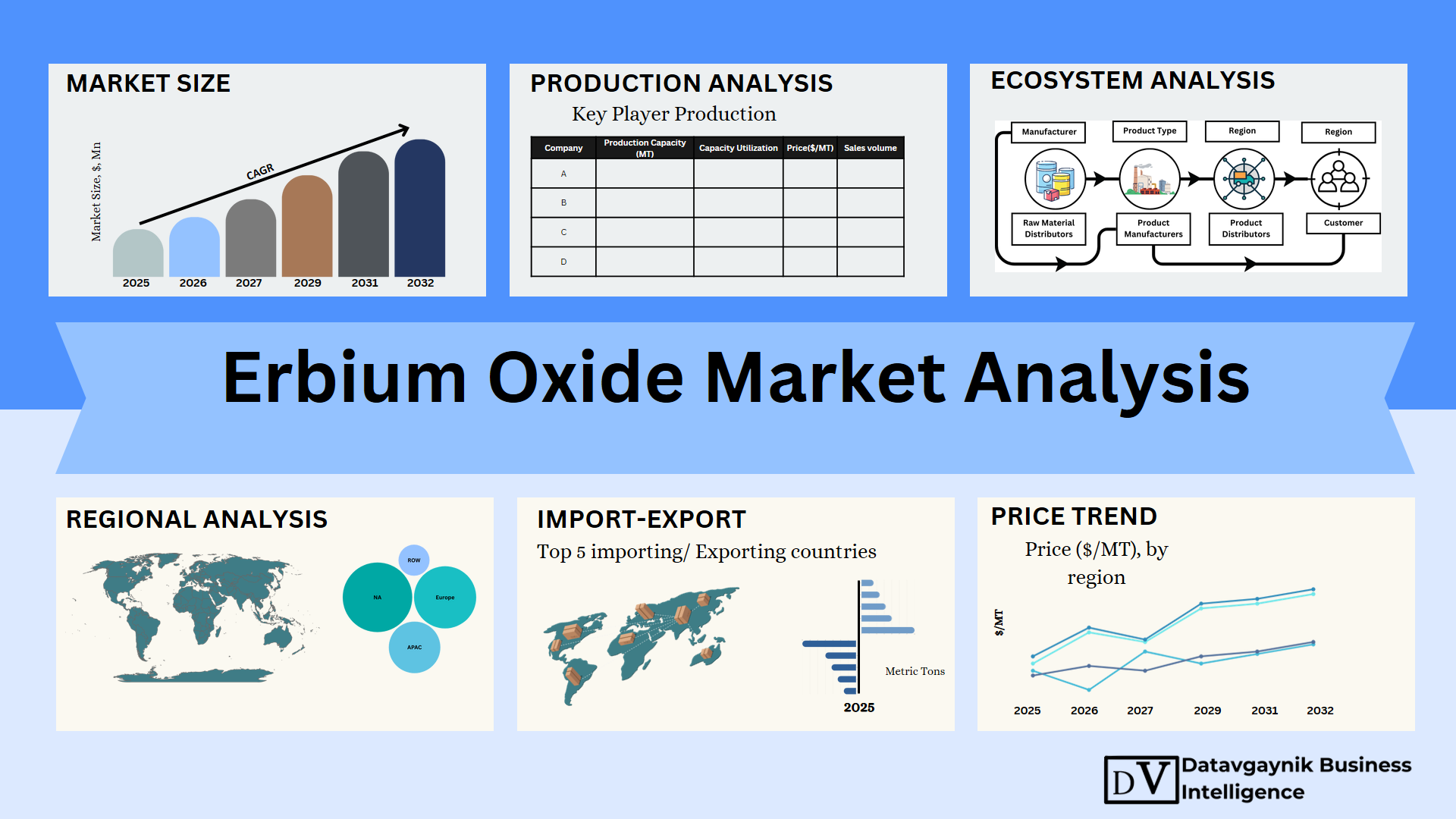
The Erbium Oxide Market is gaining significant momentum, primarily driven by its critical role in fiber optic communication. Erbium-doped fiber amplifiers (EDFAs) are indispensable in long-haul data transmission systems. With global internet traffic expected to exceed 500 exabytes per month by 2030, the need for uninterrupted, high-speed data transmission is fueling erbium oxide consumption. For instance, the rollout of 5G infrastructure, which requires a dense network of optical fibers, has created a surge in demand for erbium-based components. According to Datavagyanik, the Erbium Oxide Market Size is expected to register robust growth through 2032, aligning with the exponential rise in fiber optic cable deployment across North America, Europe, and Asia-Pacific.
Erbium Oxide Market Expansion Driven by Growth in Medical Laser Technologies
A key application of erbium oxide lies in medical-grade lasers, especially in dermatology, dentistry, and minimally invasive surgery. Erbium-doped lasers offer precise cutting with minimal thermal damage, making them ideal for delicate medical procedures. The global medical laser systems market is projected to exceed USD 10 billion by 2027, reflecting increased healthcare spending and the adoption of advanced technologies. For example, erbium:YAG lasers are widely used for skin resurfacing treatments, with demand driven by both clinical applications and cosmetic procedures. This growing adoption is directly strengthening the Erbium Oxide Market, particularly in developed healthcare ecosystems such as the U.S., Germany, South Korea, and Japan.
Datavagyanik also covers related markets such as the Erbium Sulfate Market and the Erbium Carbonate Market. These compounds are commonly used in oxidation systems and industrial chemical processing, supporting shifts in formulation standards and regulatory compliance.
Erbium Oxide Market Underpinned by Nuclear Energy Sector Developments
Erbium oxide is a reliable neutron absorber, which positions it as a crucial material in nuclear reactor control rods. The global nuclear energy capacity is forecast to increase from 390 GW in 2022 to nearly 500 GW by 2030, as countries seek carbon-neutral baseload power sources. Nations like France, China, and India are expanding their nuclear programs to meet clean energy targets. For instance, France has committed to constructing six new nuclear reactors by 2040, further reinforcing the strategic value of erbium oxide. As a result, the Erbium Oxide Market is increasingly influenced by government investments in low-emission energy infrastructure and nuclear modernization efforts.
Decorative Glass and Ceramics Applications Add Niche Value to Erbium Oxide Market
Erbium oxide’s use as a pink to rose-colored colorant in specialty glass and ceramic products contributes niche but valuable demand. Luxury brands in home décor and high-end tableware are embracing erbium-based colors for their aesthetic appeal. For example, global decorative glassware sales have seen an upward trend, with CAGR exceeding 4% since 2020. Furthermore, erbium oxide’s optical properties make it useful in manufacturing sunglasses and optical lenses with infrared absorption. The resurgence of interest in artistic ceramics, particularly in Europe and Japan, has helped the Erbium Oxide Market tap into cultural industries and boutique manufacturing sectors.
Transition to Green Energy Enhances Strategic Relevance of Erbium Oxide Market
The renewable energy transformation is a major factor enhancing the strategic importance of rare earth oxides, including erbium oxide. Erbium’s unique optical and thermal properties make it a component in advanced photovoltaic cells and energy-efficient devices. For instance, erbium-doped upconversion materials can convert infrared light into visible light, improving solar cell efficiency. With global investments in solar energy exceeding USD 300 billion annually, the Erbium Oxide Market is poised to benefit from R&D in next-generation photovoltaics. Additionally, the push for high-efficiency energy storage and smart grid systems presents new opportunities for erbium-based materials in power electronics.
Erbium Oxide Market Gains Momentum from Aerospace and Defense Applications
In aerospace and defense sectors, erbium oxide is utilized in the manufacturing of specialized coatings, rare earth magnets, and lightweight composites. These materials are essential in systems that require thermal stability, durability, and electromagnetic shielding. While erbium is not as dominant as neodymium in magnet production, its inclusion in small quantities enhances magnetostrictive properties for niche defense applications. As defense budgets continue to rise globally—surpassing USD 2.2 trillion in 2023—the demand for advanced materials is expected to grow. For example, in the U.S., the Department of Defense has classified rare earth elements like erbium as critical to national security, further boosting the Erbium Oxide Market.
Erbium Oxide Market Size Supported by Rising Global Production and Mining Initiatives
While China continues to dominate the global rare earth supply chain, countries such as Australia, the U.S., and India are accelerating efforts to diversify erbium oxide production. The Erbium Oxide Market Size is closely tied to rare earth mining output. For instance, Australia’s Lynas Rare Earths reported a 27% increase in total rare earth oxide production in 2023, a portion of which includes erbium. The U.S. has reopened the Mountain Pass mine in California and is expanding its refining capacity to reduce dependency on Chinese exports. As new mining projects advance in Sweden and Greenland, regional players are positioning themselves to meet the surging global demand for erbium oxide.
Digital Infrastructure Development Creates Sustained Growth in Erbium Oxide Market
The rapid digitalization of economies, particularly in developing regions, is pushing the demand for erbium oxide in telecommunications. Emerging markets such as India, Brazil, and Indonesia are investing heavily in digital connectivity and data infrastructure. For instance, India’s BharatNet project aims to connect over 600,000 villages with high-speed broadband, significantly increasing the demand for optical amplifiers. Such initiatives are expanding the Erbium Oxide Market beyond traditional strongholds into new geographies, creating diverse revenue opportunities for suppliers and investors. As data consumption doubles every 18–24 months globally, erbium oxide demand is set to grow in lockstep with these transformations.
Government Policies and Strategic Stockpiling Bolster the Erbium Oxide Market
Strategic government initiatives to secure rare earth supply chains are accelerating the long-term viability of the Erbium Oxide Market. In 2023, the U.S. Department of Energy announced a USD 150 million funding program to support rare earth recycling and processing. Similarly, the European Union launched the Critical Raw Materials Act to reduce foreign dependence and incentivize regional mining projects. These policy frameworks have catalyzed domestic stockpiling and public-private partnerships aimed at securing erbium and other rare earths.
For example, Japan has built rare earth reserves sufficient for up to six months of industrial use, ensuring a buffer against geopolitical disruptions. These strategic actions not only mitigate supply chain risks but also ensure the stability of the Erbium Oxide Market under shifting global dynamics.
Innovation in Solid-State Lasers Strengthens Technological Backbone of Erbium Oxide Market
Solid-state lasers utilizing erbium oxide are vital in industrial manufacturing, from micro-machining to materials processing. The global laser technology market is projected to surpass USD 20 billion by 2028, with erbium-based devices capturing a growing share. For example, erbium:YAG lasers are gaining favor in micromachining of metals and polymers due to their ability to deliver energy in controlled, short pulses. Such applications are increasingly relevant in semiconductor fabrication, where precision is paramount. As semiconductor sales are expected to exceed USD 1 trillion by 2030, the Erbium Oxide Market benefits directly from the broader expansion of high-tech manufacturing ecosystems.
Track Country-wise Erbium Oxide Production and Demand through our Erbium Oxide Production Database
- Erbium Oxide production database for 22+ countries worldwide
- Erbium Oxide sales volume for 27+ countries
- Country-wise Erbium Oxide production capacity, production plant mapping, production capacity utilization for 22+ manufacturers
- Erbium Oxide production plants and production plant capacity analysis by top manufacturers
Track real-time Erbium Oxide Prices, Erbium Oxide price charts for 22+ countries, Erbium Oxide weekly price tracker and Erbium Oxide monthly price tracker
- Track real-time Erbium Oxide prices and Erbium Oxide price trend in 22+ countries though our excel-based Erbium Oxide price charts
- Real-time Erbium Oxide price tracker dashboard with 22+ countries
- Complete transparency on Erbium Oxide price trend through our Erbium Oxide monthly price tracker, Erbium Oxide weekly price tracker
North America’s Strategic Push Boosts the Erbium Oxide Market
In North America, the Erbium Oxide Market is witnessing strong momentum, fueled by the expansion of fiber-optic infrastructure and the revival of domestic rare earth mining. The United States remains a critical consumer of erbium oxide, particularly in telecommunications and defense. For instance, with over 125 million broadband subscribers in the U.S. and ongoing 5G deployments, demand for erbium-doped fiber amplifiers (EDFAs) is intensifying. Datavagyanik highlights that U.S. consumption of erbium oxide has grown by nearly 20% over the last three years, supported by investments in digital infrastructure and smart city initiatives.
Furthermore, the reopening of the Mountain Pass rare earth mine in California and federal funding for refining facilities are reshaping the regional supply chain. Canada, with its exploration projects in Quebec and Northwest Territories, is also emerging as a future supplier. The North American Erbium Oxide Market benefits from policy frameworks like the Inflation Reduction Act and Defense Production Act, which prioritize local sourcing and strategic reserves of critical materials such as erbium.
Europe’s Clean Energy and Nuclear Sector Drives the Erbium Oxide Market
Europe’s Erbium Oxide Market is being shaped by a dual thrust of clean energy investments and nuclear modernization. Countries like France, Germany, and Sweden are leading the demand, driven by telecom advancements and nuclear reactor upgrades. For example, France generates over 70% of its electricity from nuclear power, and the use of erbium oxide as a neutron absorber aligns with its reactor safety and efficiency goals. Germany’s smart grid and Industry 4.0 projects have also increased the adoption of erbium-based components in industrial automation systems.
According to Datavagyanik, the European Union’s new Critical Raw Materials Act is set to streamline permitting processes for rare earth mining projects across member states. Sweden’s vast deposits near Kiruna and Finland’s exploration projects in central Lapland could provide substantial future supply. Moreover, the European Erbium Oxide Market is supported by growing demand in medical technology, particularly from the UK, where erbium-doped lasers are widely used in minimally invasive surgical equipment.
Asia-Pacific Emerges as the Dominant Hub for the Erbium Oxide Market
Asia-Pacific is the largest regional contributor to the Erbium Oxide Market, led by China, Japan, South Korea, and India. China holds over 80% of global erbium oxide production capacity and controls a vast share of reserves, particularly in the Bayan Obo mine of Inner Mongolia. Chinese dominance in 5G deployment and data center development translates directly into higher erbium consumption. For example, China added more than 900,000 5G base stations in 2023 alone, making erbium-doped fiber amplifiers indispensable.
Japan’s high-speed internet infrastructure, coupled with its precision manufacturing ecosystem, makes it a key consumer. Japanese firms also rely on erbium oxide in laser-based automotive and semiconductor applications. South Korea’s semiconductor fabrication industry, with exports surpassing USD 120 billion annually, is another demand center. Erbium oxide is used in laser trimming and wafer cutting tools.
India is rapidly catching up, investing over USD 30 billion in 5G and broadband infrastructure over the next five years. The Indian government’s exploration of rare earth reserves in Andhra Pradesh and Odisha indicates a longer-term strategy to support domestic demand and reduce reliance on imports. Datavagyanik emphasizes that Asia-Pacific will continue to lead the Erbium Oxide Market not only due to production but also due to accelerating consumption across multiple industries.
Middle East and Africa’s Growing Investment in Telecom and Energy Affects the Erbium Oxide Market
The Middle East and Africa region, although nascent in rare earths, is showing signs of expansion in the Erbium Oxide Market. Saudi Arabia and the UAE are heavily investing in digital transformation projects under Vision 2030 and similar frameworks. For example, Saudi Arabia’s NEOM smart city project includes extensive use of fiber optic networks, thus driving demand for erbium oxide.
The region is also exploring rare earth mining opportunities. Saudi Arabia’s recent discovery of rare earth-rich zones in the Arabian Shield is expected to contribute to domestic production in the next decade. Meanwhile, South Africa is evaluating its monazite reserves, which contain erbium and other heavy rare earths. These developments, although in early stages, could transform regional dynamics and position the Middle East and Africa as new entrants in the global Erbium Oxide Market.
Latin America’s Entry into the Erbium Oxide Market Through Telecommunications and Resource Potential
Latin America is gradually increasing its stake in the Erbium Oxide Market, primarily through expanding broadband infrastructure. Countries like Brazil and Mexico have launched ambitious plans to increase rural and urban internet access. For instance, Brazil’s telecom regulator ANATEL aims to provide 5G access to 95% of municipalities by 2027. This push has led to an increase in the import of erbium oxide-based components, especially for use in EDFAs.
In terms of supply potential, Brazil’s vast mineral resources include deposits of bastnäsite and monazite—rare earth-bearing minerals from which erbium can be extracted. If commercialized efficiently, these reserves could contribute to domestic supply, enhancing Latin America’s relevance in the Erbium Oxide Market.
Application-Based Segmentation Expands Horizons for the Erbium Oxide Market
By application, the Erbium Oxide Market is segmented into telecommunications, medical and healthcare, glass and ceramics, nuclear energy, and other industrial uses. Telecommunications account for over 40% of global demand, as erbium-doped fiber amplifiers remain a core component of modern networks. Medical lasers represent another 20–25% share, supported by growing demand for non-invasive cosmetic and surgical procedures.
Glass and ceramics constitute a niche but steadily growing segment, particularly in luxury markets and industrial optics. The nuclear energy segment is gaining relevance again, especially in countries with net-zero carbon pledges, driving incremental demand for erbium oxide as a neutron absorber. Datavagyanik also highlights emerging applications in solid-state lasers and high-end coatings in aerospace and automotive industries.
End-User Industry Trends Continue to Shape the Erbium Oxide Market
The telecommunications sector remains the leading end-user of erbium oxide, and with global fiber-optic cable deployment increasing by 12% annually, this trend shows no signs of slowing. Healthcare follows closely, driven by the integration of erbium-doped lasers in advanced diagnostics and surgery. Renewable energy is another promising area, especially with advancements in erbium-based upconversion materials in solar technologies.
Aerospace and defense end-use has grown by 8% CAGR over the past four years, where erbium oxide supports the development of heat-resistant coatings and advanced composites. As industries pursue miniaturization, lightweighting, and efficiency, erbium oxide’s multifunctional properties provide a valuable edge, further supporting the Erbium Oxide Market.
Erbium Oxide Price Trend Influenced by Production Concentration and Supply Constraints
The Erbium Oxide Price has historically been influenced by the concentrated nature of global production. For instance, during 2022–2023, prices rose nearly 18% due to reduced output from Chinese mines amidst environmental inspections. The average Erbium Oxide Price ranged between USD 120 and USD 140 per kilogram in late 2023, depending on purity levels and supply chain stability.
Price volatility remains a concern due to geopolitical tensions, export restrictions, and logistical costs. Datavagyanik notes that the Erbium Oxide Price Trend is increasingly linked to the rare earth policy decisions in China, Australia, and the U.S., with supply diversification efforts expected to gradually stabilize prices in the medium term. Additionally, higher demand from medical and renewable energy sectors could place upward pressure on prices through 2026.
Global Trade Dynamics and Import-Export Trends Shaping the Erbium Oxide Market
China continues to be the dominant exporter of erbium oxide, supplying over 70% of the world’s processed volume. Major importers include Japan, South Korea, Germany, and the United States, which rely on erbium oxide for their telecom and tech sectors. However, bilateral trade policies are shifting, with countries like Australia entering into export agreements to reduce overdependence on Chinese supply.
Meanwhile, the EU and U.S. have implemented incentives for recycling rare earth elements, including erbium, from industrial waste and e-waste. These programs are not only aimed at supply security but also at reducing environmental footprint, creating a secondary channel of supply in the Erbium Oxide Market.
Conclusion: Erbium Oxide Market Positioned for Diversified Global Growth
The Erbium Oxide Market is entering a transformative phase, with geographical demand becoming more balanced and supply-side developments creating new growth corridors. The interplay of digital infrastructure expansion, medical innovation, renewable energy push, and strategic mining initiatives are reinforcing the long-term potential of erbium oxide across continents.
Datavagyanik emphasizes that sustained investment in refining capacity, exploration, and circular economy practices will be key to addressing supply bottlenecks and stabilizing the Erbium Oxide Price Trend. As markets become more interlinked through trade and policy alignment, the Erbium Oxide Market stands at the intersection of technological advancement and geopolitical strategy.
Erbium Oxide Manufacturing Database, Erbium Oxide Manufacturing Capacity
- Erbium Oxide top manufacturers market share for 22+ manufacturers
- Top 6 manufacturers and top 12 manufacturers of Erbium Oxide in North America, Europe, Asia Pacific
- Erbium Oxide production plant capacity by manufacturers and Erbium Oxide production data for 22+ market players
- Erbium Oxide production dashboard, Erbium Oxide production data in excel format
Erbium Oxide price charts, Erbium Oxide weekly price tracker and Erbium Oxide monthly price tracker
- Factors impacting real-time Erbium Oxide prices in 17+ countries worldwide
- Erbium Oxide monthly price tracker, Erbium Oxide weekly price tracker
- Real-time Erbium Oxide price trend, Erbium Oxide price charts, news and updates
- Tracking Erbium Oxide price fluctuations
Leading Players Shaping the Erbium Oxide Market
The Erbium Oxide Market is led by a concentrated group of manufacturers who dominate global production and supply chains. Chinese companies continue to hold the lion’s share, due to their control over rare earth reserves and advanced processing capabilities. Among the most influential manufacturers is China Minmetals Rare Earth Co., Ltd., known for supplying high-purity erbium oxide for telecom, nuclear, and ceramic industries. Their vertically integrated operations—from mining to refining—give them a significant cost and supply chain advantage.
Ganzhou Qiandong Rare Earth Group Co., Ltd. also plays a pivotal role, particularly in erbium oxide production for optoelectronics and laser systems. The company has focused on expanding its presence in high-performance materials used in defense and precision medical equipment.
In North America, Stanford Advanced Materials has emerged as a key supplier of high-purity erbium oxide powder, catering primarily to research labs, medical device manufacturers, and specialty glass producers. Their product line includes 4N (99.99% purity) erbium oxide, often used in the fabrication of optical amplifiers and advanced ceramics.
SkySpring Nanomaterials, Inc., another U.S.-based player, focuses on erbium oxide in nanoscale form, targeting high-tech applications in semiconductors, photonics, and smart coatings. Their development of nanoparticle-grade erbium oxide addresses emerging needs in miniaturized electronics and displays.
EPI Materials, with operations in Europe and Asia, specializes in custom-grade erbium oxide for use in photonic crystals and energy materials. The company has made significant strides in supplying erbium-based compounds for solid-state laser technologies.
Erbium Oxide Market Share by Manufacturers
The global Erbium Oxide Market is heavily concentrated, with Chinese manufacturers controlling an estimated 60–65% of total global output. This includes refined erbium oxide used in fiber optics, as well as variants for nuclear and medical applications. Among these, China Minmetals alone holds a substantial share, primarily due to its large-scale access to rare earth ores and processing infrastructure.
Other Asian producers contribute another 15–20% of the global output, including smaller Chinese firms and facilities in Malaysia and Vietnam involved in the early stages of refining. Companies in the U.S. and Europe collectively contribute a smaller share—roughly 10–15%—but they cater predominantly to the high-purity and specialty application segment, where margins are higher.
North American firms like Stanford Advanced Materials and SkySpring Nanomaterials, despite their smaller volume output, are highly influential in markets such as medical lasers and optical ceramics due to the purity and consistency of their erbium oxide products. Their high-end customer base and research collaborations have helped establish their dominance in niche sectors.
Product Lines and Technological Specialization Driving Market Growth
Each of the leading manufacturers in the Erbium Oxide Market has developed specialized product lines to address evolving demand. China Minmetals, for instance, supplies multiple grades of erbium oxide, ranging from 99% to 99.999% purity. These are used in fiber optic amplifiers, infrared lasers, and nuclear reactor components. The company has also initiated R&D programs to develop erbium compounds for next-generation optical coatings.
Ganzhou Qiandong’s erbium oxide materials are designed for optoelectronic systems, including photodetectors and signal processing devices. Their erbium-doped materials are in high demand from manufacturers of LiDAR and quantum computing components.
Stanford Advanced Materials provides both standard erbium oxide powders and custom-sized granules for precision ceramics and laser crystal growth. Their products are known for their stability in high-temperature environments, making them suitable for advanced aerospace coatings.
SkySpring’s nanoparticle-grade erbium oxide represents one of the most technologically advanced offerings in the market. With particle sizes ranging from 20 to 50 nanometers, these materials are used in solar cell coatings, advanced transistors, and high-resolution display panels.
Recent Developments Among Erbium Oxide Market Players
Over the past year, several significant events have shaped the competitive landscape of the Erbium Oxide Market. One key development was a large-scale capacity expansion by a leading Chinese manufacturer, aimed at increasing erbium oxide output by 25% over the next two years. This move is expected to further consolidate China’s dominance while also stabilizing global supply amid increasing demand.
In the U.S., a major supplier of rare earths announced the completion of a new refining facility capable of processing erbium and other heavy rare earth oxides. This facility is part of a broader national effort to reduce dependency on imported materials and secure critical mineral supply chains for defense and communication systems.
Another major European producer reported successful testing of a new erbium-based ceramic additive for laser fusion reactors and extreme environment coatings. This breakthrough has opened new avenues for erbium oxide in both civilian energy research and high-temperature industrial manufacturing.
Additionally, fluctuations in erbium oxide pricing have prompted companies to diversify sourcing strategies. Several manufacturers entered into long-term offtake agreements with suppliers outside China, including rare earth mining ventures in Australia and Africa. These agreements are aimed at ensuring uninterrupted access to raw materials amid increasing price volatility.
The market also saw a minor correction in erbium oxide prices earlier this year, following a temporary oversupply caused by stockpiling in anticipation of regulatory changes. However, prices quickly stabilized as downstream demand from telecommunications and semiconductor sectors absorbed the surplus. Industry analysts note that the current erbium oxide price trend remains moderately bullish, with a projected upward slope through the end of the fiscal year due to rising consumption in Asia and North America.
Industry Outlook and Forward-Looking Statements
The Erbium Oxide Market is expected to remain competitive and dynamic, with growing segmentation based on purity, form, and application type. High-purity erbium oxide will continue to command premium pricing, particularly in markets like optical components, medical laser systems, and nuclear technology. Meanwhile, producers with capabilities in nanoparticle engineering and material customization will be well-positioned to capture growth in the electronics and renewable energy sectors.
Upcoming product launches by leading players, including erbium-based thin-film materials and hybrid composites, are likely to shift the focus from raw oxide to value-added erbium compounds. As governments around the world strengthen rare earth strategies, the role of erbium oxide in economic and technological development will become increasingly prominent.
With advancements in processing technologies, diversification of sources, and increasing industrial applications, the Erbium Oxide Market is set for a sustained growth trajectory over the next decade.
“Erbium Oxide Production Data and Erbium Oxide Production Trend, Erbium Oxide Production Database and forecast”
- Erbium Oxide production database for historical years, 10 years historical data
- Erbium Oxide production data and forecast for next 7 years
- Erbium Oxide sales volume by manufacturers
“Track Real-time Erbium Oxide Prices for purchase and sales contracts, Erbium Oxide price charts, Erbium Oxide weekly price tracker and Erbium Oxide monthly price tracker”
- Gain control on your purchase and sales contracts through our real-time Erbium Oxide price tracker and Erbium Oxide price trend analysis
- Erbium Oxide weekly price tracker and forecast for next four weeks
- Erbium Oxide monthly price tracker and forecast for next two months
Market Scenario, Demand vs Supply, Average Product Price, Import vs Export, till 2032
- Global Erbium Oxide Market revenue and demand by region
- Global Erbium Oxide Market production and sales volume
- United States Erbium Oxide Market revenue size and demand by country
- Europe Erbium Oxide Market revenue size and demand by country
- Asia Pacific Erbium Oxide Market revenue size and demand by country
- Middle East & Africa Erbium Oxide Market revenue size and demand by country
- Latin America Erbium Oxide Market revenue size and demand by
- Import-export scenario – United States, Europe, APAC, Latin America, Middle East & Africa
- Average product price – United States, Europe, APAC, Latin America, Middle East & Africa
- Market player analysis, competitive scenario, market share analysis
- Business opportunity analysis
Key questions answered in the Global Erbium Oxide Market Analysis Report:
- What is the market size for Erbium Oxide in United States, Europe, APAC, Middle East & Africa, Latin America?
- What is the yearly sales volume of Erbium Oxide and how is the demand rising?
- Who are the top market players by market share, in each product segment?
- Which is the fastest growing business/ product segment?
- What should be the business strategies and Go to Market strategies?
The report covers Erbium Oxide Market revenue, Production, Sales volume, by regions, (further split into countries):
- Asia Pacific (China, Japan, South Korea, India, Indonesia, Vietnam, Rest of APAC)
- Europe (UK, Germany, France, Italy, Spain, Benelux, Poland, Rest of Europe)
- North America (United States, Canada, Mexico)
- Latin America (Brazil, Argentina, Rest of Latin America)
- Middle East & Africa
Table of Contents:
1. Introduction to the Erbium Oxide Market
- Overview of Erbium Oxide and Its Industrial Applications
- Key Uses in Optical Fibers, Lasers, Ceramics, and Glass Manufacturing
- Market Scope, Growth Potential, and Emerging Business Opportunities
2. Erbium Oxide Market Segmentation and Product Classification
- Classification by Purity Levels and Chemical Composition
- Industrial-Grade vs. High-Purity Erbium Oxide Applications
- Technological Innovations in Erbium Oxide Production
3. Global Erbium Oxide Market Size and Forecast (2019-2032)
- Market Valuation and Revenue Trends
- Global Demand-Supply Balance and Market Expansion Forecast
- Key Growth Factors, Market Challenges, and Investment Opportunities
4. Regional Analysis of the Erbium Oxide Market
4.1 North America (United States, Canada, Mexico)
- Market Share and Key Players in Erbium Oxide Production
- Regional Sales, Pricing Trends, and Consumption Patterns
- Import-Export Statistics and Trade Regulations
4.2 Europe (Germany, UK, France, Russia, etc.)
- Industrial Demand for Erbium Oxide in Various Applications
- Market Expansion Strategies and Regional Supply Chain Trends
- Trade Policies and Regulatory Impact on Market Growth
4.3 Asia-Pacific (China, Japan, India, South Korea, etc.)
- Erbium Oxide Production Hubs and Export Trends
- Regional Market Share and Competitive Positioning
- Strategic Developments by Leading Market Participants
4.4 Latin America (Brazil, Argentina, Chile, etc.)
- Market Growth Potential in Emerging Economies
- Local Erbium Oxide Production and Supply Chain Development
- Trade Relations, Market Challenges, and Expansion Opportunities
4.5 Middle East & Africa (Saudi Arabia, UAE, South Africa, etc.)
- Industrial Demand and Consumption Growth for Erbium Oxide
- Trade Flow and Export Market Potential
- Local Production Capabilities and Investment Trends
5. Erbium Oxide Production Analysis and Market Forecast (2019-2032)
- Global and Regional Erbium Oxide Production Capacity and Trends
- Advances in Manufacturing Techniques and Process Optimization
- Key Production Facilities and Future Growth Projections
6. Competitive Landscape and Market Share Analysis
- Leading Erbium Oxide Manufacturers and Their Market Positioning
- Revenue, Business Strategies, and Competitive Developments
- Mergers, Acquisitions, and Expansion Strategies in the Industry
7. Global Trade and Market Flow of Erbium Oxide
- Erbium Oxide Production vs. Global Export Trends
- Import vs. Consumption Analysis in Key Markets
- Leading Exporting and Importing Countries and Their Market Influence
8. Consumption Insights and Industry Demand Trends
- Erbium Oxide Consumption by End-Use Applications
- Market Share Analysis Across Various Industries
- Future Demand Growth and Emerging Market Opportunities
9. Cost Structure and Raw Material Supply Chain Overview
- Breakdown of Erbium Oxide Manufacturing Costs
- Key Raw Material Suppliers and Their Market Influence
- Impact of Rare Earth Supply Chain Disruptions on Production
10. Supply Chain and Market Logistics Evaluation
- Erbium Oxide Value Chain from Raw Material to End-User Applications
- Distribution Networks and Logistics Optimization Strategies
- Role of Suppliers, Distributors, and Key Market Participants
11. Distribution Channels and Sales Strategies
- List of Erbium Oxide Distributors and Global Supply Chain Partners
- Sales and Marketing Strategies of Leading Companies
- Strategies for Market Expansion and Distribution Network Growth
12. Future Market Outlook and Growth Projections (2024-2032)
- Expected Trends in Erbium Oxide Production and Market Demand
- Innovations, Emerging Technologies, and Industry Advancements
- Investment Opportunities and Business Growth Strategies


