

Global Carnallite (Potassium Magnesium Chloride) Supplier Structure and Competitive Positioning
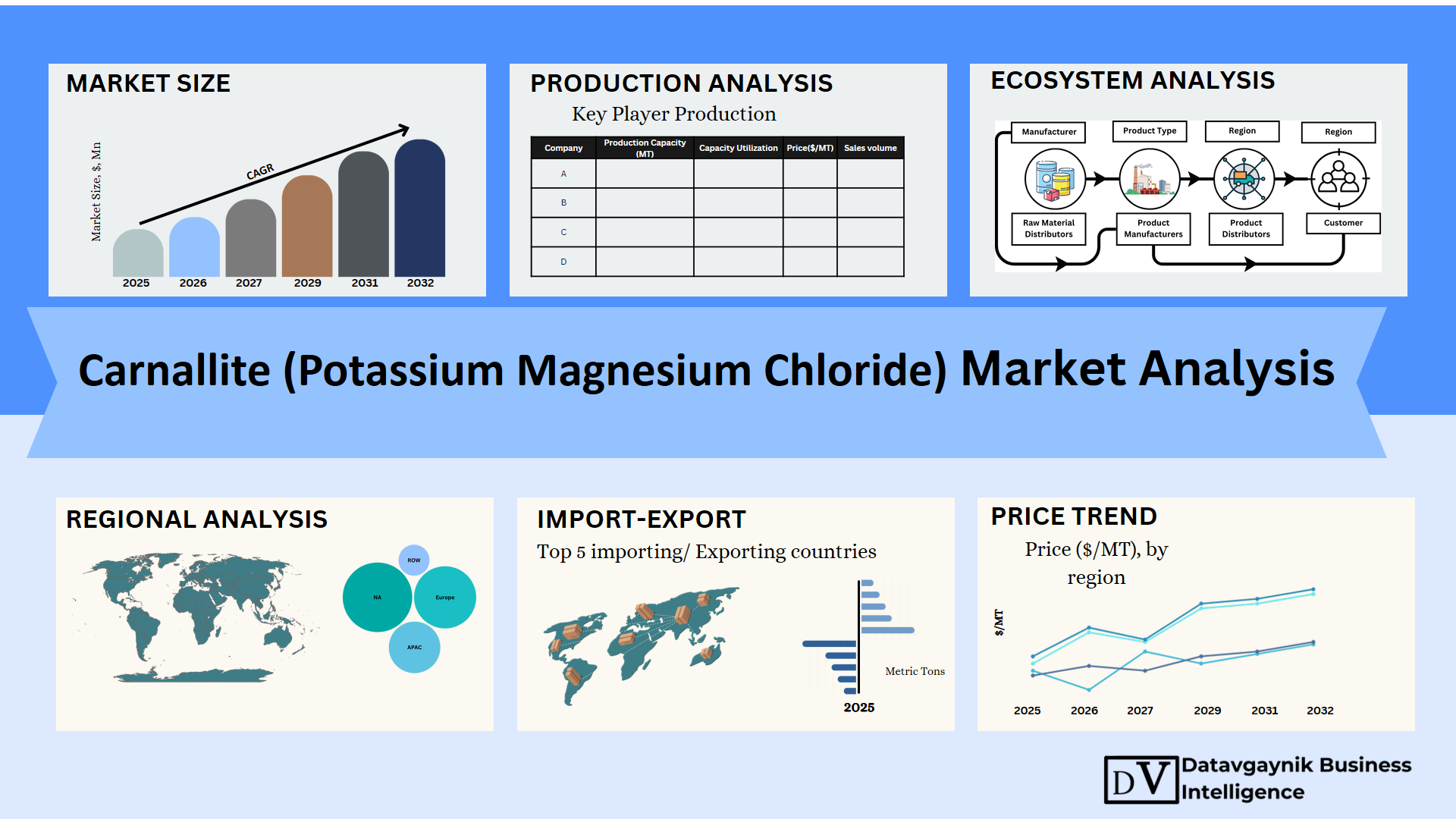
Global Carnallite (Potassium Magnesium Chloride) is a supplier-concentrated mineral market where competition is shaped less by branding and more by brine access, potash-processing capability, magnesium chloride recovery, fertilizer offtake channels, and logistics into agriculture-intensive countries. The market is estimated at USD 1.94 billion in 2026 and, based on a 4.5% CAGR, is projected to reach about USD 2.53 billion by 2032. The strongest companies are not pure carnallite sellers; they are integrated potash, magnesium, salt, and fertilizer producers that use carnallite as a feedstock for potassium chloride, magnesium chloride, specialty fertilizers, de-icing materials, industrial salts, and magnesium-related chemical products. Customer demand is led by fertilizer producers, large agricultural distributors, industrial magnesium chloride users, chemical processors, and regional potash blenders serving Brazil, China, India, Indonesia, the United States, and selected European markets.
Global Carnallite (Potassium Magnesium Chloride) competition is led by resource control rather than fragmented trading
The competitive structure of the carnallite market is concentrated because commercially viable carnallite supply depends on evaporite deposits, Dead Sea brines, salt-lake chemistry, solar evaporation infrastructure, and downstream separation plants. This makes the market closer to a mineral-resource and process-integration business than a commodity trading market.
ICL Group, Arab Potash Company, Qinghai Salt Lake Industry, and related salt-lake or brine-processing operators have stronger positioning because they control upstream mineral access and operate downstream potash or magnesium chloride production assets. Their advantage comes from integrated ponds, crystallization units, flotation or separation lines, export terminals, fertilizer distribution relationships, and long-term customer contracts.
In Israel, ICL produces potash through Dead Sea evaporation, where carnallite is extracted and processed into potassium chloride. This gives the company a strategic role in both potash fertilizer supply and high-purity potassium chloride supply for industrial users. In 2024, ICL Dead Sea production stood at around 3.7 million tonnes, although output was 119,000 tonnes lower year over year due to operational and war-related disruption. That decline shows why buyers value supply continuity and geographic diversification in this market.
Arab Potash Company in Jordan represents another major Dead Sea-linked supplier. The company reached record production of about 2.84 million metric tonnes in 2024, an increase of nearly 2% compared with the previous year. This directly strengthens Jordan’s position in the carnallite-derived potash supply chain because APC’s solar evaporation and processing model converts Dead Sea mineral brine into marketable potash grades for agriculture and industry.
China’s Qinghai salt-lake producers occupy a different competitive role. They are important because China has large domestic potash demand but still relies heavily on imports. Qinghai Salt Lake Industry and associated producers help reduce import exposure, but domestic supply does not fully cover China’s fertilizer requirement. This creates a competitive opening for Dead Sea suppliers, Canadian potash exporters, Russian and Belarusian supply, and cross-border fertilizer traders.
Supplier categories depend on product pathway, not only mineral ownership
The Global Carnallite (Potassium Magnesium Chloride) supplier ecosystem can be divided into four practical company groups.
The first group includes integrated potash producers using carnallite as a primary or secondary mineral feedstock. These companies compete on mineral access, production scale, KCl grade consistency, export capability, and fertilizer customer relationships. ICL and Arab Potash Company are the clearest examples because their operating model is linked to Dead Sea brine, solar evaporation, crystallization, and potash recovery.
The second group includes salt-lake and brine chemical producers. These suppliers are more common in China and Central Asia, where carnallite-bearing brines can support potash, magnesium chloride, and other salt products. Their strength is proximity to domestic fertilizer demand and lower inland logistics cost for regional customers.
The third group includes magnesium chloride and industrial salt processors. They use carnallite or associated brines to produce flakes, prills, solutions, or industrial grades for de-icing, dust control, wastewater treatment, drilling fluids, textile processing, and chemical intermediates. Their competitive advantage depends on purity, packaging format, moisture control, chloride concentration, and distributor access.
The fourth group includes fertilizer blenders, importers, and distributors. These firms may not mine carnallite but influence customer access. In Brazil, India, China, Indonesia, and the United States, fertilizer distribution networks can determine which potash or magnesium-containing products reach farmers on time. For agricultural buyers, availability during planting and application windows matters more than mineral origin.
Customer demand is strongest where potassium deficits and import dependence overlap
Carnallite demand is closely tied to potash fertilizer consumption because its largest commercial pathway is potassium chloride production. Brazil, China, the United States, India, and Indonesia are among the most important demand-linked countries because they are large potassium chloride importers or fertilizer-consuming agricultural economies.
In 2024, Brazil imported about USD 4.24 billion of potassium chloride, China imported about USD 3.77 billion with 12.78 million tonnes, and the United States imported about USD 3.72 billion with nearly 13.97 million tonnes. These figures matter for carnallite because potash derived from carnallite enters the same potassium nutrient chain serving soybean, corn, sugarcane, palm oil, rice, wheat, and horticulture production.
China remained a demand anchor in early 2026. In April 2026, market data showed China’s potassium chloride imports in the first quarter rising by about 29.29% year over year to approximately 1.52 million tonnes, supported by spring fertilizer demand. This type of import movement supports carnallite-linked suppliers because Chinese buyers tend to secure multiple supply origins when domestic salt-lake output is insufficient or when seasonal application demand tightens availability.
Demand is also reinforced by soil nutrient replacement. In February 2026, Nutrien indicated that potash demand was expected to rise in 2026 because large 2025 harvests removed nutrients from soils, while a shorter autumn application window in North America shifted demand into the next cycle. This improves the demand outlook for all potash-linked feedstocks, including carnallite-derived potassium chloride, even though carnallite itself is not usually purchased directly by farmers.
Product differentiation is based on grade, processing route, and downstream reliability
Global Carnallite (Potassium Magnesium Chloride) does not compete like a branded consumer material. Product differentiation is mainly technical and logistical. Buyers evaluate KCl yield, magnesium chloride recovery, impurity profile, moisture behavior, sodium chloride separation efficiency, particle size control, and suitability for downstream potash, magnesium chloride, or chemical processing.
For fertilizer use, the main value is potassium recovery. Carnallite is converted into potassium chloride, which can be sold as standard, granular, fine, or industrial-grade potash. Granular potash is stronger in bulk fertilizer blending because it handles better in large-scale distribution and field application. Fine and standard grades are relevant for chemical processing and some fertilizer formulations.
For magnesium chloride uses, suppliers compete through concentration, purity, hydration level, and format. Magnesium chloride derived from carnallite or brine streams can serve de-icing, dust suppression, construction material additives, industrial processing, and magnesium compound production. This segment is smaller than fertilizer use but provides margin diversification for integrated mineral companies.
Customer approval is important in industrial applications. Chemical processors require predictable chloride chemistry, low contamination, consistent supply documentation, and reliable packaging. Fertilizer customers focus more on delivered cost per nutrient unit, seasonal availability, and compatibility with blending systems.
Distribution strength separates integrated producers from smaller mineral processors
The strongest suppliers have export infrastructure, storage, port access, bulk-handling capability, and established fertilizer marketing channels. This is why Dead Sea producers remain competitive despite geopolitical and environmental constraints. Their products move into Asia, Europe, Africa, and the Americas through fertilizer traders, distributors, and direct customer relationships.
Arab Potash Company has been expanding marketing plans beyond its traditional base. Its 2024 earnings communication referred to efforts to penetrate South America, Europe, and Australia while maintaining strong positions in Asia and Africa, and also noted the establishment of a European trading company in 2024. This is important because global carnallite-derived potash demand is increasingly tied to import-heavy farming regions rather than only nearby markets.
ICL’s competitive position is also shaped by regulatory and concession developments. In December 2025, Israel published a draft law to reshape Dead Sea mineral extraction concessions, with the state’s profit share expected to rise toward 50% from about 35%. Since ICL’s Dead Sea concession expires in 2030 and the company plans to compete in the future tender, the policy change may influence long-term supply economics, royalty exposure, and investor appetite for Dead Sea mineral operations.
Major constraints are resource concentration, water stress, logistics, and buyer price sensitivity
The main constraint in the Global Carnallite (Potassium Magnesium Chloride) market is the limited number of large-scale, commercially proven carnallite-bearing resource systems. Unlike generic industrial chemicals, carnallite cannot be produced anywhere with a standard plant. It requires suitable brine chemistry, evaporation conditions, mineral rights, processing knowledge, and high-volume logistics.
Environmental pressure is another constraint, particularly around the Dead Sea. Water balance, evaporation pond management, concession terms, and land-use impacts can affect operating permissions and future capital allocation. This creates regulatory risk for suppliers but also raises entry barriers against new competitors.
Price sensitivity remains high because the largest demand channel is fertilizer. Farmers and fertilizer distributors compare potash prices against crop prices, credit conditions, and nutrient application economics. When farm margins weaken, buyers may delay procurement, reduce inventory, or switch timing. However, potassium is harder to skip for long periods in high-yield crops because soil removal must eventually be replenished.
Logistics also affect competitiveness. Bulk mineral products carry freight exposure, and delivered cost can decide supplier selection in Brazil, India, China, and Southeast Asia. Producers with port proximity, export terminals, and established freight relationships can serve customers more reliably than smaller processors with weaker distribution reach.
Overall, competition in carnallite is defined by mineral control, downstream conversion economics, and fertilizer-market access. The market remains concentrated at the production level but broad at the distribution level, where traders, blenders, and agricultural suppliers shape customer access. Integrated potash and magnesium chloride producers are stronger than standalone mineral traders because they can convert carnallite into higher-volume, specification-ready products and maintain supply through long-term customer channels.
Supplier Segmentation in Global Carnallite (Potassium Magnesium Chloride) Moves from Mineral Ownership to Product Conversion
Supplier segmentation in Global Carnallite (Potassium Magnesium Chloride) is best understood through the conversion pathway. Carnallite is not typically sold as a mass-market finished product; it is either processed into potassium chloride, separated into magnesium chloride streams, or used as part of brine-mineral recovery systems. This makes vertically integrated brine operators stronger than standalone traders because they control the mineral input, evaporation sequence, product recovery, storage, and customer shipment schedule.
The first supplier group includes integrated potash producers with carnallite-bearing brine or evaporite access. These suppliers sell mainly potassium chloride, granular potash, industrial KCl, salt products, magnesium compounds, and related mineral products. Their portfolio depth comes from processing scale and the ability to produce multiple grades for fertilizer blenders, chemical buyers, and industrial users.
The second group includes salt-lake chemical producers, especially in China. These companies are positioned closer to domestic demand and often supply potash, magnesium chloride, lithium-associated salt-lake products, sodium chloride, and other mineral derivatives. Their advantage is regional availability, but they face reserve-quality, processing-efficiency, and inland logistics limitations.
The third group includes downstream magnesium chloride processors and distributors. These suppliers focus less on potassium recovery and more on flakes, granules, liquid magnesium chloride, dust-control products, de-icing materials, industrial brines, and chemical intermediate grades. Their customer base is more fragmented and includes municipalities, construction contractors, road-maintenance agencies, oilfield service firms, chemical processors, and industrial distributors.
The fourth group includes fertilizer importers, agricultural retailers, and blending companies. They do not control carnallite deposits, but they influence demand access. In potash-importing countries, these firms decide the timing, inventory level, bagged or bulk format, and credit terms offered to farmers and cooperatives. For many agricultural customers, the effective supplier is the distributor rather than the original mineral producer.
Portfolio Depth Separates Potash-Focused Suppliers from Magnesium Chloride Players
Product portfolio comparison shows two different competitive tracks. Potash-linked suppliers compete on potassium nutrient content, grade consistency, bulk shipment reliability, and compatibility with large fertilizer blending systems. Magnesium chloride suppliers compete on concentration, purity, hydration control, packaging, corrosion profile, and delivery format.
In fertilizer applications, granular potassium chloride is stronger than standard or fine grades where bulk blending is dominant. Large fertilizer blenders prefer granules because particle-size compatibility reduces segregation during storage, transport, and field application. This gives integrated potash producers with granulation capacity a stronger position in Brazil, North America, Southeast Asia, and India.
Industrial KCl and standard-grade potash serve chemical processors and specialty fertilizer makers. These customers place more weight on chloride chemistry, impurity control, and documentation than on farm-level distribution. Industrial buyers normally purchase through long-term supply agreements, importers, or chemical distributors rather than seasonal farm channels.
Magnesium chloride product formats follow a different pattern. Liquid magnesium chloride has stronger fit in dust suppression and road stabilization because it can be sprayed directly. Flakes and prills are preferred where storage, export, or smaller-batch industrial usage matters. Higher-purity grades are used in chemical processing and magnesium compound production, while lower-cost technical grades are used in de-icing and construction-related applications.
Segmentation highlights:
- By product type: potassium chloride remains the dominant commercial output linked to carnallite because fertilizer demand absorbs large volumes.
- By customer type: fertilizer producers, importers, and agricultural distributors represent the largest demand channel; industrial chemical buyers form the higher-specification niche.
- By application: crop nutrient use dominates volume, while de-icing, dust control, drilling fluids, and chemical processing provide diversified demand.
- By channel: bulk shipment and distributor-led sales dominate fertilizer use; packaged and liquid formats are more relevant in magnesium chloride and industrial applications.
- By service model: logistics reliability, storage access, product documentation, and on-time seasonal shipment matter more than after-sales service.
Regional Supplier Presence Is Led by Brine Assets, While Demand Is Led by Import-Heavy Agriculture
The regional structure of Global Carnallite (Potassium Magnesium Chloride) is unusual because production centers and demand centers do not fully overlap. The Middle East has a strong resource position through Dead Sea brines. China has domestic salt-lake resources but remains a major importer of potassium chloride. Brazil has high agricultural demand but limited domestic potash output. India has large fertilizer use but depends heavily on imports and public procurement-linked fertilizer distribution.
The Middle East is a strategic supplier region because Israel and Jordan convert Dead Sea brines into potash and related mineral products. Israel’s ICL produces potash at Dead Sea Works through evaporation, precipitation, crystallization, and separation, while also operating associated magnesium and salt streams. Jordan’s Arab Potash Company operates a similar Dead Sea-based model and supplies export markets across Asia, Africa, Europe, and other regions.
China is both a producer and a large buyer. Qinghai salt-lake operations support domestic potash and magnesium chloride supply, but China’s crop nutrient demand exceeds reliable domestic availability. This creates strong customer access for overseas potash suppliers, particularly when spring application demand rises. Chinese procurement is influenced by contract timing, port inventory, seasonal demand, and government attention to food security.
Brazil is demand-led rather than supply-led. Soybean, corn, sugarcane, coffee, and cotton production create heavy potassium nutrient requirements, while domestic potash output remains structurally limited. This makes Brazil one of the most important channel markets for carnallite-derived potassium chloride. Supplier strength in Brazil depends on port access, inland freight economics, relationships with fertilizer blenders, and credit-linked distribution to farms.
India is a procurement-sensitive market. Potash demand is linked to cropping intensity, subsidy policy, importer contracts, monsoon conditions, and fertilizer availability through cooperative and private distribution systems. Suppliers selling into India need reliable cargo scheduling and price competitiveness because public-policy influence is stronger than in most commercial fertilizer markets.
North America has a different profile because Canada dominates mined potash production, while carnallite-derived supply plays a smaller direct role. However, the United States remains a major potassium chloride import market and a large crop nutrient consumer. Carnallite-linked suppliers compete indirectly with Canadian potash producers, especially where delivered cost or port availability changes buyer preference.
Customer Access Depends on Seasonality, Bulk Handling, and Distributor Credit
Customer access in this market is built through timing and logistics. Fertilizer buyers purchase heavily ahead of planting and application windows, while industrial buyers require steady specification supply. This creates two different sales cycles.
Agricultural demand is seasonal and price-sensitive. Brazil and India often show procurement waves linked to planting cycles, government policy, credit availability, currency movement, and port inventory. Suppliers that can maintain bulk cargo availability during peak windows have stronger customer pull than smaller firms offering only spot material.
Industrial magnesium chloride demand is less seasonal but more specification-sensitive. Municipal de-icing buyers in colder regions purchase ahead of winter, while dust-control and road-stabilization customers buy according to construction and mining activity. Chemical buyers tend to favor approved suppliers because changes in chloride feedstock can affect process consistency.
Channel structure is therefore split into three layers. Bulk potash moves through direct producer contracts, trading houses, and large fertilizer importers. Regional distributors and blenders convert bulk material into local fertilizer formulations. Magnesium chloride products move through chemical distributors, industrial-salt suppliers, road-service contractors, and packaged chemical channels.
Service coverage is mainly logistics service, not technical field service. Buyers value port storage, inland warehousing, moisture-safe packaging, vessel scheduling, product certificates, customs documentation, and claim-handling capability. In fertilizer channels, credit availability and distributor relationships can influence buyer choice as much as product specification.
Buying Behavior Favors Reliable Cargo Over Lowest Nominal Price
Customer buying behavior in Global Carnallite (Potassium Magnesium Chloride) favors suppliers that can deliver predictable volume during application windows. The lowest quoted price is not always the winning offer when buyers face crop-season deadlines or port congestion. A fertilizer blender that misses the soybean or corn application window can lose more value than it saves through a small discount.
Replacement behavior is not comparable to equipment markets, but nutrient replacement is central to demand. High-yield crops remove potassium from soil, and farmers may defer application for one season when economics are weak, but repeated under-application reduces soil fertility and crop performance. This creates delayed but recurring demand for potash, including potassium chloride derived from carnallite.
For magnesium chloride, replacement behavior is linked to inventory consumption. Road agencies, dust-control users, and industrial plants reorder based on seasonal usage, storage capacity, and price. Product switching can occur between magnesium chloride, calcium chloride, sodium chloride, or organic dust suppressants, but performance, corrosion, and delivered cost determine the final choice.
Leading Companies in Global Carnallite (Potassium Magnesium Chloride) Compete Through Resource Position and Channel Control
ICL Group is one of the strongest company-level participants because its Dead Sea Works operation links carnallite-bearing brines with potassium chloride, magnesium, bromine, salt, and industrial mineral output. The company’s potash segment benefits from evaporation infrastructure, export experience, and established fertilizer customer relationships. ICL’s strength is not only the mineral deposit but also its ability to sell multiple mineral streams into agriculture, industrial, and specialty markets.
ICL’s product relevance is strongest in potassium chloride and associated Dead Sea mineral products. Its potash output serves global agriculture, while industrial products and magnesium-related streams broaden its customer base. The company’s 2026 guidance for potash sales volumes in the range of 4.5 million to 4.7 million metric tonnes indicates a large operating platform and consistent customer access.
Arab Potash Company is the leading Jordanian producer and a major Dead Sea-based potash supplier. Its competitive advantage comes from resource access, solar evaporation capacity, product-grade expansion, and export-market reach. APC’s 2024 production of approximately 2.84 million tonnes marked its highest annual level, and its portfolio expansion from three core grades to nine grades and sub-grades improved its ability to serve different fertilizer and industrial customers.
Qinghai Salt Lake Industry and other Chinese salt-lake producers hold a regional advantage in China’s domestic supply chain. Their position is supported by proximity to western Chinese salt-lake resources and access to domestic fertilizer customers. However, they compete in a market where import volumes remain high, which means domestic producers must compete with international cargoes on price, availability, and seasonal timing.
Nutrien is not a carnallite-centered supplier in the same way as Dead Sea producers, but it is important in the wider potash competitive environment. Its mined potash scale in Canada influences benchmark pricing, global shipment expectations, and customer procurement behavior. Nutrien’s guidance for 2026 global potash shipments of 74 million to 77 million tonnes shows the size of the demand environment in which carnallite-derived potash competes.
The Mosaic Company also affects competitive pricing and customer choice through its North American potash and phosphate operations. Mosaic’s position is more relevant to delivered fertilizer economics than to carnallite mineral supply. In markets such as Brazil and North America, large fertilizer companies influence distributor inventory, procurement timing, and nutrient substitution decisions.
K+S, Uralkali, Belaruskali, and Intrepid Potash participate in the broader potassium chloride supply ecosystem. Their production routes differ from Dead Sea carnallite processing, but they compete for the same fertilizer and industrial KCl demand. This matters because carnallite-derived suppliers do not price in isolation; they compete against mined potash, salt-lake potash, and traded cargoes from multiple origins.
Pricing, Distribution Cost, and Margin Pressure Are Driven by Fertilizer Cycles
Pricing behavior is tied to potash benchmarks, freight rates, currency movement, crop economics, and import inventory. Carnallite itself is not usually priced transparently in the same way as potassium chloride, so buyer economics are mainly reflected in KCl and magnesium chloride prices.
Distribution cost is material because potash and magnesium chloride are bulk products with relatively high freight exposure. Brazil’s inland logistics, India’s port handling and subsidy-linked distribution, and China’s port inventory cycles all influence landed cost. Producers with lower processing cost can still lose competitiveness if freight routes, storage, or port access are weak.
Margin pressure appears when fertilizer affordability tightens. Farmers may delay purchases when crop prices are weak, but distributors still need inventory to serve application windows. This creates short-term volatility: producers may see stable annual demand but uneven quarterly sales.
Recent Developments Affecting Supplier Position and Demand Access
- February 2026, Canada: Nutrien projected 2026 global potash shipments at 74 million to 77 million tonnes, supported by soil nutrient replenishment needs, low inventories in China and Brazil, and improved potash affordability. This supports demand for all potassium chloride supply routes, including carnallite-derived material.
- May 2026, Canada: Nutrien reported Q1 2026 potash adjusted EBITDA of USD 578 million and record sales volumes, while keeping controllable cash cost below USD 60 per tonne. This reinforced cost pressure on higher-freight or less integrated suppliers.
- April 2026, China: Chinese potassium chloride imports rose 29.29% year over year to about 1.52 million tonnes in Q1 2026, driven by spring fertilizer demand. This strengthened import opportunities for producers able to secure cargo timing and port availability.
- February 2025, Israel: ICL’s 2024 results indicated expected 2025 potash sales volumes of 4.5 million to 4.7 million tonnes, confirming the company’s scale in Dead Sea-linked potash supply.
- 2024, Jordan: Arab Potash Company achieved around 2.84 million tonnes of production and expanded its portfolio from three core grades to nine grades and sub-grades, improving customer fit across export markets.
- December 2025, Israel: Israel advanced a proposed change to Dead Sea mineral concession economics, with higher state profit participation expected for future extraction rights. This could influence long-term investment economics, pricing discipline, and supplier strategy for Dead Sea-based mineral production.


