

Surging Global Demand Propels the Kaolin Market Toward Sustainable Growth
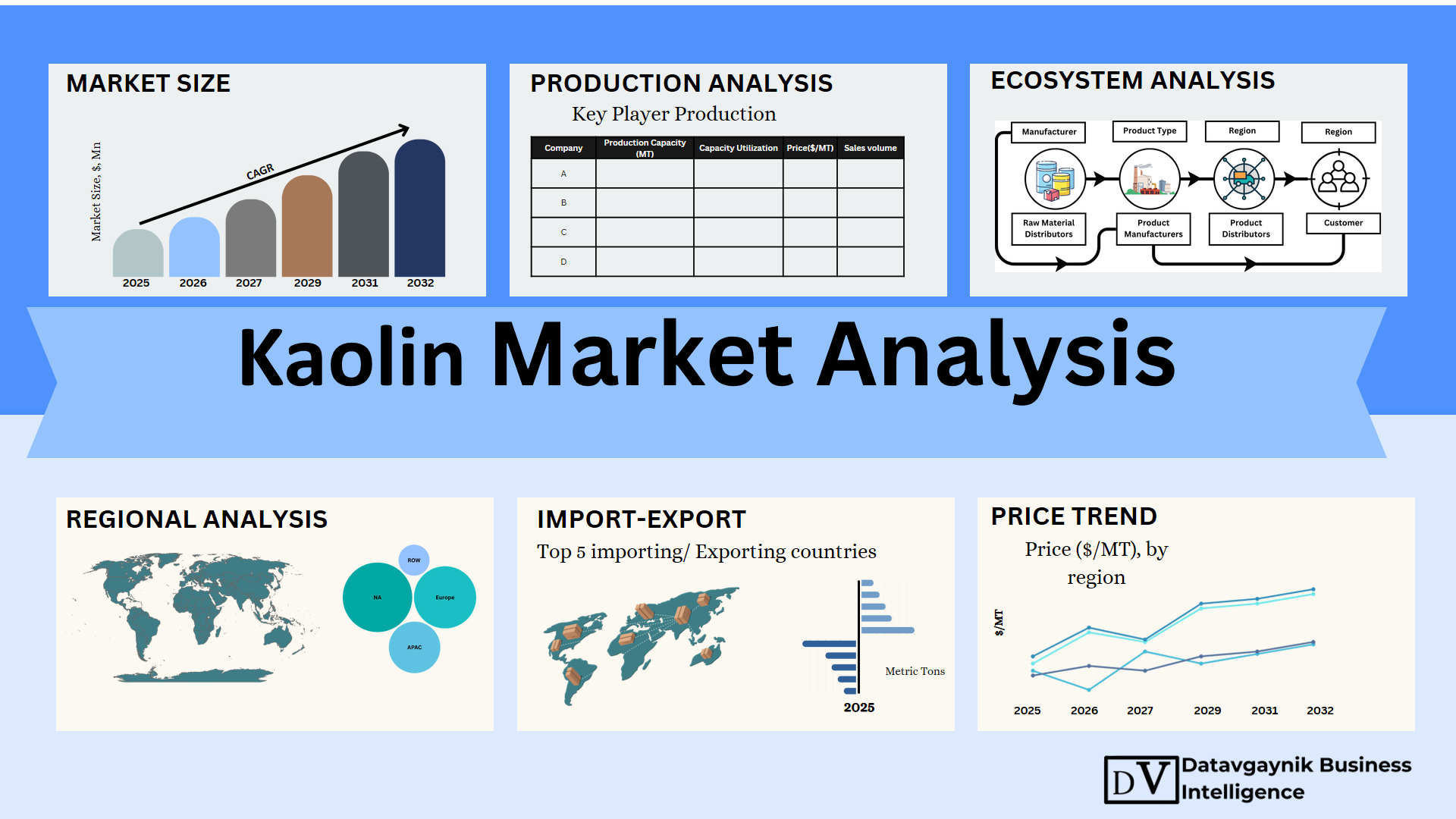
The kaolin market is witnessing a significant transformation, driven by the rising need for high-performance materials in industrial manufacturing. As per Datavagyanik, the kaolin market size is expected to expand at a steady pace through 2032, owing to its growing applications across paper, ceramics, construction, pharmaceuticals, cosmetics, and engineered materials. This upward trend is underpinned by technological advancements, shifting environmental policies, and increasing demand for value-added materials in both developed and emerging economies.
Kaolin Market Grows with the Expansion of the Global Paper Industry
One of the primary drivers of the kaolin market is the sustained demand from the global paper industry. Kaolin is extensively used as a coating and filling agent to enhance paper brightness, opacity, smoothness, and printability. For instance, high-quality coated paper products such as catalogs, magazines, and premium packaging rely heavily on kaolin for their aesthetic and functional appeal. Although digitalization has affected traditional paper consumption, there has been a notable surge in demand for specialty and packaging papers. The rise of e-commerce, which grew by over 20% globally in 2023 alone, has intensified the demand for high-quality, printable, and recyclable packaging, directly boosting the kaolin market.
In regions such as Asia-Pacific and Latin America, where the packaging sector is expanding rapidly, kaolin-based paper solutions are becoming increasingly popular. China and India, for example, are experiencing double-digit growth in the packaging segment, with China’s packaging industry valued at over USD 200 billion as of 2023. This directly supports the upward trajectory of the kaolin market in these regions.
Datavagyanik also covers related markets such as the Kaolin Fillers Market and the Kaolin (China Clay) Market. Such interlinked markets help paint a fuller story of the supply chain, influencing the primary topic’s trajectory.
Ceramics Industry Drives Structural Demand in the Kaolin Market
The ceramics industry remains another major end-user that continues to strengthen the kaolin market. Kaolin is a critical raw material in the production of ceramic tiles, sanitaryware, and tableware due to its high plasticity, whiteness, and resistance to thermal shock. The global ceramics industry was valued at over USD 240 billion in 2023 and is expected to grow at more than 6% CAGR through 2030.
For example, in countries like Spain, Italy, and China—renowned for ceramic manufacturing—kaolin is used extensively in tile and porcelain production. Additionally, the Middle East’s ongoing infrastructure projects, such as Saudi Arabia’s NEOM and the UAE’s smart city developments, are catalyzing demand for high-quality ceramic materials, indirectly expanding the kaolin market in the region. The increasing preference for luxury housing and interior design aesthetics in emerging economies also supports ceramic consumption, reinforcing kaolin’s importance in the sector.
Construction Boom Amplifies Opportunities in the Kaolin Market
The global construction industry, valued at over USD 10 trillion, continues to be a powerhouse for kaolin consumption. Kaolin is widely used in paints, coatings, cement, and construction composites. In paints and coatings, kaolin serves as an extender pigment and rheology modifier, offering benefits such as improved opacity, durability, and weather resistance. As more countries enforce green building regulations and seek energy-efficient materials, kaolin’s non-toxic, insulating, and stabilizing properties are being widely adopted.
For instance, in North America, federal infrastructure investments have surged, with the United States committing over USD 1.2 trillion through the Infrastructure Investment and Jobs Act. This has led to increased use of kaolin in paints, coatings, and lightweight aggregates. Similarly, in India, government programs like the Smart Cities Mission and Housing for All are fueling massive construction projects, creating substantial demand for kaolin-based construction materials.
Growing Applications in Plastics and Rubber Fuel the Kaolin Market
In the plastics and rubber industries, kaolin plays a vital role as a functional filler. It enhances the tensile strength, stiffness, and chemical resistance of end products. With global plastic production surpassing 400 million metric tons annually, the need for efficient and cost-effective fillers like kaolin is more critical than ever.
For example, in automotive applications, kaolin-filled plastics are used to reduce weight while maintaining structural integrity, aligning with the industry’s push toward lightweight vehicles for improved fuel efficiency. In rubber, kaolin is used in tires, seals, and gaskets to improve performance under stress and heat. The global automotive market, valued at over USD 3.8 trillion in 2023, continues to explore innovative composite solutions, which directly benefit the kaolin market.
Paints and Coatings Industry Reinforces the Kaolin Market’s Upward Trend
Kaolin’s utility as a rheology modifier and extender pigment makes it essential in the paints and coatings industry. The growing emphasis on high-performance architectural coatings and environmentally friendly paints has elevated kaolin’s status in this sector. The global paints and coatings market, which exceeded USD 160 billion in 2023, is expected to grow steadily due to rising urbanization and infrastructure investments.
For example, kaolin-based coatings are increasingly used in energy-efficient buildings to enhance thermal insulation. In aerospace and automotive sectors, specialty coatings containing kaolin improve surface protection and heat resistance. These innovations are expanding the material’s use cases and strengthening the position of the kaolin market.
Pharmaceutical and Cosmetics Innovations Stimulate the Kaolin Market
Kaolin’s biocompatibility and absorbent properties make it suitable for pharmaceutical and cosmetic formulations. In pharmaceuticals, it is used in anti-diarrheal and gastrointestinal medications due to its ability to absorb toxins. In cosmetics, kaolin is used in facial masks, powders, and creams as a natural and soothing agent.
The global cosmetics industry crossed USD 570 billion in 2023 and is projected to grow at over 5% annually. Similarly, the pharmaceutical industry continues to rise, driven by aging populations and rising healthcare awareness, particularly in Asia-Pacific and Latin America. The surge in demand for clean-label and natural ingredients is pushing manufacturers to replace synthetic components with mineral-based alternatives like kaolin, thereby expanding the kaolin market.
Emerging Energy Sector Applications Accelerate Kaolin Market Diversification
Kaolin is now being researched and deployed in advanced battery and energy storage systems, particularly in lithium-ion batteries. It is used as a ceramic separator or additive to enhance performance, safety, and lifecycle. With global electric vehicle sales expected to exceed 17 million units in 2025, the demand for reliable battery materials is surging. This trend is unlocking a new growth vertical for the kaolin market.
In addition, kaolin is used in refractories and high-temperature applications within the steel, glass, and energy-intensive manufacturing sectors. These applications require materials that can withstand thermal stress without degradation, a niche where kaolin performs exceptionally well.
Environmental and Regulatory Shifts Reinforce the Kaolin Market’s Relevance
As sustainability becomes a global priority, the kaolin market is witnessing increased adoption in environmental applications. Kaolin is being used in wastewater treatment systems to absorb heavy metals and other contaminants. It also plays a role in air purification and industrial emissions control due to its porous structure and ion-exchange capabilities.
Countries across Europe, North America, and parts of Asia are tightening environmental regulations, which encourages industries to opt for eco-friendly raw materials. Kaolin’s inert nature, recyclability, and non-toxic profile make it a preferred choice in green manufacturing. With carbon-neutral targets set for 2030 and beyond, industries are increasingly aligning their sourcing strategies with sustainable materials like kaolin.
Technological Advancements Elevate Value in the Kaolin Market
One of the pivotal factors driving the kaolin market is the enhancement of kaolin through advanced processing technologies. Techniques such as magnetic separation, chemical bleaching, and calcination are enabling producers to generate ultra-refined grades with superior brightness, opacity, and thermal resistance.
These value-added products are finding applications in high-performance sectors such as aerospace, electronics, and biomedical engineering. For example, high-purity calcined kaolin is being used in polymers for 3D printing and additive manufacturing—a field that grew by over 20% year-on-year in 2023. This level of technological integration signals the transition of the kaolin market from a commodity-based segment to a high-performance material ecosystem.
“Track Country-wise Kaolin Production and Demand through our Kaolin Production Database”
- Kaolin production database for 23+ countries worldwide
- Kaolin sales volume for 28+ countries
- Country-wise Kaolin production capacity, production plant mapping, production capacity utilization for 23+ manufacturers
- Kaolin production plants and production plant capacity analysis by top manufacturers
“Track real-time Kaolin Prices, Kaolin price charts for 23+ countries, Kaolin weekly price tracker and Kaolin monthly price tracker”
- Track real-time Kaolin prices and Kaolin price trend in 23+ countries though our excel-based Kaolin price charts
- Real-time Kaolin price tracker dashboard with 23+ countries
- Complete transparency on Kaolin price trend through our Kaolin monthly price tracker, Kaolin weekly price tracker
Asia Pacific Emerges as the Powerhouse of the Kaolin Market
The Asia Pacific region holds the dominant position in the global kaolin market, driven by rapid industrialization, construction booms, and large-scale ceramic and paper production. Countries such as China, India, and Indonesia are leading the regional growth, with China alone accounting for over 35% of global kaolin consumption as of 2023, according to Datavagyanik. China’s extensive ceramic tile manufacturing industry, valued at more than USD 60 billion, depends heavily on kaolin for its high plasticity and thermal stability.
India, on the other hand, is rapidly catching up, fueled by urban housing initiatives such as Pradhan Mantri Awas Yojana and smart city projects. These programs have increased demand for tiles, paints, and sanitaryware, all of which use kaolin as a key input. Additionally, India’s paper packaging sector is projected to grow at over 7% CAGR through 2030, further reinforcing its reliance on kaolin. Southeast Asian nations like Vietnam and Thailand are also expanding their domestic kaolin processing capabilities to meet rising demand, particularly in the plastics and construction segments.
North America Kaolin Market Bolstered by Advanced Manufacturing and Infrastructure
North America remains a critical contributor to the global kaolin market, especially due to the United States, which is one of the largest producers and exporters of high-grade kaolin. The U.S. state of Georgia, known for its rich kaolin reserves, alone accounts for approximately 80% of North American kaolin production. The material is primarily used in the paper, paints, plastics, and ceramics sectors, with recent innovations in calcined kaolin products for engineered materials further diversifying its applications.
For instance, the U.S. infrastructure drive under federal funding programs has spurred demand for kaolin-based paints, coatings, and lightweight aggregates used in roads and buildings. Moreover, the country’s pharmaceutical industry, valued at over USD 550 billion, continues to adopt kaolin in tablet formulations and gastrointestinal treatments. Datavagyanik notes that the North American kaolin market is also benefiting from rising exports to Europe and Asia, supported by advanced refining technologies that allow customized kaolin grades for high-performance uses.
Europe’s Sustainability Focus Boosts High-Purity Kaolin Market Demand
Europe is not only a major consumer of kaolin but also home to some of the world’s highest purity deposits, particularly in the United Kingdom and the Czech Republic. The UK’s Cornwall region, for instance, is known for producing bright white kaolin used in specialty papers and ceramics. Datavagyanik highlights that the European kaolin market is being shaped by the region’s strong commitment to sustainability and environmental compliance.
Germany, France, and Italy are key demand centers where kaolin is used extensively in ceramics, construction, and automotive coatings. In Germany, the building materials sector alone exceeded USD 100 billion in 2023, with a growing shift toward eco-friendly and low-carbon construction solutions. Kaolin is increasingly used in this space due to its inert, non-toxic properties and ability to improve insulation and paint longevity. The cosmetics sector, particularly in France, is also a major contributor, as kaolin meets the region’s strict standards for natural skincare formulations.
Middle East and Africa Kaolin Market Fueled by Infrastructure and Industrialization
The kaolin market in the Middle East and Africa is witnessing steady growth, largely fueled by infrastructure development and expanding domestic manufacturing capabilities. Saudi Arabia, the UAE, and Egypt are at the forefront, with kaolin demand closely tied to construction megaprojects such as NEOM, Lusail City, and Egypt’s New Administrative Capital.
Saudi Arabia is investing heavily in ceramic and tile production to meet domestic and regional demand, pushing kaolin consumption higher. Egypt’s natural kaolin reserves, mostly located in Aswan and Sinai, are being tapped into with enhanced mining practices. South Africa and Nigeria are also increasing their kaolin imports to support their growing paper and packaging sectors. According to Datavagyanik, kaolin applications in cement, coatings, and water treatment systems are on the rise across the region, contributing to market diversification.
Latin America’s Growing Manufacturing Sector Enhances Kaolin Market Potential
Latin America presents an emerging frontier for the kaolin market. Brazil, in particular, stands out as both a producer and exporter of high-brightness kaolin. The country’s reserves, concentrated in the Amazon basin, supply domestic ceramic, paper, and construction industries while supporting export markets in North America and Europe.
For example, Brazil’s ceramic tile industry, which grew by over 8% in 2023, relies on kaolin for high-quality glazing and shaping properties. In Argentina and Colombia, increasing demand for sustainable paints and insulation products is driving new uses of kaolin. Additionally, with rising investment in local pharmaceutical and cosmetics manufacturing, Latin American nations are beginning to refine kaolin into specialized grades for these sectors, further unlocking market potential.
Diverse Market Segmentation Expands the Scope of the Kaolin Market
The kaolin market is segmented based on grade, application, and end-use industry—each contributing uniquely to the market’s growth dynamics. Among the grades, calcined kaolin is gaining momentum due to its superior thermal resistance and brightness. It is extensively used in high-end paints, plastics, and ceramics. Hydrous kaolin remains a staple in the rubber and paper sectors due to its ease of dispersion and reinforcement capabilities. Coated kaolin, valued for its smooth surface finish and printability, is widely used in premium paper products.
In terms of application, the paper and packaging industry leads the kaolin market, although ceramics and construction are rapidly narrowing the gap. Paints and coatings account for over 20% of global kaolin demand, especially in architectural and automotive uses. The rubber and plastics sector continues to grow, supported by automotive light-weighting and consumer goods production. The cosmetics and pharmaceutical applications of kaolin are also expanding, driven by consumer preference for safe, natural, and absorbent ingredients.
Regional Production Clusters Influence Global Supply and Kaolin Price Trends
Global kaolin production is concentrated in select countries such as China, the United States, Brazil, and the United Kingdom. China, while being the largest consumer, is also a leading producer and is increasingly focused on processing kaolin into high-value applications. U.S. producers are known for their high-quality calcined kaolin, while Brazil dominates the export market for high-purity hydrous kaolin.
This regional concentration often influences the kaolin price and supply trends globally. For example, disruptions in Chinese mining operations due to environmental regulations have caused intermittent supply shortages, pushing kaolin prices upward. In 2023, average kaolin price per metric ton ranged between USD 130 and USD 180 depending on grade and application, with calcined kaolin fetching the highest rates. Datavagyanik observes that the kaolin price trend is expected to remain bullish due to rising demand from advanced applications in batteries, composites, and green construction materials.
Kaolin Price Trend Reflects Supply Chain Pressures and Value-Added Growth
The kaolin price trend is also shaped by rising production costs, including energy, labor, and logistics. With more companies focusing on sustainable mining and low-carbon processing, the upfront investment in kaolin refining is increasing. However, this is offset by the growing demand for high-purity, specialized kaolin grades.
For instance, in the U.S., kaolin prices increased by 6% in 2023 due to higher energy costs and labor shortages, while in Europe, kaolin price hikes were more moderate due to long-term supplier agreements. In Asia, particularly in India and China, the kaolin price trend is influenced by both domestic demand and export opportunities, with domestic prices kept competitive to support local manufacturers.
As industries move toward customized and high-performance applications, the kaolin price trend is expected to align more closely with value-addition than raw volume. This shift is creating a bifurcated pricing environment—standard-grade kaolin remains relatively stable, while engineered and calcined variants are seeing consistent price increases.
Strategic Trade Flows and Export Dynamics Support the Global Kaolin Market
The global kaolin market is supported by a complex web of trade relationships. The United States exports significant volumes of kaolin to Europe and Asia, while Brazil has emerged as a top supplier to North America. Meanwhile, countries like Japan and South Korea are major importers due to limited domestic reserves but strong industrial demand.
For example, Japan imports kaolin for use in electronics, automotive coatings, and high-end ceramics. Similarly, Germany’s paper and plastics industries rely on imports from the U.S. and UK. Trade policies, transportation infrastructure, and port connectivity all influence kaolin supply chains and pricing mechanisms. Datavagyanik notes that countries with stable political climates, robust mining regulations, and proximity to demand centers are best positioned to capitalize on future trade expansion.
Conclusion: Global Synergies Driving Long-Term Kaolin Market Evolution
The kaolin market continues to evolve in response to regional demand shifts, production innovations, and macroeconomic influences. As kaolin finds increasing relevance in green construction, advanced composites, cosmetics, and electronics, the global market is becoming more diversified and resilient. Supported by rising kaolin prices in high-end segments and consistent trade flows, the future outlook remains optimistic for stakeholders across the value chain.
“Kaolin Manufacturing Database, Kaolin Manufacturing Capacity”
- Kaolin top manufacturers market share for 23+ manufacturers
- Top 6 manufacturers and top 13 manufacturers of Kaolin in North America, Europe, Asia Pacific
- Kaolin production plant capacity by manufacturers and Kaolin production data for 23+ market players
- Kaolin production dashboard, Kaolin production data in excel format
“Kaolin price charts, Kaolin weekly price tracker and Kaolin monthly price tracker”
- Factors impacting real-time Kaolin prices in 18+ countries worldwide
- Kaolin monthly price tracker, Kaolin weekly price tracker
- Real-time Kaolin price trend, Kaolin price charts, news and updates
- Tracking Kaolin price fluctuations
Top Manufacturers Shaping the Global Kaolin Market
The kaolin market is led by a combination of multinational corporations and regionally dominant players that control a significant portion of global production and supply. These companies operate across the entire value chain, from mining and processing to distribution and application-specific formulation. Their influence on the kaolin market extends beyond just volume, as they also set technological standards, pricing dynamics, and market direction through product innovation and strategic investments.
Key players in the kaolin market include Imerys S.A., KaMin LLC, Thiele Kaolin Company, BASF SE, SCR-Sibelco, Ashapura Group, EICL Limited, Quarzwerke GmbH, Sedlecký Kaolin A.S., and I-Minerals Inc. Each of these manufacturers holds substantial shares in different regional segments of the kaolin market and specializes in tailored product lines based on industry demand.
Kaolin Market Share by Leading Manufacturers
The kaolin market is moderately consolidated, with the top five players collectively accounting for approximately 25%–30% of the global market. Imerys S.A. is widely considered the global leader in terms of volume and breadth of application segments. With production facilities and processing units across Europe, North America, and Asia, Imerys maintains a diversified kaolin portfolio catering to ceramics, paper, paints, cosmetics, pharmaceuticals, and more.
KaMin LLC has grown significantly in recent years and now holds a strong position in the North American kaolin market. The company has leveraged strategic acquisitions to enhance its production footprint, particularly in the high-grade kaolin segment for paper and engineered applications. Thiele Kaolin Company is another major producer with deep specialization in air-floated and water-washed kaolin, supplying to industries including coatings, construction materials, and specialty ceramics.
European players such as SCR-Sibelco and Quarzwerke GmbH dominate in high-purity kaolin grades suited for fine ceramics and eco-friendly construction. In Asia, Indian-based Ashapura Group and EICL Limited serve domestic and export markets with a wide range of kaolin grades, while also focusing on cost-effective production.
Key Product Lines Strengthening Competitive Advantage
Each major manufacturer in the kaolin market has carved a niche through proprietary product lines that address specific industrial needs. Imerys offers a comprehensive portfolio of calcined, hydrous, and surface-modified kaolin products. These are widely used in high-end paper, thermoplastic compounds, and specialty coatings, with sub-brands tailored for each sector.
KaMin LLC’s product line includes Amazon Premium and Amazon Plus, which are high-performance kaolin grades designed to deliver superior brightness and printability in coated paper. The company also markets OptiGloss and MetaMax, which target applications in paints, plastics, and rubber composites. These products are recognized for their exceptional dispersion, opacity, and reinforcement capabilities.
Thiele Kaolin Company has focused on developing ultra-refined kaolin grades such as Thiele Bright and Thiele Coating Clay, widely used in graphic paper, adhesives, and sealants. The company has invested in sustainable processing technologies to reduce environmental impact while maintaining product performance.
Ashapura Group’s offering includes a diverse mix of hydrous and calcined kaolin suited for both bulk commodities and specialized applications. The company’s geographic advantage in proximity to major ports allows it to export cost-efficient kaolin to markets in the Middle East, Africa, and Southeast Asia.
EICL Limited is known for its water-washed and micronized kaolin, particularly for applications in rubber and plastics. Its focus on consistent particle size distribution and high chemical purity makes its products valuable in automotive and consumer goods manufacturing.
Competitive Differentiation Through Innovation and Processing
The competitiveness of kaolin manufacturers is increasingly defined by their ability to offer application-specific customizations. High-performance industries like aerospace, electronics, and automotive now demand kaolin that meets strict particle morphology and thermal resistance standards. This has encouraged manufacturers to invest in advanced technologies such as calcination, chemical surface modification, and magnetic separation to enhance brightness, viscosity control, and reinforcement.
Calcined kaolin, for example, is rapidly gaining traction in polymer composites due to its ability to withstand high processing temperatures without degrading. Manufacturers that offer thermally stable, high-purity calcined grades are now positioned to benefit from the growing demand in electric vehicle parts, solar panels, and engineered plastics.
In parallel, the rise of sustainable construction practices has increased the demand for kaolin-based paints and insulation materials. Producers are responding by introducing low-carbon kaolin processing techniques and recyclable packaging, adding value to their product lines and capturing environmentally conscious customers.
Recent Developments and Strategic Market Shifts
In the last two years, the kaolin market has witnessed a series of developments that have reshaped the competitive landscape. One of the most notable was a major acquisition by a U.S.-based manufacturer that absorbed a leading European kaolin business. This move expanded its reserves, processing capacity, and customer base across multiple continents. The deal also allowed the company to introduce a broader range of high-brightness kaolin grades to paper and plastic converters in North America and Europe.
Another development was the expansion of a leading Indian manufacturer’s kaolin processing facility in early 2024. This expansion was driven by rising domestic demand from the construction and pharmaceuticals sectors. The upgraded facility includes advanced filtration and spray-drying technologies that enable the production of medical-grade kaolin with high levels of purity and consistency.
In early 2025, several players in the European market began investing in energy-efficient calcination units aimed at reducing emissions by up to 40%. This initiative is in line with the European Union’s Green Deal goals and is expected to drive a wave of low-emission kaolin products suitable for sustainable building applications.
Furthermore, a consortium of Southeast Asian manufacturers announced a regional trade agreement in late 2024 that facilitates the free movement of kaolin across member states. This has reduced tariffs and streamlined logistics, especially between major production hubs and growing demand centers like Vietnam and the Philippines.
“Kaolin Production Data and Kaolin Production Trend, Kaolin Production Database and forecast”
- Kaolin production database for historical years, 10 years historical data
- Kaolin production data and forecast for next 7 years
- Kaolin sales volume by manufacturers
“Track Real-time Kaolin Prices for purchase and sales contracts, Kaolin price charts, Kaolin weekly price tracker and Kaolin monthly price tracker”
- Gain control on your purchase and sales contracts through our real-time Kaolin price tracker and Kaolin price trend analysis
- Kaolin weekly price tracker and forecast for next four weeks
- Kaolin monthly price tracker and forecast for next two months
Market Scenario, Demand vs Supply, Average Product Price, Import vs Export, till 2032
- Global Kaolin Market revenue and demand by region
- Global Kaolin Market production and sales volume
- United States Kaolin Market revenue size and demand by country
- Europe Kaolin Market revenue size and demand by country
- Asia Pacific Kaolin Market revenue size and demand by country
- Middle East & Africa Kaolin Market revenue size and demand by country
- Latin America Kaolin Market revenue size and demand by
- Import-export scenario – United States, Europe, APAC, Latin America, Middle East & Africa
- Average product price – United States, Europe, APAC, Latin America, Middle East & Africa
- Market player analysis, competitive scenario, market share analysis
- Business opportunity analysis
Key questions answered in the Global Kaolin Market Analysis Report:
- What is the market size for Kaolin in United States, Europe, APAC, Middle East & Africa, Latin America?
- What is the yearly sales volume of Kaolin and how is the demand rising?
- Who are the top market players by market share, in each product segment?
- Which is the fastest growing business/ product segment?
- What should be the business strategies and Go to Market strategies?
The report covers Kaolin Market revenue, Production, Sales volume, by regions, (further split into countries):
- Asia Pacific (China, Japan, South Korea, India, Indonesia, Vietnam, Rest of APAC)
- Europe (UK, Germany, France, Italy, Spain, Benelux, Poland, Rest of Europe)
- North America (United States, Canada, Mexico)
- Latin America (Brazil, Argentina, Rest of Latin America)
- Middle East & Africa
Table of Contents:
Introduction to Kaolin Market
- Definition and Mineral Composition
- Industrial Applications and Market Significance
- Market Growth Trends and Key Influencing Factors
Market Segmentation and Product Classification
- By Type (Hydrous Kaolin, Calcined Kaolin, Delaminated Kaolin, Surface-Modified Kaolin)
- By Application (Paper Industry, Ceramics, Paints & Coatings, Rubber, Plastics, Pharmaceuticals)
- By End-Use Industry
Global Kaolin Market Trends and Forecast (2019-2032)
- Market Size, Valuation, and Historical Growth Trends
- Future Demand and Market Expansion Forecasts
- Emerging Technologies in Kaolin Processing and Applications
Regional Market Analysis and Economic Overview
- North America: Market Demand, Supply Chain, and Industrial Usage
- Europe: Regulatory Compliance, Trade Dynamics, and Competitive Landscape
- Asia-Pacific: Leading Producers, Market Demand, and Industrial Growth
- Latin America: Economic Development, Mining Operations, and Market Opportunities
- Middle East & Africa: Resource Potential, Market Challenges, and Investment Strategies
Kaolin Production and Processing Technologies
- Mining and Extraction Techniques
- Refinement and Processing Methods for Various Applications
- Global Production Capacity and Industry Supply Chains
Competitive Landscape and Key Market Players
- Major Producers and Market Share Distribution
- Strategic Partnerships, Mergers, and Acquisitions
- Competitive Strategies and Innovation Trends
Pricing and Revenue Analysis (2019-2024)
- Global Price Trends and Market Influences
- Revenue Performance of Leading Market Participants
- Cost-Efficiency and Profitability in Kaolin Production
Trade and Supply Chain Analysis: Export, Import, and Logistics
- Leading Exporting and Importing Countries
- International Trade Regulations and Compliance Challenges
- Supply Chain Bottlenecks and Market Distribution Networks
Industrial and Commercial Applications of Kaolin
- Use in Paper & Packaging Industry as a Coating and Filler Material
- Applications in Ceramics and Porcelain Manufacturing
- Role in Paints, Coatings, and Polymer Production
- Utilization in Pharmaceuticals, Cosmetics, and Personal Care Products
Manufacturing Cost Structure and Raw Material Sourcing
- Breakdown of Mining, Processing, and Production Costs
- Major Raw Material Suppliers and Market Influence
- Cost Optimization and Supply Chain Efficiency Strategies
Marketing, Distribution, and Sales Strategies
- Distribution Networks and Regional Market Penetration
- B2B and Direct Sales Strategies for Industrial Buyers
- Consumer Demand, Emerging Market Trends, and Sales Forecasting
Future Market Outlook and Strategic Forecast (2025-2032)
- Advancements in Kaolin-Based Products and Processing Techniques
- Investment and Market Growth Opportunities in Emerging Regions
- Market Risks, Challenges, and Regulatory Considerations


