

Steel Production Expansion Accelerating Demand in the Calcium Fluoride Market
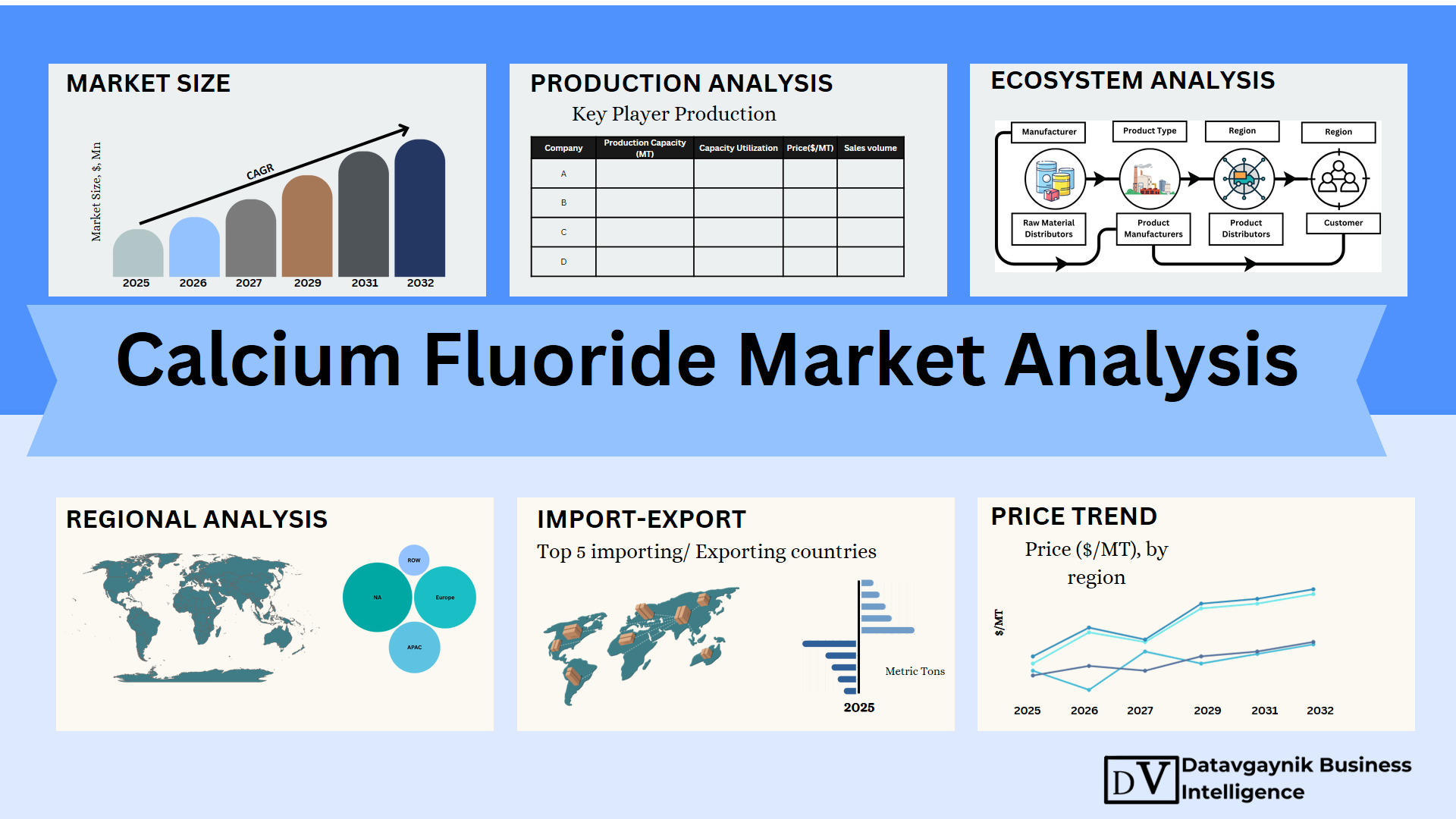
The Calcium Fluoride Market is witnessing accelerated growth as global steel production scales up. Calcium fluoride, often sourced from fluorspar, plays a vital role in the metallurgical industry, particularly as a flux in steelmaking and aluminum smelting. By reducing the melting point of raw materials, it facilitates more efficient processing and better quality output. For instance, global crude steel production reached approximately 1.89 billion metric tons in 2023, up from 1.84 billion metric tons in 2022.
A substantial portion of this volume relies on calcium fluoride during manufacturing. With steel demand projected to rise steadily, particularly from infrastructure and automotive sectors in Asia-Pacific and the Middle East, the Calcium Fluoride Market is expected to benefit significantly from sustained consumption in metallurgy.
Growing Demand from Hydrofluoric Acid Applications Boosting the Calcium Fluoride Market
Another major growth vector for the Calcium Fluoride Market is its use in the production of hydrofluoric acid (HF), a precursor to numerous fluorochemicals. Hydrofluoric acid is central to producing refrigerants, fluoropolymers like PTFE (Teflon), and uranium hexafluoride used in nuclear fuel processing. As global refrigerant consumption expands, so does the requirement for HF—and, by extension, calcium fluoride. For example, global fluorochemical sales surpassed USD 25 billion in 2023, with hydrofluoric acid commanding a major share of feedstock demand. Additionally, the transition to low-GWP refrigerants aligned with Kigali Amendment targets is accelerating the need for new HF-based formulations, adding further momentum to the Calcium Fluoride Market.
Datavagyanik also covers related markets such as the Fluorite (Calcium Fluoride) Market, the Calcium Fluoride (Fluorite) Market, and the Sodium Fluoride Market. Tracking these sectors reveals parallel dynamics and helps anticipate shifts likely to affect the primary market.
Electronics Industry Expansion Supporting the Calcium Fluoride Market
The electronics and optics sectors are emerging as high-value applications within the Calcium Fluoride Market. Calcium fluoride’s excellent transparency in the ultraviolet and infrared spectrum makes it ideal for precision lenses, laser systems, and semiconductor lithography. For instance, the global photonics market, valued at over USD 750 billion in 2023, continues to grow due to rising demand for high-speed data transmission and advanced imaging systems. As chip manufacturing becomes increasingly complex, the use of calcium fluoride crystals in UV-grade lenses and photomask blanks is surging. South Korea, Taiwan, and Japan—leaders in advanced semiconductor manufacturing—are expanding their imports of high-purity calcium fluoride, indicating its growing strategic relevance.
Glass and Ceramics Applications Enhancing the Calcium Fluoride Market Outlook
The Calcium Fluoride Market is also benefitting from its increasing use in specialty glass and ceramics. Calcium fluoride enhances the optical properties, durability, and thermal resistance of glass, especially in applications requiring high transparency and low light dispersion. For example, in the production of camera lenses, telescopes, and optical windows, calcium fluoride is chosen for its superior clarity and reduced chromatic aberration.
In ceramics, it improves glaze appearance and processing consistency. The global specialty glass market alone was valued at over USD 65 billion in 2023, and is expected to grow at a CAGR of over 6 percent through 2030. As demand for advanced glass and ceramic solutions rises in automotive displays, building facades, and mobile device screens, the Calcium Fluoride Market is positioned for long-term gains.
Fluoropolymer Demand in Clean Energy Sector Fueling the Calcium Fluoride Market
The global push toward clean energy and electric vehicles is creating new opportunities within the Calcium Fluoride Market through its indirect linkage to fluoropolymers. Materials like PVDF (polyvinylidene fluoride), which rely on hydrofluoric acid derived from calcium fluoride, are increasingly used in lithium-ion battery binders and separators. For instance, PVDF demand from the battery sector alone grew by more than 30 percent between 2022 and 2024. With global EV production expected to surpass 20 million units annually by 2026, the need for battery-grade fluoropolymers is rising exponentially. As a result, the Calcium Fluoride Market is becoming deeply intertwined with the future of renewable energy infrastructure and electrified transportation.
Calcium Fluoride Market Size Strengthened by Infrastructure Development in Asia-Pacific
Infrastructure development across China, India, Southeast Asia, and Africa is having a profound effect on the Calcium Fluoride Market Size. In these regions, large-scale construction and urbanization projects are driving demand for steel, aluminum, ceramics, and glass—all sectors that depend on calcium fluoride. China’s Belt and Road Initiative alone involves over USD 1 trillion in infrastructure investments, and India’s National Infrastructure Pipeline (NIP) outlines more than 7,400 projects worth USD 1.4 trillion. This construction boom continues to reinforce the Calcium Fluoride Market Size as essential materials manufacturing scales up to meet regional needs.
Rising Investment in Domestic Mining Bolstering Supply Chains in the Calcium Fluoride Market
To reduce import dependency and secure long-term supplies, several countries are investing in domestic fluorspar mining, a primary source of calcium fluoride. For instance, the United States included fluorspar in its 2022 critical minerals list, encouraging domestic production and processing capabilities. Similarly, Mexico, South Africa, and Mongolia are expanding mining capacities to meet global demand. In 2023, global fluorspar production reached approximately 8.7 million metric tons, with China leading at 63 percent of global output. As mining projects expand and governments prioritize supply chain security, the Calcium Fluoride Market is poised for a more stable and diversified production landscape.
Environmental Regulations Shaping Sustainability in the Calcium Fluoride Market
Environmental considerations are becoming increasingly important in the Calcium Fluoride Market, especially regarding waste disposal and emissions during mining and processing. Regulatory authorities across Europe and North America are tightening standards on fluorine-based compound handling. For instance, the European Chemicals Agency (ECHA) mandates strict controls on workplace exposure limits and the use of hazardous fluorides. These developments are pushing producers toward more sustainable processing techniques and higher-purity calcium fluoride production. Companies that adopt cleaner extraction and refining technologies are likely to gain a competitive edge as regulatory scrutiny intensifies.
Calcium Fluoride Market Size Supported by Strategic End-Use Diversification
The Calcium Fluoride Market Size is further supported by its diversification into niche but fast-growing segments such as water fluoridation, dental care, and oil refining. In water treatment, calcium fluoride is a source of fluoride ions that aid in the prevention of dental decay. In 2023, over 370 million people globally received fluoridated water—a population that continues to grow annually due to public health initiatives. Meanwhile, the dental care market, valued at USD 38 billion in 2023, increasingly uses calcium fluoride in varnishes and mouth rinses. The oil refining sector also uses fluoride-based catalysts, further broadening calcium fluoride’s end-user footprint and enhancing overall market stability.
Geopolitical Dynamics and Export Restrictions Reshaping the Calcium Fluoride Market
Geopolitical influences are beginning to reshape trade flows within the Calcium Fluoride Market. With China being the world’s dominant exporter of fluorspar, accounting for over 60 percent of global trade, any export restrictions or shifts in trade policy have a direct effect on global calcium fluoride supply. For example, China’s 2023 export quota revisions for critical minerals, including fluorine-based compounds, caused a 14 percent rise in global fluorspar prices. These developments are prompting major importers like Japan, the EU, and the U.S. to explore alternate sources and stockpiling strategies, reinforcing the importance of diversified sourcing in the Calcium Fluoride Market.
“Track Country-wise Calcium Fluoride Production and Demand through our Calcium Fluoride Production Database”
- Calcium Fluoride production database for 23+ countries worldwide
- Calcium Fluoride sales volume for 28+ countries
- Country-wise Calcium Fluoride production capacity, production plant mapping, production capacity utilization for 23+ manufacturers
- Calcium Fluoride production plants and production plant capacity analysis by top manufacturers
“Track real-time Calcium Fluoride Prices, Calcium Fluoride price charts for 23+ countries, Calcium Fluoride weekly price tracker and Calcium Fluoride monthly price tracker”
- Track real-time Calcium Fluoride prices and Calcium Fluoride price trend in 23+ countries though our excel-based Calcium Fluoride price charts
- Real-time Calcium Fluoride price tracker dashboard with 23+ countries
- Complete transparency on Calcium Fluoride price trend through our Calcium Fluoride monthly price tracker, Calcium Fluoride weekly price tracker
Asia Pacific Leading the Global Calcium Fluoride Market with High Consumption and Production
The Asia Pacific region dominates the Calcium Fluoride Market both in terms of consumption and production. China remains the global epicenter of fluorspar mining, contributing over 60 percent of the world’s output. In 2023 alone, China produced more than 4.2 million metric tons of fluorspar, which is the principal source of calcium fluoride. This dominance is closely tied to its expansive steel and aluminum industries, as well as its position as the world’s largest producer of hydrofluoric acid and fluorochemicals. For instance, China’s domestic steel consumption reached nearly 1 billion metric tons in 2023, each ton requiring fluxing agents like calcium fluoride.
India also continues to scale its role in the regional Calcium Fluoride Market with increasing demand from metallurgy, glass, and fluorine-based chemical sectors. The country’s infrastructure expansion under its USD 1.4 trillion National Infrastructure Pipeline is creating new demand for materials that rely heavily on calcium fluoride-based processes. In parallel, emerging economies like Vietnam and Indonesia are ramping up imports to support their local steel, construction, and electronics manufacturing capacities, all of which contribute directly to the growth of the Calcium Fluoride Market in Asia Pacific.
Europe Focusing on High-Purity Grades in the Calcium Fluoride Market
Europe represents a key hub for high-purity applications in the Calcium Fluoride Market, particularly in optics, electronics, and pharmaceutical sectors. Countries such as Germany, Finland, and Italy have well-established markets for ultra-pure calcium fluoride used in advanced optics, EUV lithography, and medical-grade formulations. For example, Germany’s precision optics industry, which contributed over USD 1.8 billion in 2023, relies heavily on crystal-grade calcium fluoride for laser lenses and spectrometers.
Italy and Finland are notable producers within Europe. Italy, with fluorspar mines in the Piedmont region, supplies high-quality material for European and global customers. Finland exports significant volumes to Central Europe, supporting applications in the paper and plastics industries. As sustainability regulations tighten, European manufacturers are prioritizing cleaner production methods and investing in domestic sourcing to reduce reliance on external suppliers, particularly from China. This strategic shift is reshaping the regional dynamics of the Calcium Fluoride Market.
North America Strengthening Domestic Supply in the Calcium Fluoride Market
The North American Calcium Fluoride Market is transitioning toward self-reliance. The United States, which currently imports a large share of its calcium fluoride, has added fluorspar to its list of critical minerals, prompting increased exploration and domestic mining efforts. In 2023, U.S. fluorspar imports exceeded 350,000 metric tons, sourced primarily from Mexico and South Africa. However, new mining projects in Nevada and Utah aim to revive local supply, reducing exposure to volatile international markets.
North America’s industrial base remains a strong consumer of calcium fluoride. For instance, the U.S. aluminum industry, which produced over 880,000 metric tons of primary aluminum in 2023, continues to require calcium fluoride for refining and smelting. Moreover, the region’s rising investments in electric vehicle battery technologies and fluoropolymer-based components support sustained growth in the Calcium Fluoride Market. As regional demand for high-purity calcium fluoride intensifies, especially for semiconductor-grade materials, the United States is working to close the supply-demand gap through targeted infrastructure development.
Middle East and Africa Expanding Fluorspar Production to Support the Calcium Fluoride Market
The Middle East and Africa are emerging as strategic contributors to the global Calcium Fluoride Market, primarily through untapped mineral reserves and government-backed industrialization efforts. Morocco, in particular, is gaining recognition as one of the world’s largest exporters of acid-grade fluorspar. In 2023, the country exported over 500,000 metric tons, primarily to Europe and Asia.
South Africa, with its extensive mineral resources, also plays a growing role. The country’s Vergenoeg mine is one of the largest known fluorspar reserves globally. The development of infrastructure for processing calcium fluoride locally is helping retain value and enhance export potential. Meanwhile, nations such as Egypt and Namibia are exploring public-private partnerships to ramp up their role in the Calcium Fluoride Market.
Latin America Integrating More Deeply into the Calcium Fluoride Market Supply Chain
Latin America’s role in the Calcium Fluoride Market is expanding due to increasing mining activity and rising domestic consumption in key sectors like construction, glass manufacturing, and refrigeration. Mexico, the leading producer in the region, exported over 600,000 metric tons of fluorspar in 2023, serving markets across North and South America. With established supply chains and favorable trade agreements, Mexican suppliers remain vital to the stability of calcium fluoride prices in the Western Hemisphere.
Brazil and Argentina are experiencing a notable rise in calcium fluoride consumption, driven by new infrastructure investments and the modernization of industrial manufacturing. For instance, Brazil’s construction industry grew by 9 percent in 2023, directly increasing demand for steel, glass, and adhesives—all of which depend on calcium fluoride either as a flux or a raw material.
Segmentation Trends Reshaping the Calcium Fluoride Market Landscape
The Calcium Fluoride Market is segmented by grade, application, and end-user industry, each contributing to a nuanced demand pattern. Acid-grade calcium fluoride remains the most dominant segment, accounting for more than 60 percent of global consumption. This grade is primarily used in hydrofluoric acid production. For example, the global hydrofluoric acid market exceeded USD 2.6 billion in 2023, growing at a CAGR of 6.1 percent, which reflects the increasing pull on calcium fluoride as a feedstock.
Metallurgical-grade calcium fluoride represents the next largest segment, widely used in steel and aluminum production. This segment continues to grow, fueled by global infrastructure expansion. Ceramic and optical grades, though smaller in volume, command premium pricing due to stringent purity requirements. In optics, calcium fluoride is used in lenses for space telescopes, industrial lasers, and UV lithography systems, creating high-margin opportunities for suppliers specializing in crystal-grade production.
Diversified End-Use Sectors Driving Resilience in the Calcium Fluoride Market
The Calcium Fluoride Market serves a diverse range of end-use industries, including metallurgy, chemicals, glass, ceramics, electronics, optics, dental care, and water fluoridation. For instance, the global aluminum market, valued at USD 180 billion in 2023, heavily relies on calcium fluoride during smelting and refining processes. The specialty chemicals segment, driven by fluorocarbon-based refrigerants and fluoropolymers, continues to expand due to demand from electric mobility and solar power installations.
The optics and electronics industries, particularly in Japan, Germany, and South Korea, are creating specialized demand for ultra-pure calcium fluoride. With global demand for semiconductors reaching USD 630 billion in 2023, manufacturers require precise optical equipment that depends on calcium fluoride-based lenses and components. This evolving industrial profile ensures the long-term resilience and versatility of the Calcium Fluoride Market.
Global Calcium Fluoride Price Trends Reflecting Supply Chain Pressures
Calcium Fluoride Price dynamics have been increasingly volatile, shaped by geopolitical tensions, mining restrictions, and surging demand from downstream industries. In 2023, the average global Calcium Fluoride Price for acid-grade material ranged between USD 340 and USD 410 per metric ton, marking a 12 percent increase from the previous year. This rise was driven by limited supply out of China and Morocco, as well as heightened demand from hydrofluoric acid producers.
Crystal-grade calcium fluoride, used in optics and electronics, commanded prices as high as USD 3,000 per metric ton due to purity requirements and limited global production. The Calcium Fluoride Price Trend in Europe remained upward due to energy cost inflation and stringent environmental regulations that increased production costs. In contrast, Southeast Asia saw more stable pricing as local suppliers ramped up capacity.
Calcium Fluoride Price Trend Indicates Upward Momentum in High-Purity Grades
Datavagyanik highlights that the Calcium Fluoride Price Trend will likely continue upward through 2025 for high-purity and acid-grade segments, driven by three key factors: rising demand in fluorochemical manufacturing, supply chain realignments post-COVID, and environmental compliance costs. For instance, increased adoption of PFAS-free fluoropolymers requires cleaner, more controlled calcium fluoride feedstocks, further driving up the Calcium Fluoride Price in specialty markets.
The supply-demand imbalance in optical-grade materials is especially concerning. Global demand for laser systems and EUV lithography equipment is outpacing the capacity of crystal-grade calcium fluoride producers. This tight supply is creating a persistent upward Calcium Fluoride Price Trend in the optics industry. In contrast, metallurgical-grade calcium fluoride pricing remains moderately stable due to higher production volumes and regional sourcing diversification.
Export and Trade Barriers Further Influencing the Calcium Fluoride Price
Export controls and tariffs are emerging as important influencers of the Calcium Fluoride Price across global markets. In 2023, China revised its export quotas on fluorspar products, including calcium fluoride derivatives, which immediately caused a 10 to 15 percent spike in regional prices. Similarly, logistical delays in South African ports and Mexican mining regulations affected shipment volumes, reinforcing an upward Calcium Fluoride Price Trend.
Datavagyanik projects that these structural challenges, combined with rising downstream demand, will continue to exert pressure on global pricing mechanisms. As a result, buyers in North America and Europe are actively diversifying their supply bases, exploring new sources in Africa and Latin America to counterbalance the concentration of supply in Asia.
“Calcium Fluoride Manufacturing Database, Calcium Fluoride Manufacturing Capacity”
- Calcium Fluoride top manufacturers market share for 23+ manufacturers
- Top 6 manufacturers and top 13 manufacturers of Calcium Fluoride in North America, Europe, Asia Pacific
- Calcium Fluoride production plant capacity by manufacturers and Calcium Fluoride production data for 23+ market players
- Calcium Fluoride production dashboard, Calcium Fluoride production data in excel format
“Calcium Fluoride price charts, Calcium Fluoride weekly price tracker and Calcium Fluoride monthly price tracker”
- Factors impacting real-time Calcium Fluoride prices in 18+ countries worldwide
- Calcium Fluoride monthly price tracker, Calcium Fluoride weekly price tracker
- Real-time Calcium Fluoride price trend, Calcium Fluoride price charts, news and updates
- Tracking Calcium Fluoride price fluctuations
Top Manufacturers Dominating the Calcium Fluoride Market
The Calcium Fluoride Market is led by a mix of global mining giants, specialty chemical producers, and optics-grade material specialists. These companies not only command substantial shares of the global supply but also play key roles in innovation and application-specific product development. Their strategic investments in mining, processing, and purification technologies have helped shape the structure of the market across regions and end-use segments.
Among the major players, Chinese manufacturers hold the lion’s share of global calcium fluoride output. Firms such as Hunan Nonferrous Chenzhou Fluoride Chemical Co., Inner Mongolia Huasheng, and China Kings Resources Group are recognized for their scale of operations and ability to meet large-volume industrial demand. These companies supply both acid-grade and metallurgical-grade calcium fluoride to customers across steel, aluminum, and chemical manufacturing sectors.
European producers like Solvay and Deutsche Flussspat GmbH focus more on high-purity grades and synthetically processed calcium fluoride. These companies primarily serve industries with exacting quality standards, such as optics, aerospace, and semiconductors. Their product lines emphasize consistency, controlled particle size, and low impurity content.
In North America, companies such as Koura Global and Canada Fluorspar Ltd. are re-establishing regional supply chains with renewed focus on critical mineral independence. Their operations support demand across metallurgy, fluorochemicals, and battery materials. These producers are expanding capacity to serve growing downstream applications like electric vehicles and renewable energy systems.
Emerging players in Australia, such as Tivan Ltd., are developing significant new reserves of high-grade fluorspar, positioning themselves to meet Asia-Pacific demand for both traditional and specialty applications of calcium fluoride.
Calcium Fluoride Market Share by Leading Producers
The Calcium Fluoride Market is moderately consolidated, with the top five producers accounting for over 50 percent of global supply. Chinese manufacturers dominate in terms of raw production volume, controlling roughly 40 percent of the market share collectively. This dominance stems from abundant fluorspar reserves, low-cost production, and large-scale chemical manufacturing infrastructure.
Solvay, known for its synthetic calcium fluoride product line, holds a leading position in the European market and maintains a global presence in specialty-grade segments. The company is estimated to account for nearly 10 percent of the global calcium fluoride market, with a larger share in Europe’s high-end applications.
Koura Global and Canada Fluorspar Ltd. have a combined market share of around 8–10 percent in North America, with strong ties to chemical manufacturing and aluminum smelting sectors. These companies also serve as strategic suppliers for U.S.-based buyers seeking alternatives to Chinese-sourced materials.
Other notable contributors include Ax Group and Deutsche Flussspat GmbH, which together represent around 5 percent of the market, focused on servicing European customers in ceramics, glass, and refractories industries.
Specialized Product Lines in the Calcium Fluoride Market
Different producers in the Calcium Fluoride Market offer unique product lines tailored to the needs of various industries. Solvay’s product range includes synthetic calcium fluoride with controlled purity and particle size, often used in high-precision brake pads, aluminum fluxing agents, and optical coatings. Their materials are engineered for thermal stability, low water solubility, and minimal contamination—critical traits for electronics and aerospace use.
In the field of optics, several manufacturers produce laser-grade and crystal-grade calcium fluoride components. These include finished lenses, blanks, and windows used in UV and IR spectrums. Companies specializing in this segment often offer customized fabrication, antireflective coatings, and dimensional tolerances required by the defense, medical, and semiconductor industries.
Metallurgical-grade calcium fluoride, which is used primarily in steel and non-ferrous metallurgy, is typically offered in lump or granular form. This segment emphasizes cost-efficiency, thermal resistance, and de-slagging properties, with bulk buyers being foundries, steelmakers, and smelters.
Producers also offer acid-grade calcium fluoride for hydrofluoric acid production, where purity, reactivity, and low silica content are essential. This segment continues to be a growth engine due to rising demand from fluoropolymers, refrigerants, and advanced battery technologies.
Recent Developments in the Calcium Fluoride Market
The Calcium Fluoride Market has seen a series of important developments in recent quarters, many of which are reshaping the competitive and geographic landscape of the industry.
In Q2 2023, one of the largest Canadian producers completed expansion of its underground mining capacity to double its fluorspar output. This move was aimed at reducing North American dependency on imported calcium fluoride and aligning with new government incentives for domestic critical mineral development.
In Q4 2023, a major European chemical producer announced upgrades to its synthetic calcium fluoride processing lines to meet rising demand from the optical and electronics industries. These upgrades included automation of purification stages, improved particle classification systems, and enhanced environmental controls.
In early 2024, a leading Australian mining firm revealed the discovery of an expanded high-grade fluorspar deposit, increasing the estimated resource volume by 37 percent. The company confirmed that the site will begin phased commercial production by 2026, with projected output to supply Asia-Pacific manufacturers across metallurgy and fluorochemicals.
Simultaneously, major players in China have begun investing in cleaner mining and refining techniques to address stricter domestic environmental regulations. These efforts include transitioning to enclosed kilns, chemical filtration systems, and wastewater recycling plants—all of which align with global supply chain expectations for lower carbon and pollutant footprints.
Q1 2024 also saw a strategic alliance formed between a European optics manufacturer and a high-purity calcium fluoride producer, aimed at securing long-term raw material supply for UV lithography lens systems. This partnership underscores the increasing competition for ultra-pure calcium fluoride as demand from advanced semiconductor applications grows.
Outlook for Manufacturers in the Calcium Fluoride Market
Manufacturers in the Calcium Fluoride Market are expected to benefit from expanding applications across multiple sectors, especially as global investment accelerates in electric vehicles, precision optics, semiconductor fabrication, and sustainable infrastructure. The push toward supply chain independence in North America and Europe is also prompting new mine developments and vertical integration strategies among key producers.
As specialty grades command premium pricing and higher margins, companies focusing on innovation, environmental compliance, and application-specific customization are likely to outperform the market average. At the same time, bulk producers catering to steel, aluminum, and acid-grade markets must focus on operational efficiency and cost control to maintain competitiveness amid fluctuating demand cycles.
“Calcium Fluoride Production Data and Calcium Fluoride Production Trend, Calcium Fluoride Production Database and forecast”
- Calcium Fluoride production database for historical years, 10 years historical data
- Calcium Fluoride production data and forecast for next 7 years
- Calcium Fluoride sales volume by manufacturers
“Track Real-time Calcium Fluoride Prices for purchase and sales contracts, Calcium Fluoride price charts, Calcium Fluoride weekly price tracker and Calcium Fluoride monthly price tracker”
- Gain control on your purchase and sales contracts through our real-time Calcium Fluoride price tracker and Calcium Fluoride price trend analysis
- Calcium Fluoride weekly price tracker and forecast for next four weeks
- Calcium Fluoride monthly price tracker and forecast for next two months
Market Scenario, Demand vs Supply, Average Product Price, Import vs Export, till 2032
- Global Calcium Fluoride Market revenue and demand by region
- Global Calcium Fluoride Market production and sales volume
- United States Calcium Fluoride Market revenue size and demand by country
- Europe Calcium Fluoride Market revenue size and demand by country
- Asia Pacific Calcium Fluoride Market revenue size and demand by country
- Middle East & Africa Calcium Fluoride Market revenue size and demand by country
- Latin America Calcium Fluoride Market revenue size and demand by
- Import-export scenario – United States, Europe, APAC, Latin America, Middle East & Africa
- Average product price – United States, Europe, APAC, Latin America, Middle East & Africa
- Market player analysis, competitive scenario, market share analysis
- Business opportunity analysis
Key questions answered in the Global Calcium Fluoride Market Analysis Report:
- What is the market size for Calcium Fluoride in United States, Europe, APAC, Middle East & Africa, Latin America?
- What is the yearly sales volume of Calcium Fluoride and how is the demand rising?
- Who are the top market players by market share, in each product segment?
- Which is the fastest growing business/ product segment?
- What should be the business strategies and Go to Market strategies?
The report covers Calcium Fluoride Market revenue, Production, Sales volume, by regions, (further split into countries):
- Asia Pacific (China, Japan, South Korea, India, Indonesia, Vietnam, Rest of APAC)
- Europe (UK, Germany, France, Italy, Spain, Benelux, Poland, Rest of Europe)
- North America (United States, Canada, Mexico)
- Latin America (Brazil, Argentina, Rest of Latin America)
- Middle East & Africa
Table of Contents:
Calcium Fluoride Market
1. Introduction to the Calcium Fluoride Market
1.1 Overview and Chemical Composition of Calcium Fluoride
1.2 Physical and Optical Properties of Calcium Fluoride
1.3 Industrial and Commercial Applications
2. Market Segmentation and Product Classification
2.1 Categorization by Purity Levels (Metallurgical Grade, Optical Grade, Acid Grade)
2.2 Calcium Fluoride Market Segmentation by Application (Glass & Ceramics, Metallurgy, Optics, Chemicals, Others)
2.3 End-Use Industry Demand and Growth Factors
3. Global Calcium Fluoride Market Overview and Industry Trends
3.1 Market Size and Growth Forecast (2019-2032)
3.2 Emerging Trends and Advancements in Calcium Fluoride Applications
3.3 Market Constraints, Challenges, and Risk Factors
4. Regional Market Insights and Performance Analysis
4.1 North America Calcium Fluoride Market Overview
- U.S. Calcium Fluoride Production, Demand, and Trade Analysis4.2 Europe Calcium Fluoride Market Trends
- Key Countries, Market Expansion, and Consumption Patterns4.3 Asia-Pacific Calcium Fluoride Market Growth
- Major Producers, Trade Networks, and Regional Market Potential4.4 Latin America Market Outlook
- Industrial Applications and Business Opportunities4.5 Middle East & Africa Market Overview
- Investment Potential and Strategic Developments
5. Global Calcium Fluoride Production and Supply Chain Analysis
5.1 Calcium Fluoride Production Volume by Country (2019-2032)
5.2 Key Mining Locations and Processing Facilities
5.3 Raw Material Supply, Processing, and Distribution Logistics
6. Competitive Landscape and Market Players
6.1 Leading Calcium Fluoride Manufacturers and Market Share Analysis
6.2 Global Revenue and Market Positioning of Key Players (2019-2024)
6.3 Business Strategies, Expansion Plans, and Mergers & Acquisitions
6.4 Competitive Pricing Strategies and Regional Market Penetration
7. Calcium Fluoride Production and Trade Analysis
7.1 Global Production Trends and Capacity Utilization
7.2 Import-Export Statistics and Trade Balance by Region
7.3 Supply-Demand Analysis in Major Markets
8. Consumption Analysis and Market Demand Forecast
8.1 Calcium Fluoride Consumption by Application Sector
8.2 Growth in Industrial Demand and Emerging Use Cases
8.3 Market Share Breakdown by Product Type and End-User Industry
8.4 Future Demand Projections and Market Expansion Forecast (2024-2032)
9. Cost Analysis and Manufacturing Economics
9.1 Calcium Fluoride Mining, Processing, and Refinement Costs
9.2 Raw Material Availability and Procurement Strategies
9.3 Profitability, Pricing Analysis, and Cost Optimization Measures
10. Calcium Fluoride Market Value Chain and Distribution Channels
10.1 Supply Chain Analysis from Extraction to End-Use Applications
10.2 Role of Distributors and Market Expansion Strategies
10.3 Sales and Marketing Approaches for Calcium Fluoride Products
11. Market Entry Strategies and Investment Opportunities
11.1 High-Growth Markets and Investment Hotspots
11.2 Regulatory Framework and Environmental Compliance Requirements
11.3 Strategic Partnerships, Joint Ventures, and Business Collaborations
11.4 Risk Assessment and Sustainable Growth Strategies
12. Future Market Outlook and Industry Innovations
12.1 Calcium Fluoride Production Forecast and Market Expansion (2024-2032)
12.2 Technological Innovations in Calcium Fluoride Processing and Applications
12.3 Environmental Sustainability and Circular Economy Trends
12.4 Strategic Recommendations for Market Players and Investors


