

Andalusite Market Trends: Strong Growth in Refractory and Ceramics Sectors
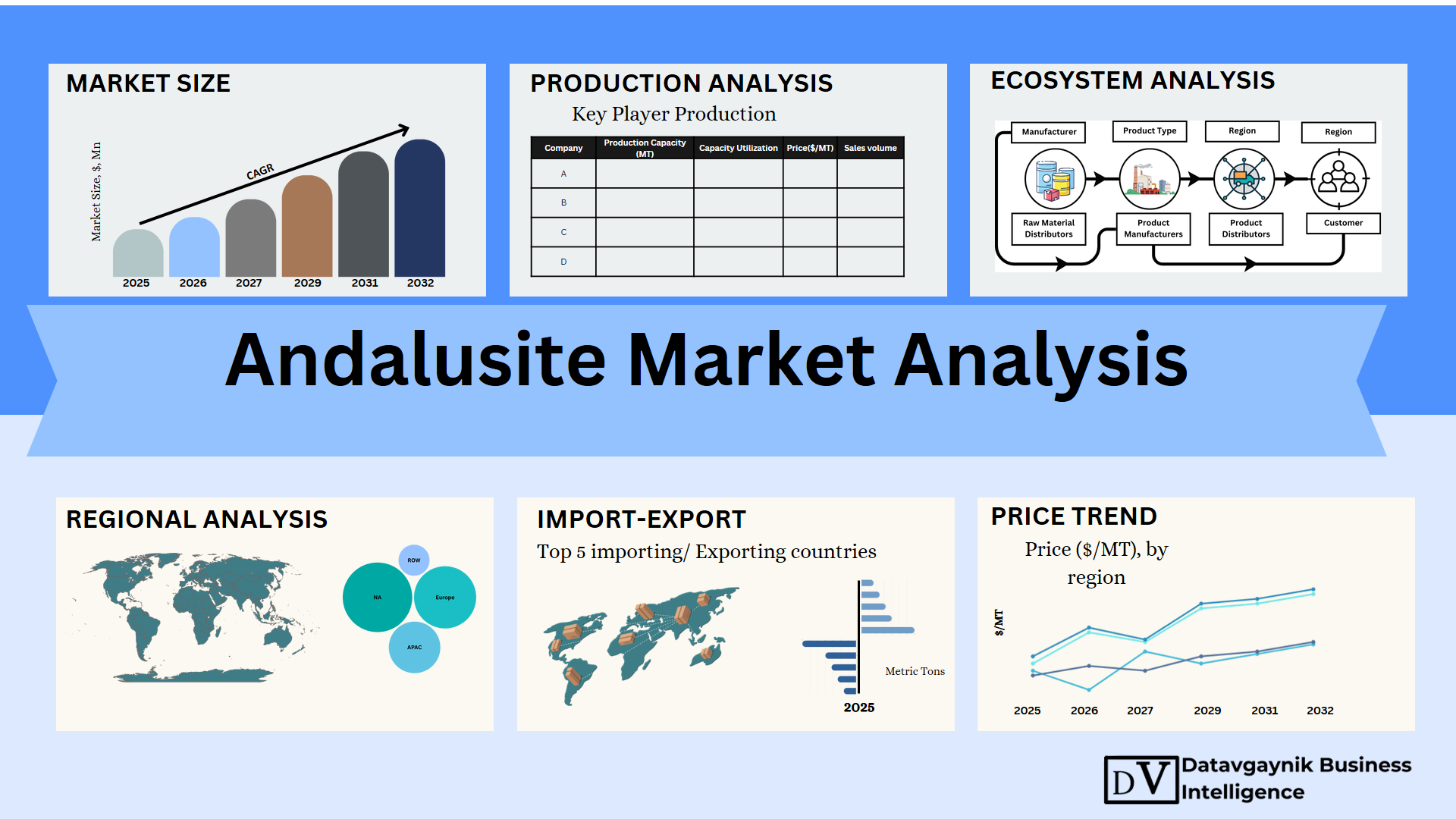
The Andalusite Market is witnessing remarkable growth, particularly driven by the increasing demand for refractory materials. Andalusite’s unique thermal properties, such as its ability to withstand extreme temperatures and thermal shock, have made it indispensable in various high-temperature industries. The demand for refractories used in steel and cement production is surging globally, largely due to the rapid industrialization of emerging markets and a robust construction sector. For example, the demand for refractories in the global steel industry alone is expected to grow at a compound annual growth rate (CAGR) of over 3% between 2024 and 2032, with Andalusite playing a pivotal role in this development.
The importance of Andalusite in the refractories sector cannot be overstated. It is primarily used in steel production for furnaces, ladles, and kilns, where it ensures durability and longevity of the equipment. Countries like China, India, and Brazil, which have seen substantial expansion in their steel manufacturing capacities, are increasingly reliant on Andalusite. For instance, in China, which is the largest steel producer globally, the demand for Andalusite-based refractories has seen an annual increase of 4.5%, directly correlating with the rise in steel production capacity and the ongoing infrastructure boom in the region.
Rising Demand in Steel Industry: Andalusite’s Role in Steelmaking
Andalusite Market growth is heavily influenced by the steel industry, where it serves as a critical material for refractory linings. The demand for steel in infrastructure development, particularly in Asia-Pacific and Latin America, has driven an uptick in Andalusite consumption. For example, in India, steel production has been growing at a rate of 6% per year, and as a result, the demand for refractories is expected to rise in tandem. Andalusite is a key component in refractories used for steelmaking, particularly in electric arc furnaces, which require materials that can withstand extreme conditions.
As countries focus on increasing steel output to meet the needs of rapidly urbanizing populations, Andalusite’s role in these processes becomes more critical. The strong link between steel production and Andalusite consumption is expected to continue strengthening, with the global Andalusite Market Size anticipated to reach significant figures by 2032. Steelmakers are increasingly adopting Andalusite-based refractories due to the material’s superior performance under high temperatures and thermal shock resistance, qualities that are essential in ensuring the durability of steelmaking equipment.
Growth of Ceramics Industry: A Major Driver for Andalusite
In addition to its widespread use in refractories, the Andalusite Market is also benefiting from the growing demand for high-performance ceramics. Andalusite’s excellent thermal properties, wear resistance, and ability to enhance the mechanical strength of ceramic products make it an ideal material for industries such as electronics, automotive, aerospace, and healthcare. As the demand for advanced ceramics continues to grow, particularly in the automotive and aerospace industries, the Andalusite Market is positioned for continued expansion.
For example, the rise of electric vehicles (EVs) is fueling the demand for advanced ceramics in the automotive sector. These materials, which incorporate Andalusite, help improve the efficiency and performance of key components like batteries and engine parts. The global automotive ceramics market is projected to grow by 6.8% annually, with Andalusite playing a key role in the production of lightweight, durable, and heat-resistant materials used in EVs. Similarly, in aerospace, Andalusite is being increasingly adopted for the production of heat-resistant components for turbine engines, where its high thermal stability is crucial. The aerospace industry’s focus on reducing weight and improving fuel efficiency further drives Andalusite demand, positioning the mineral as a key material in the development of advanced ceramics.
Technological Advancements Fueling Andalusite Market Growth
The technological advancements in the processing of Andalusite are opening up new opportunities for its use in various applications. With improved mining and manufacturing techniques, Andalusite is becoming more accessible and cost-effective for industries worldwide. This has led to its adoption not only in refractories and ceramics but also in niche applications such as casting and glassmaking. For example, Andalusite is now used in the production of high-performance casting materials that are required in industries like automotive manufacturing and foundries.
The increased availability of Andalusite is directly tied to the rising demand for energy-efficient and sustainable manufacturing practices. As industries seek to reduce their environmental impact, the use of Andalusite in refractories and ceramics helps lower overall energy consumption during production. This shift toward energy efficiency is reflected in the growing interest in Andalusite as a key material for sustainable manufacturing processes, such as those employed in the cement and steel industries, which account for a significant portion of global Andalusite consumption.
Andalusite Market Expansion in Emerging Economies
The Andalusite Market is also benefiting from the rapid industrialization of emerging economies in Asia-Pacific, Latin America, and the Middle East. As these regions invest in infrastructure and industrial development, the demand for Andalusite in sectors like construction, steel production, and ceramics continues to rise. For instance, in Brazil, the construction sector is growing at an impressive pace, with the government investing heavily in infrastructure projects such as roads, bridges, and housing. This has resulted in a sharp increase in demand for materials like Andalusite, which is used to enhance the durability and thermal stability of concrete and construction materials.
Similarly, in the Middle East, countries like Saudi Arabia and Qatar are seeing significant growth in the demand for Andalusite due to their large-scale infrastructure projects. The Middle East is focusing on energy-efficient building materials and advanced ceramics, which is driving the demand for Andalusite in the region. In Saudi Arabia, the government’s Vision 2030 initiative has accelerated the demand for sustainable materials in construction, boosting the need for Andalusite-based products in cement and concrete applications.
Andalusite Market in North America and Europe: Steady Demand in Key Industries
The North American and European markets for Andalusite are well-established, driven by ongoing demand from industries like steel, automotive, and ceramics. In the United States, the focus on infrastructure renewal and energy-efficient manufacturing practices is pushing up demand for Andalusite. The U.S. government’s infrastructure spending plans, which include large-scale projects in roads, bridges, and public buildings, are expected to sustain the demand for cement and steel, both of which rely on Andalusite for their production processes.
Similarly, Europe’s steel industry, particularly in Germany and Italy, continues to be a major consumer of Andalusite. The European market is expected to grow steadily as the region focuses on sustainable manufacturing practices. For example, Germany’s commitment to reducing CO2 emissions in steel production is likely to further fuel the demand for energy-efficient materials like Andalusite, which helps reduce overall energy consumption during production.
Conclusion: Andalusite Market Growth Driven by Industrialization and Sustainability
In conclusion, the Andalusite Market is experiencing substantial growth driven by a range of factors, including increasing demand in refractories, ceramics, and advanced manufacturing materials. As industries continue to prioritize energy efficiency, durability, and sustainability, Andalusite’s unique properties make it an essential material in a variety of high-temperature applications. The Andalusite Market Size is expected to see significant growth over the coming years, particularly in emerging economies and established markets alike. The mineral’s role in meeting the evolving demands of industries like steel, cement, automotive, aerospace, and construction further solidifies its position as a key driver of industrial development and innovation.
“Track Country-wise Andalusite Production and Demand through our Andalusite Production Database”
- Andalusite production database for 23+ countries worldwide
- Andalusite sales volume for 28+ countries
- Country-wise Andalusite production capacity, production plant mapping, production capacity utilization for 23+ manufacturers
- Andalusite production plants and production plant capacity analysis by top manufacturers
“Track real-time Andalusite Prices, Andalusite price charts for 23+ countries, Andalusite weekly price tracker and Andalusite monthly price tracker”
- Track real-time Andalusite prices and Andalusite price trend in 23+ countries though our excel-based Andalusite price charts
- Real-time Andalusite price tracker dashboard with 23+ countries
- Complete transparency on Andalusite price trend through our Andalusite monthly price tracker, Andalusite weekly price tracker
Geographical Demand for Andalusite Market: A Global Perspective
The Andalusite Market exhibits diverse demand patterns across different regions, driven by unique industrial growth trajectories and local market conditions. Key regions contributing to the surge in Andalusite consumption include Asia-Pacific, Europe, North America, and the Middle East. The Asia-Pacific region, led by countries such as China, India, and Japan, remains the largest consumer of Andalusite, with a dominant share in both production and consumption. For instance, China, as the world’s largest producer of steel, consumes over 35% of the global Andalusite supply, particularly in its steel and cement industries. India, with its rapidly growing infrastructure and steel production capacities, has seen a consistent increase in Andalusite consumption, particularly in refractories used in steel furnaces.
In Europe, nations like Germany, France, and Italy are major players in the Andalusite Market, driven by strong industrial sectors in steel manufacturing, ceramics, and automotive industries. The demand for high-performance refractories in steelmaking and for advanced ceramics in the automotive sector has propelled Andalusite’s consumption in these countries. The European market is expected to grow steadily at a rate of approximately 3% annually, owing to the region’s increasing focus on sustainable manufacturing and energy-efficient solutions.
North America, especially the United States, has seen a growing demand for Andalusite due to ongoing infrastructure development projects and the automotive sector’s shift toward lightweight, high-performance materials. The U.S. market is projected to witness a steady increase in Andalusite consumption, driven by the growth of the steel industry and the increasing adoption of advanced ceramics in various high-tech applications. Meanwhile, the Middle East, with countries like Saudi Arabia and the UAE heavily investing in infrastructure and steel production, has seen a sharp rise in demand for Andalusite. As the region shifts toward energy-efficient construction and advanced materials, the Andalusite Market in the Middle East is expected to expand significantly in the coming years.
Andalusite Market Production Landscape: Key Global Players
The production of Andalusite is concentrated in a few key countries, with South Africa being the dominant global supplier. South Africa’s Eastern Cape region, known for its rich Andalusite deposits, continues to lead in global production, accounting for more than 40% of the world’s supply. The country’s well-established mining infrastructure and favorable geological conditions make it a key player in the Andalusite Market. South Africa’s Andalusite production caters not only to domestic demand but also to international markets, particularly in Europe, Asia-Pacific, and North America.
Other significant producers include Brazil, India, and Spain. Brazil, with its extensive mining operations in the Minas Gerais region, is the second-largest producer of Andalusite. The country’s output serves both local industries, particularly in refractories and ceramics, and international markets. Spain, while a smaller player in terms of production volume, is known for producing high-quality Andalusite with specific mineralogical properties, making it suitable for niche applications such as advanced ceramics and high-performance refractories. India’s growing production capacity is also noteworthy, as the country continues to expand its mining operations to meet the increasing demand from domestic industries.
The production of Andalusite is influenced by several factors, including mining costs, technological advancements, and environmental regulations. In regions like South Africa, where mining operations are more mature, the production of Andalusite remains relatively cost-effective. However, in other regions such as Europe, production costs are higher due to stricter environmental standards and labor costs. As a result, there is an increasing trend of outsourcing Andalusite supply from cost-effective regions like South Africa and Brazil to meet the growing demand in more industrialized regions.
Andalusite Price Trend: Factors Driving Fluctuations
The Andalusite Price has experienced fluctuations in recent years, largely due to supply-demand dynamics, production costs, and global economic factors. The Andalusite Price is influenced by the availability of high-quality deposits, mining costs, and global demand from key industries like steel, cement, and ceramics. For example, in 2022, the average Andalusite Price per ton increased by approximately 5% due to a combination of higher mining costs in key producing regions and a surge in demand from emerging economies, particularly in Asia-Pacific.
The Andalusite Price Trend is expected to remain relatively stable in the near future, with moderate increases anticipated due to growing demand in high-temperature applications. For instance, the rise in infrastructure development projects in regions like India, China, and the Middle East is expected to drive the demand for Andalusite in cement and steel manufacturing, placing upward pressure on prices. In contrast, the global shift toward sustainable materials and energy-efficient manufacturing processes could mitigate some price increases, as Andalusite’s role in energy-efficient refractories becomes more pronounced.
Price volatility in the Andalusite Market is also tied to geopolitical factors and fluctuations in global trade. Disruptions in major supply chains, particularly in key producing countries like South Africa and Brazil, could lead to short-term price hikes. Similarly, changes in global steel and cement production levels, which directly correlate with Andalusite demand, are likely to impact the Andalusite Price Trend. The price trend in Europe and North America has also been influenced by increasing transportation and logistics costs, which have led to higher landed costs for Andalusite imports.
Andalusite Market Segmentation: Applications and End-User Industries
The Andalusite Market is segmented by application and end-user industry, with refractories, ceramics, and advanced materials being the largest contributors to overall demand. The refractories segment dominates the market, driven by the increasing demand for high-performance materials in steel, cement, and glass manufacturing. Andalusite-based refractories are crucial in steel production, where they are used to line furnaces, ladles, and kilns, withstanding extreme temperatures and thermal shock. The demand for refractories in the global steel industry is expected to grow by 3.2% annually, with Andalusite continuing to play a key role in ensuring the durability and performance of steelmaking equipment.
The ceramics segment is another significant driver of Andalusite Market growth, with demand stemming from the construction, automotive, and electronics industries. Andalusite’s ability to enhance the mechanical strength and thermal resistance of ceramics makes it an ideal material for use in tiles, sanitary ware, and other high-performance ceramics. The global ceramics industry is projected to grow at a CAGR of 4% over the next decade, with Andalusite playing a critical role in enhancing the durability and heat resistance of ceramic products.
The advanced materials segment is also seeing increasing demand for Andalusite, particularly in aerospace, automotive, and electronics applications. The material’s high thermal stability and mechanical properties make it a key component in lightweight, durable, and heat-resistant materials used in high-tech industries. As industries like aerospace and automotive focus on reducing weight and improving fuel efficiency, the adoption of Andalusite in advanced materials is expected to continue growing.
Andalusite Price Trends and Regional Variations
The Andalusite Price varies significantly across different regions, influenced by factors such as local production costs, transportation expenses, and regional demand. For instance, the price of Andalusite in South Africa remains relatively low compared to regions like Europe and North America, where higher production costs and logistical challenges drive up prices. In South Africa, where mining operations are more cost-effective, the average Andalusite Price is typically 10-15% lower than in Europe, where stricter environmental regulations and higher labor costs contribute to a higher price point.
In Asia-Pacific, the Andalusite Price Trend is characterized by a mix of both affordable domestic production in countries like India and China and higher prices driven by imports. In China, the growing demand for Andalusite from the steel and ceramics sectors has led to a steady rise in prices, particularly in regions where high-quality deposits are limited. Similarly, in India, the Andalusite Price has been trending upwards as the country expands its steel production capacity and invests in infrastructure development.
In conclusion, the Andalusite Market is influenced by a range of factors, from regional demand and production capabilities to fluctuations in price trends driven by supply chain dynamics and global economic conditions. The continued expansion of key industries such as steel, cement, and advanced materials will likely drive the demand for Andalusite in the coming years, while regional price variations and market segmentation will shape the overall market landscape. As industries continue to focus on sustainability, energy efficiency, and high-performance materials, the Andalusite Price and Andalusite Market Size are expected to follow an upward trajectory, further solidifying the material’s importance in modern manufacturing.
“Andalusite Manufacturing Database, Andalusite Manufacturing Capacity”
- Andalusite top manufacturers market share for 23+ manufacturers
- Top 6 manufacturers and top 13 manufacturers of Andalusite in North America, Europe, Asia Pacific
- Andalusite production plant capacity by manufacturers and Andalusite production data for 23+ market players
- Andalusite production dashboard, Andalusite production data in excel format
“Andalusite price charts, Andalusite weekly price tracker and Andalusite monthly price tracker”
- Factors impacting real-time Andalusite prices in 18+ countries worldwide
- Andalusite monthly price tracker, Andalusite weekly price tracker
- Real-time Andalusite price trend, Andalusite price charts, news and updates
- Tracking Andalusite price fluctuations
Andalusite Market: Leading Manufacturers and Their Market Shares
The andalusite market is characterized by several prominent manufacturers who contribute significantly to the global demand for this highly sought-after refractory material. These companies provide a diverse range of andalusite products tailored to meet the needs of industries such as steel manufacturing, cement production, ceramics, and advanced materials. The competitive landscape is dominated by a few key players, each offering unique product lines and commanding substantial market shares.
- Imerys Refractory Minerals
Imerys is one of the leading manufacturers in the andalusite market, known for its extensive product portfolio that caters to a variety of high-temperature applications. The company produces a range of andalusite-based products under well-known brands like DAMREC™, PURUSITE™, and DURANDAL™. These products are designed to offer high thermal shock resistance, durability, and performance in extreme temperature environments. Imerys’ dominance in the market is supported by its global presence and ability to serve industries such as steel, cement, and glass manufacturing. With consistent innovation in product development, Imerys continues to maintain a leading position in the market, leveraging its expertise in refractory minerals.
- Andalucita S.A.
Andalucita S.A. is another significant player in the andalusite market, offering high-quality andalusite products primarily focused on refractory applications. The company is known for its reliability and consistency in providing andalusite to industries that require exceptional performance at high temperatures. Andalucita S.A. has developed a strong market presence, particularly in regions with high demand for steel production and construction materials. Their product lines are known for their ability to withstand harsh thermal conditions, which makes them indispensable in industries such as cement and steel manufacturing.
- LKAB Minerals
LKAB Minerals specializes in the production and supply of high-quality andalusite to industries that demand high-performance materials. The company offers various grades of andalusite, each suited for different applications, including refractories and foundries. LKAB’s andalusite products are valued for their consistent quality, and the company has established itself as a trusted supplier in both European and global markets. LKAB Minerals has also expanded its operations to serve the growing demand in the Asia-Pacific region, providing a reliable source of andalusite for emerging industrial markets.
- Andalusite Resources
Andalusite Resources, a key player in the andalusite market, focuses on mining and processing andalusite to meet the growing demand across various sectors. The company is recognized for its high-purity products, which offer enhanced performance in demanding industrial applications. Andalusite Resources has developed a robust supply chain that serves industries like refractories, ceramics, and steel manufacturing, with a particular emphasis on providing high-performance materials that meet strict industry standards.
- Xinrong Yilong Andalusite Co. Ltd.
Based in China, Xinrong Yilong Andalusite Co. Ltd. is a major manufacturer and supplier of andalusite to the Asian market. The company plays a pivotal role in meeting the increasing demand for andalusite products in this rapidly industrializing region. Xinrong Yilong specializes in producing andalusite for use in refractories and foundries, particularly in the steel industry. With China’s expanding steel production and construction sectors, Xinrong Yilong continues to be a significant supplier of andalusite in Asia, leveraging its proximity to major manufacturing hubs.
Andalusite Market Share by Manufacturers
The andalusite market is moderately consolidated, with the top manufacturers holding significant shares in the global market. While exact market share percentages are proprietary, key players like Imerys, Andalucita S.A., LKAB Minerals, and Andalusite Resources command a large portion of the market due to their extensive product portfolios, strong supply chains, and established brand reputations.
Imerys, being one of the largest suppliers of andalusite, is recognized for holding a substantial share of the market. The company’s global presence and the comprehensive range of products it offers ensure a dominant position in industries such as steel, cement, and glass manufacturing. Imerys’ continuous investment in research and development helps solidify its market-leading position by offering innovative solutions that meet the evolving needs of its customers.
Andalucita S.A., with its reliable supply of high-quality andalusite, is also a key player in the market. Its strong foothold in regions with high industrial growth, such as Latin America and parts of Europe, allows it to maintain a competitive share in the market. Similarly, LKAB Minerals’ consistent product quality and commitment to meeting the needs of high-temperature industries contribute to its prominent position in the market.
Andalusite Resources also plays a vital role in the market by providing high-purity andalusite, which is increasingly sought after for applications in advanced ceramics and specialized refractory products. The company’s ability to deliver high-performance materials for niche applications positions it as a key player in the overall market.
Recent Developments and Industry News
In recent years, several developments have shaped the andalusite market, with key manufacturers making strategic moves to expand their market presence and meet growing demand.
- Expansion of Production Capacity: Companies like Imerys and LKAB Minerals have announced plans to expand their production capacity to meet the rising demand for andalusite, particularly from the steel and cement industries. This expansion is driven by the increasing need for high-performance refractory materials as industrial production ramps up in emerging markets like Asia-Pacific and the Middle East.
- Sustainability Initiatives: Several leading manufacturers, including Imerys and LKAB Minerals, have invested in sustainable mining and processing practices to minimize their environmental impact. These initiatives are designed to improve the ecological footprint of andalusite extraction while ensuring a steady supply of high-quality material to industries focusing on sustainable manufacturing practices.
- Strategic Partnerships: In 2023, Imerys entered into strategic partnerships with leading steel manufacturers to supply high-performance andalusite for use in energy-efficient and sustainable steelmaking processes. These partnerships are aimed at supporting the growing demand for refractories in the global steel industry, particularly in regions focused on reducing carbon emissions and improving production efficiency.
- New Market Entrants: Emerging companies in the Asia-Pacific region, such as Xinrong Yilong Andalusite Co. Ltd., have contributed to the expansion of the andalusite supply chain, offering competitively priced products to meet the demand in rapidly industrializing economies like China and India.
These developments reflect the dynamic nature of the andalusite market, with manufacturers actively working to adapt to the evolving needs of industries and regions. The continued focus on expanding production capacity, improving sustainability, and forging strategic partnerships ensures that the andalusite market remains a critical component in meeting the high-temperature material demands of industries across the globe.
“Andalusite Production Data and Andalusite Production Trend, Andalusite Production Database and forecast”
- Andalusite production database for historical years, 10 years historical data
- Andalusite production data and forecast for next 7 years
- Andalusite sales volume by manufacturers
“Track Real-time Andalusite Prices for purchase and sales contracts, Andalusite price charts, Andalusite weekly price tracker and Andalusite monthly price tracker”
- Gain control on your purchase and sales contracts through our real-time Andalusite price tracker and Andalusite price trend analysis
- Andalusite weekly price tracker and forecast for next four weeks
- Andalusite monthly price tracker and forecast for next two months
Market Scenario, Demand vs Supply, Average Product Price, Import vs Export, till 2032
- Global Andalusite Market revenue and demand by region
- Global Andalusite Market production and sales volume
- United States Andalusite Market revenue size and demand by country
- Europe Andalusite Market revenue size and demand by country
- Asia Pacific Andalusite Market revenue size and demand by country
- Middle East & Africa Andalusite Market revenue size and demand by country
- Latin America Andalusite Market revenue size and demand by
- Import-export scenario – United States, Europe, APAC, Latin America, Middle East & Africa
- Average product price – United States, Europe, APAC, Latin America, Middle East & Africa
- Market player analysis, competitive scenario, market share analysis
- Business opportunity analysis
Key questions answered in the Global Andalusite Market Analysis Report:
- What is the market size for Andalusite in United States, Europe, APAC, Middle East & Africa, Latin America?
- What is the yearly sales volume of Andalusite and how is the demand rising?
- Who are the top market players by market share, in each product segment?
- Which is the fastest growing business/ product segment?
- What should be the business strategies and Go to Market strategies?
The report covers Andalusite Market revenue, Production, Sales volume, by regions, (further split into countries):
- Asia Pacific (China, Japan, South Korea, India, Indonesia, Vietnam, Rest of APAC)
- Europe (UK, Germany, France, Italy, Spain, Benelux, Poland, Rest of Europe)
- North America (United States, Canada, Mexico)
- Latin America (Brazil, Argentina, Rest of Latin America)
- Middle East & Africa
Table of Contents:
Introduction to Andalusite Market
- Definition and Mineral Composition
- Industrial Importance and Key Properties
- Market Growth Drivers, Challenges, and Emerging Opportunities
Market Segmentation and Product Classification
- By Grade (High-Purity Andalusite, Industrial-Grade Andalusite, Processed Andalusite)
- By Application (Refractories, Ceramics, Foundry, Metallurgy, Glass Manufacturing)
- By End-Use Industry
Global Andalusite Market Trends and Forecast (2019-2032)
- Market Valuation and Historical Growth Analysis
- Future Demand Projections and Market Expansion Strategies
- Technological Innovations in Andalusite Processing
Regional Market Analysis and Economic Impact
- North America: Market Demand, Supply Chain Dynamics, and Trade Policies
- Europe: Industrial Applications, Competitive Landscape, and Regulatory Trends
- Asia-Pacific: Leading Producers, Market Growth, and Emerging Applications
- Latin America: Economic Developments, Resource Availability, and Export Trends
- Middle East & Africa: Market Challenges, Investment Potential, and Industrial Utilization
Andalusite Production and Processing Technologies
- Mining and Extraction Methods
- Refinement, Purification, and Processing Techniques
- Global Production Capacities and Leading Suppliers
Competitive Landscape and Industry Leaders
- Key Market Players and Their Market Positioning
- Strategic Partnerships, Mergers, and Acquisitions
- Competitive Strategies and Innovation in Andalusite-Based Products
Pricing and Revenue Analysis (2019-2024)
- Global Pricing Trends and Cost-Influencing Factors
- Revenue Performance of Major Industry Participants
- Cost Optimization and Profitability in Andalusite Production
Trade and Supply Chain Analysis: Export, Import, and Logistics
- Major Exporting and Importing Countries
- International Trade Regulations and Compliance Issues
- Supply Chain Bottlenecks and Logistics Optimization Strategies
Industrial and Commercial Applications of Andalusite
- Role in High-Temperature Refractories and Furnace Linings
- Use in Ceramics, Kiln Furniture, and High-Performance Materials
- Applications in Metallurgy, Foundry, and Steel Industries
- Utilization in Glass Manufacturing and Other Industrial Sectors
Manufacturing Cost Structure and Raw Material Sourcing
- Breakdown of Mining, Processing, and Production Costs
- Key Suppliers of Raw Materials and Global Dependencies
- Supply Chain Efficiency and Cost-Reduction Strategies
Marketing, Distribution, and Sales Strategies
- Global Distribution Networks and Industry-Specific Demand Trends
- B2B Sales, Direct Supplier Networks, and Emerging Market Expansion
- Consumer Demand, Market Growth, and Sales Forecasting
Future Market Outlook and Strategic Forecast (2025-2032)
- Innovations in Andalusite Processing and Sustainable Applications
- Investment and Market Growth Opportunities in Key Sectors
- Market Risks, Regulatory Challenges, and Industry Disruptions


