

Chlorite (Hydrous Silicate) Market Growth Drivers and Emerging Trends
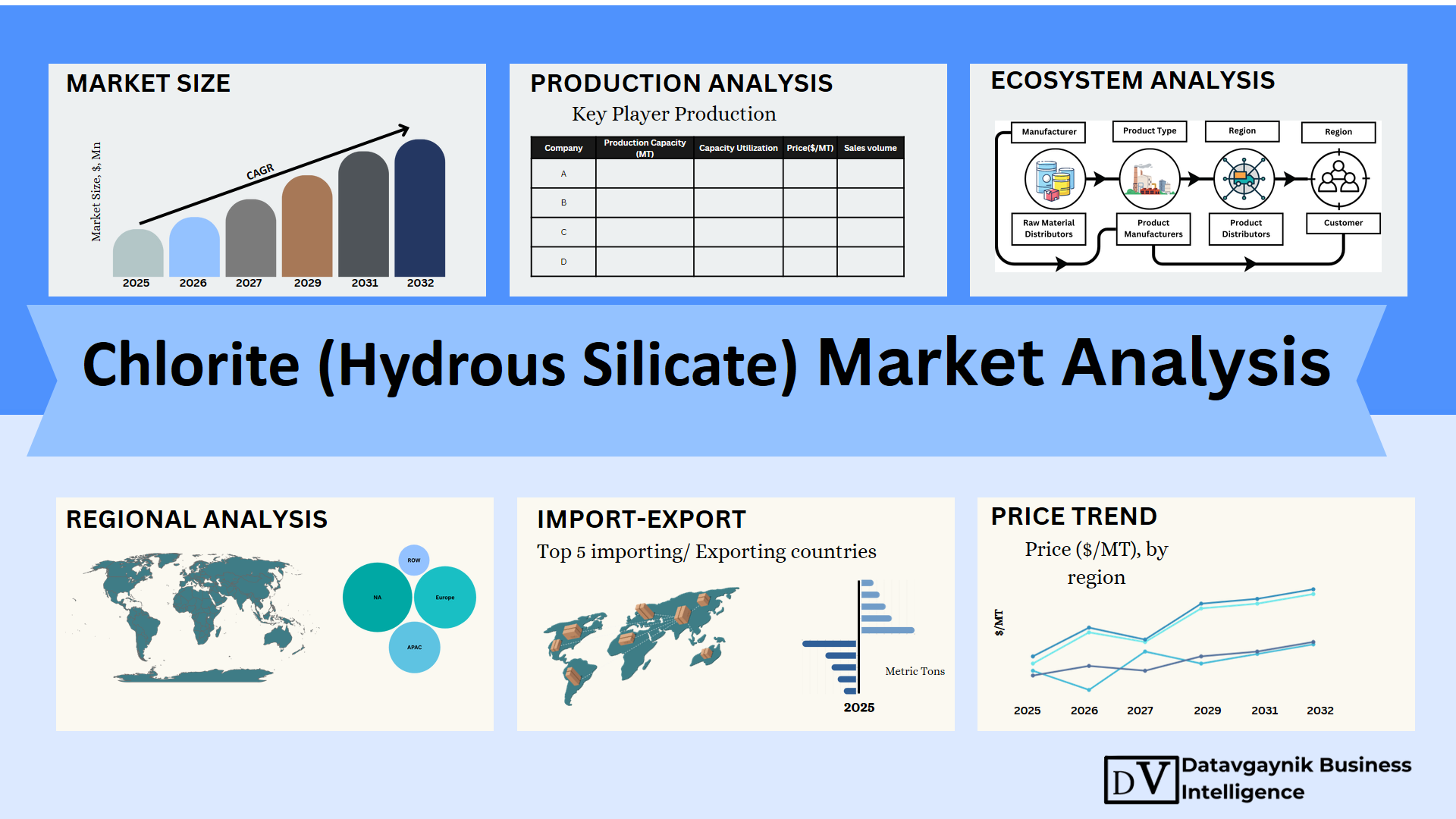
The Chlorite (Hydrous Silicate) Market is poised for significant growth during the forecast period of 2024–2032, driven by its expanding applications across various industries such as construction, energy, environmental sustainability, and industrial manufacturing. This versatile mineral, known for its stability and unique properties, is becoming increasingly crucial in a variety of sectors, which is propelling its demand globally.
Increased Demand in the Construction Sector
The construction industry is one of the major drivers for the Chlorite (Hydrous Silicate) Market. The mineral is widely used in the production of cement, concrete additives, and insulation materials. Chlorite’s thermal stability and strength-enhancing properties make it an ideal ingredient for these applications. As the global construction industry experiences continued growth, particularly in developing regions such as Asia Pacific and Africa, the demand for Chlorite (Hydrous Silicate) is also increasing. According to a report by the International Monetary Fund (IMF), the construction industry in emerging economies is expected to grow at a compound annual growth rate (CAGR) of 6.3% from 2024 to 2032, which directly impacts the demand for materials like Chlorite.
For instance, countries like India and China, which are witnessing rapid urbanization and large-scale infrastructure projects, are major consumers of Chlorite in construction. The growing need for durable, high-performance materials in infrastructure, residential, and commercial construction is driving the Chlorite (Hydrous Silicate) Market. These regions’ construction booms provide a significant opportunity for chlorite-based products, such as additives for concrete and as a heat-resistant component in insulation materials.
Chlorite (Hydrous Silicate) Market Expansion in the Oil and Gas Industry
The increasing demand for Chlorite (Hydrous Silicate) in the oil and gas sector is another key growth driver. Chlorite is used as a proppant in hydraulic fracturing and in drilling fluids to enhance well performance and stabilize boreholes. As unconventional oil and gas reserves are explored in regions such as North America, the demand for proppants, including Chlorite, has surged. The Permian Basin in the United States, a prime example, has seen a 20% growth in the number of wells drilled since 2020, fueling the need for more proppants and additives like Chlorite.
The global energy sector’s push toward energy independence, coupled with the ongoing exploration of shale gas and other unconventional reserves, has amplified the role of Chlorite in energy extraction. With hydraulic fracturing being integral to modern drilling operations, the demand for high-performance minerals like Chlorite continues to rise. Additionally, advancements in fracking technologies have led to more efficient operations, further increasing the consumption of minerals that enhance well productivity.
Growth in Environmental Applications of Chlorite (Hydrous Silicate)
Chlorite (Hydrous Silicate) is also gaining prominence in environmental applications, particularly in water treatment and soil stabilization. The increasing global focus on sustainable practices, cleaner water solutions, and pollution control is driving this growth. Chlorite’s absorbent properties make it an ideal material for industrial wastewater management and municipal water treatment systems. The growing importance of environmental sustainability, coupled with stricter regulations on water quality and soil remediation, has boosted the demand for Chlorite-based products.
For example, the Safe Drinking Water Act (SDWA) and Environmental Protection Agency (EPA) regulations in the United States have led to the adoption of Chlorite in water purification systems. The global push for clean water solutions and soil stabilization, especially in industrial and agricultural applications, is expanding the Chlorite (Hydrous Silicate) Market. As governments and organizations continue to prioritize environmental protection and waste management, the role of Chlorite in these sectors is expected to grow, contributing to a more sustainable future.
Advancements in the Ceramics Industry and Chlorite (Hydrous Silicate) Demand
The ceramics industry, known for its heat-resistant and durable products, has also become a key driver for the Chlorite (Hydrous Silicate) Market. Chlorite’s exceptional thermal stability makes it an essential ingredient in the production of advanced ceramics. These ceramics are widely used in construction, electronics, automotive, and aerospace applications. As the demand for advanced ceramics continues to rise, so does the demand for Chlorite.
For example, in the automotive sector, the use of advanced ceramics for parts that require high heat resistance is growing. This includes applications in engine components, exhaust systems, and brakes, where materials like Chlorite are crucial for performance. The global automotive industry, particularly in regions such as Europe and North America, is expected to grow at a CAGR of 4.5% from 2024 to 2032, driving the need for heat-resistant ceramics and, consequently, for Chlorite.
The Role of Chlorite (Hydrous Silicate) in Renewable Energy and Technology
An emerging application of Chlorite (Hydrous Silicate) is in the renewable energy sector, where it is being studied for use in battery technologies and energy storage systems. The global shift toward green energy and sustainability has led to an increased interest in the potential of hydrous silicate minerals, including Chlorite, in energy storage and renewable technologies. Research is ongoing into the mineral’s ability to enhance the performance of batteries, which is critical for the growing electric vehicle (EV) market and energy storage solutions for renewable sources like wind and solar power.
For example, in the United States, the electric vehicle market is expected to grow by 28% annually through 2030, creating substantial opportunities for the use of advanced materials, including Chlorite, in battery technologies. As the world transitions to clean energy, the demand for minerals that contribute to energy storage systems is set to rise, further expanding the Chlorite (Hydrous Silicate) Market. This trend aligns with global initiatives to reduce carbon emissions and move towards a sustainable energy future.
Chlorite (Hydrous Silicate) Market Size and Strategic Developments in North America
North America is expected to play a significant role in the growth of the Chlorite (Hydrous Silicate) Market due to ongoing infrastructure projects, advancements in the energy sector, and an increasing focus on environmental solutions. The United States, for instance, is seeing a rise in demand for Chlorite in construction, oil and gas, and water treatment applications. With substantial investments in infrastructure modernization, such as the $1 trillion infrastructure bill passed in 2021, the demand for materials like Chlorite is expected to grow significantly.
Furthermore, the U.S. is experiencing a shift towards sustainable energy solutions, which is further boosting the demand for Chlorite in energy storage systems and renewable energy applications. The government’s focus on clean energy technologies, combined with state-level initiatives to promote sustainable practices, creates a favorable environment for the Chlorite (Hydrous Silicate) Market in North America.
Regional Demand for Chlorite (Hydrous Silicate) in Europe and Asia-Pacific
Europe and Asia-Pacific are also expected to contribute significantly to the Chlorite (Hydrous Silicate) Market’s growth. In Europe, countries like Germany, France, and Italy are increasing their adoption of Chlorite in sectors such as construction, ceramics, and environmental sustainability. For instance, Germany’s commitment to reducing carbon emissions by 55% by 2030 is driving the demand for eco-friendly construction materials and innovative technologies where Chlorite plays a role.
In Asia-Pacific, countries like China and India are experiencing rapid industrialization and urbanization, leading to an increase in construction and manufacturing activities, which in turn is driving the demand for Chlorite. China, being the largest consumer of Chlorite in the region, is witnessing a construction boom fueled by initiatives like the Belt and Road Initiative. India’s infrastructure development programs, such as the Smart Cities Mission, further contribute to the growing demand for high-performance construction materials like Chlorite.
“Track Country-wise Chlorite (Hydrous Silicate) Production and Demand through our Chlorite (Hydrous Silicate) Production Database”
- Chlorite (Hydrous Silicate) production database for 23+ countries worldwide
- Chlorite (Hydrous Silicate) sales volume for 28+ countries
- Country-wise Chlorite (Hydrous Silicate) production capacity, production plant mapping, production capacity utilization for 23+ manufacturers
- Chlorite (Hydrous Silicate) production plants and production plant capacity analysis by top manufacturers
“Track real-time Chlorite (Hydrous Silicate) Prices, Chlorite (Hydrous Silicate) price charts for 23+ countries, Chlorite (Hydrous Silicate) weekly price tracker and Chlorite (Hydrous Silicate) monthly price tracker”
- Track real-time Chlorite (Hydrous Silicate) prices and Chlorite (Hydrous Silicate) price trend in 23+ countries though our excel-based Chlorite (Hydrous Silicate) price charts
- Real-time Chlorite (Hydrous Silicate) price tracker dashboard with 23+ countries
- Complete transparency on Chlorite (Hydrous Silicate) price trend through our Chlorite (Hydrous Silicate) monthly price tracker, Chlorite (Hydrous Silicate) weekly price tracker
Geographical Demand in the Chlorite (Hydrous Silicate) Market
The demand for Chlorite (Hydrous Silicate) is steadily increasing across various regions, fueled by growth in industrial applications, infrastructure development, and environmental sustainability initiatives. Different regions have distinct needs and drivers that impact the demand for this versatile mineral.
In North America, particularly in the United States, the demand for Chlorite (Hydrous Silicate) has been substantial, driven by the booming construction industry and increased focus on environmental regulations. The passage of the Infrastructure Investment and Jobs Act in 2021 has sparked a wave of investments in infrastructure, leading to a significant uptick in demand for construction materials, including Chlorite. For example, the U.S. construction sector is expected to grow at a CAGR of 5.8% through 2032, which will continue to drive the consumption of Chlorite in cement and concrete additives.
Meanwhile, in Europe, the demand for Chlorite (Hydrous Silicate) is heavily influenced by the region’s commitment to sustainability. The EU’s green deal and stricter environmental regulations, such as the Clean Energy for All Europeans package, are pushing industries toward more eco-friendly alternatives. In countries like Germany and France, Chlorite is in demand for its role in construction and ceramics, as it is used for high-performance materials that contribute to energy efficiency and sustainable construction.
Asia-Pacific remains the fastest-growing region for Chlorite (Hydrous Silicate) demand. In China, rapid urbanization, government-led infrastructure programs such as the Belt and Road Initiative, and a flourishing ceramics industry are key factors driving the demand for Chlorite. The Chinese construction industry alone is expected to grow by 7.2% annually, which will significantly boost Chlorite consumption. Similarly, in India, the government’s push for affordable housing and smart cities initiatives is increasing the demand for Chlorite-based construction materials. The country’s urbanization rate is expected to reach 40% by 2032, leading to higher infrastructure demand and the increased use of Chlorite in cement and concrete production.
Production and Supply Dynamics in the Chlorite (Hydrous Silicate) Market
The production of Chlorite (Hydrous Silicate) is dominated by regions with abundant natural reserves of hydrous silicate minerals. China is the largest producer of Chlorite, leveraging its vast mineral resources and advanced extraction techniques. The country accounts for nearly 40% of the global production, driven by its large-scale industrial activities and high domestic demand. China’s leading position in the Chlorite (Hydrous Silicate) Market is further bolstered by its competitive pricing and export capabilities. For instance, in 2021, China exported approximately 1.5 million tons of Chlorite to regions including Europe, North America, and Southeast Asia.
India also plays a significant role in Chlorite production, with an increasing focus on expanding its mining and manufacturing sectors. India’s production of Chlorite is largely fueled by the rapid growth of its construction and industrial sectors. In fact, India’s Chlorite production increased by 15% from 2020 to 2022, primarily driven by the need for construction materials and environmental applications.
In Brazil, Chlorite production is gaining momentum, particularly as the country focuses on industrial diversification. The rich natural resources of Brazil, combined with its efforts to modernize mining operations, are positioning it as a key producer of Chlorite for export. Brazil’s Chlorite production is also expected to rise by 8% annually, supported by its robust construction and manufacturing industries.
Chlorite (Hydrous Silicate) Market Segmentation by Application
The Chlorite (Hydrous Silicate) Market can be segmented based on its application areas, with key sectors driving demand. Among the major segments, the construction industry is by far the largest consumer, accounting for nearly 35% of the global market. Chlorite’s role in enhancing the strength and durability of cement and concrete makes it indispensable in infrastructure projects. The global construction boom, particularly in emerging economies, continues to fuel the growth of this segment. For example, in India, the construction industry is projected to reach $1 trillion by 2025, further elevating the demand for Chlorite in concrete and building materials.
Another significant segment driving the Chlorite (Hydrous Silicate) Market is the ceramics industry. Chlorite’s exceptional thermal stability makes it a vital component in the production of heat-resistant and durable ceramics, which are used in a range of applications, including automotive, electronics, and aerospace. In the automotive sector, for instance, the demand for advanced ceramics has grown as manufacturers seek to improve the performance of engine components and exhaust systems. The global automotive ceramics market is expected to grow at a CAGR of 6.4% from 2024 to 2032, directly impacting the demand for Chlorite in this sector.
Water treatment applications also account for a substantial portion of the Chlorite (Hydrous Silicate) Market. Chlorite’s absorbent properties make it ideal for industrial wastewater management and municipal water purification systems. In the United States, the demand for Chlorite in water treatment is increasing due to stricter environmental regulations under the Safe Drinking Water Act. The global water treatment market is expected to grow at a CAGR of 7.2% from 2024 to 2032, creating substantial opportunities for Chlorite suppliers in this segment.
Additionally, the oil and gas sector remains a strong driver of demand for Chlorite. As energy exploration continues to expand, particularly in unconventional reserves such as shale gas, the need for high-performance proppants and drilling fluids increases. Chlorite is used in hydraulic fracturing operations to stabilize boreholes and improve well efficiency. With the resurgence of shale gas exploration, particularly in the United States, the demand for Chlorite in the oil and gas industry is set to grow at a CAGR of 5.1% through 2032.
Chlorite (Hydrous Silicate) Price Trend and Its Impact on Market Dynamics
The price trend for Chlorite (Hydrous Silicate) has seen fluctuations in recent years, influenced by global supply chain dynamics, demand in key industries, and raw material costs. In 2023, the price of Chlorite was around $200 per ton, but it has risen steadily due to increasing demand from the construction, ceramics, and environmental sectors. A key factor driving the price increase is the rising cost of mining and processing, as well as logistical challenges that have increased transportation costs. For instance, the global shortage of shipping containers in 2021-2022 impacted the price of Chlorite, leading to a 5% increase in its price over a six-month period.
The Chlorite (Hydrous Silicate) Price Trend in the global market is also affected by regional variations in production costs. In China, the price of Chlorite remains relatively lower due to the country’s established extraction infrastructure and economies of scale. However, in regions like North America and Europe, the price trend for Chlorite has been increasing due to higher production and regulatory compliance costs.
Looking forward, the Chlorite (Hydrous Silicate) Price Trend is expected to continue rising, particularly in markets with high demand for environmentally friendly materials. As industries push for greener construction and manufacturing practices, the need for Chlorite in sustainable products will continue to elevate its value. The increasing adoption of Chlorite in renewable energy applications, such as energy storage systems and batteries, is also likely to impact its price, driving a further upward trend.
Regional Price Variations and Their Influence on the Chlorite (Hydrous Silicate) Market
Price variations across different regions significantly impact the Chlorite (Hydrous Silicate) Market. In North America, the price of Chlorite has been steadily increasing due to high demand in construction, water treatment, and oil and gas applications. The rising costs of raw materials and regulatory compliance are contributing factors. The average price of Chlorite in the U.S. is approximately $220 per ton, which is higher compared to other regions, reflecting the increased cost of production and transportation.
In Europe, the price trend is influenced by demand from industries such as automotive ceramics and green construction. The Chlorite (Hydrous Silicate) Price Trend in Europe has experienced a rise of about 6% from 2022 to 2023, driven by the region’s push for sustainability and the transition to energy-efficient building materials. As European nations continue to prioritize carbon-neutral construction projects, the demand for Chlorite is expected to keep prices elevated.
In contrast, Asia-Pacific, led by China and India, has seen relatively stable Chlorite prices due to abundant production and lower operational costs. However, as these countries focus on sustainable development and clean energy, it is anticipated that the price of Chlorite in these regions will increase in line with global trends.
Future Outlook for the Chlorite (Hydrous Silicate) Market
The future outlook for the Chlorite (Hydrous Silicate) Market remains highly optimistic, driven by continued demand across diverse sectors, including construction, ceramics, energy, and environmental applications. The market’s expansion is also supported by technological advancements in extraction processes, which are improving production efficiency and helping to mitigate rising costs.
The Chlorite (Hydrous Silicate) Price Trend will likely continue to follow an upward trajectory, influenced by the growing focus on green technologies, infrastructure development, and industrial diversification. As industries move toward more sustainable practices, Chlorite will play an increasingly important role in eco-friendly products, further elevating its market value.
“Chlorite (Hydrous Silicate) Manufacturing Database, Chlorite (Hydrous Silicate) Manufacturing Capacity”
- Chlorite (Hydrous Silicate) top manufacturers market share for 23+ manufacturers
- Top 6 manufacturers and top 13 manufacturers of Chlorite (Hydrous Silicate) in North America, Europe, Asia Pacific
- Chlorite (Hydrous Silicate) production plant capacity by manufacturers and Chlorite (Hydrous Silicate) production data for 23+ market players
- Chlorite (Hydrous Silicate) production dashboard, Chlorite (Hydrous Silicate) production data in excel format
“Chlorite (Hydrous Silicate) price charts, Chlorite (Hydrous Silicate) weekly price tracker and Chlorite (Hydrous Silicate) monthly price tracker”
- Factors impacting real-time Chlorite (Hydrous Silicate) prices in 18+ countries worldwide
- Chlorite (Hydrous Silicate) monthly price tracker, Chlorite (Hydrous Silicate) weekly price tracker
- Real-time Chlorite (Hydrous Silicate) price trend, Chlorite (Hydrous Silicate) price charts, news and updates
- Tracking Chlorite (Hydrous Silicate) price fluctuations
Leading Manufacturers in the Chlorite (Hydrous Silicate) Market
The Chlorite (Hydrous Silicate) Market is characterized by the presence of several key manufacturers who play a pivotal role in its global supply chain. These companies are renowned for their extensive product portfolios, strategic market presence, and significant contributions to the industry.
- Imerys
Imerys stands as a prominent player in the Chlorite (Hydrous Silicate) Market, with a legacy spanning over a century in talc production. The company operates talc mines in Austria, France, Italy, and Australia, with the Trimouns mine in southwest France being one of the largest working talc mines globally. Imerys offers a diverse range of talc products catering to various applications, including ceramics, paints, and personal care. Their commitment to innovation and sustainability has solidified their position as a market leader.
- Mineral Technologies Inc.
Mineral Technologies Inc. is recognized for its expertise in mineral processing and a comprehensive portfolio of talc products. Their offerings are utilized across multiple industries, including ceramics, paints, and plastics. The company’s focus on technological advancement and customer-centric solutions has contributed to its substantial market share in the Chlorite (Hydrous Silicate) sector.
- Shree Chlorates Pvt. Ltd.
Shree Chlorates Pvt. Ltd. is a significant manufacturer of sodium chlorite, a compound closely related to chlorite minerals. Their products find applications in water treatment, textiles, and medical sectors. The company’s dedication to quality and customer satisfaction has enhanced its reputation in the global market.
- ERCO Worldwide
ERCO Worldwide is a leading producer of sodium chlorite, serving various industries, including water treatment and pulp bleaching. Their commitment to environmental sustainability and operational excellence has positioned them as a key player in the Chlorite (Hydrous Silicate) Market.
- Occidental Petroleum Corporation
Occidental Petroleum Corporation, primarily known for its oil and gas operations, also manufactures sodium chlorite. Their products are utilized in water treatment and other industrial applications. The company’s integrated approach and extensive distribution network have contributed to its significant market presence.
Market Share Distribution Among Manufacturers
The Chlorite (Hydrous Silicate) Market exhibits a diversified market share distribution among its key manufacturers. Imerys leads the market, attributed to its extensive mining operations and diverse product range. Mineral Technologies Inc. and Shree Chlorates Pvt. Ltd. hold substantial shares, owing to their specialized products and strong industry relationships. ERCO Worldwide and Occidental Petroleum Corporation also command notable market shares, supported by their strategic operations and commitment to quality.
Recent Industry Developments
The Chlorite (Hydrous Silicate) Market has witnessed several notable developments in recent years:
- April 2021: Ercros initiated the construction of a new sodium chlorite production line at its factory in Sabiánigo, Spain. This investment aims to increase production capacity from 6,000 to 11,300 tonnes per year, with operations expected to commence in the third quarter of 2022.
- August 2019: Occidental Petroleum Corporation completed the acquisition of Anadarko Petroleum Corporation for $55 billion. This strategic move expanded Occidental’s portfolio, enhancing its position in the global sodium chlorite market.
- June 2024: New regulations were introduced to halve allowable silica dust levels in mines, aiming to improve worker safety. The mining industry has expressed opposition, citing concerns over increased costs and operational challenges.
“Chlorite (Hydrous Silicate) Production Data and Chlorite (Hydrous Silicate) Production Trend, Chlorite (Hydrous Silicate) Production Database and forecast”
- Chlorite (Hydrous Silicate) production database for historical years, 10 years historical data
- Chlorite (Hydrous Silicate) production data and forecast for next 7 years
- Chlorite (Hydrous Silicate) sales volume by manufacturers
“Track Real-time Chlorite (Hydrous Silicate) Prices for purchase and sales contracts, Chlorite (Hydrous Silicate) price charts, Chlorite (Hydrous Silicate) weekly price tracker and Chlorite (Hydrous Silicate) monthly price tracker”
- Gain control on your purchase and sales contracts through our real-time Chlorite (Hydrous Silicate) price tracker and Chlorite (Hydrous Silicate) price trend analysis
- Chlorite (Hydrous Silicate) weekly price tracker and forecast for next four weeks
- Chlorite (Hydrous Silicate) monthly price tracker and forecast for next two months
Market Scenario, Demand vs Supply, Average Product Price, Import vs Export, till 2032
- Global Chlorite (Hydrous Silicate) Market revenue and demand by region
- Global Chlorite (Hydrous Silicate) Market production and sales volume
- United States Chlorite (Hydrous Silicate) Market revenue size and demand by country
- Europe Chlorite (Hydrous Silicate) Market revenue size and demand by country
- Asia Pacific Chlorite (Hydrous Silicate) Market revenue size and demand by country
- Middle East & Africa Chlorite (Hydrous Silicate) Market revenue size and demand by country
- Latin America Chlorite (Hydrous Silicate) Market revenue size and demand by
- Import-export scenario – United States, Europe, APAC, Latin America, Middle East & Africa
- Average product price – United States, Europe, APAC, Latin America, Middle East & Africa
- Market player analysis, competitive scenario, market share analysis
- Business opportunity analysis
Key questions answered in the Global Chlorite (Hydrous Silicate) Market Analysis Report:
- What is the market size for Chlorite (Hydrous Silicate) in United States, Europe, APAC, Middle East & Africa, Latin America?
- What is the yearly sales volume of Chlorite (Hydrous Silicate) and how is the demand rising?
- Who are the top market players by market share, in each product segment?
- Which is the fastest growing business/ product segment?
- What should be the business strategies and Go to Market strategies?
The report covers Chlorite (Hydrous Silicate) Market revenue, Production, Sales volume, by regions, (further split into countries):
- Asia Pacific (China, Japan, South Korea, India, Indonesia, Vietnam, Rest of APAC)
- Europe (UK, Germany, France, Italy, Spain, Benelux, Poland, Rest of Europe)
- North America (United States, Canada, Mexico)
- Latin America (Brazil, Argentina, Rest of Latin America)
- Middle East & Africa
Table of Contents:
1. Introduction to the Chlorite (Hydrous Silicate) Market
1.1 Overview of Chlorite (Hydrous Silicate) and Its Mineral Composition
1.2 Chemical and Physical Properties of Chlorite (Hydrous Silicate)
1.3 Industrial and Scientific Significance of Chlorite (Hydrous Silicate)
1.4 Market Scope, Research Approach, and Data Collection
2. Market Dynamics and Key Growth Factors
2.1 Factors Driving Demand for Chlorite (Hydrous Silicate) in Various Industries
2.2 Market Challenges in Chlorite (Hydrous Silicate) Production and Distribution
2.3 Environmental and Regulatory Aspects Impacting Market Development
2.4 Emerging Applications and Market Opportunities
3. Global Chlorite (Hydrous Silicate) Production Landscape
3.1 Leading Countries in Chlorite (Hydrous Silicate) Extraction and Processing
3.2 Trends in Chlorite (Hydrous Silicate) Production Volume and Capacity
3.3 Technological Advancements in Mining and Refinement Processes
3.4 Global Trade Flow and Supply Chain Integration
4. Regional Market Analysis for Chlorite (Hydrous Silicate)
4.1 North America: Market Size, Production Hubs, and Consumption Trends
4.2 Europe: Import-Export Balance and Industry Expansion
4.3 Asia Pacific: Market Potential, Demand Growth, and Investment Trends
4.4 Latin America: Resource Availability and Industrial Utilization
4.5 Middle East & Africa: Opportunities for Market Development and Investment
5. Competitive Landscape and Key Industry Players
5.1 Overview of Leading Chlorite (Hydrous Silicate) Manufacturers
5.2 Market Positioning and Business Strategies of Key Companies
5.3 Strategic Developments: Mergers, Acquisitions, and Partnerships
5.4 Competitive Analysis and SWOT Assessment of Market Leaders
6. Raw Material Sourcing and Supply Chain Analysis
6.1 Primary Raw Materials for Chlorite (Hydrous Silicate) Production
6.2 Global Supply Chain Challenges and Logistics Constraints
6.3 Key Suppliers and Their Influence on Market Pricing
6.4 Sustainable Sourcing and Ethical Mining Practices
7. Pricing Trends and Revenue Forecast (2019-2024)
7.1 Historical Price Analysis of Chlorite (Hydrous Silicate)
7.2 Revenue Generation and Market Share of Major Producers
7.3 Factors Influencing Pricing and Cost Structures
7.4 Future Pricing Projections and Industry Forecast
8. Market Demand and End-User Applications
8.1 Industrial and Scientific Uses of Chlorite (Hydrous Silicate)
8.2 Regional Consumption Patterns and Market Demand Shifts
8.3 Domestic Utilization vs. Global Trade and Export Markets
8.4 Future Demand Growth Across Key Application Sectors
9. Cost Structure and Economic Feasibility of Chlorite (Hydrous Silicate) Production
9.1 Breakdown of Production Costs and Profitability Analysis
9.2 Energy Utilization and Efficiency in Chlorite (Hydrous Silicate) Processing
9.3 Strategies for Cost Optimization and Production Scalability
9.4 Investment Potential and Economic Impact of the Market
10. Distribution and Market Expansion Strategies
10.1 Overview of Chlorite (Hydrous Silicate) Distribution Channels
10.2 Role of Wholesalers, Distributors, and Global Traders
10.3 Market Entry Strategies for New Participants
10.4 Expansion Strategies for Established Producers
11. Future Market Trends and Long-Term Forecast (2024-2032)
11.1 Predicted Growth Trajectory and Key Industry Trends
11.2 Technological Innovations in Chlorite (Hydrous Silicate) Extraction and Processing
11.3 Emerging Applications and New Market Developments
11.4 Strategic Recommendations for Market Players and Investors
Other recently published reports:


