

Beryl (Beryllium Aluminum Silicate) Market Trends Driven by Aerospace and Defense Expansion
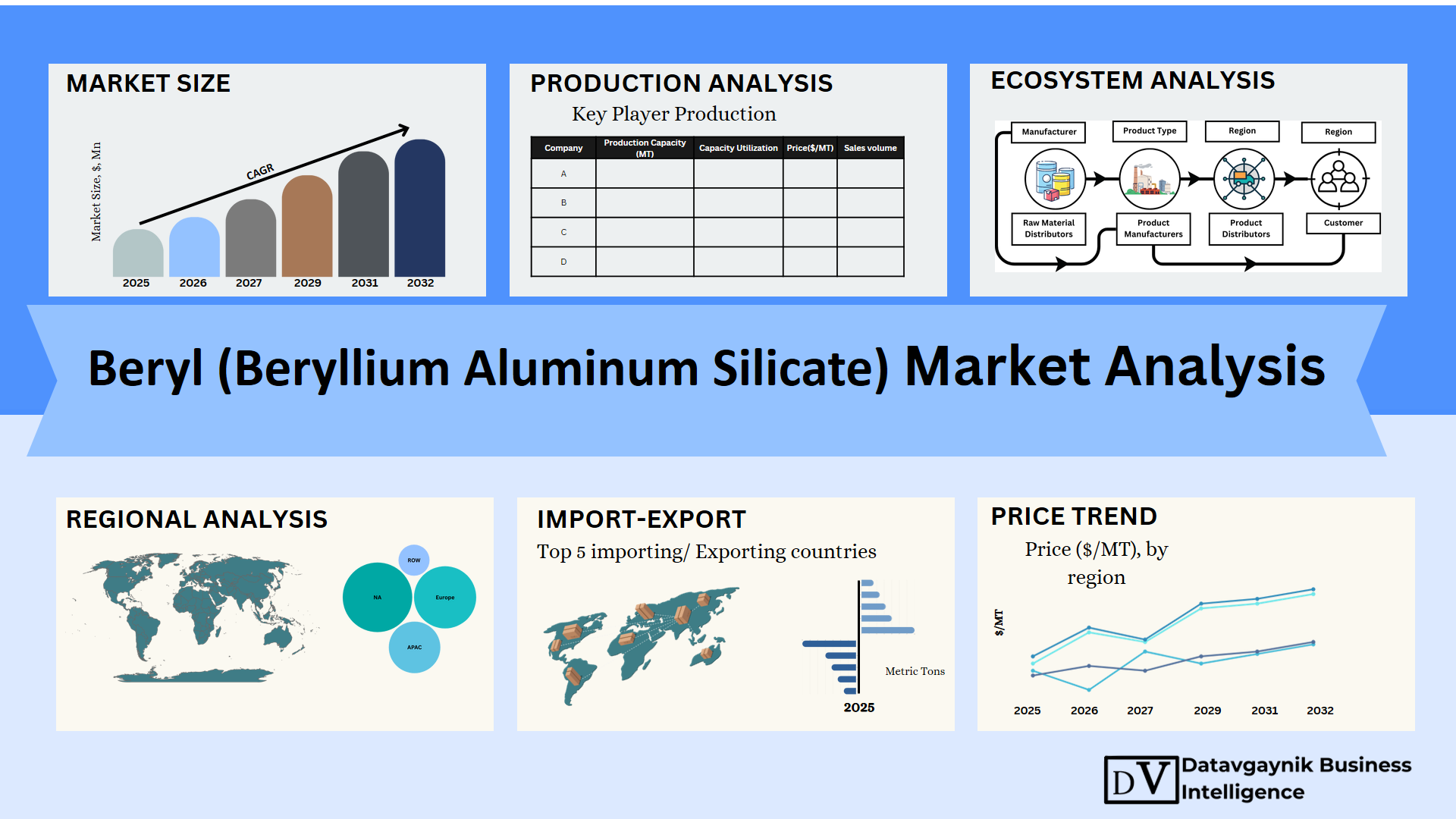
The Beryl (Beryllium Aluminum Silicate) Market is gaining significant momentum, fueled primarily by its strategic importance in the aerospace and defense sectors. Beryl, as the primary source of beryllium, plays a critical role in manufacturing lightweight, high-strength materials. Beryllium’s high stiffness, excellent dimensional stability, and resistance to heat and corrosion make it indispensable in aerospace components such as satellite structures, missile guidance systems, and high-performance aircraft parts.
For instance, the U.S. Department of Defense has listed beryllium as a critical material, citing its essential use in national security technologies. With global defense spending reaching $2.2 trillion in 2023 (according to SIPRI), and countries like the U.S., China, and India prioritizing space exploration and defense modernization, the demand for beryl-derived beryllium is escalating. NASA’s Artemis lunar missions and ongoing commercial satellite launches by SpaceX are further amplifying the growth of the Beryl (Beryllium Aluminum Silicate) Market.
Electronics Sector Growth Accelerates Beryl (Beryllium Aluminum Silicate) Market Expansion
The Beryl (Beryllium Aluminum Silicate) Market is witnessing robust growth from the electronics industry, where beryllium is used extensively due to its superior thermal conductivity and electrical insulation. Beryllium’s unique properties enable its use in semiconductors, printed circuit boards, microelectronic connectors, and heat sinks in high-performance devices.
For example, global semiconductor sales reached $574 billion in 2023 (as reported by the Semiconductor Industry Association), reflecting the surging demand for microchips across industries. This surge is supported by the proliferation of 5G infrastructure, IoT-enabled devices, and advanced automotive electronics, especially in electric vehicles (EVs). Beryllium-copper alloys, derived from beryl, are preferred in these components due to their conductivity and mechanical resilience, solidifying the Beryl (Beryllium Aluminum Silicate) Market as a backbone of next-gen electronics.
Datavagyanik also covers related markets such as the Beryllium Oxide Market, the Beryllium Sulfate Market, and the Beryllium Carbonate Market. These compounds are commonly used in oxidation systems and industrial chemical processing, supporting shifts in formulation standards and regulatory compliance.
Renewable Energy Boom Strengthens Beryl (Beryllium Aluminum Silicate) Market Demand
The global transition toward renewable energy sources is significantly influencing the Beryl (Beryllium Aluminum Silicate) Market. Beryllium is a vital component in wind turbines, solar panels, and advanced nuclear reactors due to its low density, high stiffness, and thermal stability.
For example, wind turbine generators require lightweight and heat-resistant alloys for their operational efficiency. Beryllium-based materials meet these demands. According to the International Energy Agency (IEA), global renewable energy capacity is projected to increase by over 2,400 GW between 2022 and 2027. Similarly, in the nuclear sector, beryllium acts as a neutron moderator and reflector, making it essential for the development of Small Modular Reactors (SMRs) and Generation IV reactors. This push for cleaner and more efficient energy sources is reinforcing the strategic importance of the Beryl (Beryllium Aluminum Silicate) Market.
Jewelry Industry Innovation Enhances Beryl (Beryllium Aluminum Silicate) Market Value
Another significant driver of the Beryl (Beryllium Aluminum Silicate) Market is the global jewelry industry, where gem-quality beryl varieties such as emerald, aquamarine, and morganite are in high demand. These precious gemstones are prized for their vivid color, clarity, and symbolic value, especially in bridal and high-end fashion jewelry.
For instance, the global gemstone jewelry market surpassed $30 billion in 2023, and is projected to grow at a CAGR of 5.5% through 2030. Increasing disposable income in markets like China, India, and the U.S., coupled with a growing preference for colorful, ethically sourced stones, is bolstering demand. Emeralds remain a top choice for luxury and investment-grade jewelry, while aquamarine and morganite are increasingly used in contemporary designs. This demand is further elevating the Beryl (Beryllium Aluminum Silicate) Market Size globally.
Medical Technology Innovations Propel Beryl (Beryllium Aluminum Silicate) Market Growth
The Beryl (Beryllium Aluminum Silicate) Market is also advancing due to its critical applications in the healthcare sector. Beryllium’s radiation transparency and lightweight nature make it an ideal material for X-ray windows, mammography equipment, and precision surgical instruments.
For example, as per Datavagyanik, the global medical imaging market is expected to exceed $50 billion by 2026, driven by increasing diagnostic needs and the expansion of healthcare infrastructure in emerging markets. Beryllium’s role in improving imaging clarity and reducing equipment weight is vital in portable medical devices, which are increasingly used in remote and resource-constrained areas. The medical laser equipment market is also adopting beryllium-based components for enhanced precision, creating new avenues for the Beryl (Beryllium Aluminum Silicate) Market.
Electric Vehicle Surge Stimulates Beryl (Beryllium Aluminum Silicate) Market Demand
With the global pivot to electric mobility, the automotive industry is becoming a major consumer in the Beryl (Beryllium Aluminum Silicate) Market. Beryllium-copper alloys are widely used in EV battery connectors, charging systems, and onboard electronic control modules, thanks to their high durability and conductivity.
For instance, global electric vehicle sales hit 14 million units in 2023, accounting for nearly 18% of all car sales worldwide. Automakers are incorporating more lightweight and thermally stable materials to enhance battery performance and vehicle range. Beryllium’s ability to withstand extreme heat and mechanical stress makes it an ideal choice for high-voltage EV components, contributing directly to the expansion of the Beryl (Beryllium Aluminum Silicate) Market.
High-Tech Manufacturing Accelerates Beryl (Beryllium Aluminum Silicate) Market Size
The Beryl (Beryllium Aluminum Silicate) Market Size is also being amplified by its use in high-tech manufacturing. Industries such as additive manufacturing, robotics, aerospace tooling, and next-generation optics rely on beryllium-infused components for high precision and performance.
For example, beryllium is a key material in the James Webb Space Telescope’s mirror structure, which required materials that are both lightweight and dimensionally stable under extreme conditions. The market for precision optics alone is forecasted to surpass $21 billion by 2028. As high-performance technologies continue to evolve, the demand for beryl-derived materials is surging, solidifying the Beryl (Beryllium Aluminum Silicate) Market’s foothold in critical manufacturing segments.
Infrastructure Projects in Emerging Economies Drive Beryl (Beryllium Aluminum Silicate) Market
Emerging markets are becoming key contributors to the growth of the Beryl (Beryllium Aluminum Silicate) Market due to aggressive infrastructure development and industrialization. Countries such as India, Brazil, Vietnam, and South Africa are investing heavily in transportation, urban housing, energy grids, and smart city projects, creating demand for advanced construction and electronic materials.
For instance, India’s $1.4 trillion National Infrastructure Pipeline and Brazil’s expanding solar infrastructure are examples where beryllium-containing components are deployed in high-temperature construction materials and renewable energy systems. As these economies continue to modernize, the need for lightweight, high-performance materials derived from beryl will continue to rise.
Sustainability and Lightweight Engineering Propel Beryl (Beryllium Aluminum Silicate) Market
A growing emphasis on sustainability and energy efficiency is further propelling the Beryl (Beryllium Aluminum Silicate) Market. Beryllium’s lightweight nature enables the production of energy-efficient components in sectors ranging from aerospace to consumer electronics.
For instance, in aviation, every kilogram of weight reduction translates into significant fuel savings—up to 0.03% fuel savings per kg per 1,000 km. The European Union and U.S. have set ambitious carbon-neutral targets by 2050, prompting industries to seek materials that reduce emissions without compromising on performance. Beryllium’s properties align with these requirements, positioning the Beryl (Beryllium Aluminum Silicate) Market as a critical enabler of sustainable innovation.
“Track Country-wise Beryl (Beryllium Aluminum Silicate) Production and Demand through our Beryl (Beryllium Aluminum Silicate) Production Database”
- Beryl (Beryllium Aluminum Silicate) production database for 23+ countries worldwide
- Beryl (Beryllium Aluminum Silicate) sales volume for 28+ countries
- Country-wise Beryl (Beryllium Aluminum Silicate) production capacity, production plant mapping, production capacity utilization for 23+ manufacturers
- Beryl (Beryllium Aluminum Silicate) production plants and production plant capacity analysis by top manufacturers
“Track real-time Beryl (Beryllium Aluminum Silicate) Prices, Beryl (Beryllium Aluminum Silicate) price charts for 23+ countries, Beryl (Beryllium Aluminum Silicate) weekly price tracker and Beryl (Beryllium Aluminum Silicate) monthly price tracker”
- Track real-time Beryl (Beryllium Aluminum Silicate) prices and Beryl (Beryllium Aluminum Silicate) price trend in 23+ countries though our excel-based Beryl (Beryllium Aluminum Silicate) price charts
- Real-time Beryl (Beryllium Aluminum Silicate) price tracker dashboard with 23+ countries
- Complete transparency on Beryl (Beryllium Aluminum Silicate) price trend through our Beryl (Beryllium Aluminum Silicate) monthly price tracker, Beryl (Beryllium Aluminum Silicate) weekly price tracker
North America Leads Innovation in Beryl (Beryllium Aluminum Silicate) Market
In North America, the Beryl (Beryllium Aluminum Silicate) Market is primarily driven by the United States, where beryllium is classified as a strategic and critical material. The U.S. aerospace and defense industries remain the largest consumers of beryl-derived materials. For example, defense allocations in the U.S. exceeded $880 billion in 2023, a sizable portion of which was channeled into technologies that use beryllium—such as missile guidance systems, satellite components, and advanced avionics.
The U.S. also has significant reserves of beryl and has made considerable investments in domestic mining and refining facilities to reduce reliance on imports. Companies like Materion Corporation dominate the beryllium supply chain, from raw material processing to high-value alloy manufacturing. Additionally, growing demand from sectors such as electric vehicles and medical imaging has led to steady expansion of the Beryl (Beryllium Aluminum Silicate) Market in North America.
Europe Embraces Technological Innovation in Beryl (Beryllium Aluminum Silicate) Market
Europe represents another high-potential region in the global Beryl (Beryllium Aluminum Silicate) Market, driven by its advanced manufacturing base, green energy transition, and thriving luxury goods sector. Germany, for instance, has seen increased demand for beryl-derived beryllium in electric mobility and aerospace engineering. With more than 1.1 million EVs sold in Germany in 2023, the use of beryllium in connectors, battery systems, and lightweight components is expanding rapidly.
France, home to aerospace giants like Airbus, relies heavily on beryllium for structural parts in aircraft and satellite systems. Additionally, France’s investment in nuclear energy, which supplies around 70% of its electricity, supports the use of beryllium in reactor components. Similarly, Switzerland’s high-end watchmaking industry utilizes beryllium alloys for precision parts, boosting the region’s Beryl (Beryllium Aluminum Silicate) Market significantly. The region’s sustained innovation in renewable energy and medical technology continues to underpin long-term market growth.
Asia Pacific Dominates Consumption in Beryl (Beryllium Aluminum Silicate) Market
The Asia Pacific region is currently the largest and fastest-growing consumer in the Beryl (Beryllium Aluminum Silicate) Market. China is at the forefront, importing and processing significant volumes of beryl to support its vast electronics, defense, and renewable energy industries. For example, China produced over 7 million EVs in 2023 alone, many of which depend on beryllium-copper connectors and high-strength components. The government’s push toward self-reliant aerospace and defense capabilities has also expanded the use of beryllium across military and commercial aviation programs.
India, on the other hand, is leveraging beryl for both industrial and ornamental uses. As part of its Smart Cities Mission and energy security goals, India is investing in solar infrastructure and electric transportation—two applications where beryllium is essential. Moreover, India’s world-renowned gemstone industry continues to fuel demand for emeralds, aquamarines, and morganites, bolstering the Beryl (Beryllium Aluminum Silicate) Market across both industrial and consumer segments.
Japan and South Korea contribute heavily through their global leadership in semiconductor production and precision instruments. Beryllium, derived from beryl, is used extensively in wafer production, optical filters, and heat-resistant microcomponents. These high-tech applications ensure stable and increasing demand, consolidating Asia Pacific’s role as a critical hub in the Beryl (Beryllium Aluminum Silicate) Market.
Middle East Expands Industrial Demand in Beryl (Beryllium Aluminum Silicate) Market
The Middle East Beryl (Beryllium Aluminum Silicate) Market is evolving, driven by a blend of industrial diversification, renewable energy ambitions, and luxury consumption. For example, Saudi Arabia’s Vision 2030 program includes heavy investments in aerospace, smart cities, and renewable energy—all areas that heavily rely on high-performance materials like beryllium. NEOM, a $500 billion smart city project, is one of the primary catalysts behind the regional demand for durable, lightweight materials.
Similarly, the UAE has made significant strides in developing its space program, including satellite launches, which employ beryllium components for thermal stability and precision. The region’s luxury jewelry market, especially in Dubai, also contributes to the Beryl (Beryllium Aluminum Silicate) Market through rising demand for high-quality gemstones like emeralds and aquamarines.
Latin America Supports Supply Chain in Beryl (Beryllium Aluminum Silicate) Market
Latin America, particularly Brazil, plays a strategic role as a global supplier in the Beryl (Beryllium Aluminum Silicate) Market. Brazil holds some of the largest known reserves of gem-quality beryl, including world-renowned emerald deposits in Minas Gerais. These mines supply both raw material for beryllium extraction and high-grade gemstones to international markets.
Brazil also exports industrial-grade beryl to processing hubs in the U.S., China, and Europe. With rising infrastructure and renewable energy investments across Latin America, regional consumption is beginning to grow. For example, Brazil’s solar energy installations grew by over 30% year-on-year in 2023, encouraging increased use of lightweight, corrosion-resistant beryllium materials in energy systems.
Beryl (Beryllium Aluminum Silicate) Market Segmentation by Application
The Beryl (Beryllium Aluminum Silicate) Market is segmented across critical application areas. Aerospace and defense lead with high demand for beryllium alloys used in satellite frames, missile parts, and military-grade electronics. The expansion of commercial and private space missions continues to support this segment.
In the electronics segment, beryllium’s use in semiconductors, connectors, and thermal management components is growing rapidly. With over 15 billion connected devices globally as of 2023, the demand for reliable and heat-resistant electronic components has never been higher.
In the renewable energy sector, beryllium is increasingly found in solar panel reflectors, wind turbine gearboxes, and nuclear reactor linings. These applications are essential in meeting global carbon reduction targets, making the Beryl (Beryllium Aluminum Silicate) Market crucial to sustainability goals.
Gemstones remain a lucrative niche, with rising global demand for unique, ethically sourced stones. Aquamarine and morganite have emerged as affordable yet desirable alternatives to traditional diamonds, especially in North America and Europe.
Beryl (Beryllium Aluminum Silicate) Market Segmentation by Processing Type
Raw beryl continues to be a primary input for industrial applications and gemstone markets. However, refined beryllium extracted from beryl is the real value driver, especially in high-tech sectors. Treated gemstone beryl, such as irradiated aquamarines and heat-treated emeralds, is gaining popularity for its enhanced visual appeal and durability.
These processing techniques are expanding the scope of the Beryl (Beryllium Aluminum Silicate) Market by enabling both mass-market and luxury applications from the same raw material base.
Beryl (Beryllium Aluminum Silicate) Price Dynamics Reflect Supply Chain Tightness
The Beryl (Beryllium Aluminum Silicate) Price has shown a consistent upward trend over the past five years. Limited availability of high-purity beryl sources, combined with increasing downstream demand, is creating price pressure. For example, the average Beryl (Beryllium Aluminum Silicate) Price for industrial-grade material rose by nearly 12% in 2023, while high-quality emerald-grade beryl saw price increases exceeding 20% in major gemstone exchanges.
Beryl (Beryllium Aluminum Silicate) Price Trend is also influenced by geopolitical events and trade policies. For instance, export restrictions from African countries and rising transportation costs have affected global pricing. Additionally, environmental regulations around beryllium processing in China have tightened supply, pushing prices higher.
Datavagyanik highlights that the Beryl (Beryllium Aluminum Silicate) Price Trend is expected to remain bullish through 2030, with annual average growth rates in pricing between 8–10%, depending on grade and processing level. The price volatility is especially pronounced in the gemstone segment, where scarcity, clarity, and color drive value, while in industrial markets, purity and composition determine cost dynamics.
Beryl (Beryllium Aluminum Silicate) Market Outlook Shaped by Strategic Investments
Across regions and sectors, the Beryl (Beryllium Aluminum Silicate) Market is strategically positioned for long-term growth. National governments are increasingly classifying beryllium as a critical mineral, prompting policy-backed investments in domestic mining, processing, and R&D. Companies that focus on vertical integration—from mining to advanced applications—are likely to gain competitive advantages in a market shaped by technological advancement and supply chain complexity.
At the same time, sustainable sourcing and ethical mining practices are becoming important differentiators, especially in the gemstone segment. Traceability, eco-friendly extraction, and fair trade certifications are influencing consumer choices, creating additional layers of value in the Beryl (Beryllium Aluminum Silicate) Market.
“Beryl (Beryllium Aluminum Silicate) Manufacturing Database, Beryl (Beryllium Aluminum Silicate) Manufacturing Capacity”
- Beryl (Beryllium Aluminum Silicate) top manufacturers market share for 23+ manufacturers
- Top 6 manufacturers and top 13 manufacturers of Beryl (Beryllium Aluminum Silicate) in North America, Europe, Asia Pacific
- Beryl (Beryllium Aluminum Silicate) production plant capacity by manufacturers and Beryl (Beryllium Aluminum Silicate) production data for 23+ market players
- Beryl (Beryllium Aluminum Silicate) production dashboard, Beryl (Beryllium Aluminum Silicate) production data in excel format
“Beryl (Beryllium Aluminum Silicate) price charts, Beryl (Beryllium Aluminum Silicate) weekly price tracker and Beryl (Beryllium Aluminum Silicate) monthly price tracker”
- Factors impacting real-time Beryl (Beryllium Aluminum Silicate) prices in 18+ countries worldwide
- Beryl (Beryllium Aluminum Silicate) monthly price tracker, Beryl (Beryllium Aluminum Silicate) weekly price tracker
- Real-time Beryl (Beryllium Aluminum Silicate) price trend, Beryl (Beryllium Aluminum Silicate) price charts, news and updates
- Tracking Beryl (Beryllium Aluminum Silicate) price fluctuations
Top Manufacturers Dominating the Beryl (Beryllium Aluminum Silicate) Market
The Beryl (Beryllium Aluminum Silicate) Market is shaped by a combination of mining giants, specialized beryllium processors, and high-performance material manufacturers. These players hold a substantial share of global supply chains, influencing pricing, availability, and innovation in the industry. With rising demand across aerospace, electronics, defense, and jewelry segments, these manufacturers are intensifying their focus on expanding production capacity, refining technologies, and securing high-grade beryl sources.
Materion Corporation – Undisputed Leader in Beryl (Beryllium Aluminum Silicate) Market
Materion Corporation stands as the most prominent and vertically integrated player in the global Beryl (Beryllium Aluminum Silicate) Market. Headquartered in the United States, Materion operates from beryl extraction and beryllium refining to manufacturing high-performance alloys and components. The company’s key product lines include Beryllium Pebbles, Beryllium-Copper Alloys, Optical Coatings, and AlBeMet®, a beryllium-aluminum composite extensively used in aerospace structures and satellite systems.
Materion’s dominance is reflected in its control over nearly 35–40% of the global refined beryllium market, giving it unmatched leverage in pricing and contract supply. Its defense-grade materials are widely adopted in military avionics, missile targeting systems, and space telescopes. Additionally, the company is a major supplier to OEMs and Tier-1 suppliers in the EV and electronics industries, strengthening its hold in the Beryl (Beryllium Aluminum Silicate) Market.
Ulba Metallurgical Plant – Key Asian Producer of Beryl-Derived Beryllium
Based in Kazakhstan, Ulba Metallurgical Plant (UMP) is another significant player in the Beryl (Beryllium Aluminum Silicate) Market. The company processes industrial-grade beryl to produce refined beryllium and associated alloys. UMP’s extensive refining capacity supports regional demand in Central Asia, Russia, and parts of Europe.
UMP produces technical-grade beryllium for use in aerospace, nuclear energy, and metallurgical applications. The plant’s contribution is estimated at 12–15% of the global beryllium refining capacity, making it a critical component of the global supply chain, especially for customers outside North America.
China Nonferrous Metal Industry’s Foreign Engineering and Construction Co., Ltd. (NFC)
China’s role in the Beryl (Beryllium Aluminum Silicate) Market is expanding rapidly through state-supported companies like NFC. While China does not have the same volume of domestic beryl reserves as Brazil or the U.S., it imports and refines large quantities of beryl to meet internal demand for electronics, semiconductors, and military-grade materials.
NFC’s facilities are equipped to process imported beryl into beryllium oxide ceramics, beryllium-copper connectors, and coated substrates for electronics. The company also collaborates with defense suppliers, making it a crucial cog in the expanding Chinese aerospace and EV sectors. China’s processing capacity contributes to more than 20% of global beryl utilization, securing its growing share in the global Beryl (Beryllium Aluminum Silicate) Market.
Berilo Industria e Comercio Ltda – Brazil’s Emerald and Beryl Powerhouse
Brazil’s Berilo Industria e Comercio Ltda is a leading producer of both industrial-grade beryl and gem-quality beryl varieties like emeralds, aquamarines, and morganites. Located in the Minas Gerais region, the company operates several beryl-rich mines and supplies raw material to both domestic processors and international traders.
While Berilo focuses more on upstream activities, its role in supplying consistent volumes of raw beryl gives it indirect influence over refined output. It controls a significant portion of Brazil’s beryl production, which accounts for approximately 8–10% of the global Beryl (Beryllium Aluminum Silicate) Market by volume.
Hunan Nonferrous Metals Holding Group Co. – Expanding China’s Processing Reach
This state-owned enterprise has diversified operations across rare earths and specialty metals, including beryllium. The company is ramping up its investments in processing infrastructure for beryllium oxide and alloy production, aiming to strengthen China’s domestic capacity and reduce dependency on foreign suppliers.
With the surge in Chinese EV production and the need for high-conductivity materials, Hunan Nonferrous Metals is gaining traction in the regional Beryl (Beryllium Aluminum Silicate) Market. Its market share is growing steadily, particularly in downstream electronics manufacturing and renewable energy components.
Other Emerging and Niche Players in the Beryl (Beryllium Aluminum Silicate) Market
Several smaller players are carving out niches in gemstone production, high-purity beryl mining, and localized alloy manufacturing:
- Gemfields Group Ltd. – A notable player in the gemstone segment, focusing on emerald and aquamarine mining in Zambia and Mozambique.
- American Beryllia Inc. – Specializes in beryllium oxide ceramics for medical and electronic applications in the U.S. market.
- Kazatomprom – Though primarily a uranium producer, this Kazakh company is involved in beryl extraction as part of broader rare metal exploration.
Beryl (Beryllium Aluminum Silicate) Market Share by Manufacturer
As of the latest estimates by Datavagyanik, market share distribution among top manufacturers in the Beryl (Beryllium Aluminum Silicate) Market is approximately:
- Materion Corporation – 35% to 40% (including alloys, pebbles, oxide, composite)
- Ulba Metallurgical Plant – 12% to 15%
- Chinese Processors (NFC, Hunan Group, etc.) – 20% to 22%
- Brazilian Producers (Berilo, others) – 8% to 10%
- Other Regional and Niche Manufacturers – 10% to 15%
These shares reflect a highly consolidated supply chain where a few vertically integrated players dominate high-purity refining and specialty applications, while smaller producers operate in gemstone and upstream mining sectors.
Recent Developments in the Beryl (Beryllium Aluminum Silicate) Market
- January 2024 – Materion Expansion: Materion Corporation announced the commissioning of a new beryllium alloy production line in Ohio, aimed at doubling capacity to meet growing aerospace and EV demand by 2026.
- March 2024 – China’s Strategic Reserve Buildup: China began stockpiling strategic beryllium alloys as part of its critical mineral reserve strategy, boosting spot Beryl (Beryllium Aluminum Silicate) Prices across Asia by 7% in just two weeks.
- June 2023 – Brazil Mining Reforms: Brazil’s mining authority introduced reforms to accelerate beryl exploration licensing, resulting in 12 new mining permits issued for beryl-rich areas in Minas Gerais and Bahia.
- October 2023 – Ulba Plant Modernization: Ulba Metallurgical Plant completed a $90 million upgrade to its beryllium refining unit, increasing output capacity by 40% and improving oxide purity for nuclear-grade applications.
- December 2023 – Hunan’s EV Contracts: Hunan Nonferrous Metals signed multi-year supply agreements with two major Chinese EV battery manufacturers, securing over 1,000 metric tons of beryllium-copper alloy annually.
These developments underscore the strategic and high-value nature of the Beryl (Beryllium Aluminum Silicate) Market. As demand continues to rise across defense, energy, and electronics sectors, the role of manufacturers in securing supply and advancing processing capabilities will become increasingly critical to global industrial growth.
“Beryl (Beryllium Aluminum Silicate) Production Data and Beryl (Beryllium Aluminum Silicate) Production Trend, Beryl (Beryllium Aluminum Silicate) Production Database and forecast”
- Beryl (Beryllium Aluminum Silicate) production database for historical years, 10 years historical data
- Beryl (Beryllium Aluminum Silicate) production data and forecast for next 7 years
- Beryl (Beryllium Aluminum Silicate) sales volume by manufacturers
“Track Real-time Beryl (Beryllium Aluminum Silicate) Prices for purchase and sales contracts, Beryl (Beryllium Aluminum Silicate) price charts, Beryl (Beryllium Aluminum Silicate) weekly price tracker and Beryl (Beryllium Aluminum Silicate) monthly price tracker”
- Gain control on your purchase and sales contracts through our real-time Beryl (Beryllium Aluminum Silicate) price tracker and Beryl (Beryllium Aluminum Silicate) price trend analysis
- Beryl (Beryllium Aluminum Silicate) weekly price tracker and forecast for next four weeks
- Beryl (Beryllium Aluminum Silicate) monthly price tracker and forecast for next two months
Market Scenario, Demand vs Supply, Average Product Price, Import vs Export, till 2032
- Global Beryl (Beryllium Aluminum Silicate) Market revenue and demand by region
- Global Beryl (Beryllium Aluminum Silicate) Market production and sales volume
- United States Beryl (Beryllium Aluminum Silicate) Market revenue size and demand by country
- Europe Beryl (Beryllium Aluminum Silicate) Market revenue size and demand by country
- Asia Pacific Beryl (Beryllium Aluminum Silicate) Market revenue size and demand by country
- Middle East & Africa Beryl (Beryllium Aluminum Silicate) Market revenue size and demand by country
- Latin America Beryl (Beryllium Aluminum Silicate) Market revenue size and demand by
- Import-export scenario – United States, Europe, APAC, Latin America, Middle East & Africa
- Average product price – United States, Europe, APAC, Latin America, Middle East & Africa
- Market player analysis, competitive scenario, market share analysis
- Business opportunity analysis
Key questions answered in the Global Beryl (Beryllium Aluminum Silicate) Market Analysis Report:
- What is the market size for Beryl (Beryllium Aluminum Silicate) in United States, Europe, APAC, Middle East & Africa, Latin America?
- What is the yearly sales volume of Beryl (Beryllium Aluminum Silicate) and how is the demand rising?
- Who are the top market players by market share, in each product segment?
- Which is the fastest growing business/ product segment?
- What should be the business strategies and Go to Market strategies?
The report covers Beryl (Beryllium Aluminum Silicate) Market revenue, Production, Sales volume, by regions, (further split into countries):
- Asia Pacific (China, Japan, South Korea, India, Indonesia, Vietnam, Rest of APAC)
- Europe (UK, Germany, France, Italy, Spain, Benelux, Poland, Rest of Europe)
- North America (United States, Canada, Mexico)
- Latin America (Brazil, Argentina, Rest of Latin America)
- Middle East & Africa
Table of Contents:
1. Introduction to the Beryl (Beryllium Aluminum Silicate) Market
1.1 Overview of Beryl (Beryllium Aluminum Silicate)
1.2 Chemical Composition and Physical Properties
1.3 Industrial and Commercial Importance
2. Beryl (Beryllium Aluminum Silicate) Market Trends and Growth Drivers
2.1 Factors Driving Global Demand
2.2 Emerging Applications in Industrial and High-Tech Sectors
2.3 Challenges in Beryl (Beryllium Aluminum Silicate) Extraction and Processing
2.4 Key Opportunities in the Beryl (Beryllium Aluminum Silicate) Industry
3. Beryl (Beryllium Aluminum Silicate) Production Analysis
3.1 Global Beryl (Beryllium Aluminum Silicate) Production Output and Trends
3.2 Technological Developments in Mining and Refining
3.3 Regional Beryl (Beryllium Aluminum Silicate) Production Hubs
3.4 Innovations in Processing Techniques
4. Regional Overview of the Beryl (Beryllium Aluminum Silicate) Market
4.1 North America: Market Size, Production, and Trade Flow
4.2 Europe: Industrial Demand and Import-Export Trends
4.3 Asia Pacific: Emerging Producers and Consumption Growth
4.4 Latin America: Beryl (Beryllium Aluminum Silicate) Extraction Potential
4.5 Middle East & Africa: Market Expansion and Investment Insights
5. Competitive Landscape in the Beryl (Beryllium Aluminum Silicate) Market
5.1 Leading Producers and Their Market Strategies
5.2 Competitive Positioning of Key Industry Players
5.3 Mergers, Acquisitions, and Strategic Partnerships
6. Global Supply Chain and Raw Material Analysis
6.1 Key Sources of Beryl (Beryllium Aluminum Silicate)
6.2 Supply Chain Challenges and Logistics
6.3 Market Trends in Beryl (Beryllium Aluminum Silicate) Distribution
7. Pricing Dynamics and Revenue Trends (2019-2024)
7.1 Historical Price Movements and Influencing Factors
7.2 Revenue Generation by Major Market Players
7.3 Profitability and Cost Structure in Beryl (Beryllium Aluminum Silicate) Production
8. Consumption Patterns and End-Use Applications
8.1 Industrial Applications of Beryl (Beryllium Aluminum Silicate)
8.2 Market Demand Across Key Sectors
8.3 Domestic Consumption vs. Imports by Region
9. Manufacturing Cost Structure and Market Economics
9.1 Raw Material Sourcing and Price Analysis
9.2 Beryl (Beryllium Aluminum Silicate) Processing Costs and Energy Usage
9.3 Sustainability and Environmental Considerations
10. Distribution Channels and Market Reach
10.1 Key Distributors and Wholesale Market Insights
10.2 Beryl (Beryllium Aluminum Silicate) Sales Networks and Partnerships
10.3 Export Trends and Global Market Penetration
11. Future Outlook and Market Forecast (2024-2032)
11.1 Predicted Growth Trajectories and Demand Forecasts
11.2 Emerging Technologies and Market Innovations
11.3 Investment Opportunities and Strategic Market Recommendations


