

Rising Demand from Food and Beverage Sector Fueling Monosodium Phosphate Market Growth
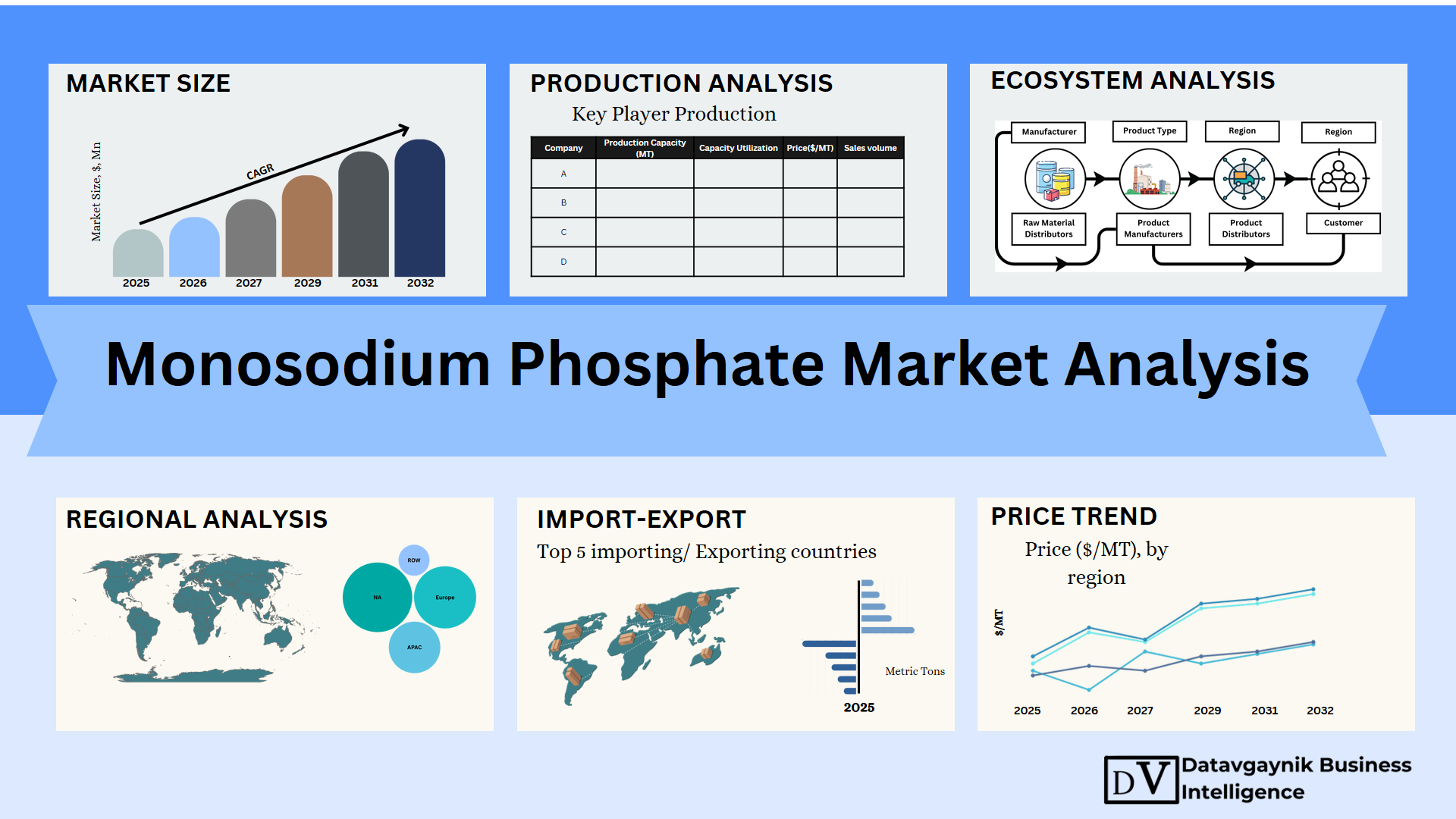
The Monosodium Phosphate Market is witnessing robust demand from the food and beverage industry due to its essential role as a pH stabilizer, emulsifier, and buffering agent. For instance, in processed foods such as ready-to-eat meals, bakery goods, and carbonated beverages, monosodium phosphate enhances shelf stability, texture, and product consistency. As per Datavagyanik, global revenue from convenience food is projected to grow at over 5.2% CAGR between 2024 and 2032, directly influencing the rising requirement for high-performance additives like monosodium phosphate. The compound’s ability to maintain product integrity under varying storage conditions makes it indispensable in high-volume production environments.
Monosodium Phosphate Market Driven by Expansion in Agricultural Applications
Agriculture is another significant end-use sector that is catalyzing the Monosodium Phosphate Market. The compound, owing to its high phosphorus content, is widely adopted in fertilizers and livestock feed formulations. In phosphate-based fertilizers, monosodium phosphate supports root development and improves crop yields. For example, in countries such as India and Brazil, where demand for food production is escalating due to population growth, the reliance on phosphate-based nutrient solutions has intensified. Datavagyanik highlights that the global fertilizer industry is expected to exceed USD 250 billion by 2030, with phosphorus-based variants accounting for nearly 30% of the total. This ongoing demand underpins the growth trajectory of the Monosodium Phosphate Market.
Datavagyanik also covers related markets such as the Sodium Phosphate Market. Their relevance lies in how they intersect with the core topic, influencing investment trends and shaping market opportunities.
Water Treatment Applications Expanding the Monosodium Phosphate Market
Water treatment facilities across industrial and municipal sectors are increasingly incorporating monosodium phosphate due to its effectiveness in preventing scale buildup and corrosion in water pipelines. This is especially critical for infrastructure in regions facing hard water issues. For instance, in the United States alone, investments in water infrastructure modernization are projected to surpass USD 1 trillion over the next two decades, as noted by Datavagyanik. Monosodium phosphate acts as a sequestering agent, enhancing water quality and protecting pipelines and equipment from mineral deposition. These applications are significantly contributing to the Monosodium Phosphate Market’s expansion, particularly in developed nations with aging infrastructure.
Healthcare Industry Contributing to Monosodium Phosphate Market Expansion
The pharmaceutical and healthcare sectors are increasingly utilizing monosodium phosphate in both medicinal formulations and oral hygiene products. For example, it is a core ingredient in saline laxatives and pH-regulating oral care products such as toothpaste and mouthwashes. According to Datavagyanik, global spending in the oral care segment alone is expected to grow at over 4.7% CAGR through 2030, indicating broader opportunities for compounds like monosodium phosphate. Additionally, its high biocompatibility and buffering capacity make it suitable for sensitive formulations. The rising global focus on personal hygiene and preventive healthcare is directly fueling growth in this segment of the Monosodium Phosphate Market.
Monosodium Phosphate Market Growth Fueled by Rising Use in Cleaning and Detergent Products
A notable driver for the Monosodium Phosphate Market is its increasing integration in cleaning agents, particularly industrial and household-grade detergents. The compound’s efficacy in water softening, stain removal, and cleaning enhancement has led to its wide adoption in automatic dishwashing solutions and laundry detergents. For example, in the Asia-Pacific region, the household cleaning products segment is growing at over 6% annually, driven by urbanization and improved living standards. These trends are compelling detergent manufacturers to include high-performance phosphate compounds, such as monosodium phosphate, to ensure optimal cleaning even in hard water conditions.
Chemical Industry Driving Innovation within the Monosodium Phosphate Market
The Monosodium Phosphate Market is experiencing steady growth due to its utilization in various chemical manufacturing processes, including dyeing, ceramics, and metal surface treatment. Its properties as a pH regulator and buffering agent are critical in achieving consistent product quality across these industries. For instance, in metal finishing applications, monosodium phosphate is used to inhibit corrosion and ensure uniform coating adhesion. According to Datavagyanik, demand for industrial surface treatment chemicals is projected to grow at 4.9% CAGR through 2032, aligning with the increasing application of monosodium phosphate in specialty chemical formulations.
Technological Advancements in Emerging Markets Strengthening the Monosodium Phosphate Market
Emerging economies such as China, India, and Indonesia are playing a significant role in reshaping the global Monosodium Phosphate Market. For example, China has invested heavily in expanding its food processing and fertilizer manufacturing capacities, with over USD 300 billion in food production output in 2023 alone. Simultaneously, India’s commitment to sustainable farming under government schemes like PM-KUSUM is encouraging the use of efficient and bioavailable phosphorus sources such as monosodium phosphate. Datavagyanik forecasts that Asia-Pacific will maintain its position as the leading regional contributor to the Monosodium Phosphate Market through 2032, driven by industrialization, food security goals, and water infrastructure improvements.
Sustainability Trends Reinforcing the Role of Monosodium Phosphate in Industrial Operations
Sustainability regulations are increasingly influencing chemical choices across industries, and monosodium phosphate is emerging as a favorable option due to its relatively low environmental footprint and high efficiency. For example, in the European Union, industries are shifting toward biodegradable and non-toxic chemical agents for water treatment and agriculture, aligning with REACH and CLP regulatory frameworks. Monosodium phosphate fits well within these constraints, driving its adoption as a sustainable alternative to other chemical additives. The Monosodium Phosphate Market is expected to gain long-term traction as global industries intensify their commitment to environmental responsibility.
Monosodium Phosphate Market Size Benefiting from Urbanization and Food Infrastructure Growth
Urbanization has led to a structural transformation in food consumption and infrastructure. As urban centers expand, the demand for packaged and processed food increases, boosting the consumption of food additives like monosodium phosphate. Datavagyanik estimates that over 68% of the world’s population will live in urban areas by 2050, leading to exponential growth in food production and distribution systems. The Monosodium Phosphate Market Size is therefore expected to expand in tandem with the infrastructure required to support these trends, especially in Asia-Pacific and Latin American countries, where urbanization rates are among the highest globally.
Investment in Research and Specialty Applications Enhancing Monosodium Phosphate Market Potential
Ongoing research is unlocking new applications for monosodium phosphate, especially in specialized sectors such as pharmaceuticals, precision agriculture, and biotechnology. For example, in advanced crop nutrition solutions, monosodium phosphate is being incorporated into micronutrient delivery systems to improve plant uptake efficiency. Similarly, pharmaceutical researchers are exploring its use in buffered intravenous solutions and as excipients in controlled-release drug formulations. With global R&D investment expected to exceed USD 2.4 trillion by 2032, according to Datavagyanik, the Monosodium Phosphate Market is poised to benefit from breakthrough innovations and tailored application development.
Conclusion: Diversified Applications Ensuring Resilient Growth in the Monosodium Phosphate Market
The Monosodium Phosphate Market is evolving rapidly due to its multi-sectoral relevance and alignment with emerging global trends. From enhancing food stability to improving agricultural productivity, supporting healthcare innovations, and reinforcing water infrastructure, monosodium phosphate continues to demonstrate versatility and critical value. With consistent growth across end-use sectors and favorable regulatory and economic tailwinds, the Monosodium Phosphate Market Size is projected to grow steadily through 2032. As global industries adapt to sustainability mandates and increasing consumer expectations, the compound’s strategic importance is expected to grow further.
“Track Country-wise Monosodium Phosphate Production and Demand through our Monosodium Phosphate Production Database”
- Monosodium Phosphate production database for 24+ countries worldwide
- Monosodium Phosphate sales volume for 29+ countries
- Country-wise Monosodium Phosphate production capacity, production plant mapping, production capacity utilization for 24+ manufacturers
- Monosodium Phosphate production plants and production plant capacity analysis by top manufacturers
“Track real-time Monosodium Phosphate Prices, Monosodium Phosphate price charts for 24+ countries, Monosodium Phosphate weekly price tracker and Monosodium Phosphate monthly price tracker”
- Track real-time Monosodium Phosphate prices and Monosodium Phosphate price trend in 24+ countries though our excel-based Monosodium Phosphate price charts
- Real-time Monosodium Phosphate price tracker dashboard with 24+ countries
- Complete transparency on Monosodium Phosphate price trend through our Monosodium Phosphate monthly price tracker, Monosodium Phosphate weekly price tracker
Asia Pacific Leading Global Demand in the Monosodium Phosphate Market
The Asia Pacific region remains the dominant force in the global Monosodium Phosphate Market, driven by massive industrialization, population growth, and rapid expansion of food and agricultural sectors. For example, China accounts for more than 35% of global monosodium phosphate consumption, with significant demand coming from its food processing and fertilizer industries. With over 1.4 billion people and rising per capita food consumption, China’s focus on food preservation and shelf life enhancement has directly increased the demand for additives like monosodium phosphate.
India is also a major growth driver, where agricultural applications account for more than 40% of the country’s total monosodium phosphate usage. With government initiatives such as the PM-Kisan scheme and a growing emphasis on soil fertility, phosphate-based fertilizers are experiencing increased adoption. Datavagyanik highlights that India’s agricultural GDP is expected to grow by 3.7% annually through 2030, reinforcing the strong upward trajectory of the Monosodium Phosphate Market in the region.
North America Remains a Strategic Production and Consumption Hub for the Monosodium Phosphate Market
The North American Monosodium Phosphate Market is characterized by high-quality domestic production and stable demand across food processing, pharmaceuticals, and water treatment sectors. The United States leads in both production and consumption, with a significant share of monosodium phosphate being utilized in oral care products and packaged food. For instance, U.S. households spend over USD 180 billion annually on processed food and beverages, and this is projected to increase by 4.5% annually through 2032, according to Datavagyanik.
The region’s strict regulatory framework—such as FDA regulations for food-grade phosphate use—drives demand for high-purity monosodium phosphate. Additionally, Canada’s water treatment and municipal infrastructure upgrades, including USD 1.5 billion allocated for clean water initiatives in 2023, have led to increased demand for corrosion inhibitors like monosodium phosphate in public utilities.
Europe’s Monosodium Phosphate Market Fueled by Sustainability and Agro-Tech Innovations
Europe presents a mature yet innovation-driven landscape in the Monosodium Phosphate Market. Countries such as Germany, France, and the Netherlands are incorporating monosodium phosphate in eco-friendly formulations for agriculture, food processing, and water purification. Germany, for example, has seen a rise in sustainable agriculture practices, where phosphate-based inputs such as monosodium phosphate are key in boosting crop yield under EU-approved nutrient guidelines.
France’s processed dairy industry, valued at over USD 28 billion, relies on phosphate compounds for pH stabilization and texture enhancement. Meanwhile, the UK’s clean water initiatives and investments in infrastructure are increasing the use of monosodium phosphate in advanced filtration systems. Datavagyanik notes that Europe’s demand for environmentally compliant chemical compounds will grow at 3.8% CAGR through 2032, further propelling the regional Monosodium Phosphate Market.
Middle East Strengthening Monosodium Phosphate Market Through Water and Agriculture Projects
The Monosodium Phosphate Market in the Middle East is being strengthened by critical investments in agriculture and water management. Countries like Saudi Arabia and the UAE are implementing extensive desalination and wastewater treatment projects, where monosodium phosphate is used to inhibit scaling in piping systems. For example, Saudi Arabia’s Saline Water Conversion Corporation plans to expand its desalination capacity by 35% by 2028, directly influencing demand for scale inhibitors such as monosodium phosphate.
In agriculture, arid regions are increasingly dependent on phosphate-enriched fertilizers to enhance productivity. Israel, known for precision farming, has integrated monosodium phosphate in drip irrigation systems to deliver nutrients more efficiently. Datavagyanik projects Middle East regional demand for such phosphate products to grow at 5.1% CAGR due to climate-smart agriculture initiatives.
Latin America Experiencing a Resurgence in Monosodium Phosphate Market Demand
Latin America, particularly Brazil and Argentina, is witnessing renewed demand in the Monosodium Phosphate Market due to agricultural modernization and the rising food export economy. Brazil is the fourth-largest food producer globally, and over 45% of its agricultural nutrient demand is met through phosphate fertilizers. Monosodium phosphate is favored for its high solubility and compatibility with large-scale farming operations.
Moreover, Argentina’s focus on expanding its dairy and meat industries has increased the demand for livestock feed additives enriched with monosodium phosphate. Datavagyanik reports that Latin America’s fertilizer market is expected to grow at a pace of 6.2% annually through 2032, making it a key emerging geography for monosodium phosphate suppliers.
Global Production Clusters Driving Supply in the Monosodium Phosphate Market
On the production front, China, the United States, India, and Germany dominate global manufacturing of monosodium phosphate. China, with its cost-effective phosphate processing infrastructure, is the largest producer, accounting for over 40% of global supply. The country exports substantial volumes to Southeast Asia, Europe, and Africa, leveraging its low-cost and high-volume production models.
India, supported by favorable government policies, is strengthening its production capabilities with the launch of integrated chemical parks and increased investment in specialty phosphate compounds. In 2023, Indian production of monosodium phosphate crossed 120,000 metric tons, a 9.2% year-on-year increase. Datavagyanik expects Indian exports to Africa and the Middle East to rise by over 30% by 2030.
The U.S. and Germany, although producing in lower volumes than China, cater primarily to high-purity applications in pharmaceuticals and food. These markets are built around quality, safety, and consistency, serving premium segments within the global Monosodium Phosphate Market.
Segmentation of the Monosodium Phosphate Market by Application and Industry
The Monosodium Phosphate Market is segmented into several key applications: food and beverages, agriculture, water treatment, pharmaceuticals, and industrial processing. Among these, the food and beverage industry continues to dominate global consumption, accounting for nearly 38% of the total market demand in 2023. This trend is expected to continue, supported by growing packaged food consumption across urban regions.
Agriculture follows closely, with over 30% market share, particularly due to increasing emphasis on sustainable crop nutrition and livestock health. Water treatment accounts for roughly 18% of global demand, with significant potential in developing nations investing in clean water infrastructure.
From an industry perspective, food processing, chemical manufacturing, municipal utilities, and healthcare form the largest user base. Datavagyanik estimates that healthcare-related applications of monosodium phosphate will grow by 5.5% CAGR through 2032, driven by oral hygiene and therapeutic formulations.
Monosodium Phosphate Market Segmentation by Form and Purity
The Monosodium Phosphate Market is further categorized by form: powder and liquid. Powdered monosodium phosphate dominates with more than 65% share, primarily due to ease of transportation, stability, and compatibility with dry formulations in food, agriculture, and pharmaceuticals. Liquid monosodium phosphate, although niche, is gaining traction in continuous water treatment systems and automated industrial processing.
By purity, the market is split into food-grade and technical-grade variants. Food-grade monosodium phosphate is witnessing strong demand from North America and Europe, where regulatory standards are stringent. Technical-grade monosodium phosphate is largely consumed by the agriculture, water treatment, and detergent sectors due to its affordability and functional versatility.
Analyzing Monosodium Phosphate Price and Recent Monosodium Phosphate Price Trend
Monosodium Phosphate Price is influenced by raw material availability, energy costs, and supply chain stability. For example, disruptions in phosphate rock supply due to geopolitical tensions or mining restrictions can cause sharp price fluctuations. In 2023, Monosodium Phosphate Price averaged USD 1,150 per metric ton for food-grade quality, up from USD 980 in 2022—a rise of 17.3% driven by energy price hikes and logistical constraints.
The Monosodium Phosphate Price Trend in Asia Pacific showed moderate inflation due to increased domestic demand, while Europe witnessed sharper increases due to import dependency. In contrast, North America maintained relatively stable prices, owing to regional production and mature supply chains.
Datavagyanik indicates that the Monosodium Phosphate Price Trend for 2024–2026 is expected to remain slightly upward, with projected growth of 4.2% annually, reflecting increasing input costs and consistent demand across application sectors.
Outlook: Monosodium Phosphate Market Expansion Backed by Strategic Global Developments
The Monosodium Phosphate Market is positioned for sustained global growth, with regional markets responding to distinct economic, industrial, and regulatory forces. From Asia’s manufacturing strength and agricultural intensity to Europe’s sustainability-driven demand and North America’s premium product requirements, monosodium phosphate continues to evolve as a critical compound in modern industry.
Furthermore, Monosodium Phosphate Price dynamics are expected to remain balanced as long-term supply agreements and domestic production investments offset short-term volatility. As industries prioritize efficiency, food safety, and environmental compliance, the strategic importance of the Monosodium Phosphate Market is only set to intensify through 2032.
“Monosodium Phosphate Manufacturing Database, Monosodium Phosphate Manufacturing Capacity”
- Monosodium Phosphate top manufacturers market share for 24+ manufacturers
- Top 7 manufacturers and top 14 manufacturers of Monosodium Phosphate in North America, Europe, Asia Pacific
- Monosodium Phosphate production plant capacity by manufacturers and Monosodium Phosphate production data for 24+ market players
- Monosodium Phosphate production dashboard, Monosodium Phosphate production data in excel format
“Monosodium Phosphate price charts, Monosodium Phosphate weekly price tracker and Monosodium Phosphate monthly price tracker”
- Factors impacting real-time Monosodium Phosphate prices in 19+ countries worldwide
- Monosodium Phosphate monthly price tracker, Monosodium Phosphate weekly price tracker
- Real-time Monosodium Phosphate price trend, Monosodium Phosphate price charts, news and updates
- Tracking Monosodium Phosphate price fluctuations
Key Manufacturers Driving the Monosodium Phosphate Market
The Monosodium Phosphate Market is dominated by a select group of global manufacturers that possess the technical capabilities and infrastructure to produce high-purity and cost-effective phosphate compounds. These companies play a crucial role in shaping supply dynamics and are consistently expanding their market presence through innovation and capacity expansion.
Notable players in the global Monosodium Phosphate Market include Innophos Inc., Aditya Birla Chemicals, Hubei Xingfa Chemicals Group, Prayon S.A., and ICL Group. Each of these manufacturers has carved a distinct niche in the market, catering to diverse application sectors such as food processing, agriculture, water treatment, and industrial chemicals.
Monosodium Phosphate Market Share by Leading Manufacturers
The Monosodium Phosphate Market exhibits a moderately consolidated structure, where the top five manufacturers collectively account for over 60% of global supply. Among these, Innophos Inc. holds a significant market share, particularly in North America, due to its extensive focus on food-grade phosphate products. The company’s vertically integrated operations and well-established distribution channels enhance its dominance in the region.
Aditya Birla Chemicals commands a notable share in the Asia Pacific region. The company has built a robust phosphate product portfolio with large-scale production facilities capable of meeting high-volume industrial and agricultural demand. Its strategic focus on cost efficiency and regional logistics has enabled strong market penetration in emerging economies.
Hubei Xingfa Chemicals Group is one of the largest producers in China and maintains a competitive edge by supplying to both domestic and international markets. Its share in the Monosodium Phosphate Market is further supported by its ability to produce tailored formulations that meet stringent export quality standards.
Prayon S.A. operates across Europe with a product range that caters to high-purity requirements in food, beverage, and pharmaceutical sectors. The company holds a solid share in the European market and is known for consistent product innovation aligned with sustainability trends.
ICL Group, with production facilities in Israel and a global marketing reach, is heavily invested in agricultural applications of monosodium phosphate. Its market share is driven by the increasing adoption of precision agriculture and crop nutrition products, particularly in dry and nutrient-deficient regions.
Product Line Overview from Leading Manufacturers
Each of the top manufacturers offers differentiated product lines that support their market positioning:
- Innophos Inc. produces both food-grade and technical-grade monosodium phosphate under various brand formulations tailored for use in baking, meat processing, oral hygiene products, and water treatment systems.
- Aditya Birla Chemicals offers high-purity monosodium phosphate primarily for agriculture, cleaning chemicals, and pharmaceuticals. Its phosphate-based animal feed supplements are gaining popularity in South Asia and the Middle East.
- Hubei Xingfa Chemicals Group supplies granular and powdered monosodium phosphate in bulk packaging for large-scale fertilizer producers, livestock feed mills, and municipal water treatment projects.
- Prayon S.A. provides specialty-grade MSP with applications in processed foods, beverages, dairy products, and oral care. The company emphasizes consistency in pH regulation and compliance with European food safety regulations.
- ICL Group focuses its MSP product line on agricultural yield enhancement, offering compatibility with soil conditioners and nutrient delivery systems for dry climates.
Monosodium Phosphate Market Share Dynamics Across Regions
The global Monosodium Phosphate Market is segmented geographically, with Asia Pacific holding the highest share, followed by North America and Europe. China accounts for a major portion of global MSP production, with over 35% of market output originating from the country. The combination of low-cost production, local phosphate rock availability, and mature chemical infrastructure supports its dominance.
In North America, the United States represents the largest consumer base for high-grade MSP, particularly in food and pharmaceutical segments. The region’s market share is attributed to high product quality requirements, regulatory oversight, and a preference for consistent supply chains.
Europe holds a strong share in high-purity technical and food-grade applications, driven by stringent environmental regulations and demand for sustainable additives. Countries like Germany, France, and the UK are at the forefront of phosphate-based innovation.
The Middle East and Latin America are emerging markets with increasing share contributions. Demand in these regions is largely driven by agriculture, water treatment, and food preservation needs, creating new opportunities for manufacturers to establish regional supply chains.
Recent Developments and Strategic Moves in the Monosodium Phosphate Market
The Monosodium Phosphate Market has seen several notable developments in recent years, reflecting shifts in demand, capacity expansions, and industry alignment with sustainability goals.
In mid-2023, multiple manufacturers announced production capacity enhancements to meet rising demand in Asia Pacific. A leading Chinese producer expanded its phosphate chemical production facility by 20%, enabling it to serve more export markets with granular MSP formulations.
During the first quarter of 2024, a major North American manufacturer introduced a new food-grade MSP variant designed to improve dispersion and solubility in beverage applications. This move was aimed at capturing demand from the growing functional drinks segment in the United States and Canada.
In late 2024, a European manufacturer initiated R&D efforts to develop environmentally friendly packaging solutions for MSP products intended for the food industry. This innovation was part of a broader strategy to align with green manufacturing principles and reduce the environmental footprint of phosphate supply chains.
In early 2025, a leading global manufacturer entered a strategic partnership with a Middle Eastern distributor to enhance the availability of MSP for use in desalination and wastewater treatment plants. This collaboration is expected to improve response time and reduce import dependency for regional customers.
There has also been a growing emphasis on traceability and digital integration in the Monosodium Phosphate Market. Several companies are investing in smart logistics and digital inventory tracking systems to ensure seamless order fulfillment, improve transparency, and reduce delivery lead times.
Conclusion: Competitive Landscape and Future Outlook
The Monosodium Phosphate Market is driven by a mix of established global players and emerging regional manufacturers, each contributing to the sector’s resilience and innovation. Market share is concentrated among a few key players, but opportunities for growth remain robust due to expanding end-use applications, especially in food, agriculture, and water treatment.
With ongoing investments in production capacity, technological upgrades, and product differentiation, leading manufacturers are well-positioned to meet evolving market needs. As regulatory standards tighten and demand for sustainable chemicals rises, the competitive landscape of the Monosodium Phosphate Market is expected to evolve further, offering ample space for both incumbents and new entrants to scale and innovate.
“Monosodium Phosphate Production Data and Monosodium Phosphate Production Trend, Monosodium Phosphate Production Database and forecast”
- Monosodium Phosphate production database for historical years, 10 years historical data
- Monosodium Phosphate production data and forecast for next 7 years
- Monosodium Phosphate sales volume by manufacturers
“Track Real-time Monosodium Phosphate Prices for purchase and sales contracts, Monosodium Phosphate price charts, Monosodium Phosphate weekly price tracker and Monosodium Phosphate monthly price tracker”
- Gain control on your purchase and sales contracts through our real-time Monosodium Phosphate price tracker and Monosodium Phosphate price trend analysis
- Monosodium Phosphate weekly price tracker and forecast for next four weeks
- Monosodium Phosphate monthly price tracker and forecast for next two months
Market Scenario, Demand vs Supply, Average Product Price, Import vs Export, till 2032
- Global Monosodium Phosphate Market revenue and demand by region
- Global Monosodium Phosphate Market production and sales volume
- United States Monosodium Phosphate Market revenue size and demand by country
- Europe Monosodium Phosphate Market revenue size and demand by country
- Asia Pacific Monosodium Phosphate Market revenue size and demand by country
- Middle East & Africa Monosodium Phosphate Market revenue size and demand by country
- Latin America Monosodium Phosphate Market revenue size and demand by
- Import-export scenario – United States, Europe, APAC, Latin America, Middle East & Africa
- Average product price – United States, Europe, APAC, Latin America, Middle East & Africa
- Market player analysis, competitive scenario, market share analysis
- Business opportunity analysis
Key questions answered in the Global Monosodium Phosphate Market Analysis Report:
- What is the market size for Monosodium Phosphate in United States, Europe, APAC, Middle East & Africa, Latin America?
- What is the yearly sales volume of Monosodium Phosphate and how is the demand rising?
- Who are the top market players by market share, in each product segment?
- Which is the fastest growing business/ product segment?
- What should be the business strategies and Go to Market strategies?
The report covers Monosodium Phosphate Market revenue, Production, Sales volume, by regions, (further split into countries):
- Asia Pacific (China, Japan, South Korea, India, Indonesia, Vietnam, Rest of APAC)
- Europe (UK, Germany, France, Italy, Spain, Benelux, Poland, Rest of Europe)
- North America (United States, Canada, Mexico)
- Latin America (Brazil, Argentina, Rest of Latin America)
- Middle East & Africa
Table of Contents:
Monosodium Phosphate Market: Insights, Trends, and Forecasts
- Introduction to Monosodium Phosphate
- Overview of Monosodium Phosphate and Its Chemical Properties
- Historical Uses and Industrial Applications
- Scope and Objectives of the Market Study
- Market Segmentation
- By Type (Monosodium Phosphate Anhydrous, Monosodium Phosphate Dihydrate)
- By Application (Food Additives, Water Treatment, Fertilizers, Pharmaceuticals)
- By End-Use Industry (Food & Beverages, Agriculture, Pharmaceuticals, Water Treatment)
- Global Monosodium Phosphate Market Overview (2015-2035)
- Market Growth Patterns and Historical Development
- Key Drivers of Demand and Emerging Trends
- Market Challenges and Future Growth Opportunities
- Demand and Supply Dynamics
- Key Drivers of Demand in Agriculture, Food, and Industrial Sectors
- Raw Material Availability and Global Sourcing Insights
- Production Insights and Key Suppliers in the Market
- Regional Market Insights
- North America
- Demand for Monosodium Phosphate in Food and Agricultural Applications
- Regulatory Influence and Market Growth Trends
- Europe
- Applications in Water Treatment and Sustainable Agriculture
- Market Development and Regulatory Standards
- Asia Pacific
- Rapid Industrial Growth and Expanding Demand in Agriculture
- Key Market Drivers and Opportunities in Emerging Economies
- Latin America
- Opportunities in Fertilizer Applications and Industrial Sectors
- Market Expansion and Regional Trends
- Middle East & Africa
- Growing Demand in Water Treatment and Agriculture
- Market Trends and Challenges in the Region
- North America
- Production and Manufacturing Insights
- Methods of Monosodium Phosphate Production
- Key Manufacturers and Market Share Analysis
- Innovations in Production Processes and Efficiency
- Competitive Landscape
- Key Players in the Monosodium Phosphate Market
- Market Share and Competitive Positioning
- Focus on Research & Development and Product Innovation
- Pricing Trends and Economic Insights
- Historical Price Trends (2015-2024)
- Factors Influencing Pricing and Economic Impacts
- Price Forecast and Economic Outlook (2025-2035)
- Applications of Monosodium Phosphate
- Food & Beverages: Use as a Preservative, Buffering Agent, and Emulsifier
- Water Treatment: Role in Water Softening and Purification
- Agriculture: Use in Fertilizers and Soil Treatment
- Pharmaceuticals: Application in Medicine and Nutritional Supplements
- Sustainability and Environmental Impact
- Environmental Concerns in the Production of Monosodium Phosphate
- Innovations in Eco-Friendly Manufacturing Practices
- Regulatory Compliance and Environmental Standards
- Global Trade and Distribution Networks
- Key Exporting and Importing Regions
- Trade Policies and Barriers Affecting Market Access
- Distribution Channels and Market Logistics
- Consumer Insights and Market Behavior
- Shifting Consumer Preferences in Food and Agricultural Products
- Growing Demand for Sustainable and Eco-Friendly Products
- Regional Consumption Trends and Behavioral Insights
- Technological Developments in Monosodium Phosphate
- Advances in Manufacturing Efficiency and Product Formulations
- Role of Nanotechnology and Advanced Materials in Applications
- Innovations in Water Treatment and Agricultural Solutions
- Market Risks and Challenges
- Supply Chain Disruptions and Raw Material Sourcing Issues
- Regulatory Barriers and Compliance Costs
- Environmental and Health Risks Associated with Production
- Growth Opportunities in the Monosodium Phosphate Market
- Expanding Applications in Sustainable Agriculture
- Market Potential in Water Treatment and Environmental Solutions
- Opportunities in Pharmaceutical and Food Industries
- Market Forecast and Projections (2025-2035)
- Revenue and Demand Projections by Region
- Application-Specific Market Forecasts
- Long-Term Growth Trends and Emerging Markets
- Sustainability and Circular Economy
- Role of Monosodium Phosphate in Sustainable Practices
- Innovations in Recycling and Resource Efficiency
- Contribution to Circular Economy Models in Agriculture and Industry
- Value Chain and Stakeholder Analysis
- Key Stakeholders in the Monosodium Phosphate Value Chain
- Collaboration Opportunities Across the Supply Chain
- Role of Governments and Research Institutions in Market Growth
- Emerging Applications and Innovations
- New Uses in Clean Energy Solutions and Water Purification
- Expansion in Pharmaceutical Applications and Nutritional Supplements
- Technological Breakthroughs in Agricultural and Industrial Use
- Appendix and Supporting Resources
- Glossary of Key Terms
- Research Methodology and Data Sources
- References and Further Reading


