

Surging Demand for High-Performance Fertilizers Fuels Monopotassium Phosphate Market
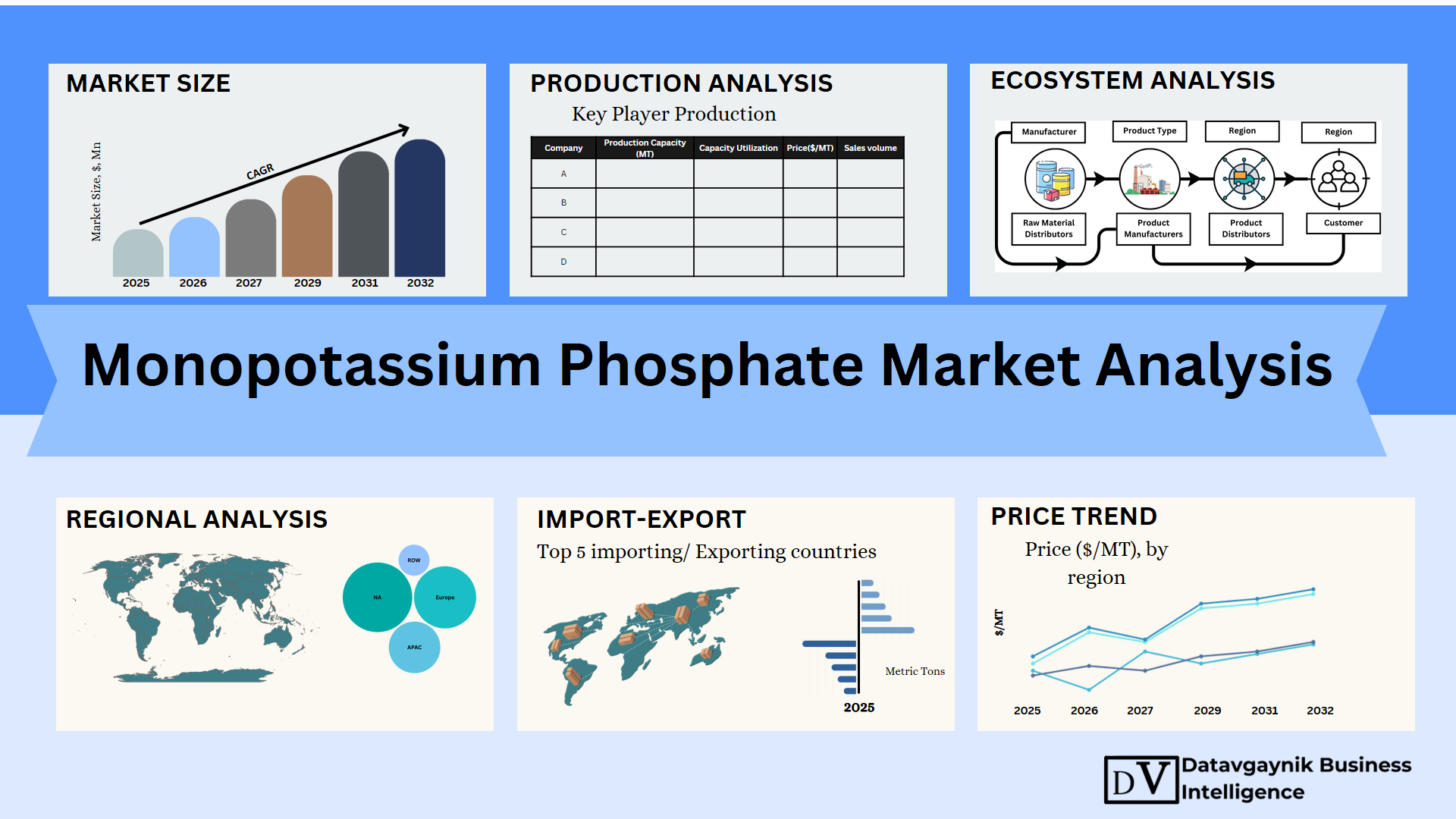
The Monopotassium Phosphate Market is undergoing a significant transformation, driven by the rising need for efficient, high-performance fertilizers across global agricultural landscapes. Monopotassium phosphate (MKP), a highly water-soluble compound offering both phosphorus and potassium, has become essential in precision agriculture. For instance, the global market for water-soluble fertilizers is expected to surpass USD 24 billion by 2027, with MKP comprising a substantial portion due to its ability to boost crop yield and nutrient uptake efficiency. According to Datavagyanik, this trend is particularly evident in countries like the United States, India, and Brazil, where the push for sustainable and high-output farming systems has rapidly accelerated.
Growth in Precision and Hydroponic Farming Enhances Monopotassium Phosphate Market Performance
The Monopotassium Phosphate Market is witnessing exceptional growth due to the increasing adoption of precision agriculture and hydroponic systems. These advanced farming methods demand exact nutrient control, where MKP proves indispensable. For example, in hydroponics, MKP enables controlled phosphorus and potassium dosing, which directly improves flowering and fruiting stages in crops such as tomatoes, lettuce, and strawberries. As per industry data, the global hydroponics market was valued at over USD 10 billion in 2022 and is projected to expand at a CAGR of more than 11 percent through 2030. This growth directly contributes to increased consumption of MKP in the agriculture sector, making it a key driver of the Monopotassium Phosphate Market.
Datavagyanik also covers related markets such as the Sodium Phosphate Market. Exploring these markets offers a broader view of the industry landscape and how adjacent sectors influence the main topic.
Rising Specialty Crop Production Elevates Monopotassium Phosphate Market Traction
The expansion of high-value specialty crop cultivation—fruits, vegetables, and ornamental plants—has amplified the growth of the Monopotassium Phosphate Market. These crops demand precise nutrient formulations to maximize quality and yield. For example, MKP is widely used in fertigation systems supporting grape cultivation in France, strawberry farming in California, and bell pepper production in Mexico. According to Datavagyanik, global fruit and vegetable exports grew by 5.8 percent annually over the last five years, signaling rising emphasis on quality-enhancing fertilizers like MKP. As growers seek to meet export quality standards, MKP’s role in nutrient delivery systems is expanding rapidly.
Monopotassium Phosphate Market Growth Driven by Food Preservation and Processing Applications
Beyond agriculture, the Monopotassium Phosphate Market is experiencing robust growth from its role in the food and beverage sector. MKP is increasingly used as a food additive to stabilize pH and improve shelf life in products such as dairy beverages, meat products, and baked goods. For instance, in the dairy sector, MKP maintains the pH balance in processed cheese and flavored milk, supporting texture and consistency. The global processed food market, valued at over USD 2.3 trillion in 2023, continues to grow, particularly in Asia Pacific and North America. This rising consumption of processed food directly supports MKP demand, adding another dimension to the expansion of the Monopotassium Phosphate Market.
Regulatory Support for Sustainable Farming Stimulates Monopotassium Phosphate Market
Government support for sustainable agriculture has become a central force behind the Monopotassium Phosphate Market expansion. Several countries have introduced subsidies for water-soluble fertilizers to encourage the adoption of efficient and environmentally responsible farming practices. For example, India’s nutrient-based subsidy (NBS) scheme includes components like MKP, making it more affordable for farmers. Similarly, the European Union’s CAP reform emphasizes nutrient efficiency and reduction of chemical runoff, where MKP fits as a low-impact fertilizer. According to Datavagyanik, global subsidies for sustainable fertilizers surpassed USD 4.5 billion in 2022, reinforcing the policy-driven momentum behind MKP adoption.
Monopotassium Phosphate Market Strengthens with the Rise of Eco-Friendly Solutions
As global focus shifts toward eco-friendly agricultural inputs, the Monopotassium Phosphate Market has gained favor due to MKP’s non-toxic and environmentally safe profile. Unlike some alternatives, MKP does not contribute to heavy metal contamination or soil degradation. It aligns with rising demand for clean-label farming and organic input certifications. For example, in countries like the Netherlands and Denmark, strict environmental standards for nutrient application have encouraged the use of MKP in greenhouse farming systems. According to Datavagyanik, the market for organic and low-impact fertilizers grew by over 7 percent annually over the past three years, a trend that directly benefits the Monopotassium Phosphate Market.
Monopotassium Phosphate Market Size to Expand with Increasing Crop Yield Optimization
The global Monopotassium Phosphate Market Size is set to increase substantially over the next decade due to the critical role MKP plays in crop yield optimization. Data from the International Fertilizer Association indicates that phosphate fertilizer demand is expected to reach 48 million metric tons by 2026, with MKP contributing significantly in high-efficiency segments. As growers shift from traditional bulk fertilizers to more targeted nutrient delivery solutions, MKP is being adopted in various fertigation and foliar spray regimes. This transformation is especially visible in the cultivation of export-oriented crops such as avocados in Mexico and blueberries in Peru, where MKP helps farmers meet international residue and quality standards.
Urban Farming and Greenhouse Cultivation Propel Monopotassium Phosphate Market Demand
The growth of urban farming and controlled-environment agriculture is adding momentum to the Monopotassium Phosphate Market. These systems require precise input management, and MKP’s solubility makes it ideal for integration into hydroponic and vertical farming nutrient solutions. In cities like Tokyo, New York, and Dubai, commercial greenhouse operations and vertical farms have adopted MKP to enhance efficiency. According to Datavagyanik, the global vertical farming market is projected to grow at over 20 percent CAGR through 2030, signaling significant downstream demand for MKP. This shift toward space-efficient farming methods aligns perfectly with the compound’s utility, contributing to increased Monopotassium Phosphate Market penetration.
Expanding Role in Pharmaceutical and Industrial Formulations Drives Monopotassium Phosphate Market
The Monopotassium Phosphate Market is also seeing a rise in industrial and pharmaceutical usage. MKP’s ability to regulate pH and act as a buffering agent makes it valuable in pharmaceutical formulations, including intravenous solutions and oral medications. Additionally, it plays a role in industrial sectors such as fire extinguishers, detergents, and water treatment systems. For instance, in fire safety, MKP acts as a key ingredient in dry chemical extinguishers for class A and B fires. As per Datavagyanik, the global industrial water treatment chemicals market exceeded USD 28 billion in 2023, with MKP securing a growing share due to its functional versatility. These auxiliary industries present additional growth channels for the Monopotassium Phosphate Market beyond agriculture and food.
Monopotassium Phosphate Market Size Bolstered by Global Food Security Concerns
With the global population projected to surpass 9.7 billion by 2050, food security has become a critical concern. This demographic pressure is driving the need for fertilizers that enhance agricultural productivity without compromising environmental safety. The Monopotassium Phosphate Market is directly positioned to address this challenge, as MKP supports high-efficiency farming practices. For example, in sub-Saharan Africa and parts of Southeast Asia, MKP is being introduced as part of international agricultural aid programs to improve yields in nutrient-deficient soils. According to Datavagyanik, government and NGO investments in agricultural productivity across developing regions surpassed USD 6 billion in 2023, directly contributing to rising demand in the Monopotassium Phosphate Market.
“Track Country-wise Monopotassium Phosphate Production and Demand through our Monopotassium Phosphate Production Database”
- Monopotassium Phosphate production database for 24+ countries worldwide
- Monopotassium Phosphate sales volume for 29+ countries
- Country-wise Monopotassium Phosphate production capacity, production plant mapping, production capacity utilization for 24+ manufacturers
- Monopotassium Phosphate production plants and production plant capacity analysis by top manufacturers
“Track real-time Monopotassium Phosphate Prices, Monopotassium Phosphate price charts for 24+ countries, Monopotassium Phosphate weekly price tracker and Monopotassium Phosphate monthly price tracker”
- Track real-time Monopotassium Phosphate prices and Monopotassium Phosphate price trend in 24+ countries though our excel-based Monopotassium Phosphate price charts
- Real-time Monopotassium Phosphate price tracker dashboard with 24+ countries
- Complete transparency on Monopotassium Phosphate price trend through our Monopotassium Phosphate monthly price tracker, Monopotassium Phosphate weekly price tracker
North America’s Evolving Agricultural Landscape Boosts Monopotassium Phosphate Market
The Monopotassium Phosphate Market in North America has witnessed accelerated growth, driven by a shift toward high-efficiency and sustainable agriculture. For instance, in the United States, the rise in precision farming and greenhouse crop production has increased the uptake of water-soluble fertilizers like MKP. States such as California, Florida, and Arizona have seen a surge in specialty crop cultivation, where MKP is preferred due to its chloride-free formulation and nutrient density. Datavagyanik estimates that more than 60 percent of hydroponic farms in the U.S. use MKP as part of their fertigation programs. This regional demand has contributed significantly to the expansion of the Monopotassium Phosphate Market across North America.
Monopotassium Phosphate Market Expands Amid Europe’s Push for Eco-Friendly Fertilizers
In Europe, stringent agricultural policies and environmental standards have supported the steady rise of the Monopotassium Phosphate Market. Countries such as Germany, France, the Netherlands, and Spain have incorporated MKP into mainstream farming, particularly in horticulture and organic crop production. For example, the Netherlands, a global leader in greenhouse agriculture, has adopted MKP for nutrient-sensitive crops grown in controlled environments. France’s emphasis on vineyard productivity and organic fertilizers has also amplified regional MKP consumption. As per Datavagyanik, the adoption rate of water-soluble fertilizers in Europe has grown at a CAGR of 6.5 percent since 2018, highlighting the expanding role of MKP in the region’s sustainable agriculture model.
Asia Pacific Leads Global Demand in Monopotassium Phosphate Market
The Asia Pacific region dominates the global Monopotassium Phosphate Market, both in terms of consumption and growth trajectory. China, India, and Japan collectively account for a significant portion of global MKP usage. China, being the largest producer and consumer, integrates MKP into both agricultural and industrial applications.
For example, Chinese tomato and cucumber greenhouse farms extensively use MKP to optimize crop yields. India, with its agriculture-heavy economy, has ramped up MKP imports due to government-led initiatives supporting fertigation and micro-irrigation. According to Datavagyanik, MKP imports to India rose by 11 percent in 2023 alone, driven by increased use in high-value crops like pomegranates, capsicum, and grapes. Meanwhile, Japan continues to rely on MKP for hydroponics and urban vertical farming, adding depth to the region’s overall demand.
Middle East Monopotassium Phosphate Market Grows on Back of Water-Efficient Farming
The Monopotassium Phosphate Market in the Middle East has shown promising growth due to the urgent need for water-efficient agriculture. Countries like Saudi Arabia, the United Arab Emirates, and Israel have implemented advanced irrigation systems such as drip and fertigation, where MKP fits perfectly due to its water solubility and high nutrient value. For instance, in Saudi Arabia’s Al-Kharj region, large-scale greenhouse projects rely on MKP to enhance vegetable and fruit production under arid conditions. Datavagyanik notes that MKP consumption in the Middle East has grown by over 9 percent annually since 2020, supported by policy initiatives promoting food self-sufficiency and sustainable farming practices.
Latin America’s Specialty Crop Boom Spurs Monopotassium Phosphate Market Growth
Latin America represents an emerging force in the Monopotassium Phosphate Market, primarily due to expanding fruit and vegetable exports. Brazil, Chile, and Peru are leading the regional charge, especially in crops like blueberries, grapes, and avocados. MKP has become essential in boosting nutrient delivery and enhancing shelf life for export produce. For example, in Chile’s central valley, MKP is used extensively in vineyard fertigation systems to support high-quality wine grape production. Datavagyanik reports a double-digit increase in MKP demand in Latin America over the last five years, driven by export-oriented agriculture and the growing shift from conventional to water-soluble fertilizers.
Strategic Global Production Hubs Reshape Monopotassium Phosphate Market Dynamics
Global production of MKP is concentrated in regions with abundant access to phosphoric acid and potassium carbonate—key raw materials in the manufacturing process. China leads the global supply chain, accounting for more than 50 percent of total MKP production, thanks to its cost-effective manufacturing infrastructure. The United States and Russia also contribute significantly to global output, while Europe maintains smaller but technologically advanced MKP production capacities. For example, leading Chinese producers have scaled capacity by over 15 percent year-on-year since 2020 to meet growing global demand. Datavagyanik forecasts that production output in China alone will cross 1.5 million metric tons annually by 2027, solidifying its role as the epicenter of Monopotassium Phosphate Market supply.
Monopotassium Phosphate Market Shaped by Import-Export Imbalances
While production is concentrated in select regions, the Monopotassium Phosphate Market is characterized by extensive cross-border trade. Countries with high agricultural activity but low MKP manufacturing capacity—such as India, Indonesia, and Egypt—depend heavily on imports. For instance, India imported over 75,000 metric tons of MKP in 2023 to support its expanding micro-irrigation and high-value crop sectors. In contrast, China and Israel remain major exporters, leveraging their production strengths and strategic location advantages. Datavagyanik observes that global MKP trade volumes have grown by 8.2 percent CAGR over the last five years, a trend that is expected to persist through the end of the decade.
Market Segmentation by Application Diversifies Monopotassium Phosphate Market Opportunities
Segmentation by application reveals a well-diversified Monopotassium Phosphate Market landscape. Agriculture remains the largest segment, accounting for more than 60 percent of total MKP usage. Within this segment, fertigation and foliar spray applications dominate due to the precision and efficiency they offer. The food and beverage segment follows, where MKP acts as a stabilizer and emulsifier. It is commonly used in bakery, dairy, and beverage processing. Industrial applications, while smaller in share, are steadily rising, especially in water treatment, pharmaceuticals, and fire retardants. Datavagyanik estimates that industrial use of MKP has grown by over 5 percent annually, suggesting new frontiers for market expansion.
Product Form Segmentation Enhances Efficiency Across Monopotassium Phosphate Market
The Monopotassium Phosphate Market is further segmented by product form—powder, granules, and liquid. Powdered MKP holds the majority share due to its ease of dissolution and quick nutrient release in fertigation systems. For example, commercial greenhouse growers in the United States and Japan prefer powdered MKP for its compatibility with automated mixing systems. Granular MKP, though less prevalent, is favored in specific industrial settings where controlled nutrient release is needed. Liquid MKP is gaining ground, especially in hydroponic and precision agriculture setups. Datavagyanik forecasts that the liquid MKP segment will grow at a CAGR of over 7.5 percent through 2030, reflecting changing preferences in high-tech farming environments.
Monopotassium Phosphate Price Trend Influenced by Raw Material Volatility
The Monopotassium Phosphate Price has remained subject to fluctuations, primarily driven by the volatility in raw material costs and global logistics. Potassium carbonate and phosphoric acid prices are sensitive to geopolitical events, mining output, and transportation bottlenecks. For instance, in 2022, Monopotassium Phosphate Price rose sharply by nearly 18 percent due to supply chain disruptions in China and energy price hikes in Europe. Datavagyanik notes that these fluctuations directly impacted fertilizer purchasing decisions in price-sensitive markets like Southeast Asia and Sub-Saharan Africa.
Long-Term Monopotassium Phosphate Price Trend Shows Stabilization Potential
Despite short-term volatility, the long-term Monopotassium Phosphate Price Trend points toward gradual stabilization. Increased investment in domestic MKP manufacturing in regions like India and Southeast Asia is expected to reduce dependency on imports and smoothen price cycles. Additionally, strategic stockpiling and futures contracts by large agribusinesses are helping buffer price shocks. Datavagyanik predicts that the Monopotassium Phosphate Price Trend will stabilize within a band of USD 1,200–1,450 per metric ton over the next five years, assuming continued growth in supply chain resilience and localized production.
Regional Price Variations Add Complexity to Monopotassium Phosphate Market
Price discrepancies across regions add another layer of complexity to the Monopotassium Phosphate Market. For example, MKP is priced higher in regions like Sub-Saharan Africa and Oceania due to limited local production and high import dependency. In contrast, China and the Middle East benefit from relatively lower prices due to domestic availability and proximity to raw materials. Datavagyanik highlights that understanding these regional Monopotassium Phosphate Price variations is crucial for distributors and manufacturers aiming to optimize supply chain strategies and target high-margin markets.
“Monopotassium Phosphate Manufacturing Database, Monopotassium Phosphate Manufacturing Capacity”
- Monopotassium Phosphate top manufacturers market share for 24+ manufacturers
- Top 7 manufacturers and top 14 manufacturers of Monopotassium Phosphate in North America, Europe, Asia Pacific
- Monopotassium Phosphate production plant capacity by manufacturers and Monopotassium Phosphate production data for 24+ market players
- Monopotassium Phosphate production dashboard, Monopotassium Phosphate production data in excel format
“Monopotassium Phosphate price charts, Monopotassium Phosphate weekly price tracker and Monopotassium Phosphate monthly price tracker”
- Factors impacting real-time Monopotassium Phosphate prices in 19+ countries worldwide
- Monopotassium Phosphate monthly price tracker, Monopotassium Phosphate weekly price tracker
- Real-time Monopotassium Phosphate price trend, Monopotassium Phosphate price charts, news and updates
- Tracking Monopotassium Phosphate price fluctuations
Leading Manufacturers Driving the Monopotassium Phosphate Market
The Monopotassium Phosphate Market is shaped by a mix of global conglomerates and specialized chemical producers that have positioned themselves as critical suppliers across agriculture, food, pharmaceutical, and industrial sectors. These players not only dominate volume but also set the tone for innovation and market direction.
Haifa Group is one of the most recognized names in the global Monopotassium Phosphate Market. Known for its flagship product Haifa MKP™, the company supplies high-purity, fully water-soluble MKP tailored for fertigation and foliar nutrition. Its strong R&D backing and distribution network across Europe, Asia, and North America give it a leading edge in the premium agricultural input segment.
Prayon Group, a European phosphate specialist, is another major manufacturer in the Monopotassium Phosphate Market. It caters to both fertilizer and food-grade applications and is particularly known for consistent product quality and advanced processing capabilities. The company’s vertical integration across phosphate supply chains provides strong control over cost and quality.
Master Plant-Prod Inc. operates predominantly in the North American region and is renowned for its water-soluble fertilizer series, including MKP tailored for greenhouse and hydroponic growers. Its strength lies in its regional customization and focus on high-value crops such as berries, tomatoes, and lettuce.
Sandoz AG and Pharmaceutical Associates Inc. contribute from the pharmaceutical end of the Monopotassium Phosphate Market. These firms produce MKP that adheres to stringent pharmaceutical standards for use in intravenous solutions, buffer systems, and other medical formulations.
Other key players include Charkit Chemical Company LLC and Allan Chemical Corporation, which offer MKP for both agricultural and industrial clients. These companies specialize in high-purity MKP grades suitable for specific use cases such as water treatment and fire suppression systems.
Monopotassium Phosphate Market Share by Manufacturer
The Monopotassium Phosphate Market is moderately consolidated, with top manufacturers holding significant shares due to their extensive distribution capabilities, high-volume production, and established customer base.
Haifa Group currently holds an estimated 15 percent share of the global market, driven by its strong presence in the premium fertilizer segment and wide adoption of Haifa MKP™ across fertigation systems in Europe and North America.
Prayon Group accounts for around 12 percent of the global Monopotassium Phosphate Market. Its diverse customer base, spanning food, agriculture, and specialty applications, ensures steady demand across product cycles.
Master Plant-Prod Inc. controls roughly 10 percent of the market, primarily in North America. Its emphasis on specialty agriculture and tailored nutrient formulations gives it a strategic advantage, especially in controlled-environment farming sectors.
Sandoz AG and Pharmaceutical Associates Inc. collectively contribute 8 percent to the market, focused largely on pharmaceutical-grade MKP. Though their market size is smaller in volume, their high-margin product lines provide steady revenue.
The remaining 55 percent of the Monopotassium Phosphate Market is distributed among regional and niche manufacturers like Charkit Chemical, Allan Chemical, and several Chinese and Indian producers. These players typically serve either price-sensitive markets or niche industrial applications.
Product Lines and Innovation in the Monopotassium Phosphate Market
Leading manufacturers in the Monopotassium Phosphate Market have introduced differentiated product lines to meet the diverse demands across sectors.
Haifa MKP™ by Haifa Group remains a market benchmark. It is chloride-free, fully water-soluble, and compatible with other fertilizers, making it ideal for fertigation, greenhouse farming, and specialty crop production. The company has expanded the product line to include micronutrient-enriched MKP variants, addressing the needs of intensive cultivation systems.
Prayon has developed both technical- and food-grade MKP products, offering flexibility for agriculture, processed food stabilization, and pharmaceutical blending. Its technical MKP is used in water treatment applications where pH regulation and phosphate-based scaling prevention are necessary.
Master Plant-Prod’s MKP offerings are formulated for compatibility with automated fertigation systems and are widely used in hydroponic greenhouses. The company has recently introduced packaging innovations to improve shelf life and minimize caking in humid environments.
Charkit Chemical and Allan Chemical emphasize flexibility in packaging and purity customization, allowing them to cater to industrial buyers with unique specifications. Their product lines are often used in fire retardants and advanced water purification systems.
Recent Developments in the Monopotassium Phosphate Market
The Monopotassium Phosphate Market has seen a number of strategic developments and product advancements over the last 12–18 months, reflecting the market’s adaptability and innovation-driven growth.
In early 2024, several North American and European manufacturers announced expansions in their MKP production lines to meet growing demand in precision agriculture and hydroponic systems. These expansions aimed to address rising consumption in urban farming hubs and greenhouse clusters, particularly in Canada, Germany, and the Netherlands.
By mid-2024, a major shift in product innovation began emerging with the launch of organic-certified MKP alternatives aimed at serving the organic farming community. These products were positioned as sustainable solutions for growers seeking to comply with organic certification programs in Europe and North America.
In September 2024, a large Asian producer completed a new MKP facility with a capacity of 200,000 metric tons annually. This development is expected to ease the supply-demand gap in fast-growing markets such as India, Vietnam, and Bangladesh, where high-value fruit and vegetable farming is rapidly expanding.
Q4 2024 saw new product rollouts by multiple manufacturers focusing on microgranular MKP designed specifically for controlled-release systems. This innovation allows MKP to be incorporated into slow-dissolving carriers, enhancing efficiency in long-cycle crops like citrus and vineyards.
In January 2025, logistics and supply chain optimization took center stage, as several manufacturers announced partnerships with local distributors in Africa and Southeast Asia. These partnerships aim to ensure last-mile delivery of MKP even in remote agricultural regions, reducing costs and improving availability.
Additionally, the global price volatility in 2022 and 2023 triggered a wave of long-term procurement contracts between large agribusinesses and MKP producers. These contracts are designed to stabilize Monopotassium Phosphate Price trends and minimize the impact of raw material fluctuations on end-user pricing.
“Monopotassium Phosphate Production Data and Monopotassium Phosphate Production Trend, Monopotassium Phosphate Production Database and forecast”
- Monopotassium Phosphate production database for historical years, 10 years historical data
- Monopotassium Phosphate production data and forecast for next 7 years
- Monopotassium Phosphate sales volume by manufacturers
“Track Real-time Monopotassium Phosphate Prices for purchase and sales contracts, Monopotassium Phosphate price charts, Monopotassium Phosphate weekly price tracker and Monopotassium Phosphate monthly price tracker”
- Gain control on your purchase and sales contracts through our real-time Monopotassium Phosphate price tracker and Monopotassium Phosphate price trend analysis
- Monopotassium Phosphate weekly price tracker and forecast for next four weeks
- Monopotassium Phosphate monthly price tracker and forecast for next two months
Market Scenario, Demand vs Supply, Average Product Price, Import vs Export, till 2032
- Global Monopotassium Phosphate Market revenue and demand by region
- Global Monopotassium Phosphate Market production and sales volume
- United States Monopotassium Phosphate Market revenue size and demand by country
- Europe Monopotassium Phosphate Market revenue size and demand by country
- Asia Pacific Monopotassium Phosphate Market revenue size and demand by country
- Middle East & Africa Monopotassium Phosphate Market revenue size and demand by country
- Latin America Monopotassium Phosphate Market revenue size and demand by
- Import-export scenario – United States, Europe, APAC, Latin America, Middle East & Africa
- Average product price – United States, Europe, APAC, Latin America, Middle East & Africa
- Market player analysis, competitive scenario, market share analysis
- Business opportunity analysis
Key questions answered in the Global Monopotassium Phosphate Market Analysis Report:
- What is the market size for Monopotassium Phosphate in United States, Europe, APAC, Middle East & Africa, Latin America?
- What is the yearly sales volume of Monopotassium Phosphate and how is the demand rising?
- Who are the top market players by market share, in each product segment?
- Which is the fastest growing business/ product segment?
- What should be the business strategies and Go to Market strategies?
The report covers Monopotassium Phosphate Market revenue, Production, Sales volume, by regions, (further split into countries):
- Asia Pacific (China, Japan, South Korea, India, Indonesia, Vietnam, Rest of APAC)
- Europe (UK, Germany, France, Italy, Spain, Benelux, Poland, Rest of Europe)
- North America (United States, Canada, Mexico)
- Latin America (Brazil, Argentina, Rest of Latin America)
- Middle East & Africa
Table of Contents:
Monopotassium Phosphate Market: Trends, Insights, and Forecast
- Introduction to Monopotassium Phosphate
- Overview of Monopotassium Phosphate and Its Chemical Properties
- Historical Applications and Importance in Industry
- Market Scope and Purpose of the Study
- Market Segmentation
- By Form (Granules, Powder, Liquid)
- By Application (Fertilizers, Food Additives, Animal Feed, Water Treatment)
- By End-Use Industry (Agriculture, Food & Beverages, Pharmaceuticals, Industrial)
- Global Monopotassium Phosphate Market Overview (2016-2035)
- Market Trends and Growth Insights
- Key Market Drivers and Influencing Factors
- Challenges and Opportunities in the Market
- Demand and Supply Dynamics
- Major Demand Drivers in Agriculture and Food Processing
- Global Production Insights and Key Suppliers
- Raw Material Sourcing and Distribution Networks
- Regional Market Insights
- North America
- Role of Monopotassium Phosphate in Fertilizer and Food Additives
- Market Trends and Regulatory Environment
- Europe
- Focus on Sustainable Agriculture and Green Technologies
- Demand in Food and Beverage Sectors
- Asia Pacific
- Expanding Agricultural Applications in Emerging Economies
- Market Growth in China, India, and Southeast Asia
- Latin America
- Opportunities in Agricultural Development and Fertilizer Demand
- Regional Growth Potential and Market Dynamics
- Middle East & Africa
- Increasing Demand for Fertilizers and Water Treatment Solutions
- Market Insights in Agricultural and Industrial Applications
- North America
- Production and Manufacturing Insights
- Methods of Monopotassium Phosphate Production
- Key Global Manufacturers and Market Share Analysis
- Innovations in Manufacturing and Process Efficiency
- Competitive Landscape
- Major Market Players and Their Strategic Positioning
- Competitive Trends and R&D Investment Areas
- Focus on Product Innovation and Market Expansion
- Pricing Trends and Economic Insights
- Historical Pricing Trends (2016-2024)
- Factors Affecting Price Fluctuations and Economic Impacts
- Price Forecasts and Market Outlook (2025-2035)
- Applications of Monopotassium Phosphate
- Fertilizers: Role in Crop Yield Enhancement and Soil Health
- Food & Beverages: Use as a Nutrient and Preservative
- Animal Feed: Contribution to Livestock Nutrition and Growth
- Water Treatment: Use in Softening and Purification Processes
- Sustainability and Environmental Considerations
- Environmental Impact of Monopotassium Phosphate Production
- Innovations in Eco-Friendly Manufacturing Practices
- Regulatory Compliance and Sustainability Standards
- Global Trade and Distribution Networks
- Key Exporting and Importing Countries
- Trends in Global Trade and Market Accessibility
- Distribution Challenges and Regional Market Logistics
- Consumer Insights and Market Behavior
- Shifting Consumer Preferences in Agriculture and Food Sectors
- Regional Consumption Patterns and Market Behavior
- Growing Demand for Sustainable and Green Products
- Technological Developments in Monopotassium Phosphate
- Advances in Fertilizer Production and Formulation Technologies
- Role of Nanotechnology and Smart Agriculture Solutions
- Innovations in Food and Water Treatment Applications
- Market Risks and Challenges
- Volatility in Raw Material Prices
- Regulatory Barriers and Compliance Issues
- Environmental and Health Risks Associated with Production
- Opportunities for Growth in the Monopotassium Phosphate Market
- Expanding Applications in Sustainable and Organic Agriculture
- Growth in Food and Beverage Additives
- Emerging Markets in Water Treatment and Industrial Uses
- Market Forecast and Projections (2025-2035)
- Revenue and Demand Projections by Region
- Application-Based Market Forecasts
- Long-Term Market Trends and Growth Areas
- Sustainability and Circular Economy
- Role of Monopotassium Phosphate in Supporting Sustainable Practices
- Innovations in Recycling and Waste Reduction in Agriculture
- Contribution to Circular Economy Models in Fertilizer and Food Industries
- Value Chain and Stakeholder Analysis
- Key Stakeholders: Manufacturers, Distributors, and End Users
- Opportunities for Strategic Collaboration Across the Supply Chain
- Role of Research Institutions, Governments, and Industry Regulators
- Emerging Applications and Innovations
- New Uses in Clean Energy, Agriculture, and Food Production
- Innovations in Nutraceuticals and Specialty Food Products
- Expansion of Monopotassium Phosphate in Advanced Water Treatment Solutions
- Appendix and Supporting Resources
- Glossary of Key Terms
- Research Methodology and Data Sources
- References and Further Reading


