

Market Summary and Growth Forecast
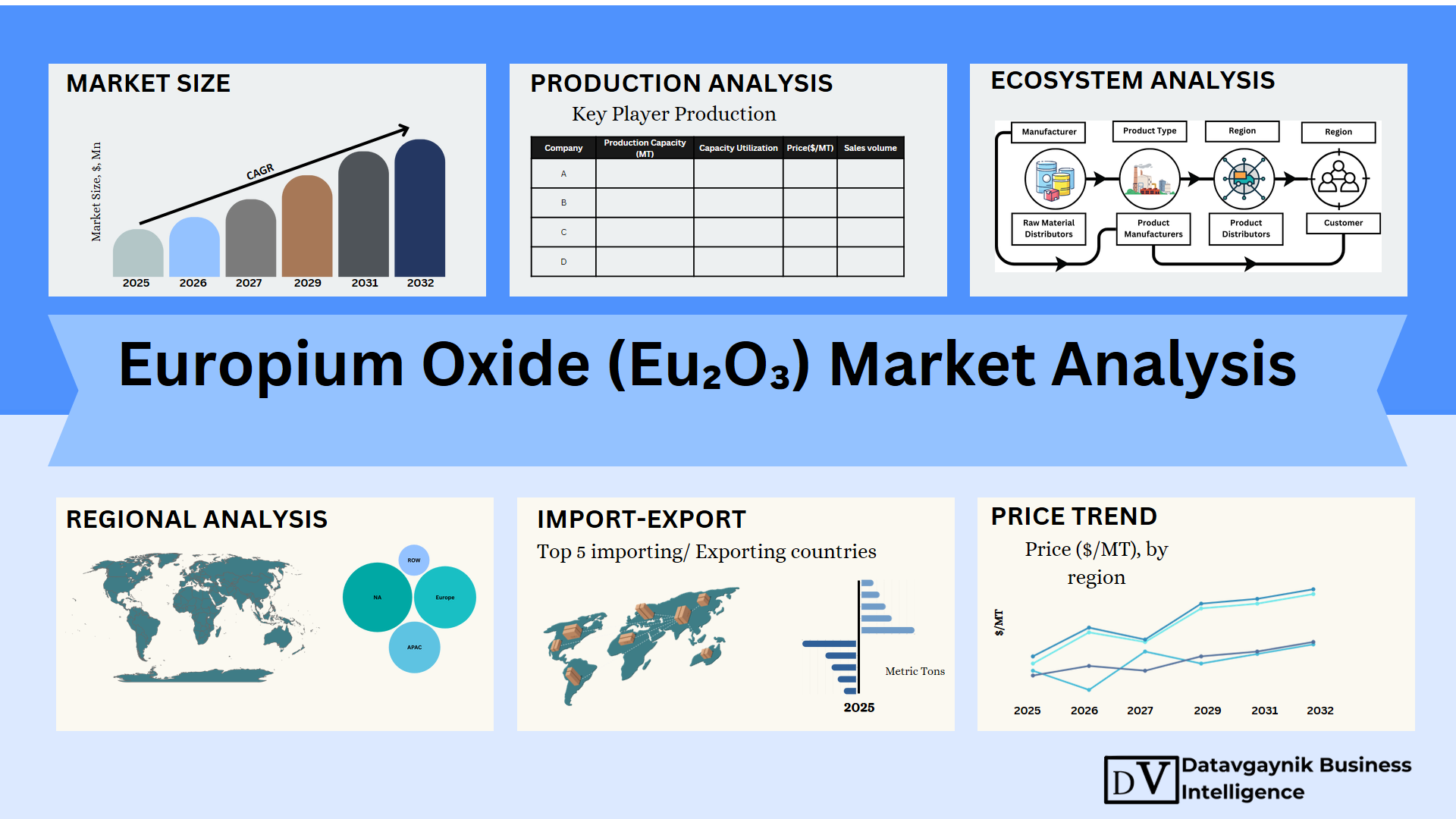
The global Europe Europium Oxide (Eu₂O₃) Market will witness a robust CAGR of 6.4%, valued at $0.18 billion in 2026, expected to appreciate and reach $0.31 billion by 2035.
Europium oxide, or Eu₂O₃, is a high-purity rare earth oxide used mainly in phosphors, display materials, specialty lighting, optical glass, nuclear control materials, ceramics, and advanced research applications. The market is small in volume but strategic in value. That distinction matters. Europium is not a bulk commodity. It sits inside high-performance material systems where purity, supply security, and end-use qualification carry more weight than tonnage.
The Europe Europium Oxide (Eu₂O₃) Market is gaining relevance because Europe wants tighter control over critical raw materials, especially rare earth compounds used in electronics, clean energy, defense-linked technologies, and advanced manufacturing. Between 2026 and 2035, demand will be shaped by three linked forces: material security, downstream technology localization, and gradual revival of rare earth processing capacity outside China.
Datavagyanik also covers related markets such as the Europium Oxide Market, the Europium Sulfate Market, and the Europium Carbonate Market. These compounds are commonly used in oxidation systems and industrial chemical processing, supporting shifts in formulation standards and regulatory compliance.
A large share of europium oxide demand still comes from phosphor applications. However, the demand mix is changing. Traditional fluorescent lighting continues to lose ground, while specialty phosphors, high-purity optical materials, research-grade oxides, and recycled rare earth recovery are becoming more important. Europe’s position is not built on mining scale. It is more connected to downstream processing, specialty chemicals, recycling, research laboratories, and high-value industrial users.
By 2026, global consumption value is estimated at $0.18 billion, with Europe accounting for nearly 19% of demand value. By 2035, global market value is projected to reach $0.31 billion, supported by demand from advanced displays, security-sensitive materials, specialty ceramics, and controlled rare earth supply chains. Europe’s share may rise modestly as regional rare earth separation, recycling, and circular material programs mature.
The real opportunity is not just selling europium oxide. It is controlling qualified supply for customers who cannot afford material inconsistency. In rare earth oxides, trust in purity often decides the supplier before price does.
Key stakeholders in this market include rare earth oxide producers, separation companies, phosphor manufacturers, display material suppliers, optical glass producers, ceramic formulators, nuclear research institutions, electronics OEMs, government critical mineral agencies, EU industrial policy bodies, investors, and academic material science labs. Industry associations, standards bodies, and recycling technology developers also play a growing role because supply transparency is becoming part of procurement strategy.
| Metric | Estimate / Forecast |
| Global market size, 2026 | $0.18 billion |
| Global market size, 2035 | $0.31 billion |
| Forecast CAGR, 2026–2035 | 6.4% |
| Europe share of global value, 2026 | 19% |
| Most strategic growth area | High-purity and recycled rare earth oxide supply |
| Core demand base | Phosphors, optical materials, specialty ceramics, research applications |
Yes, proceed to next section.
- Market Segmentation and Forecast Scope
The Europe Europium Oxide (Eu₂O₃) Market can be segmented by product purity, application, end user, and region. This structure reflects how buyers actually assess the material. They do not only ask for europium oxide. They ask for purity level, particle consistency, impurity profile, certificate traceability, and application fit.
By Product Type
The market can be segmented into standard-grade europium oxide, high-purity europium oxide, and ultra-high-purity europium oxide. Standard grades are used where tight optical or electronic performance is not the main requirement. High-purity grades are used in phosphors, specialty glass, ceramics, and advanced material formulations. Ultra-high-purity grades serve research, electronics, and niche optical applications where contamination can alter performance.
In 2026, high-purity europium oxide is estimated to hold around 52% of market value. This segment commands the strongest commercial position because it sits between research-grade pricing and industrial-scale usability. Ultra-high-purity material will grow faster, but from a smaller base.
By Application
Key application categories include phosphors and luminescent materials, display and lighting materials, optical glass and lasers, ceramics and specialty materials, nuclear and scientific research, and other advanced material uses. Phosphors remain the anchor application, especially for red-emitting materials. That said, the older lighting-led demand base is narrowing. The newer opportunity is more specialized and linked to advanced displays, traceable material sourcing, and recycled rare earth recovery.
In 2026, phosphors and luminescent materials are estimated to account for nearly 43% of market value. The fastest growth is expected in optical materials and research-grade applications, where customers tend to pay more for purity and reliable batch documentation.
By End User
End users include electronics and display manufacturers, phosphor producers, specialty chemical companies, glass and ceramics manufacturers, research institutions, nuclear laboratories, and recycling technology companies. Electronics and phosphor-related users remain the most visible demand base. However, specialty chemical companies are becoming more influential because they sit between oxide supply and final material formulation.
For European buyers, the question is becoming simple: can the supplier deliver the same purity profile every time, and can the origin be explained clearly? That may matter as much as the quoted price.
By Region
The global forecast scope covers North America, Europe, Asia Pacific, and LAMEA. Asia Pacific remains the largest demand and supply center due to its rare earth processing ecosystem, electronics manufacturing base, and phosphor production capacity. Europe is smaller in direct consumption, but strategically more active because of policy support around rare earth security, recycling, and downstream material resilience. North America is expanding through magnet, defense, and critical mineral initiatives. LAMEA remains limited but may gain relevance through rare earth exploration and resource development.
| Segmentation Dimension | Key Categories | Strategic Note |
| By Product Type | Standard grade, High-purity, Ultra-high-purity | High-purity grade leads value demand in 2026 |
| By Application | Phosphors, displays, optical glass, ceramics, nuclear research, others | Phosphors remain largest, optical and research uses grow faster |
| By End User | Electronics, specialty chemicals, glass, ceramics, labs, recyclers | Specialty chemical firms influence qualification and repeat demand |
| By Region | North America, Europe, Asia Pacific, LAMEA | Europe grows through supply security and advanced material programs |
Market Trends and Innovation Landscape
The Europe Europium Oxide (Eu₂O₃) Market is moving through a quiet but important transition. It is no longer only a phosphor-linked oxide market. It is becoming part of Europe’s wider critical materials strategy. The market is still niche, but the strategic value is rising because europium sits inside applications where performance loss is not acceptable.
One visible trend is the shift toward higher-purity europium oxide. Buyers in optical materials, advanced ceramics, and research applications are asking for tighter impurity limits and better batch-to-batch consistency. This is changing supplier behavior. Producers and distributors are placing more emphasis on certificates of analysis, traceability, controlled particle size, and customized packaging for sensitive users.
R&D is also moving toward rare earth recovery and circular processing. Europe has a practical reason to push this. Primary rare earth separation capacity remains concentrated outside the region, so recycling from phosphor powders, electronic waste, industrial residues, and mixed rare earth streams is becoming more attractive. Europium recovery is technically more complex than simple metal recycling, but the value of the oxide supports selective recovery when feedstock quality is strong.
Material science work is focused on luminescent efficiency, thermal stability, dopant behavior, and host material compatibility. Europium oxide is often not used alone. It acts as a functional input in phosphor systems and specialty formulations. So innovation is less about the oxide as a standalone product and more about how it performs inside a matrix. That is why collaborations between oxide suppliers, universities, phosphor developers, and specialty material companies matter.
AI integration is not a major direct trend in europium oxide manufacturing today. It may appear indirectly in material discovery, process control, and quality analytics. But it is not yet a central commercial driver for this market. The more relevant technology shift is improved separation chemistry, solvent extraction optimization, recycling process design, and downstream purification.
Strategic announcements across Europe point in the same direction: reduce dependence on external rare earth supply chains and rebuild selected processing capabilities. Companies such as Solvay, Neo Performance Materials, Lynas Rare Earths, Rainbow Rare Earths, Energy Fuels, and MP Materials are watched closely by European buyers and policymakers because their projects influence rare earth oxide availability, separation routes, and downstream confidence. Not every company is a direct europium oxide supplier into Europe today, but their activity shapes sourcing expectations across the rare earth value chain.
Partnerships are also forming around recycling, magnet materials, separation technology, and critical mineral financing. This matters for the Europe Europium Oxide (Eu₂O₃) Market because europium demand is too specialized to support large isolated investments on its own. It benefits when broader rare earth infrastructure improves.
The next phase of competition will not be won only by low-cost oxide supply. It will be won by suppliers that can prove purity, document origin, support smaller technical lots, and scale qualified supply when customers move from lab use to commercial production.
| Trend Area | What Is Changing | Likely Market Impact by 2035 |
| High-purity demand | Buyers require tighter impurity limits and stronger documentation | Higher average selling prices for qualified material |
| Rare earth recycling | Recovery from phosphor waste, electronics, and industrial streams gains interest | Improved European supply resilience |
| Material science R&D | Better phosphor systems, optical materials, and ceramic formulations | More specialized application demand |
| Supply chain localization | Europe pushes rare earth processing and critical material security | Greater focus on non-China sourcing options |
| Process innovation | Separation, purification, and quality control improve | Better consistency and lower qualification risk |
The Europe Europium Oxide (Eu₂O₃) Market will remain selective and technically demanding. It will not behave like a broad industrial chemical market. Growth will come from customers that need clean material, secure supply, and application-specific performance. That makes the market smaller than many rare earth categories, but more defensible for qualified suppliers.
Competitive Intelligence and Benchmarking
The competitive structure of the Europe Europium Oxide (Eu₂O₃) Market is narrow, technical, and supply-chain heavy. It is not led by hundreds of commodity chemical producers. The market depends on companies that can source rare earth feedstock, separate rare earth elements, purify oxides, document specifications, and serve customers that often buy in smaller but high-value lots.
Solvay
Solvay is one of Europe’s most strategically relevant rare earth players. Its position is linked to rare earth separation, purification, and downstream oxide supply from its European processing base. The company is not just a chemical supplier in this context. It is a rare earth infrastructure player for Europe.
Its portfolio focus covers separated rare earth oxides and specialty material inputs used across clean technology, electronics, catalysts, and advanced material systems. For europium oxide buyers, Solvay matters because of its European operating footprint, technical processing capability, and alignment with the EU’s critical raw materials agenda.
In a market where many buyers worry about origin and consistency, a European processing base becomes a commercial advantage.
Neo Performance Materials
Neo Performance Materials holds a strong position in rare earth separation, engineered materials, and downstream magnet-related value chains. Its European relevance is supported by its operations in Estonia, where it has built rare earth processing and magnet-related capabilities.
The company’s portfolio is broader than europium oxide alone. It includes rare earth compounds, specialty materials, and value-added products linked to electronics, automotive, energy, and industrial technologies. Its market position is important because it connects rare earth oxide processing with higher-value downstream demand.
For the Europe Europium Oxide (Eu₂O₃) Market, Neo Performance Materials is best viewed as a strategic rare earth materials platform rather than only a product supplier.
Lynas Rare Earths
Lynas Rare Earths is one of the most important non-China rare earth producers globally. Its relevance comes from mining, processing, and rare earth oxide supply across light and selected separated rare earth products. The company has become a preferred reference point for customers seeking diversified rare earth sourcing.
While Europe is not its only market, Lynas Rare Earths influences European procurement confidence because it offers an alternative supply route outside China-dominated processing chains. Its portfolio supports multiple rare earth oxide categories and feeds into high-growth end markets such as automotive electrification, wind energy, electronics, and specialty materials.
China Northern Rare Earth Group
China Northern Rare Earth Group is among the largest rare earth producers globally and remains a major force across separated rare earth oxides. Its position is built on feedstock access, processing scale, and deep integration with China’s rare earth industrial ecosystem.
For europium oxide, Chinese suppliers continue to hold strong pricing and availability influence. The company’s scale allows it to serve phosphor, electronic materials, magnetic materials, and other rare earth applications. European buyers may reduce dependency over time, but China-linked supply remains difficult to replace fully in the near term.
China Minmetals Rare Earth
China Minmetals Rare Earth is another important player in the rare earth oxide landscape. The company has access to processing capability, downstream industrial channels, and a wide rare earth product base. Its competitive strength sits in scale, supply integration, and domestic industrial demand support.
In europium oxide, companies of this type influence global benchmark pricing and supply availability. Even when European buyers seek alternative sources, Chinese producers continue to shape commercial terms because of their capacity and established separation networks.
Shenghe Resources
Shenghe Resources has become a visible rare earth supply-chain participant through its exposure to rare earth resources, trading, processing, and global partnerships. Its role is important because rare earth oxide supply is no longer only about production plants. Feedstock relationships and offtake channels matter just as much.
The company’s portfolio spans rare earth concentrates, separated products, and downstream material routes. It is relevant to the europium oxide market because it participates in the broader rare earth oxide ecosystem that determines availability, pricing, and procurement alternatives.
American Elements
American Elements serves the market from a specialty materials and high-purity chemical supply angle. It is especially relevant for research, laboratory, small-volume industrial, and application-specific oxide demand. The company’s strength is not bulk mining scale. It is catalogue breadth, technical grades, and availability of high-purity rare earth compounds.
For customers buying europium oxide for R&D, specialty ceramics, optical materials, or experimental phosphor systems, suppliers like American Elements are often more practical than bulk rare earth producers.
| Company | Market Position | Portfolio Role | Strategic Relevance |
| Solvay | European rare earth processing leader | Separated oxides and specialty rare earth materials | Strong fit with EU supply security |
| Neo Performance Materials | Rare earth materials and magnet-chain player | Oxides, engineered materials, downstream rare earth systems | Important European processing footprint |
| Lynas Rare Earths | Major non-China rare earth supplier | Rare earth oxides and processed materials | Supports supply diversification |
| China Northern Rare Earth Group | Large-scale global rare earth producer | Separated oxides and downstream materials | Strong pricing and supply influence |
| China Minmetals Rare Earth | Integrated Chinese rare earth group | Rare earth oxides and industrial inputs | Major role in global availability |
| Shenghe Resources | Resource and processing-linked supplier | Concentrates, oxides, trading channels | Important feedstock and supply-chain participant |
| American Elements | Specialty high-purity material supplier | Research and industrial-grade oxides | Useful for small-volume technical demand |
Regional Landscape and Adoption Outlook
The regional adoption outlook is shaped by one simple reality: europium oxide demand is specialized, but rare earth supply chains are geopolitical. Countries with electronics manufacturing, phosphor development, specialty materials, nuclear research, and rare earth processing capacity have stronger adoption depth.
North America
North America accounts for an estimated 17% of global europium oxide demand value in 2026. The U.S. leads regional adoption due to its electronics R&D base, defense-related material programs, advanced ceramics, laboratories, and critical mineral policy support.
The market is supported by federal attention on rare earth resilience, domestic processing, and alternative sourcing. However, North America still faces a processing gap. Mining activity is improving, but separated oxide availability remains more limited than the region wants. This creates white space for purification, recycling, and secure distribution models.
High-growth countries: United States, followed by Canada
White space: rare earth recycling, high-purity oxide qualification, and domestic separation capacity
Europe
Europe represents an estimated 19% of global demand value in 2026. The region is not the largest consumer by volume, but it is one of the most policy-driven markets. Demand is supported by advanced materials, specialty chemicals, display research, optical glass, ceramics, nuclear research, and circular raw material programs.
The Europe Europium Oxide (Eu₂O₃) Market benefits from EU-level critical raw material policy, downstream industrial demand, and a push to reduce exposure to concentrated supply chains. Germany, France, Estonia, Belgium, the Netherlands, and the Nordics are strategically relevant because of their industrial material base, chemical infrastructure, research ecosystem, or rare earth project activity.
High-growth countries: France, Germany, Estonia, Netherlands, Sweden
White space: recycling of rare earth-bearing waste streams and local high-purity oxide finishing
China
China remains the dominant force in rare earth oxide supply and downstream rare earth manufacturing. It accounts for the largest share of production influence and an estimated 36% of global europium oxide demand value in 2026. Its advantage comes from integrated mining, separation, refining, phosphor production, electronics manufacturing, and established technical know-how.
China’s adoption is mature, but still strategically important. It has scale, buyer density, and internal policy support. The main restraint is not demand. It is rising global pressure to diversify away from single-country dependency.
High-growth areas: advanced phosphors, high-purity oxides, rare earth functional materials
White space: limited from a capacity standpoint, but higher-value specialty grades still offer margin upside
India
India is a smaller market today, with an estimated 4% global value share in 2026, but it has one of the more interesting long-term adoption stories. The demand base is tied to electronics manufacturing, defense research, nuclear science, laboratories, lighting materials, ceramics, and specialty chemicals.
India has rare earth resources and public-sector activity around rare earth processing, but commercial-scale separated oxide capacity remains narrower than China’s. The growth case depends on whether India can deepen rare earth separation, expand electronics value chains, and convert domestic resource potential into qualified industrial material supply.
High-growth areas: electronics manufacturing, defense-linked materials, research-grade oxides
White space: commercial purification, application-grade oxide supply, and private-sector downstream processing
Japan
Japan is a high-value and technically mature market. It accounts for an estimated 8% of global demand value in 2026. Adoption is driven by electronics, display materials, precision ceramics, optical applications, phosphor technology, and advanced material science.
Japan’s strength is not low-cost production. It is qualification discipline. Buyers focus heavily on purity, consistency, impurity control, and supplier reliability. The country also has a long history of rare earth efficiency and recycling research, especially after past supply disruptions.
High-growth areas: optical materials, specialty phosphors, high-purity technical grades
White space: more secure non-China sourcing and circular rare earth recovery
South Korea
South Korea holds an estimated 6% of global market value in 2026. Demand is supported by electronics, displays, semiconductors, batteries, advanced ceramics, and high-tech materials. Europium oxide demand is not broad across every industry, but it fits well into South Korea’s precision manufacturing base.
The country’s large electronics and display ecosystem makes it a strategic buyer of rare earth-based functional materials. Adoption is strongest where europium oxide contributes to luminescence, optical performance, research materials, or specialty formulations.
High-growth areas: display materials, advanced electronics, R&D-grade rare earth compounds
White space: localized rare earth recovery and secure technical-grade sourcing
Rest of the World
Rest of the World includes Southeast Asia, Australia, Latin America, the Middle East, and Africa. Collectively, the group accounts for an estimated 10% of global market value in 2026. Adoption is uneven. Australia is more important on the upstream rare earth resource side, while Southeast Asia matters for electronics and assembly ecosystems. Africa and Latin America are more relevant as potential resource and feedstock regions.
Underserved markets include parts of Southeast Asia, the Middle East, Africa, and Latin America where advanced material demand is still developing. These regions may not become major europium oxide consumers quickly, but they can become relevant through mining, processing, recycling, or industrial policy partnerships.
| Region / Country Group | Estimated 2026 Demand Value Share | Adoption Profile | Main Growth Lever |
| China | 36% | Largest integrated rare earth and electronics ecosystem | Scale and downstream manufacturing |
| Europe | 19% | Policy-backed, specialty demand-led market | Supply security and circular materials |
| North America | 17% | R&D, defense, electronics, and critical minerals focus | Domestic processing and secure sourcing |
| Japan | 8% | High-purity and precision material demand | Specialty applications and recycling |
| South Korea | 6% | Display and electronics-linked demand | Advanced materials and technical qualification |
| India | 4% | Emerging rare earth and electronics demand base | Industrial localization |
| Rest of the World | 10% | Mixed upstream and downstream roles | Resource development and electronics expansion |
Europe’s advantage is not volume. It is policy alignment, industrial quality standards, and willingness to pay for supply certainty. That makes the region commercially attractive even when tonnage is modest.
End-User Dynamics and Use Case
End-user demand for europium oxide varies by purity requirement, application qualification, and procurement risk tolerance. Buyers are selective because europium oxide is normally a performance input rather than a visible final product. A small impurity shift can change optical performance, color output, thermal behavior, or research repeatability.
Electronics and Display Material Producers
Electronics and display-related users adopt europium oxide mainly through phosphor and luminescent material systems. Demand is not driven by simple oxide consumption. It is driven by the need for stable red emission, controlled particle behavior, and reliable performance in downstream formulations.
These buyers typically prefer qualified suppliers with consistent batch records. Switching suppliers can take time because downstream testing is required.
Phosphor Manufacturers
Phosphor producers remain the largest practical buyer group. They use europium compounds in luminescent systems for display, lighting, security marking, and specialty optical uses. Traditional lighting demand has softened, but advanced phosphor formulations continue to support demand for high-quality material.
Optical Glass and Ceramic Manufacturers
Optical glass and ceramic users adopt europium oxide where luminescence, optical response, thermal behavior, or specialty coloration is required. These users buy smaller volumes, but often at higher value per kilogram because purity and impurity profile matter.
Research Institutions and Laboratories
Research institutions purchase europium oxide for material science, photonics, nuclear research, ceramics, and experimental phosphor systems. This segment is small in volume but important for innovation. It also influences future commercial applications because lab-scale formulations can later move into industrial trials.
Recycling and Circular Material Companies
Recycling companies are emerging as indirect end users and suppliers. Their role is to recover rare earth oxides from waste streams and return them into qualified material channels. This is still technically demanding, especially where europium is present in low concentrations or mixed with other rare earths.
Realistic Use Case
A specialty phosphor producer in Germany qualifies high-purity europium oxide from two suppliers before scaling a new luminescent material formulation. The company uses the oxide in pilot batches for red-emitting phosphor systems. During testing, one supplier shows stronger batch consistency and lower trace-metal variation. The buyer accepts a slightly higher price because requalification delays would cost more than the material savings. This is typical for the Europe Europium Oxide (Eu₂O₃) Market: the buying decision is based on performance assurance, not just procurement cost.
| End User | Adoption Pattern | Purchase Priority |
| Electronics and display material producers | Application-qualified demand | Performance stability and supply reliability |
| Phosphor manufacturers | Core demand base | Luminescence performance and purity |
| Optical glass and ceramic manufacturers | Smaller but high-value demand | Impurity control and formulation fit |
| Research institutions | Low-volume, high-specification demand | Grade availability and documentation |
| Recycling companies | Emerging circular supply role | Recovery yield and oxide quality |
Recent Developments + Opportunities & Restraints
Recent Developments
| Year / Month | Event | Market Relevance |
| 2025 / March | European Commission selected 47 Strategic Projects under the Critical Raw Materials Act. | Supports rare earth processing, recycling, and supply security across Europe. This improves the policy backdrop for rare earth oxides including europium oxide. |
| 2025 / April | Solvay inaugurated a new rare earth production line at La Rochelle, France. | Strengthens Europe’s separated rare earth oxide ecosystem and improves confidence in European rare earth processing. |
| 2025 / September | Neo Performance Materials opened its rare earth magnet manufacturing facility in Narva, Estonia. | Reinforces Europe’s downstream rare earth value chain and increases regional focus on qualified rare earth inputs. |
| 2025 / November | Solvay announced rare earth oxide supply agreements with U.S. magnet makers. | Shows rising demand for non-China rare earth oxide supply from Western buyers and supports broader oxide supply-chain diversification. |
| 2026 / April | Neo Performance Materials commissioned a small-scale heavy rare earth separation line in Europe. | Adds rare earth separation capability in Europe and signals continued movement toward regional critical material independence. |
Opportunities
High-purity and traceable supply: European customers are willing to pay more for certified, consistent, and origin-transparent europium oxide.
Rare earth recycling: Recovery from phosphor waste, electronics, and industrial residues can support regional resilience if purity targets are met.
Specialty applications: Optical materials, ceramics, research-grade compounds, and advanced luminescent systems can lift average selling value.
Restraints
Concentrated supply chain: China still holds major influence over rare earth separation and oxide availability.
Small addressable volume: Europium oxide remains a niche market, so large standalone investment cases are harder to justify.
Qualification barriers: Buyers often require long validation cycles before approving new suppliers.
The market has a narrow demand base, but it is becoming more strategic. That combination creates a clear opening for suppliers that can offer purity, documentation, and credible non-China sourcing.


