

Ammonium Iodide Market Trends Reflecting Multisectoral Demand Surge
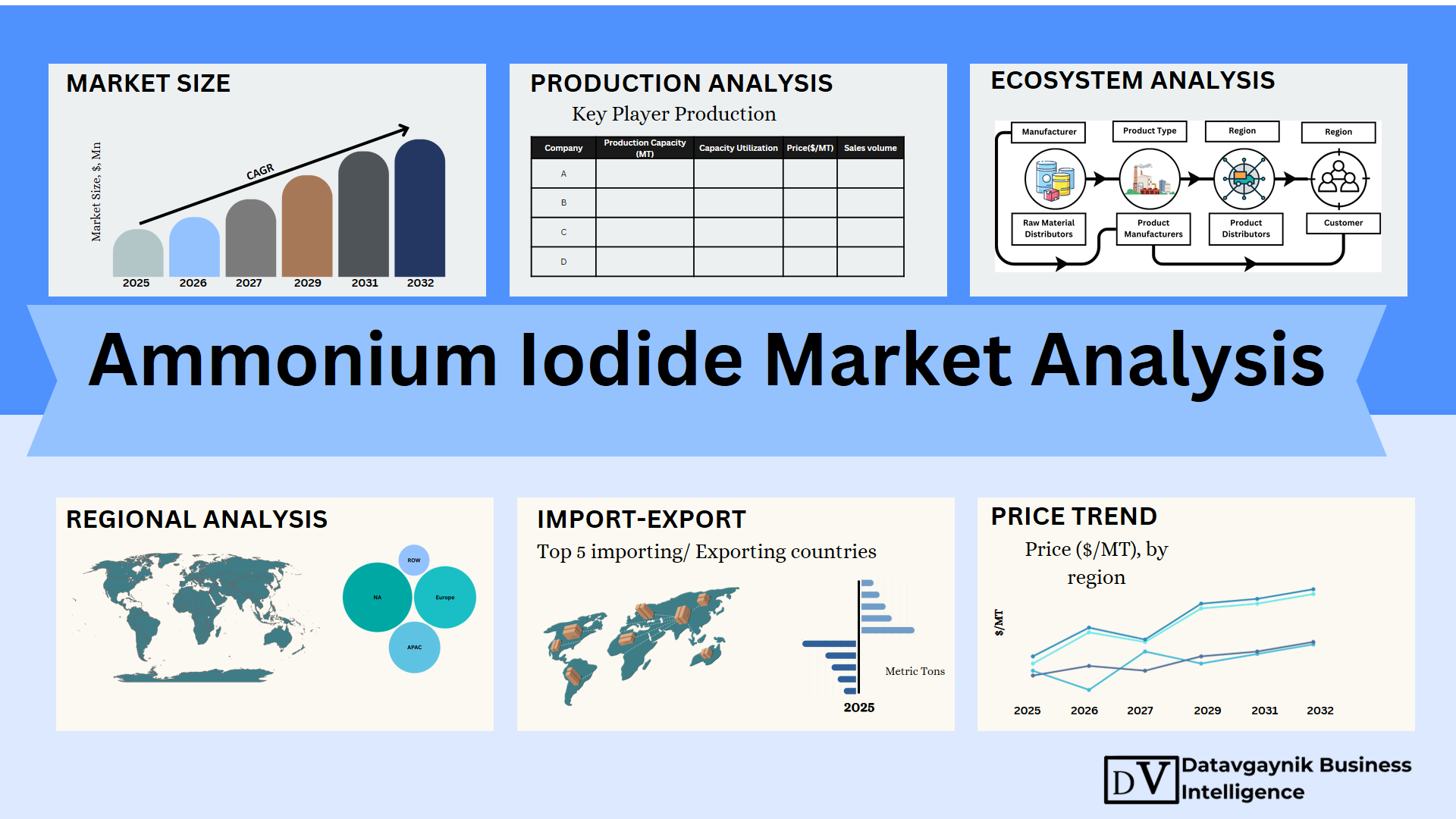
The Ammonium Iodide Market is undergoing a structural transformation driven by the convergence of healthcare advancements, chemical innovations, and increasing iodine-centric nutritional applications. As per Datavagyanik, this market is witnessing a steady uptick in volume demand, particularly propelled by healthcare and pharmaceutical end-use sectors. For instance, in respiratory therapies, Ammonium Iodide is frequently utilized in expectorant formulations targeting bronchitis and chronic cough. With respiratory diseases projected to affect over 650 million people globally by 2030, the rising demand for effective mucolytic agents is significantly boosting the Ammonium Iodide Market.
Pharmaceutical Innovation Driving Ammonium Iodide Market Expansion
One of the leading trends defining the trajectory of the Ammonium Iodide Market is the consistent expansion of pharmaceutical applications. The compound’s antimicrobial capabilities are increasingly leveraged in the development of infection-targeted formulations. As an example, recent research and development efforts in antibiotic-resistant treatments have renewed the interest in iodine-based active pharmaceutical ingredients (APIs). The global pharmaceutical R&D investment exceeded USD 250 billion in 2023, with iodine-derived compounds witnessing notable allocation. This push is directly stimulating the growth of the Ammonium Iodide Market Size.
Datavagyanik also covers related markets such as the Sodium Iodide Market, the Zinc iodide Market, and the Potassium Iodide Market. These markets reflect the interconnectedness of industrial forces that define the growth and direction of the primary topic.
Ammonium Iodide Market Supported by Chemical Synthesis Applications
Beyond pharmaceuticals, the Ammonium Iodide Market is deeply anchored in the field of chemical synthesis. As a vital reagent in iodinated compound formation, Ammonium Iodide plays a pivotal role in producing specialty chemicals used across agrochemicals, electronics, and dyes. For instance, the growing demand for precision agrochemicals and targeted pesticides in North America and Asia is catalyzing the adoption of iodinated intermediates. The specialty chemicals segment, which surpassed USD 800 billion globally in 2023, remains one of the most aggressive adopters of Ammonium Iodide.
Digital Transition Impacting Niche Segments in the Ammonium Iodide Market
While traditional photography has diminished due to the proliferation of digital technologies, the Ammonium Iodide Market retains relevance in niche imaging applications. It continues to be used in specialized photographic emulsions and silver halide film production for scientific and archival purposes. For instance, historical film preservation societies and high-resolution imaging research centers in Japan and Germany continue to source Ammonium Iodide-based compounds due to their chemical compatibility with legacy systems. Although this application segment is small in volume, it provides stability to demand within highly specialized industrial verticals.
Ammonium Iodide Market Growth Tied to Nutritional Supplementation Trends
The global focus on addressing iodine deficiency disorders (IDDs) has significantly elevated the role of the Ammonium Iodide Market in food and nutrition. For example, in Southeast Asia and parts of Sub-Saharan Africa, government-led programs are promoting iodine-fortified supplements and iodized foods. Ammonium Iodide serves as a controlled iodine source in such applications. The market for iodine-enriched nutritional products grew at a CAGR of 6.8% over the last five years, with Ammonium Iodide being a preferred compound due to its solubility and formulation flexibility. This health-driven trend is adding considerable momentum to the Ammonium Iodide Market Size.
Animal Feed Industry Emergence in the Ammonium Iodide Market Landscape
Another noteworthy growth driver within the Ammonium Iodide Market is its incorporation into animal feed supplements. In livestock-intensive economies such as Brazil, India, and Australia, iodine deficiency in grazing animals is a growing concern. Ammonium Iodide is being integrated into feed formulations to enhance animal health and reproductive performance. For instance, in India’s organized dairy segment, the adoption of iodized feed has grown by 12% year-on-year since 2020, underlining its impact on productivity and milk yield. This trend contributes to consistent base demand across the Ammonium Iodide Market.
Healthcare Infrastructure Investments Accelerating Ammonium Iodide Market Growth
Datavagyanik analysis indicates that emerging economies are now strategically investing in modernizing healthcare infrastructure, particularly focusing on respiratory care, diagnostics, and drug manufacturing. Countries like Indonesia, Vietnam, and Egypt have doubled their pharmaceutical investments between 2018 and 2023. Ammonium Iodide, due to its direct application in cough formulations and its use in iodinated diagnostic compounds, is benefitting from these expansions. The resulting increase in demand is reflected in higher procurement from local and regional pharmaceutical manufacturers, adding volume growth to the Ammonium Iodide Market.
Regulatory Support Bolstering the Ammonium Iodide Market
An important supportive trend observed in the Ammonium Iodide Market is the policy-level push for iodine sufficiency across various regions. For instance, salt iodization programs, nutritional mandates, and livestock feed guidelines issued by public health agencies are indirectly stimulating the uptake of iodine-based compounds. Ammonium Iodide, due to its adaptability and availability in multiple grades (pharmaceutical, industrial, laboratory), is increasingly being specified in regional procurement programs. In Latin America and East Africa, iodine compound imports increased by 14% year-over-year in 2023, with Ammonium Iodide forming a substantial share.
Technological Advancements Reshaping Ammonium Iodide Market Dynamics
The global shift toward sustainable chemical production is also influencing the Ammonium Iodide Market. For example, recent process enhancements in high-purity synthesis and environmentally neutral production methods have enabled manufacturers in Japan and the U.S. to meet regulatory compliance while expanding export volumes. As green chemistry practices become a defining theme in specialty chemical production, Ammonium Iodide suppliers that align with ISO and REACH standards are gaining stronger traction in both developed and developing regions.
Ammonium Iodide Market Benefits from Strategic Manufacturer Collaborations
The role of strategic partnerships between raw iodine suppliers, pharmaceutical formulators, and chemical synthesis companies is becoming more pronounced. For instance, supply chain collaboration between iodine mining firms in Chile and manufacturing plants in South Korea is creating a stable input channel for Ammonium Iodide production. This vertical integration ensures quality control and price stabilization, especially crucial in markets with high-purity grade requirements. Such developments are enabling consistent product availability across the Ammonium Iodide Market.
Rising Demand in Academic and Industrial Research Enhancing Ammonium Iodide Market Utilization
Academic institutions and industrial laboratories represent a fast-evolving demand segment in the Ammonium Iodide Market. The compound’s application in experimental chemistry, spectroscopy, and pharmaceutical synthesis studies is gaining prominence. For example, the rise in government-funded research programs in countries like Germany, South Korea, and Canada has led to increased purchases of laboratory-grade Ammonium Iodide. These purchases often align with precision requirements, emphasizing quality, batch consistency, and traceability—factors that premium-grade suppliers are capitalizing on.
“Track Country-wise Ammonium Iodide Production and Demand through our Ammonium Iodide Production Database”
-
-
- Ammonium Iodide production database for 26+ countries worldwide
- Ammonium Iodide sales volume for 30+ countries
- Country-wise Ammonium Iodide production capacity, production plant mapping, production capacity utilization for 26+ manufacturers
- Ammonium Iodide production plants and production plant capacity analysis by top manufacturers
-
“Track real-time Ammonium Iodide Prices, Ammonium Iodide price charts for 26+ countries, Ammonium Iodide weekly price tracker and Ammonium Iodide monthly price tracker”
-
-
- Track real-time Ammonium Iodide prices and Ammonium Iodide price trend in 26+ countries though our excel-based Ammonium Iodide price charts
- Real-time Ammonium Iodide price tracker dashboard with 26+ countries
- Complete transparency on Ammonium Iodide price trend through our Ammonium Iodide monthly price tracker, Ammonium Iodide weekly price tracker
-
North America Emerging as a Strategic Hub in the Ammonium Iodide Market
The Ammonium Iodide Market in North America is experiencing consistent growth, underpinned by a well-established pharmaceutical manufacturing ecosystem and the rising prevalence of respiratory disorders. For instance, the United States remains a top consumer of pharmaceutical-grade Ammonium Iodide, particularly for use in expectorants and iodine-enriched therapies. With chronic respiratory diseases affecting over 25 million people in the U.S. alone, the demand for iodine-based actives continues to rise. Moreover, high investment in R&D—over USD 100 billion annually by American pharmaceutical firms—is fueling the need for laboratory-grade Ammonium Iodide for synthesis and formulation trials.
Asia Pacific Leading Global Consumption in the Ammonium Iodide Market
Asia Pacific dominates the global Ammonium Iodide Market in terms of volume consumption, driven by surging demand in China and India. China, with its extensive base of chemical and pharmaceutical industries, not only consumes but also produces significant volumes of Ammonium Iodide. The nation’s chemical exports surpassed USD 400 billion in 2023, with iodinated compounds forming a crucial category. India, on the other hand, is witnessing a boom in pharmaceutical manufacturing due to growing domestic demand and export opportunities. India’s respiratory care drug market has been growing at over 11% CAGR since 2020, translating to rising requirements for Ammonium Iodide. Additionally, salt iodization programs and livestock iodine supplementation schemes in both nations are creating multiple touchpoints for the compound’s use.
Europe Strengthening Specialty Applications in the Ammonium Iodide Market
In Europe, the Ammonium Iodide Market is characterized by a focus on pharmaceutical innovation and specialty chemical synthesis. Countries such as Germany, France, and the UK are leading in pharmaceutical-grade consumption, particularly in therapeutic and diagnostic segments. Germany’s chemical industry, the largest in Europe, continues to integrate Ammonium Iodide in the synthesis of high-value iodinated intermediates for export. Additionally, the region’s push for personalized medicine and increased diagnostic accuracy is encouraging the use of iodine-based contrast agents, where Ammonium Iodide plays a preparatory role. As an example, the UK’s National Health Service has doubled procurement of iodine-based diagnostics between 2018 and 2023, amplifying demand within the Ammonium Iodide Market.
Middle East and Africa Expanding Demand through Healthcare and Agriculture
The Ammonium Iodide Market is gaining a foothold in the Middle East and Africa due to increased focus on public health and food security. For instance, Saudi Arabia and the UAE are investing heavily in iodine-based medication formulations, aligning with their national healthcare reforms. In regions such as East Africa, Ammonium Iodide demand is also supported by government-backed salt iodization campaigns. In Kenya, over 85% of the population is now covered by iodized salt programs, with Ammonium Iodide being used in production processes. This expanding footprint is establishing a reliable growth base in these regions, particularly for pharmaceutical and food-grade Ammonium Iodide.
Latin America Contributing as a Supplier and Consumer in the Ammonium Iodide Market
Latin America plays a dual role in the Ammonium Iodide Market—as a supplier of iodine raw material and a growing consumer of the end compound. Chile, the world’s second-largest iodine producer, provides essential inputs to Ammonium Iodide manufacturers globally. Meanwhile, Brazil and Argentina are increasing consumption, particularly in the agricultural and nutritional sectors. In Brazil, the livestock feed sector has adopted iodine-fortified formulations to boost milk production and reduce thyroid-related livestock diseases. This integration is driving up procurement from local and imported sources, creating steady growth for industrial-grade Ammonium Iodide.
Ammonium Iodide Market Segmentation by Application Indicates Strong Diversification
The Ammonium Iodide Market is segmented by application into pharmaceuticals, chemical synthesis, agriculture, food and nutrition, and research and laboratory use. Among these, the pharmaceutical segment accounts for over 40% of global demand, primarily driven by the widespread use of Ammonium Iodide in cough formulations, antimicrobial agents, and iodine-enriched nutritional products. For example, in Southeast Asia, demand for iodine-based expectorants has surged in urban areas with high pollution levels, triggering an annual growth of 9.4% in pharmaceutical-grade consumption.
Chemical synthesis represents another robust segment, particularly in the production of iodinated intermediates for specialty chemicals. Advanced materials manufacturing in regions like South Korea and Japan continues to integrate Ammonium Iodide in proprietary synthesis workflows. Meanwhile, the agricultural sector accounts for nearly 15% of the total demand, with strong traction from livestock health programs and iodine supplementation strategies.
End-User Industry Analysis Shows Strong Role of Pharmaceuticals and Agro-Economy
Pharmaceutical and healthcare industries are the largest end-users in the Ammonium Iodide Market, driven by the need for high-purity compounds. Hospitals, diagnostic labs, and contract manufacturing organizations are primary buyers. The agriculture sector follows closely, especially in iodine-deficient regions where animal feed manufacturers are mandated to add iodine fortifiers. For example, in Poland and Hungary, regulatory guidelines now require iodine supplementation in dairy feed, increasing the use of Ammonium Iodide across Eastern Europe.
The food industry also constitutes a growing consumer base. With rising awareness around iodine deficiency disorders, producers of fortified foods and iodine supplements are incorporating Ammonium Iodide due to its solubility and bioavailability. The laboratory and research segment, though niche, is expanding steadily due to the increase in public and private R&D spending globally.
Ammonium Iodide Market Segmentation by Grade Reflects Application-Specific Growth
By grade, the Ammonium Iodide Market is divided into pharmaceutical, industrial, and laboratory grades. Pharmaceutical-grade Ammonium Iodide commands the highest share due to stringent purity requirements in formulations. Laboratory-grade is increasingly in demand from institutions conducting spectroscopic and chemical analysis. Meanwhile, industrial-grade Ammonium Iodide caters to agriculture and chemical synthesis needs, particularly in high-volume, cost-sensitive applications. Each grade sees demand growth corresponding to regional policy and industrial specialization.
Global Ammonium Iodide Production Landscape and Trade Flow Patterns
The global production landscape of the Ammonium Iodide Market is strategically aligned with iodine availability. Japan, leveraging its iodine-rich brine sources and advanced chemical processing technology, remains a dominant producer of high-purity Ammonium Iodide. The United States and China also host significant manufacturing capacities, supported by domestic iodine refining and pharmaceutical integration.
Trade flow dynamics show that pharmaceutical-grade Ammonium Iodide is primarily exported from Japan and the U.S. to Europe, Southeast Asia, and Latin America. Meanwhile, industrial-grade volumes are traded more freely, with China, India, and South Korea both producing and importing to meet flexible specifications. Datavagyanik notes that export of Ammonium Iodide from Japan increased by 17% between 2020 and 2023, signifying strong external demand, particularly from pharmaceutical contract manufacturers in emerging markets.
Ammonium Iodide Price Reflecting Supply Chain Complexity and Regulatory Compliance
The current Ammonium Iodide Price reflects the interplay of supply chain logistics, raw iodine availability, and regulatory stringency. For instance, in early 2024, Ammonium Iodide Price saw a modest increase of 6% in North America due to raw iodine shortages and tightening FDA quality requirements. Similarly, European buyers faced a 4–7% rise in Ammonium Iodide Price due to increased energy costs impacting chemical production in Germany and France.
Ammonium Iodide Price Trend analysis from Datavagyanik shows that prices for pharmaceutical-grade variants have remained 15–20% higher than industrial grades over the past three years, primarily due to purification costs and batch validation expenses. In Asia Pacific, however, price volatility is relatively muted due to strong local production and government-backed price stabilization efforts in essential medicines.
Ammonium Iodide Price Trend Impacting Procurement Strategies
Shifts in Ammonium Iodide Price Trend are reshaping procurement strategies across industries. For example, pharmaceutical manufacturers in India and Thailand are increasingly entering into long-term supply contracts to lock in pricing amid anticipated regulatory changes. Similarly, feed additive producers in Latin America are exploring multi-source imports to avoid price shocks in the Ammonium Iodide Market.
Manufacturers are also investing in backward integration and refining technologies to mitigate cost pressures. In Japan, high-purity production facilities have implemented real-time process controls to optimize yields and reduce impurity-related reprocessing, helping stabilize Ammonium Iodide Price in premium segments.
Conclusion: Geographical Demand and Pricing Trends Reinforce a Resilient Ammonium Iodide Market
From China’s bulk chemical production to North America’s high-purity pharmaceutical formulation, the Ammonium Iodide Market is uniquely positioned with broad geographical integration and sectoral depth. With multiple demand drivers operating across regional and industrial lines, coupled with evolving Ammonium Iodide Price dynamics, the market remains resilient. As per Datavagyanik, the upward Ammonium Iodide Price Trend in regulated markets and the diversification of application areas continue to fortify long-term growth prospects globally.
“Ammonium Iodide Manufacturing Database, Ammonium Iodide Manufacturing Capacity”
-
-
- Ammonium Iodide top manufacturers market share for 26+ manufacturers
- Top 8 manufacturers and top 16 manufacturers of Ammonium Iodide in North America, Europe, Asia Pacific
- Ammonium Iodide production plant capacity by manufacturers and Ammonium Iodide production data for 26+ market players
- Ammonium Iodide production dashboard, Ammonium Iodide production data in excel format
-
“Ammonium Iodide price charts, Ammonium Iodide weekly price tracker and Ammonium Iodide monthly price tracker”
-
-
- Factors impacting real-time Ammonium Iodide prices in 21+ countries worldwide
- Ammonium Iodide monthly price tracker, Ammonium Iodide weekly price tracker
- Real-time Ammonium Iodide price trend, Ammonium Iodide price charts, news and updates
- Tracking Ammonium Iodide price fluctuations
-
Leading Manufacturers Shaping the Ammonium Iodide Market Landscape
The Ammonium Iodide Market is increasingly consolidated, with a handful of global manufacturers dominating high-purity production and a broad base of regional players fulfilling industrial and bulk requirements. These manufacturers are differentiated by their technological capabilities, iodine sourcing strategies, and their alignment with regulatory frameworks for pharmaceutical and food-grade applications. High-purity producers based in Japan, the United States, and parts of Europe are setting global benchmarks, while manufacturers in China and India are expanding aggressively into cost-efficient, volume-driven segments.
Top Manufacturers in the Global Ammonium Iodide Market
- Ajay-SQM Group – A key player in the high-purity segment of the Ammonium Iodide Market, this manufacturer focuses on iodine derivatives including Ammonium Iodide for pharmaceutical and food-grade applications. Their product line includes purified iodide salts used in respiratory therapeutics and nutritional supplements. With vertically integrated operations involving iodine extraction and compound formulation, the company holds a strong position in the North American and European markets.
- Iofina plc – Specializing in iodine-based compounds, this company is known for its innovative extraction technology from brine streams in the U.S. Its Ammonium Iodide products serve high-end pharmaceutical customers and laboratory research institutions. The company’s robust iodine sourcing model ensures stable pricing and quality, making it a preferred supplier for clients with stringent purity requirements.
- Deepwater Chemicals – With a focus on pharmaceutical and reagent-grade iodine derivatives, this manufacturer supplies a consistent range of high-purity Ammonium Iodide products under specialized product codes. Their U.S.-based manufacturing setup caters to both domestic healthcare markets and export demands, especially in Europe and Southeast Asia. The company’s cleanroom formulation processes and batch traceability protocols have earned it contracts with top-tier pharmaceutical formulators.
- Samrat Pharmachem Ltd. – Based in India, this manufacturer is among the largest producers of iodine salts in South Asia. Their Ammonium Iodide portfolio is primarily geared towards bulk supply for pharmaceutical companies, food supplement producers, and chemical synthesis plants. The company’s flexibility in customizing grades and packaging sizes makes it a preferred partner for contract manufacturing organizations (CMOs).
- Nippoh Chemicals Co., Ltd. – Headquartered in Japan, this company plays a dominant role in the Asia-Pacific Ammonium Iodide Market. It supplies ultra-high purity Ammonium Iodide, used extensively in diagnostics and advanced chemical synthesis. The company has established long-term supply contracts with electronic materials firms and pharmaceutical innovators, allowing it to maintain a high-margin segment in the premium-grade category.
- Hangzhou Dayangchem Co., Ltd. – A significant exporter of fine chemicals and specialty compounds from China, this manufacturer covers industrial-grade and lab-grade Ammonium Iodide requirements for customers in over 40 countries. Their diverse product catalog and ability to produce customized batches have made them a versatile supplier across segments like agrochemicals, research, and electronic manufacturing.
- Triveni Interchem Pvt. Ltd. – With a focus on domestic distribution and moderate exports, this India-based firm offers competitively priced Ammonium Iodide for the chemical and pharmaceutical industries. Their regional presence is particularly strong in South Asia and Africa, where price sensitivity is a major factor.
Ammonium Iodide Market Share by Manufacturers
The top five players collectively hold approximately 60%–65% of the global high-purity Ammonium Iodide Market share. Among them, Japanese and U.S. firms account for over 30% due to their dominance in pharmaceutical and diagnostic-grade production. Indian manufacturers collectively represent about 20% of the global market, primarily due to their strength in industrial and generic pharmaceutical applications. Chinese manufacturers maintain 10%–15% share, with focus on flexible manufacturing, competitive pricing, and bulk exports to emerging markets.
Regional players, while not dominating globally, often capture significant market share within their respective territories. For instance, Eastern European firms and Middle Eastern distributors cater to institutional and feed additive buyers under public health procurement schemes. These players tend to operate in lower-margin segments but provide essential supply chain flexibility.
Manufacturer Strategy and Product Positioning
Top manufacturers are increasingly focused on diversifying their Ammonium Iodide portfolios across pharmaceutical, industrial, and research segments. For example, Ajay-SQM and Deepwater Chemicals have launched product variants with improved solubility and stability for use in complex formulations. Nippoh Chemicals has recently introduced a diagnostic-grade Ammonium Iodide with 99.9% purity aimed at contrast media synthesis.
On the other hand, companies like Samrat Pharmachem and Triveni Interchem are introducing value packaging and blended compounds for livestock feed manufacturers and food processors. This strategic segmentation is enabling broader penetration of Ammonium Iodide in both developed and emerging markets.
Recent Developments in the Ammonium Iodide Market
- January 2024: Deepwater Chemicals announced a facility upgrade in Oklahoma, focused on increasing capacity for pharmaceutical-grade Ammonium Iodide by 25%. The expansion is targeted to serve growing demand from European respiratory drug manufacturers.
- March 2024: Samrat Pharmachem Ltd. secured a new export contract with a multinational nutraceutical company to supply Ammonium Iodide for iodine-enriched supplements across Southeast Asia. This deal is expected to raise the company’s export volume by 15% year-on-year.
- April 2024: Hangzhou Dayangchem expanded its laboratory-grade chemical catalog to include micronized Ammonium Iodide tailored for precision synthesis and photochemical applications, particularly aimed at R&D institutions in North America.
- February 2024: Iofina plc disclosed a new partnership with a diagnostics company to develop next-generation iodine-based tracers, leveraging their Ammonium Iodide production for formulation trials. The project is part of a broader initiative to innovate non-radioactive imaging agents.
“Ammonium Iodide Production Data and Ammonium Iodide Production Trend, Ammonium Iodide Production Database and forecast”
-
-
- Ammonium Iodide production database for historical years, 10 years historical data
- Ammonium Iodide production data and forecast for next 7 years
- Ammonium Iodide sales volume by manufacturers
-
“Track Real-time Ammonium Iodide Prices for purchase and sales contracts, Ammonium Iodide price charts, Ammonium Iodide weekly price tracker and Ammonium Iodide monthly price tracker”
-
-
- Gain control on your purchase and sales contracts through our real-time Ammonium Iodide price tracker and Ammonium Iodide price trend analysis
- Ammonium Iodide weekly price tracker and forecast for next four weeks
- Ammonium Iodide monthly price tracker and forecast for next two months
-
Market Scenario, Demand vs Supply, Average Product Price, Import vs Export, till 2032
- Global Ammonium Iodide Market revenue and demand by region
- Global Ammonium Iodide Market production and sales volume
- United States Ammonium Iodide Market revenue size and demand by country
- Europe Ammonium Iodide Market revenue size and demand by country
- Asia Pacific Ammonium Iodide Market revenue size and demand by country
- Middle East & Africa Ammonium Iodide Market revenue size and demand by country
- Latin America Ammonium Iodide Market revenue size and demand by
- Import-export scenario – United States, Europe, APAC, Latin America, Middle East & Africa
- Average product price – United States, Europe, APAC, Latin America, Middle East & Africa
- Market player analysis, competitive scenario, market share analysis
- Business opportunity analysis
Key questions answered in the Global Ammonium Iodide Market Analysis Report:
- What is the market size for Ammonium Iodide in United States, Europe, APAC, Middle East & Africa, Latin America?
- What is the yearly sales volume of Ammonium Iodide and how is the demand rising?
- Who are the top market players by market share, in each product segment?
- Which is the fastest growing business/ product segment?
- What should be the business strategies and Go to Market strategies?
The report covers Ammonium Iodide Market revenue, Production, Sales volume, by regions, (further split into countries):
- Asia Pacific (China, Japan, South Korea, India, Indonesia, Vietnam, Rest of APAC)
- Europe (UK, Germany, France, Italy, Spain, Benelux, Poland, Rest of Europe)
- North America (United States, Canada, Mexico)
- Latin America (Brazil, Argentina, Rest of Latin America)
- Middle East & Africa
Table of Contents:
Ammonium Iodide Market
- Introduction to Ammonium Iodide
-
- 1.1 Overview and Chemical Properties of Ammonium Iodide
- 1.2 Historical Context and Key Industrial Applications
- Market Dynamics and Insights
-
- 2.1 Drivers Supporting Market Growth
- 2.2 Challenges and Constraints Impacting the Market
- 2.3 Emerging Trends and New Opportunities
- Product Segmentation of Ammonium Iodide
-
- 3.1 Pharmaceutical-Grade Ammonium Iodide
- 3.2 Industrial-Grade Ammonium Iodide
- 3.3 Specialty and Research-Grade Ammonium Iodide
- Applications of Ammonium Iodide
-
- 4.1 Use in Pharmaceuticals and Medical Formulations
- 4.2 Role in Chemical Synthesis and Reagents
- 4.3 Applications in Photography and Imaging Technologies
- 4.4 Emerging Uses in Advanced Materials and Catalysis
- Global Market Overview and Key Trends
-
- 5.1 Historical Market Data (2019-2024)
- 5.2 Forecasted Market Growth and Trends (2024-2032)
- Regional Market Analysis
-
- 6.1 North America: Insights into Research and Medical Applications
- 6.2 Europe: Regulatory Dynamics and Market Drivers
- 6.3 Asia Pacific: Rising Production and Application Diversification
- 6.4 Latin America: Untapped Potential in Industrial Sectors
- 6.5 Middle East & Africa: Opportunities and Regional Challenges
- Production and Manufacturing Insights
-
- 7.1 Leading Manufacturers and Production Capacities
- 7.2 Technological Innovations in Ammonium Iodide Synthesis
- Raw Material and Supply Chain Analysis
-
- 8.1 Availability of Iodine Resources and Extraction Processes
- 8.2 Supply Chain Challenges and Risk Mitigation
- End-Use Market Demand and Consumption Analysis
-
- 9.1 Growth in Pharmaceutical and Medical Industries
- 9.2 Demand from Specialty Chemical Manufacturing
- 9.3 Role in Advanced Research and Development
- Pricing Trends and Cost Structure Analysis
-
- 10.1 Historical Pricing Patterns for Ammonium Iodide
- 10.2 Cost Dynamics in Production and Distribution
- Global Trade and Market Connectivity
-
- 11.1 Export Patterns and Leading Exporting Countries
- 11.2 Import Demand in High-Growth Regions
- 11.3 Impacts of Trade Policies and Tariffs
- Competitive Landscape
-
- 12.1 Overview of Key Market Players and Market Shares
- 12.2 Strategies for Competitive Advantage
- 12.3 Recent Developments and Partnerships
- Technological Innovations in Ammonium Iodide Applications
-
- 13.1 Advances in Catalytic and Chemical Applications
- 13.2 Emerging Uses in High-Performance Materials
- Environmental and Safety Considerations
-
- 14.1 Environmental Impacts of Ammonium Iodide Manufacturing
- 14.2 Safety Standards and Compliance Requirements
- Emerging Applications and Market Potential
-
- 15.1 Role in Green and Sustainable Technologies
- 15.2 Use in Cutting-Edge Research Fields
- Market Growth Projections and Future Trends (2024-2032)
-
- 16.1 Regional Demand and Supply Forecasts
- 16.2 Growth Potential in Emerging Economies
- Distribution and Marketing Strategies
-
- 17.1 Role of Distributors in Expanding Market Reach
- 17.2 Opportunities in Online and Direct Sales Platforms
- Investment Opportunities in Ammonium Iodide Market
-
- 18.1 Strategic Areas for Growth and Development
- 18.2 Collaborative Ventures and Mergers
- Macroeconomic and Policy Impacts
-
- 19.1 Influence of Economic Trends on Market Dynamics
- 19.2 Regulatory and Trade Policy Implications
- Strategic Recommendations for Market Stakeholders
-
- 20.1 Entry Strategies for New Market Participants
- 20.2 Innovation and Differentiation as Key Strategies


