

Global Demand Dynamics and Structural Growth in the Perfluoroalkoxy PFA Market
The Perfluoroalkoxy PFA Market is undergoing a substantial transformation driven by rising demand for high-performance polymers across industrial verticals. This transformation is not isolated to a specific region or application; instead, it reflects a broader industry shift toward materials that offer chemical inertness, high thermal resistance, and ultra-high purity. Perfluoroalkoxy (PFA), a melt-processable fluoropolymer, is emerging as a critical enabler of innovation in sectors ranging from semiconductors and electronics to renewable energy and life sciences.
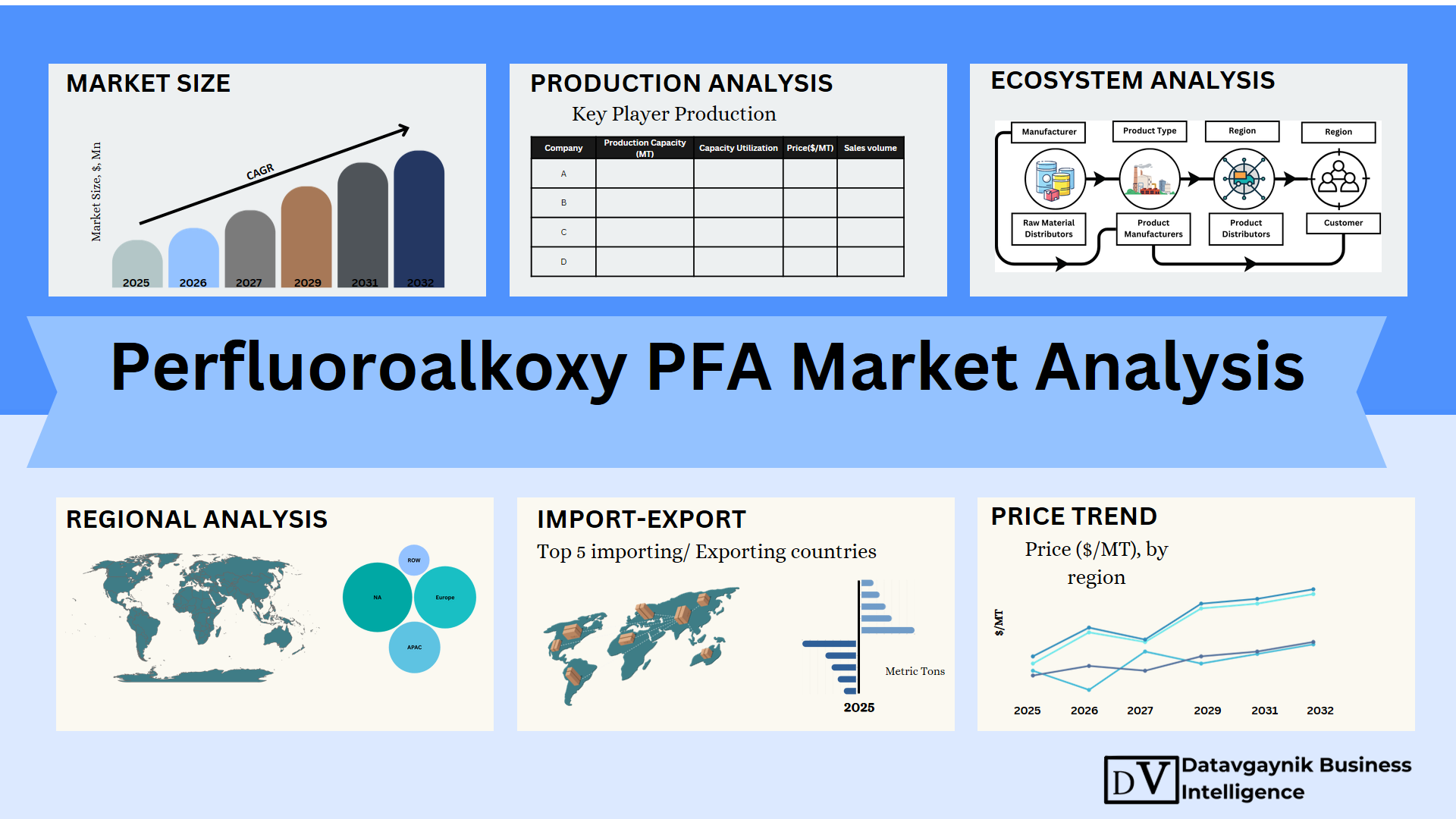
Perfluoroalkoxy PFA Market Size is set to expand significantly between 2024 and 2032, driven by its widening scope of application. For instance, the global shift toward smart electronics, clean energy, and high-purity chemical manufacturing has directly translated into an increased reliance on fluoropolymers like PFA. Datavagyanik estimates indicate a multi-billion-dollar market trajectory, with above-average CAGR expected during the forecast window.
Semiconductor Industry: The Core Growth Engine for the Perfluoroalkoxy PFA Market
The semiconductor sector has become the largest consumer of PFA globally, and this trend is poised to strengthen. For example, in the manufacturing of advanced microchips, PFA is used in wafer handling, etching tools, and ultrapure chemical transport systems. These applications demand materials that can perform reliably under extreme thermal and chemical stress while ensuring zero contamination. PFA’s non-leaching, chemically resistant profile aligns precisely with these performance benchmarks.
The global semiconductor industry, valued at over USD 600 billion in 2023, is forecasted to surpass USD 1 trillion by 2030. This growth directly fuels demand in the Perfluoroalkoxy PFA Market, especially as new fabs are being constructed across Asia Pacific, North America, and Europe to support chip production for AI, 5G, and IoT applications. Each fabrication facility requires kilometers of PFA-lined piping and dozens of PFA-coated tools, creating strong forward demand momentum.
Datavagyanik also covers related markets such as the PFA (Perfluoroalkoxy) Pipes Market. Their relevance lies in how they intersect with the core topic, influencing investment trends and shaping market opportunities.
Chemical Processing Sector Driving Volume Consumption in the Perfluoroalkoxy PFA Market
The chemical processing industry has been a legacy consumer of PFA due to the material’s excellent chemical resistance and thermal endurance. It is extensively used in reactor linings, gaskets, seals, and pipes handling strong acids, alkalis, and solvents. For instance, in acid processing units or chlor-alkali plants, PFA-lined components reduce corrosion rates and extend maintenance intervals, leading to improved plant uptime.
With global chemical production projected to grow at 3–4% CAGR until 2030, especially in emerging regions like Southeast Asia and Latin America, the Perfluoroalkoxy PFA Market is poised to benefit from increasing capex in chemical plants. Additionally, sustainability regulations are pushing plant operators to adopt durable, non-leaching materials to reduce the risk of environmental leakage—another factor supporting the penetration of PFA over traditional linings.
Renewable Energy Integration Expanding the Application Base for the Perfluoroalkoxy PFA Market
The clean energy transition has created new avenues for PFA utilization, particularly in photovoltaic panels and battery energy storage systems. In solar applications, PFA coatings are used to protect photovoltaic modules from UV degradation, chemical exposure, and extreme weather. In energy storage, PFA is applied in battery pack liners and chemical transport tubes due to its non-reactivity and mechanical strength.
For example, global solar PV capacity surpassed 1,400 GW in 2023, and installations are expected to exceed 2,500 GW by 2030. Each megawatt of solar capacity contains components that benefit from PFA protection, especially in utility-scale projects exposed to harsh environmental conditions. As battery energy storage is forecasted to grow at a CAGR exceeding 25% over the next decade, the Perfluoroalkoxy PFA Market will continue to gain from this ongoing transformation.
Medical and Life Sciences Sector Accelerating High-Purity Consumption in the Perfluoroalkoxy PFA Market
In the pharmaceutical and medical device industries, PFA’s biocompatibility and non-reactive nature make it the material of choice for applications such as sterile tubing, labware, and analytical equipment. For instance, during biopharma production, the use of PFA-lined containers and tubing ensures that there is no interaction between reactive pharmaceutical ingredients and the container wall.
The global pharmaceutical manufacturing sector is undergoing a modernization wave focused on contamination control and process integrity. This directly correlates with rising demand in the Perfluoroalkoxy PFA Market, especially in countries with high R&D investment like the United States, Germany, and Japan. The use of PFA in single-use systems (SUS) and continuous manufacturing platforms is expected to further boost its role in this sector.
Electronics and Wiring Applications Strengthening Material Demand Across Developed Economies
Another significant growth contributor to the Perfluoroalkoxy PFA Market is the electronics industry, where PFA is used as an insulator in wire and cable applications due to its exceptional dielectric properties. For example, high-frequency cables in aerospace, defense, and data centers demand insulation materials that can withstand both electrical stress and thermal cycling, and PFA meets both requirements.
As the global electric vehicle (EV) market expands, so does the need for high-voltage cable insulation. In 2023 alone, over 14 million EVs were sold globally, and that number is projected to reach 35 million units annually by 2030. PFA is increasingly replacing conventional insulators in EVs due to its ability to handle higher currents and reduce thermal breakdown—enhancing vehicle safety and reliability. This evolving demand structure supports continued expansion in the Perfluoroalkoxy PFA Market.
3D Printing and Advanced Manufacturing Creating Niche Demand in the Perfluoroalkoxy PFA Market
Additive manufacturing is another segment where PFA’s properties offer competitive advantages. For example, in industrial 3D printing applications that use aggressive resins or require high dimensional accuracy at elevated temperatures, PFA-based nozzles and feed lines ensure uninterrupted operation and resistance to chemical fouling.
Though still a niche, the 3D printing market is growing at a CAGR above 20%, and PFA’s ability to operate in chemically reactive environments presents new monetization opportunities for material producers. As industries continue to adopt digital manufacturing technologies, PFA’s role in high-performance polymer additive applications is expected to increase.
Environmental Regulations and Compliance Mandates Reinforcing PFA Adoption
One of the most significant drivers of the Perfluoroalkoxy PFA Market is regulatory pressure. Stricter norms related to chemical exposure, emissions, and product durability have led to a re-evaluation of material choices across multiple sectors. For instance, in the European Union, REACH and RoHS directives have compelled industries to adopt non-leaching, long-lasting materials such as PFA to meet compliance standards.
Similarly, in the United States, the EPA’s increasing scrutiny of industrial waste and corrosion-prone infrastructure has pushed chemical processors and manufacturers toward materials that ensure minimal leakage and extended lifespan. This regulatory-driven shift in procurement practices continues to underpin the long-term demand trajectory of the Perfluoroalkoxy PFA Market.
Perfluoroalkoxy PFA Market Size Reflects Its Strategic Value Across Applications
As of 2024, the Perfluoroalkoxy PFA Market Size is witnessing a year-over-year increase in both volume and value. For instance, high-purity PFA grades used in semiconductor and pharmaceutical sectors command a premium due to their stringent quality requirements. The average selling price (ASP) of such grades has increased by over 8% in the past two years, reflecting the supply-demand imbalance in high-tech end-uses.
In contrast, industrial-grade PFA used in chemical processing or automotive wire insulation has experienced stable pricing due to broader supply availability. This segmentation within the Perfluoroalkoxy PFA Market is essential to understanding its performance across value chains. Datavagyanik projects the market size to exceed a significant threshold by 2032, driven by volume growth in semiconductors, EVs, and green energy.
“Track Country-wise Perfluoroalkoxy PFA Production and Demand through our Perfluoroalkoxy PFA Production Database”
- Perfluoroalkoxy PFA production database for 27+ countries worldwide
- Perfluoroalkoxy PFA Powder sales volume for 31+ countries
- Country-wise Perfluoroalkoxy PFA production capacity and production plant mapping, production capacity utilization for 27+ manufacturers
- Perfluoroalkoxy PFA production plants and production plant capacity analysis for top manufacturers
Asia Pacific Leading Regional Consumption in the Perfluoroalkoxy PFA Market
The Asia Pacific region remains the largest consumer in the Perfluoroalkoxy PFA Market, with countries like China, Japan, South Korea, and India driving substantial volume demand. This dominance is primarily due to the region’s leadership in semiconductor fabrication, chemical processing, and electronics manufacturing. For instance, China alone accounted for more than 35% of global semiconductor packaging output in 2023, and with increasing localization of chip production, demand for high-purity PFA materials used in etching and wafer transport systems continues to rise sharply.
In Japan and South Korea, the integration of PFA into high-performance electronic applications and clean energy systems is well established. Japan’s solar capacity exceeded 85 GW in 2023, with PFA components being deployed in protective linings of photovoltaic systems and battery containers. South Korea’s emphasis on electric vehicle production and solid-state battery R&D has further increased demand for thermally stable PFA components. Datavagyanik projects a CAGR of over 6.5% for the Asia Pacific Perfluoroalkoxy PFA Market between 2024 and 2030, supported by infrastructure expansions in semiconductor fabs and next-gen battery plants.
North America Expanding Domestic Capabilities in the Perfluoroalkoxy PFA Market
North America, led by the United States, represents a mature but rapidly evolving region within the Perfluoroalkoxy PFA Market. Historically dependent on imports, the U.S. is now investing heavily in domestic semiconductor and advanced materials production under policy frameworks such as the CHIPS and Science Act. For instance, over USD 50 billion in incentives have been announced to boost local chip fabrication. As each wafer fab requires extensive use of PFA-lined piping, valves, and containment systems, regional demand is surging.
The healthcare sector is another important contributor in North America. With the U.S. pharmaceutical and bioprocessing industries shifting toward single-use systems and contamination-free production, PFA tubing, gaskets, and labware have seen increased uptake. Canada, with its growing clean energy capacity—especially in solar and hydrogen—also adds to regional demand, particularly for components requiring both non-reactivity and resistance to UV and heat. As a result, the North American Perfluoroalkoxy PFA Market is expected to grow at 5.8% CAGR through 2030.
Europe Showing Strong Sustainability-Driven Demand in the Perfluoroalkoxy PFA Market
Europe’s Perfluoroalkoxy PFA Market is being fueled by the continent’s focus on clean technology, chemical safety, and high-precision manufacturing. Germany, the region’s largest market, integrates PFA into its growing semiconductor ecosystem as well as renewable energy systems. For example, in wind turbine installations, PFA-coated cabling and chemical containment systems are used to enhance operational life and resist marine corrosion. With Germany targeting 80% renewable electricity by 2030, the use of PFA in energy systems is forecasted to rise accordingly.
France and the United Kingdom are also key players. France’s aerospace and medical industries utilize PFA in sterile medical components and high-performance insulation for aircraft wiring. In the UK, significant investment in offshore wind farms and EV infrastructure supports rising PFA demand in both energy and automotive segments. Scandinavian countries such as Sweden and Denmark, leaders in sustainable engineering, are increasingly incorporating PFA in hydrogen production facilities and grid storage systems due to its non-leaching and high thermal stability properties.
Middle East and Latin America Emerging as Strategic Growth Zones for the Perfluoroalkoxy PFA Market
The Middle East is a rising player in the global Perfluoroalkoxy PFA Market, particularly in countries like the United Arab Emirates and Saudi Arabia. With massive investments in solar farms such as the Mohammed bin Rashid Al Maktoum Solar Park and the Red Sea renewable energy projects, the deployment of PFA in solar module coatings and energy storage units has increased. Saudi Arabia’s Vision 2030 industrial policy is also driving PFA consumption in desalination plants and high-purity chemical systems, both of which benefit from PFA’s superior corrosion resistance.
Latin America, led by Brazil and Mexico, is experiencing a gradual increase in demand for Perfluoroalkoxy PFA due to industrial modernization. In Brazil, where agrochemical production and mining dominate the economy, PFA is used in reactor linings, transfer piping, and protective coatings to manage aggressive chemicals. Mexico, with growing EV component exports, is incorporating PFA in battery insulation and thermal control systems. Though currently a small percentage of global share, Datavagyanik forecasts Latin America’s Perfluoroalkoxy PFA Market to register over 4.5% CAGR from 2024 to 2032.
Production Trends Shaping Global Supply in the Perfluoroalkoxy PFA Market
Global production of PFA is heavily concentrated in Asia Pacific, with China, Japan, and South Korea accounting for more than 60% of total output. China, in particular, has ramped up capacity in response to surging domestic demand in semiconductors and EVs. While local firms supply the bulk of industrial-grade PFA, high-purity variants for semiconductor and pharmaceutical use still depend on imports from Japan and the U.S.
Japanese companies maintain a leading position in ultra-high-purity PFA production through proprietary refining technologies. These materials are critical for applications requiring zero contamination, such as logic chip fabrication at sub-5 nm nodes. South Korea, with its proximity to major electronics producers, balances internal demand and strategic exports. Meanwhile, the United States has increased efforts to localize production through public-private collaborations, although it still imports from Asia for several specialty grades.
Diverse Application-Based Segmentation Defining the Perfluoroalkoxy PFA Market Landscape
The Perfluoroalkoxy PFA Market is segmented across several high-growth verticals. The semiconductor segment remains dominant, accounting for over 35% of total PFA demand in 2023. This includes usage in wafer baths, chemical distribution piping, and precision tubing for acid transport. With AI chip production set to grow at a double-digit CAGR, this segment will remain a cornerstone of volume growth.
Chemical processing forms the second-largest segment, covering use in linings, tanks, and seals where aggressive media are handled. The renewable energy segment is fast catching up, particularly with increasing installations of photovoltaic panels, battery storage units, and hydrogen production systems. In healthcare and life sciences, PFA finds use in sterile filtration systems, diagnostic devices, and continuous drug processing.
The automotive and EV sector is also emerging as a high-potential application area. Thermal management systems and high-voltage EV cabling now increasingly demand PFA insulation due to its stability and resistance to thermal and mechanical degradation.
Perfluoroalkoxy PFA Price and Perfluoroalkoxy PFA Price Trend Across Grades and Regions
Perfluoroalkoxy PFA Price varies widely depending on the purity level, application grade, and supply origin. As of Q1 2025, the average global industrial-grade Perfluoroalkoxy PFA Price stands between USD 60 to 80 per kilogram, with high-purity grades for semiconductor applications priced at USD 130 to 160 per kilogram. This wide price gap reflects not only purity differentials but also supply chain complexity and limited production capabilities in certain regions.
In Asia, particularly China, the Perfluoroalkoxy PFA Price has shown moderate fluctuations due to changes in raw material availability, particularly fluorspar. In 2023, raw material shortages pushed prices up by nearly 12% year-on-year. However, with capacity expansions coming online in 2025, stabilization is expected. In North America, prices have remained relatively stable due to long-term procurement contracts, although specialty imports from Japan have shown volatility.
Europe’s Perfluoroalkoxy PFA Price Trend reflects premium pricing, especially for medical and clean energy applications, due to regulatory compliance and stricter quality norms. Meanwhile, emerging markets in Latin America and the Middle East are witnessing higher prices due to limited domestic production and dependency on imports.
Overall, the Perfluoroalkoxy PFA Price Trend suggests continued upward pressure in high-purity segments through 2026, while industrial-grade prices may stabilize as production catches up with demand.
“Perfluoroalkoxy PFA Manufacturing Database, Perfluoroalkoxy PFA Manufacturing Capacity”
- Perfluoroalkoxy PFA top manufacturers market share for 27+ manufacturers
- Top 8 manufacturers and top 17 manufacturers of Perfluoroalkoxy PFA in North America, Europe, Asia Pacific
- Production plant capacity by manufacturers and Perfluoroalkoxy PFA production data for 27+ market players
- Perfluoroalkoxy PFA production dashboard, Perfluoroalkoxy PFA production data in excel format
Top Manufacturers Driving Growth in the Perfluoroalkoxy PFA Market
The Perfluoroalkoxy PFA Market is led by a select group of global manufacturers that dominate both production capacity and technological innovation. These companies supply a broad range of PFA product grades tailored to applications in semiconductors, chemical processing, healthcare, electronics, and renewable energy. Each has established a distinct positioning through specialized formulations, proprietary technologies, and integrated supply chains.
The Chemours Company – Teflon™ PFA Series
One of the most prominent manufacturers in the Perfluoroalkoxy PFA Market is The Chemours Company. It holds a substantial share of the global market, supplying PFA under its Teflon™ brand. The Teflon™ PFA series is widely used in high-purity applications such as semiconductor etching baths, acid delivery tubing, and ultra-clean fluid systems. These products are engineered to maintain dimensional stability and prevent contamination under extreme thermal and chemical conditions. Chemours’ extensive global distribution network and focus on high-end industrial sectors position it as a benchmark in the industry.
Daikin Industries – Neoflon™ PFA Grades
Daikin Industries is another major stakeholder in the Perfluoroalkoxy PFA Market, offering the Neoflon™ line of PFA resins. These grades are designed for superior chemical resistance and formability, making them ideal for high-temperature coatings, semiconductor wafers, and critical fluid control systems. Daikin’s strength lies in its ability to serve both general industrial needs and highly specialized markets such as electronics and pharmaceutical processing. Its backward integration into fluorochemical production ensures stable supply and cost control, which further enhances its global market share.
Solvay – Hyflon® PFA Portfolio
Solvay has made its mark in the Perfluoroalkoxy PFA Market through the Hyflon® PFA product range. These materials are tailored for applications where ultra-pure processing is required, such as in biopharmaceutical production systems, precision chemical reactors, and energy storage equipment. Hyflon® PFA grades are known for low extractables and high clarity, making them suitable for medical and analytical equipment. Solvay’s global manufacturing footprint and R&D investment in high-performance materials reinforce its strategic market positioning.
AGC Inc. – Fluon® PFA Series
AGC Inc. continues to expand its role in the Perfluoroalkoxy PFA Market through its Fluon® PFA line. The company focuses on advanced applications such as automotive cable insulation, aerospace fuel system components, and hydrogen-compatible valves. AGC’s materials are optimized for performance in extreme environments, including cryogenic conditions and aggressive media. Its innovation pipeline includes new grades with enhanced flexibility and mechanical strength, targeting growth in electric vehicles and clean energy applications.
3M – Dyneon™ PFA Technologies
3M’s Dyneon™ brand offers several grades of PFA used in demanding applications across semiconductor tools, chemical containment vessels, and high-voltage cabling. Dyneon™ PFA is particularly noted for its high melt strength and extrusion processability, supporting large-scale production of components with precise geometries. 3M’s emphasis on high-purity manufacturing environments makes it a preferred supplier in microelectronics and medical device industries.
Perfluoroalkoxy PFA Market Share by Manufacturer
The Perfluoroalkoxy PFA Market is significantly consolidated, with five manufacturers controlling the majority of global volume. The Chemours Company and Daikin Industries are estimated to hold a combined market share exceeding 55%, driven by their robust production capacities and vertically integrated operations. Solvay and AGC Inc. follow closely behind, each accounting for approximately 10–15% share, supported by diversified product offerings and geographic presence. 3M, while slightly smaller in volume share, commands a premium in high-purity segments due to its technical capabilities and brand recognition.
These top-tier companies are supported by a second tier of regional players and contract manufacturers that cater to more price-sensitive applications. However, the high barrier to entry for producing medical-grade and semiconductor-grade PFA ensures that market leadership remains concentrated.
Manufacturer Product Differentiation and Strategic Focus
Each leading company in the Perfluoroalkoxy PFA Market has adopted a specific strategic focus. For example:
- Chemours emphasizes purity and contamination-free processing in chip manufacturing.
- Daikin targets thermal and mechanical endurance for process piping and industrial coating.
- Solvay leads in transparent and sterilization-resistant PFA for healthcare.
- AGC is investing in hydrogen-ready and EV-compatible PFA materials.
- 3M differentiates with high-end materials optimized for wire and cable insulation.
These distinctions reflect not only product quality but also alignment with high-growth sectors such as AI chip fabrication, EV mobility, and pharmaceutical cleanrooms.
Recent Developments in the Perfluoroalkoxy PFA Market
The past two years have seen a wave of developments in the Perfluoroalkoxy PFA Market that reflect both demand evolution and strategic industry moves:
- In Q4 2023, one of the leading semiconductor equipment manufacturers announced a long-term supply agreement with a PFA supplier for ultrapure tubing components, locking in multi-million-dollar volumes over five years.
- In early 2024, several manufacturers expanded their production facilities in Asia to meet surging demand from the regional semiconductor and EV industries. This includes new reactor units capable of producing higher-purity and melt-processable PFA at scale.
- By mid-2024, new automotive-grade PFA materials entered the market with improved flexural modulus and long-term thermal stability, designed specifically for electric drivetrain systems.
- Several producers have begun to disclose next-generation PFA compounds that integrate anti-permeation technologies, targeting hydrogen fuel cell applications with aggressive chemical exposure and pressure fluctuations.
- There is also a growing trend of sustainability-focused PFA production, with some players announcing their transition to renewable energy-powered manufacturing units and environmentally safer emulsification agents in PFA polymerization.
“Perfluoroalkoxy PFA Production Data and Perfluoroalkoxy PFA Production Trend, Perfluoroalkoxy PFA Production Database and forecast”
- Perfluoroalkoxy PFA production database for historical years, 10 years historical data
- Perfluoroalkoxy PFA production data and forecast for next 7 years
Market Scenario, Demand vs Supply, Average Product Price, Import vs Export, till 2035
- Global Perfluoroalkoxy PFA Market revenue and demand by region
- Global Perfluoroalkoxy PFA Market production and sales volume
- United States Perfluoroalkoxy PFA Market revenue size and demand by country
- Europe Perfluoroalkoxy PFA Market revenue size and demand by country
- Asia Pacific Perfluoroalkoxy PFA Market revenue size and demand by country
- Middle East & Africa Perfluoroalkoxy PFA Market revenue size and demand by country
- Latin America Perfluoroalkoxy PFA Market revenue size and demand by
- Import-export scenario – United States, Europe, APAC, Latin America, Middle East & Africa
- Average product price – United States, Europe, APAC, Latin America, Middle East & Africa
- Market player analysis, competitive scenario, market share analysis
- Business opportunity analysis
Key questions answered in the Global Perfluoroalkoxy PFA Market Analysis Report:
- What is the market size for Perfluoroalkoxy PFA in United States, Europe, APAC, Middle East & Africa, Latin America?
- What is the yearly sales volume of Perfluoroalkoxy PFA and how is the demand rising?
- Who are the top market players by market share, in each product segment?
- Which is the fastest growing business/ product segment?
- What should be the business strategies and Go to Market strategies?
The report covers Perfluoroalkoxy PFA Market revenue, Production, Sales volume, by regions, (further split into countries):
- Asia Pacific (China, Japan, South Korea, India, Indonesia, Vietnam, Rest of APAC)
- Europe (UK, Germany, France, Italy, Spain, Benelux, Poland, Rest of Europe)
- North America (United States, Canada, Mexico)
- Latin America (Brazil, Argentina, Rest of Latin America)
- Middle East & Africa
Table of Contents:
- Introduction to Perfluoroalkoxy (PFA) Materials
- Overview of PFA and Its Unique Properties
- Key Benefits and Applications of PFA in Various Industries
- Chemical Composition and Characteristics of PFA
- Molecular Structure and Properties of PFA
- Thermal Stability, Chemical Resistance, and Mechanical Strength
- Global Market Overview for PFA
- Market Trends and Technological Developments
- Demand Drivers and Key Industry Growth Areas
- Market Size, Share, and Forecast (2019-2035)
- Global Market Value and Projections
- Market Growth by Region and Key Applications
- Regional Market Insights
- North America: PFA Market Trends and Opportunities
- Europe: Regulatory Influence and Market Developments
- Asia Pacific: Market Growth Drivers and Key Producers
- Latin America: Emerging Trends and Regional Insights
- Middle East & Africa: Market Potential and Key Developments
- Manufacturing and Production of PFA Materials
- Overview of PFA Production Methods
- Key Manufacturing Innovations and Techniques
- Leading Manufacturers and Their Market Strategies
- Raw Materials and Sourcing for PFA Production
- Key Raw Materials Required for PFA Manufacturing
- Sourcing and Supply Chain Challenges
- Trends in Raw Material Availability and Costs
- Pricing Trends and Economic Factors
- Historical Price Trends for PFA Materials (2019-2035)
- Key Factors Affecting the Price of PFA
- Regional Price Variations and Influences
- End-Use Applications of PFA
- Chemical Processing and Industrial Applications
- Use in Electronics and Semiconductor Industries
- Role in the Food and Beverage Industry
- Applications in Medical and Pharmaceutical Sectors
- Competitive Landscape of the PFA Market
- Key Market Players and Their Market Share
- Competitive Strategies and Innovations
- Mergers, Acquisitions, and Collaborations in the Industry
- Demand and Consumption Patterns
- Sector-Specific Demand Drivers for PFA
- Regional Consumption Trends and Forecasts
- Market Dynamics Affecting Consumption Growth
- Technological Innovations in PFA Materials
- Advances in PFA Processing and Production Techniques
- New Developments in PFA Coatings and Film Applications
- Research and Development in PFA Material Enhancements
- Challenges in the PFA Market
- Supply Chain and Raw Material Sourcing Issues
- Technological and Manufacturing Constraints
- Environmental and Regulatory Barriers
- Environmental Impact and Sustainability of PFA
- Ecological Impact of PFA Manufacturing
- Sustainability Challenges in PFA Production and Use
- Recycling and Waste Management Solutions for PFA
- Regulatory and Compliance Framework
- Regulatory Standards Governing PFA Production
- Environmental Policies and Compliance for PFA Manufacturing
- Industry-Specific Standards for PFA Applications
- Investment Opportunities in the PFA Market
- Investment Trends and Opportunities for Market Players
- Business Expansion and Growth Strategies in the PFA Industry
- Key Areas of Investment Potential for Stakeholders
- Future Outlook and Market Trends
- Long-Term Market Projections and Emerging Applications
- Technological Advancements Shaping the Future of PFA
- Opportunities in Untapped Markets and New Sectors
- Strategic Recommendations for Stakeholders
- Insights for Manufacturers and Producers
- Market Entry and Expansion Strategies for Investors
- Recommendations for Policymakers and Regulatory Authorities


