

Rising Demand for Lightweight Polymers Fuels Nucleated Polypropylene Market Growth
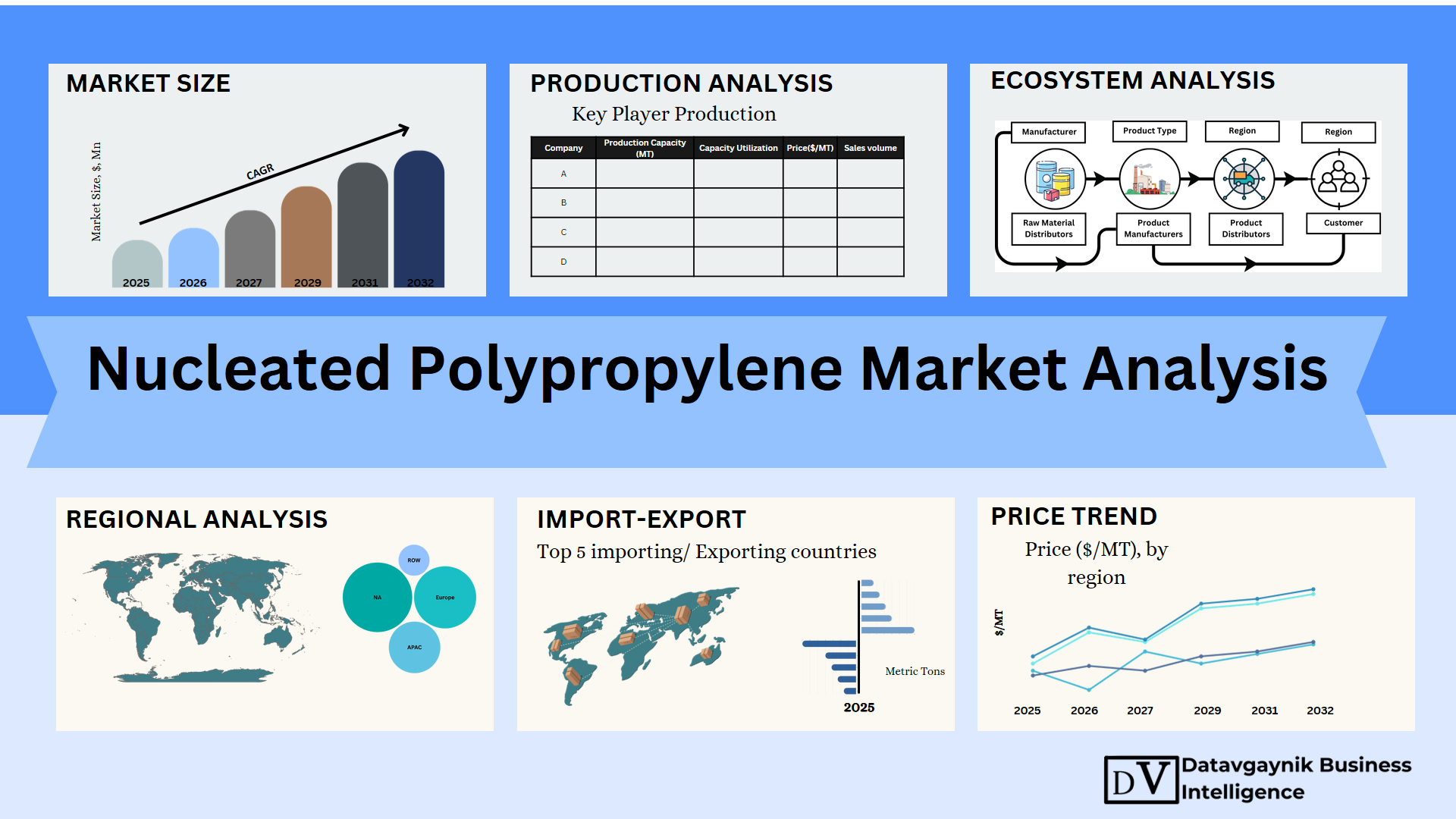
The Nucleated Polypropylene Market is experiencing a sharp upward trajectory driven by growing industry demand for lightweight yet high-performance materials. As industries such as automotive, packaging, and consumer goods push for reduced material weight without compromising structural performance, nucleated polypropylene has emerged as a critical enabler. For instance, in automotive manufacturing, weight reduction is directly correlated with improved fuel efficiency. Nucleated polypropylene, with its enhanced rigidity and lower density, offers automakers a viable alternative to traditional plastics or metals. Between 2020 and 2024, the usage of lightweight polymers in automotive production increased by over 15%, with nucleated polypropylene capturing a growing share due to its mechanical advantages and cost efficiency.
Mechanical Property Enhancement Drives Nucleated Polypropylene Market Expansion
One of the principal growth drivers in the Nucleated Polypropylene Market is the improved mechanical performance offered by nucleating agents. These additives accelerate crystallization during processing, resulting in a material with higher stiffness, strength, and dimensional stability. Such properties are crucial in high-load applications across industrial, automotive, and household product domains. For instance, manufacturers of food storage containers and appliance housings are increasingly replacing conventional polypropylene with nucleated variants to reduce warping, improve rigidity, and extend shelf life. Datavagyanik indicates that over 60% of polypropylene-based storage products produced in 2023 contained nucleating agents to achieve better strength-to-weight ratios and impact resistance.
Datavagyanik also covers related markets such as the Polypropylene Market, the Polypropylene Wax Market, and the Modified Polypropylene Market. Exploring these markets offers a broader view of the industry landscape and how adjacent sectors influence the main topic.
Nucleated Polypropylene Market Benefits from Thermo-Stability Across Industries
Thermal resistance is another differentiating factor driving the adoption of nucleated polypropylene. In high-temperature environments such as automotive interiors or under-hood components, conventional polypropylene may deform or lose performance integrity. Nucleated polypropylene, however, retains shape and function over a wider range of thermal conditions. For example, automotive components like center consoles, door panels, and air ducts are increasingly manufactured using heat-resistant nucleated polypropylene. The ability to perform under thermal stress also benefits industrial equipment manufacturers, particularly in Asia Pacific, where ambient operational temperatures often exceed 40°C. As per Datavagyanik, nearly 70% of polymer applications requiring thermal stability enhancements in 2023 favored nucleated polypropylene.
Processing Efficiency and Cost Reduction Accelerate Nucleated Polypropylene Market Penetration
The efficiency gains from using nucleated polypropylene during processing are significant contributors to market growth. The faster crystallization kinetics enabled by nucleating agents result in reduced cooling times and shorter molding cycles. This translates directly into lower energy consumption and higher throughput. For example, injection molding lines that integrate nucleated polypropylene can achieve cycle time reductions of up to 15%, thereby decreasing operational costs. Datavagyanik data shows that manufacturers who transitioned from conventional to nucleated polypropylene reported a 12% reduction in energy expenditure and a 9% increase in production yield between 2021 and 2024. These operational advantages continue to attract producers aiming to optimize large-scale production while maintaining mechanical and visual quality.
Nucleated Polypropylene Market Size Boosted by Packaging Sector Advancements
The Nucleated Polypropylene Market Size has expanded considerably in tandem with the rapid evolution of packaging technologies. Transparent and rigid packaging formats are in high demand, particularly in the food and consumer goods segments. Nucleated polypropylene offers the ideal combination of clarity, stiffness, and thermal stability required for packaging trays, tubs, and thin-walled containers. As brands look to enhance shelf appeal and reduce packaging waste, nucleated polypropylene enables both goals by minimizing material usage without compromising performance. In 2023, over 45% of polypropylene-based clear packaging in Europe used nucleating agents, with that number projected to exceed 55% by 2026. These developments have elevated the role of nucleated polypropylene as a foundational material in next-generation packaging strategies.
Sustainability Trends Strengthen Outlook for Nucleated Polypropylene Market
The ongoing shift toward sustainable manufacturing has created substantial momentum for the Nucleated Polypropylene Market. Due to its recyclability and energy-efficient processing, nucleated polypropylene is increasingly being selected as a preferred alternative to less sustainable polymers. For instance, packaging producers in North America have initiated programs that mandate the use of recyclable polymers with high production efficiency, where nucleated polypropylene meets both criteria. Additionally, the lower melt processing temperatures reduce carbon footprint during manufacturing. Datavagyanik analysis suggests that between 2020 and 2023, the use of recyclable polypropylene materials with enhanced mechanical performance grew by over 18%, with nucleated variants contributing significantly to this growth.
Technological Innovation in Nucleating Agents Expands Nucleated Polypropylene Market Use Cases
Ongoing R&D in nucleating agent chemistry continues to unlock new applications for nucleated polypropylene. Advances in organic sorbitol-based nucleators and hybrid inorganic-organic systems have yielded formulations with ultra-high transparency, improved tactile finish, and enhanced dimensional control. These characteristics are now being utilized in sectors as diverse as electronics, where visual aesthetics and durability matter, and medical devices, where sterilizability and structural integrity are key. For instance, in 2023, several consumer electronics brands introduced casings made from advanced nucleated polypropylene grades, achieving reductions in weight and processing time while improving surface finish. Datavagyanik highlights that over 30 new formulations of nucleating agents were commercialized between 2021 and 2024, directly impacting the expansion of the Nucleated Polypropylene Market Size.
Automotive Sector Integration Deepens Role of Nucleated Polypropylene Market
The Nucleated Polypropylene Market has firmly established its relevance in the automotive sector, a domain that demands material solutions combining strength, aesthetics, and cost efficiency. As regulatory pressures around vehicle emissions intensify, automakers are compelled to reduce weight without compromising safety or performance. Nucleated polypropylene offers a compelling balance by enabling lighter parts with comparable structural reliability. For example, front-end modules, bumper fascias, and underbody shields increasingly incorporate nucleated polypropylene due to its ease of molding, reduced shrinkage, and compatibility with complex geometries. Based on Datavagyanik projections, the automotive industry’s consumption of nucleated polypropylene is expected to grow at a CAGR of 6.8% from 2024 to 2030, underscoring the material’s long-term integration in vehicle platforms.
Consumer Goods Drive Broad-Based Adoption in Nucleated Polypropylene Market
Beyond automotive and packaging, the Nucleated Polypropylene Market is gaining traction across a wide spectrum of consumer goods. Durability, ease of processing, and aesthetic customization make nucleated polypropylene ideal for homewares, kitchenware, toys, and storage products. Brands that prioritize both product lifecycle and sustainability have shifted toward nucleated polypropylene as it aligns with both functional and regulatory expectations. For example, leading storage container manufacturers in Asia and North America have adopted nucleated polypropylene to enhance stackability, reduce wall thickness, and deliver higher clarity. Between 2020 and 2024, the adoption of nucleated polypropylene in non-durable consumer goods rose by nearly 14%, confirming its role as a material of choice for performance-driven product design.
Regulatory Compliance and Product Safety Standards Elevate Nucleated Polypropylene Market Trust
Regulatory frameworks around food safety, recyclability, and environmental performance have reinforced confidence in the Nucleated Polypropylene Market. Given its compliance with FDA and EU food contact regulations, nucleated polypropylene is widely used for direct-contact packaging. Moreover, the shift toward circular economies and extended producer responsibility (EPR) frameworks further benefits nucleated polypropylene due to its compatibility with closed-loop recycling systems. Datavagyanik notes that compliance-ready polymers, such as nucleated polypropylene, accounted for over 40% of material certifications issued for food packaging in 2023. This regulatory alignment continues to position nucleated polypropylene as a forward-compatible solution for manufacturers focused on safety and sustainability.
“Nucleated Polypropylene Manufacturing Database, Nucleated Polypropylene Manufacturing Capacity”
- Nucleated Polypropylene top manufacturers market share for 27+ manufacturers
- Top 8 manufacturers and top 17 manufacturers of Nucleated Polypropylene in North America, Europe, Asia Pacific
- Production plant capacity by manufacturers and Nucleated Polypropylene production data for 27+ market players
- Nucleated Polypropylene production dashboard, Nucleated Polypropylene production data in excel format
Asia Pacific Dominates Global Nucleated Polypropylene Market Demand
The Asia Pacific region holds the dominant position in the Nucleated Polypropylene Market, accounting for the largest share of global consumption. This growth is propelled by robust industrialization, rapid urbanization, and the presence of major manufacturing hubs. Countries such as China, India, Japan, and South Korea have significantly ramped up their polypropylene production capacities, with nucleated polypropylene representing a substantial portion of value-added variants. For instance, in 2023, China accounted for nearly 37% of the global nucleated polypropylene demand, driven by its automotive and packaging industries. The nation’s push for electric vehicles, smart appliances, and cost-effective consumer goods has further fueled the consumption of nucleated polypropylene.
In India, the demand for nucleated polypropylene is expanding at a CAGR of over 8%, primarily supported by increasing adoption in lightweight consumer durables, automotive parts, and cost-efficient packaging. As domestic manufacturing expands under initiatives like “Make in India,” the reliance on performance polymers such as nucleated polypropylene has intensified.
North America Maintains Steady Consumption in Nucleated Polypropylene Market
North America remains a vital region in the Nucleated Polypropylene Market, especially due to its advanced automotive sector and demand for sustainable, recyclable packaging materials. The United States leads this regional market, supported by its well-established plastic compounding industry and continuous investment in high-efficiency manufacturing processes. For instance, automotive companies in Michigan and Ohio are integrating nucleated polypropylene for interior components, benefiting from the polymer’s rigidity, lightweight properties, and cost-effectiveness.
In addition, packaging converters in the U.S. are increasingly using nucleated polypropylene for food-grade applications, leveraging its clarity and thermal resistance for microwave-safe containers and ready-to-eat packaging. The rise in home-delivery services and e-commerce has further supported this shift.
Europe Advances Sustainability through Nucleated Polypropylene Market Adoption
The Nucleated Polypropylene Market in Europe is gaining momentum as regional governments and industries prioritize sustainability, recyclability, and lightweight solutions. Germany, France, and Italy are leading adopters, driven by their automotive and consumer goods sectors. Germany’s automotive giants are integrating nucleated polypropylene into dashboards and internal trims to reduce vehicle weight and comply with CO₂ emission standards. In France and Italy, demand is accelerating for recyclable rigid packaging formats, where nucleated polypropylene is enabling high-clarity and food-safe packaging solutions.
Furthermore, European packaging companies are aligning with EU directives on single-use plastic reduction by investing in polypropylene formats that allow recyclability without sacrificing performance. Nucleated polypropylene enables this transition by offering the required balance between form and function.
Middle East and Africa Emerge as New Frontiers for Nucleated Polypropylene Market
The Middle East and Africa are rapidly emerging in the Nucleated Polypropylene Market landscape, with countries such as Saudi Arabia and the UAE increasing downstream plastic processing capabilities. Investments in petrochemical infrastructure, especially around polypropylene derivatives, have made these regions important suppliers and consumers of nucleated polypropylene. For example, in Saudi Arabia, demand for nucleated polypropylene is increasing in sectors like industrial packaging and automotive interiors as the country diversifies beyond crude oil.
South Africa and Egypt also represent potential demand centers where automotive assembly and FMCG packaging are showing consistent growth. The rising middle-class population and growing retail infrastructure are supporting adoption of value-added polymers like nucleated polypropylene across Africa.
Latin America Shows Moderate Yet Strategic Growth in Nucleated Polypropylene Market
In Latin America, the Nucleated Polypropylene Market is displaying moderate but steady growth. Countries like Brazil and Mexico are utilizing nucleated polypropylene in a range of applications from rigid packaging to white goods components. For instance, local appliance manufacturers in Brazil are turning toward nucleated polypropylene for housing parts, driven by its superior moldability and improved surface finish. Packaging converters in Mexico are adopting the material to create cost-effective yet robust packaging formats suitable for export markets.
Trade liberalization and increasing foreign investments into Latin America’s consumer and industrial sectors are expected to fuel further demand for nucleated polypropylene, particularly in low- to mid-income product categories that still require durable and visually consistent materials.
Nucleated Polypropylene Market Segmentation by Additive Type
The Nucleated Polypropylene Market is segmented by the type of nucleating agents used—organic, inorganic, and hybrid. Organic nucleating agents, such as sorbitol derivatives, dominate the market due to their clarity-enhancing and processing benefits, especially in food and cosmetic packaging. In contrast, inorganic nucleating agents such as talc and sodium benzoate are gaining traction in automotive and industrial components where stiffness and thermal performance are prioritized.
Hybrid nucleating systems are also growing in use, offering manufacturers the flexibility to balance clarity, rigidity, and cycle times. This is particularly useful in electronics housings and multipurpose containers, where both mechanical and visual performance are required.
Application-Based Segmentation Propels Nucleated Polypropylene Market Depth
Packaging remains the largest application in the Nucleated Polypropylene Market, accounting for over 40% of the global demand. The shift toward transparent, microwaveable, and impact-resistant packaging has increased the use of nucleated polypropylene in containers, lids, and trays. In automotive, the segment’s share is also rising rapidly due to lightweighting initiatives. Applications include under-the-hood parts, seat backings, and trunk trims.
Consumer goods form another high-growth segment, where nucleated polypropylene’s strength and processability enable products such as storage bins, baby products, and personal care containers. Industrial applications, though smaller in volume, are expanding as manufacturers seek durable, lightweight alternatives for technical parts and electrical components.
Nucleated Polypropylene Price Trend Shaped by Feedstock Volatility and Additive Innovation
The Nucleated Polypropylene Price Trend is closely tied to the price of polypropylene resin, which in turn depends on crude oil and naphtha price fluctuations. For instance, in 2022–2023, resin prices experienced sharp fluctuations due to geopolitical tensions and logistics disruptions. These factors pushed the average Nucleated Polypropylene Price up by 6% globally.
However, advancements in additive technology are offsetting price pressures by enhancing material performance per unit volume. For example, the use of high-efficiency nucleating agents allows processors to reduce wall thickness while maintaining rigidity, thus reducing overall material consumption. In the U.S., this has led to cost savings of up to 8% in packaging applications.
Regional Variations in Nucleated Polypropylene Price Driven by Supply Chains
Geographical variations also impact the Nucleated Polypropylene Price across markets. In Asia Pacific, particularly China and India, the average price per metric ton is lower due to vertically integrated supply chains and scale economies. In Europe, the price is higher due to stringent regulatory costs and the energy-intensive nature of polymer processing. In North America, pricing remains relatively stable but is influenced by feedstock price shifts and local demand patterns.
For instance, in Q1 2024, the average Nucleated Polypropylene Price in China stood at USD 1,430/MT, while in Europe, it averaged around USD 1,780/MT. In the Middle East, rising domestic production is gradually narrowing the pricing gap with Asian exporters, giving local manufacturers a competitive edge in regional markets.
Outlook for Nucleated Polypropylene Price Trend Remains Cautiously Optimistic
Going forward, the Nucleated Polypropylene Price Trend is expected to remain moderately volatile in the short term, reflecting changes in energy markets and feedstock dynamics. However, long-term projections suggest a steady decline in per-unit costs driven by technological advancements in additive chemistry and improvements in processing efficiency.
For instance, newly commercialized nucleating masterbatches in 2024 have shown potential to reduce energy consumption by up to 10% during molding, thereby lowering both environmental impact and cost. Datavagyanik projects that by 2027, widespread adoption of such innovations will lead to a 4–6% drop in average Nucleated Polypropylene Price globally, enhancing its competitiveness against alternative materials.
“Track Country-wise Nucleated Polypropylene Production and Demand through our Nucleated Polypropylene Production Database”
- Nucleated Polypropylene production database for 27+ countries worldwide
- Nucleated Polypropylene Powder sales volume for 31+ countries
- Country-wise Nucleated Polypropylene production capacity and production plant mapping, production capacity utilization for 27+ manufacturers
- Nucleated Polypropylene production plants and production plant capacity analysis for top manufacturers
Leading Manufacturers in the Nucleated Polypropylene Market
The Nucleated Polypropylene Market is highly competitive, with a mix of global chemical conglomerates and specialized polymer technology companies contributing to product innovation, supply chain optimization, and market expansion. Some of the most prominent manufacturers dominating this market include Milliken & Company, BASF SE, Adeka Corporation, Clariant AG, Avient Corporation, and LyondellBasell. These companies are recognized not only for their scale but also for their ability to provide tailored nucleating agent formulations that meet specific application requirements across sectors.
Milliken & Company stands as a global leader with its differentiated product line of nucleating agents under the Millad brand. These additives are particularly known for their high clarity, energy-efficient processing, and suitability for food-grade packaging. Milliken’s focus on sustainability and their investment in global compounding facilities have positioned them as the preferred supplier for many packaging converters worldwide.
BASF SE remains a strong player in the Nucleated Polypropylene Market with its portfolio of performance-enhancing additives used across automotive, electronics, and industrial packaging. The company’s focus has been on providing nucleating agents that deliver improved stiffness and thermal performance, especially for under-the-hood applications in vehicles and high-heat consumer goods.
Adeka Corporation of Japan is another key contributor to the market, particularly in Asia. The company specializes in advanced nucleating agent chemistry, offering solutions for both homo-polymer and random copolymer grades of polypropylene. Adeka’s product lines are frequently used by processors targeting medical devices, injection molded housewares, and microwave-safe packaging.
Clariant AG, a global specialty chemical company, has developed a wide range of additives optimized for optical properties, stiffness enhancement, and faster molding cycles. Its Licocene and AddWorks series are gaining traction in both packaging and automotive interior applications. Clariant continues to expand its market share through R&D efforts focused on customized solutions for different regions.
Avient Corporation, formerly known as PolyOne, has a growing footprint in the Nucleated Polypropylene Market through its custom masterbatch solutions. The company offers polymer additive formulations that include nucleating agents designed to improve clarity, cycle time, and dimensional stability across a range of industries.
LyondellBasell, primarily a resin manufacturer, has also been integrating nucleated polypropylene grades into its product portfolio. With a focus on ready-to-process resin compounds that include nucleating agents, the company offers tailored polypropylene grades targeting OEMs in automotive and packaging sectors.
Nucleated Polypropylene Market Share by Manufacturer
In terms of market share, Milliken & Company holds a leading position with approximately 22% of the global market, primarily driven by its dominance in transparent nucleated polypropylene used in packaging. Its ability to offer cost-effective solutions with energy-saving benefits has ensured continued preference among packaging giants and converters.
BASF follows with a market share of around 16%, with strengths in Europe and North America where high-performance applications such as automotive and electronics benefit from its robust additive technologies. BASF’s collaborative programs with auto OEMs have further reinforced its share in engineered polypropylene components.
Clariant AG commands close to 12% of the global market, especially in segments where regulatory compliance and optical clarity are crucial. Its focus on additive integration into masterbatches has allowed it to gain ground in smaller packaging and consumer goods markets, especially in Europe and Latin America.
Adeka Corporation holds an estimated 10% share, with strong roots in Asia Pacific. The company continues to leverage its chemistry innovations to target the fast-evolving markets of Japan, China, and Southeast Asia. Its growth trajectory is aided by local partnerships with compounders and end-users.
Avient and LyondellBasell together account for about 15% of the market, with Avient’s masterbatch-based model allowing flexibility across geographies, while LyondellBasell’s resin-integrated approach appeals to high-volume OEM manufacturers.
The remaining share is occupied by regional players and compounders who offer cost-effective, localized solutions—especially in developing markets like Southeast Asia, Eastern Europe, and South America—where customization and affordability play a major role.
Recent Industry Developments in the Nucleated Polypropylene Market
The Nucleated Polypropylene Market has witnessed several noteworthy developments in the last few years, emphasizing product innovation, capacity expansion, and strategic collaborations.
In June 2023, Milliken announced the expansion of its chemical additive plant in Asia, aiming to reduce lead times and support local demand from packaging and appliance manufacturers. The expansion is set to enhance production of its flagship nucleating agent line for clear PP applications.
In March 2024, Clariant unveiled a new series of hybrid nucleating agents designed for both clarity and rigidity, targeting converters in food packaging and microwave-safe container segments. The development addresses the dual requirement of aesthetic performance and structural durability.
BASF initiated a partnership in Q4 2022 with a European automotive OEM to co-develop nucleated polypropylene grades for high-heat under-hood components. The collaboration led to pilot-scale trials of nucleated PP in structural assemblies, reducing part weight by 12% while maintaining mechanical integrity.
Adeka Corporation expanded its production footprint in early 2023, commissioning a new compounding facility in India to supply nucleating additives to local polypropylene processors. This move was aligned with India’s surging demand in FMCG and electronics.
In November 2023, Avient launched a range of sustainable masterbatches incorporating bio-based nucleating agents aimed at reducing carbon footprints. These solutions are now under evaluation for consumer packaging and thin-wall container applications in North America and Europe.
LyondellBasell, in January 2024, introduced a new nucleated polypropylene grade under its Purell brand, specifically designed for medical packaging and labware. The material meets stringent regulatory compliance requirements and offers enhanced clarity and sterilization stability.
These developments reflect the market’s continual pivot toward high-performance, sustainable, and application-specific solutions. As demand rises from downstream industries for materials that offer a balance of performance, clarity, processability, and environmental responsibility, top-tier manufacturers are strategically positioning themselves through innovation, regional presence, and end-user collaboration.
“Nucleated Polypropylene Production Data and Nucleated Polypropylene Production Trend, Nucleated Polypropylene Production Database and forecast”
- Nucleated Polypropylene production database for historical years, 10 years historical data
- Nucleated Polypropylene production data and forecast for next 7 years
Market Scenario, Demand vs Supply, Average Product Price, Import vs Export, till 2035
- Global Nucleated Polypropylene Market revenue and demand by region
- Global Nucleated Polypropylene Market production and sales volume
- United States Nucleated Polypropylene Market revenue size and demand by country
- Europe Nucleated Polypropylene Market revenue size and demand by country
- Asia Pacific Nucleated Polypropylene Market revenue size and demand by country
- Middle East & Africa Nucleated Polypropylene Market revenue size and demand by country
- Latin America Nucleated Polypropylene Market revenue size and demand by
- Import-export scenario – United States, Europe, APAC, Latin America, Middle East & Africa
- Average product price – United States, Europe, APAC, Latin America, Middle East & Africa
- Market player analysis, competitive scenario, market share analysis
- Business opportunity analysis
Key questions answered in the Global Nucleated Polypropylene Market Analysis Report:
- What is the market size for Nucleated Polypropylene in United States, Europe, APAC, Middle East & Africa, Latin America?
- What is the yearly sales volume of Nucleated Polypropylene and how is the demand rising?
- Who are the top market players by market share, in each product segment?
- Which is the fastest growing business/ product segment?
- What should be the business strategies and Go to Market strategies?
The report covers Nucleated Polypropylene Market revenue, Production, Sales volume, by regions, (further split into countries):
- Asia Pacific (China, Japan, South Korea, India, Indonesia, Vietnam, Rest of APAC)
- Europe (UK, Germany, France, Italy, Spain, Benelux, Poland, Rest of Europe)
- North America (United States, Canada, Mexico)
- Latin America (Brazil, Argentina, Rest of Latin America)
- Middle East & Africa
Table of Contents:
- Introduction to Nucleated Polypropylene
- Overview of Nucleated Polypropylene and Its Significance in Polymer Industry
- Key Properties and Advantages of Nucleated Polypropylene
- Chemical Composition and Structure of Nucleated Polypropylene
- The Role of Nucleating Agents in Enhancing Polypropylene Crystallization
- Effect of Nucleation on Thermal, Mechanical, and Optical Properties
- Global Market Overview for Nucleated Polypropylene
- Market Trends and Growth Drivers
- Key Technological Developments and Innovations in Nucleated Polypropylene
- Market Size, Share, and Forecast (2019-2035)
- Global Market Value and Projected Growth
- Segment-wise Analysis and Regional Market Breakdown
- Regional Market Insights
- North America: Market Demand and Adoption Trends
- Europe: Technological Advancements and Industry Regulation
- Asia Pacific: Key Producers and Growing Applications
- Latin America: Expanding Market and Regional Consumption
- Middle East & Africa: Emerging Opportunities and Industry Growth
- Manufacturing Processes for Nucleated Polypropylene
- Overview of Manufacturing Techniques for Nucleated Polypropylene
- Innovations in Production Methods to Enhance Performance and Efficiency
- Leading Manufacturers and Market Positioning
- Raw Materials and Sourcing for Nucleated Polypropylene
- Sourcing Raw Materials for Polypropylene and Nucleating Agents
- Supply Chain Considerations and Material Availability
- Impact of Raw Material Sourcing on Market Pricing
- Price Trends and Market Dynamics
- Price Fluctuations in the Nucleated Polypropylene Market (2019-2035)
- Factors Influencing Pricing and Market Conditions
- Regional Price Differences and Economic Influences
- End-Use Applications of Nucleated Polypropylene
- Packaging Industry: Rigid and Flexible Packaging Solutions
- Automotive Sector: Lightweight Components and Efficiency Improvements
- Consumer Goods: Household Products, Electronics, and Appliances
- Healthcare and Medical Applications: Sterilization Packaging and Disposable Items
- Competitive Landscape of the Nucleated Polypropylene Market
- Market Share and Key Players in the Nucleated Polypropylene Industry
- Competitive Strategies: Innovation, Product Differentiation, and Mergers
- Major Manufacturers and Their Market Impact
- Demand and Consumption Patterns
- Factors Driving Increased Demand for Nucleated Polypropylene
- Regional Consumption Trends and Forecasts
- Impact of Technological Advancements and Market Shifts on Demand
- Technological Innovations in Nucleated Polypropylene
- Developments in Nucleating Agents and Their Performance Enhancements
- Innovations in Processing Techniques for Better Product Performance
- Future Technologies and R&D in Nucleated Polypropylene
- Challenges in the Nucleated Polypropylene Market
- Challenges in Scaling Production and Ensuring Quality Consistency
- Supply Chain Constraints and Raw Material Availability
- Environmental and Regulatory Challenges
- Environmental Impact and Sustainability
- Environmental Benefits of Nucleated Polypropylene in Recycling and Sustainability
- Carbon Footprint of Production Processes and Eco-friendly Alternatives
- Strategies for Sustainable Manufacturing and Disposal of Nucleated Polypropylene
- Regulatory Environment and Compliance
- Global Regulations Governing Nucleated Polypropylene Production and Use
- Compliance with Safety, Environmental, and Quality Standards
- Impact of Regional Regulations on Market Access and Growth
- Investment Opportunities in the Nucleated Polypropylene Market
- Investment Trends and Areas of Opportunity for Market Stakeholders
- Emerging Market Opportunities and High-Growth Segments
- Potential for New Applications and Technologies in Nucleated Polypropylene
- Future Outlook and Market Projections
- Long-Term Market Growth Predictions and Trends
- Shifting Consumer Preferences and Technological Innovations
- Opportunities for Expansion in Emerging Markets
- Strategic Recommendations for Industry Stakeholders
- Insights for Manufacturers, Distributors, and Policymakers
- Best Practices for Market Entry, Expansion, and Competitive Positioning
- Strategic Guidance for Navigating Market Challenges and Leveraging Opportunities


