

Market Summary and Growth Forecast
The global Zinc Diethyl Dithiocarbamate (ZDEC) Market will witness a robust CAGR of 5.4%, valued at $0.18 billion in 2026, expected to appreciate and reach $0.29 billion by 2035.
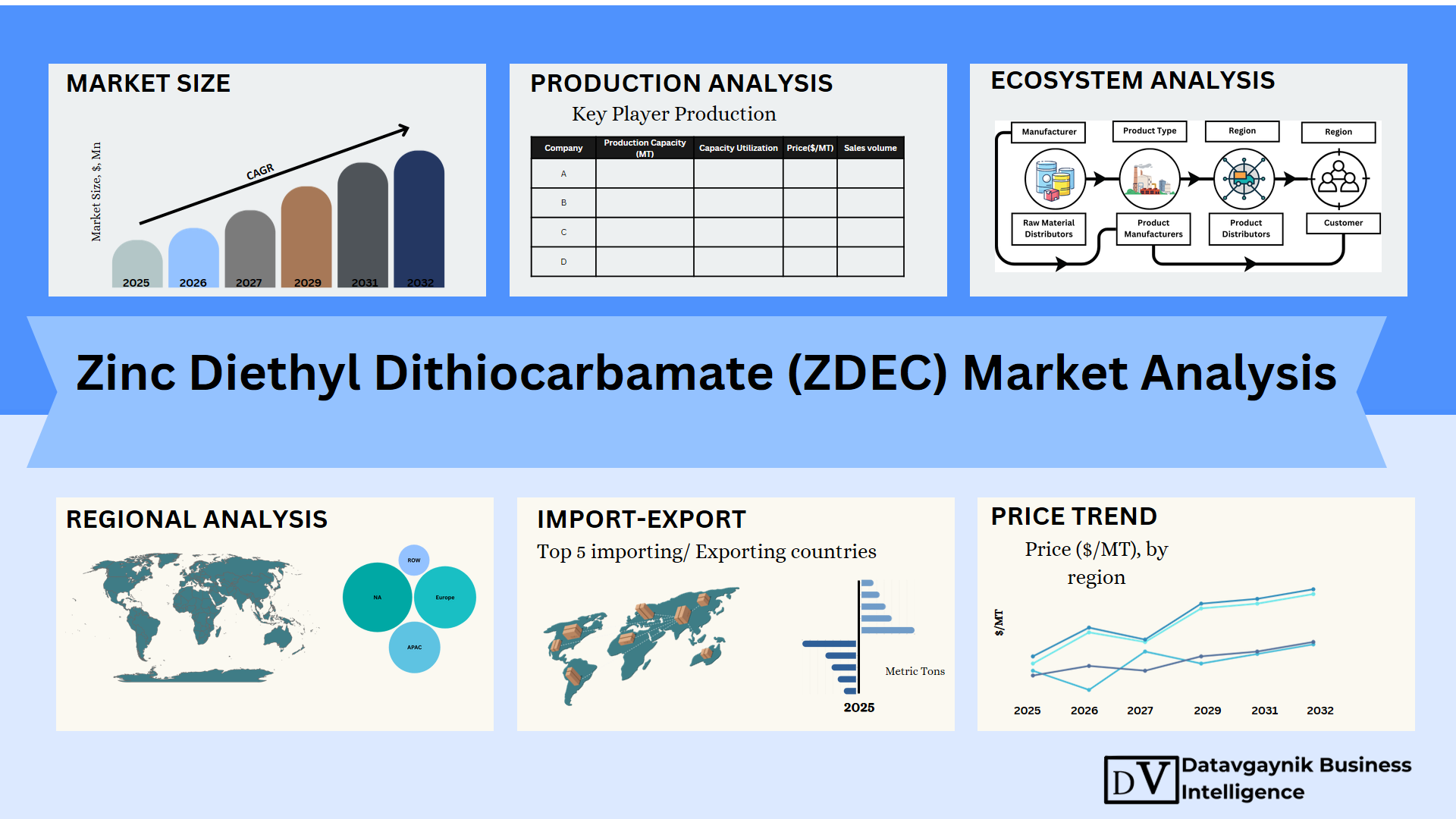
The Zinc Diethyl Dithiocarbamate (ZDEC) Market sits inside the specialty rubber chemicals value chain. ZDEC is an ultra-accelerator used mainly in rubber and latex vulcanization. It helps reduce curing time, supports faster processing, and improves production efficiency in products where controlled crosslinking is critical. Its relevance is strongest in latex goods, medical and industrial gloves, rubber threads, dipped products, rubber-coated fabrics, seals, hoses, footwear components, adhesives, and selected tire and non-tire rubber formulations.
For 2026–2035, demand will not be driven by one large end market alone. It will come from many mid-sized consumption pockets. Latex processing remains the core demand base. Industrial rubber goods are the second layer. Specialty elastomer applications will add incremental value where fast curing and clean processing are needed. ZDEC is commonly positioned as a primary or secondary accelerator for natural rubber, synthetic latex, SBR, EPDM, NBR, and related elastomer systems, with suppliers also highlighting its use in latex goods and rubber-coated fabrics.
The market is small in absolute dollar terms, but strategically important. Why? Because rubber processors do not buy ZDEC as a commodity filler. They buy it to control cure speed, reduce cycle time, stabilize product properties, and protect downstream productivity. A small change in accelerator dosage can affect rejection rates, line speed, surface finish, tensile performance, and scorch safety. That makes ZDEC a high-sensitivity input in rubber compounding.
| Metric | Estimate |
| Global Market Size, 2026 | $0.18 billion |
| Projected Market Size, 2035 | $0.29 billion |
| Forecast CAGR, 2026–2035 | 5.4% |
| Estimated 2026 Volume Demand | 42–48 kilotons |
| Estimated 2035 Volume Demand | 62–70 kilotons |
| Largest Demand Base, 2026 | Asia Pacific |
| Most Strategic Application Base | Latex and dipped rubber products |
The underlying growth logic is straightforward. Asia Pacific will continue to anchor production because rubber compounding, latex dipping, footwear manufacturing, and general rubber goods remain concentrated across China, India, Southeast Asia, Japan, and South Korea. Europe and North America will account for lower volume but higher specification demand. These regions will focus more on compliance, impurity control, workplace exposure management, and substitution risk.
Regulation will shape the market more than it expands it. Dithiocarbamate accelerators have faced scrutiny because some conventional systems may contribute to nitrosamine-related concerns during vulcanization. This is why processors are increasingly reviewing accelerator systems, especially in applications linked to medical goods, food-contact rubber, consumer products, and export-oriented manufacturing. Some suppliers already position alternative accelerators such as ZBEC as options to reduce or eliminate hazardous nitrosamine generation, which indirectly pressures ZDEC producers to improve purity, documentation, and safer compounding guidance.
Expert view: ZDEC will not disappear from rubber compounding. It is too useful in fast-cure latex and rubber systems. But the market will become more selective. Buyers will ask for better technical files, tighter residue control, and more transparent sourcing. Low-cost suppliers may still win on price, but certified and consistent grades will capture the better-margin demand.
Production economics will remain tied to three factors: zinc intermediate availability, amine and carbon disulfide chemistry, and rubber accelerator capacity in Asia. The market is not highly capital intensive compared with large petrochemical chains. Still, it is quality-sensitive. Particle size, purity, ash level, moisture, melting point range, and dispersion behavior matter in downstream compounding. Suppliers that can offer powder, masterbatch, and pre-dispersed formats will be better positioned because many rubber processors want safer handling and more uniform mixing.
Technology change will be gradual. The main shift will not be “new chemistry” replacing ZDEC overnight. It will be formulation refinement. Processors will optimize accelerator blends, reduce dosage where possible, use pre-dispersed masterbatches, and move toward lower-emission cure packages for regulated applications. This gives the Zinc Diethyl Dithiocarbamate (ZDEC) Market a stable but controlled growth profile rather than a high-breakout growth curve.
Key stakeholders include rubber chemical manufacturers, latex goods producers, tire and non-tire rubber OEMs, rubber compounders, medical glove manufacturers, industrial product manufacturers, footwear producers, adhesive formulators, chemical distributors, regulatory bodies, industry associations, investors, and testing laboratories. Governments and workplace safety agencies will also influence procurement behavior through chemical registration, exposure rules, and product safety standards.
From a market-size standpoint, the base case assumes steady consumption in latex and non-tire rubber, moderate price appreciation for high-purity grades, and gradual movement toward pre-dispersed accelerator formats. In 2026, latex and dipped rubber products will represent the largest demand block. By 2035, growth will be more balanced as automotive rubber parts, industrial sealing products, and specialty elastomer goods increase their use of controlled accelerator systems.
That said, pricing pressure will remain visible. ZDEC is not a premium specialty additive in every application. In standard industrial rubber, buyers will switch between equivalent accelerators based on performance, price, and compliance requirements. So the winners will be suppliers that combine scale, technical support, and consistent quality. Pure trading-based supply will remain vulnerable when buyers tighten audit standards.
In practical terms, the Zinc Diethyl Dithiocarbamate (ZDEC) Market will grow because rubber manufacturers still need fast, predictable curing systems. But its next phase will be cleaner, more documented, and more application-specific. The product will stay relevant where curing speed matters. The margin pool will shift toward suppliers that help customers manage both production efficiency and chemical-risk expectations.
Competitive Intelligence and Benchmarking
The Zinc Diethyl Dithiocarbamate (ZDEC) Market has a mixed competitive structure. It is not dominated by one global chemical major. Instead, supply is split between large rubber chemical producers, China-based accelerator manufacturers, Indian specialty chemical suppliers, European niche producers, and distributors offering technical-grade imports. The market rewards scale, but it also rewards formulation support. This is important because ZDEC is rarely sold as a standalone “price-only” input to advanced rubber processors. It is usually evaluated as part of a broader cure package.
China Sunsine Chemical Holdings holds one of the strongest positions in the wider rubber accelerator ecosystem. Its advantage comes from scale, broad accelerator coverage, and direct exposure to global tire and rubber goods customers. While ZDEC is a smaller item within the wider dithiocarbamate family, the company’s strength lies in its ability to supply multiple accelerator chemistries along with insoluble sulfur and antioxidants. That makes it a preferred supplier for large compounders that want supply continuity and multi-product sourcing from one platform. Its market position is strongest in Asia Pacific and export-linked rubber manufacturing.
NOCIL Limited is a key India-based rubber chemical manufacturer with strong relevance in accelerators, antioxidants, pre-vulcanization inhibitors, and latex-focused chemical systems. Its ZDC/ZDEC-type accelerator portfolio is positioned for sulphur-cured rubber and latex-based products. The company benefits from India’s expanding rubber goods manufacturing base, growing tire ecosystem, and rising domestic latex product demand. Its strength is not just product supply. It also sits close to Indian rubber compounders that need technical support and reliable domestic availability.
MLPC International, part of the broader European specialty chemicals ecosystem, competes more on technical depth than low-cost volume. Its position is relevant in vulcanization agents, specialty accelerators, and polymer-bound masterbatch formats. This matters because European rubber processors are increasingly moving toward safer handling, cleaner processing, and better dispersion. MLPC’s competitive edge is stronger in industrial rubber, automotive rubber, technical goods, and customers looking for pre-dispersed or masterbatch-type delivery rather than simple powder supply.
LANXESS remains one of the most recognized names in rubber additives and high-performance rubber chemical systems. Its competitive position is strongest among tire, industrial rubber, seals, belts, and engineered elastomer producers. In the ZDEC value chain, LANXESS is better viewed as a strategic benchmark rather than a pure ZDEC-volume player. Its broader accelerator and rubber additive portfolio influences customer expectations on quality, documentation, and application support. For buyers serving regulated export markets, this kind of supplier profile carries weight.
Shandong Yanggu Huatai Chemical is a major China-based rubber additives producer with a broad portfolio across standard rubber chemicals, pre-dispersed rubber chemicals, insoluble sulfur, processing aids, protective waxes, and resins. Its role in the Zinc Diethyl Dithiocarbamate (ZDEC) Market is linked to China’s scale advantage in rubber chemical manufacturing. The company is well placed to serve tire producers, automotive rubber goods makers, belts, hoses, seals, and rubber sheet manufacturers. Its competitive strength is breadth plus production depth.
Kemai Chemical is another important China-linked supplier in the rubber accelerator ecosystem. Its relevance comes from its established accelerator portfolio and international distribution presence through rubber chemical channels. The company is typically associated with mainstream accelerator chemistries used in tire and industrial rubber applications. In ZDEC-linked competition, Kemai’s advantage is portfolio coverage, export access, and ability to serve customers that require accelerator families rather than isolated single chemicals.
Pukhraj Additives has a more focused India-oriented position. The company is active in rubber and plastic additives, including oleochemical derivatives, metal soaps, vulcanization activators, processing aids, and related specialty materials. Its role is more relevant in regional rubber processing, specialty additives, and application-specific supply. It is not positioned like a global accelerator giant, but it matters in India’s fragmented downstream rubber goods industry where mid-sized customers often value supplier access, responsiveness, and smaller-batch flexibility.
| Company | Competitive Position | Portfolio Relevance | Likely Strength Area |
| China Sunsine Chemical Holdings | Large-scale rubber accelerator producer | Accelerators, insoluble sulfur, antioxidants | Global tire and rubber goods supply |
| NOCIL Limited | India’s major rubber chemical producer | Accelerators, antioxidants, latex-use chemicals | India and export-linked rubber processing |
| MLPC International | European specialty vulcanization chemical supplier | Accelerators, specialty agents, masterbatches | Technical rubber and safer handling formats |
| LANXESS | Global rubber additives benchmark supplier | Rubber chemicals, processing aids, performance additives | Premium tire and engineered rubber goods |
| Shandong Yanggu Huatai Chemical | Large China-based rubber additives producer | Accelerators, insoluble sulfur, waxes, resins | China domestic and export rubber supply |
| Kemai Chemical | Broad accelerator supplier | Mainstream rubber accelerator chemistries | Tire and industrial rubber applications |
| Pukhraj Additives | Regional specialty additives producer | Rubber additives, activators, processing aids | India-focused rubber compounding customers |
The competitive pattern is clear. China-based producers will keep the volume advantage. Indian suppliers will gain from local rubber manufacturing and import-substitution demand. European and global specialty suppliers will defend higher-value segments through compliance support, masterbatch formats, lower-dust handling, and technical service.
Expert commentary: The next competitive shift will not be about who can sell ZDEC at the lowest price. That market already exists. The better-margin contest will be around cleaner grades, documented supply chains, pre-dispersed forms, and accelerator systems that help customers reduce curing defects without increasing regulatory risk.
For suppliers, the strategic question is simple: sell ZDEC as a commodity powder, or sell it as part of a controlled vulcanization solution. The second route is harder, but it gives better customer retention. Rubber compounders do not change accelerator systems casually once a formulation is validated. That stickiness gives technically strong suppliers an advantage even when cheaper offers are available.
The Zinc Diethyl Dithiocarbamate (ZDEC) Market will remain competitive, but not fully commoditized. Large-volume buyers will push price. Export-oriented latex and rubber goods producers will push documentation. Automotive and technical rubber customers will push consistency. So the companies that combine cost control with formulation reliability will hold the strongest position through 2035.

