

Cost Pressure Turns Recycled Sand for Fracking Operations into a Procurement-Side Efficiency Market
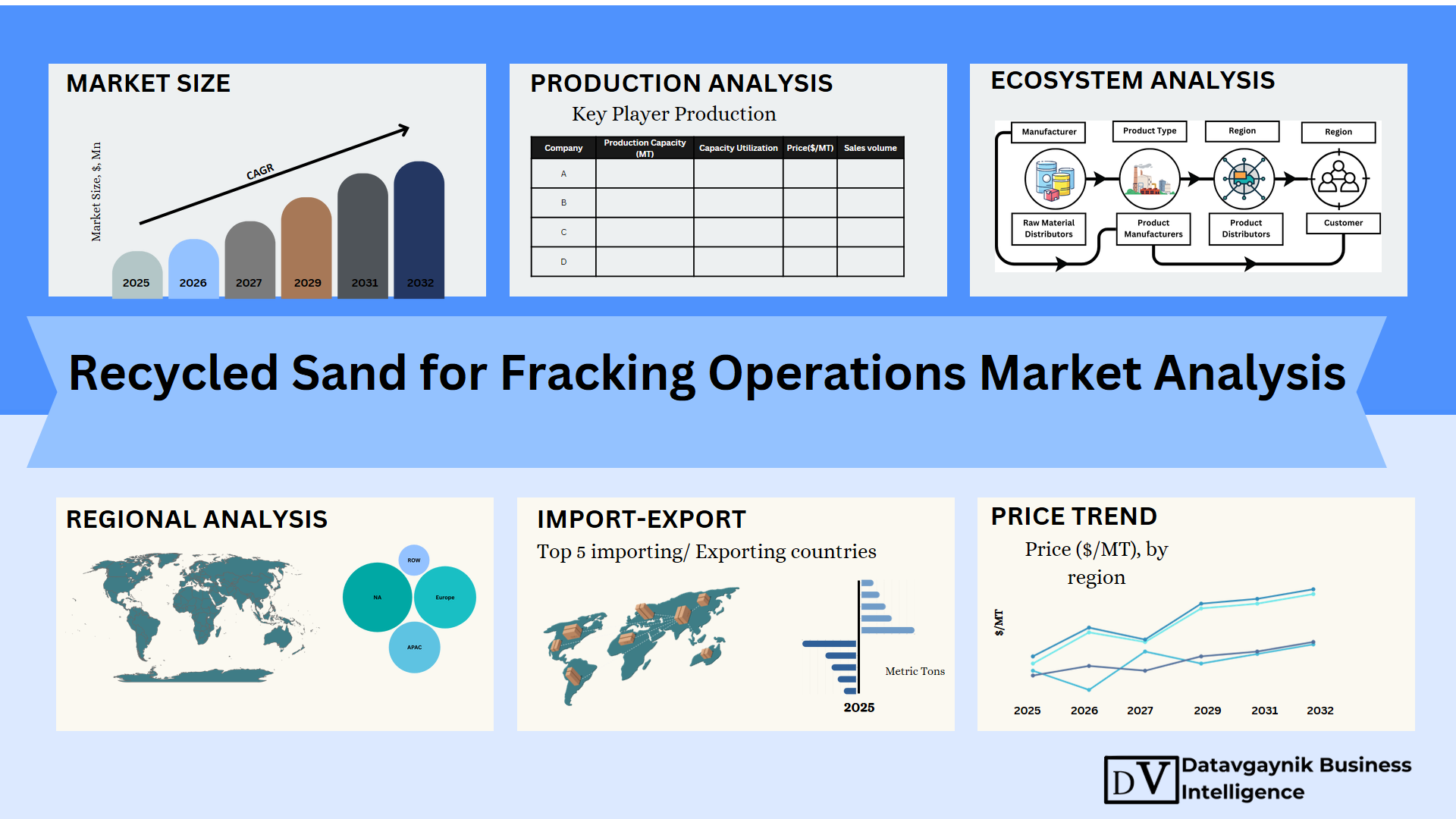
Proppant procurement is becoming more cost-sensitive as longer laterals, simul-frac designs, higher water volumes, and wellsite logistics increase the delivered cost of sand per completed well. The Recycled Sand for Fracking Operations Market is estimated at USD 420–460 million in 2026, with demand projected to reach USD 720–780 million by 2032, growing at about 8.5–9.2% CAGR as operators reuse recovered proppant, flowback sand, and solids from sand-management systems instead of relying only on freshly mined frac sand.
Recycled Sand for Fracking Operations demand is not a direct replacement for all API-grade frac sand. Its use is strongest where recovered sand can be cleaned, screened, dried, and blended for secondary hydraulic fracturing, refrac support, pad construction, wellsite stabilization, or lower-spec oilfield uses. The market scenario is therefore tied to both proppant cost control and waste-volume reduction.
The main consumption logic comes from three pressure points:
- High sand intensity per well: modern shale completions consume thousands of tons of proppant per well, making even partial recycling commercially relevant.
- Solids-handling cost: flowback operations generate sand, fines, scale, and sludge that require separation, transport, treatment, or disposal.
- Basin logistics: in the Permian, delivered sand cost depends on mine proximity, trucking availability, diesel cost, storage, and last-mile coordination.
In January 2026, EIA projected Permian crude production to hold near its 2025 average of 6.6 million barrels per day in 2026, keeping completion activity concentrated in the highest-productivity shale region. That production base supports recurring demand for sand handling, proppant logistics, and recycled sand recovery where operators seek lower cost per stage rather than only higher well counts.
Cost-driven adoption is also visible in the logistics chain. In early 2026, Detmar Logistics and Aurora planned supervised autonomous frac-sand trucking in the Permian with an initial fleet of 30 trucks operating more than 20 hours per day, showing how sand movement has become a major optimization target. Recycled Sand for Fracking Operations benefits from the same logic: reducing virgin-sand hauling, landfill movement, and disposal mileage improves wellsite economics.
The market is still operationally selective. Recycled sand must meet usable particle-size distribution, low clay/fines contamination, acceptable crush behavior for the intended application, and moisture limits for storage and rehandling. Higher-value reuse requires tighter washing, classification, and quality control; lower-value reuse can tolerate broader gradation.
October 2025 also showed the service-side opportunity when WaterTectonics and Clearvale launched WT Oil & Gas in Midland to target water reuse, solids management, and treatment services for oilfield operations. Their reference to frac operations using up to 250,000 barrels of water highlights why recycled sand demand is increasingly linked with integrated water-and-solids treatment rather than stand-alone proppant supply.
Production Economics Shift from Virgin Proppant Supply to Basin-Level Sand Recovery
Recycled Sand for Fracking Operations production begins at the wellsite, not at a mine. The usable feedstock is recovered proppant, formation sand, fines, and solids carried back during flowback and early production. This makes supply irregular: one pad may return enough recoverable sand for reuse support, while another may produce material too fine, wet, contaminated, or mixed with scale and hydrocarbons.
The production route has five operating steps:
- Separation: sand traps, cyclonic desanders, shale shakers, and settling systems remove solids from flowback streams.
- Washing and cleaning: hydrocarbons, clay, salts, and chemical residues are reduced to make the material reusable.
- Classification: recovered sand is screened by mesh size, usually separating coarse reusable fractions from fines.
- Drying or dewatering: moisture is lowered for storage, blending, or transport.
- Quality control: crush resistance, turbidity, particle-size distribution, and contaminant levels decide whether the sand can re-enter fracking support use or only lower-spec oilfield applications.
This supply model differs from mined frac sand, where production depends on reserves, washing plants, wet plants, dry plants, silos, rail, and trucking. Recycled Sand for Fracking Operations depends more on mobile treatment units, onsite solids management, produced-water infrastructure, operator willingness, and local disposal economics.
The Permian Basin has the strongest production logic because it combines dense completions, high sand volumes, intense water handling, and short-haul reuse opportunities. EIA’s January 2026 outlook placed Permian crude production near a 2025 average of 6.6 million barrels per day, keeping the region’s well-completion and flowback-services base large enough to support recurring solids recovery.
Recycled Sand for Fracking Operations production is also shaped by water-management infrastructure. In October 2025, WaterTectonics and Clearvale launched WT Oil & Gas in Midland to serve oilfield water reuse and solids-management demand, citing frac operations that can use up to 250,000 barrels of water. This matters because sand recycling becomes more practical when water treatment, solids separation, and field services are integrated at the basin level rather than handled as separate disposal jobs.
Supply security remains uneven. Virgin frac sand suppliers can offer scheduled tonnage, mesh-grade consistency, and delivery contracts. Recycled Sand for Fracking Operations suppliers must work around variable flowback timing, changing solids load, contamination levels, and operator-specific reuse rules. This limits its use in high-pressure primary proppant placement but supports blending, refrac support, pad construction, road-base use, and lower-risk completion support.
Logistics define the economics. In 2025, Total Sand Solutions’ acquisition of Sand Revolution created a proppant logistics platform with more than 25 million tons per year of capacity, 500 tractors, and 1,250 trailers, showing how scale in sand movement remains central to oilfield cost control. Recycled Sand for Fracking Operations competes inside this logistics equation by reducing disposal trips, lowering fresh-sand haul distance, and keeping recovered material closer to the wellsite.
Production bottlenecks are technical rather than geological. The main constraints are fines removal, moisture control, hydrocarbon contamination, variable mesh distribution, and repeatable testing. Where operators require API-grade proppant performance, recycled material faces qualification barriers. Where the buyer needs cost-efficient sand for secondary oilfield use, the quality threshold is lower and adoption becomes easier.
Application Segments Show Recycled Sand Demand Is Wider Than Primary Frac Proppant Reuse
Recycled Sand for Fracking Operations is segmented less by geology and more by reuse tolerance. The highest-value use is cleaned recovered sand that can be blended into oilfield sand streams, while the highest-volume use is lower-spec reuse near the wellsite where particle-size variation and residual fines are less restrictive.
The demand split can be understood through four practical segments:
| Segment | Estimated 2026 Demand Share | Use Logic |
| Recovered proppant for secondary oilfield use | 35–40% | Used where cleaned sand supports refrac, remedial work, or non-primary completion support |
| Pad, road, and lease construction sand | 25–30% | Absorbs broader particle-size fractions with lower quality barriers |
| Flowback solids recovery and disposal reduction | 20–25% | Converts waste-handling cost into reusable material or reduced landfill volume |
| Blended low-spec proppant support | 10–15% | Limited to operators accepting tested recycled fractions in lower-risk stages |
Recovered proppant for secondary use leads because it carries the strongest price logic. Virgin frac sand must be mined, washed, dried, stored, railed or trucked, transloaded, and delivered to the pad. Recycled Sand for Fracking Operations avoids part of that chain when recoverable sand is available close to the next reuse point. Even a 10–15% substitution rate on selected field uses can lower delivered sand and disposal cost across a multi-well pad.
Pad construction and lease-road use form the second major segment. This application does not require the same crush resistance, roundness, or tight mesh distribution as primary proppant. It can absorb recovered sand fractions that fail higher-value reuse tests, which improves the economics of recovery systems by reducing the share sent to disposal.
Flowback solids recovery is the operational bridge between waste management and Recycled Sand for Fracking Operations sales. TETRA reports sand-management systems with 97–100% separation efficiency and sand recovery improvement of up to 50% versus competing desanders, indicating why field-level solids capture is becoming a measurable service category rather than a back-end waste process. Higher recovery directly increases the available feedstock pool for recycled sand handling.
Application demand is strongest where completion intensity stays high despite fewer rigs. In November 2025, EIA data showed Lower 48 active rigs had declined from 750 in December 2022 to 517 in October 2025, while production still increased due to longer laterals and more efficient completions. That shift favors Recycled Sand for Fracking Operations because fewer but more productive wells can still generate large proppant flows, high water handling, and concentrated solids-management demand.
The regional segmentation is similarly concentrated:
- Permian Basin: largest demand pool, supported by high oil output, dense pad drilling, and large sand logistics networks.
- Eagle Ford and Bakken: selective demand where operator economics favor local reuse and disposal reduction.
- Marcellus and Haynesville: gas-price sensitivity limits activity swings, but water and solids management remain important where completions restart.
- Canadian shale and oilfield service regions: smaller but technically relevant where disposal distance and environmental handling costs are high.
Buyer segmentation also matters. Large E&P operators evaluate Recycled Sand for Fracking Operations through completion risk, testing records, and cost per stage. Oilfield service companies focus on handling efficiency, equipment uptime, and margin per treated barrel or ton. Construction and lease-maintenance users buy on local availability, hauling distance, and particle-size suitability.
Price-Performance Trade-Off Defines Recycled Sand Economics More Than Spot Sand Pricing
Recycled Sand for Fracking Operations pricing is controlled by avoided cost as much as selling price. Buyers compare recycled material against three expense lines: fresh frac sand procurement, trucking or transloading cost, and disposal cost for flowback solids. If recovered sand reduces two of these three costs, the commercial case becomes stronger even when the recycled material cannot match premium virgin proppant specifications.
Virgin frac sand pricing is usually tied to mesh grade, mine location, rail access, wet/dry processing cost, and last-mile delivery. Recycled Sand for Fracking Operations has a different cost stack: recovery equipment, washing, dewatering, screening, hydrocarbon removal, testing, storage, and local movement. The price gap depends on whether the recovered material is sold as reusable proppant support, construction-grade oilfield sand, or disposal-offset material.
The strongest pricing advantage appears near dense shale activity. In the Permian, each avoided truck movement has measurable value because sand must move between mines, yards, transload points, and pads. In early 2026, Detmar Logistics and Aurora planned an initial 30-truck autonomous frac-sand fleet operating more than 20 hours per day in West Texas, showing how logistics cost has become large enough to justify automation investment. Recycled Sand for Fracking Operations fits the same cost logic by reducing hauling distance where recovered sand is reused inside the basin.
A practical pricing structure usually has four layers:
| Pricing Factor | Impact on Recycled Sand for Fracking Operations |
| Recovery and separation efficiency | Higher recovery lowers cost per usable ton |
| Washing, drying, and screening intensity | Raises cost but improves reuse grade |
| Contamination level | Hydrocarbons, clay, salts, and fines reduce sale value |
| Distance to reuse point | Short-haul reuse improves margin versus virgin sand |
Processing complexity creates a grade premium. Recovered sand used for pad construction or lease-road support may need only basic dewatering and screening. Material intended for blended completion support requires tighter particle-size control, lower turbidity, and more testing. TETRA reports frac-flowback sand separation efficiencies of 97–100% and sand recovery improvement of up to 50% over competing desanders; such recovery performance reduces waste volume and increases the usable feedstock pool, but it also shifts pricing toward service quality and equipment uptime.
Supplier concentration also affects pricing. In November 2025, Total Sand Solutions acquired Sand Revolution, creating a platform with more than 25 million tons per year of proppant logistics capacity, 500 tractors, and 1,250 trailers serving major shale basins. Larger logistics platforms can pressure recycled-sand suppliers by offering integrated virgin sand delivery, but they also validate the scale of sand handling costs that recycled recovery tries to reduce.
Recycled Sand for Fracking Operations does not win on price alone. Operators discount recycled material if it creates completion risk, equipment abrasion, plugging risk, or inconsistent flow behavior. The usable price band is therefore highest when testing proves stable gradation, acceptable fines, controlled moisture, and repeatable handling.
Customer Concentration Keeps Competition Tied to Basin Access, Testing Discipline, and Service Integration
Competition in the Recycled Sand for Fracking Operations Market is shaped less by ownership of sand reserves and more by control over field recovery systems, solids-handling assets, water-treatment capability, and operator relationships. Unlike virgin frac sand, where mine location and mesh-grade output decide competitiveness, Recycled Sand for Fracking Operations suppliers compete on recovery yield, contamination control, reuse qualification, and cost reduction per pad.
The competitive field includes three supplier groups:
| Supplier Group | Competitive Advantage | Limitation |
| Oilfield water and solids-management companies | Onsite access to flowback sand, water streams, and disposal data | Must prove sand quality and reuse consistency |
| Proppant logistics companies | Trucking, storage, basin delivery networks, and operator contracts | More exposed to virgin sand economics than recycling economics |
| Specialized recovery and treatment providers | Screening, washing, desanding, dewatering, and reuse systems | Scale depends on basin density and operator adoption |
The customer base is concentrated around large E&P operators, pressure-pumping companies, flowback-service contractors, and basin logistics providers. A single multi-well pad can influence thousands of tons of sand movement, so qualification with a small number of active operators can produce a larger commercial impact than selling to many fragmented buyers.
TETRA Technologies is relevant in this space because its production-testing, flowback, and sand-management systems directly address recovered sand control. The company’s published sand-management performance range of 97–100% separation efficiency indicates the type of measurable operating metric that buyers use when selecting service providers. In Recycled Sand for Fracking Operations, recovery efficiency is a competitive metric because every additional recoverable ton reduces disposal volume or creates potential reuse material.
WaterTectonics and Clearvale also strengthen the integrated-service side of the market through WT Oil & Gas in Midland. Their positioning around produced-water reuse and solids management fits the Recycled Sand for Fracking Operations market scenario because recovered sand is rarely handled independently from water treatment. Operators prefer fewer vendors when one system can reduce water disposal, solids hauling, and sand waste at the same location.
Total Sand Solutions and Sand Revolution represent the logistics-pressure side of competition. Their combined platform of more than 25 million tons per year of proppant logistics capacity, 500 tractors, and 1,250 trailers shows why recycled sand suppliers must compete against highly organized virgin-sand delivery networks. Recycled Sand for Fracking Operations suppliers gain leverage only when local recovery reduces delivered cost, disposal cost, or trucking intensity below what large proppant logistics platforms can offer.
Competitive advantage is therefore built around five factors:
- Basin density: Permian-focused suppliers have stronger utilization because completion activity, water handling, and recovered sand volumes are concentrated.
- Testing credibility: particle-size distribution, turbidity, moisture, crush behavior, and contaminant control decide whether recycled material can move into higher-value use.
- Mobile equipment uptime: recovery units must work during flowback windows, not after the solids stream has already moved to disposal.
- Operator qualification: large shale operators require documented performance before allowing recycled sand near completion-sensitive uses.
- Integrated pricing: suppliers with per-barrel, per-ton, or per-pad service models can sell cost reduction rather than only recycled material.
The market is still fragmented because many participants operate locally across flowback, water treatment, hauling, rental equipment, and solids disposal. No supplier controls the Recycled Sand for Fracking Operations Market in the way large frac sand miners control regional virgin-sand supply.
Entry barriers are operational rather than capital-heavy. A new entrant can lease screening or dewatering equipment, but it cannot easily secure operator trust, pad access, field-service timing, or reuse approval. Switching cost rises when a supplier handles both solids recovery and water treatment because replacing that vendor can disrupt multiple field processes at once.


