Market Summary and Growth Forecast
The global Tungsten Alloys in Radiation Shielding Market is estimated at $612 million in 2026 and is expected to reach $1,061 million by 2035, growing at a CAGR of 6.3%.
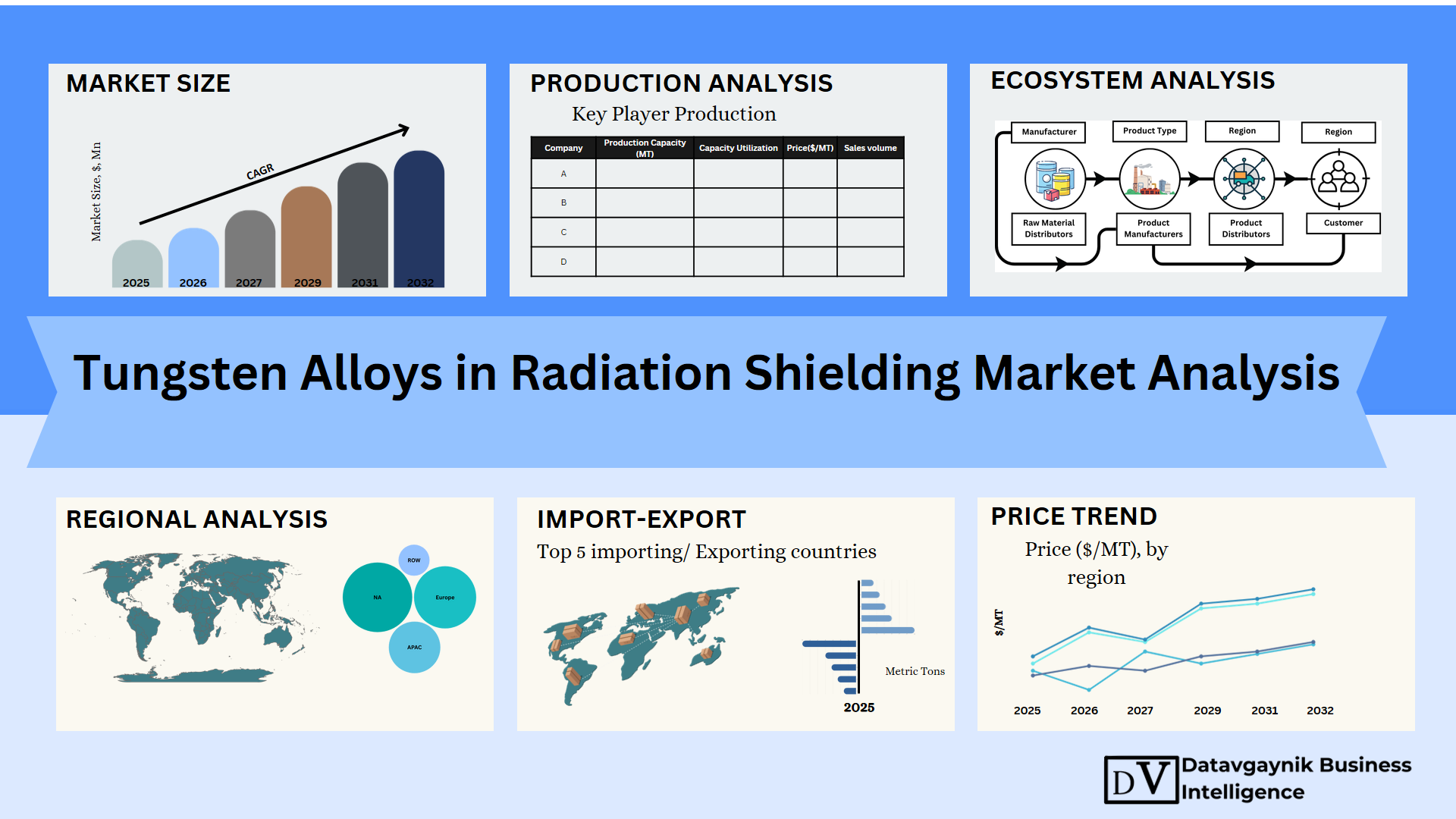
This is an original analyst estimate. It measures revenue generated from tungsten-heavy alloy shielding materials, semi-finished forms and precision-machined components. It includes material conversion, powder metallurgy, sintering, machining, testing and component-level engineering. It excludes tungsten used in X-ray targets, balance weights, ammunition, cutting tools and other non-shielding applications.
Datavagyanik also covers related markets such as the Radiation Shielding Materials Market. These related markets contribute valuable context to the primary topic by highlighting complementary trends and technologies.
The Tungsten Alloys in Radiation Shielding Market covers dense tungsten-based materials used to absorb or redirect X-rays, gamma rays and selected forms of secondary radiation. Commercial products are generally made from tungsten combined with nickel, iron, copper or other binder metals. These alloys retain much of tungsten’s density while becoming easier to sinter, machine and integrate into medical or industrial equipment.
Tungsten-heavy alloys are typically selected where the shield must fit inside a restricted space. Lead remains cheaper. Yet it is softer, bulkier for an equivalent compact design and more difficult to use as a structural precision component. Tungsten alloys can combine shielding, dimensional stability and mechanical load-bearing capability in the same part. That combination matters in collimators, source containers, detector housings, syringe shields and compact imaging systems. Plansee and Elmet Technologies, for example, identify tungsten-heavy alloys as materials for medical shielding, X-ray equipment, collimation and nuclear medicine components.
Global Market Forecast
| Forecast Indicator | Analyst Estimate | Commercial Interpretation |
| Global market size, 2026 | $612 million | Established specialist market led by medical imaging, radiotherapy and nuclear medicine |
| Intermediate market size, 2030 | $782 million | Higher use of precision shielding in compact equipment and radiopharmaceutical handling |
| Projected market size, 2035 | $1,061 million | Wider lead substitution and more high-value custom shielding components |
| CAGR, 2026–2035 | 6.3% | Growth above conventional fabricated-metal demand but below emerging medical technology platforms |
The forecast is based on component demand across four commercial pools: medical imaging and radiotherapy equipment, nuclear medicine and radiopharmaceutical handling, nuclear and industrial radiation systems, and specialized aerospace or research applications. The model also accounts for tungsten price pressure, machining premiums and the gradual replacement rather than immediate elimination of lead.
Why the Market Matters During 2026–2035
The business case is not driven by raw tungsten volume alone. Finished shielding parts often contain demanding geometries, narrow tolerances and application-specific material grades. So, value shifts toward suppliers that can manage powder quality, sintering, non-destructive testing, precision machining and traceability under one production system.
Medical equipment miniaturization is one of the strongest structural forces. CT scanners, radiation therapy systems, mobile imaging units and nuclear medicine equipment need shielding close to the radiation source or detector. A high-density material permits thinner walls and smaller housings. It can also serve as a collimator that shapes the radiation beam rather than merely blocking it.
Use case: A compact tungsten-alloy collimator can both attenuate stray radiation and create the precise beam opening needed by an imaging or therapeutic system. A lead part may require more volume and additional mechanical support.
Nuclear medicine is another important demand pool. Shielded syringes, vials, transport containers and dispensing equipment are required when healthcare workers handle diagnostic or therapeutic radioisotopes. The International Atomic Energy Agency notes that shielding of vials and syringes is essential in nuclear medicine. Its technical guidance cites minimum tungsten thicknesses of 2 mm for technetium-99m syringe shielding and 5 mm for fluorine-18.
The expansion of targeted radionuclide therapy should increase the value of this segment. These therapies introduce higher-activity isotopes and more handling stages across production, transport, preparation and administration. That does not mean every shield will use tungsten. It does mean more facilities will evaluate compact and durable shielding for repeated clinical use. The IAEA also describes growing use of PET, multimodality imaging and newer therapeutic radiopharmaceuticals as important developments in nuclear medicine practice.
Regulation and Material Substitution
Radiation safety regulation supports demand for qualified shielding, but regulators rarely prescribe tungsten as the mandatory material. Equipment manufacturers and facility designers select the material based on energy level, geometry, allowable weight, cost and worker exposure targets.
Lead substitution is therefore gradual. It is not a universal regulatory ban story. European restrictions on hazardous substances continue to provide specific exemptions for lead in certain medical and ionizing-radiation equipment. Even so, environmental compliance, worker-handling concerns and end-of-life requirements are encouraging OEMs to examine lead-free designs where the economics work.
This distinction matters. Large static shielding walls will continue to favour concrete, steel or lead-based systems in many installations. Tungsten alloys are strongest in compact, engineered and high-value parts where space savings or mechanical performance justifies the premium.
Production and Supply-Side Risk
Raw-material concentration will remain the main restraint. According to the U.S. Geological Survey, global tungsten mine production reached an estimated 85,000 metric tons in 2025, of which China accounted for 67,000 metric tons. China also introduced export controls on selected tungsten products in February 2025. Tungsten concentrate and ammonium paratungstate prices then increased sharply during the year.
So, shielding-component manufacturers face two linked challenges:
- Maintaining access to qualified tungsten powder and intermediate materials.
- Passing higher material and inventory costs through long OEM qualification cycles.
For buyers in the Tungsten Alloys in Radiation Shielding Market, supply assurance may become almost as important as quoted unit price. Medical, nuclear and aerospace customers cannot switch material sources quickly. New powders or production locations can require repeat testing, process validation and documentation.
Key Consumers and Clients
| Consumer Group | Typical Procurement Requirement |
| Medical imaging equipment OEMs | Detector shielding, source housings, apertures and collimators |
| Radiotherapy system manufacturers | Beam-shaping components, multileaf collimator parts and internal shielding |
| Hospitals and nuclear medicine centres | Syringe shields, vial shields, storage devices and handling accessories |
| Radiopharmaceutical producers | Shielded processing, dispensing, packaging and transport components |
| Nuclear power and research facilities | Source containment, detector protection and localized shielding assemblies |
| Industrial radiography and NDT companies | Source projectors, exposure-device components and inspection-system shielding |
| Security-scanning OEMs | X-ray source and detector shielding for baggage, cargo and parcel inspection |
| Aerospace and scientific laboratories | Compact shielding around sensors, electronics and radiation sources |
Expert view: The most attractive revenue pool through 2035 will not be standard tungsten blocks. It will be qualified, machined shielding components designed into equipment platforms for several product generations.
Market Segmentation and Forecast Scope
The Tungsten Alloys in Radiation Shielding Market is segmented by alloy composition, tungsten concentration, product form, radiation type, application, end user and geography. Each dimension answers a different commercial question. Alloy chemistry determines density and machinability. Product form indicates the degree of value addition. Application defines the operating environment. End-user segmentation shows who controls specifications and procurement.
By Alloy Composition
Tungsten–Nickel–Iron Alloys
Tungsten–nickel–iron is the most widely used commercial family. These alloys offer high density, workable mechanical properties and better machinability than pure tungsten. They are suitable for collimators, housings, plates, source shields and complex machined components.
This family is estimated to account for 64% of global market revenue in 2026. Its position is supported by the availability of standard grades and established powder-metallurgy processes.
Tungsten–Nickel–Copper Alloys
These alloys are used when low magnetic response or specific electrical and thermal characteristics are important. They are relevant around sensitive detectors, scientific instruments and equipment where ferromagnetic binder materials could interfere with operation.
Demand is smaller than for tungsten–nickel–iron. However, the segment carries a higher customization premium and should expand steadily in advanced imaging and scientific instrumentation.
Specialty and Low-Magnetic Tungsten Alloys
This category includes modified binder systems and application-specific grades designed for low magnetic permeability, improved corrosion behaviour or specialized mechanical performance.
It is strategically important rather than volume-led. Procurement is usually tied to individual equipment programs, detector designs or research systems.
By Tungsten Concentration
90%–92.5% Tungsten Grades
These materials provide a practical balance of density, strength, machinability and cost. They are commonly considered when the part needs shielding capability but also contains threads, mounting features or detailed machined surfaces.
Above 92.5%–95% Tungsten Grades
Higher tungsten content raises density and shielding performance. These grades are used in demanding medical and industrial components where available space is limited.
Above 95%–97% Tungsten Grades
The highest-density commercial heavy alloys are used where compact attenuation is the main design priority. They may be specified for high-energy X-ray shielding, source containment and small components requiring maximum mass within a fixed envelope.
The trade-off is straightforward. Higher tungsten content generally improves density but can make production and machining more demanding. Elmet Technologies identifies nominal tungsten levels ranging from 90% in ASTM B777 Class 1 to approximately 97% in Class 4, with higher classes used for more demanding X-ray and radiation-shielding applications.
By Product Form
Precision-Machined Shielding Components
This segment includes housings, inserts, detector shields, sleeves and application-specific parts. It generates higher revenue per kilogram because the supplier delivers both material performance and tight dimensional control.
It should remain one of the most commercially attractive categories through 2035. OEMs increasingly prefer parts supplied close to final specification rather than purchasing raw material and managing specialist machining separately.
Collimators and Beam-Control Components
Collimators absorb unwanted radiation while permitting a controlled beam to pass through defined openings. They are used in radiotherapy, diagnostic imaging, X-ray inspection and scientific equipment.
This is the fastest-growing strategic product category. Growth comes from more precise treatment delivery, detector miniaturization and higher equipment complexity. Plansee supplies tungsten-heavy alloy shielding and multileaf collimator components for radiation-protection applications.
Syringe, Vial and Source Shields
These products protect workers who prepare, move or administer radioactive materials. They include reusable syringe shields, vial containers, isotope-storage devices and small source housings.
Demand is closely tied to nuclear medicine procedures, PET imaging and therapeutic radiopharmaceutical use. Product ergonomics also matter. A technically effective shield that slows handling or obstructs visibility may not deliver the expected occupational benefit.
Blocks, Plates, Rings and Semi-Finished Forms
Standard geometries are purchased by machine shops, research facilities and equipment fabricators. Pricing is more exposed to tungsten input costs because engineering content is lower.
Modular and Integrated Shielding Assemblies
These combine tungsten-alloy elements with stainless steel, aluminium, polymers or other materials. The assembly may include mounting structures, cooling features, liners and removable shielding modules.
This category should gain relevance where OEMs want one qualified supplier to provide a finished subsystem.
By Application
Medical Imaging and Radiotherapy
This application is estimated to represent 44% of market revenue in 2026, making it the largest identified application segment.
It includes CT systems, conventional and digital X-ray equipment, radiotherapy machines, surgical imaging systems and specialized scanners. Shielding is used around X-ray sources, detectors, beam paths and internal electronics.
Growth will be supported by equipment replacement, increased installation of imaging systems in emerging healthcare markets and more precise radiation delivery. Radiotherapy itself remains widely used in cancer care, with both external beam and internal radiation treatment requiring controlled exposure and properly shielded equipment.
Nuclear Medicine and Radiopharmaceutical Handling
This includes PET and SPECT facilities, isotope-production sites, radiopharmacies, dispensing systems and therapeutic radionuclide workflows.
The segment is forecast to grow faster than conventional diagnostic imaging. Its revenue base is smaller, but it benefits from expanding clinical pipelines for targeted radionuclide therapies and the need for shielding at several points in the supply chain.
Nuclear Energy and Research
Tungsten-heavy alloys are used in localized shielding, instrument protection, source handling and research assemblies. They do not replace bulk concrete or steel shielding in reactor buildings. Their role is concentrated in compact components where high density and mechanical stability are required.
Fusion research creates a longer-term opportunity. Yet shielding materials for fusion may involve pure tungsten, tungsten borides, hydrides and layered structures rather than standard heavy alloys alone. The commercial scope should therefore be defined carefully.
Industrial Radiography and Non-Destructive Testing
Industrial users require compact shielding around sealed sources and X-ray inspection systems. Demand is linked to aerospace inspection, weld testing, pipeline maintenance, casting inspection and advanced manufacturing quality control.
Security Screening and Scientific Equipment
Cargo scanners, baggage scanners, diffraction systems, radiation detectors and laboratory instruments use precision shielding to reduce stray radiation and improve detector performance.
By End User
Medical Equipment OEMs
These companies control material specifications for high-volume equipment platforms. They require repeatability, regulatory documentation, dimensional accuracy and long-term supply agreements.
Healthcare and Nuclear Medicine Facilities
Hospitals and imaging centres purchase smaller finished shields and handling accessories. Their buying decisions are influenced by occupational safety, usability, cleaning requirements and replacement cycles.
Radiopharmaceutical Companies
These users require shielding for production cells, isotope handling, dispensing, storage and transport. They are among the most attractive emerging clients because their requirements extend across multiple workflow stages.
Nuclear Operators and Research Institutions
Purchases are project-specific. Qualification periods are long and documentation requirements are high. Once approved, however, supplier relationships can be durable.
Industrial, Security and Aerospace Integrators
These clients use tungsten-alloy components inside larger systems. Procurement is normally based on drawings, performance specifications and traceability requirements rather than standard catalog products.
By Region
North America
North America is the leading commercial region. It has a large installed base of imaging and radiotherapy equipment, established radiopharmaceutical production and domestic suppliers capable of producing qualified tungsten-heavy alloy components.
The region will also favour local or allied-country sourcing because tungsten is treated as a critical input for medical, aerospace and defence supply chains.
Europe
Europe has strong capabilities in powder metallurgy, medical equipment and precision manufacturing. Environmental procurement standards support interest in lead-free designs, although regulatory exemptions mean lead will remain in use for selected applications.
Austria and Germany are important locations in the tungsten-processing value chain. The region also has established suppliers such as Plansee and Wolfmet.
Asia Pacific
Asia Pacific is forecast to record the fastest regional expansion. China, Japan, South Korea and India are increasing medical-equipment production, nuclear medicine capacity and industrial inspection activity.
The region also sits at the centre of tungsten mining and intermediate processing. This creates cost and availability advantages for local manufacturers, but export controls may complicate supply to overseas customers.
Latin America, Middle East and Africa
Demand is concentrated in new hospitals, diagnostic centres, radiotherapy infrastructure, industrial radiography and oil and gas inspection. Most tungsten-alloy shielding components are imported.
Growth can be strong from a small base. However, high upfront cost and limited local machining capability will restrict broader adoption.
Forecast Scope Boundaries
| Included in the Market | Excluded from the Market |
| Tungsten-heavy alloy shielding components | Tungsten X-ray tube targets |
| Tungsten-alloy collimators and apertures | Pure lead sheets and lead-lined rooms |
| Source, syringe and vial shields | Concrete and structural steel shielding |
| Detector housings and localized equipment shielding | Tungsten ballast and counterweights |
| Machined plates, sleeves, blocks and rings used for shielding | Tungsten carbide cutting tools |
| Integrated shielding assemblies containing tungsten-heavy alloy | Depleted uranium shielding |
Expert view: Nuclear medicine will generate the strongest incremental opportunity, while precision collimators and integrated shielding assemblies will deliver the best margin profile.
Market Trends and Innovation Landscape
The innovation cycle in the Tungsten Alloys in Radiation Shielding Market is shifting from basic material supply toward application-engineered components. Customers are no longer buying density alone. They want controlled composition, verified attenuation, stable tolerances, low magnetic response where required and documented performance across the life of the equipment.
Evolution of Powder Metallurgy
Conventional tungsten-heavy alloys are produced by blending tungsten powder with binder metals, compacting the mixture and applying liquid-phase sintering. The resulting material is then heat-treated and machined.
R&D is focused on five practical goals:
- Higher final density with fewer internal defects.
- Better control of tungsten grain size and binder distribution.
- Improved ductility without sacrificing attenuation.
- Reduced machining waste.
- More repeatable near-net-shape production.
Material uniformity is critical. Voids, binder segregation or dimensional changes during sintering can affect both mechanical integrity and shielding consistency. This gives vertically integrated suppliers an advantage. They can connect powder characteristics with final-part inspection rather than treating each production step as a separate transaction.
Higher-Density and Application-Specific Grades
Demand is gradually moving toward compositions designed around a specific equipment function. Standard tungsten–nickel–iron grades will continue to dominate. Still, low-magnetic and high-tungsten grades are gaining relevance in detector systems, research equipment and compact medical devices.
Non-magnetic compositions can reduce interference near sensitive instruments. Higher tungsten concentration allows thinner walls or smaller collimators. Lower-density grades remain useful when machinability, impact performance or cost is more important than minimum component size.
So, there is no single “best” alloy. The optimum grade depends on photon energy, allowable thickness, component geometry, magnetic sensitivity and mechanical load.
Use case: A detector housing may use a low-magnetic tungsten alloy even when a conventional tungsten–nickel–iron grade offers a lower price. Signal integrity may be worth more than the material saving.
Additive Manufacturing of Complex Shielding Parts
Additive manufacturing is one of the most important technology trends, but commercial adoption is still at an early stage.
Traditional machining removes a large amount of costly material when producing internal channels, curved apertures or lattice-like structures. Additive processes could reduce waste and create geometries that are difficult to machine. Potential applications include customized collimators, conformal shields, detector housings and components with integrated cooling passages.
Plansee has reported additive-manufacturing capabilities for tungsten, tungsten-heavy metal and related refractory alloys. Research into bound-metal deposition has also demonstrated extrusion-based processing of tungsten-heavy alloy parts for rapid prototyping and low-volume production.
The main barriers are not concept design. They are density, cracking, shrinkage control, surface finish and qualification. A printed component must show that its internal porosity and attenuation are consistent across the entire geometry. Medical and nuclear customers will not accept additive manufacturing solely because it reduces lead time.
Research laboratories are making progress. Oak Ridge National Laboratory reported a substrate-preheating method that enabled the deposition of crack-free tungsten beads, addressing thermal shock during additive repair and manufacturing. The work was directed toward extreme-environment tungsten applications, but the process knowledge is relevant to future high-density shielding production.
Expert view: Additive manufacturing will first gain commercial traction in low-volume scientific and aerospace shields. Adoption in serial medical equipment will follow only after repeatable density and validation protocols are established.
Tungsten-Loaded Polymer and Hybrid Shielding
Tungsten-filled polymers are adjacent to the core alloy market. They do not offer the same density or structural strength as sintered heavy alloys. Yet they can provide flexibility, lower weight, easier shaping and lead-free handling.
Recent studies have examined PMMA containing tungsten oxide and flexible polymer composites containing high-atomic-number fillers. Experimental work published in 2025 found that adding tungsten oxide improved gamma-ray attenuation in PMMA composites. Other research has evaluated flexible lead-free materials for X-ray shielding.
These products could take demand from tungsten alloys in curtains, panels, wearable protection and low-energy shielding. They are less likely to displace dense alloys in compact collimators, source housings or structural components.
A hybrid design may prove more practical. A dense tungsten-alloy element can be placed near the radiation source, while a polymer composite controls lower-intensity scatter around the wider assembly.
Graded-Z and Multimaterial Designs
A single high-density metal is not always the best shield. High-energy interactions can generate secondary radiation. Engineers are therefore studying layered structures that combine high-atomic-number materials with lower-atomic-number absorbers.
In nuclear medicine, the IAEA has noted that an internal plastic layer can be used with lead or tungsten syringe shielding to absorb positrons before they strike the dense metal, reducing unwanted bremsstrahlung.
This principle is encouraging more multimaterial designs. Future assemblies may combine tungsten-heavy alloy, polymers, boron-containing materials and structural metals. The exact stack depends on whether the system is managing X-rays, gamma radiation, beta particles, neutrons or mixed fields.
For tungsten-alloy suppliers, this creates an integration opportunity. Selling a completed shielding assembly offers more value than supplying one machined ring or block.
Simulation-Led Shield Design
Monte Carlo radiation-transport modelling is becoming standard in complex shielding development. Engineers can model source energy, geometry, scatter, attenuation and secondary radiation before producing a physical prototype.
Digital simulation reduces trial-and-error machining. It also allows designers to place tungsten only where it produces meaningful dose reduction. This is important because tungsten is expensive and heavy. A shield optimized by geometry can outperform a thicker but poorly designed component.
Topology optimization and digital twins could push this further. A supplier may eventually receive radiation-field data and return an optimized component geometry rather than simply machining a customer drawing.
Artificial Intelligence: Relevant but Not Yet Mainstream
Artificial intelligence is not currently a major operational feature of commercial tungsten shielding. Claims of widespread AI-driven shielding production would be premature.
The credible use case is upstream material and process development. Machine-learning models can screen alloy compositions, predict cracking and accelerate parameter selection for additive manufacturing.
A 2026 study used machine-learning interatomic potentials to evaluate tungsten–tantalum–niobium compositions for ductility and additive manufacturability. Experimental validation found that selected predicted compositions avoided intergranular microcracking. The work concerns refractory-alloy design rather than established medical shielding products, but it shows how computational screening may shorten future development cycles.
Expert view: AI will influence alloy formulation and process control before it becomes visible to shielding buyers. The commercial outcome will be shorter qualification cycles, not an “AI-enabled shield.”
Radiopure Tungsten for Scientific Instruments
Low-background physics and radiation-detection experiments require shielding materials with minimal internal radioactivity. Lead can contain lead-210, which adds background noise.
Research has identified tungsten and tungsten pseudo-alloys with low levels of selected radioactive contaminants. Tests have also shown potential benefits in compact low-background shielding configurations. This creates a specialized market in particle physics, gamma spectroscopy and sensitive detector systems.
Volumes will remain small. Unit values can be high because customers require material screening, documented purity and customized geometry.
Supply-Chain Consolidation and Strategic Transactions
The tungsten value chain is becoming more integrated. This affects shielding suppliers because powder availability and recycling access influence both price and delivery reliability.
In December 2024, Masan High-Tech Materials completed the sale of H.C. Starck Tungsten Powders to Mitsubishi Materials Corporation. The transaction followed a definitive agreement valuing the equity purchase at $134.5 million. H.C. Starck Tungsten Powders operates production sites in Germany, Canada and China and supplies tungsten powders and intermediate products.
The deal was not limited to radiation shielding. Still, it matters to this market because it consolidates an important upstream powder platform under a large integrated materials group. Medical and nuclear component suppliers increasingly prefer powder sources with recycling capability, multiple production locations and long-term supply stability.
Earlier, Plansee Group acquired Mi-Tech Tungsten Metals, expanding its position in North American tungsten-heavy alloy components. The transaction created a stronger link between powder-metallurgy expertise and finished high-density parts serving medical, aerospace, energy and government markets.
Export Controls and Localization
China’s February 2025 export-control announcement covering selected tungsten items altered procurement behaviour. The controls were licensing measures rather than a full export ban. However, they increased administrative uncertainty and contributed to stronger prices during 2025.
This may lead to:
- Larger safety stocks among European and North American fabricators.
- More qualification of recycled tungsten.
- Increased interest in Canadian, Australian, Kazakh and European supply.
- Longer-duration powder and concentrate offtake agreements.
- Higher customer preference for regional machining and finishing.
Localization will not remove dependence on Chinese raw materials quickly. Yet it can reduce exposure at the final component stage.
Innovation Outlook Through 2035
| Innovation Area | Current Position | Likely Commercial Impact by 2035 |
| Advanced powder metallurgy | Commercial and improving | Better yield, consistency and mechanical performance |
| Higher-density specialized alloys | Commercial | Thinner shielding and higher-value compact components |
| Low-magnetic alloys | Established niche | Wider use in detectors and scientific equipment |
| Additive manufacturing | Pilot to early commercial | Customized collimators and low-volume complex shields |
| Tungsten-polymer composites | Emerging adjacent technology | Growth in flexible and lightweight shielding |
| Multimaterial shielding | Application-specific | Better control of mixed and secondary radiation |
| Simulation-led optimization | Increasingly established | Lower material use and shorter development cycles |
| Machine-learning alloy design | Research stage | Faster screening of printable or crack-resistant compositions |
| Recycled tungsten feedstock | Commercial but supply-limited | Lower supply risk and improved environmental profile |
Expert view: By 2035, the Tungsten Alloys in Radiation Shielding Market will compete less on nominal tungsten content and more on engineering capability. Suppliers that combine secure powder access, simulation, near-net-shape processing, precision machining and application validation will capture the strongest contracts.
Competitive Intelligence and Benchmarking
Competition in the Tungsten Alloys in Radiation Shielding Market is based on more than alloy density. Buyers examine powder traceability, material uniformity, machining tolerances, magnetic properties, radiation attenuation data and the supplier’s ability to remain qualified for several equipment generations.
The competitive structure includes vertically integrated refractory-metal groups, specialized tungsten-alloy manufacturers and shielding fabricators that purchase alloy material and convert it into finished assemblies.
Competitive Benchmarking
| Company | Core Position | Shielding Portfolio and Capabilities | Competitive Assessment |
| Plansee Group | Integrated global leader | Tungsten-heavy alloy components, beam collimation systems, medical equipment shielding, X-ray components and precision-machined assemblies | Strongest integrated position |
| Elmet Technologies | Major United States producer | Heavy-alloy classes, medical shielding, isotope containers, collimator materials and customized components | Strong North American platform |
| M&I Materials – Wolfmet | European specialist | Magnetic and non-magnetic heavy alloys, medical and nuclear shielding, additive manufacturing and scientific components | Innovation-led niche leader |
| Nippon Tungsten Co., Ltd. | Established Japanese materials company | High-density sintered alloys, shielding elements, weights and precision-engineered material forms | Strong in Japan and East Asia |
| Nidec Material Corporation | Japanese specialty-alloy supplier | High-density tungsten alloys for X-ray and gamma-ray shielding, medical equipment and engineered industrial parts | Application-focused regional player |
| Mars Metal Company – MarShield | Custom shielding fabricator | Tungsten shielding for nuclear medicine, diagnostic imaging, nuclear energy and non-destructive testing | Strong custom-project position |
| Mitsubishi Materials Corporation / H.C. Starck Tungsten Powders | Upstream tungsten platform | Tungsten powders, recycled feedstock, chemicals and alloy inputs supporting downstream shielding production | Strategic supply-chain benchmark |
Plansee Group
Plansee Group has one of the broadest positions across the tungsten value chain. It supplies tungsten-heavy alloy material and finished components for radiation therapy, diagnostic imaging and X-ray generation. Its capabilities include powder metallurgy, material development, forming and precision machining.
The company is particularly well positioned in beam-control components. These include movable collimator elements and shielding parts installed inside radiotherapy and imaging equipment. It also benefits from an international production network and access to tungsten recycling through affiliated operations.
Its competitive advantage is integration. A medical equipment OEM can work with one supplier from alloy selection through prototype development and serial manufacturing. That reduces qualification complexity. Plansee’s published healthcare portfolio includes tungsten-heavy alloy shielding and multileaf collimator components used to control radiation exposure.
Elmet Technologies
Elmet Technologies is a major United States-based supplier of tungsten and molybdenum materials. Its heavy-alloy portfolio covers the four principal density classes under the ASTM B777 framework. It supplies standard material forms and machined components for medical imaging, oncology equipment, isotope management and industrial X-ray systems.
The acquisition of the Americas operations of H.C. Starck Solutions in 2023 expanded Elmet’s manufacturing presence across Maine, Ohio and Michigan. This added more refractory-metal processing and component capabilities to its existing vertically integrated facility.
Elmet’s positioning is strongest where customers require United States production, controlled material provenance and compliance with medical, aerospace or government procurement requirements. The company states that its heavy alloys are used by CT and oncology system producers for shielding and multileaf collimator applications.
M&I Materials – Wolfmet
M&I Materials, through its Wolfmet business, is a specialized United Kingdom manufacturer of tungsten-heavy alloy products. It supplies magnetic and non-magnetic compositions for medical scanners, nuclear medicine, industrial systems, scientific instruments and nuclear facilities.
The company differentiates itself through engineering support and complex geometry production. It offers conventional machined components alongside additive-manufactured tungsten parts. This is relevant for customized collimators and shielding structures that would generate excessive waste if produced through subtractive machining.
Wolfmet also supplies shielding for major scientific infrastructure. In March 2026, it disclosed its role in delivering precision tungsten-alloy shielding for the High-Luminosity Large Hadron Collider program at CERN.
The company is smaller than the largest integrated tungsten groups. Still, its focus on radiation attenuation, non-magnetic grades and additive manufacturing gives it a strong position in high-value projects.
Nippon Tungsten Co., Ltd.
Nippon Tungsten Co., Ltd. manufactures powder-metallurgy products, cemented materials and high-density tungsten alloys in Japan. Its heavy alloys are used in shielding, balancing and other applications requiring high mass within a restricted space.
The company is well placed to serve Japanese imaging, electronics, industrial equipment and scientific instrument manufacturers. Its market position relies on materials consistency and close integration with domestic precision-manufacturing customers.
Nippon Tungsten identifies radiation shielding and lead replacement as applications for its high-density alloys.
Nidec Material Corporation
Nidec Material Corporation supplies high-density tungsten-alloy products for radiation shielding, balancing and specialized industrial functions. Its shielding materials are designed for X-ray and gamma-ray attenuation.
The company benefits from Japan’s established medical equipment, electronics and precision-component ecosystem. Its portfolio is narrower than that of Plansee or Elmet. However, it can compete effectively in customized Japanese and Asian OEM programs where quality control and close engineering coordination matter more than global production scale.
Mars Metal Company – MarShield
Mars Metal Company, operating its radiation-protection business under MarShield, specializes in customized shielding assemblies. It works with tungsten-heavy alloys as well as other shielding materials.
The company addresses nuclear power, nuclear medicine, radioisotope handling, diagnostic imaging and non-destructive testing. Its value proposition is fabrication rather than primary tungsten-alloy production. Customers can procure containers, blocks, housings and application-specific shielding structures without establishing their own specialist machining capabilities.
This makes MarShield an important downstream competitor. It may purchase material from integrated tungsten producers but compete with them when a customer requires a completed shielding assembly.
Mitsubishi Materials Corporation / H.C. Starck Tungsten Powders
Mitsubishi Materials Corporation strengthened its tungsten platform through the acquisition of H.C. Starck Tungsten Powders in December 2024. The acquired business manufactures tungsten powders, tungsten carbide powders and tungsten chemicals and operates processing facilities across Europe, North America and China.
This group should be viewed primarily as an upstream competitive benchmark rather than a direct competitor in every finished shielding component. Its importance comes from powder quality, recycling capabilities and geographic supply coverage.
The combined platform can influence material availability and qualification options for downstream shielding manufacturers. Mitsubishi Materials also intends to expand tungsten recycling and establish a more integrated resource circulation model.
Competitive Positioning Matrix
| Capability | Best-Positioned Companies |
| Integrated powder-to-component production | Plansee Group, Elmet Technologies |
| Medical collimation and internal equipment shielding | Plansee Group, Elmet Technologies, Wolfmet |
| Non-magnetic alloy capability | Wolfmet, Elmet Technologies, Nippon Tungsten |
| Additive manufacturing | Wolfmet, Plansee Group, Elmet Technologies |
| Customized shielding assemblies | MarShield, Wolfmet, Elmet Technologies |
| Japanese OEM access | Nippon Tungsten, Nidec Material, Mitsubishi Materials |
| Tungsten powder and recycling scale | Mitsubishi Materials / H.C. Starck, Plansee Group |
| North American local production | Elmet Technologies, MarShield, Plansee Group |
Expert view: Competitive advantage will move toward suppliers that control material sourcing and final-part validation. A company selling only semi-finished blocks will face more price pressure than one supplying a qualified collimator or completed shielding subsystem.
Regional Landscape and Adoption Outlook
Regional demand is shaped by three factors: access to advanced radiation equipment, availability of tungsten processing and the regulatory burden attached to medical or nuclear applications.
The following values are original analyst estimates. They are intended to show relative market positioning rather than audited country revenue.
Regional and Country Outlook
| Market | Estimated Share, 2026 | Estimated CAGR, 2026–2035 | Adoption Position |
| United States | 30% | 5.6% | Largest individual country market |
| Europe | 28% | 5.8% | Strongest specialized manufacturing cluster |
| China | 14% | 8.2% | Largest upstream supply base |
| India | 3% | 9.4% | Fastest-growing large healthcare market |
| Japan | 7% | 4.7% | Mature precision-material market |
| South Korea | 4% | 7.6% | Strategic supply and technology market |
| Middle East | 3% | 7.9% | Hospital and nuclear infrastructure-led growth |
| Rest of the World | 11% | 5.9% | Mixed medical, research and industrial demand |
United States
The United States is the largest individual market for tungsten-alloy radiation shielding. It has a substantial installed base of CT scanners, radiotherapy systems, industrial inspection equipment and nuclear medicine facilities. It also hosts equipment OEMs, specialized machine shops and integrated tungsten manufacturers.
Medical imaging and oncology equipment represent the central demand pool. Nuclear medicine provides the higher-growth layer. Radiopharmaceutical production, PET imaging and targeted radionuclide therapy require shielding across isotope manufacturing, dispensing, storage and clinical administration.
Domestic sourcing is becoming more valuable. Elmet Technologies produces tungsten-heavy alloys and finished components within the country. Yet the wider United States tungsten economy remains exposed to imported raw material. The U.S. Geological Survey identifies tungsten among the minerals affected by Chinese export restrictions and broader import dependence.
The regulatory environment is mature but demanding. Medical devices may require FDA clearance or approval. Radioactive-material handling is supervised through the Nuclear Regulatory Commission and authorized state programs. This raises qualification costs but also protects established suppliers from rapid low-cost entry.
Adoption outlook: Growth will favour domestic or allied-country suppliers, integrated medical components, non-magnetic shielding and products used in radiopharmaceutical handling.
Europe
Europe has the strongest concentration of specialized tungsten processing and radiation-component engineering. Austria, Germany and the United Kingdom are the main production centres. France, Italy, Switzerland, the Netherlands and the Nordic countries also contribute through medical technology, nuclear research and scientific equipment.
The region benefits from companies such as Plansee Group, Wolfmet and H.C. Starck Tungsten Powders. These businesses give European customers access to alloy development, powder processing, recycling and finished-part production.
Tungsten appears on the European Union’s critical raw materials list. The Critical Raw Materials Act seeks to improve extraction, processing and recycling capacity while reducing exposure to concentrated external supply. European importers of tungsten are also covered by responsible-sourcing requirements under the EU Conflict Minerals Regulation.
Radiation equipment must comply with the EU Medical Device Regulation where applicable. Facilities also operate under national rules implementing European radiation-protection standards. These requirements create demand for traceable materials and documented component performance.
Germany and Austria will remain the leading manufacturing locations. The United Kingdom has a strong position in scientific research, nuclear medicine and customized shielding. Central and Eastern Europe should record higher equipment-installation growth but will remain more dependent on imported components.
Adoption outlook: Europe will remain a high-value region for lead-free equipment design, recycled tungsten, scientific shielding and advanced collimation.
China
China controls the largest share of global tungsten mining and intermediate processing. This gives domestic manufacturers favourable access to powders and alloy feedstock. It also supports a wide network of producers supplying plates, rods, rings, containers and customized shielding parts.
Demand is expanding through hospital construction, medical-equipment manufacturing, nuclear medicine, security scanning and industrial inspection. China is also strengthening its radiation-medicine capabilities. In June 2026, the IAEA designated CNNC Medical as a Rays of Hope Anchor Centre. The organization operates seven hospitals focused on nuclear medicine, molecular imaging and advanced radiotherapy.
Domestic suppliers compete aggressively on price. However, international medical and scientific customers may require tighter documentation, non-destructive testing and longer qualification histories than many smaller fabricators currently provide.
The most important external risk is export policy. In February 2025, China introduced licensing controls covering selected tungsten products and technologies. The measures were described as export controls rather than an outright ban, but they increased documentation requirements and contributed to overseas supply uncertainty.
Adoption outlook: China will record strong internal consumption while remaining the most influential country in global tungsten pricing and availability.
India
India is expected to record the fastest percentage growth among the covered markets. Its starting base is small, but demand is broadening across diagnostic imaging, radiotherapy, nuclear medicine, industrial radiography and nuclear-energy applications.
Most high-performance tungsten shielding components are imported or produced from imported powder and semi-finished material. Local fabrication capability is emerging, but medical OEM qualification and consistent high-density alloy production remain limitations.
The Atomic Energy Regulatory Board regulates nuclear medicine and other radiation facilities. New nuclear medicine facilities must obtain regulatory consent through the eLORA licensing system and comply with applicable radiation-protection rules and safety codes.
AERB’s outreach to nuclear medicine facilities indicates that the regulated user base is expanding beyond a small group of metropolitan institutions. Its May 2025 awareness program for northern India involved about 150 nuclear medicine physicians, radiation safety officers and technologists.
Public cancer hospitals, private hospital chains and diagnostic networks will lead demand. Indian suppliers have an opportunity to localize syringe shields, vial shields, collimator parts and standard equipment inserts before moving into more complex OEM components.
Adoption outlook: India offers high growth, but suppliers will need technical support, regulatory documentation and price-sensitive product designs.
Japan
Japan is a mature market with established capabilities in medical imaging, precision machining, powder metallurgy and advanced materials. Demand is supported by a large diagnostic infrastructure and domestic manufacturers requiring highly consistent components.
Nippon Tungsten, Nidec Material and Mitsubishi Materials provide local alloy, powder or processing capabilities. Japanese customers generally emphasize long service life, dimensional stability and repeatable production over low initial pricing.
Japan is also involved in regional radiation-medicine capacity building. The IAEA established a partnership with Japanese universities and institutions to support clinical nuclear medicine, radiotherapy training and medical infrastructure across Asia and the Pacific.
The domestic market will grow more slowly than China or India. Still, Japan should maintain an above-average revenue contribution per component because of its concentration in advanced imaging and high-specification equipment.
Adoption outlook: Replacement demand, non-magnetic materials and precision medical components will matter more than large increases in raw shielding volume.
South Korea
South Korea combines advanced hospitals, electronics manufacturing, nuclear technology and high-quality machining. Its domestic shielding market is smaller than Japan’s, but growth is supported by medical imaging, research equipment and nuclear applications.
The reopening of the Sangdong tungsten project could improve South Korea’s strategic position in the upstream supply chain. The deposit is presented by its operator as one of the largest tungsten resources outside China and is intended to become a major non-Chinese source of concentrate.
Local availability will not automatically create a medical shielding industry. Powder conversion, alloy qualification and component machining remain separate capabilities. Even so, proximity to a strategic tungsten source may encourage investment in downstream processing.
Adoption outlook: South Korea can become an important bridge between raw-material security and advanced Asian manufacturing.
Middle East
The Middle East is relevant but remains an import-led market. The United Arab Emirates and Saudi Arabia are the strongest growth centres. Israel has advanced medical and scientific capabilities, while Jordan serves as an important regional cancer-care and training hub.
Growth is tied to new oncology hospitals, PET imaging, radiopharmaceutical services and nuclear infrastructure. The UAE reported 25 medical facilities dealing with nuclear medicine, radiotherapy or teletherapy, with additional facilities under consideration.
Jordan’s King Hussein Cancer Center has been designated as an IAEA collaborating centre for radiation oncology, medical physics, nuclear medicine and radiology. This reinforces its role in regional training and technical capacity building.
The region has limited tungsten-alloy production. Buyers depend on European, North American or Asian suppliers for finished shields and equipment components. Government-backed hospital projects provide funding, but procurement can be project-based and uneven.
Adoption outlook: The best opportunities are finished shielding products, isotope-handling accessories and OEM components supplied through medical equipment distributors.
Infrastructure and Regulatory Comparison
| Market | Healthcare Infrastructure | Tungsten Supply Position | Regulatory Complexity | Commercial Priority |
| United States | Very high | Import-dependent with domestic fabrication | Very high | High-value OEM and radiopharma components |
| Europe | Very high | Strong processing and recycling | Very high | Precision shielding and lead substitution |
| China | Rapidly expanding | Dominant upstream position | High and policy-sensitive | Domestic equipment and export manufacturing |
| India | Expanding from a low base | Import-dependent | High and centralized | Localized standard shielding products |
| Japan | Mature | Strong materials capability | Very high | High-specification precision components |
| South Korea | Advanced | Improving upstream position | High | Integrated regional supply chain |
| Middle East | Uneven but improving | Almost fully import-dependent | Medium to high | Finished medical and nuclear assemblies |
Expert view: India, China and the Middle East will contribute the highest percentage growth. The United States, Europe and Japan will continue to generate the highest revenue per component because specifications are tighter and qualification requirements are more demanding.
Recent Developments, Opportunities and Restraints
Recent Developments
- December 2024 – Mitsubishi Materials completed the acquisition of H.C. Starck’s global tungsten business. The transaction added major powder-production and recycling operations across Europe, North America and China. It strengthened Mitsubishi Materials’ position in secure tungsten sourcing and circular material supply.
- February 2025 – China introduced export controls on selected tungsten items. Exporters became subject to licensing requirements covering specified materials and technologies. The action increased uncertainty for non-Chinese alloy and component manufacturers and contributed to higher tungsten input costs.
- March 2026 – Wolfmet announced precision tungsten shielding supply for CERN’s High-Luminosity Large Hadron Collider. The project demonstrates demand for highly engineered tungsten-alloy shielding in scientific infrastructure where magnets and sensitive systems must be protected from intense radiation fields.
- June 2026 – CNNC Medical became the twentieth IAEA Rays of Hope Anchor Centre. The designation recognizes its capabilities in nuclear medicine, molecular imaging and advanced radiotherapy. It also signals continued investment in Chinese radiation-medicine infrastructure.
Opportunities and Business Insights
Radiopharmaceutical and Nuclear Medicine Shielding
Targeted radionuclide therapies create demand for shielding at production sites, radiopharmacies, hospitals and transport points. Suppliers can address this opportunity through syringe shields, vial containers, dispensing-system components and compact source-storage assemblies.
The attractive feature is repeat demand. Clinical isotope workflows require multiple shielding products rather than one large installation.
Near-Net-Shape and Additive Manufacturing
Material waste is a major cost in tungsten machining. Near-net-shape pressing, metal injection moulding and additive manufacturing can reduce the quantity of material removed from complex components.
The strongest early applications will be low-volume collimators, curved shielding inserts, internal channels and customized scientific parts. Conventional machining will remain necessary for final tolerances and surface finishing.
Regional Supply and Recycling Services
Export controls and tungsten price volatility create an opportunity for regional powder qualification, scrap recovery and closed-loop recycling. Suppliers that collect used shielding components and return qualified material to the production cycle can reduce raw-material exposure.
This model is particularly relevant in the United States and Europe, where customers increasingly value traceability and supply continuity.
Principal Restraints
Raw-Material Concentration
China remains the dominant source of mined and processed tungsten. Export licensing or geopolitical disruption can raise costs and extend delivery schedules.
High Component Cost
Tungsten alloys cost more than lead, steel and concrete. Their use must be justified by reduced component volume, durability, precision or regulatory benefits. Bulk structural shielding will often remain with lower-cost materials.
Lengthy Qualification Cycles
Medical, nuclear and aerospace customers require documented composition, density, mechanical properties and manufacturing consistency. Changing a powder source or production site may trigger repeat validation.
Manufacturing Complexity
Tungsten-heavy alloys require controlled powder blending, pressing, liquid-phase sintering and specialized machining. Poor process control can produce porosity, binder segregation or dimensional inconsistency.
Expert view: AI is unlikely to become a visible product feature in this market. Its practical role will be in alloy screening, process optimization and shielding simulation. The larger commercial gains will come from automation, near-net-shape manufacturing and closed-loop material recovery.