

Solid-State Electrolytes for Lithium Competition Is Moving Around Supplier Qualification, OEM Access, and Scale-Up Control
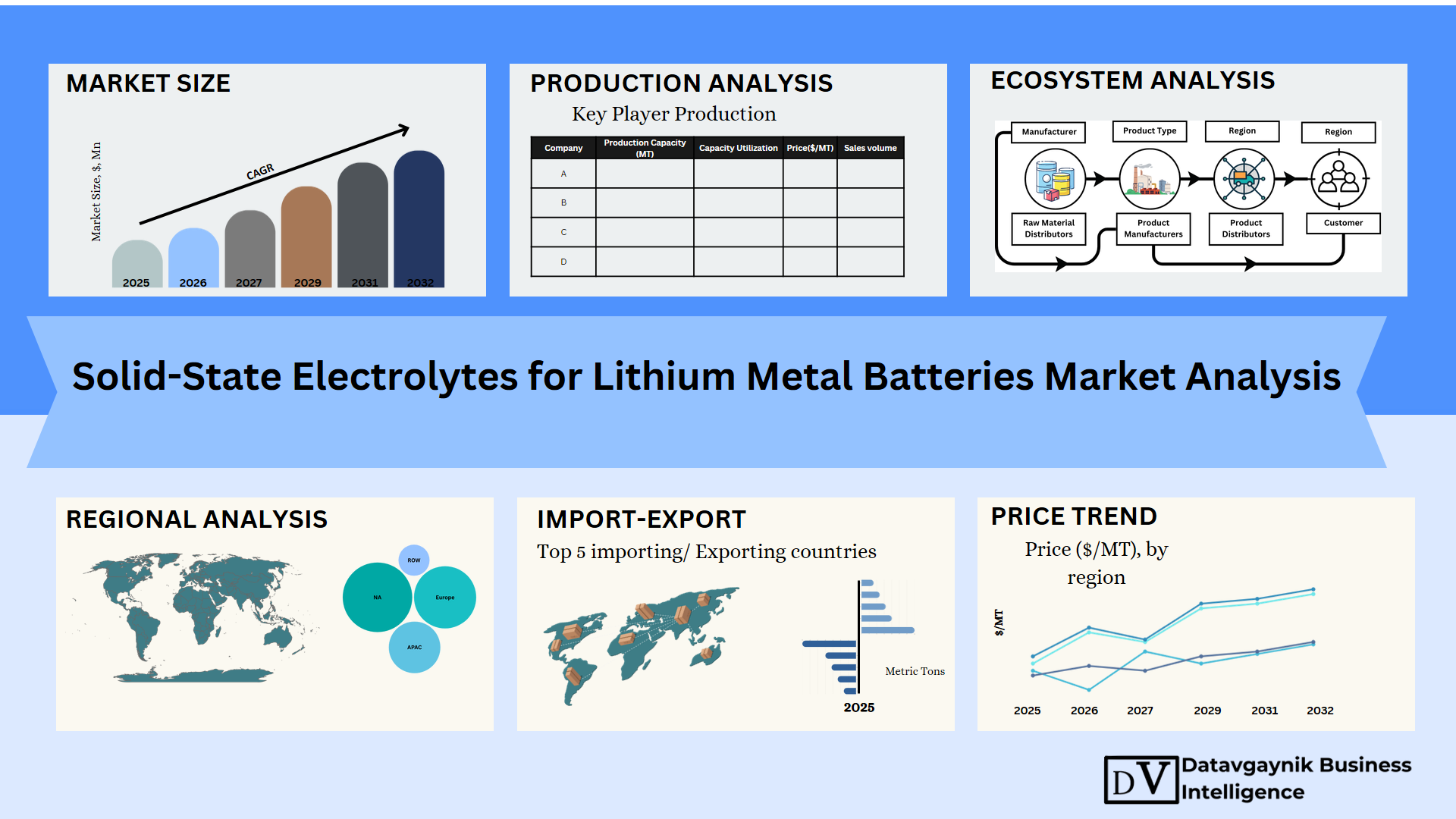
Solid-State Electrolytes for Lithium remain a pre-commercial but increasingly supplier-defined materials market, where competition is concentrated around sulfide powders, oxide/ceramic separators, polymer-composite electrolytes, lithium sulfide precursors, electrolyte-coated cathode materials, and cell-integration know-how. The global solid-state electrolyte market is estimated at about USD 264 million in 2026, based on a 2025 base of USD 216.85 million and a 21.91% CAGR, with the market projected to reach nearly USD 1.56 billion by 2035. Supplier strength is not measured only by chemistry patents; it is being shaped by who can secure battery OEM validation, produce consistent electrolyte powder at pilot scale, control moisture-sensitive handling, and align with automotive launch windows.
The competitive structure is narrow at the top and fragmented below it. Large Japanese groups such as Idemitsu Kosan, Toyota, Honda, and Sumitomo Metal Mining are building an integrated ecosystem around all-solid-state batteries, while U.S. and European-linked developers such as Solid Power, QuantumScape, and Factorial Energy are using licensing, joint evaluation, and OEM demonstration programs to build customer access before mass production. South Korean material suppliers and battery companies are also moving into sulfide electrolyte capacity, mainly because Samsung SDI, SK On, LG Energy Solution, and automotive customers require localized technical support and secure material supply.
Supplier Ecosystem Is Stronger Where Electrolyte Chemistry Is Linked to Battery OEM Programs
Sulfide-based electrolytes currently attract the highest strategic attention in automotive lithium solid-state batteries because they offer high ionic conductivity and better mechanical contact with electrodes than many oxide systems. The drawback is that sulfide electrolytes are highly sensitive to moisture and can generate hydrogen sulfide under poor handling conditions. This makes the market less like a commodity chemical market and more like a qualified battery-materials market, where process control, dry-room capability, packaging, impurity management, and customer co-development decide supplier selection.
Idemitsu Kosan has one of the clearest supplier positions because its electrolyte strategy is directly linked to Toyota’s 2027–2028 all-solid-state BEV target. In February 2025, Idemitsu announced a 21.3 billion yen lithium sulfide plant at its Chiba refinery, with completion targeted for June 2027 and annual capacity of 1,000 metric tons, enough to support electrolyte demand for about 50,000–60,000 EVs. This matters because lithium sulfide is a core precursor for sulfide solid electrolytes, and stable precursor availability is one of the biggest bottlenecks in moving from laboratory cells to automotive packs.
Toyota’s role is not simply that of a buyer. It is acting as a system integrator that links electrolyte quality to cathode durability, cell processing, pack design, and vehicle targets. In October 2025, Toyota and Sumitomo Metal Mining announced progress on a highly durable cathode material for all-solid-state batteries, with Sumitomo targeting mass production from fiscal 2028. For electrolyte suppliers, this shows why the market is customer-approval-driven: electrolyte powders must work with specific cathode coatings, anode systems, stack pressure requirements, and cell assembly methods rather than being sold as standalone materials.
Honda is building a different type of competitive position by internalizing cell process learning. In November 2024, Honda unveiled a demonstration production line for all-solid-state batteries in Sakura City, Tochigi Prefecture, with a floor area of about 27,400 square meters and an investment of roughly 43 billion yen. The line includes weighing and mixing, coating, roll pressing, cell formation, and module assembly. Honda’s emphasis on roll pressing is important for Solid-State Electrolytes for Lithium because dense electrolyte layers and stable solid-solid contact are central to reducing internal resistance and improving durability. This gives Honda stronger process visibility than companies relying only on external material sampling.
Solid-State Electrolytes for Lithium Are Not Sold Through Broad Distribution Channels
Unlike conventional battery electrolyte salts and solvents, solid-state lithium electrolytes are not moving mainly through open chemical distribution. Customer access is concentrated through joint development agreements, evaluation samples, battery pilot lines, licensing structures, and direct OEM qualification. This limits near-term volume but raises switching costs once a material is embedded into a cell design.
Solid Power illustrates this model clearly. The company is positioned around sulfide-based solid electrolyte materials and a licensing strategy rather than high-capex cell manufacturing. In September 2024, Solid Power was selected by the U.S. Department of Energy for up to USD 50 million in support for continuous production of sulfide-based solid electrolyte materials. In 2025, the company reported capital spending tied to construction of a continuous electrolyte production pilot line and later stated that commissioning was expected by the end of 2026. Its customer access depends on supplying electrolyte samples to partners such as BMW, Samsung SDI, SK On, and Ford, then converting technical evaluation into cell programs.
QuantumScape competes differently. Its value is centered on a ceramic solid-state separator and lithium-metal cell architecture rather than selling electrolyte powder as a conventional material. In July 2024, Volkswagen Group’s PowerCo and QuantumScape signed an agreement under which PowerCo could license QuantumScape’s technology platform for mass production, subject to technical progress and royalty payments. This positions QuantumScape less as a bulk electrolyte supplier and more as a platform technology owner with automotive industrialization access through Volkswagen.
Factorial Energy is also stronger through OEM linkage than through broad material distribution. In April 2025, Stellantis and Factorial validated automotive-sized solid-state battery cells using Factorial’s FEST technology, reporting 375 Wh/kg energy density and charging from 15% to more than 90% in 18 minutes at room temperature. Stellantis had invested EUR 75 million in Factorial in 2021 and plans to place the batteries into a demonstration fleet in 2026. For electrolyte competition, this shows that cell-level validation is often more commercially meaningful than standalone material claims.
Product Differentiation Depends on Interface Stability, Manufacturing Fit, and Cost Path
The market is divided across sulfide electrolytes, oxide/ceramic electrolytes, polymer electrolytes, and composite systems. Sulfides are stronger in high-power EV applications because of conductivity and electrode contact, while oxides offer better air stability but can be harder to process due to brittleness and interface resistance. Polymer and composite electrolytes are more manufacturable and flexible, but many still face limitations in room-temperature conductivity and high-voltage compatibility.
This is why supplier differentiation is moving toward application fit rather than one universal winning chemistry. Automotive OEMs require long cycle life, fast charging, low-temperature performance, safety, stack-pressure tolerance, and manufacturability on modified lithium-ion lines. Consumer electronics and specialty applications can accept smaller volumes and higher material cost if energy density or safety improves. Stationary storage is less likely to adopt expensive solid-state lithium electrolytes early unless cycle life, safety, or operating-temperature advantages offset cost.
Cost remains the largest commercial constraint. Idemitsu has directly linked its lithium sulfide investment to reducing solid electrolyte costs toward parity with liquid lithium-ion electrolyte systems. Solid Power’s continuous production line has similar logic: batch synthesis may support samples, but automotive supply requires repeatable powder production, lower unit cost, and impurity control at meaningful tonnage. Until electrolyte cost, yield, and cell assembly losses improve, many programs will remain in pilot and demonstration stages.
Competitive Constraints Are Still Technical, Not Demand-Limited
Demand signals are visible from EV OEMs, battery manufacturers, aerospace, drones, robotics, and premium electronics, but supply qualification remains slow. Buyers are not choosing Solid-State Electrolytes for Lithium only because they want higher energy density; they need proof that the electrolyte can survive cell cycling, high voltage, lithium-metal interfaces, dry-room processing, transport, storage, and module assembly. This makes customer trust and technical service more important than channel reach.
Japan currently has a stronger integrated commercialization route because Toyota, Idemitsu, Honda, Sumitomo Metal Mining, and NEDO-backed funding are aligned around materials, process development, and vehicle targets. The U.S. has strong technology developers, supported by DOE funding and OEM partnerships, but still faces scale-up risk. Europe’s position is mostly tied to Volkswagen-PowerCo and Stellantis partnerships, while South Korea is building supplier relevance through battery-maker proximity and materials capacity.
The near-term market will therefore be led by companies that can combine three capabilities: verified electrolyte chemistry, pilot-to-continuous production know-how, and direct access to automotive or battery-cell customers. In this market, the strongest supplier is not necessarily the company with the widest product catalog. It is the company whose electrolyte can pass cell-level validation, fit a customer’s manufacturing route, and reach enough material volume before planned solid-state battery launches move from demonstration fleets to limited commercial production.
Supplier Segmentation in Solid-State Electrolytes for Lithium Is Defined by Chemistry Control and Customer Qualification
Supplier segmentation in Solid-State Electrolytes for Lithium is better understood through chemistry capability and customer access than through conventional battery-material categories. The market is currently divided into four practical supplier groups: sulfide electrolyte specialists, oxide or ceramic electrolyte developers, polymer and quasi-solid electrolyte companies, and integrated battery OEMs that internalize electrolyte development for their own cell programs. Each group competes with a different strength. Sulfide suppliers compete on ionic conductivity, powder consistency, precursor sourcing, dry processing, and automotive validation. Oxide and ceramic players compete on separator durability, air stability, and high-voltage compatibility. Polymer and quasi-solid electrolyte companies compete on manufacturability, safety improvement, and easier integration into lithium-ion-like production lines.
Sulfide electrolytes are the most OEM-intensive segment because they are tied to high-energy lithium-metal and all-solid-state EV batteries. Idemitsu Kosan, Solid Power, and several Asian battery-material companies are positioned in this group. Idemitsu’s advantage comes from its hydrocarbon refining and sulfur chemistry background, which gives it a stronger route into lithium sulfide precursor production. Solid Power’s advantage is different: it has a sulfide electrolyte platform, U.S. pilot-line funding, and customer programs with automakers and battery manufacturers. The segment is technically attractive, but it has higher handling requirements because sulfide materials need moisture control, gas-safety management, and tight impurity specifications.
Oxide and ceramic electrolyte suppliers have a stronger fit where chemical stability and separator durability matter more than easy electrode contact. QuantumScape’s ceramic separator approach is the best-known example in this group, although its commercial model is centered on cell technology licensing rather than selling bulk electrolyte powder. Oxide systems can support lithium-metal architectures, but manufacturing challenges remain because ceramic layers are harder, less flexible, and more difficult to integrate with high-speed electrode assembly than polymer or sulfide systems. Their customer base is therefore concentrated around advanced cell developers, automotive battery programs, and strategic industrialization partners.
Polymer, gel, and quasi-solid electrolytes occupy a more flexible middle ground. They are often closer to existing lithium-ion manufacturing practices and can support earlier deployment in premium EVs, aerospace, drones, or consumer electronics where safety and energy density improvements justify higher cost. Factorial Energy fits this category through its FEST platform, which has been validated with Stellantis in automotive-sized cells. Polymer and quasi-solid players usually have better manufacturability narratives than pure ceramic systems, but they still need to prove room-temperature conductivity, cycle life, thermal stability, and compatibility with high-energy cathodes.
Product and Customer Segments Show Why Automotive Buyers Dominate Early Commercial Access
Automotive OEMs and battery-cell manufacturers are the strongest customer group because they bring the technical validation budgets, pilot-line capacity, and vehicle-launch discipline needed to industrialize solid-state batteries. A small electronics buyer can validate a material faster, but it rarely creates the same material-volume pull as an automotive platform. This explains why the largest supplier movements are tied to Toyota, Volkswagen PowerCo, BMW, Ford, Stellantis, Samsung SDI, SK On, and Honda rather than to open catalog sales.
The main segmentation logic is as follows:
- By product type: sulfide solid electrolytes lead in high-output EV development because of conductivity and electrode contact; oxide and ceramic electrolytes are stronger where stability and separator integrity are central; polymer and quasi-solid materials are stronger where processing flexibility and near-term integration matter.
- By customer type: automotive OEMs dominate strategic qualification; battery manufacturers dominate process validation; electronics and specialty mobility buyers support smaller early-volume applications.
- By application: EV traction batteries account for most future volume potential, while aerospace, drones, medical devices, robotics, and premium electronics provide narrower but technically valuable use cases.
- By channel: direct technical selling, joint development, licensing, and pilot-supply agreements dominate; broad chemical distribution is minimal because electrolyte selection is tied to cell design.
- By service model: supplier support is concentrated around sample qualification, cell integration, moisture-handling guidance, process optimization, safety documentation, and scale-up engineering rather than conventional after-sales service.
The channel structure is therefore technical and closed. A supplier does not win through distributor reach; it wins through early access to battery engineers, prototype cells, automotive test protocols, and long qualification cycles. In conventional liquid electrolytes, sales can move through chemical producers, formulators, and cell manufacturers. In solid-state lithium electrolytes, customer approval is much narrower because the electrolyte is structurally part of the cell architecture. Once a sulfide powder, ceramic separator, or quasi-solid electrolyte is selected, changing it can alter stack pressure, interface resistance, cathode coating, anode behavior, cycling performance, and safety results.
Regional Company Presence Is Led by Japan, Followed by the U.S., South Korea, and Europe
Japan has the deepest integrated company presence because material suppliers, automakers, and process developers are working in the same commercialization window. Idemitsu, Toyota, Honda, and Sumitomo Metal Mining together cover electrolyte precursors, solid electrolyte process development, cathode compatibility, battery cell design, and vehicle integration. This matters because Solid-State Electrolytes for Lithium cannot scale through material supply alone; the electrolyte must match cathode powder, separator design, anode strategy, stack pressure, and manufacturing route.
The U.S. has a stronger position in venture-backed technology platforms and DOE-supported scale-up. Solid Power and QuantumScape are the two clearest examples. Solid Power gives the U.S. a sulfide electrolyte production pathway, while QuantumScape provides a ceramic separator and lithium-metal cell platform with Volkswagen PowerCo as the industrialization partner. U.S. supplier access is improving through government funding and OEM partnerships, but the region still has to prove repeatable production economics and automotive-scale yield.
South Korea is important because it houses globally relevant cell makers and battery-material companies. SK On’s Daejeon pilot activity, supported by its technology relationship with Solid Power, places South Korea in the scale-up group rather than only the buyer group. Samsung SDI and LG Energy Solution also influence qualification expectations because Korean battery companies already supply global automakers and understand high-volume lithium-ion manufacturing, dry-room operations, and cell-level quality control. If Korean cell makers localize solid-state electrolyte sourcing, regional suppliers could gain faster access to global EV programs.
Europe’s position is more customer-led than materials-led. Volkswagen PowerCo and Stellantis are shaping the European channel through licensing and validation partnerships with QuantumScape and Factorial Energy. Europe has strong automotive demand, battery manufacturing policy support, and safety regulation pressure, but fewer visible independent solid electrolyte material suppliers at scale. This makes Europe a likely early adopter of licensed or partner-supplied technology rather than the first region to dominate electrolyte precursor production.
China remains a critical demand and supply variable because of its lithium-ion battery scale, chemical manufacturing depth, and EV production base. However, many Chinese solid-state developments are tied to semi-solid batteries, hybrid electrolytes, or cell-level platforms rather than fully open solid electrolyte material supply. Chinese companies can pressure pricing if they commercialize oxide, polymer, or sulfide systems at scale, but near-term automotive qualification for export markets will still depend on safety validation, customer trust, and long-duration cell performance.
Service Coverage and Procurement Behavior Are Concentrated Around Engineering Support
Service coverage in this market does not mean field repair or replacement. It means technical support during material evaluation, sample handling, electrode compatibility testing, safety documentation, and process transfer. Sulfide electrolyte suppliers must support moisture-controlled transport, dry-room storage, particle-size control, and hazard management. Ceramic separator developers must support cell design, lamination, pressure conditions, and failure analysis. Polymer and quasi-solid electrolyte companies must prove compatibility with existing coating, filling, curing, or assembly equipment.
Procurement is also different from normal battery chemicals. Early contracts are unlikely to be simple price-per-kilogram supply agreements. They are more likely to involve co-development milestones, technical samples, royalty rights, licensing fees, pilot-line access, or strategic investment. QuantumScape’s PowerCo model demonstrates this licensing-led structure. Factorial’s Stellantis relationship demonstrates the strategic investment and validation route. Solid Power’s relationships with BMW, Ford, Samsung SDI, and SK On demonstrate the material supply and technology collaboration model.
Pricing remains high because production is not yet mature. Sulfide electrolytes require expensive precursors, controlled synthesis, low-moisture packaging, and specialized safety controls. Oxide and ceramic systems face processing and yield cost. Polymer and quasi-solid systems may have lower process barriers, but they still carry qualification costs and cell-design risk. As a result, early commercial volumes are expected to move into premium EVs, demonstration fleets, high-value mobility, and specialty electronics before broader cost-sensitive EV models.
Leading Companies in Solid-State Lithium Electrolytes Compete Through Different Routes to Industrialization
Idemitsu Kosan is one of the most strategically important material suppliers because it is working directly on sulfide solid electrolytes and lithium sulfide precursor production. Its planned Chiba lithium sulfide facility gives it a tangible supply-side advantage that many technology developers still lack. The company’s collaboration with Toyota strengthens buyer trust because Toyota has one of the most disciplined automotive validation systems in the world. Idemitsu’s portfolio relevance is strongest in sulfide chemistry, precursor control, and future electrolyte mass production.
Toyota is not a merchant supplier, but it is one of the most influential market participants because it shapes the specifications that suppliers must meet. Its work with Idemitsu on sulfide electrolytes and with Sumitomo Metal Mining on cathode materials gives Toyota strong control over the material stack. Toyota’s advantage lies in integration capability, vehicle-level requirements, and long battery-development experience. Its commercial influence is high even if it does not sell electrolyte materials externally.
Honda is another integrated OEM participant. Its Sakura City demonstration line gives it in-house process-learning capability across mixing, coating, pressing, formation, and module assembly. Honda’s position is strongest in manufacturing verification and cost reduction, not in external electrolyte distribution. The company’s demonstration line helps it test which electrolyte and electrode combinations can survive actual production processes rather than only laboratory cycling.
Solid Power is a leading U.S. sulfide electrolyte developer with a model focused on electrolyte materials, cell technology, and licensing. Its Thornton, Colorado expansion and DOE-backed continuous electrolyte production project are important because continuous production is closer to automotive supply logic than laboratory-scale batch synthesis. Solid Power’s competitive advantage is customer access across automakers and battery makers, but it still has to prove large-scale material consistency, customer conversion, and commercial margins.
QuantumScape’s position is built around its ceramic separator and lithium-metal cell technology. It is not competing as a broad electrolyte powder supplier. Its PowerCo agreement gives it a route to industrialization through Volkswagen’s battery manufacturing arm. The company’s strength is platform ownership and IP licensing, while its risk remains scale-up yield, manufacturing repeatability, and meeting automotive durability requirements at volume.
Factorial Energy competes through its FEST quasi-solid battery technology and strong OEM relationships. Its validation with Stellantis gives it one of the more visible automotive proof points among private solid-state developers. Factorial’s customer access is strengthened by Stellantis and earlier relationships with global automakers, while its commercial challenge is turning cell validation into fleet deployment and then into repeatable pack-level production.
SK On is positioned as a battery manufacturer and technology integrator rather than a standalone electrolyte merchant. Its Daejeon all-solid-state pilot line gives South Korea stronger regional presence in sulfide and lithium-metal development. The company’s relationship with Solid Power also shows how regional battery makers may adopt external electrolyte technologies while building their own process know-how.
Sumitomo Metal Mining’s relevance comes from cathode material compatibility rather than direct electrolyte leadership. Its powder synthesis capability is important because cathode degradation and solid-solid interface control directly affect electrolyte performance. In solid-state batteries, cathode material and electrolyte cannot be treated as isolated inputs. This gives cathode specialists a stronger role than they would have in a narrow electrolyte-only market.
Pricing pressure will increase as pilot programs move toward commercial sampling. Suppliers with precursor integration, continuous production, automotive partners, and strong process-support teams should have better cost control. Smaller developers may hold valuable IP, but without customer-funded validation or licensing partners, they may face higher capital intensity and slower commercialization.
Recent developments shaping supplier position include:
- February 2025, Japan: Idemitsu announced a 21.3 billion yen lithium sulfide plant at Chiba with 1,000 metric tons annual capacity planned by June 2027, strengthening sulfide electrolyte precursor availability.
- November 2024, Japan: Honda disclosed its Sakura demonstration line with about 27,400 square meters floor area and 43 billion yen investment, improving in-house process validation for all-solid-state cells.
- September 2024, United States: Solid Power was selected for up to USD 50 million in DOE support for continuous sulfide-based solid electrolyte production, reinforcing U.S. pilot-scale supply capability.
- July 2024, Germany/United States: Volkswagen PowerCo and QuantumScape signed a licensing agreement allowing up to 40 GWh annual production, expandable to 80 GWh, subject to technical milestones.
- April 2025, United States/Europe: Stellantis and Factorial validated 375 Wh/kg automotive-sized cells with 15%–90% charging in 18 minutes, supporting quasi-solid electrolyte commercialization.
- September 2025, South Korea: SK On opened an all-solid-state battery pilot facility in Daejeon focused mainly on sulfide-based cells, adding regional scale-up capability in Asia.

