

Electrolyzers for Green Hydrogen Supplier Competition Is Moving from Capacity Claims to Bankable Project Execution
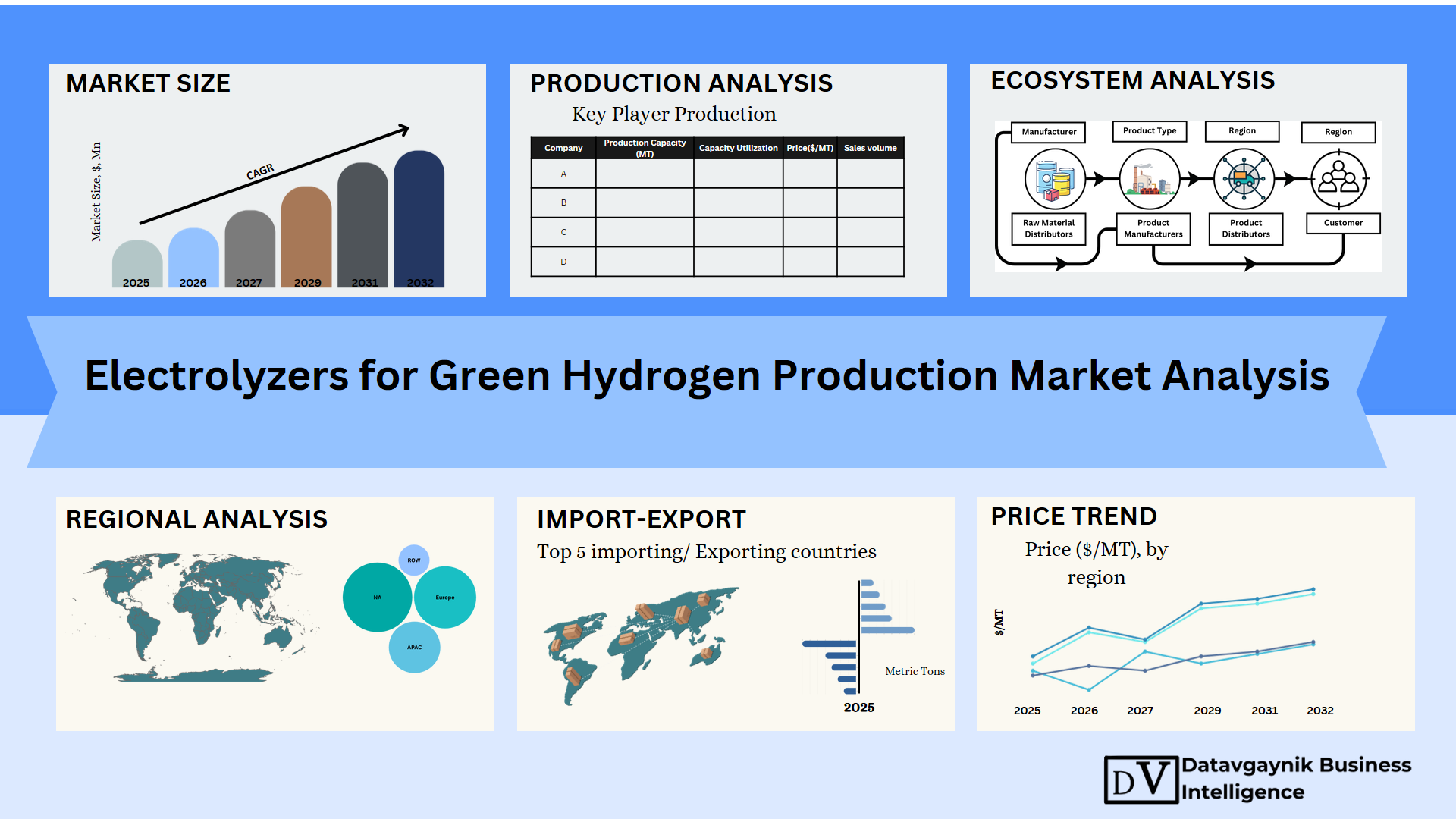
Electrolyzers for Green Hydrogen are now a supplier-qualification market as much as a clean-energy equipment market. The global electrolyzers market is estimated at about USD 11.28 billion in 2026 and is projected to reach nearly USD 483.17 billion by 2034, reflecting a CAGR of about 59.95% during the forecast period. Competition is concentrated around alkaline, PEM, solid oxide, and emerging AEM systems, but buyer decisions are being shaped by project delivery record, stack durability, balance-of-plant integration, grid connection, water treatment, after-sales service, and bankability with lenders. Large industrial users, ammonia producers, refineries, steel companies, port operators, chemical producers, hydrogen developers, and public-sector energy agencies remain the core customer base, while China, Europe, India, the United States, and the Middle East define most of the supplier contest.
Electrolyzers for Green Hydrogen competition is split between Chinese scale, European engineering, and emerging Indian manufacturing
The competitive structure is not evenly distributed. Chinese suppliers dominate alkaline electrolyzer production because they have larger domestic manufacturing capacity, lower stack costs, and direct access to utility-scale hydrogen projects. Companies such as LONGi Hydrogen, PERIC Hydrogen, Sungrow Hydrogen, Cockerill Jingli Hydrogen, and SANY Hydrogen compete strongly on alkaline systems, large-unit manufacturing, and price. Their advantage is visible in project sizes above 100 MW, where alkaline systems remain preferred because capital cost per kilowatt matters more than compactness or fast dynamic response.
European and Japanese suppliers compete differently. thyssenkrupp nucera, Siemens Energy, Nel, ITM Power, McPhy, John Cockerill, Sunfire, and Topsoe depend more on engineering quality, project documentation, long-cycle service, plant integration, and customer trust with industrial buyers. Their strongest markets are not always the lowest-cost projects; they are refinery, ammonia, chemicals, and industrial clusters where uptime, certification, warranty risk, and grid-compliant operation carry higher weight.
The United States has a different supplier pattern. Plug Power, Electric Hydrogen, Bloom Energy, Cummins Accelera, and Ohmium focus on PEM, large modular systems, solid oxide, and project-linked hydrogen production. The U.S. supplier base is more connected to federal funding, hydrogen hubs, tax credits, and domestic manufacturing incentives than to immediate low-cost export competitiveness.
India is becoming a manufacturing-led market rather than only an end-use market. Under the National Green Hydrogen Mission, India has allocated 3,000 MW of annual electrolyzer manufacturing capacity across 15 firms, with companies such as Reliance, Adani New Industries, John Cockerill Greenko, Ohmium, HomiHydrogen, and L&T-linked manufacturing ecosystems gaining visibility. This does not yet make India a global supplier equal to China, but it gives domestic project developers a procurement base and reduces dependence on imported stacks.
Product categories differ sharply by buyer need, not only by technology label
Alkaline electrolyzers are stronger in large-scale, cost-sensitive green hydrogen and green ammonia projects. Their installed base is larger, the technology is familiar, and Chinese suppliers have made the category highly price-competitive. Buyers choosing alkaline systems usually prioritize lower capital cost, larger hydrogen output, and availability of bigger modules. The limitation is operational flexibility: alkaline systems are less attractive where renewable power fluctuates sharply or where compact, high-pressure, fast-response operation is required.
PEM electrolyzers are positioned around flexibility, smaller footprint, faster ramping, and higher purity output. Siemens Energy, Plug Power, ITM Power, Nel, Cummins Accelera, Ohmium, and Electric Hydrogen compete in this space. PEM is stronger where the customer wants integration with intermittent renewable power, refueling infrastructure, mobility-linked hydrogen, backup power, or high-value industrial hydrogen. The constraint is cost. Iridium and other specialty material dependencies still make PEM more exposed to component pricing and supply-chain risk.
Solid oxide electrolyzers remain a smaller but strategically important category. Bloom Energy, Sunfire, Topsoe, and a few specialized suppliers focus on high-temperature electrolysis where industrial waste heat, ammonia, methanol, refinery, or synthetic fuel integration can improve efficiency. The customer base is narrower, but the technology attracts industrial buyers because energy efficiency matters heavily when electricity cost dominates hydrogen production economics.
AEM electrolyzers are still in the early commercialization stage. They are discussed because they could combine some alkaline cost advantages with PEM-like flexibility, but procurement teams still treat AEM as a smaller-volume, qualification-heavy option. For 2026 buying decisions, AEM suppliers need demonstration hours, stack lifetime proof, service capability, and bankable warranties before they can compete at scale with alkaline and PEM.
Company positioning is increasingly decided by project reference, not factory announcement
Electrolyzer suppliers spent the last few years announcing gigawatt-scale manufacturing plans, but customers are now separating nameplate production capacity from proven delivery. Installed water electrolyzer capacity reached about 1.4 GW by the end of 2023 and was expected to reach around 5 GW by the end of 2024, while announced projects pointed toward hundreds of gigawatts by 2030. This gap shows why buyer approval is stricter: a supplier may have factory capacity, but only a smaller group has delivered multi-megawatt systems that have operated under real industrial conditions.
thyssenkrupp nucera has strong industrial credibility because of chlor-alkali electrolysis experience and large alkaline project references, but its recent financial guidance also shows how difficult the market is. In March 2026, the company lowered its full-year revenue and earnings outlook, citing higher green hydrogen segment costs and weak investment decisions. That matters because even established European suppliers are facing delayed final investment decisions, contract cancellations, and cost overruns.
Siemens Energy benefits from power equipment credibility, utility relationships, grid knowledge, and European industrial access. Its PEM systems are well suited for buyers who want renewable power integration and project-level engineering. Nel competes through alkaline and PEM experience, manufacturing expansion, and refueling-adjacent customer access. ITM Power has a strong PEM technology identity but remains exposed to project timing and the need to convert technology credibility into repeatable delivery. Plug Power has vertical integration across electrolyzers, liquefaction, hydrogen production, and end-use applications, but it also faces scrutiny because customers and investors now want proof of profitable execution.
Chinese manufacturers are stronger on price and factory scale. PERIC Hydrogen, LONGi Hydrogen, Sungrow Hydrogen, and Cockerill Jingli have large alkaline product ranges and direct participation in domestic hydrogen projects. In February 2026, World Bank-linked industry analysis highlighted China’s dominance in alkaline manufacturing and its expansion into PEM supply. This is changing competitive behavior outside China because European and U.S. suppliers are being pushed to defend value through reliability, certification, service, and local-content compliance rather than price alone.
Customer access depends on energy developers, EPC firms, industrial offtakers, and government-backed procurement
The strongest customers are not small hydrogen startups; they are large industrial buyers with access to renewable power, water, land, offtake agreements, and financing. Refining, ammonia, methanol, steel, chemicals, mobility, and port operations form the most practical demand base. In April 2025, Germany’s VNG confirmed test operations for a 30 MW electrolyzer at Bad Lauchstädt in Q3 2025, designed to produce about 2,700 tonnes of green hydrogen annually for the Leuna chemicals and oil park, with TotalEnergies as anchor customer. This kind of project shows the real buying pattern: electrolyzer demand moves when power supply, industrial offtake, pipeline access, and anchor customers are aligned.
Europe remains procurement-led. The European Hydrogen Bank is creating demand visibility by subsidizing production rather than simply encouraging equipment purchases. In May 2026, the third auction awarded about EUR 1.09 billion to nine projects across seven EEA countries, representing almost 1.1 GW of electrolyzer capacity and about 1.3 million tonnes of hydrogen production over the first 10 years. This supports suppliers with European certification and project documentation, but it also makes bidding highly competitive because buyers are pressured to reduce delivered hydrogen cost.
The United States is funding the supply chain as much as the projects. In March 2024, the U.S. Department of Energy announced USD 750 million for 52 clean hydrogen projects across 24 states, covering electrolysis technology, manufacturing, recycling, and component supply. This improves domestic supplier access for PEM, advanced alkaline, and component manufacturers, but demand remains tied to tax-credit clarity, hydrogen hub execution, and industrial offtake contracts.
India’s customer access is linked to public tenders, refinery demand, fertilizer producers, port projects, and domestic manufacturing incentives. The 3,000 MW electrolyzer manufacturing allocation creates a supplier base, while early projects at ports and industrial sites help validate local systems. Buyers in India are likely to prefer suppliers that can combine lower equipment cost, local manufacturing, fast service response, and eligibility under national programs.
Distribution strength and service capability are now commercial differentiators
Electrolyzers are not plug-and-play equipment. The supplier must support site engineering, water quality management, power electronics, compression, safety systems, permitting documents, spare parts, remote monitoring, stack replacement, and performance guarantees. This gives an advantage to suppliers with EPC partners, regional service teams, and existing industrial customer relationships.
Large European and U.S. suppliers are stronger in documentation, warranty structure, and project finance acceptance. Chinese suppliers are stronger in equipment availability and pricing. Indian suppliers are building local service networks but still need longer operating references. Middle Eastern projects often depend on global EPC contractors and technology partners because project scale is large and hydrogen is tied to ammonia export, refining, or industrial cluster development.
Market constraints are commercial, not only technical
The main constraint for Electrolyzers for Green Hydrogen is not lack of supplier interest. It is the mismatch between announced capacity and bankable demand. Many projects remain at feasibility or early development stage because green hydrogen offtake is expensive, renewable power contracts are complex, water and grid approvals take time, and buyers hesitate to sign long-term contracts without subsidy support.
Equipment overcapacity is another constraint. When factories are announced faster than projects reach final investment decision, prices fall and margins weaken. This benefits buyers in the short term but weakens smaller suppliers that cannot absorb warranty risk or delayed orders. Certification and local-content rules also shape competition. Europe wants resilient local manufacturing, the U.S. links funding to domestic supply chains, India supports local manufacturing, and China uses scale to compete internationally.
The strongest suppliers in 2026 are therefore not simply those with the largest production capacity. They are the companies that can prove operating references, secure industrial customers, offer competitive delivered cost, maintain service coverage, and survive delayed project cycles. In this market, electrolyzer technology matters, but bankability, service execution, and buyer confidence decide which suppliers convert the green hydrogen pipeline into actual equipment revenue.
Supplier Segmentation in Electrolyzers for Green Hydrogen Is Dividing by Technology Depth, Project Scale, and Service Access
Electrolyzer suppliers are now segmented less by corporate size and more by the type of buyer they can serve. A 10 MW industrial pilot, a 100 MW refinery-linked project, a 500 MW ammonia complex, and a port-based mobility project do not use the same supplier logic. The market is separating into four practical supplier groups: large alkaline system manufacturers, PEM-focused technology suppliers, solid oxide specialists, and integrated hydrogen project developers that combine electrolyzers with production, storage, compression, and offtake.
Alkaline manufacturers have the broadest installed base and the clearest cost advantage. Chinese suppliers such as LONGi Hydrogen, PERIC Hydrogen, Sungrow Hydrogen, Cockerill Jingli Hydrogen, and SANY Hydrogen compete with larger stacks, lower capital cost, and faster domestic equipment availability. Their systems are preferred where hydrogen is produced continuously for ammonia, methanol, refining, or industrial feedstock use. The buyer usually values cost per kilowatt, project size, and supplier ability to deliver large equipment packages more than compactness or fast load-following.
PEM suppliers compete where operating flexibility is more important. Siemens Energy, Plug Power, ITM Power, Nel, Cummins Accelera, Ohmium, and Electric Hydrogen position PEM systems for renewable-linked hydrogen, refueling, industrial clusters, and projects that require fast response to variable electricity supply. PEM systems are typically costlier than alkaline units, but they are commercially stronger where space, pressure, ramping speed, and high-purity hydrogen matter. This makes PEM more attractive in mobility, distributed industrial hydrogen, hydrogen hubs, and grid-interactive projects.
Solid oxide suppliers form a smaller but technically distinct category. Bloom Energy, Sunfire, and Topsoe are positioned around high-temperature electrolysis, where integration with steam, industrial heat, ammonia, methanol, synthetic fuels, and refinery processes can improve overall energy efficiency. This category does not yet compete with alkaline systems on broad project count, but it has relevance for customers that already operate high-temperature industrial processes and can use heat integration to lower electricity intensity.
AEM suppliers are still mostly in the validation and early commercial stage. Companies such as Enapter and HYDGEN are building visibility around modular systems and lower dependence on platinum-group metals. AEM is interesting for decentralized hydrogen, small industrial users, laboratories, backup power, and mobility-linked sites, but large industrial buyers still demand stronger evidence on stack life, service response, and warranty reliability before treating AEM as a full substitute for alkaline or PEM.
Portfolio Depth Separates Equipment Vendors from Project-Ready Suppliers
Portfolio depth is becoming a serious purchasing filter. A supplier offering only stacks is not evaluated the same way as a company offering electrolyzer modules, power electronics, water treatment, gas purification, compression readiness, safety systems, digital monitoring, and long-term maintenance support. Project developers increasingly prefer suppliers that can reduce interface risk between electrolyzer, renewable power, EPC contractor, grid connection, storage, and offtake.
thyssenkrupp nucera is stronger in large alkaline plants and industrial project documentation. Its advantage comes from electrochemical engineering experience, chlor-alkali background, and large-scale project credibility. Siemens Energy benefits from its power equipment base and grid-facing customer relationships, making it stronger for industrial buyers that need electrical integration and long-term service assurance. Nel competes through alkaline and PEM portfolios, containerized systems, refueling-related exposure, and manufacturing experience in Europe and the United States. Plug Power is more vertically integrated than many peers because it combines electrolyzers with hydrogen production, liquefaction, logistics, and end-use systems.
Chinese suppliers have deeper cost-based portfolios in alkaline systems. LONGi Hydrogen benefits from the wider LONGi renewable-energy manufacturing ecosystem. Sungrow Hydrogen connects with power conversion and renewable project infrastructure. PERIC Hydrogen and Cockerill Jingli are recognized in large alkaline supply, especially where Chinese project developers and EPC networks are active. Their competitive weakness outside China is not equipment availability; it is often bankability documentation, customer qualification in Western markets, certification preferences, and service coverage.
For industrial buyers, the product comparison is straightforward:
- Alkaline systems are strongest for large, steady-load hydrogen and ammonia projects where lower capital cost and scale matter most.
• PEM systems are stronger for variable renewable power, space-constrained installations, refueling, and projects requiring fast operating response.
• Solid oxide systems fit customers with heat integration potential, especially in synthetic fuels, ammonia, methanol, and refinery-linked hydrogen.
• AEM systems are suitable for early distributed use cases, but large-scale buyers still require longer operating records.
• Integrated supplier models are preferred when developers want one accountable partner for equipment, controls, commissioning, service, and performance guarantees.
Regional Company Presence Is Led by China, Europe, India, and the United States, but Each Region Buys Differently
China is the largest deployment and manufacturing center for electrolyzers. Its supplier base has scale, domestic demand, low-cost manufacturing, and policy-backed project access. China’s advantage is strongest in alkaline systems, where cost-sensitive utility and industrial projects create large domestic order flow. The International Energy Agency reported that global installed water electrolysis capacity reached 2 GW in 2024, with China accounting for around 65% of installed capacity and capacity that had reached final investment decision. This gives Chinese manufacturers operating feedback, supply-chain scale, and cost learning that smaller regional suppliers cannot easily match.
Europe is more specification-driven. Buyers in Germany, the Netherlands, Spain, Denmark, France, and the Nordic region often require project finance documentation, EU certification alignment, emissions accounting, renewable fuel compliance, safety systems, and long-term service support. European suppliers benefit from proximity to industrial clusters, but they face cost pressure from Chinese equipment and delayed final investment decisions. The European Hydrogen Bank’s third auction in May 2026 selected nine projects with EUR 1.09 billion of support, almost 1.1 GW of electrolyzer capacity, and 1.3 million tonnes of hydrogen output over the first 10 operating years. This type of auction-led procurement favors suppliers that can meet European compliance, schedule discipline, and bankability requirements.
India is moving from import dependence toward local manufacturing. The National Green Hydrogen Mission has awarded 3,000 MW of annual electrolyzer manufacturing capacity to 15 firms, while 862,000 tonnes per year of green hydrogen production capacity has been allocated to 19 companies. This creates a domestic supplier base for refinery, fertilizer, port, steel, and mobility projects. Indian buyers are expected to favor suppliers with local manufacturing, price competitiveness, public-program eligibility, and fast service response. Reliance Electrolyser Manufacturing, John Cockerill Greenko, Ohmium, Adani New Industries, and other selected firms are therefore positioned around import substitution as much as technology supply.
The United States has a funding-driven supplier model. Domestic suppliers such as Plug Power, Bloom Energy, Electric Hydrogen, Cummins Accelera, and Ohmium benefit from hydrogen hubs, federal grants, and domestic manufacturing support. In March 2024, the U.S. Department of Energy announced USD 750 million for 52 clean hydrogen projects across 24 states, covering electrolyzer manufacturing, component supply, and recycling. This does not guarantee immediate equipment orders, but it improves supplier access to funded projects and strengthens domestic production capability.
The Middle East is project-scale driven. Saudi Arabia, the UAE, and Oman are not mainly small electrolyzer markets; they are export-oriented hydrogen and ammonia project markets. Suppliers that can work with EPC contractors, ammonia developers, desalination systems, large renewable power projects, and port logistics are better placed than suppliers focused only on equipment shipment. European, Chinese, Japanese, and U.S. technology providers all compete for these projects, but final supplier selection depends on project financing, EPC structure, local partnership, and long-term offtake.
Customer Access and Channel Structure Depend on EPC Partnerships, Industrial Qualification, and Public Funding
Electrolyzer sales channels are not similar to standard industrial equipment distribution. Large projects are sold through direct supplier engagement, EPC contractors, technology partnerships, project developers, renewable-energy companies, and government-backed procurement programs. Distributors have limited relevance for large systems, though they may support small modular units, laboratory systems, replacement parts, and decentralized installations.
EPC relationships matter because electrolyzers sit inside a wider hydrogen production system. The supplier must coordinate with power supply, rectifiers, water treatment, gas drying, compression, cooling, safety systems, civil works, permitting, and plant automation. This is why companies with strong EPC links or in-house project engineering have higher customer access. A buyer choosing an electrolyzer supplier is also choosing commissioning support, warranty risk, stack replacement terms, response time, and performance accountability.
Customer access is strongest in four buyer groups. Industrial gas and hydrogen developers purchase systems for merchant hydrogen, onsite supply, and hydrogen hubs. Refiners and chemical producers buy for decarbonization of existing hydrogen consumption. Ammonia, methanol, and steel developers purchase at larger scale because hydrogen is used as feedstock or process input. Public-sector and port buyers create smaller but visible demand through buses, trucks, marine pilots, and port decarbonization programs.
Service coverage is a stronger differentiator than many early forecasts assumed. Stack replacement, membrane degradation, electrolyte handling, power electronics maintenance, sensor calibration, remote monitoring, and safety inspections create recurring service requirements. Suppliers with regional service teams, spare-parts inventory, digital diagnostics, and trained commissioning engineers are better positioned with risk-averse industrial buyers. This favors established engineering firms in Europe and the United States, while Chinese suppliers need stronger overseas service models to convert price advantage into long-term acceptance.
Segment-Level Demand Is Strongest Where Hydrogen Use Already Exists
The strongest near-term applications are not entirely new hydrogen uses. Refining, ammonia, methanol, chemicals, and industrial gas remain stronger than speculative long-distance mobility or pure merchant hydrogen because these sectors already consume hydrogen or hydrogen-derived molecules. Green ammonia is especially important because it converts hydrogen into a transportable chemical product and supports export-oriented projects.
Mobility is visible but selective. Fuel-cell buses, trucks, ports, and forklifts create demand for distributed PEM and modular systems, but the volumes are smaller than ammonia or industrial feedstock projects. Steel is strategically important but highly project-dependent. Direct reduced iron projects need large hydrogen volumes, firm renewable power, and long-term capital support, so electrolyzer demand from steel will remain concentrated in selected clusters rather than broadly distributed.
Replacement behavior is still limited because the installed base is young. However, stack replacement, performance upgrades, and balance-of-plant service will become more important as early systems accumulate operating hours. Over the next several years, service revenue will come less from full equipment replacement and more from stack refurbishment, control-system upgrades, membrane replacement, power electronics maintenance, and performance optimization.
Leading Companies in Electrolyzers for Green Hydrogen Are Competing on Bankability, Portfolio Fit, and Regional Execution
thyssenkrupp nucera remains one of the most visible large-scale alkaline electrolyzer suppliers. Its positioning is strongest in industrial plants, large hydrogen projects, and customers that value electrochemical engineering experience. The company’s strength is project credibility rather than lowest price. However, its 2026 outlook shows the pressure on European suppliers: in November 2025, the company projected fiscal 2026 revenue of EUR 500 million to EUR 600 million, down from EUR 845 million in the previous year, citing delayed investment decisions and a more difficult hydrogen market.
Siemens Energy is positioned as a power-sector and industrial engineering supplier rather than a niche electrolyzer vendor. Its PEM electrolyzer business benefits from electrical integration capability, utility relationships, and access to large industrial customers. The company’s advantage is strongest where hydrogen projects need grid connection, renewable power integration, and long-term service credibility.
Nel has a broader electrolyzer identity because it offers both alkaline and PEM systems. Its customer base spans industrial hydrogen, refueling, and project developers. The company’s strength lies in manufacturing experience, recognized hydrogen branding, and participation in both stationary and mobility-linked demand. Its challenge is the same as other Western suppliers: converting project pipeline into profitable, repeatable orders while competing with low-cost alkaline equipment from China.
Plug Power is differentiated by vertical integration. It sells electrolyzers but also operates in hydrogen production, liquefaction, storage, logistics, and fuel-cell applications. This gives it access to customers seeking an end-to-end hydrogen ecosystem. The risk is execution complexity. Vertical integration improves customer reach but also raises capital intensity, operating exposure, and investor scrutiny.
Bloom Energy is positioned through solid oxide technology. Its relevance is strongest in customers that want higher electrical efficiency, industrial heat integration, or hydrogen production linked to high-temperature processes. Sunfire also competes in high-temperature electrolysis and industrial decarbonization, while Topsoe brings process-industry credibility through ammonia, methanol, and refining technology exposure.
LONGi Hydrogen, PERIC Hydrogen, Sungrow Hydrogen, Cockerill Jingli Hydrogen, and SANY Hydrogen represent China’s cost-scale supplier group. Their strength is large alkaline manufacturing, domestic project experience, and lower cost. Their international expansion depends on certification, customer approval, warranty confidence, and service infrastructure outside China.
Ohmium and Electric Hydrogen represent the newer generation of modular and large-format PEM suppliers. Ohmium has India and U.S. relevance, while Electric Hydrogen is focused on large PEM systems for industrial-scale deployment. Their competitive position depends on manufacturing ramp-up, cost reduction, stack life, and conversion of funded project pipelines into operating references.
Recent developments show the market’s direction:
- May 2026: The European Hydrogen Bank selected nine hydrogen projects with EUR 1.09 billion in support, almost 1.1 GW of electrolyzer capacity, and 1.3 million tonnes of output over 10 years, strengthening demand for compliant European projects.
• May 2025: India reported 3,000 MW of annual electrolyzer manufacturing awards to 15 firms and 862,000 tonnes per year of green hydrogen production allocation to 19 companies, supporting domestic supplier access.
• March 2024: The U.S. Department of Energy announced USD 750 million for 52 clean hydrogen projects across 24 states, improving domestic supply-chain development.
• November 2025: thyssenkrupp nucera lowered its 2026 revenue outlook to EUR 500 million–600 million, confirming that delayed final investment decisions are affecting even established suppliers.
• 2024–2025: IEA data showed China holding about 65% of installed and FID-stage electrolyzer capacity, reinforcing China’s cost and manufacturing advantage in alkaline systems.

