

Market Summary and Growth Forecast
The global Zinc Oxide Nanoparticles in Sunscreens Market will witness a robust CAGR of 8.4%, valued at $0.62 billion in 2026, expected to appreciate and reach $1.28 billion by 2035.
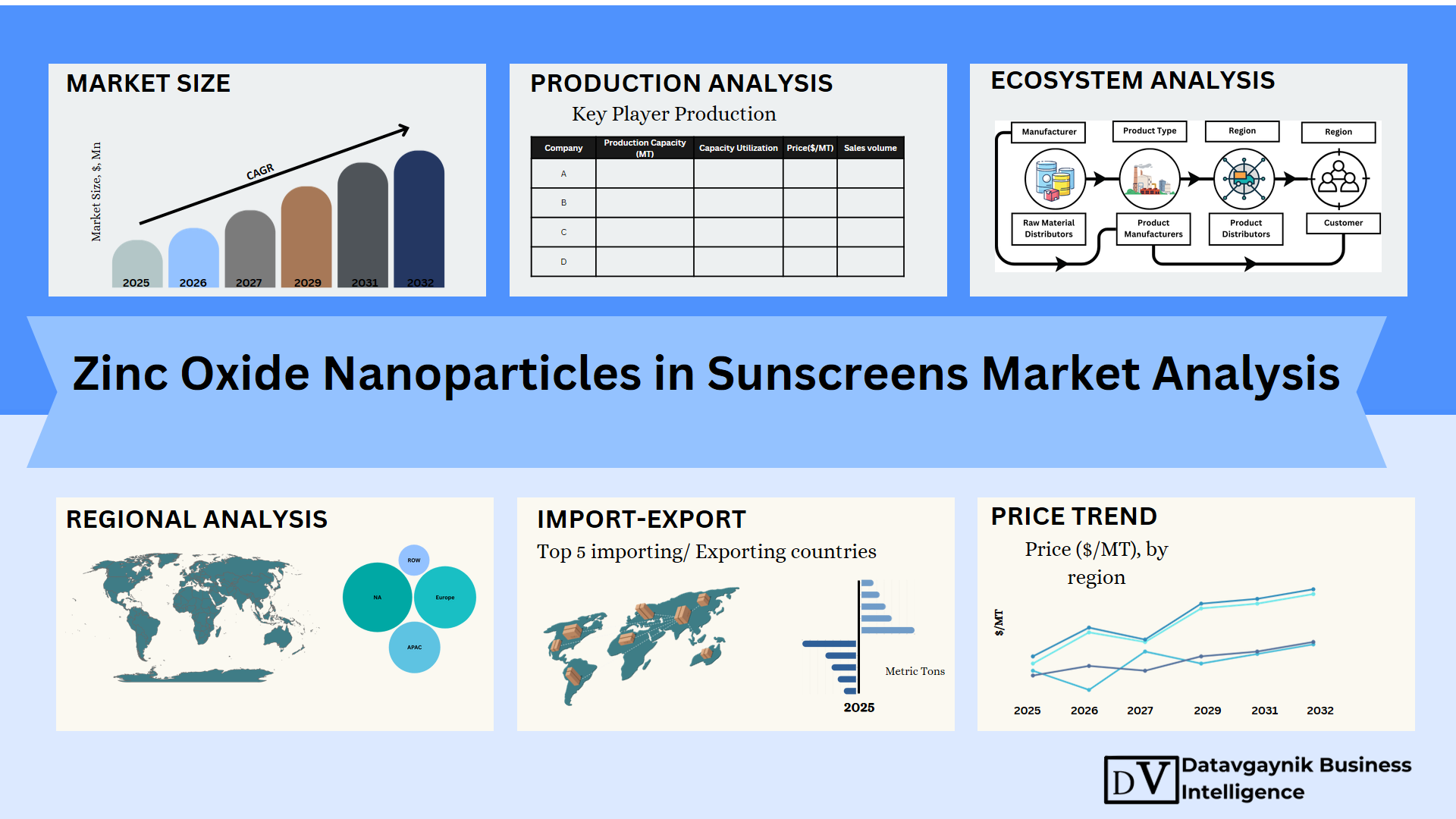
The market covers nano-sized zinc oxide used as a UV filter in sunscreen creams, lotions, gels, sticks, tinted formulations, hybrid skincare-sunscreen products, baby sun protection, and dermatology-led sensitive-skin ranges. In practical terms, this is not a bulk zinc oxide market. It is a high-value specialty ingredient space where particle size control, surface coating, dispersion quality, transparency, SPF performance, regulatory acceptance, and skin-feel decide commercial success.
The strategic relevance of the market during 2026–2035 comes from a simple shift: consumers want high-SPF sun protection without the heavy white cast traditionally linked with mineral sunscreens. Zinc oxide nanoparticles solve part of that problem. They offer broad UVA and UVB coverage while allowing formulators to build lighter, cleaner, and more cosmetically acceptable products. That matters because sunscreen is no longer only a beach product. It is becoming a daily skincare layer, especially in urban markets where anti-aging, hyperpigmentation control, and dermatologist-backed routines are influencing purchase behavior.
The demand base is strongest in facial sunscreens, premium mineral sunscreens, pediatric sun care, sensitive-skin products, and hybrid cosmetic formulations. By 2026, facial and daily-wear sunscreen formats are estimated to account for the largest value contribution because brands can charge higher prices for elegant textures, tinted finishes, matte feel, and skincare claims. Body sunscreen still consumes larger volume in many countries, but value creation is moving toward facial protection and dermocosmetic positioning.
Regulation is a major force shaping this market. In the U.S., zinc oxide benefits from its position as one of the most accepted mineral UV filters. In Europe, nano zinc oxide is permitted under defined cosmetic rules, while inhalation risk keeps aerosol and loose-powder formats under closer scrutiny. So, the growth opportunity is not uniform across all sunscreen formats. Creams, lotions, sticks, emulsions, and non-inhalable products will capture the bulk of demand. Spray sunscreens using nano-grade zinc oxide will remain more restricted and technically sensitive.
Technology is also changing the economics. Earlier zinc oxide sunscreens had a clear trade-off: good UV protection but poor skin aesthetics. Newer nano-dispersions, coated particles, silicone-compatible grades, hydrophilic and hydrophobic surface treatments, and pre-dispersed concentrates are helping brands reduce grittiness, improve spreadability, and avoid instability in emulsions. This is where ingredient suppliers are gaining pricing power. The value is no longer in zinc oxide alone. It is in engineered zinc oxide that a sunscreen formulator can use without months of rework.
Production capacity is expanding selectively, not aggressively. High-purity nano zinc oxide requires tight control over particle morphology, heavy metal content, coating uniformity, agglomeration behavior, and batch-to-batch performance. This keeps the market moderately consolidated at the specialty materials level. Large cosmetics brands may source from qualified ingredient suppliers rather than backward-integrate because compliance, toxicology documentation, and formulation support are too important to compromise.
By region, Asia Pacific will remain the largest growth engine through 2035, helped by strong sunscreen adoption in Japan, South Korea, China, Australia, India, and Southeast Asia. K-beauty and J-beauty have already normalized daily sunscreen use, while India and Southeast Asia are moving from seasonal sun care to everyday face protection. North America and Europe will remain high-value markets because consumers pay a premium for mineral, sensitive-skin, pediatric, and dermatologist-recommended sunscreens. LAMEA will grow from a smaller base, supported by rising heat exposure, tourism, and expanding modern retail access.
Expert insight: the next phase of the Zinc Oxide Nanoparticles in Sunscreens Market will be less about “nano versus non-nano” and more about how safely and elegantly the ingredient is delivered. Brands that can combine transparent finish, high SPF, reef-conscious positioning, and clean regulatory documentation will capture stronger margins.
The key stakeholders include zinc oxide nanoparticle manufacturers, specialty chemical suppliers, cosmetic ingredient distributors, sunscreen and skincare brands, contract manufacturers, dermatology-led product developers, regulatory agencies, toxicology testing laboratories, industry associations, retailers, e-commerce platforms, investors, and consumer safety groups. OEM-style formulation partners and private-label manufacturers will also play a bigger role as indie beauty and pharmacy brands launch mineral sunscreen lines without owning full R&D infrastructure.
Overall, the market’s growth profile is healthy but not speculative. The forecast to $1.28 billion by 2035 reflects four grounded assumptions: mineral sunscreen demand will keep rising, daily facial SPF usage will expand, premium coated nano-dispersions will command better pricing, and regulators will continue to support controlled dermal use while limiting inhalable exposure routes. That gives the category a clear path, but also a clear warning: growth will favor technically credible suppliers, not commodity zinc oxide producers.
Competitive Intelligence and Benchmarking
Competition in the Zinc Oxide Nanoparticles in Sunscreens Market is shaped by technical credibility more than raw production scale. Buyers are not only looking for zinc oxide. They want controlled particle size, strong UVA coverage, lower whitening, stable dispersion, low heavy-metal content, coating reliability, and documentation that can pass cosmetic safety review in the U.S., Europe, Japan, South Korea, Australia, and China.
The market has two supplier layers. The first includes specialty zinc oxide and inorganic UV-filter manufacturers. These companies control powder chemistry, surface treatment, and dispersion technology. The second includes cosmetic ingredient distributors and formulation partners that help sunscreen brands convert raw mineral filters into finished SPF products. Larger sunscreen brands usually dual-source because formulation failure can delay launches by one or two seasons.
Croda holds a strong position in mineral UV filters through its inorganic sunscreen ingredient portfolio. The company’s strength sits in pre-dispersed mineral actives, formulation support, and its access to premium skincare and sun-care brands. Its zinc oxide and titanium dioxide mineral filters are positioned for broad-spectrum protection and global formulation flexibility. Croda is more relevant in premium and dermocosmetic sunscreens than in low-cost mass formulations because its value lies in performance, regulatory support, and easier processing.
Kobo Products is one of the more formulation-led players in this market. Its portfolio includes nano and non-nano zinc oxide dispersions, treated powders, pigment technologies, and sunscreen formulation systems. Kobo’s competitive advantage is practical: it understands the pain points of formulators. Whitening, aggregation, viscosity drift, poor spreadability, and SPF inconsistency are common issues in zinc oxide sunscreens. Kobo addresses these through dispersion engineering and technical guidance. This makes it a strong supplier for indie brands, contract manufacturers, and premium cosmetic developers.
EverZinc is strategically positioned through its specialty zinc materials platform and its ultrafine zinc oxide range used in sun care and skincare. The company benefits from upstream zinc oxide know-how and a global industrial footprint. Its market position is stronger where customers need high-purity ultrafine grades with reliable documentation. EverZinc also has relevance beyond cosmetics, which gives it scale resilience. That said, sunscreen-grade zinc oxide requires different commercial behavior than industrial zinc oxide. Cosmetic customers expect technical service, safety files, and formulation support.
Sakai Chemical is an important Japanese supplier with strength in ultrafine zinc oxide and cosmetic raw materials. Its positioning is closely tied to Japan’s high-performance sunscreen culture, where light texture, transparency, and daily use are central. Sakai’s fine particle control and material-shaping capabilities give it a strong role in Asian beauty supply chains. The company is particularly relevant for brands developing high-transparency mineral or hybrid sunscreen formats.
BASF remains an influential sunscreen ingredient supplier even where its role is broader than zinc oxide alone. Its advantage comes from sunscreen science, global regulatory familiarity, UV-filter expertise, and relationships with large personal care brands. In zinc oxide nanoparticle sunscreen formulations, BASF competes through integrated formulation knowledge and broader UV-protection systems. Its position is strongest with multinational brands that want ingredient consistency across regions.
Sunjin Beauty Science has built a notable position in Asia’s cosmetic powder and UV-filter ecosystem. The company’s relevance comes from treated mineral powders, surface modification, and cosmetic-grade functional particles. It benefits from South Korea’s fast-moving sunscreen market, where brands frequently reformulate for better skin feel, tone-up effects, matte finish, and hybrid skincare claims. Sunjin is not simply a raw material supplier. It sits closer to application-led innovation.
Antaria has a more specialized position, linked to advanced zinc oxide materials for personal care and sunscreen applications. Its competitive role is narrower than that of Croda or BASF, but it remains relevant in mineral sunscreen supply because specialty zinc oxide suppliers with proven particle-control know-how are not easily replaced. In this market, even a smaller supplier can hold strategic value if its material helps brands solve transparency and SPF performance issues.
| Company | Core Position | Portfolio Strength | Market Relevance |
| Croda | Premium mineral UV-filter supplier | Zinc oxide and titanium dioxide filters, dispersions, formulation support | Strong in premium mineral sunscreen and dermocosmetics |
| Kobo Products | Formulation-driven dispersion specialist | Nano ZnO, non-nano ZnO, treated powders, pigment systems | Strong with contract manufacturers and indie/premium brands |
| EverZinc | Specialty zinc materials producer | Ultrafine ZnO for cosmetics and sun care | Strong in high-purity zinc oxide supply |
| Sakai Chemical | Japanese fine-particle materials specialist | Ultrafine ZnO and cosmetic powders | Strong in Asian sunscreen innovation |
| BASF | Global UV-filter and formulation science player | Broad sunscreen ingredient systems | Strong with multinational personal care brands |
| Sunjin Beauty Science | Asian cosmetic functional powder supplier | Treated mineral powders and UV-filter materials | Strong in K-beauty and formulation-led innovation |
| Antaria | Specialty advanced materials supplier | Zinc oxide materials for personal care | Niche but relevant in mineral sunscreen inputs |
Expert commentary: the winning suppliers will not be the cheapest zinc oxide producers. They will be the companies that help brands avoid white cast, pass safety review, hit SPF targets, and launch faster. That is where pricing power sits.
Regional Landscape and Adoption Outlook
North America will remain one of the highest-value regions for zinc oxide nanoparticle use in sunscreens. The U.S. market has a strong preference for dermatologist-recommended, sensitive-skin, baby-safe, and mineral sunscreen formats. Zinc oxide benefits from its accepted regulatory position in the U.S. sunscreen system, especially as several chemical filters face closer safety scrutiny or data requirements. Premium facial SPF, tinted mineral sunscreen, pediatric sun care, and post-procedure dermatology products will be the strongest demand pockets. Canada follows a similar path but with a smaller addressable base and a more pharmacy-led sunscreen channel.
The main constraint in North America is cosmetic elegance. Consumers want mineral sunscreen but often reject products that feel heavy or leave a white cast. That creates a strong opportunity for nano-dispersed zinc oxide and coated grades. The region is also seeing stronger competition from advanced chemical UV filters after recent regulatory movement. So, zinc oxide suppliers must position around sensitive skin, mineral claims, broad-spectrum coverage, and reef-conscious messaging rather than only SPF performance.
Europe is a technically mature market. The region has strict cosmetic regulation, clear nano-labeling expectations, and a sophisticated consumer base. Zinc oxide nanoparticles are used under defined conditions, with stronger caution around inhalable formats. This pushes demand toward creams, lotions, sticks, emulsions, and facial care products rather than spray-heavy formats. Germany, France, Italy, Spain, and the U.K. are the key commercial markets. France and Germany are especially important because pharmacy, dermocosmetic, and clinical skincare channels are strong.
Europe’s growth will not be explosive, but it will be quality-led. Brands will pay for coated particles, clean documentation, eco-positioning, and lower-whitening mineral systems. The white space lies in affordable mineral sunscreen for darker skin tones and daily facial SPF for men. Both remain underdeveloped compared with premium pharmacy lines.
China is becoming one of the most important growth markets. Sunscreen adoption is rising through beauty e-commerce, urban skincare routines, livestream selling, and consumer awareness around pigmentation and anti-aging. Domestic Chinese beauty brands are moving faster in SPF products, but high-performance zinc oxide inputs are still often benchmarked against Japanese, Korean, European, and U.S. ingredient systems. China also has a large contract manufacturing base, which supports fast product launches.
The market opportunity in China is broad but competitive. Local brands want lighter feel, high SPF, tone-up finish, and lower visible residue. Imported ingredient credibility still matters in premium products. That said, local sourcing will increase as domestic cosmetic ingredient producers improve quality and regulatory documentation.
India is a high-growth but underpenetrated market. The sunscreen category is still developing from a low base compared with East Asia and North America. Growth is being driven by dermatologists, beauty influencers, pharmacy brands, D2C skincare companies, and rising awareness around pigmentation, tanning, and UV exposure. Mineral sunscreen has strong potential in baby care, sensitive-skin products, acne-prone skincare, and dermatologist-led recommendations.
India’s main challenge is affordability. Premium zinc oxide sunscreen formulations can become expensive because high-quality nano-dispersions and coated particles raise formulation cost. White cast is also a bigger issue across diverse Indian skin tones. The white space is clear: affordable, non-greasy, low-cast mineral sunscreen for humid climates. Brands that solve this can create a large mass-premium segment.
Japan is one of the world’s most advanced sunscreen markets. Daily sunscreen use is deeply embedded in skincare routines. Consumers expect elegance, transparency, water resistance, high SPF, and compatibility with makeup. Japanese suppliers such as Sakai Chemical benefit from strong local material science and close ties with cosmetic formulators. Zinc oxide nanoparticles are used in both mineral and hybrid sunscreen systems where transparency and UVA protection are critical.
Japan will grow steadily rather than sharply. Its strategic value is not only market size. It is innovation influence. Many sunscreen textures and formulation ideas that later spread across Asia first mature in Japan.
South Korea is a formulation trendsetter. K-beauty brands move quickly across tone-up sunscreens, lightweight daily SPF, serum sunscreens, cushion SPF, sun sticks, and hybrid skincare protection. Zinc oxide nanoparticles are relevant, but South Korea also uses advanced organic filters widely. This means zinc oxide must compete on sensitive-skin positioning, mineral claims, texture, and brand trust.
South Korea’s export-oriented beauty ecosystem makes it more important than its population size suggests. If a Korean sunscreen format succeeds, it can travel into Southeast Asia, the U.S., India, and the Middle East. That gives the country a strong influence on the Zinc Oxide Nanoparticles in Sunscreens Market.
Rest of the World includes Australia, Southeast Asia, Latin America, the Middle East, and Africa. Australia is mature and highly regulated, with strong sun-safety culture and high SPF usage. Southeast Asia is growing quickly due to heat, humidity, beauty adoption, and rising urban disposable income. Brazil and Mexico are the key Latin American markets. The Middle East has strong premium skincare potential, especially in the UAE and Saudi Arabia. Africa remains underserved, but urban skincare and pharmacy channels are slowly expanding.
The largest white space sits in India, Southeast Asia, Latin America, and selected Middle Eastern markets. These regions need sunscreen products designed for darker skin tones, high humidity, lower price points, and daily comfort. A standard Western mineral sunscreen will not work well enough. Local formulation adaptation will decide growth.
Expert commentary: regional growth will depend less on UV awareness and more on whether brands can make zinc oxide sunscreens feel invisible, affordable, and wearable every day. The science is available. The commercial challenge is localizing it.
End-User Dynamics and Use Case
The core end users in this market are sunscreen brands, skincare companies, contract manufacturers, dermatology-led brands, pharmacy and baby-care product developers, and cosmetic OEM/ODM manufacturers. Each group buys zinc oxide nanoparticles differently.
Premium sunscreen and skincare brands use zinc oxide nanoparticles to create daily facial SPF products with better transparency and broader skin compatibility. Their focus is not only sun protection. They also want claims around sensitive skin, mineral protection, anti-aging, post-treatment use, and clean beauty positioning. These brands usually prefer coated or pre-dispersed zinc oxide because it shortens development time.
Mass-market sunscreen brands are more cost-sensitive. They adopt zinc oxide nanoparticles selectively, mainly in baby sunscreen, sport sunscreen, sensitive-skin lines, or products marketed as mineral. For them, raw material cost and processing behavior matter heavily. A dispersion that improves SPF efficiency or reduces rework can justify a premium.
Contract manufacturers and OEM/ODM partners are the real execution layer. They need zinc oxide grades that behave predictably in emulsions, sticks, gels, and hybrid formulas. Their adoption is driven by ease of processing, storage stability, viscosity control, and compatibility with emollients, polymers, pigments, and other UV filters. When a contract manufacturer qualifies a zinc oxide supplier, that supplier can often gain access to several brands at once.
Dermatology and pharmacy brands use zinc oxide nanoparticles in sensitive-skin, acne-prone, pediatric, post-laser, and post-peel sunscreen products. They care more about safety documentation, irritation profile, and broad-spectrum coverage than trend-led marketing. This segment is smaller in volume but stronger in value per kilogram of active ingredient.
Color cosmetics and hybrid skincare brands are becoming more important. SPF foundations, tinted moisturizers, BB creams, tone-up creams, and sun sticks use zinc oxide not only for UV protection but also for coverage, opacity, and skin finish. This creates formulation complexity because zinc oxide must interact well with iron oxides, emollients, film formers, and sensory additives.
Use case: A South Korean OEM developing a lightweight SPF 50 facial sunscreen for export to Southeast Asia selected a coated nano zinc oxide dispersion instead of untreated zinc oxide powder. The goal was to reduce white cast on medium-to-deeper skin tones while keeping broad-spectrum mineral positioning. The formulation team used the dispersion in an oil-in-water emulsion with iron oxide tint adjustment and humidity-resistant film formers. The product was positioned for daily urban use, not beach-only protection. This helped the brand target consumers who wanted mineral sunscreen but rejected thick textures and visible residue.
This use case reflects the market’s direction. The ingredient is no longer judged only by lab SPF. It is judged by how it performs on real skin, across climate conditions, skin tones, and daily skincare routines. That is why the Zinc Oxide Nanoparticles in Sunscreens Market is moving toward engineered dispersions rather than basic powders.
Recent Developments + Opportunities & Restraints
Recent Developments
June 2026 – U.S. FDA expanded OTC sunscreen active options by adding bemotrizinol.
This is not a zinc oxide nanoparticle launch, but it matters for the market. A new approved chemical UV filter gives U.S. formulators more flexibility and may increase competition against mineral-only sunscreens. At the same time, it can support hybrid sunscreen systems where zinc oxide is used with advanced organic filters for better texture and broad-spectrum performance.
December 2025 – EverZinc completed its acquisition transaction with Cerberus Capital Management.
The deal strengthens EverZinc’s capital base and supports future growth in specialty zinc products, including high-value applications such as sunscreen, pharmaceuticals, batteries, coatings, and fine zinc materials. For sunscreen-grade zinc oxide, this signals continued investor interest in specialty zinc platforms rather than commodity zinc oxide alone.
February 2026 – EverZinc reinforced its cosmetic-grade ultrafine zinc oxide positioning through its Zano portfolio.
The company’s ultrafine zinc oxide range is positioned for broad UVA/UVB absorption and transparency in skincare and sun-care applications. This matters because high-transparency mineral filters are central to premium sunscreen growth.
2025–2026 – Ingredient suppliers continued pushing mineral UV-filter dispersions for lower whitening and easier formulation.
Companies such as Croda and Kobo Products continue to position zinc oxide and titanium dioxide dispersions as practical formulation tools for sunscreen brands. The commercial importance is clear: sunscreen makers want high SPF, broad-spectrum coverage, lower residue, and fewer development failures.
2026 – EU-style nano labeling and inhalation-safety discipline continued to shape global sunscreen formulation strategy.
The European regulatory approach remains influential because nano zinc oxide is allowed under defined conditions but remains sensitive in formats that may create inhalation exposure. This keeps creams, lotions, sticks, and emulsions more attractive than spray formats for nano zinc oxide use.
Sources: FDA; European Commission / EU Cosmetics Regulation; Croda Beauty; Kobo Products; EverZinc; Sakai Chemical.
Opportunities
Emerging market daily SPF adoption:
India, Southeast Asia, Latin America, and the Middle East offer strong upside because sunscreen use is moving from seasonal protection to daily skincare. The commercial opportunity is not just SPF. It is low-cast, sweat-resistant, affordable mineral sunscreen for real climates.
Premium mineral and dermocosmetic positioning:
Sensitive skin, baby care, acne-prone skin, post-procedure skincare, and dermatologist-led products are natural growth areas for zinc oxide nanoparticles. These categories can absorb higher ingredient costs because safety perception and skin compatibility matter more than unit price.
Advanced dispersion and surface treatment technology:
Suppliers that improve transparency, reduce aggregation, improve SPF efficiency, and support hybrid formulations can capture better margins. This is where the market shifts from commodity material to formulation-enabling technology.
Restraints
White cast and sensory limitations:
Even nano zinc oxide can leave visible residue if poorly dispersed or used at high loadings. This is a serious adoption barrier in darker skin tones and humid regions.
Regulatory and safety scrutiny around nanoparticles:
Nano labeling, toxicology documentation, particle characterization, and inhalation concerns increase development complexity. Spray and powder formats face tighter practical limitations than creams and lotions.
Cost pressure in mass-market sunscreen:
High-quality coated or pre-dispersed zinc oxide is more expensive than basic mineral powders and many conventional UV-filter systems. This can limit adoption in price-sensitive markets unless suppliers improve cost-performance balance.
Expert commentary: the best opportunity in the Zinc Oxide Nanoparticles in Sunscreens Market is not simply selling more active ingredient. It is helping brands build mineral sunscreens that consumers actually enjoy using every morning. That is the difference between regulatory acceptance and commercial success.


