

Regional Battery Localization Pushes Graphite Additives in 3D Printed Batteries Toward Early Commercial Qualification
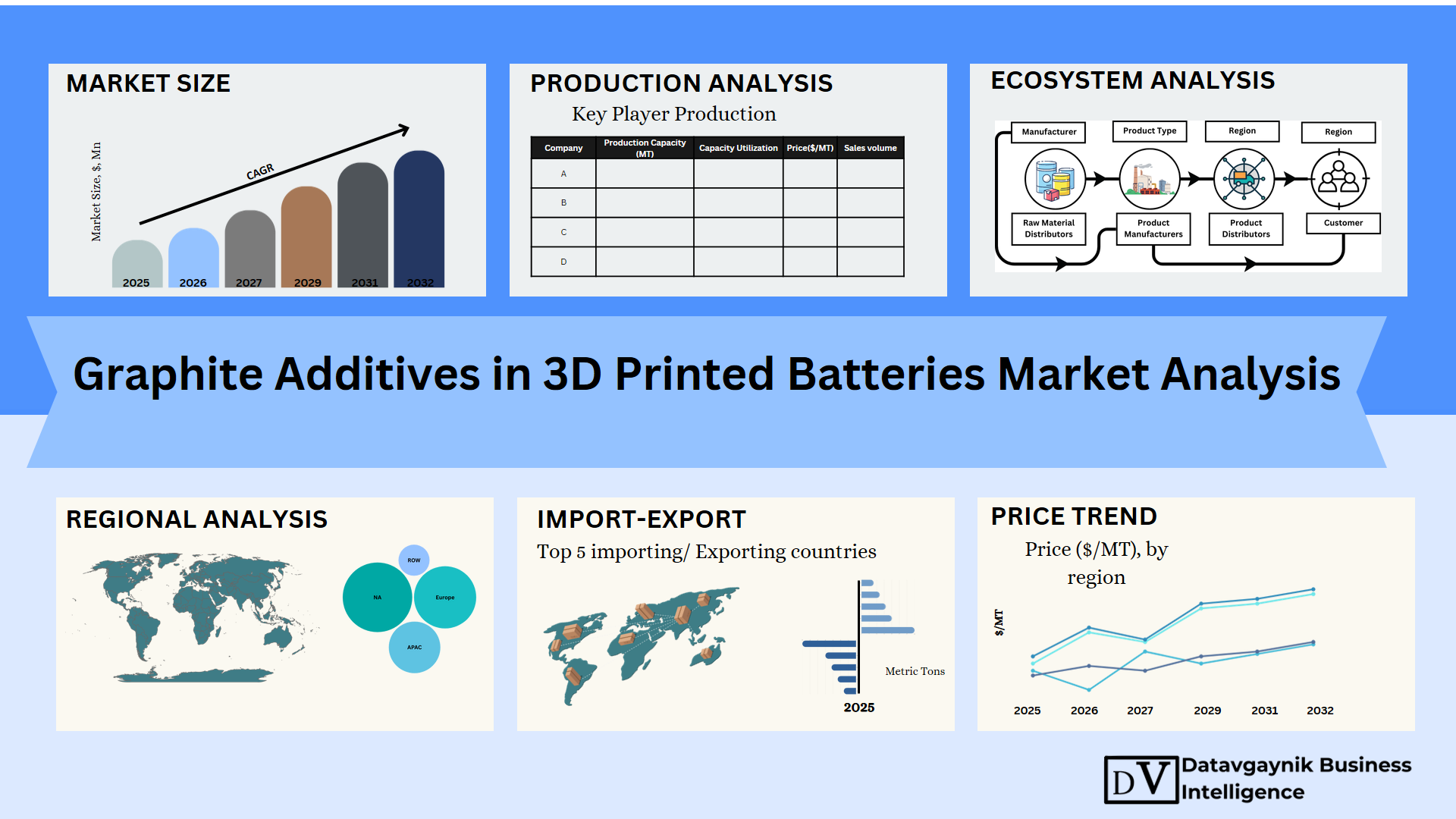
Regional battery supply shifts are creating a narrow but high-value opening for printable graphite systems used in customized cell architectures. The Graphite Additives in 3D Printed Batteries Market is estimated at USD 42.6 million in 2026 and is projected to reach USD 178.4 million by 2032, advancing at a 27.0% CAGR as printed electrodes, current collectors, and solid-state battery prototypes move from laboratory-scale deposition to pilot manufacturing. In January 2025, GM signed a multi-year, multi-billion-dollar agreement with Vianode for synthetic graphite anode materials, with North American production expected from 2027 and planned output of about 80,000 tons annually by 2030, reinforcing regional graphite qualification outside China.
Graphite additives in 3D printed batteries are not bought like bulk anode graphite. They are purchased as conductivity modifiers, rheology-adjusting fillers, printable carbon additives, or graphite-rich composite feedstocks that help printed battery inks maintain electrical pathways after extrusion, curing, drying, or sintering. Demand is strongest where the battery design requires shaped electrodes, interdigitated architectures, compact micro-batteries, wearable electronics, defense sensors, medical devices, and customized energy-storage formats that conventional roll-to-roll electrode coating cannot serve efficiently.
The commercial base remains small because most 3D printed battery platforms are still at prototype, defense, aerospace, research, and early pilot scale. The growth rate is high because material loading, particle morphology, binder compatibility, viscosity control, and conductivity retention directly decide whether a printed electrode can deliver usable capacity after repeated charge-discharge cycles. A 2025 review of additive manufacturing for next-generation batteries highlighted printed electrodes, electrolytes, separators, and integrated energy-storage structures as active development areas, with design freedom and material architecture control forming the technical basis for adoption.
Graphite Additives in 3D Printed Batteries Demand is also linked to the shift from flat battery formats to device-integrated energy storage. A printed battery for a wearable patch, implantable sensor, IoT node, or miniaturized defense device may require millimeter-scale geometry control rather than high-volume cylindrical or pouch-cell output. In these uses, graphite additive cost is less important than print stability, conductivity, electrode adhesion, and cycle reliability.
The main growth logic is concentrated in four buying conditions:
- Printable electrode inks: graphite improves conductive network formation where active materials and binders alone cannot maintain low resistance.
- Composite filaments and pastes: graphite loading supports electrical functionality in extrusion-based battery structures.
- Solid-state battery prototypes: graphite and carbon additives support interface control between printed electrode and electrolyte layers.
- Micro-battery formats: customized geometry increases additive value per gram because design tolerance is more important than bulk material cost.
Supply security is becoming part of procurement behavior. A 2025 graphite supply-chain study estimated that China produces more than 92% of global anode material, creating qualification pressure for battery companies trying to localize graphite-derived materials for advanced formats. Northern Graphite also reported in May 2025 that its Namibia-to-France battery anode material proposal was selected under the EU Critical Raw Materials Act strategic project list, showing how regional graphite processing is moving into policy-backed battery supply planning.
Localized Graphite Processing Becomes the Supply Constraint Behind Printable Battery Materials
Production of graphite additives for 3D printed batteries depends less on mined graphite volume and more on particle engineering, purification, dispersion stability, and compatibility with printable battery inks. The supply chain usually begins with natural flake graphite or synthetic graphite, followed by purification, micronization, spheroidization where required, surface treatment, blending with conductive carbon, and conversion into paste, slurry, filament, or composite ink formats.
The manufacturing geography remains highly concentrated because battery-grade graphite processing is still dominated by China. A 2025 graphite supply-chain study estimated that more than 92% of global anode material is produced in China, creating a direct bottleneck for companies trying to qualify localized graphite feedstock for advanced batteries, including printed battery formats. This concentration affects Graphite Additives in 3D Printed Batteries Demand because R&D users can test many materials, but commercial buyers require repeatable impurity levels, conductivity, particle-size distribution, and documentation before adopting a printable formulation.
The production route has three practical supply layers:
- Primary graphite source: natural flake graphite or synthetic graphite controls purity baseline, carbon content, ash level, and cost.
- Particle engineering: milling, classification, and surface modification decide printability, viscosity behavior, sedimentation control, and electrical contact.
- Ink/feedstock conversion: graphite is blended with binders, solvents, active materials, conductive additives, or polymers to create printable battery pastes and filaments.
Regional localization is becoming more important because battery buyers do not want every advanced graphite input tied to Chinese processing. In January 2025, Vianode signed a multi-year, multi-billion-dollar agreement with General Motors to supply synthetic anode graphite toward 2033, with North American production planned from 2027 and an annual capacity target of about 80,000 tons by 2030. While this volume is aimed mainly at EV anode graphite, it strengthens the regional synthetic graphite base that can support higher-purity specialty additive streams for printed battery developers.
Europe is moving in the same direction. In March 2025, Northern Graphite’s Namibia-to-France battery anode material proposal was selected as one of 47 Strategic Projects under the EU Critical Raw Materials Act. The relevance for Graphite Additives in 3D Printed Batteries Market supply is not immediate volume; it is the creation of qualified non-China processing routes that can later support smaller high-spec additive markets where documentation and traceability matter more than bulk tonnage.
Supply bottlenecks are sharper in printable battery materials than in standard graphite powders. A conventional anode producer can optimize graphite for coating density and electrochemical performance on copper foil. A 3D printed battery material supplier must control additional properties such as shear-thinning behavior, nozzle stability, drying shrinkage, layer adhesion, electrical percolation threshold, and compatibility with lithium-ion, zinc-ion, solid-state, or micro-battery chemistries.
Capacity expansion therefore does not automatically translate into supply readiness. A graphite plant producing thousands of tons of anode-grade material may still need separate lines for fine particle classification, contamination-controlled packaging, solvent-specific dispersion, and small-batch customization. This is why Graphite Additives in 3D Printed Batteries Trends favor suppliers with pilot-scale formulation capability, not only miners or bulk synthetic graphite producers.
Manufacturing economics also create a scale mismatch. EV anode material plants are designed for tens of thousands of tons per year, while printed battery additives may be ordered in kilograms to low-tonnage batches during qualification. That shifts cost toward testing, formulation adjustment, and technical service. For early commercial buyers, supply reliability is measured by lot-to-lot conductivity, printable viscosity window, and electrochemical repeatability rather than only delivered graphite price per kilogram.
Geographic Segmentation Shows Why Printed Battery Graphite Demand Will Start in Pilot Manufacturing Hubs
Graphite Additives in 3D Printed Batteries Market segmentation is still shaped by technical readiness rather than mass production volume. The largest demand does not come from conventional EV battery plants; it comes from laboratories, defense electronics developers, wearable device designers, micro-battery companies, solid-state battery researchers, and additive manufacturing groups trying to convert battery chemistry into printable architectures.
Key market segments include:
- By graphite form: natural graphite powder, synthetic graphite powder, expanded graphite, graphene-enhanced graphite blends, graphite-carbon black composites.
- By printable format: slurry, paste, ink, filament, gel-based feedstock, composite electrode formulation.
- By battery chemistry: lithium-ion, lithium-metal, solid-state, zinc-ion, sodium-ion, micro-battery formats.
- By printing route: extrusion printing, direct ink writing, aerosol jet printing, screen printing, inkjet printing, and hybrid additive manufacturing.
- By end use: wearables, medical sensors, IoT devices, defense electronics, aerospace systems, compact consumer electronics, and research-grade energy devices.
- By geography: North America, Europe, China, Japan, South Korea, and emerging battery-material hubs in India and Southeast Asia.
The leading segment is expected to remain graphite-based printable paste and slurry, because most early-stage 3D printed battery structures require high-solids loading and controlled viscosity. Paste-based systems can carry active materials, conductive carbon, graphite additives, binders, and solvents in one printable formulation. This makes them easier to adapt for thick electrodes, shaped micro-batteries, and prototype cells than low-viscosity inks that require tighter drying and deposition control.
Synthetic graphite-based additives are likely to gain premium share in high-reliability printed battery formats. Synthetic graphite offers better consistency in particle structure, lower impurity variation, and stronger qualification potential for battery developers that need repeatable electrochemical behavior. Natural graphite remains relevant where cost, conductivity, and availability matter, but printed battery applications often tolerate higher material cost if the additive improves dispersion, layer strength, and cycle stability.
Application segmentation is led by micro-batteries and device-integrated energy storage. A wearable patch, smart sensor, or compact medical device cannot always use a standard pouch or coin-cell format. Printed batteries allow energy storage to follow the device geometry, while graphite additives help preserve electron pathways inside thin, curved, or miniaturized electrode structures.
The strongest near-term demand clusters are:
| Segment | Demand logic | Graphite additive requirement |
| Micro-batteries | Small geometry, customized electrode design | Fine particle control, stable conductivity |
| Wearable electronics | Flexible and shaped battery formats | Bend tolerance, adhesion, printable viscosity |
| Defense sensors | Low-volume, high-reliability devices | Repeatability, documentation, shelf stability |
| Solid-state prototypes | Layered electrode-electrolyte printing | Interface control, low contamination |
| Research and pilot cells | Rapid chemistry testing | Formulation flexibility, small-batch supply |
North America and Europe are expected to hold higher value share because early demand is tied to funded R&D, defense electronics, medical technology, and battery localization programs. China, Japan, and South Korea hold stronger battery manufacturing depth, but printed battery demand depends on whether additive manufacturing moves beyond research lines into functional device production.
Graphite Additives in 3D Printed Batteries Demand will remain concentrated in high-value, low-volume formats through 2026–2028. The market will not behave like conventional graphite anode demand, where EV cell output drives tonnage. In this segment, one kilogram of qualified additive can carry more value if it enables stable printing, lower resistance, better cycle repeatability, or a device-specific battery shape.
Graphite Additives in 3D Printed Batteries Trends point toward blended formulations rather than single-material adoption. Graphite may be combined with carbon black, graphene nanoplatelets, CNTs, binders, ceramic solid electrolytes, or active materials depending on the battery system. This creates a segmentation pattern based on formulation performance rather than graphite grade alone.
Regional Qualification Cost Defines Pricing More Than Bulk Graphite Input Cost
Pricing in the Graphite Additives in 3D Printed Batteries Market is controlled by qualification, formulation complexity, and small-batch customization rather than mined graphite cost alone. Conventional battery-grade graphite may be priced on purity, particle size, carbon content, ash level, and anode performance. Printable graphite additives carry additional cost because the material must work inside a controlled deposition process, not only inside a coated electrode.
The main price gap comes from the difference between bulk graphite powder and print-ready graphite additive systems. A standard graphite powder can be sold as a dry material. A graphite additive for 3D printed battery use may need particle-size narrowing, surface treatment, solvent compatibility, binder matching, dispersion testing, rheology control, and electrochemical validation. Each additional test increases cost before commercial production begins.
Price behavior is shaped by four cost layers:
| Pricing layer | Cost driver | Impact on buyer price |
| Graphite feedstock | Natural or synthetic graphite quality, purity, regional source | Sets the baseline material cost |
| Particle engineering | Milling, classification, surface treatment, contamination control | Creates premium over commodity graphite |
| Printable formulation | Binder, solvent, conductive blend, viscosity control | Raises cost for paste, ink, slurry, or filament formats |
| Battery qualification | Cycle testing, conductivity validation, lot documentation | Adds high value in medical, defense, and aerospace uses |
Synthetic graphite additives usually command higher prices than natural graphite additives because synthetic material provides tighter consistency, lower impurity variation, and better repeatability in controlled battery systems. Natural graphite remains cost-competitive where the printed battery is used for research, prototyping, low-cost IoT devices, or applications where ultra-high purity is not mandatory.
Graphite Additives in 3D Printed Batteries Trends show that buyers are paying for process reliability as much as electrical conductivity. A material that clogs a nozzle, sediments during storage, cracks after drying, or changes viscosity between lots can waste more money than the graphite itself. For pilot users, one failed print batch can consume several hours of equipment time, testing labor, and cell-assembly work.
This is why additive suppliers can charge premiums when they provide a stable viscosity window, repeatable dispersion, and documented compatibility with common printing routes such as direct ink writing, extrusion printing, screen printing, or inkjet-style deposition. The value is highest where the battery geometry is complex, the production batch is small, and failure tolerance is low.
Regional price differences are also emerging. North American and European buyers are likely to pay more for non-China graphite processing, traceability, technical documentation, and supply-chain security. China-linked supply can remain more cost-efficient because of scale in graphite processing and battery-material manufacturing. The gap is not only labor or energy cost; it comes from established purification, spheroidization, coating, and anode-material infrastructure.
Graphite Additives in 3D Printed Batteries Demand is therefore less sensitive to simple price-per-kilogram comparisons. A research lab, defense electronics producer, or medical micro-device company may buy only kilograms of material, but it may require narrow quality controls and formulation support. In such cases, the effective price is closer to a specialty material than a commodity battery input.
Order volume creates another pricing split. Large battery-material buyers negotiate long-term supply and lower unit costs. Printed battery developers often purchase small qualification batches, custom paste blends, or project-specific formulations. This raises per-unit cost because production lines must handle smaller lots, additional cleaning, separate packaging, and more technical support.
The strongest margin opportunity sits in ready-to-print graphite additive systems, not generic graphite powders. Suppliers that sell only dry graphite compete mainly on purity, particle size, and source reliability. Suppliers that convert graphite into printable, battery-tested formulations can capture higher value because they reduce the buyer’s internal formulation burden.
Graphite Additives in 3D Printed Batteries Growth will depend on whether price premiums can be justified by device-level performance. In wearable electronics, medical sensors, compact defense devices, and micro-batteries, the additive cost may represent a small share of the finished device value. In larger energy-storage formats, the same premium becomes harder to justify unless 3D printing improves electrode utilization, weight reduction, packaging efficiency, or design flexibility.
Vertical Integration Splits Graphite Additive Suppliers From Printed Battery Platform Developers
Competition in the Graphite Additives in 3D Printed Batteries Market is not yet defined by large market-share blocks because commercial volumes remain small, qualification cycles are long, and many users still formulate materials internally. The competitive structure is split between three groups: graphite material producers, conductive additive specialists, and 3D printed battery platform developers that integrate graphite into proprietary electrode or cell architectures.
Large graphite and carbon-material companies hold the stronger upstream position. Imerys Graphite & Carbon, SGL Carbon, Superior Graphite, NeoGraf Solutions, Asbury Carbons, Talga Group, Northern Graphite, Syrah Resources, and Vianode are relevant because they control graphite grades, purification routes, synthetic graphite capability, or battery-anode material development. Their advantage is not direct dominance in printed batteries; it is access to controlled carbon materials that can be adapted into printable formulations.
The second group includes specialty carbon and nanomaterial suppliers such as Cabot Corporation, Birla Carbon, Graphenea, Nanografi, NanoXplore, and Haydale, where conductive carbon, graphene-enhanced materials, or functionalized carbon additives can be blended with graphite. These suppliers compete on dispersion behavior, surface chemistry, conductivity gain at low loading, and compatibility with polymers, solvents, binders, or active electrode materials.
A third competitive layer comes from 3D printed battery and additive-manufacturing developers. Sakuu, Blackstone Technology, Photocentric, and research-linked battery-printing developers influence demand because their cell designs decide what graphite additive properties are needed. Their buying behavior is different from conventional battery makers: they often need customized rheology, layer stability, and electrochemical repeatability rather than standard anode powder.
Competitive positioning is expected to follow this structure:
| Competitive group | Relevant companies | Advantage in printed battery additives |
| Battery graphite producers | Vianode, Syrah Resources, Talga Group, Northern Graphite | Regional supply, battery-grade purification, traceability |
| Industrial graphite suppliers | Imerys, SGL Carbon, Superior Graphite, NeoGraf, Asbury Carbons | Particle engineering, specialty grades, established customer base |
| Conductive additive specialists | Cabot, Birla Carbon, Graphenea, NanoXplore, Haydale | Conductivity tuning, dispersion, hybrid carbon blends |
| 3D battery developers | Sakuu, Blackstone Technology, Photocentric | Application pull, printable architecture knowledge, qualification control |
The market is fragmented at the additive level but concentrated at the qualified graphite-processing level. A laboratory can source graphite powder from many suppliers, but a commercial printed battery developer needs reproducible particle-size distribution, low impurity variation, battery-grade documentation, and formulation support. That reduces the real supplier pool sharply once the material moves from experiment to qualification.
Graphite Additives in 3D Printed Batteries Trends favor suppliers that can operate between bulk graphite and specialty formulation. A company selling only standard graphite powder has limited pricing power unless it offers consistent morphology, narrow particle distribution, or high-purity grades. A supplier offering printable graphite paste, dispersion-ready powder, or graphite-carbon hybrid formulation can charge a higher premium because it reduces the buyer’s process-development burden.
Customer approval is a major entry barrier. Printed battery developers must validate conductivity, nozzle behavior, drying profile, electrode adhesion, cycle life, storage stability, and contamination limits before locking in a material. Once a graphite additive is qualified, switching becomes difficult because a new material can change viscosity, layer density, impedance, and cycle performance.
Graphite Additives in 3D Printed Batteries Growth will therefore be shaped by partnerships rather than commodity distribution. Graphite producers need collaboration with battery-printing companies, universities, defense labs, medical-device developers, and pilot-cell manufacturers to convert powder capability into application-specific demand. Printed battery developers need stable additive suppliers because each chemistry change can require new ink tuning and battery testing.
Share leadership will likely remain difficult to measure before broader commercialization. The top-tier supplier group is expected to consist of companies with battery-grade graphite access, specialty carbon formulation capability, and regional supply security. Smaller technology suppliers may still capture high-value niches if they provide printable formulations for micro-batteries, solid-state prototypes, wearable devices, or defense electronics.


