

Personalization Trends Reshaping the Memory Foam Additives for Custom Mattresses Market
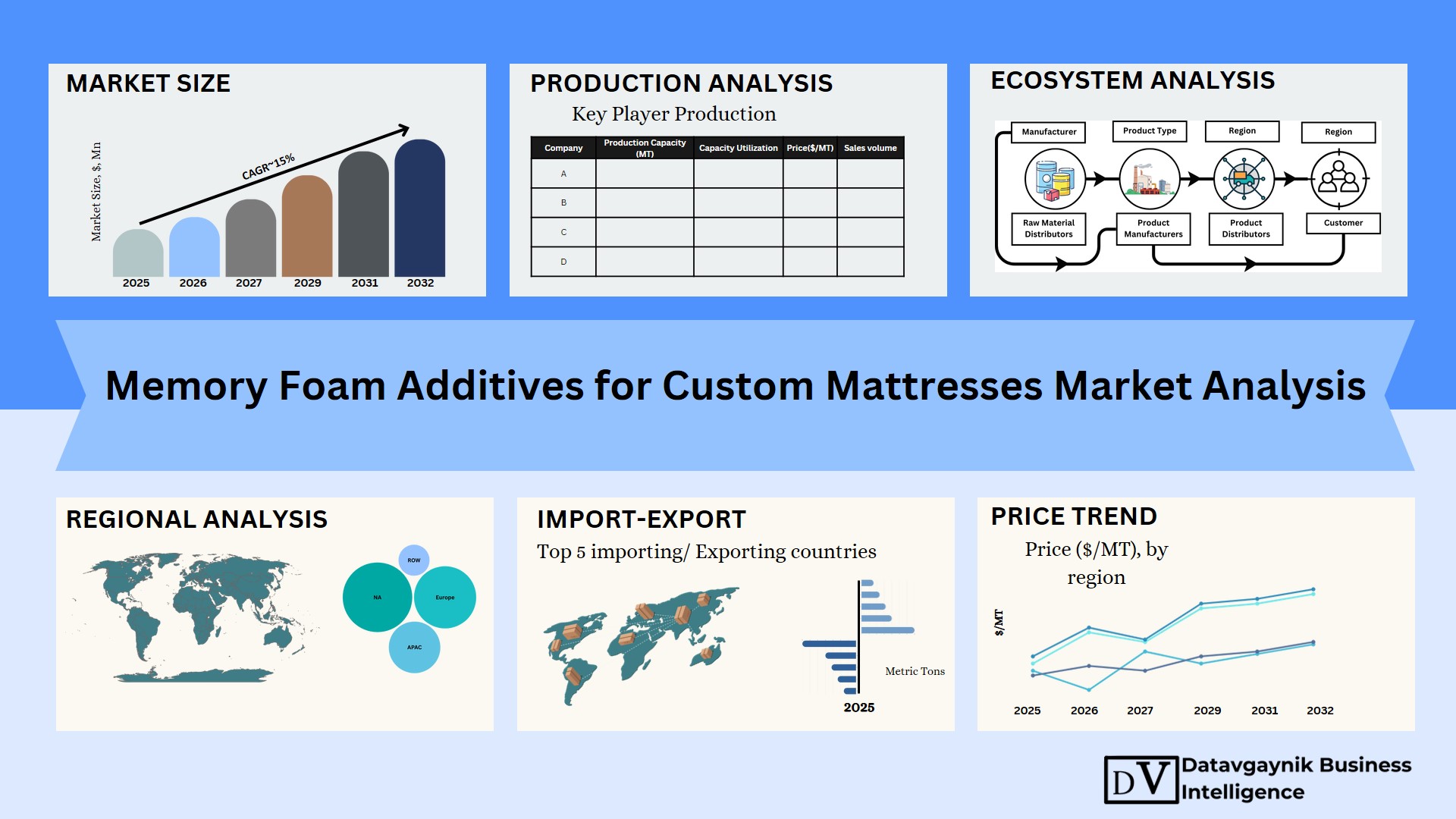
The Memory Foam Additives for Custom Mattresses Market is rapidly expanding as consumers increasingly seek sleep solutions tailored to individual comfort, health needs, and lifestyle preferences. Custom mattresses are no longer a niche offering but a mainstream demand, driven by factors such as rising disposable income, sleep-health awareness, and technological integration in bedding products.
For example, a study by Datavagyanik highlights that over 68 percent of consumers now consider mattress personalization an essential purchase criterion, particularly in North America and Europe. This trend directly fuels the demand for specialized additives that enable features such as targeted support, zoned pressure relief, and temperature regulation within memory foam layers.
Thermal Management and Cooling Technologies Accelerating the Memory Foam Additives for Custom Mattresses Market
One of the most significant drivers in the Memory Foam Additives for Custom Mattresses Market is the integration of cooling technologies to combat heat retention—a long-standing drawback of conventional memory foam. Additives such as phase-change materials (PCMs), graphite particles, and gel infusions are now critical components in premium and mid-range mattress segments.
For instance, graphite-infused foam, which dissipates body heat 30 percent faster than standard memory foam, is gaining traction among consumers in hot and humid regions like Southeast Asia and the Southern United States. The surge in demand for gel-based cooling memory foam mattresses has led to a 9.2 percent year-over-year growth in this segment as of 2024, as noted by Datavagyanik’s recent insights.
Orthopedic and Ergonomic Focus Enhancing the Memory Foam Additives for Custom Mattresses Market
Health-conscious consumers are driving the Memory Foam Additives for Custom Mattresses Market toward solutions that offer orthopedic and ergonomic benefits. Back pain, joint discomfort, and posture-related sleep issues are now common concerns influencing mattress purchases across all age demographics.
Additives that enhance contouring, motion isolation, and spinal alignment—such as viscoelastic compounds and advanced polyurethane blends—have become increasingly prominent. For example, mattresses designed for orthopedic support have seen a 13 percent CAGR since 2020, with nearly 38 percent of this growth attributed to memory foam infused with support-enhancing additives. This trend is especially noticeable in regions like Europe and Japan, where aging populations are fueling demand for therapeutic sleep surfaces.
Sustainability Imperatives Driving Eco-Friendly Solutions in the Memory Foam Additives for Custom Mattresses Market
Sustainability is no longer an optional feature but a competitive differentiator in the Memory Foam Additives for Custom Mattresses Market. As consumers become more eco-conscious, demand is rising for memory foam additives derived from renewable sources such as castor oil, soy-based polyols, and recycled polymers.
Datavagyanik data reveals that in 2023, nearly 21 percent of memory foam mattresses sold globally contained at least one eco-friendly additive, a figure expected to surpass 30 percent by 2026. European countries, particularly Germany and the Netherlands, are leading the transition toward green additives. Mattress manufacturers in these regions are partnering with sustainable chemical suppliers to develop additives that reduce carbon footprints without compromising on performance.
Smart Mattress Integration Expanding the Scope of the Memory Foam Additives for Custom Mattresses Market
The rise of smart home ecosystems has spilled over into the sleep industry, with smart mattresses gaining momentum due to their embedded sensors, biometric monitoring capabilities, and AI-driven adaptability. Memory foam additives compatible with electronic components and capable of withstanding repeated compression without degrading are crucial in the development of these advanced products.
For example, in South Korea and the United States, smart mattresses accounted for over 12 percent of all premium mattress sales in 2024. Many of these products rely on proprietary blends of memory foam enhanced with additives that support dynamic contouring and localized temperature adjustment. This fusion of tech and material science is opening a new frontier in the Memory Foam Additives for Custom Mattresses Market.
Hospitality and Healthcare Sectors Creating Institutional Demand in the Memory Foam Additives for Custom Mattresses Market
The commercial segment of the Memory Foam Additives for Custom Mattresses Market is witnessing strong momentum, particularly within the hospitality and healthcare industries. Hotels and wellness resorts are investing in custom mattresses that offer premium sleep experiences, while hospitals and elderly care facilities are adopting pressure-relieving memory foam to enhance patient care.
In the United States alone, over 25,000 hotel rooms were upgraded in 2023 with memory foam mattresses containing advanced additives, aimed at improving guest comfort and reducing complaints related to sleep discomfort. Similarly, the European healthcare sector has increased procurement of custom mattresses with antimicrobial and orthopedic-grade additives by 17 percent year-over-year, driven by regulatory focus on hygiene and recovery support.
Youth-Centric Customization Broadening the Memory Foam Additives for Custom Mattresses Market
Younger consumers, particularly millennials and Gen Z, are influencing the direction of the Memory Foam Additives for Custom Mattresses Market. This demographic prefers customizable, tech-friendly, and health-oriented sleep solutions. As online mattress retail grows, companies are leveraging digital platforms to offer build-your-own mattress options with specific additives for cooling, allergen resistance, and firmness.
In India, for example, digital-first mattress brands saw a 41 percent increase in sales in 2023, with memory foam products enhanced with lifestyle-specific additives accounting for 60 percent of total orders. Customization engines on these platforms allow users to select from additives such as charcoal-infused foam for detoxification, aloe vera for skin benefits, and copper for antimicrobial protection.
Durability Enhancements Fueling Long-Term Value in the Memory Foam Additives for Custom Mattresses Market
One of the growing considerations in the Memory Foam Additives for Custom Mattresses Market is durability. Additives that enhance the lifespan of memory foam by increasing resistance to compression, sagging, and material breakdown are now a top priority for both manufacturers and consumers.
Advanced polymer networks and high-resilience polyurethane infusions are being used to extend mattress life cycles from the average 7 years to over 10 years. This added durability appeals to value-focused consumers and also contributes to reduced mattress waste, aligning with sustainability goals.
In regions like Australia and Canada, where mattress replacement rates are traditionally lower due to higher initial investments, demand for durable memory foam with enhanced additives has grown by 11 percent in the past 18 months, as per Datavagyanik findings.
Memory Foam Additives for Custom Mattresses Market Size and Regional Growth Insights
The Memory Foam Additives for Custom Mattresses Market Size continues to expand at a significant rate. Datavagyanik estimates place the market valuation at USD 1.8 billion in 2024, with projections reaching nearly USD 3.2 billion by 2028. This represents a CAGR of 14.6 percent, driven by evolving consumer lifestyles, the growing smart home economy, and institutional adoption across key regions.
North America remains the largest contributor, accounting for over 35 percent of global revenues, followed closely by Europe at 28 percent. Asia Pacific, however, is the fastest-growing market, with China, India, and Japan leading adoption due to rising middle-class incomes and rapid urbanization.
Emerging Material Science Innovations Catalyzing the Memory Foam Additives for Custom Mattresses Market
Material science innovations are reshaping the capabilities of the Memory Foam Additives for Custom Mattresses Market. New-generation additives, including thermally activated gels, breathable nanomaterials, and odor-neutralizing compounds, are enabling foam to meet a wider range of functional demands.
For example, a new class of bio-ceramic additives is being used to reflect far-infrared energy back into the body to promote muscle recovery during sleep—a feature now embedded in athletic recovery mattresses marketed to professional sports teams in Europe and the U.S. Such innovations not only elevate product performance but also justify premium pricing strategies, further boosting market revenue.
“Track Country-wise Memory Foam Additives for Custom Mattresses Production and Demand through our Memory Foam Additives for Custom Mattresses Production Database”
- Memory Foam Additives for Custom Mattresses production database for 28+ countries worldwide
- Memory Foam Additives for Custom Mattresses Powder sales volume for 32+ countries
- Country-wise Memory Foam Additives for Custom Mattresses production capacity and production plant mapping, production capacity utilization for 28+ manufacturers
- Memory Foam Additives for Custom Mattresses production plants and production plant capacity analysis for top manufacturers
North America Leads Global Demand in the Memory Foam Additives for Custom Mattresses Market
The Memory Foam Additives for Custom Mattresses Market in North America, particularly the United States, is characterized by robust demand driven by a mature consumer base, high per capita mattress replacement rates, and strong innovation in smart and luxury mattresses. Datavagyanik indicates that North America accounted for 34 percent of the global demand in 2024, with the U.S. contributing more than 80 percent of the regional volume.
For instance, memory foam mattresses with cooling additives, such as phase-change materials and gel beads, dominate the premium segment. These products often command a 15 to 20 percent higher price due to the integration of advanced additives. In cities like New York, Los Angeles, and Chicago, consumer preferences lean toward mattresses with personalized firmness zones, allergen resistance, and IoT compatibility—all made possible by high-performance additives.
Asia Pacific Emerges as the Fastest-Growing Region in the Memory Foam Additives for Custom Mattresses Market
The Memory Foam Additives for Custom Mattresses Market is expanding rapidly across Asia Pacific, led by China, India, Japan, and South Korea. Datavagyanik estimates the region is growing at a CAGR of 15.8 percent, driven by rising urbanization, middle-class income growth, and increased awareness of sleep health.
In China, manufacturers such as DeRucci and Mlily are incorporating additives like graphite, aloe vera, and antimicrobial agents to meet rising consumer expectations. Local production has surged by 27 percent in the past two years, with significant capacity additions in Jiangsu and Guangdong provinces. These facilities supply both domestic and export markets, particularly Southeast Asia and the Middle East.
India presents a unique growth narrative. While affordability remains a key factor, demand for orthopedic and eco-friendly custom mattresses has increased sharply in Tier 1 and Tier 2 cities. Brands like Wakefit and Sleepyhead now offer mattresses with memory foam additives targeting specific health concerns such as lower back pain and overheating—features that previously only existed in premium international brands.
Europe Prioritizes Sustainability and Precision in the Memory Foam Additives for Custom Mattresses Market
The Memory Foam Additives for Custom Mattresses Market in Europe is heavily driven by sustainability mandates, technical innovation, and health-conscious consumer behavior. Countries like Germany, France, and the UK lead demand, each with distinct market priorities.
In Germany, the focus is on engineering excellence and orthopedic performance. Memory foam additives such as bio-based polyols and breathable fiber blends are widely used in manufacturing processes to meet both comfort and ecological standards. Datavagyanik highlights that over 63 percent of custom mattresses sold in Germany in 2023 contained at least one eco-friendly additive.
France’s demand is driven by a blend of luxury and health. For example, premium mattress brands are integrating lavender-infused and copper-enriched additives to target wellness-conscious consumers. Meanwhile, in the UK, antibacterial and hypoallergenic additives are in high demand due to rising consumer sensitivity to allergens and pollutants in indoor environments.
Middle East and Africa Represent an Emerging Frontier in the Memory Foam Additives for Custom Mattresses Market
The Memory Foam Additives for Custom Mattresses Market in the Middle East and Africa is gaining momentum, fueled by increasing investments in hospitality and healthcare infrastructure. In the UAE and Saudi Arabia, luxury hotels and wellness resorts are opting for custom memory foam mattresses with cooling and pressure-relieving additives to offer differentiated guest experiences.
Datavagyanik notes that imports of additive-enhanced memory foam rose by 21 percent in the GCC region in 2023. These products are particularly suited for the region’s climate, where thermal regulation is a critical factor. The growth of medical tourism and hospital expansion projects is also boosting the demand for antimicrobial and orthopedic-grade memory foam additives.
Latin America Building Domestic Capacity in the Memory Foam Additives for Custom Mattresses Market
In Latin America, Brazil and Mexico are key players in the evolving Memory Foam Additives for Custom Mattresses Market. Although the market is in its nascent stages, demand for affordable yet feature-rich custom mattresses is rising, particularly among urban middle-income groups.
Brazil’s local production of memory foam additives grew by 12 percent in 2023, with manufacturers focusing on basic yet effective formulations such as gel-infused and high-resilience additives. Imports from the U.S. and China still dominate the premium segment, where consumers seek advanced cooling and support features.
Segmentation by Additive Type: Diversification Shapes the Memory Foam Additives for Custom Mattresses Market
The Memory Foam Additives for Custom Mattresses Market is increasingly segmented by additive type, with each category playing a unique role in shaping consumer preferences and price structures.
Cooling additives account for the largest share, representing 36 percent of global demand. These include phase-change materials, gel particles, and graphite—which are particularly effective in regions with hot climates or for individuals with higher basal body temperatures.
Support-enhancing additives are gaining popularity among older consumers and athletes. High-density foam infusions and polyurethane microcell structures are used to improve weight distribution, relieve pressure points, and prevent sagging over time.
Antimicrobial and hypoallergenic additives, including silver nanoparticles, bamboo charcoal, and aloe vera extracts, have seen a surge in demand, especially post-pandemic. In markets like Japan and the UK, over 40 percent of consumers consider antimicrobial properties a non-negotiable feature.
Eco-friendly additives are also creating a new product category. Recycled content, plant-based oils, and biodegradable compounds now feature in nearly one out of every five memory foam mattresses sold in environmentally conscious regions.
Segmentation by Application: Residential and Commercial Sectors Driving Diverse Demand in the Memory Foam Additives for Custom Mattresses Market
The Memory Foam Additives for Custom Mattresses Market is clearly segmented by end-use application. The residential segment dominates with nearly 70 percent of market volume, driven by consumer-focused innovation and digital retail adoption.
In contrast, the commercial segment is rapidly evolving, led by the hospitality, healthcare, and wellness industries. Hospitals prefer memory foam mattresses enhanced with pressure-relieving and antimicrobial additives to minimize patient discomfort and infection risks. Luxury hotels are investing in sleep-enhancing additives such as aromatherapy infusions and temperature-sensitive foams to elevate customer satisfaction.
Datavagyanik projects that commercial applications of memory foam additives will grow at a CAGR of 10.6 percent through 2028, significantly outpacing earlier forecasts.
Memory Foam Additives for Custom Mattresses Price Trends Vary Across Regions and Additive Types
The Memory Foam Additives for Custom Mattresses Price varies significantly based on the type and function of the additive. For instance, phase-change materials and graphite-enhanced additives command premium prices, typically 25 to 40 percent higher than standard foam-enhancing chemicals.
In 2024, the average Memory Foam Additives for Custom Mattresses Price for cooling-based additives ranged between USD 9.80 to USD 14.50 per kg, while eco-friendly additives—due to higher production costs—averaged between USD 12.00 to USD 18.00 per kg. Support-enhancing additives remain the most cost-efficient, ranging from USD 5.00 to USD 9.00 per kg depending on the polymer concentration and performance grade.
Datavagyanik emphasizes that Memory Foam Additives for Custom Mattresses Price Trend is heavily influenced by global oil prices, chemical supply chain disruptions, and regional manufacturing capacity. In 2023, price fluctuations were observed primarily in Europe and Asia due to increased transportation and raw material costs.
Regional Capacity Expansion Helping Stabilize Memory Foam Additives for Custom Mattresses Price Trend
Several large manufacturers have responded to demand-supply imbalances by expanding their production footprint, which is expected to stabilize the Memory Foam Additives for Custom Mattresses Price Trend over the next three years.
For instance, new production lines in Vietnam and Indonesia are producing mid-range additives for export to North America and Europe, reducing dependency on traditional hubs in China and South Korea. Meanwhile, Western players like BASF and Covestro are investing in localized R&D to produce custom additives suited to regional consumer preferences.
Datavagyanik predicts that price volatility will decrease by 2026 as these expansions reach full-scale operation, with global Memory Foam Additives for Custom Mattresses Price expected to normalize across most segments, except for niche luxury additives that will continue to carry premium pricing.
“Memory Foam Additives for Custom Mattresses Manufacturing Database, Memory Foam Additives for Custom Mattresses Manufacturing Capacity”
- Memory Foam Additives for Custom Mattresses top manufacturers market share for 28+ manufacturers
- Top 8 manufacturers and top 18 manufacturers of Memory Foam Additives for Custom Mattresses in North America, Europe, Asia Pacific
- Production plant capacity by manufacturers and Memory Foam Additives for Custom Mattresses production data for 28+ market players
- Memory Foam Additives for Custom Mattresses production dashboard, Memory Foam Additives for Custom Mattresses production data in excel format
Leading Manufacturers Dominating the Memory Foam Additives for Custom Mattresses Market
The Memory Foam Additives for Custom Mattresses Market is highly consolidated among a handful of global chemical and sleep solution companies that control the innovation, production, and distribution of high-performance additives. These companies are not only expanding their additive portfolios but also forming strategic partnerships with mattress manufacturers to enable integrated product development.
BASF SE: Global Innovation Leader
BASF holds a dominant position in the Memory Foam Additives for Custom Mattresses Market, accounting for approximately 16 percent of the global additive volume used in memory foam applications. Through its performance materials division, BASF offers advanced polyurethane solutions under its Lupranate and Elastoflex product lines. These additives are engineered to enhance foam density, resilience, and heat dissipation—critical factors in luxury and orthopedic custom mattresses.
BASF’s R&D efforts have led to the creation of bio-based additive formulations using renewable feedstocks. These are now being tested for integration into high-end European and Japanese mattress lines. The company operates key production facilities in Germany, China, and the United States, allowing it to serve both developed and emerging markets efficiently.
Covestro AG: Sustainable Additive Pioneer
Covestro commands an estimated 12 percent market share in the Memory Foam Additives for Custom Mattresses Market and is renowned for its eco-conscious innovations. The company’s Bayfit® and Baynat® additive systems are widely used in both residential and commercial mattress applications. These products offer superior airflow, pressure relief, and reduced VOC emissions, aligning with the growing demand for sustainable mattresses.
Covestro’s major clientele includes mattress OEMs across Europe and Southeast Asia. Its emphasis on carbon-neutral production and circular economy initiatives makes it a preferred supplier for brands positioning themselves as environmentally responsible.
Dow Inc.: Engineered Performance Solutions
Dow Inc. is another major player, capturing approximately 10 percent of the Memory Foam Additives for Custom Mattresses Market. The company’s VORANOL™ polyether polyols are extensively used to modify foam flexibility and compression recovery in memory foam mattresses. These additives are found in premium product lines sold across North America and South Korea, particularly in smart and temperature-controlled mattresses.
Dow has focused heavily on compatibility with sensor-embedded foams, enabling its additives to be used in next-gen sleep tech applications. The company also supplies specialty additives to mattress brands producing orthopedic products in collaboration with sports and wellness clinics.
Huntsman Corporation: Custom Formulation Specialist
Huntsman specializes in tailored formulations for niche mattress segments. With roughly 7 percent market share, the company’s TEROL® and JEFFOL® additives are frequently used in motion-isolating, cooling, and high-durability foam products. Huntsman’s additives are found in luxury mattresses across the U.S. and Middle East, where heat resistance and prolonged comfort are key selling points.
Their Middle Eastern expansion, especially in UAE and Saudi Arabia, has enabled direct supply to hospitality projects and luxury developments, further increasing their market penetration.
Evonik Industries: Functional Additives Innovator
Evonik commands 6 percent of the Memory Foam Additives for Custom Mattresses Market and focuses on performance-enhancing and antimicrobial additives. Their TEGOSTAB® and ORTEGOL® ranges are popular among European mattress manufacturers seeking foam stability, hypoallergenic properties, and odor control.
Evonik’s recent investment in antimicrobial technology has led to increased usage in healthcare-focused mattresses, especially across Germany, France, and Italy, where institutional demand is rapidly growing.
FXI and Sheela Foam: Integrated Mattress and Additive Producers
Unlike chemical companies supplying raw additives, companies like FXI (USA) and Sheela Foam (India) operate across the full value chain—from additive formulation to finished mattress manufacturing. FXI offers custom formulations for use in its own mattress brands like Aerus™, which are known for their breathable and cooling foam layers.
Sheela Foam, under its Sleepwell brand, utilizes proprietary foam blends that include memory foam additives optimized for Indian climatic conditions and price-sensitive markets. Both companies are rapidly gaining ground by leveraging in-house formulation capabilities and end-user branding.
Restonic and Tempur Sealy: Strategic Users of High-End Additives
While not producers of additives, mattress companies like Restonic and Tempur Sealy play an influential role in shaping demand in the Memory Foam Additives for Custom Mattresses Market. Restonic’s Biltmore® and ComfortCare® series include memory foam infused with copper, gel, and phase-change materials for advanced cooling and support.
Tempur Sealy, through its TEMPUR-ProAdapt® and TEMPUR-LuxeAdapt® lines, uses proprietary TEMPUR® foam infused with multi-zone additives that offer customized response based on body weight and sleep position. These innovations directly impact additive manufacturers by pushing performance expectations higher, especially in North American and European markets.
Memory Foam Additives for Custom Mattresses Market Share by Manufacturer
The current global Memory Foam Additives for Custom Mattresses Market is divided among the top players as follows:
- BASF SE – 16%
- Covestro AG – 12%
- Dow Inc. – 10%
- Huntsman Corporation – 7%
- Evonik Industries – 6%
- FXI and Sheela Foam (combined) – 8%
- Other regional and specialty suppliers – 41%
The high share held by “other” manufacturers includes regional formulators in Southeast Asia, China, and Latin America, many of which specialize in basic support or low-cost cooling additives for entry-level custom mattresses. These suppliers are expected to become increasingly competitive as demand shifts toward emerging markets.
Recent Developments in the Memory Foam Additives for Custom Mattresses Market
The last 12 months have seen a series of strategic moves by major players in the Memory Foam Additives for Custom Mattresses Market, including product launches, facility expansions, and sustainability initiatives.
- January 2024 – BASF unveiled a new low-VOC additive for luxury custom mattresses aimed at the European market. The new formulation is expected to reduce off-gassing time by 45%.
- March 2024 – Covestro announced its partnership with a Scandinavian mattress brand to deliver bio-based additives for their entire product range by 2026.
- May 2024 – FXI expanded its manufacturing footprint with a new facility in Tennessee, adding 20,000 metric tons of annual additive-blended foam capacity.
- July 2024 – Evonik completed its acquisition of a Swiss biotech firm specializing in antimicrobial compounds. This move positions them to strengthen their share in the healthcare mattress segment.
- September 2024 – Sheela Foam launched India’s first AI-powered mattress customization app integrated with additive selection based on consumer sleep profiles.
These strategic developments underscore how competition in the Memory Foam Additives for Custom Mattresses Market is intensifying not just in terms of volume, but also in innovation, sustainability, and regional adaptability.
“Memory Foam Additives for Custom Mattresses Production Data and Memory Foam Additives for Custom Mattresses Production Trend, Memory Foam Additives for Custom Mattresses Production Database and forecast”
- Memory Foam Additives for Custom Mattresses production database for historical years, 10 years historical data
- Memory Foam Additives for Custom Mattresses production data and forecast for next 7 years
Market Scenario, Demand vs Supply, Average Product Price, Import vs Export, till 2035
- Global Memory Foam Additives for Custom Mattresses Market revenue and demand by region
- Global Memory Foam Additives for Custom Mattresses Market production and sales volume
- United States Memory Foam Additives for Custom Mattresses Market revenue size and demand by country
- Europe Memory Foam Additives for Custom Mattresses Market revenue size and demand by country
- Asia Pacific Memory Foam Additives for Custom Mattresses Market revenue size and demand by country
- Middle East & Africa Memory Foam Additives for Custom Mattresses Market revenue size and demand by country
- Latin America Memory Foam Additives for Custom Mattresses Market revenue size and demand by
- Import-export scenario – United States, Europe, APAC, Latin America, Middle East & Africa
- Average product price – United States, Europe, APAC, Latin America, Middle East & Africa
- Market player analysis, competitive scenario, market share analysis
- Business opportunity analysis
Key questions answered in the Global Memory Foam Additives for Custom Mattresses Market Analysis Report:
- What is the market size for Memory Foam Additives for Custom Mattresses in United States, Europe, APAC, Middle East & Africa, Latin America?
- What is the yearly sales volume of Memory Foam Additives for Custom Mattresses and how is the demand rising?
- Who are the top market players by market share, in each product segment?
- Which is the fastest growing business/ product segment?
- What should be the business strategies and Go to Market strategies?
The report covers Memory Foam Additives for Custom Mattresses Market revenue, Production, Sales volume, by regions, (further split into countries):
- Asia Pacific (China, Japan, South Korea, India, Indonesia, Vietnam, Rest of APAC)
- Europe (UK, Germany, France, Italy, Spain, Benelux, Poland, Rest of Europe)
- North America (United States, Canada, Mexico)
- Latin America (Brazil, Argentina, Rest of Latin America)
- Middle East & Africa
Table of Contents:
Memory Foam Additives for Custom Mattresses Market
- Introduction to Memory Foam Additives in Custom Mattresses
- Overview of Memory Foam Technology
- Importance of Additives in Enhancing Mattress Performance
- Key Properties and Benefits of Memory Foam Additives
- Enhanced Comfort and Pressure Relief
- Improved Durability and Thermal Regulation
- Market Scope and Applications
- Role in Customizable and Specialty Mattresses
- Applications in Residential and Commercial Bedding Solutions
- Global Market Overview and Trends (2019-2035)
- Growth in Demand for Personalized Sleep Solutions
- Innovations in Additive Technologies for Foam Production
- Market Segmentation by Additive Type
- Cooling Additives (Gel, Phase Change Materials)
- Flame Retardant Additives
- Antimicrobial and Hypoallergenic Additives
- Performance Enhancers (Elasticity, Density Modifiers)
- Market Segmentation by Mattress Type
- Luxury and Premium Mattresses
- Orthopedic and Medical Mattresses
- Smart and Adjustable Mattresses
- Budget and Standard Memory Foam Mattresses
- Regional Market Dynamics (2019-2035)
- North America
- Europe
- Asia-Pacific
- Latin America
- Middle East & Africa
- United States Market Insights
- Demand for Health-Oriented and Smart Bedding Solutions
- Trends in Customizable Mattress Manufacturing
- European Market Insights
- Adoption of Eco-Friendly and Sustainable Additives
- Innovations in Luxury Bedding Products
- Asia-Pacific Market Insights
- Expansion of Mattress Manufacturing Facilities
- Rising Demand for Affordable Customized Mattresses
- Latin America Market Insights
- Opportunities in Emerging Markets for Comfort Bedding
- Trends in Regional Bedding Preferences
- Middle East & Africa Market Insights
- Applications in Hospitality and High-End Residences
- Challenges and Opportunities in Regional Markets
- Manufacturing Processes for Memory Foam with Additives
- Techniques for Integrating Additives in Foam Production
- Innovations in Additive Dispersion and Performance
- Competitive Landscape and Market Share Analysis
- Leading Manufacturers of Memory Foam Additives
- Strategies for Expanding Market Reach
- Cost Analysis of Memory Foam Additives
- Breakdown of Additive and Manufacturing Costs
- Economic Benefits of Enhanced Foam Longevity
- Raw Materials for Additive Production
- Sourcing of Cooling Agents, Polymers, and Specialty Chemicals
- Trends in Raw Material Sustainability
- Supply Chain and Distribution Strategies
- Role of Additive Suppliers in Mattress Manufacturing
- Challenges in Global Distribution Networks
- Industrial Chain and Value Chain Analysis
- Integration of Additives in Mattress Production
- Opportunities for Value Addition in Custom Bedding
- Revenue and Profitability Analysis
- Revenue Trends Across Mattress Segments
- Profit Margins by Additive Type and Region
- End-User and Consumer Insights
- Preferences for Comfort, Cooling, and Durability Features
- Trends in Customization and Smart Mattress Features
- Marketing and Branding Strategies
- Role of Additives in Promoting Premium Mattress Brands
- Collaborations Between Mattress Manufacturers and Retailers
- Environmental and Regulatory Considerations
- Compliance with Safety and Environmental Standards
- Role of Sustainable Additives in Reducing Environmental Impact
- Research and Development in Memory Foam Additives
- Innovations in Smart Materials for Adaptive Comfort
- Emerging Trends in Multi-Functional Additives
- Challenges in the Memory Foam Additives Market
- Cost Sensitivity and Market Competition
- Technological Barriers in Advanced Additive Integration
- Opportunities in Emerging Applications
- Use in Hybrid Mattresses and Furniture Upholstery
- Role in Wellness-Oriented and Medical Bedding Solutions
- Import and Export Dynamics
- Trade Patterns of Additives and Memory Foam Products
- Regional Trends in Export and Import Markets
- Market Forecast and Projections (2019-2035)
- Regional and Global Growth Predictions
- Key Trends Shaping the Future of Memory Foam Additives
- Introduction to Memory Foam Additives in Custom Mattresses


