

Surging Demand for OLED Materials in Premium TVs Market Driven by Display Technology Evolution
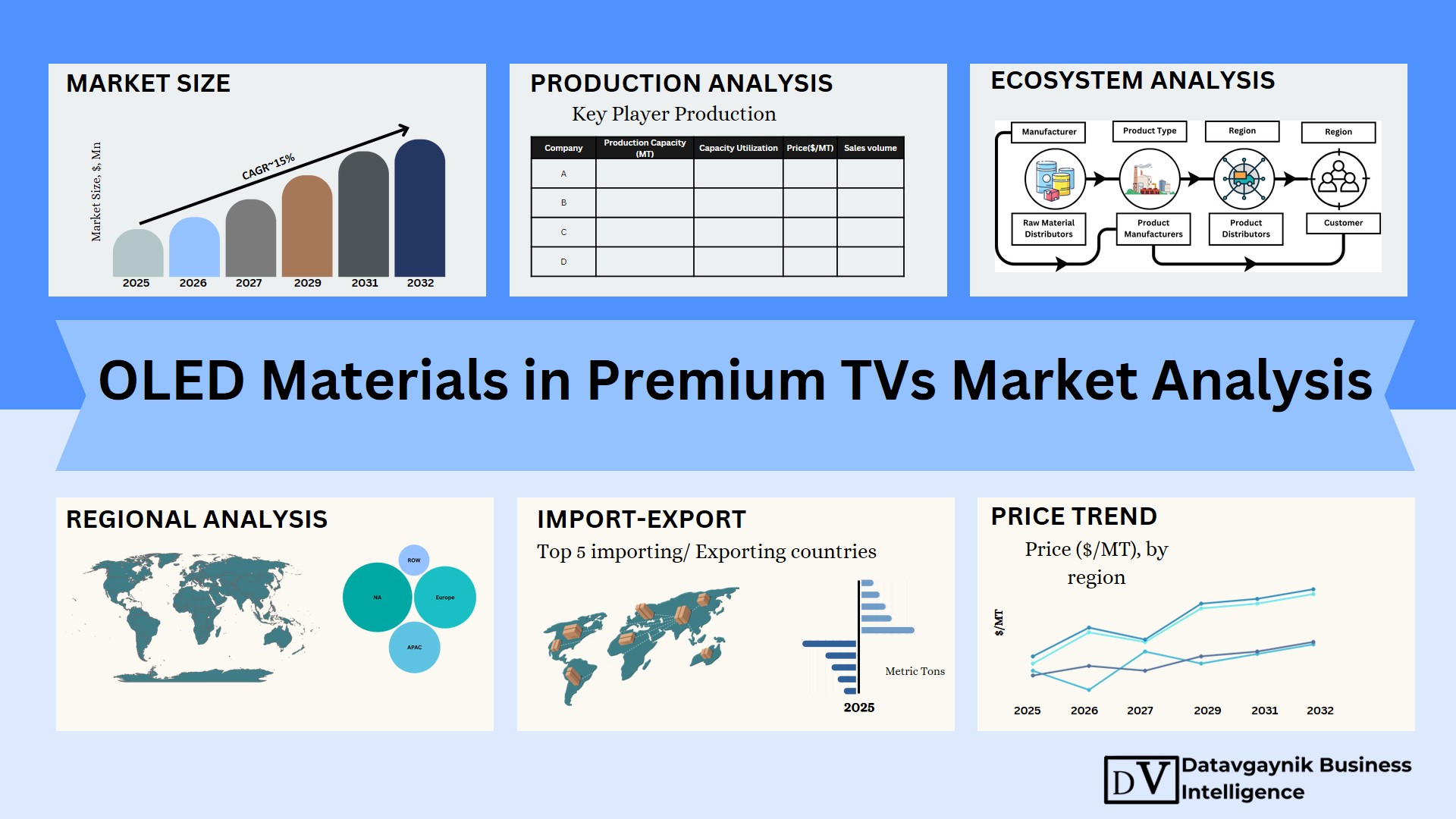
The OLED Materials in Premium TVs Market is undergoing a structural transformation, driven by rapid innovation in display technologies and shifting consumer demand. With increasing consumer appetite for advanced viewing experiences, the integration of OLED technology in premium TVs is accelerating. For instance, over 6.5 million OLED TVs were shipped globally in 2023, up from 4.8 million in 2021, indicating a compounded annual growth rate (CAGR) of over 15% in premium display segments. This expansion is directly impacting the OLED Materials in Premium TVs Market, as manufacturers scale up production to meet performance and design requirements in high-end televisions.
Superior Visual Quality Elevating OLED Materials in Premium TVs Market Traction
A primary driver of the OLED Materials in Premium TVs Market is the demand for superior picture quality. OLED panels offer unparalleled contrast ratios, true blacks, and richer color profiles compared to LED and QLED counterparts. These outcomes are achieved through high-performance materials such as red, green, and blue phosphorescent emitters. For instance, Universal Display Corporation’s phosphorescent emitter technologies have been credited with enhancing energy efficiency by up to 25% while improving brightness levels in OLED displays. Such material-level innovations continue to elevate the desirability of OLED TVs among consumers, fueling the overall OLED Materials in Premium TVs Market Size globally.
Energy Efficiency a Core Advantage in OLED Materials in Premium TVs Market
Another key factor propelling the OLED Materials in Premium TVs Market is energy efficiency. OLED panels function without a backlight, which enables each pixel to illuminate independently. This significantly reduces power consumption, especially during darker scenes. According to Datavagyanik, OLED TVs consume up to 40% less power in typical usage compared to LED-lit LCDs. As global regulations tighten around energy efficiency, especially in Europe and North America, OLED materials that support low-power operation are gaining strategic importance. Material producers are now developing optimized hole and electron transport layers to further reduce operational voltages while preserving luminance and color integrity.
Flexible and Thin Form Factors Reinventing OLED Materials in Premium TVs Market
The OLED Materials in Premium TVs Market is benefiting immensely from the ability of OLED panels to be ultra-thin, bendable, or even rollable. This flexibility is enabled by substrate and encapsulation materials designed specifically for curved and foldable screen applications. South Korean brands like LG have capitalized on this trend with products such as the LG Signature OLED R – a rollable TV built with advanced flexible OLED materials. These innovations are not just reshaping product design but also reshaping the competitive landscape in premium electronics, expanding the addressable OLED Materials in Premium TVs Market.
4K and 8K Adoption Reinforcing Demand in OLED Materials in Premium TVs Market
High-definition content has rapidly transitioned from 1080p to 4K and is now shifting towards 8K. According to Datavagyanik, over 40% of premium TV sales in 2024 are expected to be 4K OLED models, with 8K OLED adoption growing steadily in regions such as Japan and the United States. High pixel density in these displays places immense pressure on material performance, especially for emissive layers and transport materials. Blue emitters, traditionally weaker in longevity, are now being enhanced through extensive R&D efforts to support ultra-high-definition displays, which is directly fueling innovation and growth in the OLED Materials in Premium TVs Market.
Durability and Longevity Enhancements Bolstering OLED Materials in Premium TVs Market Outlook
Historically, issues such as screen burn-in and shorter lifespan of blue emitters constrained OLED adoption in premium TVs. However, recent advances in OLED material chemistry and layer engineering have significantly extended operational lifespans. For example, new generation host-dopant systems and advanced encapsulation layers are now delivering OLED TVs with lifespans exceeding 100,000 hours. As durability becomes less of a concern, especially in 4K and 8K applications, the OLED Materials in Premium TVs Market is gaining momentum among both manufacturers and consumers seeking long-term display quality assurance.
Affluent Consumer Base Expanding OLED Materials in Premium TVs Market Size
Rising disposable incomes across major economies are contributing to the expansion of the OLED Materials in Premium TVs Market. In 2023, global premium TV revenue surpassed $40 billion, with OLED models accounting for nearly 20% of this figure. Countries like China, India, and Brazil are witnessing a surge in high-net-worth households who prioritize luxury electronics, including premium televisions. As these regions transition from mid-range to high-end consumer electronics, the underlying demand for OLED materials such as emissive compounds, barrier films, and flexible substrates is expected to increase proportionally.
Sustainability Imperatives Accelerating Transition to OLED Materials in Premium TVs Market
Sustainability is emerging as a competitive differentiator within the OLED Materials in Premium TVs Market. OLED panels inherently consume less power and require fewer raw materials compared to LED-backlit LCDs. Furthermore, material science innovations are increasingly focused on creating recyclable or bio-based components. European firms, for example, are leading initiatives to develop solvent-free OLED formulations and biodegradable encapsulation layers. These trends align with global environmental goals and regulatory frameworks, reinforcing the position of OLED as a green alternative in the premium display sector.
Technological Synergies Unlocking New Frontiers in OLED Materials in Premium TVs Market
Advancements in inkjet printing and vacuum deposition are improving the cost efficiency of OLED material application. For instance, solution-processable OLED materials are now being adopted in large-format TVs, reducing material waste and lowering manufacturing costs. Companies like Sumitomo Chemical are spearheading this transformation by developing soluble emitter materials that streamline production. As material costs decrease, OEMs are more inclined to integrate OLED panels in mid-to-high-tier products, thereby widening the OLED Materials in Premium TVs Market reach without compromising performance.
OLED Materials in Premium TVs Market Gaining Edge Over Competing Technologies
While QLED and mini-LED continue to compete for market share, OLED technology retains a commanding lead in premium applications due to its superior visual fidelity and design versatility. Datavagyanik identifies OLED as the preferred choice for over 70% of premium TV launches in 2024 from leading brands like Sony, LG, and Panasonic. As OLED materials continue to improve in brightness, efficiency, and color accuracy, the OLED Materials in Premium TVs Market is expected to outpace alternative display materials in both revenue and unit share by 2026.
Conclusion: Strong Growth Trajectory for OLED Materials in Premium TVs Market
The OLED Materials in Premium TVs Market Size is projected to exceed $3.8 billion by 2027, driven by sustained investments in material innovation, growing consumer demand for high-quality visuals, and global expansion in premium TV segments. Each technological leap—from improved emitters to scalable production processes—is directly influencing the market dynamics, positioning OLED materials as the cornerstone of future-ready display solutions.
“Track Country-wise OLED Materials in Premium TVs Production and Demand through our OLED Materials in Premium TVs Production Database”
- OLED Materials in Premium TVs production database for 28+ countries worldwide
- OLED Materials in Premium TVs Powder sales volume for 32+ countries
- Country-wise OLED Materials in Premium TVs production capacity and production plant mapping, production capacity utilization for 28+ manufacturers
- OLED Materials in Premium TVs production plants and production plant capacity analysis for top manufacturers
Asia Pacific Leading Global OLED Materials in Premium TVs Market Demand
The Asia Pacific region dominates the OLED Materials in Premium TVs Market, accounting for over 60% of global demand. This dominance is attributed to the region’s stronghold in OLED display manufacturing, led by South Korea, China, and Japan. For instance, South Korean firms like LG Display and Samsung Display are producing more than 80% of the world’s OLED TV panels, requiring a consistent and large-scale supply of high-purity OLED materials such as phosphorescent emitters and encapsulation films.
China is rapidly scaling up its domestic OLED capabilities through firms like BOE Technology and CSOT. As of 2024, China has established over 10 Gen 8.5 and Gen 10 OLED fabrication lines specifically designed for large-format panels. These expansions are directly fueling demand in the OLED Materials in Premium TVs Market, especially for materials optimized for 4K and 8K resolutions. Additionally, Japanese firms such as Idemitsu Kosan remain key suppliers of blue and green emitter materials, contributing significantly to the regional production ecosystem.
North America Emerging as Innovation Hub in OLED Materials in Premium TVs Market
While North America is not a major manufacturing center for OLED panels, it plays a critical role in materials innovation and consumption of premium TVs. Datavagyanik identifies the United States as a major importer of OLED materials, particularly for research, prototyping, and integration into high-end consumer electronics. Companies like Universal Display Corporation (UDC) lead in the development of phosphorescent emitter materials that are licensed globally to manufacturers in Asia.
In terms of end-user demand, North America holds a substantial market share for premium OLED TVs, driven by rising adoption of home theater systems and gaming displays. The average selling price of OLED TVs in the U.S. was over $1,600 in 2023, far above the global average, which underscores a consumer base with higher willingness to invest in premium visual technologies. This translates into growing volumes in the OLED Materials in Premium TVs Market, particularly for high-performance emissive and transport layers tailored to luxury TV models.
Europe Prioritizing Sustainability in OLED Materials in Premium TVs Market
Europe remains a significant contributor to the OLED Materials in Premium TVs Market through its emphasis on sustainable material development and precision engineering. Germany, France, and the UK are investing in bio-based emitters and solvent-free encapsulation layers. For example, German firms such as Merck KGaA have developed eco-friendly transport materials that meet EU regulations for chemical safety and energy efficiency.
Consumer demand for OLED TVs is also strong in Europe, particularly in Western markets where premium product adoption is supported by high disposable incomes. Over 2.5 million OLED TVs were sold across the continent in 2023, and this number is expected to exceed 3.2 million units in 2025. Each OLED TV sold represents incremental consumption of multiple layers of materials, further expanding the OLED Materials in Premium TVs Market footprint in the region.
Emerging Economies Expanding Reach of OLED Materials in Premium TVs Market
Regions such as Latin America, the Middle East, and Southeast Asia are showing strong potential for OLED TV penetration, particularly among upper-middle-class consumers. Brazil, for instance, saw a 20% increase in premium TV sales between 2022 and 2023, driven by sporting events and digital content consumption. In Southeast Asia, Vietnam and Thailand are becoming secondary manufacturing hubs, with global players setting up OLED-related production lines to serve regional markets.
While these markets currently rely on imported OLED materials, Datavagyanik expects localized supply chains to emerge over the next 5 years. This shift will expand the OLED Materials in Premium TVs Market by integrating new demand pockets and reducing logistical costs for material suppliers.
Diverse Material Segments Fueling OLED Materials in Premium TVs Market Growth
The OLED Materials in Premium TVs Market is segmented into several key material types, each playing a distinct role in display performance. Emissive materials, particularly red, green, and blue phosphorescent compounds, account for over 35% of material consumption value in premium TV applications. These materials are central to achieving true HDR quality and are frequently updated to enhance brightness and reduce degradation.
Transport layers, including hole and electron transport materials, make up approximately 25% of the OLED Materials in Premium TVs Market. These are engineered to improve charge mobility and reduce energy losses. Substrate materials, which include rigid glass and flexible plastic, form around 20% of market share, enabling innovations like curved and rollable screens.
Encapsulation layers represent another critical segment, as they shield sensitive organic layers from oxygen and moisture. Advanced thin-film encapsulation (TFE) technologies are replacing traditional glass encapsulation, reducing thickness and improving panel flexibility. These segmented innovations create multiple entry points for material suppliers in the OLED Materials in Premium TVs Market.
Application Segmentation Driving Material Demand in OLED Materials in Premium TVs Market
The OLED Materials in Premium TVs Market is closely tied to evolving application formats. 4K TVs represent the largest consumer of OLED materials, with Datavagyanik reporting that over 70% of all OLED TVs sold globally in 2023 were 4K models. As content streaming services and next-gen gaming consoles normalize 4K content, demand for corresponding OLED materials will continue to rise.
8K OLED TVs, while still niche, are gaining momentum in markets such as Japan, South Korea, and the UAE. These displays require more precise material deposition due to the higher pixel density, increasing demand for ultra-pure emitter and transport materials.
Flexible, curved, and transparent OLED TV formats are expected to grow at a CAGR of 19% between 2024 and 2028. These innovative formats rely heavily on flexible substrates and new-generation encapsulation layers, thus diversifying the demand base within the OLED Materials in Premium TVs Market.
OEM Relationships Shaping Supply Chains in OLED Materials in Premium TVs Market
Original Equipment Manufacturers (OEMs) are central to the OLED Materials in Premium TVs Market structure. Companies like LG Electronics and Sony source materials through long-term contracts with OLED panel suppliers, who in turn procure specific materials based on performance requirements. These downstream relationships influence material selection, pricing, and technological compatibility.
Datavagyanik highlights a growing trend of vertical integration, with panel manufacturers investing directly in upstream material development to reduce costs and secure IP. For example, Samsung Display has partnered with domestic chemical companies to co-develop blue emitter systems with enhanced lifespan and efficiency. These partnerships reinforce material standardization and ensure a stable demand flow in the OLED Materials in Premium TVs Market.
OLED Materials in Premium TVs Price Shaped by Purity, Yield, and Volume
The OLED Materials in Premium TVs Price varies significantly depending on material type, purity levels, and manufacturing scale. High-purity blue emitters, which remain the most technically challenging, can cost up to $4,000 per kilogram, while red and green emitters range between $1,200 and $2,800 per kilogram. Hole and electron transport materials are priced more moderately, generally between $500 and $1,000 per kilogram, depending on conductivity and lifespan enhancements.
Datavagyanik identifies yield rate and deposition method as key influencers of OLED Materials in Premium TVs Price Trend. Materials used in vacuum thermal evaporation (VTE) processes are costlier due to wastage and lower efficiency, while solution-processable materials compatible with inkjet printing offer cost advantages and are shaping future OLED Materials in Premium TVs Price Trend trajectories.
OLED Materials in Premium TVs Price Trend Reflecting Market Maturity and Technological Shifts
OLED Materials in Premium TVs Price Trend is gradually stabilizing as production processes mature and material innovations reduce unit cost. Between 2019 and 2024, the average cost of emissive OLED materials declined by 18%, largely due to improved synthesis techniques and scale efficiencies. However, this trend is not uniform across all material types. For example, the OLED Materials in Premium TVs Price for blue emitters has remained elevated due to ongoing challenges with lifetime and degradation rates.
Looking ahead, Datavagyanik anticipates further reductions in OLED Materials in Premium TVs Price by 10–12% over the next three years, driven by adoption of inkjet printing in Gen 10+ fabs and higher material utilization rates. These trends will play a critical role in making OLED TVs more accessible, thereby expanding the OLED Materials in Premium TVs Market Size.
Conclusion: Geographies and Pricing Trends Redefining OLED Materials in Premium TVs Market
As regional demand diversifies and manufacturing technologies evolve, the OLED Materials in Premium TVs Market is becoming more interconnected, competitive, and innovation-driven. The interplay between geographical expansion, specialized material applications, and strategic pricing mechanisms will determine the future trajectory of the OLED Materials in Premium TVs Price Trend and supply dynamics.
“OLED Materials in Premium TVs Manufacturing Database, OLED Materials in Premium TVs Manufacturing Capacity”
- OLED Materials in Premium TVs top manufacturers market share for 28+ manufacturers
- Top 8 manufacturers and top 18 manufacturers of OLED Materials in Premium TVs in North America, Europe, Asia Pacific
- Production plant capacity by manufacturers and OLED Materials in Premium TVs production data for 28+ market players
- OLED Materials in Premium TVs production dashboard, OLED Materials in Premium TVs production data in excel format
Top Manufacturers Driving Innovation in OLED Materials in Premium TVs Market
The OLED Materials in Premium TVs Market is shaped by a select group of global manufacturers specializing in high-performance emissive materials, transport layers, and encapsulation technologies. These companies not only supply the backbone materials for OLED display production but also lead in R&D investments that define the next generation of premium TVs. The market is moderately consolidated, with the top five players collectively accounting for over 65% of the global material supply for OLED TVs.
Universal Display Corporation (UDC)
Universal Display Corporation is widely regarded as a dominant force in the OLED Materials in Premium TVs Market, particularly for its pioneering work in phosphorescent emitter materials. UDC’s PHOLED™ technology is a standard across most premium OLED TV panels, significantly boosting energy efficiency and extending display lifespan. UDC controls an estimated 35% market share in OLED emissive materials, supplying to major display manufacturers including LG Display, Samsung Display, and BOE. Their emitter series, such as UDC’s Green PHOLED and Red PHOLED, are designed for high-luminance large-screen panels used in 4K and 8K premium TVs.
Idemitsu Kosan Co., Ltd.
Based in Japan, Idemitsu Kosan holds a significant position in the OLED Materials in Premium TVs Market through its development of highly stable blue and green fluorescent emitters. Idemitsu is known for its highly efficient RGB emitters which are used extensively in OLED displays for premium consumer electronics. With roughly 15% market share, the company supplies materials to both Japanese and Korean display makers. Their latest innovation includes IDEM Blue Series, a next-gen blue emitter designed to extend lifetime while preserving color purity, critical for ultra-HD TV panels.
Merck Group (Germany)
Merck is a European leader in OLED material solutions and holds a strong position in the supply of electron transport layers and host-dopant systems. With a market share of approximately 10%, Merck’s offerings such as Licristal® HTL and ETL materials are frequently used in large-area OLED panel production for premium TV brands. The company is also focused on sustainable material development and low-solvent formulations, contributing to the eco-friendly evolution of OLED manufacturing.
Samsung SDI and Samsung Display (South Korea)
While Samsung Display is best known as a panel manufacturer, its sister company Samsung SDI is heavily invested in developing internal material solutions. Together, they support Samsung’s QD-OLED TV product line, which combines quantum dot color conversion with blue OLED emitters. Samsung’s vertical integration strategy allows them to maintain tight control over material costs, quality, and availability. The company’s internal material R&D efforts now contribute to roughly 8% of the global OLED materials used in premium TV production, with future plans to expand in-house blue emitter capabilities.
LG Chem and LG Display (South Korea)
LG Chem supplies OLED materials for LG Display’s WOLED TV panels, which dominate the global large-size OLED TV market. LG Display is the exclusive supplier for OLED panels used in LG Signature, Sony Bravia XR OLED, and Panasonic OLED TVs, making LG Chem one of the largest consumers and developers of emitter and transport layer materials. Their white OLED architecture uses a combination of yellow-green and blue emitters, which are fine-tuned to deliver accurate color after passing through a color filter. LG accounts for roughly 12–14% of the OLED Materials in Premium TVs Market when including both internal development and sourcing.
Duksan Hi-Metal (South Korea)
Duksan is an emerging player specializing in fine metal masks and solution-processable OLED materials. Their recent focus has been on soluble blue and green emitters designed for inkjet printing, which are key to future large-panel OLED TV production. Duksan’s strategic collaborations with Chinese panel makers have helped the company capture about 4% of the market, with aggressive expansion plans through 2026.
JNC Corporation (Japan)
JNC is another critical supplier in the OLED Materials in Premium TVs Market, particularly for intermediate layers and host materials. Their specialty lies in developing materials with high thermal stability and color uniformity, making them essential in panels used for high-end 8K OLED TVs. JNC is estimated to have a 3–4% global share, with ongoing R&D collaborations in both Japan and South Korea.
OLED Materials in Premium TVs Market Share by Manufacturer: Strategic Breakdown
The competitive landscape in the OLED Materials in Premium TVs Market is strongly shaped by long-term supplier relationships with panel manufacturers and continuous technological differentiation. As of early 2025, Datavagyanik reports the following estimated market share breakdown based on material volume and value contribution to premium TV production:
- Universal Display Corporation (UDC): 35%
- Idemitsu Kosan: 15%
- LG Chem + LG Display: 12–14%
- Merck Group: 10%
- Samsung SDI/Display: 8%
- Duksan Hi-Metal: 4%
- JNC Corporation: 3–4%
- Others (Toray, Sumitomo Chemical, Lumtec, Cynora, Kyulux): 10–13%
This segmentation shows the reliance of the OLED Materials in Premium TVs Market on a handful of advanced material developers with the resources to drive both mass production and innovation.
Recent Developments and Industry News Shaping OLED Materials in Premium TVs Market
- January 2024: Universal Display Corporation announced the commercial rollout of its next-generation Blue PHOLED emitter, which offers 30% increased lifespan compared to its predecessor. This is seen as a pivotal step toward achieving full RGB PHOLED integration in OLED TV panels.
- March 2024: LG Display confirmed plans to expand its WOLED panel production in Guangzhou, China, with a focus on 77” and 83” screen sizes. This expansion is expected to boost demand for high-performance emissive and encapsulation materials across Asia.
- June 2024: Merck Group unveiled its new OLED Materials Innovation Center in Darmstadt, focusing on sustainable synthesis of transport and host materials. The center is expected to bring down solvent use by over 50%, aligning with EU green targets.
- August 2024: Samsung Display announced increased investment in QD-OLED technology, with plans to triple production capacity by 2026. The initiative includes in-house development of advanced blue emitters and new quantum-dot conversion layers.
- October 2024: Duksan Hi-Metal signed a five-year supply agreement with BOE Technology for solution-processable OLED materials compatible with inkjet printing, strengthening its position in China’s rapidly expanding OLED ecosystem.
- December 2024: JNC Corporation disclosed development of a high-stability green host material with a projected application lifespan of 150,000 hours in large-format TVs, positioning it as a potential replacement for traditional host systems.
Conclusion: Competitive Dynamics Reshaping OLED Materials in Premium TVs Market
The OLED Materials in Premium TVs Market is evolving rapidly, with leadership determined by the ability to balance innovation, material longevity, and compatibility with advanced panel architectures. Strategic partnerships, internal R&D capabilities, and technological adaptability are critical for manufacturers to maintain or grow their market share. With next-gen OLED applications on the horizon—including hybrid QD-OLED and inkjet-printed large displays—the race among top material producers is intensifying.
“OLED Materials in Premium TVs Production Data and OLED Materials in Premium TVs Production Trend, OLED Materials in Premium TVs Production Database and forecast”
- OLED Materials in Premium TVs production database for historical years, 10 years historical data
- OLED Materials in Premium TVs production data and forecast for next 7 years
Market Scenario, Demand vs Supply, Average Product Price, Import vs Export, till 2035
- Global OLED Materials in Premium TVs Market revenue and demand by region
- Global OLED Materials in Premium TVs Market production and sales volume
- United States OLED Materials in Premium TVs Market revenue size and demand by country
- Europe OLED Materials in Premium TVs Market revenue size and demand by country
- Asia Pacific OLED Materials in Premium TVs Market revenue size and demand by country
- Middle East & Africa OLED Materials in Premium TVs Market revenue size and demand by country
- Latin America OLED Materials in Premium TVs Market revenue size and demand by
- Import-export scenario – United States, Europe, APAC, Latin America, Middle East & Africa
- Average product price – United States, Europe, APAC, Latin America, Middle East & Africa
- Market player analysis, competitive scenario, market share analysis
- Business opportunity analysis
Key questions answered in the Global OLED Materials in Premium TVs Market Analysis Report:
- What is the market size for OLED Materials in Premium TVs in United States, Europe, APAC, Middle East & Africa, Latin America?
- What is the yearly sales volume of OLED Materials in Premium TVs and how is the demand rising?
- Who are the top market players by market share, in each product segment?
- Which is the fastest growing business/ product segment?
- What should be the business strategies and Go to Market strategies?
The report covers OLED Materials in Premium TVs Market revenue, Production, Sales volume, by regions, (further split into countries):
- Asia Pacific (China, Japan, South Korea, India, Indonesia, Vietnam, Rest of APAC)
- Europe (UK, Germany, France, Italy, Spain, Benelux, Poland, Rest of Europe)
- North America (United States, Canada, Mexico)
- Latin America (Brazil, Argentina, Rest of Latin America)
- Middle East & Africa
Table of Contents:
OLED Materials in Premium TVs Market
- Introduction to OLED Materials in Premium TVs
- Overview of OLED Technology
- Role of Advanced Materials in Premium TV Displays
- Key Properties and Advantages of OLED Materials
- High Contrast Ratios and Superior Color Accuracy
- Flexibility, Lightweight Design, and Energy Efficiency
- Market Scope and Applications
- Role in Premium and Luxury Television Segments
- Adoption in Commercial, Residential, and Entertainment Sectors
- Global Market Overview and Trends (2019-2035)
- Growth in Demand for Next-Generation Display Technologies
- Innovations in OLED Material Formulations for Enhanced Performance
- Market Segmentation by Material Type
- Emissive Layer Materials
- Conductive Layer Materials
- Substrate and Encapsulation Materials
- Other Specialized OLED Components
- Market Segmentation by TV Type
- Ultra-HD and 4K OLED TVs
- 8K OLED TVs
- Curved and Flexible OLED TVs
- Transparent and Rollable OLED Displays
- Regional Market Dynamics (2019-2035)
- North America
- Europe
- Asia-Pacific
- Latin America
- Middle East & Africa
- United States Market Insights
- Adoption of OLED Technology in Premium Home Entertainment
- Trends in Consumer Preferences for High-End Displays
- European Market Insights
- Growth in Smart TV Adoption
- Role of OLED Displays in Sustainable Product Design
- Asia-Pacific Market Insights
- Expansion of OLED Manufacturing and R&D Facilities
- Rising Demand for Premium Electronics in Emerging Markets
- Latin America Market Insights
- Opportunities in Emerging Consumer Electronics Markets
- Growth in Middle-Class Adoption of Premium TVs
- Middle East & Africa Market Insights
- Demand for High-End Displays in Luxury Residences
- Opportunities in Hospitality and Retail Display Segments
- Production Processes for OLED Materials
- Techniques for Synthesizing OLED Layers and Components
- Innovations in Manufacturing Processes for Cost Efficiency
- Competitive Landscape and Market Share Analysis
- Key Players in OLED Materials Production
- Strategies of TV Manufacturers Adopting OLED Technology
- Cost Analysis of OLED Materials for Premium TVs
- Breakdown of Material Costs by Layer and Component
- Economic Viability of Mass Production
- Raw Materials for OLED Production
- Sourcing of Organic Compounds and Other Essential Materials
- Trends in Material Availability and Sustainability
- Supply Chain and Distribution Dynamics
- Logistics of Supplying OLED Components to TV Manufacturers
- Challenges in Global Supply Chain Optimization
- Industrial Chain and Value Chain Analysis
- Integration of OLED Materials in TV Production
- Opportunities for Value Addition Across the Chain
- Revenue and Profitability Analysis
- Revenue Trends by TV Segment and Region
- Profit Margins in Premium TV Manufacturing
- End-User and Consumer Insights
- Preferences for High-Quality Display Technologies
- Trends Among Luxury Consumers and Tech Enthusiasts
- Marketing and Branding Strategies
- Role of OLED in Promoting Premium TV Brands
- Collaborations Between TV Manufacturers and Material Suppliers
- Environmental and Regulatory Considerations
- Sustainability in OLED Material Production
- Compliance with Environmental and Energy Efficiency Standards
- Research and Development in OLED Materials
- Innovations in Lifespan and Brightness Enhancements
- Collaboration Between Material Scientists and TV Manufacturers
- Challenges in the OLED Materials Market
- High Production Costs and Scalability Issues
- Competition from Alternative Display Technologies
- Opportunities in Emerging Applications
- Role of OLED in Transparent and Wearable Displays
- Use in Immersive Gaming and Smart TV Experiences
- Import and Export Dynamics
- Trade Patterns in OLED Materials and Components
- Regional Trends in Export Markets for Display Technology
- Market Forecast and Projections (2019-2035)
- Regional and Global Growth Predictions
- Key Trends Shaping the Future of OLED Materials in TVs


