

Infrastructure Scale Is Turning Current Measurement Into a Board-Level Design Constraint
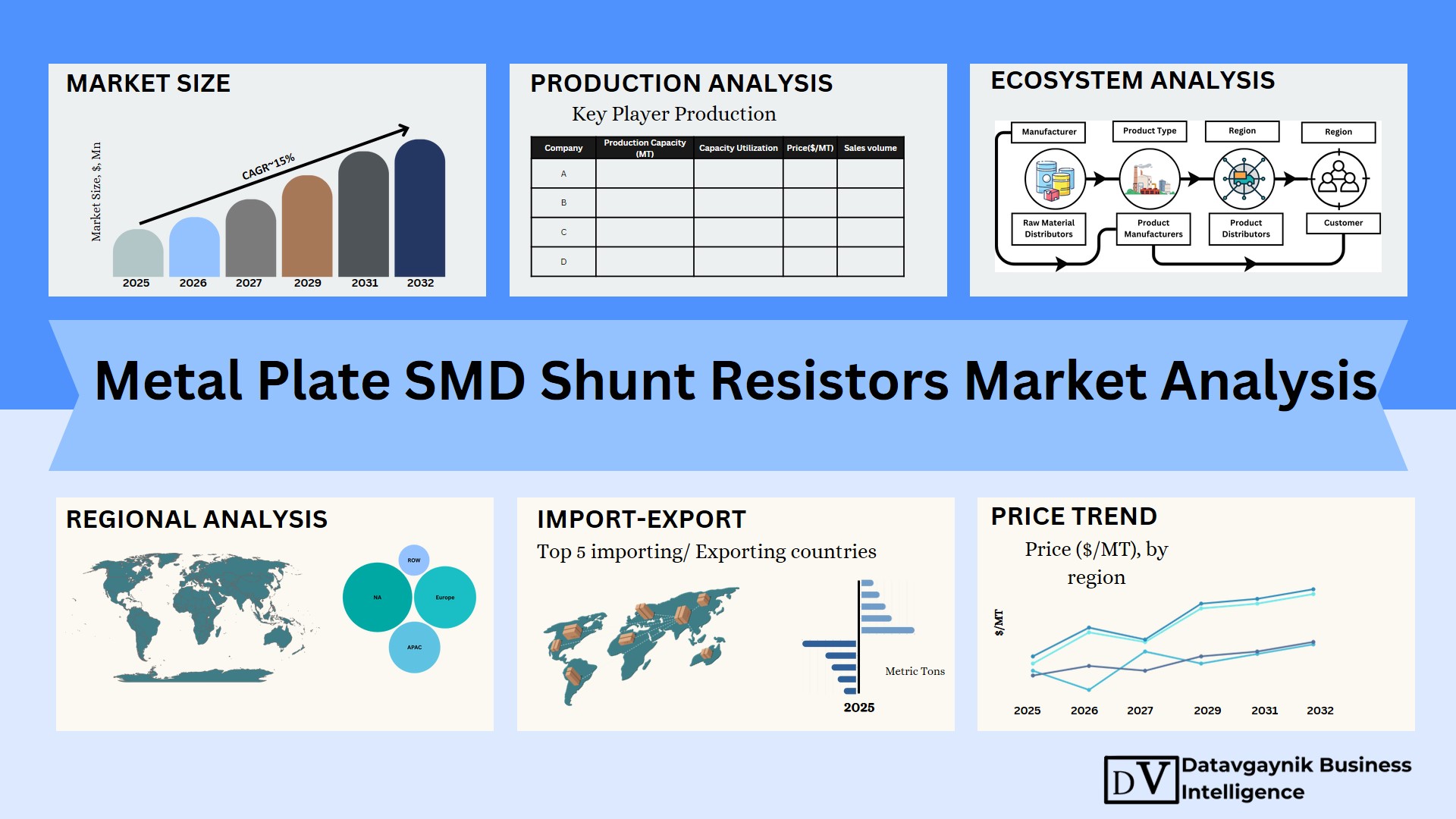
The Metal Plate SMD Shunt Resistors Market is estimated at USD 1.08 billion in 2026, with growth tracking a 7.9% CAGR toward USD 1.70 billion by 2032, as power measurement shifts from a secondary board function to a design-level requirement in EVs, battery packs, data-center power shelves, industrial drives, and compact consumer power modules. The demand base is moving toward low-resistance parts, usually in the 0.2 mΩ to 10 mΩ range, because every millivolt of measurement error affects battery balancing, inverter protection, charger efficiency, or power-module diagnostics.
Metal plate construction is gaining share because the current path is physically wider, thermally stable, and better suited for high-current sensing than standard thick-film resistors. In automotive battery management systems, DC-DC converters, onboard chargers, and inverter control boards, these resistors are selected where ±1% tolerance, low TCR, pulse stability, and heat dissipation determine qualification. A single EV platform can use current sensing across battery modules, traction inverter control, thermal management, charging circuits, and auxiliary power electronics, creating multiple placement points per vehicle.
The strongest Metal Plate SMD Shunt Resistors Demand is tied to electrification and power-density growth. In May 2025, the International Energy Agency projected global electric car sales to exceed 20 million units in 2025, representing more than one-quarter of global car sales, while first-quarter sales were already up 35% year-on-year. That scale changes resistor demand because each higher-voltage vehicle architecture requires tighter real-time current feedback for safety, charging, and energy management.
Semiconductor and electronics infrastructure adds a second demand layer. In December 2025, WSTS forecast the global semiconductor market to reach USD 975 billion in 2026, with Memory and Logic each expected to grow by more than 30% year-on-year. AI servers, storage systems, networking cards, and power delivery boards increase the number of current-monitoring points per rack because voltage rails are becoming more segmented and load transients are sharper. This supports Metal Plate SMD Shunt Resistors Growth beyond automotive and into server power distribution, telecom rectifiers, and high-current industrial control systems.
The Metal Plate SMD Shunt Resistors Market is also shaped by miniaturization. Buyers want higher power ratings in smaller case sizes such as 1206, 2512, 2725, and 3920, but heat rise and solder-joint reliability limit how far downsizing can go. This creates a price premium for products with better thermal EMF control, low inductance, and stable resistance after temperature cycling.
Metal Plate SMD Shunt Resistors Trends are therefore moving in three directions: lower resistance values for high-current applications, automotive-grade qualification for long operating life, and customized footprints for compact power boards. Suppliers with AEC-Q200 capability, high-volume stamping or alloy processing, and consistent resistance trimming gain advantage because buyers cannot easily switch parts after board validation. The market’s growth is not driven by resistor volume alone; it is driven by the rising cost of measurement failure in electrified and high-power electronics.
Production Capacity Is Concentrated Around Alloy Control, Stamping Precision, and Automotive Qualification
Metal plate shunt resistor production is not limited by basic resistor assembly capacity; it is controlled by alloy availability, precision metal processing, resistance calibration, plating quality, and high-volume inspection. The manufacturing route normally begins with copper-manganese, nickel-chromium, or similar low-resistance alloy strips, followed by stamping, welding, trimming, surface treatment, and electrical sorting. Small resistance deviations matter because a 15 µΩ to 5 mΩ part used in a battery pack or inverter can distort current measurement if the alloy profile, weld zone, or terminal geometry is inconsistent.
The production base is led by Japan, Taiwan, China, Europe, and the United States. Japan and Europe retain strength in automotive-grade and industrial precision parts, while Taiwan and China support larger electronics-volume supply through surface-mount component manufacturing clusters. The United States has a smaller but technically relevant base for high-reliability and defense-linked current sensing, especially where traceability and long qualification cycles increase switching cost.
A major production differentiator is the ability to manufacture low-resistance parts with stable temperature coefficient of resistance. In March 2025, Vishay introduced AEC-Q200 qualified Power Metal Strip shunt resistors with resistance values down to 15 µΩ, power ratings up to 50 W, and TCR down to ±10 ppm/°C. This shows how capacity is shifting toward metal-strip and metal-plate designs that combine low resistance, high power density, and automotive-grade qualification rather than standard commodity resistor output.
Supply behavior is also shaped by customer approval cycles. Automotive, energy storage, and industrial drive customers often qualify a resistor family for 3–7 years of platform use, which locks approved suppliers into recurring demand but makes new supplier entry slow. A resistor used in a traction inverter, onboard charger, or battery disconnect unit cannot be changed only on price; the buyer must revalidate thermal rise, solder profile, pulse load, resistance drift, and board-level measurement accuracy.
Production bottlenecks are visible in three areas:
| Production control point | Market impact |
| Alloy strip consistency | Controls low-ohm accuracy and thermal drift |
| Welding and terminal geometry | Affects current path, inductance, and heat spreading |
| Final electrical sorting | Raises cost for tight tolerance and AEC-Q200 grades |
China remains important for electronics-scale output, but higher-end Metal Plate SMD Shunt Resistors Demand is not purely China-centered. Japanese suppliers such as ROHM, KOA, and Panasonic Industry have strong positions in automotive and industrial current sensing. Vishay, Bourns, TT Electronics, Isabellenhütte, Susumu, and Yageo Group compete across high-current, low-ohmic, automotive, and industrial portfolios. This creates a mixed supply structure: fragmented in standard sizes, more concentrated in qualified high-power shunt designs.
Electronics localization policies are also redirecting future supply. In March 2026, India approved 29 electronics component manufacturing proposals worth about USD 751 million, while electronics manufacturing output had reached USD 125 billion in FY2025 and the country set a USD 500 billion target by 2031. Although this does not immediately make India a leading shunt resistor producer, it expands the local base for PCBs, automotive electronics, telecom hardware, and component ecosystems that can support future passive-component localization.
Metal Plate SMD Shunt Resistors Trends therefore point toward capacity being added where power electronics boards are assembled, not only where resistors are manufactured. EMS plants, EV component suppliers, battery-pack producers, and server power-module assemblers increasingly prefer regional supply assurance because a low-cost passive component can delay a high-value power board if qualification or delivery fails. For the Metal Plate SMD Shunt Resistors Market, supply advantage depends on repeatable alloy processing, automotive documentation, high-current testing infrastructure, and proximity to power-electronics customers.
Product Segmentation Is Moving Toward Low-Ohmic, High-Current and Automotive-Grade Designs
The Metal Plate SMD Shunt Resistors Market is segmented by resistance value, power rating, package size, application, and qualification grade. The leading segment is low-ohmic current sensing, especially parts below 5 mΩ, because EV traction systems, battery packs, server power shelves, and industrial drives need current feedback with low insertion loss. A lower resistance value reduces heat generation, but it also increases measurement difficulty, which raises the value of alloy stability and calibration accuracy.
Key product segments include:
- Ultra-low resistance shunts: typically 15 µΩ to 1 mΩ, used in battery packs, inverter modules, and high-current power converters
- Low-ohmic SMD shunts: generally 1 mΩ to 10 mΩ, used in power supplies, chargers, motor drives, and industrial control boards
- Automotive-grade metal plate shunts: AEC-Q200 qualified parts used in EVs, ADAS power modules, onboard chargers, and battery management systems
- High-power SMD shunts: parts rated above 3 W, selected where thermal rise, pulse load, and current density are design constraints
- Precision current-sense resistors: tight tolerance products used in instrumentation, telecom power, energy meters, and medical electronics
Automotive and energy storage represent the strongest application cluster for Metal Plate SMD Shunt Resistors Demand. Electric vehicles require current measurement at the cell-module level, pack level, charger interface, inverter control board, and auxiliary DC-DC conversion stage. In 2025, electric car sales topped 20 million units globally, and one in four new cars sold worldwide was electric, according to the IEA’s 2026 EV assessment. This directly supports shunt resistor consumption because higher-voltage EV platforms increase the number of current-sensing points per vehicle.
Industrial automation is another high-value segment. Servo drives, robotics controllers, welding equipment, factory power supplies, and motor protection circuits use metal plate shunts where resistance drift can affect torque control, overload detection, or equipment shutdown thresholds. These applications normally accept higher component prices because a failed current-sense element can stop a full production line, not just a single circuit board.
Data-center and telecom power applications are gaining weight in the Metal Plate SMD Shunt Resistors Market because AI servers and network power shelves require tighter rail-level monitoring. WSTS forecast the global semiconductor market to reach USD 975 billion in 2026, with Memory and Logic each projected to grow by more than 30% year-on-year, indicating heavier AI, storage, and compute hardware build-out. Each server power architecture adds more monitoring points across voltage regulators, power distribution boards, and backup power systems.
By package size, 2512 and larger formats dominate high-current applications because the wider conductive path helps spread heat and lowers current density. Smaller formats such as 1206 and 2010 are used where board area is constrained, but thermal headroom is lower. The performance trade-off is direct: compact designs save PCB space, while larger metal plate packages improve heat dissipation and pulse endurance.
By qualification grade, automotive-grade parts command a higher share of revenue than their volume share suggests. AEC-Q200 testing, thermal cycling, pulse load validation, humidity exposure, and solder-joint reliability raise production cost but reduce failure risk in vehicles and industrial systems operating for 8–15 years. This is why Metal Plate SMD Shunt Resistors Trends favor suppliers that can support both electrical precision and long-term reliability documentation.
Consumer electronics remains a large-volume but lower-margin segment. Chargers, laptops, power banks, gaming devices, and compact adapters use current-sense resistors, but many designs rely on cost-optimized components unless fast charging or battery protection requires tighter tolerance. The strongest Metal Plate SMD Shunt Resistors Growth is therefore concentrated in applications where current measurement failure carries safety, warranty, uptime, or energy-efficiency cost.
Raw Material and Qualification Cost Decide the Price Gap Between Commodity and Precision Shunts
Pricing in the Metal Plate SMD Shunt Resistors Market is controlled less by resistor size and more by alloy stability, resistance value, power rating, tolerance, thermal drift, and qualification grade. Standard SMD current-sense resistors can sell at low unit prices in high-volume consumer electronics, but ultra-low-ohmic metal plate parts carry a premium because resistance calibration becomes harder as values move below 1 mΩ.
Raw material cost starts with copper-manganese, nickel-chromium, or similar resistance alloys. The metal strip must maintain stable resistivity under heat, soldering, and long-duration current load. A 0.5 mΩ part used in an inverter or battery pack has less measurement margin than a 10 mΩ part in a lower-current circuit, so alloy consistency and trimming accuracy directly affect cost.
Processing cost rises with power rating. ROHM’s PSR metal plate shunt resistor series, for example, covers package sizes from 2512 to 5931, rated power from 3 W to 15 W, and resistance values from 0.1 mΩ to 3 mΩ. These specifications show why larger current-sense parts are priced differently from standard chip resistors: they require a wider current path, lower parasitic inductance, stronger terminal bonding, and better heat-spreading geometry.
Qualification cost creates the largest difference between industrial and automotive pricing. AEC-Q200 testing involves temperature cycling, humidity exposure, board flex, solderability, surge load, and resistance stability checks. In March 2025, Vishay introduced AEC-Q200 qualified Power Metal Strip shunt resistors with resistance values down to 15 µΩ, power ratings up to 50 W, and TCR down to ±10 ppm/°C for automotive, energy, industrial, and space applications. Such specifications carry higher pricing because the product cost includes testing burden, documentation, and long-term reliability validation, not only material input.
The main price bands can be read through application severity:
| Price factor | Low-cost board use | High-reliability power use |
| Resistance range | 5–50 mΩ | 15 µΩ–5 mΩ |
| Power rating | 0.25–2 W | 3–50 W |
| Tolerance need | ±1% to ±5% | ±0.5% to ±1% |
| Qualification | Commercial grade | AEC-Q200 / industrial long-life |
| Procurement logic | Unit price | Failure cost and validation risk |
Regional price differences are tied to buyer mix. China and Taiwan support high-volume electronics pricing, especially for chargers, adapters, consumer devices, and general industrial boards. Japan, Europe, and the United States hold stronger pricing in automotive, aerospace, energy storage, and precision industrial use because customers pay for traceability, stable supply, and qualified part families. The same nominal resistance value can therefore command different pricing depending on whether it is sold into consumer electronics or an EV battery disconnect circuit.
Order volume also changes pricing. Large EMS buyers can negotiate lower unit prices when annual demand reaches millions of pieces, but automotive and industrial customers often accept higher unit prices for locked specifications, PPAP documentation, and multi-year supply assurance. This supports Metal Plate SMD Shunt Resistors Growth because the revenue pool expands faster in qualified applications than in commodity volumes.
Metal Plate SMD Shunt Resistors Trends point toward a widening price spread. As WSTS forecasts the semiconductor market to approach USD 975 billion in 2026, with Memory and Logic each rising by more than 30%, power boards in servers, storage, and networking systems require more rail-level current monitoring. Higher inspection, qualification, and thermal-performance expectations shift procurement from lowest-cost sourcing toward verified performance per watt.
The pricing structure is therefore defined by risk allocation. A resistor that costs only cents can protect a battery pack, power supply, or industrial drive worth hundreds or thousands of dollars. In the Metal Plate SMD Shunt Resistors Market, buyers pay more where resistance drift, heat rise, solder-joint fatigue, or failed current measurement can create warranty exposure, downtime, or safety risk.
Market Share Is Concentrated Where Low-Ohmic Design, Automotive Approval, and Power Ratings Overlap
The Metal Plate SMD Shunt Resistors Market is moderately concentrated in high-reliability applications and more fragmented in standard commercial current-sense parts. Vishay, ROHM, KOA, Panasonic Industry, Susumu, Bourns, TT Electronics, Yageo Group, and Isabellenhütte form the leading supplier base for metal strip, metal plate, and precision low-ohmic shunt designs. In qualified automotive and industrial power applications, the top supplier group likely controls 45–60% of revenue because customers prefer approved families with documented thermal, pulse, and resistance-drift performance.
Vishay holds one of the strongest positions in high-power metal strip shunts. Its Power Metal Strip portfolio covers current sensing applications across automotive and industrial electronics, with case-size breadth and resistance values extending from extremely low micro-ohm ranges to higher low-ohmic values. In March 2025, Vishay launched AEC-Q200 qualified WSBE shunt resistors with values down to 15 µΩ, power ratings up to 50 W, and TCR down to ±10 ppm/°C. That specification gives the company a clear advantage where EV charging, battery systems, industrial power conversion, and space-grade reliability require both high current capacity and low thermal drift.
ROHM competes through automotive and industrial current detection portfolios, especially its PSR metal plate shunt resistor series. The company’s PSR range includes ultra-low-ohmic parts for high-current sensing, with package formats supporting compact board layouts and high power density. ROHM’s position is strongest where semiconductor, power device, and resistor portfolios are sold into overlapping automotive and industrial accounts, reducing qualification friction for buyers using multiple ROHM components on the same platform.
KOA and Panasonic Industry hold competitive strength in Japanese and global automotive electronics supply chains. Their advantage is not only product availability; it is long-standing approval in vehicle electronics, stable quality documentation, and high-volume delivery discipline. In automotive applications with 8–15 year platform lives, a qualified current-sense resistor supplier is difficult to replace after design validation, especially when thermal cycling, solder reliability, and resistance stability are already tested at board level.
Susumu and Isabellenhütte serve the precision and high-performance side of the market. Susumu’s strength is linked to precision resistor technology and miniaturized current sensing for compact electronics, instrumentation, and advanced power boards. Isabellenhütte has a stronger profile in precision alloy and high-current measurement, especially where low resistance, low inductance, and current-measurement accuracy matter more than lowest unit price.
Competitive positioning can be summarized by capability rather than only shipment volume:
| Supplier group | Competitive advantage | Stronger demand area |
| Vishay / ROHM | High-power metal plate and metal strip portfolios | EVs, energy storage, industrial drives |
| KOA / Panasonic Industry | Automotive approval and volume reliability | Vehicle electronics, power modules |
| Susumu / Isabellenhütte | Precision and alloy-control capability | Instrumentation, high-current measurement |
| Yageo / Bourns / TT Electronics | Broad resistor portfolio and distribution reach | Industrial, telecom, EMS customers |
The Metal Plate SMD Shunt Resistors Demand base gives large suppliers pricing power where customers need AEC-Q200 qualification, PPAP support, stable long-term supply, and multi-site availability. Smaller manufacturers can compete in standard commercial SMD shunts, but entry barriers rise sharply in EV, energy storage, aerospace, and industrial power systems because product approval can require 12–24 months of electrical, thermal, pulse, and board-level validation.
Metal Plate SMD Shunt Resistors Trends also favor suppliers with application engineering support. Buyers increasingly ask for resistance stability after reflow, thermal EMF behavior, Kelvin terminal design, PCB layout guidance, and pulse-load data. A component that appears interchangeable by resistance value may fail qualification if terminal geometry changes heat flow or creates measurement error.
The competitive structure is therefore split between volume availability and qualification control. The Metal Plate SMD Shunt Resistors Market remains open for regional suppliers in consumer electronics and general industrial boards, but the premium revenue pool is controlled by companies with alloy know-how, automotive documentation, high-current test infrastructure, and customer approvals across EV, server, telecom, and industrial power platforms.


