

Market Summary and Growth Forecast
The global Anti-Corrosion Wax Coatings Market is valued at $1,420 million in 2026 and is expected to appreciate to $2,280 million by 2035, at a CAGR of 5.4%.
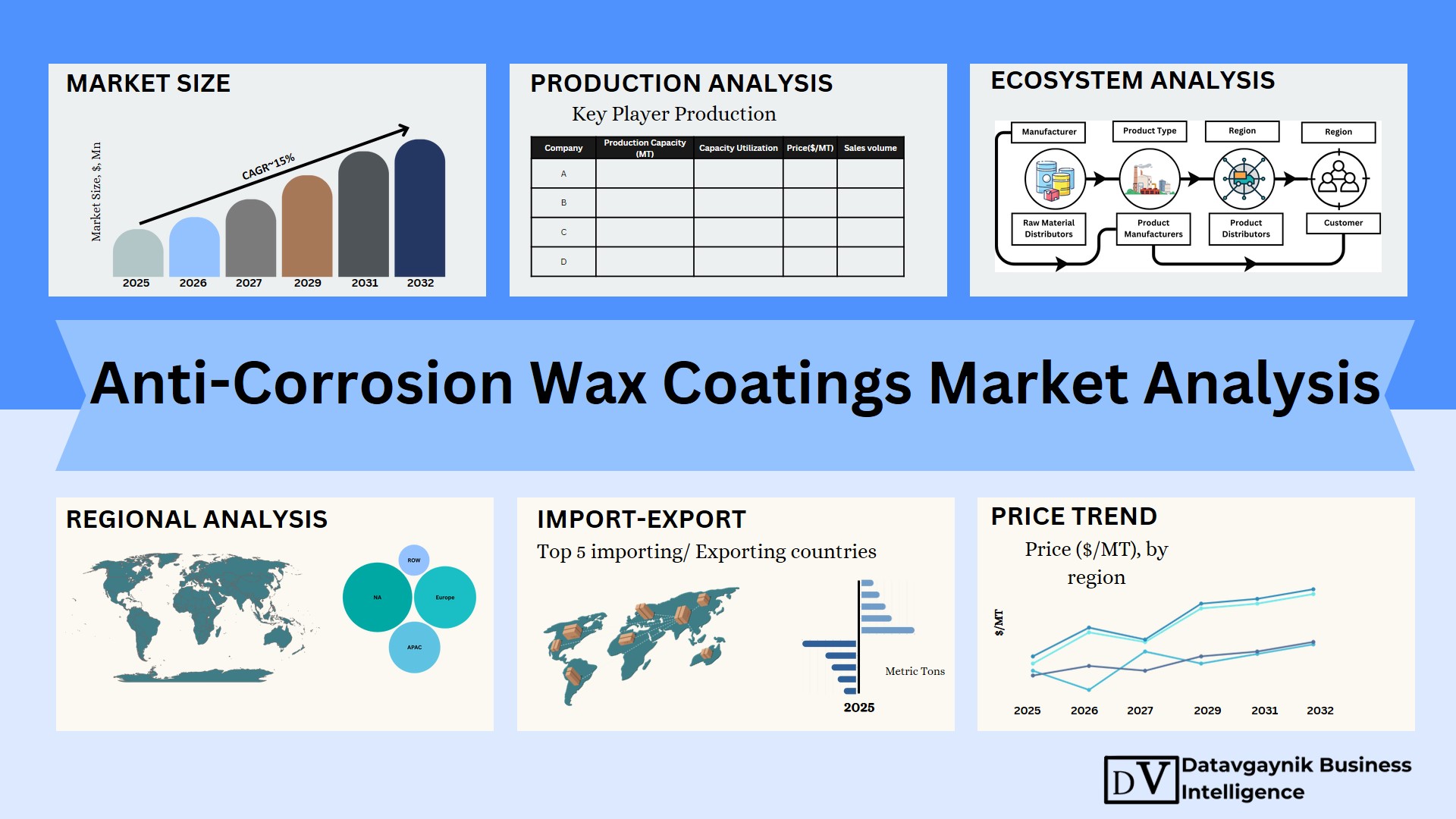
Anti-corrosion wax coatings are soft or semi-dry protective materials applied to metal surfaces. They form a water-repellent barrier that limits contact with moisture, oxygen, salt, dirt, and corrosive chemicals. Unlike rigid paint systems, wax coatings retain a degree of flexibility. They can also move into seams, joints, weld lines, cavities, and other areas that conventional coatings struggle to cover.
Datavagyanik also covers related markets such as the Pipeline Anti-Corrosion Coatings Market, the Anti-Corrosion Additives for Marine Coatings Market, and the Anti-friction coatings Market. These related markets contribute valuable context to the primary topic by highlighting complementary trends and technologies.
The market includes solvent-borne, water-borne, high-solids, and solvent-free wax formulations. These products are used for cavity protection, chassis preservation, underbody treatment, component storage, export packaging, machinery protection, and marine maintenance. The scope excludes conventional epoxy, polyurethane, acrylic, and zinc-rich coatings where wax is not a principal protective component. It also excludes standalone volatile corrosion inhibitor packaging.
The business relevance of the Anti-Corrosion Wax Coatings Market is increasing because manufacturers are keeping equipment and vehicles in service for longer periods. Replacement costs are rising. So, asset owners are placing more value on preventive corrosion control rather than waiting for structural or mechanical damage.
Global Market Forecast
| Indicator | 2026 | 2030 | 2035 |
| Global revenue | $1,420 million | $1,752 million | $2,280 million |
| Estimated product demand | 315 kilotonnes | 368 kilotonnes | 444 kilotonnes |
| Blended market value per kilogram | $4.51 | $4.76 | $5.14 |
| Revenue growth rate | — | 5.4% CAGR | 5.4% CAGR |
| Volume growth rate | — | 3.9% CAGR | 3.9% CAGR |
Estimate basis: The forecast combines vehicle production, aftermarket treatment, industrial equipment output, marine maintenance, rail investment, export preservation demand, and expected changes in the product mix.
Revenue is expected to grow faster than physical volume. This reflects a gradual move toward higher-value formulations. These include low-odour products, water-borne systems, renewable-content waxes, barium-free corrosion inhibitors, and coatings designed for mixed-metal structures.
Automotive Production and Vehicle Longevity
Automotive manufacturing remains the largest commercial demand base. Cavity waxes are applied inside doors, pillars, rocker panels, bonnet sections, chassis members, and welded joints. Underbody products are also used on frames, wheel arches, floor pans, and exposed suspension areas.
Vehicle longevity is equally important. Cars and commercial vehicles are being retained for longer periods in several mature markets. This supports demand from workshops, rust-proofing centres, fleet maintenance providers, and specialist aftermarket installers.
Electric vehicles will not remove the need for corrosion protection. Their metal structures still face road salt, moisture, stone impact, condensation, and galvanic corrosion. Battery enclosures, mounting structures, floor assemblies, brackets, seams, and mixed aluminium-steel interfaces require careful protection.
Use case: An electric delivery van operating in a coastal city may receive additional cavity and underbody wax treatment because salt, humidity, and frequent road exposure can affect seams, fasteners, and battery-support structures.
Industrial Asset Preservation
Industrial users apply wax coatings to machinery, fabricated components, tools, agricultural equipment, mining equipment, spare parts, and metal assemblies. Protection may be temporary or long term.
Temporary protection is important when components are stored or transported before installation. Exported machinery can remain inside containers for several weeks. Temperature changes may create condensation. A removable or self-healing wax film can reduce the risk of rust without requiring a permanent decorative coating.
Long-term industrial coatings are used where surfaces require flexibility and water displacement. Demand is particularly visible in agricultural machinery, construction equipment, pumps, valves, fasteners, replacement parts, and exposed mechanical assemblies.
Marine, Rail, and Harsh-Environment Demand
Marine and coastal environments create persistent corrosion pressure. Salt spray, humidity, standing water, and difficult maintenance access can shorten equipment life. Wax coatings are used on internal cavities, ballast-related components, cables, fittings, machinery housings, and protected deck equipment.
Rail operators use these coatings on underframes, internal body cavities, bogie-related parts, electrical enclosures, and maintenance components. The same logic applies to defence vehicles, airport equipment, trailers, buses, and commercial fleets.
The strongest demand comes from applications where three conditions overlap:
- Water or salt exposure is frequent.
- The protected area is difficult to inspect or repaint.
- The metal structure is expected to remain operational for many years.
Regulatory and Formulation Changes
Regulation is changing how these coatings are formulated and applied. The pressure is not directed at wax itself. It is mainly linked to volatile organic compounds, hazardous solvents, worker exposure, flammability, odour, and restricted corrosion-inhibiting chemicals.
This is encouraging investment in:
- Water-borne wax dispersions
- High-solids formulations
- Solvent-free and hot-applied coatings
- Barium-free inhibitor packages
- Lower-odour carrier systems
- Renewable or mass-balanced wax feedstocks
That said, solvent-borne systems will remain important. They provide strong penetration, rapid water displacement, and reliable application across varying temperatures. Users are unlikely to replace them until alternative products deliver comparable seam penetration, drying behaviour, adhesion, and field durability.
Raw Materials and Production Economics
Production depends on paraffin wax, microcrystalline wax, synthetic wax, corrosion inhibitors, resins, solvents, emulsifiers, rheology modifiers, and performance additives. Supply economics are linked to refinery output, petrochemical feedstocks, synthetic wax capacity, energy costs, and regional chemical logistics.
Traditional petroleum-derived waxes remain cost-effective. However, formulators are increasing their use of synthetic and bio-derived materials where performance and economics permit. Fischer–Tropsch waxes can offer controlled molecular structure and consistent melting behaviour. Vegetable-derived waxes can improve renewable-content claims, although they may require modification to meet low-temperature flexibility and long-term stability requirements.
Our Anti-Corrosion Wax Coatings Market model assumes that raw-material volatility will support moderate price increases rather than a continuous rise in producer margins. Large buyers will continue to negotiate annual price adjustments. Smaller aftermarket customers will absorb price increases more quickly.
Key Consumers and Commercial Clients
The main purchasing and specification groups include:
- Passenger vehicle and commercial vehicle manufacturers
- Automotive Tier 1 component suppliers
- Truck, bus, trailer, and rail manufacturers
- Vehicle rust-proofing and repair centres
- Industrial machinery and equipment producers
- Agricultural and construction equipment manufacturers
- Shipyards and marine maintenance companies
- Fleet operators and leasing companies
- Steel fabricators and component exporters
- Defence and government maintenance organisations
- Chemical distributors and industrial maintenance suppliers
The procurement process differs by customer type. Automotive manufacturers require extensive validation and process consistency. Industrial customers focus more on durability, application simplicity, and cost per protected component. Aftermarket buyers place greater weight on brand recognition, installer familiarity, drying time, odour, and visible coverage.
Expert view: The next phase of growth will depend less on selling more tonnes of conventional wax and more on proving lower lifecycle cost. Suppliers that quantify rework reduction, asset-life extension, and maintenance savings will gain stronger pricing power.
Market Segmentation and Forecast Scope
The Anti-Corrosion Wax Coatings Market is best segmented by carrier technology, functional application, end-user industry, and region. These dimensions capture both formulation differences and purchasing behaviour.
The forecast period covers 2026–2035, with 2026 used as the market-sizing year. Historical demand patterns from 2021–2025 inform the production, replacement, and pricing outlook.
Forecast Scope
| Parameter | Coverage |
| Base year | 2026 |
| Forecast period | 2026–2035 |
| Historical review | 2021–2025 |
| Revenue unit | USD million |
| Volume unit | Kilotonnes |
| Product basis | Finished anti-corrosion wax coating |
| Pricing basis | Manufacturer-level blended selling value |
| Geographic coverage | North America, Europe, Asia Pacific, and LAMEA |
By Product Type
Solvent-Borne Wax Coatings
Solvent-borne products represent approximately 54% of global revenue in 2026. Their position is supported by strong penetration into seams and cavities. They also displace moisture effectively and perform across a wide application-temperature range.
These products are common in automotive cavity protection, industrial preservation, marine maintenance, and field-applied rust-proofing. Their main limitations are odour, flammability, solvent emissions, and worker-handling requirements.
Demand will continue to rise in absolute terms, but the segment will expand more slowly than water-borne and solvent-free alternatives.
Water-Borne Wax Coatings
Water-borne products are projected to be the fastest-growing product category, with an estimated 7.2% CAGR from 2026 to 2035.
Growth will come from enclosed manufacturing facilities, automotive plants, component factories, and regions with tighter solvent-emission controls. These coatings can reduce odour and improve workplace conditions.
Their adoption still depends on drying speed, corrosion resistance, freezing stability, and the ability to penetrate narrow cavities. Suppliers that solve these issues without increasing cycle time will gain access to larger OEM programmes.
Solvent-Free and Hot-Applied Wax Coatings
This category includes high-solids, hot-melt, and near-solvent-free products. These coatings create thicker barriers with limited emissions. They are suited to industrial equipment, exposed metal surfaces, storage protection, marine components, and heavy-duty maintenance.
The segment is strategically important rather than universally applicable. Heated equipment and controlled processing may be required. This can limit use in small workshops but improve economics in high-volume plants.
By Functional Application
Cavity and Enclosed-Section Protection
Cavity coatings are designed to move into seams, joints, welds, pillars, frames, doors, channels, and enclosed metal structures. Penetration and creep are more important than surface hardness.
Automotive production remains the central application. Rail vehicles, buses, trailers, defence vehicles, and fabricated structures also create demand.
This application will remain one of the most defensible segments because conventional surface coatings cannot easily reach enclosed areas after assembly.
Underbody and Chassis Protection
These coatings protect vehicle floors, frames, wheel arches, chassis members, suspension-adjacent surfaces, and lower body structures. Products may combine waxes with resins, fillers, and impact-resistant additives.
The market is moving toward thinner films with better stone-chip tolerance. Manufacturers want equivalent protection with lower coating weight and shorter application cycles.
Component, Storage, and Transit Preservation
Metal components often require protection between production and final installation. Wax coatings are applied to replacement parts, machined surfaces, steel coils, tools, engines, gear assemblies, fasteners, and export equipment.
Products used for temporary protection must balance corrosion resistance with removability. Some buyers prefer films that can be cleaned with mild solvents. Others need coatings that remain in place when the component enters service.
Exposed Machinery and Equipment Protection
This segment covers agricultural machines, construction equipment, industrial systems, mining machinery, pumps, valves, and outdoor mechanical components.
Growth is linked to the rising cost of capital equipment. Extending equipment life by even one operating season can create a measurable economic benefit.
Marine and Severe-Environment Protection
These products are designed for high humidity, salt exposure, condensation, and intermittent water contact. They are used on internal cavities, cables, mechanical parts, fittings, equipment housings, and maintenance-sensitive areas.
Marine coatings require strong film retention and resistance to wash-off. They may also need compatibility with lubricants, elastomers, electrical systems, and existing coating layers.
By End User
Automotive OEM and Aftermarket
Automotive manufacturers, component suppliers, workshops, and rust-proofing centres collectively account for approximately 46% of market revenue in 2026.
OEM demand is specification-driven. Products must meet corrosion-cycle, adhesion, ageing, odour, flammability, and application-process requirements. Once qualified, supplier relationships can remain stable for several vehicle platforms.
Aftermarket demand is more fragmented. It includes private vehicles, commercial fleets, classic cars, off-road vehicles, and vehicles operating in coastal or snow-prone regions.
Industrial Manufacturing
Industrial users purchase wax coatings for component preservation, machinery protection, fabrication, storage, and export transport. This customer group is broad and less concentrated than the automotive industry.
The fastest adoption is expected among manufacturers selling equipment into humid, coastal, mining, agricultural, and infrastructure environments.
Marine and Shipbuilding
Shipyards, repair yards, offshore operators, port equipment companies, and marine service providers use wax coatings in selected maintenance and preservation applications.
The segment offers attractive value per kilogram because performance failure can create high inspection and repair costs.
Rail and Commercial Transportation
Railway manufacturers, maintenance depots, trailer manufacturers, bus producers, and logistics fleets use wax coatings on underframes, cavities, joints, components, and exposed assemblies.
Growth will be supported by fleet refurbishment and longer maintenance intervals.
Construction, Infrastructure, and Other Users
This category includes steel structures, utility equipment, defence assets, airport equipment, municipal fleets, spare-parts distributors, and specialised fabrication companies.
Demand is project-based. Product selection often depends on application access, environmental conditions, inspection frequency, and expected service life.
By Region
North America
North America has a developed automotive aftermarket and a large installed base of trucks, trailers, agricultural equipment, construction machinery, and industrial assets.
Demand is strongest in cold-weather areas using road de-icing salts, coastal zones, fleet maintenance, and equipment-storage applications. Solvent-borne products remain widely used, although low-odour and high-solids systems are gaining attention.
The region is forecast to expand at approximately 4.7% CAGR between 2026 and 2035.
Europe
Europe is an important market for premium cavity waxes, vehicle rust-proofing, rail applications, marine maintenance, and low-emission coating technologies.
Regulatory pressure and OEM sustainability targets will accelerate water-borne and lower-solvent products. Northern Europe will remain a major aftermarket market because of moisture, snow, and road-salt exposure.
Europe is forecast to grow at approximately 5.1% CAGR from 2026 to 2035.
Asia Pacific
Asia Pacific will deliver the largest absolute revenue addition. Vehicle production, industrial machinery output, shipbuilding, rail manufacturing, and export component preservation all contribute to demand.
China is the largest production and consumption centre. Japan and South Korea have strong positions in automotive and marine applications. India and Southeast Asia offer faster growth from vehicle localisation, industrial investment, and humid operating conditions.
Asia Pacific is projected to record approximately 6.2% CAGR during 2026–2035.
LAMEA
LAMEA includes Latin America, the Middle East, and Africa. Demand is driven by mining equipment, commercial fleets, offshore activity, port machinery, agricultural equipment, and industrial maintenance.
Hot, humid, coastal, and chemically exposed environments create strong technical need. Adoption is constrained by fragmented distribution and preference for lower-cost products.
The region is projected to expand at approximately 5.6% CAGR through 2035.
Regional expansion in the Anti-Corrosion Wax Coatings Market will depend on local application capability as much as product availability. A high-performance coating can fail when surface preparation, nozzle access, film thickness, or drying conditions are poorly controlled.
Expert view: Asia Pacific will lead volume expansion, while Europe will influence formulation standards. North America will remain especially valuable for aftermarket brands and fleet-maintenance suppliers.
Market Trends and Business Innovations
Innovation in wax-based corrosion protection is becoming more practical. Suppliers are not trying to turn wax coatings into decorative paints. They are improving the properties that matter in the field: penetration, water displacement, film recovery, salt resistance, odour, drying time, and application control.
Low-VOC and Water-Borne Development
The most visible R&D direction is the reduction of conventional solvents. Formulators are using improved emulsifiers, corrosion inhibitors, polymer dispersions, and rheology systems to increase the performance of water-borne wax coatings.
Earlier water-borne products often faced slow drying and inconsistent cavity penetration. Newer formulations are being designed to form continuous films at lower temperatures and across varying humidity conditions.
The commercial challenge is production speed. Automotive and component plants cannot accept a coating that extends the manufacturing cycle. Suppliers must therefore deliver lower emissions without adding drying ovens, floor space, or inspection steps.
High-Solids and Solvent-Free Systems
High-solids coatings reduce solvent use while retaining the familiar application behaviour of traditional waxes. Solvent-free systems can create durable films with low shrinkage and limited emissions.
R&D is focused on:
- Lower application temperature
- Better spray atomisation
- Reduced nozzle blockage
- Faster film stabilisation
- Improved cold-temperature flexibility
- Lower material use per protected area
Hot-applied waxes are also being refined for automated production lines. Their economics improve when plants can recover overspray, control temperature, and maintain consistent coating weight.
Material Science and Hybrid Formulations
Material development is moving beyond simple blends of wax and solvent. Suppliers are combining microcrystalline waxes, synthetic waxes, resins, oils, corrosion inhibitors, and adhesion promoters to obtain more controlled performance.
Microcrystalline wax contributes flexibility and film strength. Synthetic wax can improve melting behaviour and consistency. Resin modification can increase adhesion and resistance to wash-off. Corrosion inhibitors protect areas where the wax film becomes thin or damaged.
Hybrid wax-resin formulations are particularly relevant for underbody and severe-environment applications. They offer a softer and more repairable surface than hard coatings, while providing greater mechanical stability than basic cavity wax.
Expert view: The winning formulation will not be the hardest coating. It will be the product that remains mobile enough to seal microcracks but stable enough to resist runoff, dust pickup, and wash-off.
Self-Healing and Creep-Controlled Protection
Wax coatings can partially restore their barrier when scratched or displaced because the film remains soft. Suppliers are improving this behaviour through controlled rheology and temperature response.
The objective is not autonomous repair in the advanced-material sense. It is practical film movement. The coating should creep into seams during application, remain in place during service, and slowly cover minor disruptions.
Too much movement creates dripping and contamination. Too little movement reduces cavity coverage. R&D teams are therefore adjusting viscosity, thixotropy, softening point, and film strength for each application.
Bio-Based and Renewable-Content Materials
Customers are requesting greater renewable content and lower lifecycle emissions. This is supporting research into vegetable waxes, bio-derived oils, renewable solvents, and mass-balanced chemical inputs.
Bio-based content alone does not guarantee better environmental performance. Feedstock sourcing, formulation durability, transport, and coating life also matter. A product that requires frequent reapplication may create a larger overall footprint than a durable petroleum-based coating.
Near-term commercial products are likely to use partial renewable content rather than fully bio-based chemistry. This gives formulators more control over low-temperature performance, storage stability, and corrosion resistance.
Barium-Free and Safer Inhibitor Packages
Hazardous substance restrictions and internal corporate standards are pushing suppliers away from certain legacy inhibitor systems. Barium-free formulations are becoming more important in automotive, industrial, and workshop applications.
Alternative inhibitor packages must remain stable inside the wax matrix. They also need to protect steel, galvanised metal, aluminium, and mixed-metal structures.
This creates a formulation challenge. An inhibitor that works well on bare steel may not provide the same performance on aluminium or zinc-coated surfaces. Multi-metal compatibility is therefore becoming an important qualification criterion.
Electric Vehicle and Mixed-Material Protection
Electric vehicles use combinations of high-strength steel, aluminium, coated metals, adhesives, sealants, and composite parts. These structures can create galvanic corrosion risks where dissimilar metals are exposed to moisture.
Wax coatings are being adapted for:
- Battery-enclosure seams
- Underfloor structures
- Chassis cavities
- Fasteners and brackets
- Aluminium-steel interfaces
- Sensor-adjacent areas
- High-voltage cable-routing zones
Material compatibility is critical. The coating must not damage plastics, elastomers, adhesives, wiring, or electrical connectors. It must also avoid interfering with service access and thermal-management systems.
Use case: A vehicle manufacturer may specify different wax viscosities for narrow body cavities and wider underfloor joints, even when both coatings use a related chemistry platform.
Precision Application and Coverage Verification
Application technology is becoming a competitive differentiator. Robotic cavity injection, programmable spray patterns, heated hoses, controlled nozzle positioning, and closed-loop material delivery can reduce coating variation.
Manufacturers are also using fluorescent tracers, camera inspection, weight monitoring, and digital process records to verify coverage. These tools are more relevant than complex automation claims because they address a real production problem: wax is often applied inside areas that operators cannot see.
Better verification can lower material consumption. Plants can move away from excessive application used as a safety margin. This reduces dripping, cleaning, rework, and vehicle weight.
Application-Specific Product Platforms
Suppliers are shifting from broad multipurpose products toward platform-based portfolios. A common chemistry can be adjusted for:
- Deep cavity penetration
- Vertical surface retention
- Underbody impact resistance
- Marine wash-off resistance
- Temporary component storage
- Easy removal before assembly
- Low-temperature application
This approach simplifies manufacturing while giving customers products tuned to a specific process. It also supports faster qualification because related formulations can share performance data.
Consolidation and Partnership Activity
Pure-play acquisitions focused only on anti-corrosion wax coatings remain limited. Most consolidation is occurring across the wider protective-coatings, sealing, maintenance, and surface-treatment industries.
Henkel’s acquisition of Seal for Life Industries in 2024 illustrates the strategic interest in corrosion prevention, sealing, and infrastructure maintenance. The acquired operations were broader than wax coatings, but the transaction strengthened Henkel’s access to specialised protection technologies and industrial customers.
Similarly, Sika’s 2023 acquisition and integration of MBCC expanded its position across construction chemicals, repair systems, sealants, and protective materials. The deal was not centred on wax coatings. Still, it shows why large materials groups value specification access, technical service, and application networks.
Within the wax-coating niche, partnerships are more common than large acquisitions. Formulators work with automotive OEMs, component suppliers, spray-equipment manufacturers, and regional distributors to qualify products and improve application consistency.
News announcements are increasingly centred on low-odour, lower-VOC, renewable-content, and multi-metal-compatible formulations. Companies often introduce these products as upgrades to established coating platforms rather than entirely new technology categories.
Service-Based Commercial Models
Product performance increasingly depends on how the coating is applied. This gives suppliers an opportunity to sell technical service alongside the material.
The service package may include:
- Process design
- Nozzle and spray-pattern selection
- Film-thickness targets
- Coverage inspection
- Corrosion-cycle testing
- Operator training
- Overspray reduction
- Line troubleshooting
This model can improve customer retention. Once a coating is integrated into equipment settings, quality systems, and operating procedures, replacement becomes more difficult.
The Anti-Corrosion Wax Coatings Market will gradually shift from basic commodity protection toward application-specific systems. Chemistry will remain important. That said, process control, qualification support, and measurable asset-life improvement will decide which suppliers capture the highest-value programmes.
Expert view: By 2035, suppliers will compete on protected asset economics rather than price per litre. The strongest companies will document how their coating reduces warranty exposure, corrosion repairs, production rework, and unplanned maintenance.
Competitive Intelligence and Benchmarking
Competition in the Anti-Corrosion Wax Coatings Market is fragmented. No single supplier controls every application. Automotive OEM products require long qualification cycles. Collision-repair products depend on distribution and installer trust. Industrial preservation coatings compete on performance, removability, coverage, and total treatment cost.
Large chemical groups benefit from global customer access. Specialist companies compete through deeper corrosion expertise and broader wax-based portfolios. Regional brands remain relevant because application conditions, preferred packaging, and workshop practices vary by country.
Competitive Positioning Matrix
| Company | Primary Market Position | Portfolio Emphasis | Main Commercial Strength | Strategic Limitation |
| Henkel | Global diversified leader | Automotive cavities, seams, surfaces, machinery, and repair | OEM access and system-level selling | Wax coatings form a small part of a much larger portfolio |
| Sika | Global automotive materials supplier | Cavity protection, underbody treatment, sealants, and repair coatings | Strong body-shop and transportation channels | More concentrated in automotive than industrial preservation |
| DINOL | Focused corrosion-protection specialist | Cavity waxes, underbody coatings, surface protection, and EV battery systems | Broad specialised portfolio and application knowledge | Smaller corporate scale than diversified chemical groups |
| Daubert Chemical | North American corrosion specialist | Structural cavity waxes, industrial films, military preservation, and transport coatings | OEM customisation and wax formulation depth | Lower consumer-market visibility outside selected regions |
| 3M | Automotive aftermarket and repair leader | Cavity repair coatings, applicators, process guides, and structural repair materials | Strong workshop brand and application tools | Narrower bulk industrial wax offering |
| FUCHS | Industrial corrosion-preventive supplier | Storage, transit, machining, mould, equipment, and component protection | Strong industrial lubricant and metalworking relationships | Less focused on branded automotive rust-proofing |
| Auson | Scandinavian rust-protection specialist | Solvent-free, water-borne, cavity, underbody, and transport coatings | Strong severe-climate positioning | Smaller geographic footprint and production scale |
The positioning is an analytical assessment based on portfolio breadth, distribution, application coverage, technical services, and end-user presence. It is not a company revenue-share ranking.
Henkel
Henkel holds a strong position where cavity protection is purchased with seam sealers, adhesives, underbody materials, and vehicle-repair systems. Its wax-based offering covers hidden vehicle sections, seams, engine compartments, construction machinery, and exposed equipment surfaces.
The company’s main advantage is account access. Automotive manufacturers and repair networks already purchase several related materials from the group. So, Henkel can sell corrosion protection as part of a wider body engineering or repair process.
Its products include penetrating cavity coatings, higher-viscosity protective films, and formulations designed to minimise dripping after application. Certain products are approved or specified for automotive use. This supports stable demand from professional repair shops and vehicle programmes.
Henkel is also building a broader maintenance, repair, and overhaul platform. This can create cross-selling opportunities in mining, infrastructure, water, renewable energy, and industrial maintenance.
Competitive view: Henkel is well placed when the buyer wants one technical partner across bonding, sealing, repair, and corrosion control. It is less dependent on selling wax as a standalone product.
Sika
Sika competes mainly through automotive aftermarket, vehicle assembly support, transportation materials, and professional repair channels. Its cavity-protection range is designed for doors, pillars, cross-members, sills, bonnets, boot sections, and other concealed vehicle areas.
The products emphasise crack penetration, adhesion to multiple substrates, temperature resistance, and controlled drainage behaviour. These characteristics matter after panel replacement, welding, or accident repair, where the original factory coating may have been damaged.
Sika also sells sealants, panel-bonding systems, acoustic materials, and underbody protection. This gives the company a complete repair-system position rather than a single-product offer. Its global brand and technical documentation are important in workshops that need repeatable application procedures.
The company’s main opportunity is to expand the use of lower-odour and lower-emission products in professional repair centres. The limitation is that its industrial storage and export-preservation coverage is narrower than that of dedicated metalworking-fluid suppliers.
DINOL
DINOL, operating through the DINITROL brand, is one of the most specialised participants in this market. Its portfolio covers cavity sealing, underbody protection, stone-impact protection, engine preservation, surface treatment, rust conversion, and industrial corrosion control.
The company serves passenger cars, trucks, buses, trains, construction machinery, agricultural equipment, wind turbines, port equipment, and industrial plants. It offers traditional solvent-based waxes, moisture-displacing coatings, flexible films, and water-borne products with low odour and very low volatile organic compound content.
DINOL is also extending its portfolio toward electric-vehicle battery packs. These applications require protection of joints, cavities, fasteners, and interfaces between aluminium, steel, and zinc-coated materials. Its ability to combine cavity coatings with underbody and stone-impact protection creates a strong technical position in this emerging area.
Competitive view: DINOL has less corporate scale than Henkel or Sika, but corrosion protection is central to its business. This supports faster product adaptation and more specialised customer support.
Daubert Chemical
Daubert Chemical is a strong North American supplier of corrosion-prevention coatings for automotive, heavy equipment, steel, storage, shipping, military, and industrial markets.
Its portfolio includes solvent-borne, water-borne, oil-based, and fully solid cavity-wax technologies. It also supplies firm wax-like films for long-distance shipment and outdoor storage. Some formulations are designed for rapid curing in vehicle plants. Others prioritise long protection periods or zero solvent content.
Daubert’s advantage is formulation customisation. Automotive manufacturers frequently require changes in viscosity, film weight, drying time, spray behaviour, substrate compatibility, and corrosion-cycle performance. The company can develop products around these process targets.
Its partnership-led work on robotic cavity application is also strategically important. It connects coating chemistry with repeatable coverage, reducing the risk that hidden sections receive too little or too much material.
Daubert is likely to remain a major innovation-led competitor in structural cavity waxes. Its opportunity is to expand international distribution without losing its customised technical model.
3M
3M has a focused position in automotive collision repair. Its cavity coating is designed for inner body panels, frame rails, structural enclosures, welded areas, hem flanges, and replacement components.
The material remains soft after application. This helps it move into small cracks and reduces the risk of cracking, chipping, or peeling. The company supports the coating with flexible applicator wands that deliver material into narrow and difficult-to-see locations.
Its strength is not broad industrial wax production. It is workshop execution. 3M provides standard operating procedures, application guidance, corrosion testing, repair-process training, and complementary seam-sealing products. This can reduce costly repair returns caused by hidden corrosion.
The company is particularly competitive in the United States, Canada, and mature European collision-repair markets. Growth will be tied to insurer-approved repair processes, OEM repair specifications, and the increasing use of mixed aluminium and steel structures.
FUCHS
FUCHS occupies a different part of the competitive landscape. Its primary strength is industrial corrosion prevention rather than consumer vehicle rust-proofing.
The company supplies removable and long-duration protective films for components during machining, indoor storage, outdoor storage, and intercontinental transportation. Its portfolio includes solvent-based, oil-based, water-dilutable, dewatering, and wax-forming systems.
Wax-based products are used on moulds, press tools, outdoor vehicles, equipment, and components facing long shutdowns. Other formulations leave thin waxy or oily films after displacing water from recently machined surfaces.
FUCHS benefits from established relationships with metalworking plants, automotive component manufacturers, bearing producers, machinery companies, and industrial distributors. It can integrate corrosion protection into a wider fluid-management programme.
Its main growth route lies in high-value export manufacturing. Customers need protection that survives storage and shipping but can be removed without damaging the component or slowing assembly.
Auson
Auson, through its Noxudol and Mercasol ranges, has a strong reputation in Scandinavian and northern European rust protection.
Its portfolio includes cavity waxes, underbody compounds, water-borne products, solvent-free coatings, transport protection, and treatments for machinery and steel structures. Certain products combine waxes, oils, inhibitors, and solvents to achieve strong penetration. Others use water-borne or solvent-free chemistry to reduce emissions.
Auson’s market position is supported by harsh-weather credibility. Snow, rain, road salt, coastal humidity, and long vehicle-retention periods make northern Europe a demanding test environment.
The company has an opportunity to expand through specialist installers and electric-vehicle aftermarket protection. However, international scaling will depend on distributor support, installer training, and consistent product availability.
Strategic Competitive Benchmark
| Competitive Factor | Strongest Participants | Market Implication |
| Automotive OEM access | Henkel, Sika, Daubert Chemical | Long qualification cycles create high supplier retention |
| Collision-repair channels | 3M, Sika, Henkel | Application guidance is as important as formulation |
| Specialist corrosion portfolio | DINOL, Daubert Chemical, Auson | Faster adaptation to cavities, EVs, and severe climates |
| Industrial storage and transit | FUCHS, Daubert Chemical, DINOL | Growth linked to machinery exports and component logistics |
| Water-borne development | DINOL, Daubert Chemical, Auson | Regulatory and workplace benefits support adoption |
| Application equipment and process control | 3M, Daubert Chemical, Henkel | Better coverage can reduce material use and rework |
| Severe-climate aftermarket | Auson, DINOL, 3M | Installer networks and local trust remain decisive |
The competitive edge will gradually shift from product availability to verified application performance. Suppliers must prove film coverage, corrosion-cycle resistance, material compatibility, and lifecycle savings.
Expert view: The strongest companies will not sell wax alone. They will supply the chemistry, application method, inspection process, and technical record needed to protect the finished asset.
Regional Landscape and Adoption Outlook
Regional demand is shaped by vehicle production, installed vehicle fleets, road-salt use, humidity, marine activity, industrial exports, maintenance practices, and environmental regulation.
The following values are modelled estimates within the global total of $1,420 million in 2026.
Regional and Country Outlook
| Market | Estimated Revenue, 2026 | Forecast CAGR, 2026–2035 | Adoption Position | Main Demand Centres |
| United States | $303 million | 4.8% | Mature, high-value | Collision repair, trucks, fleets, machinery, defence |
| Europe | $348 million | 5.0% | Mature with formulation transition | Automotive, aftermarket, rail, marine, machinery |
| China | $244 million | 6.3% | Large and expanding | Vehicle production, shipbuilding, machinery, exports |
| India | $68 million | 7.5% | Early high-growth | Automotive, rail, commercial vehicles, industrial exports |
| Japan | $76 million | 4.2% | Technically mature | Automotive OEMs, components, marine, machinery |
| South Korea | $55 million | 5.1% | Specialised and export-led | Vehicles, ships, offshore systems, industrial equipment |
| Middle East | $43 million | 5.9% | Project-led growth | Marine, oil and gas, fleets, ports, infrastructure |
These figures do not represent audited company sales. They are market-model outputs based on manufacturing activity, maintenance demand, end-use mix, product pricing, and trade flows.
Global vehicle production reached approximately 96.4 million units in 2025, up from 92.7 million in 2024. Growth was increasingly concentrated in Asia. This strengthens the long-term demand base for cavity coatings, component-preservation films, and export-protection systems.
United States
The United States is expected to remain the largest single-country market by revenue in 2026. Demand is supported by a large vehicle fleet, high pickup and commercial-vehicle ownership, extensive collision repair activity, military preservation requirements, and substantial agricultural and construction-equipment use.
Northern and coastal states are especially attractive. Road salt, freeze-thaw cycles, humidity, and long vehicle ownership create demand for underbody and cavity treatment. The southern states offer more industrial, marine, defence, and heavy-equipment opportunities.
Vehicle sales reached approximately 16.7 million units in 2025, giving the country a large continuing base for OEM and aftermarket coating demand.
The market is divided between bulk OEM suppliers and aerosol-based professional repair products. Daubert Chemical, 3M, Henkel, Sika, and regional distributors hold relevant positions.
Environmental controls create continued pressure to reduce volatile organic compound emissions from automobile refinishing and industrial surface-coating operations. Federal and state requirements are not uniform across every product category, but they support investment in high-solids, water-borne, and lower-solvent systems.
Infrastructure funding indirectly supports demand through construction equipment, municipal fleets, bridges, rail systems, port machinery, and maintenance assets. However, aftermarket demand will remain more stable than project-related infrastructure demand.
Europe
Europe is the most regulation-sensitive regional market. It combines major automotive production, a developed repair sector, strong rail infrastructure, shipbuilding, industrial machinery, and strict chemical-management requirements.
Germany is the region’s largest individual demand centre. Its automotive manufacturers, component suppliers, machinery exporters, and industrial plants consume high-specification corrosion-protection materials.
The United Kingdom and Nordic countries have strong aftermarket intensity. Rain, road salt, coastal exposure, and older vehicle fleets support specialist rust-proofing services.
France, Italy, and Spain offer balanced demand across automotive repair, commercial vehicles, machinery, rail, and marine activity. Poland, Czechia, Slovakia, Hungary, and Romania are attractive production-led markets because of their automotive and component-manufacturing bases.
Europe produced approximately 17.2 million vehicles in 2024. The European Union plus the United Kingdom accounted for about 14.3 million units, although output was lower than in 2023.
The region’s Paints Directive limits volatile organic compounds in specified paints, varnishes, and vehicle-refinishing products. This reinforces the commercial case for low-solvent and water-borne technologies where performance is acceptable.
New European vehicle-circularity rules cover design, production, maintenance, traceability, and end-of-life treatment. This may require coating suppliers to provide better material documentation and demonstrate that protective systems do not obstruct repair or dismantling.
Expert view: Europe will not necessarily lead volume growth, but it will shape product standards. Low-VOC performance, repair compatibility, chemical disclosure, and lifecycle documentation will become purchasing factors.
China
China is the largest manufacturing-led opportunity in the Anti-Corrosion Wax Coatings Market. The country has scale across passenger vehicles, electric vehicles, commercial vehicles, rail equipment, construction machinery, ships, steel components, and export manufacturing.
Domestic manufacturers use cavity waxes in body structures, doors, frames, buses, trucks, battery systems, and equipment exposed to humid or coastal conditions. Industrial suppliers also use wax films to protect machinery and components during storage and overseas shipment.
China’s key demand centres include the automotive and industrial clusters around Shanghai, Jiangsu, Zhejiang, Guangdong, Hubei, Chongqing, Jilin, and Shandong. Coastal shipbuilding and port activity further increase severe-environment demand.
Competition is price-sensitive. Global suppliers are strongest in multinational OEM programmes and high-performance applications. Domestic formulators compete effectively in standard industrial and aftermarket products.
China is expected to deliver the largest absolute increase in regional consumption between 2026 and 2035. Growth will favour locally manufactured high-solids and water-borne coatings that meet global customer specifications.
The main commercial risk is price compression. Local suppliers can reduce prices quickly. International companies will need to defend their position through qualification data, application support, and consistent product quality.
India
India is forecast to be the fastest-growing major national market, with a modelled CAGR of 7.5% from 2026 to 2035.
Demand is supported by passenger-vehicle localisation, commercial-vehicle production, rail investment, agricultural equipment, construction machinery, defence manufacturing, ports, and machinery exports.
India produced approximately 6.0 million vehicles in 2024, including nearly 5.0 million passenger cars and more than 1.0 million commercial vehicles. This places it among the world’s largest vehicle-producing countries.
The strongest demand centres are Maharashtra, Tamil Nadu, Gujarat, Haryana, Karnataka, and the industrial corridors of northern and western India. Coastal humidity creates added need in Mumbai, Chennai, Gujarat, Goa, Kerala, and eastern port regions.
The PM E-DRIVE programme supports electric mobility, charging infrastructure, vehicle testing, and manufacturing-system development. The original ₹10,900 crore programme was later extended to 31 March 2028. This should expand the addressable base for coatings used on electric commercial vehicles, battery structures, brackets, mixed-metal joints, and underfloor assemblies.
Adoption remains uneven. Large OEMs use validated products and automated application. Smaller workshops often rely on basic underbody compounds without controlled cavity treatment. This creates space for installer education, packaged application kits, and lower-cost professional systems.
Japan
Japan is a technically demanding but slower-growing market. Automotive OEMs place high importance on manufacturing consistency, low odour, film control, material compatibility, and long-term corrosion testing.
The country produced about 8.2 million vehicles in 2024, including roughly 7.1 million passenger cars and 1.1 million commercial vehicles.
Demand comes from vehicle manufacturing, automotive components, machinery, rail, marine equipment, and export preservation. Japanese suppliers and OEM-approved international companies have strong positions.
The domestic aftermarket is smaller than the North American or northern European rust-proofing markets. Factory-applied quality is high, and vehicle inspection practices are structured. So, the largest opportunity lies in OEM production, component exports, marine equipment, and specialised industrial protection.
Water-borne and low-odour coatings are strategically relevant because Japanese plants prioritise clean production environments and process stability. However, new products face long qualification cycles.
South Korea
South Korea combines a major automotive industry with one of the world’s strongest shipbuilding and marine-equipment ecosystems.
The country produced approximately 4.1 million vehicles in 2024, including about 3.85 million passenger cars.
Automotive demand is concentrated around major vehicle and component groups. Marine demand comes from shipyards, offshore equipment, port machinery, fabricated structures, cables, and stored replacement parts.
Ulsan, Busan, Geoje, Changwon, Gyeonggi, and Incheon are important industrial areas. Coastal conditions create a strong technical need for corrosion protection, although hard protective coatings dominate many exposed marine surfaces. Wax systems are more suitable for cavities, stored parts, fasteners, machinery sections, and difficult-access areas.
The country’s future demand will depend on electric-vehicle manufacturing, high-value ship orders, offshore projects, and export component production. Suppliers offering multi-metal compatibility and automated application will have an advantage.
Middle East
The Middle East is relevant, but it remains a smaller market than the major automotive regions. Growth is linked to ports, marine assets, oil and gas equipment, mining, defence fleets, construction machinery, commercial vehicles, and industrial localisation.
Saudi Arabia and the United Arab Emirates are the principal demand centres. Qatar and Oman provide smaller opportunities in marine, energy, logistics, and industrial maintenance.
Hot temperatures can affect wax-film stability. Products must resist flow, dust pickup, ultraviolet exposure at open edges, and wash-off during cleaning. In coastal areas, humidity and salt create severe corrosion conditions despite the hot climate.
Saudi industrial investment and regional port expansion support demand for machinery-preservation products, transport coatings, and long-duration storage protection. The UAE offers attractive opportunities in ship repair, logistics fleets, offshore services, and imported equipment maintenance.
The region depends heavily on distributors and applicators. Suppliers need local technical support because product selection must reflect surface temperature, film thickness, storage conditions, and cleaning practices.
Infrastructure, Regulation, and Funding Comparison
| Market | Industrial Infrastructure | Regulatory Pressure | Public Funding Influence | Commercial Outlook |
| United States | Very strong automotive, defence, machinery, and fleet base | Moderate to high; federal and state VOC controls | Infrastructure and manufacturing programmes support equipment demand | Stable premium market |
| Europe | Strong automotive, rail, marine, and machinery base | Highest among major regions | Circularity, transport, and industrial-transition funding | Premium low-emission shift |
| China | Largest integrated manufacturing ecosystem | Increasing, but locally varied | Strong policy support for vehicles, rail, ships, and industry | Largest volume addition |
| India | Rapidly expanding automotive and infrastructure base | Developing | Strong EV, rail, manufacturing, and transport support | Fastest major growth |
| Japan | Advanced but mature manufacturing base | High internal quality standards | Targeted industrial and mobility support | Stable high-specification demand |
| South Korea | Advanced automotive and shipbuilding base | High for export-oriented plants | Strong industrial and maritime policy support | Attractive specialist market |
| Middle East | Expanding ports, energy, mining, and logistics assets | Varies by country | Large project and localisation programmes | Project-led high-value growth |
The Anti-Corrosion Wax Coatings Market will remain regionally uneven. China and India offer expansion. Europe drives formulation change. The United States supports high-value aftermarket demand. Japan and South Korea reward technical performance. The Middle East offers selective opportunities around large industrial assets.
Expert view: Local application capability will decide regional success. Product exports alone are not enough. Suppliers need trained installers, spray equipment, film-control methods, and technical support close to the customer.
Recent Developments, Opportunities and Restraints
Recent Developments
- April 2026 — Daubert Chemical advanced automated cavity-wax application: The company outlined a precision-application approach developed with IPR Robotics. The system targets repeatable coating of internal vehicle structures. This may reduce overspray, incomplete coverage, and process variation.
- June 2026 — European Union approved new vehicle-circularity rules: The rules cover vehicle design, production, maintenance, material recovery, and end-of-life treatment. Protective-coating suppliers will face greater pressure to document composition, repair compatibility, and lifecycle impact.
- August 2025 — India extended the PM E-DRIVE programme: The government extended the electric-mobility scheme to 31 March 2028, retaining the ₹10,900 crore outlay. The programme supports electric vehicles, charging systems, testing infrastructure, and the wider manufacturing ecosystem.
- July 2025 — Henkel acquired Nordbak in South Africa: The transaction expanded Henkel’s maintenance, repair, and overhaul platform in mining, infrastructure, and industrial markets. It also strengthened the company’s access to emerging-market protective-material demand.
- April 2025 — DINOL introduced a dedicated battery-pack protection platform: The solution set addressed galvanic corrosion, joints, cavities, fasteners, surfaces, and stone-impact exposure around electric-vehicle battery systems. It included both solvent-based and water-borne technologies.
Opportunities and Business Insights
Emerging Automotive and Industrial Markets
India, Southeast Asia, Mexico, Brazil, and selected Middle Eastern countries offer room for expansion. Vehicle production is increasing, but specialist cavity treatment remains underpenetrated.
Suppliers can enter through OEM component plants, commercial fleets, machinery exporters, rail contractors, and trained aftermarket installers.
Automated and Measurable Application
Robotic spraying, programmable nozzles, fluorescent tracers, camera inspection, and material-weight monitoring can reduce excessive coating use.
This is a direct productivity opportunity. The customer saves material, lowers rework, and receives more reliable protection. Suppliers can charge for technical service rather than competing only on price per litre.
Lifecycle Cost Reduction
A relatively small coating cost can prevent expensive warranty work, component replacement, structural repair, or export rejection.
The strongest commercial message is therefore not “better wax.” It is lower cost over the asset’s service life. Suppliers should document treatment cost per vehicle, protected area, maintenance interval, and avoided repair value.
Market Restraints
Competition from Alternative Coatings
Epoxy, polyurethane, rubberised, bituminous, oil-based, and vapour-phase systems compete with wax coatings. Wax performs best in cavities, seams, stored components, and flexible protection. It is less suitable for every exposed or high-abrasion surface.
Application Quality Risk
Poor surface preparation, blocked spray probes, insufficient coverage, excessive film thickness, and incorrect drying conditions can cause failure. Hidden cavities are difficult to inspect, which increases dependence on trained operators.
Solvent and Raw-Material Pressure
Solvent restrictions, worker-safety requirements, refinery wax availability, synthetic wax pricing, and inhibitor costs can affect formulation economics. Reformulation may require new testing and customer approval.
Expert view: Market growth will be constrained less by technical need and more by proof. Buyers need clear evidence that the coating reaches the right area, survives the operating environment, and reduces total maintenance cost.


