

Market Summary and Growth Forecast
The global Warehouse Ventilation Systems Market is estimated at $4,180 million in 2026 and is expected to reach $7,520 million by 2035, growing at a CAGR of 6.7%.
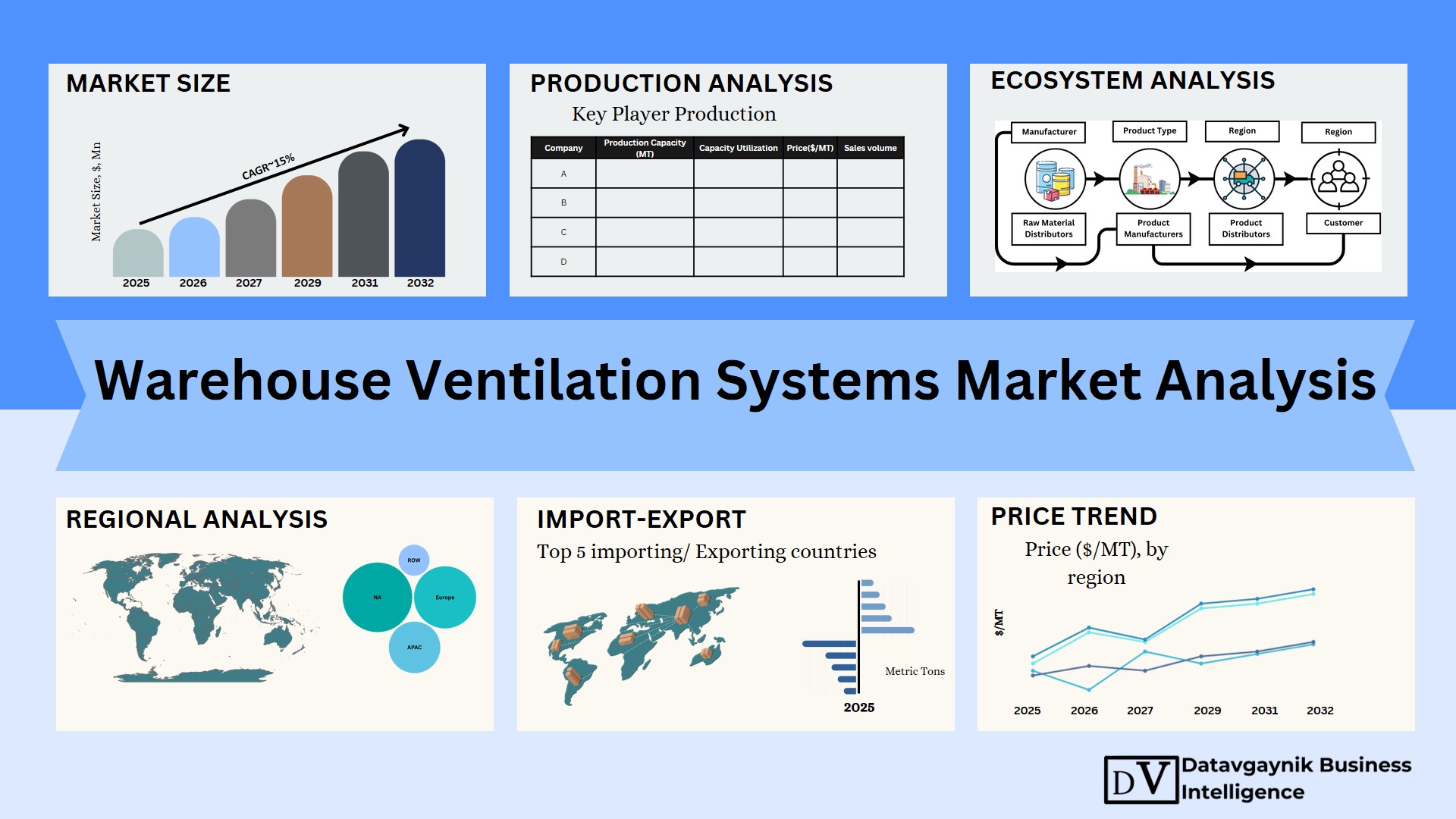
The Warehouse Ventilation Systems Market covers equipment and integrated solutions used to exchange air, remove accumulated heat, control humidity, dilute airborne contaminants and maintain safe working conditions inside storage and distribution facilities. The scope includes exhaust and supply fans, rooftop ventilators, high-volume low-speed fans, make-up air units, louvers, dampers, ducting, sensors, ventilation controls and related installation services.
Datavagyanik also covers related markets such as the Pharmaceutical Ventilation Systems Market, the Agricultural Ventilation Systems Market, and the Mining Ventilation Systems Market. They offer supporting insights that clarify downstream implications and strategic challenges in the context of the main topic.
Full warehouse air-conditioning and refrigeration systems are excluded unless ventilation is a core part of the installed solution. This distinction matters. A ceiling fan that only improves perceived comfort isn’t the same as an engineered ventilation network that manages air changes, pressure, pollutants or emergency smoke.
Global Market Forecast
| Forecast Indicator | 2026 | 2030 | 2035 |
| Global market value | $4,180 million | $5,420 million | $7,520 million |
| Forecast CAGR | 6.7% | ||
| Primary demand source | New warehouse construction and basic retrofits | Smart controls and high-efficiency fan upgrades | Integrated low-energy ventilation and automated building management |
The estimates represent an analyst-developed model based on equipment demand, installation spending, replacement cycles, warehouse construction activity and the growing value of controls within each project.
The business case is becoming more direct. Warehouses are getting larger. Storage racks are higher. Automated retrieval systems are creating dense operating zones. At the same time, employees, forklifts, charging stations, lighting and material-handling equipment continue to release heat within the building.
Natural air leakage can’t reliably manage these loads. Operators need calculated airflow across occupied aisles, picking stations, loading docks and battery-charging areas. OSHA guidance specifically calls for adequate ventilation in battery-charging locations to disperse fumes from gassing batteries.
Heat Exposure and Worker Safety
Occupational heat is emerging as a larger capital-planning issue. In July 2024, OSHA announced a proposed federal rule covering heat injury and illness prevention in indoor and outdoor workplaces. The proposal would require employers to assess heat risks and apply controls when indoor heat reaches specified thresholds. The rulemaking process was still active after public hearings concluded in July 2025.
The practical effect goes beyond compliance. Warehouse owners are beginning to evaluate airflow as part of workforce productivity, employee retention and business continuity. Installing more air movement doesn’t solve every heat problem. Yet properly designed exhaust, make-up air and destratification can reduce stagnant zones and improve the performance of other cooling measures.
Expert view: Heat-risk management will become a stronger specification factor through 2035, particularly in non-air-conditioned fulfilment centres located in hot and humid regions.
Indoor Air Quality and Building Standards
Ventilation design is also shaped by indoor-air-quality standards. ANSI/ASHRAE Standard 62.1 establishes minimum ventilation requirements and other measures intended to reduce adverse health effects in occupied non-residential buildings.
Fire and smoke requirements form another layer. NFPA 204 provides guidance for emergency venting of combustion products from building fires. Warehouse designs may therefore require separate systems for normal ventilation and emergency smoke-and-heat exhaust. The two systems can share components in certain configurations, but they must be engineered around different operating conditions.
Europe is moving toward tighter integration between energy performance and indoor environmental quality. Directive (EU) 2024/1275 covers both new and existing buildings and requires energy-performance methodologies to consider indoor environmental conditions. It also supports greater use of building automation and smart-readiness measures.
Energy Efficiency and Retrofit Demand
Ventilation can become an expensive energy load when fans operate continuously at full speed. So, the market is moving away from isolated equipment selection and toward whole-system optimisation.
The U.S. Department of Energy recommends a systems approach that considers fans, motors, ducts, controls and operating requirements together. Its retrofit guidance identifies demand-controlled ventilation, energy recovery and building automation as high-impact efficiency measures.
This supports demand for:
- Electronically commutated motors
- Variable-frequency drives
- Direct-drive fan assemblies
- Temperature and humidity sensors
- Carbon dioxide, particulate and volatile-organic-compound monitoring
- Zoned airflow controls
- Remote diagnostics
- Energy-recovery ventilation
The Warehouse Ventilation Systems Market is therefore shifting from hardware-led procurement to performance-led procurement. Buyers increasingly ask how much air the system will move per unit of electricity. They also want to know whether airflow can be reduced automatically during low-occupancy periods.
Production and Supply-Side Forces
The supply chain includes fan manufacturers, motor suppliers, sheet-metal fabricators, controls companies, ductwork contractors, system integrators and mechanical-engineering firms. Equipment availability is generally broad. However, high-efficiency motors, certified smoke-control products and specialised corrosion-resistant systems remain more concentrated among established vendors.
Production is also becoming more regional. Manufacturers are adding capacity closer to large HVAC and industrial markets to reduce freight costs for bulky products. In 2024, Systemair acquired Malaysian air-handling-unit manufacturer PHEM Engineering. In 2025, it completed the acquisition of Indian industrial-fan manufacturer NADI Airtechnics. These transactions strengthen local manufacturing and application-engineering capabilities in Asia.
Key Consumers and Clients
The principal customer groups are:
- Third-party logistics and contract-warehousing companies
- E-commerce fulfilment operators
- Retailers and wholesalers with regional distribution centres
- Food, beverage and cold-chain companies
- Automotive and industrial manufacturers
- Pharmaceutical and healthcare distributors
- Chemical and hazardous-material storage operators
- Warehouse developers and logistics real-estate owners
- Government, defence and public-sector storage agencies
- Mechanical, electrical and plumbing contractors
- Engineering, procurement and construction companies
- Facility-management and energy-service providers
Use case: A large fulfilment centre may combine rooftop exhaust fans, dock-area make-up air, HVLS fans and temperature sensors. The control system can then increase airflow during peak picking hours and reduce fan speed overnight.
Market Segmentation and Forecast Scope
The Warehouse Ventilation Systems Market can be segmented by system architecture, product, ventilation function, end user, installation type and region. These dimensions reflect how buyers specify projects and how suppliers generate revenue.
Only two 2026 market shares are disclosed below. Other shares remain reserved for the full market model.
Segmentation Framework
| Segmentation Dimension | Sub-segments Covered | 2026 Share Disclosed | Strategic Outlook |
| By System Architecture | Mechanical ventilation; natural ventilation; hybrid ventilation | Mechanical ventilation: 64.2% | Hybrid systems are forecast to grow fastest |
| By Product and Component | Exhaust and supply fans; HVLS fans; rooftop ventilators; make-up air units; louvers and dampers; ducting; sensors and controls; filtration and air-treatment components | Not disclosed | Sensors and controls show the highest value growth |
| By Application | General air exchange; heat removal and destratification; contaminant exhaust; humidity and condensation control; smoke and heat exhaust; specialised conditioned ventilation | Not disclosed | Heat-management applications gain priority |
| By End User | Logistics and distribution; retail and e-commerce; manufacturing; food and cold storage; pharmaceutical and healthcare; chemicals and hazardous goods; public-sector storage | Logistics and distribution: 36.8% | Food, pharmaceutical and specialised storage record above-average growth |
| By Installation Type | New-build installation; replacement; retrofit and system expansion | Not disclosed | Retrofit spending grows faster than new-build spending |
| By Region | North America; Europe; Asia Pacific; Latin America, Middle East and Africa | Not disclosed | Asia Pacific is the fastest-growing region |
By System Architecture
Mechanical Ventilation
Mechanical systems use powered fans and engineered air-distribution equipment to control supply and exhaust airflow. They dominate the market because they work independently of wind conditions and can be designed around specific air-change, pressure and contaminant-control requirements.
Mechanical ventilation accounted for an estimated 64.2% of revenue in 2026. Its share is supported by large enclosed warehouses, multi-level fulfilment centres, industrial storage facilities and buildings where natural openings cannot provide consistent airflow.
Natural Ventilation
Natural systems use roof vents, wall openings, ridge ventilators, louvers and pressure differences to move air without continuous fan power. Their economics are attractive in suitable climates. Performance, however, depends on building orientation, weather, internal heat load and available opening area.
This segment remains relevant in general storage, agricultural warehousing and low-density facilities. Growth will be moderate because operators have limited control over airflow during still or highly humid conditions.
Hybrid Ventilation
Hybrid designs combine natural openings with mechanical fans and automated controls. The mechanical system activates when natural airflow falls below the required level.
This is expected to be the fastest-growing architecture, with an estimated CAGR of around 8.1% during 2026–2035. The value proposition is simple: use low-energy natural airflow when conditions permit and powered ventilation when they don’t.
By Product and Component
Exhaust and Supply Fans
This category includes axial fans, centrifugal fans, wall-mounted exhaust fans, roof fans and powered supply units. It represents the core equipment base. Demand is increasingly moving toward direct-drive configurations, efficient blade geometries and speed-controlled motors.
HVLS Fans
High-volume low-speed fans move large air volumes at relatively low rotational speeds. They are primarily used for air circulation, heat destratification and occupant comfort rather than outdoor-air exchange.
They’re strategic because many warehouse operators initially address heat complaints with HVLS fans before investing in a larger ventilation retrofit. In integrated projects, HVLS units redistribute air while exhaust and supply systems remove heat from the building.
Make-Up Air and Air-Handling Units
Make-up air equipment replaces the air removed by exhaust systems. Without adequate replacement air, warehouses can experience excessive negative pressure, difficult-to-open doors, uncontrolled infiltration and reduced exhaust performance.
Higher-value units may include heating, cooling, filtration, humidity control and energy-recovery modules. Demand is strongest in cold climates, food storage, pharmaceuticals and facilities with controlled internal conditions.
Louvers, Dampers and Natural Vents
These components regulate air entry, prevent water penetration and isolate airflow during fire or shutdown conditions. Product selection depends on pressure loss, leakage, weather resistance and applicable fire or smoke requirements.
Sensors and Controls
This is expected to be the fastest-growing component group, with an estimated CAGR of approximately 9.2%. Sensors allow ventilation to respond to temperature, humidity, occupancy, particulate levels, gas concentration and operating schedules.
Controls also increase the aftermarket value of installed systems. An older fixed-speed exhaust network can often be upgraded with drives, sensors and central supervision without replacing every fan.
By Application
General Air Exchange
These systems dilute odours, vehicle emissions and low-level airborne contaminants while introducing outdoor air. They are common in general merchandise and logistics warehouses.
Heat Removal and Destratification
Warm air rises and can accumulate below high warehouse roofs. Exhaust fans remove this heat while circulation fans reduce temperature layering.
This application will gain importance as heat exposure receives more regulatory and corporate attention. It is particularly relevant in fulfilment centres with labour-intensive picking, packing and loading activities.
Contaminant and Fume Exhaust
Facilities storing chemicals, operating internal-combustion equipment or conducting light processing may require dedicated exhaust zones. These systems must account for contaminant type, generation point, ignition risk and required discharge location.
Humidity and Condensation Control
Humidity management protects packaging, metal goods, food, pharmaceuticals and moisture-sensitive inventory. In cold storage, uncontrolled outdoor air can increase frost and refrigeration loads. Ventilation therefore has to be coordinated with dehumidification and door-management systems rather than applied as unrestricted outside-air supply.
Smoke and Heat Exhaust
These systems operate during fire emergencies to manage smoke and hot gases. Demand depends on local building codes, warehouse size, rack height, stored materials and fire-protection strategy.
By End User
Logistics and Distribution
This segment held an estimated 36.8% share in 2026. It includes third-party logistics centres, cross-dock terminals, parcel hubs and regional distribution warehouses.
Large floor areas and frequent dock-door movement make these buildings major ventilation users. Project specifications increasingly combine normal ventilation, destratification, dock-area airflow and energy controls.
Retail and E-commerce
E-commerce fulfilment centres typically contain dense conveyor networks, automated storage equipment, packing stations and high employee activity. Airflow must reach occupied work zones without interfering with material movement or automated equipment.
Manufacturing Warehouses
Manufacturers often connect storage areas to production spaces. Ventilation requirements may therefore be influenced by dust, fumes, process heat or pressure relationships between the two zones.
Food and Cold Storage
Food distribution requires tighter control of humidity, temperature and contaminants. Ventilation spending per facility can be higher even when outdoor-air volumes are lower.
Pharmaceutical and Healthcare Distribution
Pharmaceutical facilities require documented environmental control. Although not every storage area needs cleanroom-level ventilation, temperature-sensitive and regulated products increase demand for monitoring, filtration and system redundancy.
By Installation Type
New-build projects remain the largest revenue source. That said, retrofits are expected to grow at an estimated 7.8% CAGR through 2035.
Many existing warehouses operate fixed-speed fans with limited zoning. Adding efficient motors, variable-speed drives and sensors can reduce operating costs while improving airflow control. Retrofit projects also face fewer land and construction constraints than new facilities.
By Region
North America benefits from a large installed warehouse base, strong logistics activity and growing focus on occupational heat.
Europe is shaped by energy-efficiency requirements, building renovation and indoor environmental standards.
Asia Pacific is expected to record the fastest regional growth. New logistics construction, manufacturing investment and modernisation of food and pharmaceutical supply chains support demand.
Latin America, Middle East and Africa present strong heat-management needs, although project activity remains sensitive to construction cycles and capital availability.
Forecast Coverage
Revenue estimates include:
- Ventilation equipment
- Industrial air-movement products
- Control panels, sensors and drives
- Standard filtration integrated into ventilation units
- Installation and commissioning
- Replacement products and major retrofits
The estimates exclude:
- Complete warehouse construction costs
- Standalone refrigeration plants
- General comfort air-conditioning without a ventilation component
- Fire sprinklers and detection systems
- Residential and light-commercial portable fans
- Routine maintenance labour not tied to equipment replacement
- Market Trends and Innovation Landscape
Innovation in the Warehouse Ventilation Systems Market is centred on energy use, airflow precision and system visibility. Basic fans still account for a large part of unit demand. Yet the strongest value creation is moving into motors, controls, sensing, software and application engineering.
Energy-Efficient Fan and Motor Technology
Traditional belt-driven fans remain widely installed. New projects are gradually moving toward direct-drive systems with electronically commutated motors or variable-frequency drives.
Direct-drive systems reduce belt maintenance and transmission losses. EC motors allow efficient speed modulation over a broad operating range. Variable-frequency drives provide similar control benefits for compatible AC motors.
Manufacturers are also refining blade profiles, inlet geometries and fan housings. The goal isn’t simply to increase maximum airflow. It is to deliver the required airflow against system resistance with less power and lower noise.
ebm-papst combines EC fan technology with integrated electronics that support control, monitoring and maintenance functions. Its NEXAIRA ecosystem links fan hardware with digital services and operating optimisation.
Expert view: Fan efficiency will remain important, but controls will determine how much of the theoretical energy saving is actually captured in day-to-day warehouse operation.
Demand-Controlled and Zoned Ventilation
Warehouses rarely operate at uniform load. A receiving dock can be busy while a reserve-storage zone remains almost empty. Running every fan at full capacity wastes electricity and can increase heating or cooling demand.
Demand-controlled systems adjust airflow using inputs such as:
- Indoor and outdoor temperature
- Relative humidity
- Carbon dioxide
- Particulate matter
- Volatile organic compounds
- Occupancy
- Dock-door status
- Equipment schedules
- Battery-charging activity
The result is a shift from whole-building ventilation to zone-based ventilation. Facility managers can provide more airflow to occupied packing areas while lowering output in inactive storage zones.
The Department of Energy identifies demand-controlled ventilation and building automation as high-impact retrofit measures.
Use case: Sensors may detect rising temperature and particulate levels near a loading dock. The control platform increases local exhaust and make-up airflow without changing fan speed across the entire building.
Selective AI Integration
AI is relevant, but it shouldn’t be overstated. Most warehouse ventilation systems still use schedules, thresholds and rule-based building controls.
More advanced platforms are beginning to apply machine learning to equipment-fault detection, energy optimisation and predictive maintenance. These functions usually sit within a broader building-management platform rather than inside the fan itself.
In December 2024, Johnson Controls announced expanded AI capabilities within its OpenBlue Enterprise Manager platform. The platform combines building data, equipment optimisation and proactive services. Siemens also offers predictive building-control functions for climate and ventilation applications.
The next step will be airflow optimisation based on several variables at once. A system could consider occupancy, weather, dock-door openings, electricity tariffs and predicted internal heat loads before selecting fan speeds.
Expert view: Through 2030, AI will remain a control-layer differentiator rather than a standard feature of every warehouse fan. Adoption will be concentrated among large multi-site operators that can justify central analytics.
HVLS Fans and Destratification
HVLS technology continues to evolve through lighter structures, improved controls and easier installation. These fans can move air across large floor areas and reduce temperature stratification in high-bay buildings.
In December 2025, Greenheck announced redesigned HVLS overhead fan models with improved configurability and simplified installation.
The technology has clear limitations. HVLS fans recirculate indoor air. They don’t independently remove pollutants or bring outdoor air into the building. Suppliers are therefore positioning them as one part of a combined heat-management system.
In winter, destratification can return warm air from the roof area toward occupied zones. In summer, increased air movement can improve perceived comfort. The operating direction and speed must be coordinated with heating, exhaust and sprinkler layouts.
Improved Rooftop and Make-Up Air Systems
Rooftop ventilation products are becoming more capable. New units combine outside air, recirculated air, filtration, cooling and dehumidification within a single platform.
Greenheck has described newer rooftop systems that modulate energy use, manage humidity and operate across a wider range of mixed-air conditions than traditional rooftop ventilators.
This trend expands the addressable market. Suppliers can move from selling a roof fan to supplying a packaged environmental-control unit with controls and service revenue.
The trade-off is higher project complexity. Designers must coordinate ventilation rates, heating and cooling loads, building pressure and dock-door infiltration. Poor integration can erase expected energy savings.
Digital Design and Airflow Simulation
Computational fluid dynamics is becoming more accessible for warehouse design. Engineers can model airflow around racks, mezzanines, conveyors and automated storage structures before equipment is installed.
Simulation helps answer practical questions:
- Will supply air reach occupied aisles?
- Are high-temperature pockets forming near the roof?
- Will racks obstruct cross-ventilation?
- Are exhaust fans drawing replacement air through the intended openings?
- Could fan placement interfere with smoke-control or sprinkler performance?
Digital models are especially useful in automated warehouses. Small layout changes can alter airflow paths, while heat loads may be concentrated around charging, conveyor and control-equipment zones.
Material and Component Development
Material science isn’t the primary growth engine in this market, but it affects durability and total ownership cost.
Product development is focused on:
- Corrosion-resistant coatings for humid or chemical environments
- Aluminium and engineered-composite fan blades
- Fibreglass-reinforced components for corrosive exhaust
- Lower-leakage dampers
- Weather-resistant louvers
- High-temperature components for smoke exhaust
- Low-maintenance bearings and sealed motor assemblies
Food, chemical and coastal warehouses create the strongest demand for specialised materials. In general logistics buildings, coated steel and aluminium remain the standard choices because buyers prioritise cost, availability and ease of maintenance.
Fire, Smoke and Operational Safety Integration
Normal ventilation, smoke exhaust and sprinkler operation must be assessed as a coordinated fire strategy. NFPA 204 covers emergency venting of combustion products. However, the use and activation of smoke vents must be evaluated carefully in sprinklered storage occupancies because airflow can influence fire behaviour and sprinkler activation.
The growing use of batteries adds another design variable. Lead-acid forklift charging can release hydrogen. OSHA guidance therefore calls for adequate ventilation in charging areas. Lithium-ion systems create different thermal and fire risks that require separate controls.
This may lead to more localised ventilation. Instead of increasing whole-building air changes, operators can install dedicated exhaust and monitoring around charging rooms or hazardous storage zones.
Mergers, Acquisitions and Product Announcements
| Date | Company Development | Market Relevance |
| May 2024 | Systemair acquired Malaysian air-handling-unit manufacturer PHEM Engineering | Expands production and customised air-handling capacity in Southeast Asia |
| December 2024 | Johnson Controls announced expanded AI functions in its OpenBlue building platform | Supports predictive control and energy optimisation across ventilation assets |
| August 2025 | Systemair completed its acquisition of Indian industrial-fan manufacturer NADI Airtechnics | Adds industrial-fan engineering and strengthens access to India |
| December 2025 | Greenheck redesigned its HVLS overhead fan range | Improves installation flexibility for warehouses and other high-bay facilities |
These developments show two parallel strategies. Dedicated ventilation companies are expanding manufacturing and industrial-fan portfolios. Building-technology companies are investing in digital controls, analytics and recurring service platforms.
Expert view: By 2035, competitive advantage in the Warehouse Ventilation Systems Market will depend less on selling the largest fan and more on proving airflow performance, energy savings, system reliability and compliance across the facility’s operating life.
Competitive Intelligence and Benchmarking
Competition is fragmented across three supplier groups. The first includes full-range ventilation companies that sell fans, air-handling units, dampers, controls and smoke-management systems. The second consists of specialist manufacturers focused on HVLS fans, motors or industrial air movement. The third includes building-automation companies that connect ventilation assets with sensors, analytics and facility-management platforms.
No single supplier controls the complete Warehouse Ventilation Systems Market. Competitive strength depends on regional distribution, engineering support, energy performance, installation capability and the ability to integrate equipment into an existing building-management system.
Competitive Benchmarking
| Company | Core Competitive Position | Portfolio Breadth | Digital Capability | Primary Strength |
| Greenheck | Full-range air-movement supplier | Very high | Moderate to high | Engineered warehouse ventilation |
| Systemair | Global ventilation specialist | Very high | Moderate | Industrial fans and regional manufacturing |
| ebm-papst | Fan, motor and control-technology supplier | High at component level | High | Energy-efficient fan technology |
| FläktGroup | Integrated commercial and industrial HVAC supplier | Very high | High | Large engineered ventilation projects |
| Big Ass Fans | HVLS and large-space air-movement specialist | Focused | Moderate | Warehouse air circulation |
| Johnson Controls | Building-controls and systems-integration company | High | Very high | Automation and portfolio-level optimisation |
| Munters | Humidity and climate-control specialist | Focused | High | Moisture-sensitive storage environments |
Greenheck
Greenheck has one of the broadest warehouse-focused portfolios among North American ventilation suppliers. Its offering covers roof-mounted exhaust and supply fans, axial and centrifugal systems, make-up air equipment, dampers, louvers, HVLS fans and packaged outdoor-air systems.
The company’s market position is strongest where a warehouse project requires several coordinated components rather than a standalone circulation fan. It also provides digital equipment-selection tools that support consultants and mechanical contractors during system design.
Its warehouse solutions address heat removal, contaminant exhaust, replacement air and air circulation. This gives Greenheck a strong position in distribution centres, manufacturing warehouses and large commercial buildings. The company’s main advantage is product breadth. Its relative weakness is that international market coverage is less extensive than that of some European ventilation groups.
Systemair
Systemair competes through a broad portfolio of axial, centrifugal, roof, duct and smoke-exhaust fans. It also supplies air-handling units, air-distribution products and control equipment.
Its global production network supports projects requiring locally manufactured or regionally configured products. The acquisition of Indian industrial-fan manufacturer NADI Airtechnics in August 2025 strengthened its position in heavy-duty blowers and industrial ventilation applications.
The company is well placed in Europe, India, the Middle East and parts of Asia. Its portfolio fits warehouses that need both standard ventilation and application-specific equipment for smoke, heat or contaminated air.
The strategic challenge is market complexity. Systemair competes against regional manufacturers in basic fans and against large HVAC groups in fully integrated building systems.
ebm-papst
ebm-papst is positioned further upstream in the value chain. It supplies fan assemblies, electronically commutated motors, axial systems, centrifugal systems and embedded controls used by ventilation-equipment manufacturers and system integrators.
The company’s competitive edge comes from motor efficiency, compact design, variable-speed operation and intelligent connectivity. It reports a portfolio of more than 20,000 products, giving equipment manufacturers a wide range of airflow and pressure configurations.
Unlike a turnkey warehouse-ventilation contractor, ebm-papst usually supplies the technology inside the final system. This gives it exposure across multiple brands and equipment categories.
Its strongest opportunity lies in retrofit and premium-efficiency systems. Warehouse operators are increasingly replacing fixed-speed and belt-driven equipment with controllable fan modules that use less power at partial load.
FläktGroup
FläktGroup, now owned by Samsung Electronics, provides warehouse ventilation, air-handling, air-distribution, fire-safety and digital-control solutions. Its warehouse offering addresses worker air quality, stock protection, temperature control and humidity management.
The company is strongest in large engineered projects where ventilation must be coordinated with heating, cooling, filtration or smoke-management systems. It also offers lifecycle services covering refurbishment, maintenance and system modernisation.
Its digital architecture supports cloud-based monitoring, real-time system data and integration with existing building-management systems. This creates an advantage in automated warehouses and multi-building logistics campuses.
The Samsung acquisition expands the company’s financial backing and geographic reach. It may also accelerate integration between applied HVAC systems, controls and connected-building platforms.
Big Ass Fans
Big Ass Fans is a focused competitor in large-diameter HVLS fans and industrial air-circulation systems. The company has strong brand recognition in warehouses, manufacturing plants, loading areas and other high-bay facilities.
Its systems are used to circulate air across large floor areas, reduce temperature stratification and improve perceived worker comfort. They can also support winter heating efficiency by pushing accumulated warm air down from the roof level.
The company’s focused portfolio is both an advantage and a limitation. It has specialist credibility in HVLS applications. However, HVLS fans don’t independently deliver outdoor air, manage building pressure or remove concentrated contaminants.
So, Big Ass Fans competes effectively in circulation-led projects but may need to work alongside exhaust, make-up air and controls suppliers in a complete ventilation design.
Johnson Controls
Johnson Controls participates mainly through building automation, HVAC controls, air-distribution equipment and lifecycle services. It isn’t primarily an industrial-fan manufacturer.
Its value becomes clearer in large warehouses with several ventilation zones. The company’s controls can coordinate fans, sensors, heating, cooling and other building systems through a central platform.
The company is particularly competitive among large logistics operators that manage multiple distribution centres. Central supervision can identify equipment faults, compare site-level energy use and adjust ventilation schedules remotely.
Its strength is system intelligence and integration. Its limitation is dependence on partner equipment or third-party fan manufacturers for parts of the physical ventilation system.
Munters
Munters is differentiated by industrial dehumidification, evaporative cooling and air-treatment technology. Its solutions are relevant where warehouses must protect moisture-sensitive products or maintain stable environmental conditions.
Industrial dehumidification can reduce condensation, corrosion, mould and frost. This supports applications in cold storage, food distribution, pharmaceuticals, chemicals, electronics and archived-material storage.
The company doesn’t compete for every general warehouse exhaust project. Its position is stronger in specialised facilities where humidity carries a measurable inventory, compliance or operational cost.
Expert view: Competitive advantage through 2035 will move toward suppliers that can combine efficient hardware, application engineering, remote monitoring and documented energy savings. A low-cost fan alone won’t be enough for complex warehouse projects.
Regional Landscape and Adoption Outlook
Regional demand is influenced by warehouse construction, climate, labour conditions, energy prices and building codes. Hot markets prioritise heat removal and worker comfort. Colder markets place more value on controlled make-up air, heat recovery and destratification.
The growth rates below are analyst estimates based on logistics infrastructure, regulatory direction, warehouse modernisation and the expected pace of ventilation retrofits.
Regional Adoption and Growth Comparison
| Market | Adoption Level in 2026 | Estimated CAGR, 2026–2035 | Funding and Procurement Model | Primary Demand Theme |
| United States | High | 5.9% | Private operator capital and retrofit budgets | Heat safety and ageing-system replacement |
| Europe | High | 5.6% | Compliance investment and energy-efficiency programmes | Decarbonisation and building automation |
| China | Medium to high | 7.4% | State-guided infrastructure and private logistics investment | New logistics capacity and digitalisation |
| India | Medium | 9.0% | Public infrastructure plus developer and 3PL capital | Grade-A warehousing and heat management |
| Japan | High in premium facilities | 4.7% | Private automation investment and green-transition support | Labour savings and energy efficiency |
| South Korea | Medium to high | 6.4% | Corporate investment supported by smart-building policies | Automated logistics and connected controls |
| Middle East | Medium | 8.1% | Sovereign, free-zone and private logistics funding | Extreme heat and logistics-hub development |
United States
The United States is a mature market with a large installed base of roof fans, make-up air units, HVLS systems and industrial controls. Demand is spread across fulfilment centres, manufacturing warehouses, food distribution and third-party logistics.
Our model identifies Texas, California, Arizona, Florida and the southeastern logistics corridor as important heat-management markets. Northern states generate more demand for controlled make-up air and destratification because unrestricted outdoor-air supply can increase winter heating costs.
Occupational heat is becoming a larger procurement factor. OSHA’s federal heat-prevention proposal covers indoor and outdoor work settings, while an updated National Emphasis Program issued in April 2026 increased attention on heat-related workplace inspections.
This doesn’t mean every warehouse will install full air-conditioning. More commonly, owners will combine exhaust fans, make-up air, HVLS circulation and shaded or cooled work zones.
Retrofits represent the most dependable opportunity. Many facilities still use fixed-speed fans and basic thermostatic controls. Variable-speed drives, efficient motors and zone-level sensors offer a lower-cost path than replacing the complete system.
Europe
Europe has a mature ventilation industry and comparatively strong adoption of energy-efficient fans, heat recovery and building controls.
The revised Energy Performance of Buildings Directive promotes improved building efficiency, lower emissions and greater use of building automation. Member states will translate the requirements into national regulations and renovation programmes.
Our model places Germany, the United Kingdom, the Netherlands and France among the largest national demand centres. Poland, Spain, the Czech Republic and parts of Central and Eastern Europe offer stronger new-build growth.
Northern Europe favours insulated air-handling systems, heat recovery and controlled make-up air. Southern Europe has a stronger requirement for summer heat exhaust and high-volume air movement.
Energy prices remain central to purchase decisions. Suppliers must demonstrate fan efficiency and part-load performance. Systems that recover exhaust heat or reduce airflow during low-occupancy hours will gain preference over constant-volume designs.
Europe’s main constraint is the age and diversity of its building stock. Retrofitting ductwork or roof openings in older warehouses can be expensive. This supports demand for modular fans, decentralised controls and equipment that can be installed without major structural work.
China
China combines a large warehouse-construction base with rapid logistics digitalisation. The government’s modern-logistics programme has promoted digital transformation, network expansion and higher operating efficiency. China has also developed a multi-tier distribution system linking national, regional and local logistics infrastructure.
The main demand centres include the Yangtze River Delta, Greater Bay Area, Beijing–Tianjin–Hebei region, Chengdu, Chongqing and major inland freight hubs.
Basic roof and wall fans remain price-sensitive. That said, Grade-A fulfilment centres, pharmaceutical distribution sites, electronics warehouses and automated facilities are moving toward sensors, variable-speed motors and central controls.
China’s climatic diversity creates different product requirements. Southern and eastern regions need humidity and heat management. Northern facilities need controlled winter ventilation and energy-efficient make-up air.
Local manufacturers maintain a strong position in standard equipment. International companies are more competitive in high-efficiency motors, certified smoke-control products, advanced air-handling and integrated building controls.
India
India is expected to record the fastest growth among the major country markets. Grade-A warehousing, e-commerce, manufacturing investment, food logistics and multimodal transport infrastructure are expanding the addressable customer base.
The National Logistics Policy, PM GatiShakti and multimodal logistics parks are intended to improve connectivity and modernise warehousing. Projects in Chennai, Bengaluru, Nagpur, Indore and Jogighopa were under development for operation across FY 2025–26 and FY 2026–27.
Demand is concentrated around Delhi NCR, Mumbai–Pune, Bengaluru, Chennai, Hyderabad, Ahmedabad and Kolkata. Secondary logistics hubs will become more important as distribution networks move closer to consumers.
India’s hot climate supports exhaust and HVLS fan demand. However, many existing facilities still rely on natural ventilation and low-cost circulation equipment. The transition toward engineered systems will be gradual.
The Energy Conservation and Sustainable Building Code 2024 addresses HVAC, thermal comfort, natural ventilation and indoor-air-quality considerations. Application will depend on building classification, connected load and state-level implementation.
Expert view: India’s strongest opportunity isn’t only new warehouses. It is the conversion of basic sheds into compliant, monitored and energy-conscious logistics facilities.
Japan
Japan is a mature but technically demanding market. Growth is slower because warehouse construction is constrained by land availability and an ageing population. Investment is increasingly directed toward automated and labour-efficient logistics facilities.
Government logistics policy promotes mechanisation, automation, data infrastructure and logistics digital transformation. These measures respond partly to labour shortages across transport and logistics services.
The leading demand centres are Greater Tokyo, Osaka–Kobe, Nagoya and major port-linked industrial zones.
Ventilation systems must operate quietly, efficiently and with limited maintenance. Space-saving fan assemblies and compact air-handling equipment are particularly relevant in multi-storey logistics buildings.
Japan’s green-transition policy and movement toward zero-energy building performance support efficient ventilation, heat recovery and intelligent controls.
Replacement demand will be more important than volume-led expansion. Suppliers offering reliable equipment, local service and measurable lifecycle savings will have the strongest position.
South Korea
South Korea has a concentrated warehouse market centred on the Seoul–Incheon–Gyeonggi region. Busan, Daegu and other manufacturing and port corridors form secondary demand centres.
The country’s logistics sector is moving toward smart warehouses that use AI, IoT, robotics and connected supply-chain platforms. This increases internal equipment density and creates a stronger case for sensor-based ventilation and thermal management.
South Korea also strengthened its building-energy-efficiency framework in June 2025 by aligning building ratings more closely with zero-energy-building performance.
Large conglomerates, online retailers and third-party logistics groups can support premium systems. Smaller operators remain cost-sensitive and may prefer standalone exhaust or circulation equipment.
The opportunity lies in integration. Ventilation controls can be connected with warehouse-management, energy-management and predictive-maintenance platforms. Suppliers that support local communication protocols and rapid service will hold an advantage.
Middle East
The Middle East is relevant because warehouse construction and extreme heat are advancing at the same time. The United Arab Emirates and Saudi Arabia are the two leading markets.
Dubai continues to invest in free-zone logistics infrastructure. In March 2025, JAFZA announced an AED 90 million expansion that would add 360,000 square feet of Grade-A logistics space.
Saudi Arabia is developing logistics infrastructure under its National Industrial Development and Logistics Program. The programme is intended to strengthen the Kingdom’s position as an industrial and international logistics hub.
Extreme summer temperatures create a clear need for worker heat management. However, ventilation alone may offer limited cooling when outdoor air is extremely hot. Projects may therefore combine air movement, evaporative cooling, conditioned make-up air and localised cooling zones.
Dust and sand also affect filtration, motor protection and maintenance intervals. Equipment specified for European indoor conditions may require modification for regional operating environments.
Sovereign-backed logistics zones, port developments and private distribution investment will support above-average growth. The main restraint is energy use. Large constant-volume ventilation systems can create high electricity loads unless they use zoning and variable-speed controls.
Recent Developments, Opportunities and Restraints
Recent Developments
| Date | Event | Strategic Relevance |
| April 2026 | OSHA updated its National Emphasis Program for outdoor and indoor heat-related hazards, directing inspections toward higher-risk industries and workplaces. | Raises attention on heat-control measures in warehouses and other indoor industrial facilities. |
| May 2026 | FläktGroup announced a new manufacturing facility in Pune, India, involving an investment of €5.7 million and planned capacity of up to 6,500 units annually. | Expands regional production of air-handling, fan-wall and climate-control equipment. |
| November 2025 | Samsung Electronics completed the acquisition of FläktGroup. | Combines Samsung’s global reach and connected-building capabilities with a major commercial and industrial HVAC portfolio. |
| August 2025 | Systemair completed its acquisition of Indian industrial-fan manufacturer NADI Airtechnics. | Strengthens industrial-fan engineering, manufacturing and distribution capabilities in India. |
| March 2025 | JAFZA announced an AED 90 million investment in the second phase of its logistics park in Dubai. | Creates new Grade-A warehouse capacity and supports ventilation demand in a high-temperature operating environment. |
Opportunities and Business Insights
Emerging logistics markets
India, Southeast Asia and the Middle East offer the strongest new-installation opportunity. Warehouse stock is expanding while the proportion of facilities using fully engineered ventilation remains comparatively low.
The commercial opportunity includes more than fans. New facilities require louvers, dampers, make-up air, sensors, electrical controls and commissioning services.
Automation and remote monitoring
Automated warehouses contain conveyors, robotics, charging equipment and control electronics that create localised heat loads. Sensors can identify these hotspots and adjust ventilation by zone.
Remote platforms also allow a logistics company to monitor several sites from one operations centre. Suppliers can generate recurring revenue through software, diagnostics and maintenance contracts.
Energy-saving retrofits
Replacing a complete ventilation system can be expensive. Retrofitting drives, efficient motors, sensors and control panels is often more practical.
This creates a large aftermarket opportunity in North America, Europe, Japan and older industrial centres in Asia. Performance-based contracts may help operators fund upgrades from verified energy savings.
Market Restraints
High project cost
Engineered exhaust and make-up air systems require electrical work, roof penetrations, ducting and structural support. Project cost can exceed the equipment price.
Limited effect in extreme climates
Ventilation cannot cool a warehouse below the outdoor temperature without refrigeration, evaporative cooling or another cooling mechanism. This can limit the value of basic outdoor-air ventilation in very hot or humid regions.
Fragmented codes and specifications
Requirements differ by country, climate zone, warehouse use, stored material and fire-protection strategy. Suppliers often need local engineering partners and separate product certifications.


