

Bio-Based Acetic Acid Supplier Competition Is Shaped by Feedstock Control, Certification, and Customer Qualification
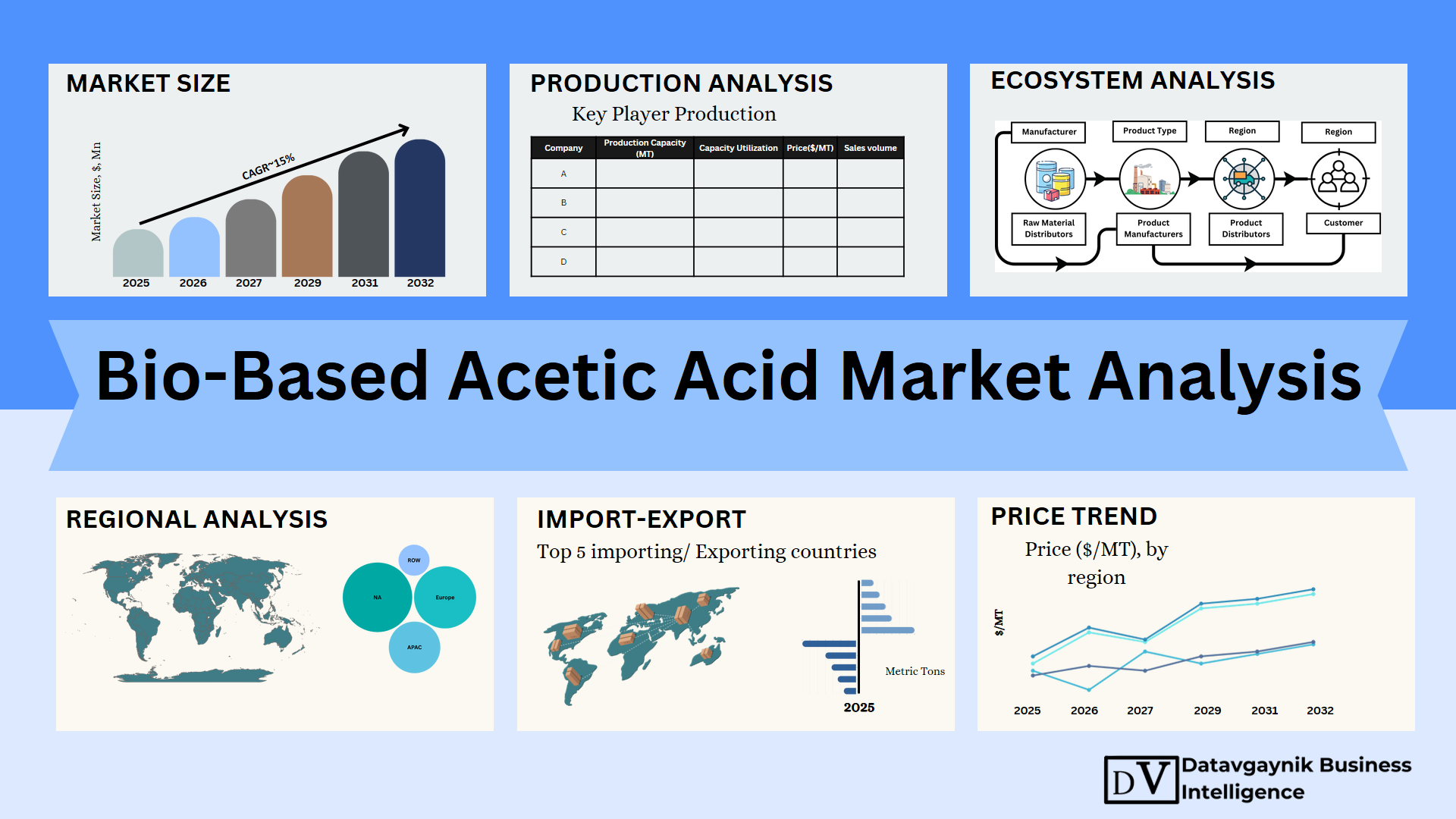
The Bio-Based Acetic Acid market is still narrow compared with the petrochemical acetic acid pool, but competition is becoming more supplier-specific because buyers are asking for verified renewable content, stable purity, and drop-in performance for chemicals, food ingredients, coatings, solvents, and acetate derivatives. The global Bio-Based Acetic Acid market is estimated at about USD 267 million in 2026 and is projected to cross USD 454 million by 2035, reflecting a CAGR of more than 6% through the forecast period. Competitive strength is concentrated among producers that can combine renewable ethanol, fermentation routes, biomass-derived feedstock access, ISCC-type certification, and customer qualification support rather than simply offering a “green” substitute. The market’s product categories are led by bio-based synthetic acetic acid produced from renewable ethanol, fermentation-based acetic acid, food and preservative grades, industrial-grade acetic acid for solvents and acetates, and specialty low-carbon acids sold into cosmetics, life sciences, nutraceuticals, and technical fluids.
Supplier ecosystem is split between chemical producers, fermentation specialists, and bio-refinery platforms
Competition in Bio-Based Acetic Acid is not organized like commodity acetic acid, where methanol carbonylation scale and Asia-based petrochemical capacity dominate. The bio-based side is smaller, more approval-driven, and more dependent on the credibility of feedstock origin. Suppliers broadly fall into three groups: established chemical producers offering bio-attributed or renewable-feedstock acetic acid, bio-refinery companies converting ethanol or biomass streams into acetic acid, and fermentation technology developers working toward commercial-scale acid platforms.
Sekab represents the renewable ethanol-based supplier model. Its Bio Acetic Acid is positioned as chemically identical to fossil-derived acetic acid and produced from bio-based ethanol with renewable bioenergy. This matters commercially because users in adhesives, coatings, PET packaging, solvents, acetate derivatives, and pharmaceuticals can test it as a drop-in raw material without redesigning downstream processes. Sekab’s differentiation is not only chemistry; it comes from European production, traceability, ISCC+ certification, halal and kosher certification, certificate-of-analysis documentation, SDS support, and greenhouse gas value-chain reporting. For European buyers facing customer sustainability audits, this documentation can carry as much weight as price.
AFYREN is positioned differently. It is not a conventional acetic acid commodity producer; it operates as a fermentation-based biobased organic acids specialist. Its AFYREN NEOXY site in France targets seven biobased carboxylic acids at full capacity, with acetic acid forming part of a broader acid portfolio. The company’s competitive logic is portfolio breadth and customer qualification in higher-value markets rather than bulk acid replacement alone. In September 2024, AFYREN reported several dozen tons of acids produced and commercialized to three customers, meeting quality standards in human food, cosmetics, and life sciences. The same update reported more than 100 tons of fertilizer commercialized since April 2024, showing that its circular production economics also depend on valorizing co-products, not only acid sales.
Bio-Based Acetic Acid customer access depends on approval cycles, not only availability
The strongest customer groups are chemical manufacturers, food ingredient companies, nutraceutical producers, cosmetics formulators, coating and adhesive producers, and acetate/ester users that need lower-carbon inputs without changing formulation behavior. Chemical manufacturers remain the largest commercial opportunity because acetic acid is a base intermediate used in vinyl acetate monomer, esters such as ethyl acetate, acetates, acetate fibers, coatings, adhesives, solvents, packaging materials, shampoo, and pharmaceutical value chains.
However, buyers do not switch only because a product is renewable. In industrial chemistry, the supplier must prove consistency in water content, assay, impurities, odor profile, acidity, traceability, and delivery reliability. For food, nutraceutical, and cosmetics buyers, supplier approval can be even slower because the acid must match safety, purity, quality, documentation, and regulatory expectations. AFYREN’s 2024 commercialization into three customers across food, cosmetics, and life sciences is important because it signals customer acceptance in higher-specification segments, even though volumes remain small compared with commodity acid flows.
BioVeritas illustrates the adjacent clean-label and bio-based ingredient route. In September 2024, the company announced a 1:1 clean-label replacement for petrochemical calcium propionate, based on bio-based ingredient positioning. Although this is not a direct bulk acetic acid capacity announcement, it reflects the buyer logic affecting organic acids: food manufacturers value products that can replace petrochemical preservatives without changing dosage, labeling, or processing behavior. This is the same procurement logic that supports fermentation-derived acetic acid and acetate salts in food-preservation applications.
Product differentiation is strongest where certification and low-carbon documentation affect procurement
Bio-Based Acetic Acid suppliers compete less on molecular functionality and more on proof of origin, carbon reporting, supply geography, and conversion pathway. Since the molecule is chemically identical to fossil acetic acid, differentiation must come from measurable renewable content, traceable feedstock, audited sustainability certification, process energy profile, and reliable batch documentation.
Bio-based synthetic acetic acid from renewable ethanol is currently more commercially straightforward than purely fermentation-based routes because it can use existing chemical processing know-how while replacing fossil feedstock. This route supports industrial users that need a low-risk substitution. Fermentation-based acetic acid, by contrast, has stronger sustainability positioning and can use agricultural co-products, food waste streams, molasses, or cellulosic biomass, but it faces higher operational sensitivity in separation, purification, yield stability, and scale-up.
AFYREN’s September 2024 operational update illustrates this constraint clearly. The company reported that adjustments were still required to achieve continuous production, particularly around separation-purification, after replacement of equipment damaged by corrosion. This is a direct market signal: in bio-based acids, commercial strength is not proven at laboratory yield stage; it is proven when purification, uptime, corrosion control, customer-grade consistency, and financing can support repeat deliveries.
Distribution strength favors regional suppliers close to certified feedstock and specialty buyers
Europe holds a stronger position in the market because certification-sensitive customers, specialty chemical buyers, food manufacturers, and low-carbon procurement frameworks are more developed. European suppliers also benefit from shorter supply chains for industrial customers needing documented renewable inputs. Sekab’s European production and planned ARA-region supply node are commercially relevant because liquid chemicals are logistics-sensitive, and buyers want predictable availability, traceability, and batch documentation.
Asia-Pacific is the faster-growth region because large downstream industries—textiles, coatings, packaging, adhesives, solvents, and acetate derivatives—are concentrated in China, India, Japan, South Korea, and Southeast Asia. Yet the region’s competitiveness is uneven. Asia has large acetic acid consumption and feedstock availability, but bio-based acetic acid adoption depends on whether downstream exporters must meet European or North American sustainability requirements. That makes export-oriented coatings, packaging, food ingredients, and specialty chemical producers more likely early adopters than purely domestic commodity users.
AFYREN’s planned Thailand activity with Mitr Phol, a major sugar-sector group, points to how regional competition may develop. The Thailand model is feedstock-linked: sugar and cane derivative streams can support local bio-based acid production while serving Asian buyers. In the first half of 2024, AFYREN created AFYREN SERVICES (THAILAND) CO. LTD to structure commercial activity around this planned partnership, showing that feedstock access and customer development are being built before larger-scale Asian capacity.
Major constraints are price gap, limited capacity, feedstock variability, and customer qualification time
The Bio-Based Acetic Acid market remains constrained by the scale advantage of petrochemical acetic acid. Conventional acetic acid is produced in very large volumes, and the wider global acetic acid market is valued in the tens of billions of dollars. This creates a pricing benchmark that bio-based producers cannot easily match unless customers assign value to carbon reduction, renewable content, food-grade positioning, or brand sustainability claims.
Capacity is another constraint. AFYREN’s full-capacity target of 16,000 tons of carboxylic acids per year is meaningful for specialty biobased acids, but small relative to global acetic acid consumption. Even when projects announce capacity, buyers need evidence of continuous operation, consistent supply, and repeatable purification. Kemvera’s January 2026 completion of a process design package for a planned 50,000 metric tons per year commercial-scale bio-acetic acid and bio-ethyl acetate plant is therefore important, but it is still a commercialization step rather than immediate supply.
Feedstock economics also affect supplier strength. Ethanol-based routes depend on renewable ethanol price, certification cost, and energy inputs. Fermentation routes depend on feedstock collection, pretreatment, microbial performance, and downstream separation. Any variability in agricultural co-products or biowaste streams can affect yield and purification cost. For this reason, companies with secured feedstock partnerships, regional biomass access, audited certification, and strong application-development support are better positioned than suppliers relying only on sustainability messaging.
The market’s near-term competitive structure will remain selective rather than broadly commoditized. Stronger suppliers will be those that prove three things at once: renewable origin, industrial reliability, and customer-grade documentation. Bio-Based Acetic Acid demand is therefore likely to grow first in applications where the buyer can recover a premium through sustainability claims, food-label improvement, regulatory alignment, or downstream customer approval, while bulk chemical substitution will move more slowly until larger certified capacity reduces the price gap.
Supplier segmentation shows a market led by certified renewable chemistry, fermentation platforms, and emerging ethanol-conversion developers
Supplier segmentation in Bio-Based Acetic Acid is best understood by production route and customer qualification rather than only by company size. The market has three practical supplier groups: renewable ethanol-based chemical producers, fermentation-based biorefinery operators, and technology-led developers scaling bio-ethanol conversion into acetic acid and ethyl acetate. Each group serves a different buyer need. Ethanol-based producers are stronger for industrial drop-in substitution. Fermentation specialists are more visible in food, cosmetics, nutrition, and life-science ingredients. Emerging technology developers are focused on future cost reduction, domestic feedstock sourcing, and large commercial plants.
Renewable ethanol-based suppliers have the clearest near-term channel advantage because their products can be positioned as chemically identical to fossil-derived acetic acid. This matters for customers in coatings, adhesives, esters, acetate derivatives, pharmaceuticals, packaging, and specialty solvents, where formulation changes increase testing cost and procurement risk. These suppliers typically compete through product carbon footprint data, ISCC PLUS certification, certificates of analysis, safety documentation, and reliable drum, IBC, or bulk chemical delivery.
Fermentation-based suppliers compete differently. They target buyers that value natural origin, non-petrochemical ingredient positioning, and circular feedstock use. Their customer base is more concentrated in food preservation, cosmetics, animal nutrition, flavors, life sciences, and personal care. These customers are less volume-driven than acetate resin or solvent buyers, but they often tolerate higher prices when the ingredient supports clean-label, natural-origin, or low-carbon claims. The commercial challenge is continuous production, purification consistency, and scale-up reliability.
A third supplier category is forming around bio-ethanol oxidation platforms. These companies are not yet as established in commercial supply as conventional acetic acid producers, but they are important because they are trying to bridge the gap between specialty bio-based acids and larger commodity-scale chemical demand. Their advantage is the ability to use existing bioethanol supply chains and produce bio-acetic acid alongside bio-ethyl acetate, a solvent with large consumption in coatings, inks, adhesives, packaging, and consumer goods.
Portfolio comparison favors suppliers that sell usable chemistry rather than single-purpose sustainability claims
Portfolio depth is now a practical divider between stronger and weaker competitors. Buyers rarely purchase Bio-Based Acetic Acid only as an isolated raw material. They evaluate whether the supplier can support related acids, acetates, solvents, alcohol-derived chemicals, regulatory documentation, carbon reporting, and repeat logistics.
The main product-type segmentation can be summarized as follows:
- Bio-based synthetic acetic acid from renewable ethanol: strongest for chemical intermediates, acetate derivatives, coatings, adhesives, and solvents because it offers drop-in use with lower switching friction.
- Fermentation-derived acetic acid and carboxylic acid blends: stronger in food, cosmetics, nutrition, life sciences, and specialty chemical markets where natural-origin positioning and customer qualification matter.
- Food and preservative grades: higher documentation requirements, smaller order volumes, longer approval cycles, and stronger value capture when linked to clean-label or non-petrochemical ingredient claims.
- Industrial-grade bio-acetic acid: larger addressable demand but more exposed to price competition from fossil acetic acid.
- Bio-acetates and downstream solvents: important for suppliers that want to move beyond acid sales into ethyl acetate, acetate salts, and derivative chemistry.
This segmentation explains why portfolio breadth matters. A supplier that can offer acetic acid, ethyl acetate, acetaldehyde, and related bio-based chemicals has more customer entry points than a single-product producer. Chemical buyers often test one bio-based input before expanding to adjacent solvents or intermediates. In procurement terms, this gives multi-product suppliers better account penetration, especially with coatings, adhesives, packaging, and personal care companies that buy several oxygenated chemicals.
Regional company presence is strongest where feedstock access and sustainability demand overlap
Europe remains the most developed regional supplier base for Bio-Based Acetic Acid because it combines certified renewable feedstock systems, industrial chemical buyers, strict sustainability reporting, and stronger willingness to pay for documented carbon reduction. Nordic and Western European producers also benefit from proximity to specialty chemical, food, pharmaceutical, and personal care customers that already use sustainability scorecards in procurement. European buyers are more likely to request lifecycle documentation, ISCC PLUS certification, and product carbon footprint data as part of supplier approval.
France is important because AFYREN NEOXY gives Europe a fermentation-based organic acids platform with customer-facing relevance in food, cosmetics, life sciences, and industrial markets. The French site’s full-capacity target is not large compared with conventional acetic acid, but its value is in qualification across several higher-margin application groups. For buyers, the key question is not whether the molecule can be produced; it is whether the plant can deliver repeatable quality and stable supply while keeping purification, corrosion, and uptime under control.
Sweden has a different role through Sekab’s renewable ethanol-based chemistry platform. Its supplier advantage is connected to bioethanol sourcing, renewable bioenergy use, and certified drop-in products for industrial customers. For European chemical buyers, regional supply can reduce logistics uncertainty and support sustainability claims without moving to unfamiliar chemical functionality.
Asia-Pacific is more demand-led than supplier-led at this stage. China, India, Japan, South Korea, Thailand, and Southeast Asian manufacturing hubs use large volumes of acetic acid derivatives in textiles, packaging, coatings, adhesives, films, solvents, pharmaceuticals, and food processing. However, large-volume adoption of bio-based grades is still restrained by price sensitivity. Export-oriented manufacturers are more likely to adopt first because they face customer sustainability requirements from Europe, North America, and global consumer brands. Thailand is strategically relevant because sugarcane and biomass by-products can support fermentation-based organic acid production, while regional demand exists in food, feed, lubricants, personal care, and specialty chemicals.
North America is gaining supplier attention because corn ethanol supply is deep, chemical buyers are looking for lower-carbon intermediates, and domestic manufacturing policy favors local feedstock upgrading. The U.S. has an established bioethanol base, but Bio-Based Acetic Acid commercialization depends on technology developers proving cost, continuous operation, distillation performance, and scale economics. The regional opportunity is strongest in bio-acetic acid for adhesives, paints, footwear materials, coatings, packaging, and acetate solvent chains.
Customer access is controlled by qualification, documentation, and channel reliability
Customer access in this market depends on application risk. Industrial customers buying acetic acid for solvents, acetate esters, coatings, and adhesives usually require technical equivalence, consistent purity, packaging flexibility, and predictable delivery. They may test bio-based grades through pilot batches before approving recurring supply. Food, cosmetics, nutrition, and pharmaceutical customers move more slowly because supplier changes can trigger quality reviews, regulatory checks, traceability audits, sensory testing, and customer-label reviews.
Channel structure is therefore split between direct technical sales and specialty chemical distribution. Large industrial and ingredient buyers are usually served directly because they need documentation, specification alignment, carbon reporting, and supply assurance. Smaller formulators, laboratories, and regional manufacturers are more likely to buy through distributors that can manage low-volume orders, safety documentation, repacking, warehousing, and local regulatory support.
Distribution cost is relevant because acetic acid is a corrosive liquid chemical with handling requirements. Transport packaging, storage compatibility, safety compliance, and regional warehousing affect delivered cost. For this reason, regional availability can be more important than nominal production capacity. A European supplier with reliable local logistics can be more attractive to an EU specialty chemical customer than a lower-priced overseas source that increases lead time and documentation complexity.
Segment-level demand is led by derivatives and specialty buyers, while bulk substitution remains selective
By application, acetate derivatives and solvents represent the largest long-term opportunity because conventional acetic acid is heavily consumed in downstream chemicals such as vinyl acetate monomer, ethyl acetate, butyl acetate, cellulose acetate, and acetate salts. Yet the early bio-based demand is stronger in applications where the customer can monetize the renewable claim. Personal care, food ingredients, coatings, packaging adhesives, specialty solvents, and branded consumer-product supply chains are stronger early adopters than commodity resin producers.
By customer type, three groups matter most. First are specialty chemical companies that need lower-carbon raw materials for product reformulation. Second are food, cosmetic, and nutrition manufacturers that can use renewable-origin ingredients in customer-facing claims. Third are industrial brands and consumer-product suppliers that want lower Scope 3 emissions in paints, footwear materials, packaging, adhesives, and cleaning products.
By channel, direct supply dominates qualified industrial accounts because buyers want supplier audits, technical support, and carbon documentation. Distributors remain important for fragmented demand, especially small-batch cosmetics, laboratories, formulation houses, and regional ingredient users. By region, Europe leads in certified adoption, Asia-Pacific leads in downstream volume potential, and North America is becoming more relevant for technology scale-up and feedstock-linked production models.
One clear buying pattern is that customers prefer drop-in grades when the application is performance-sensitive, but they prefer fermentation or natural-origin positioning when the product touches food, nutrition, cosmetics, or consumer-facing labeling. This creates two different price logics. Industrial drop-in grades must narrow the fossil-price gap, while food and personal care grades can carry higher premiums if traceability, certification, and quality documentation reduce buyer risk.
Leading Bio-Based Acetic Acid suppliers are competing through route credibility, certification, and scale-up proof
Sekab is one of the more visible commercial suppliers because it offers bio-based acetic acid produced from bio-based ethanol and supported by renewable bioenergy use. Its market position is strongest in Europe, where buyers value ISCC PLUS certification, chemical equivalence, and documented carbon reduction. Sekab’s broader bio-based chemical portfolio includes bioethanol-linked products such as acetic acid, ethyl acetate, acetaldehyde, and related renewable chemicals, giving it more commercial reach than a single-product acid supplier. Its advantage is practical: customers can treat its Bio Acetic Acid as a direct substitute while using supplier documentation for sustainability reporting.
AFYREN holds a different position. It is best viewed as a fermentation-based biobased organic acids platform rather than a dedicated acetic acid producer. Its AFYREN NEOXY plant in France targets several carboxylic acids and co-produced fertilizer. This gives the company portfolio breadth across food, cosmetics, life sciences, feed, flavors, and industrial applications. Its competitive strength lies in bio-based fermentation technology, customer qualification in high-specification markets, and circular use of biomass-derived inputs. Its main constraint is operational scale-up. The company’s 2024–2026 disclosures show commercial progress, but also highlight the difficulty of moving from batch or limited production into steady continuous operation.
Kemvera, formerly New Iridium, is an emerging U.S. technology-led supplier focused on bio-acetic acid and bio-ethyl acetate from bioethanol. Its position is not yet based on large commercial shipments; it is based on process design progress, pilot validation, and planned scale. The company’s 2026 process design package for a planned 50,000 metric tons per year commercial plant is important because it targets a size closer to industrial solvent and chemical-intermediate demand. Its portfolio also benefits from linking acetic acid with ethyl acetate, a major solvent used in coatings, adhesives, packaging, inks, and consumer goods.
AFYREN’s Thailand project with Mitr Phol adds a regional feedstock-access dimension. Mitr Phol’s sugar-sector presence gives the planned Asian model a closer link to sugarcane and biomass by-products, while Thailand offers access to Southeast Asian food, feed, lubricant, personal care, and chemical buyers. The planned regional plant is strategically useful because Asia has strong downstream acetic acid demand but needs bio-based production models that fit local feedstock economics.
Other market participants include bio-based ingredient suppliers, specialty chemical distributors, acetate derivative producers, and conventional acetic acid companies evaluating bio-attributed or renewable-feedstock options. Conventional producers have scale, logistics, and customer relationships, but they are not automatically advantaged in certified Bio-Based Acetic Acid unless they can verify renewable feedstock use and provide audited carbon documentation. This leaves room for smaller specialized suppliers in premium customer segments.
Pricing behavior remains one of the most important competitive constraints. Fossil-derived acetic acid benefits from mature methanol carbonylation capacity, large Asian production volumes, and established logistics. Bio-based grades carry higher production, certification, feedstock, and purification costs. The premium is easier to defend in cosmetics, food, specialty solvents, and branded consumer-product chains than in bulk acetate derivatives. Margin pressure will remain until larger plants demonstrate consistent operation and lower unit costs.
Recent developments shaping company positioning include:
- May 2023, Sweden – Sekab launched expanded production of bio-based acetic acid, stating that the product can reduce carbon footprint by up to 50% and that the new capacity enables faster and larger deliveries.
- September 2024, France – AFYREN reported that AFYREN NEOXY had produced and commercialized several dozen tons of biobased acids to three customers in human food, cosmetics, and life sciences, while also commercializing more than 100 tons of fertilizer since April 2024.
- September 2024, United States – New Iridium/Kemvera ecosystem highlighted bioethanol conversion into bio-acetic acid for footwear, paint, adhesives, and other consumer-product chemical chains, showing how brand-facing materials are influencing technology development.
- January 2026, United States – Kemvera completed FEL 1 process design for a planned 50,000 metric tons per year commercial plant and commissioned a 20 metric tons per year pilot reactor, supporting the case for larger U.S. bio-based chemical supply.
- January 2026, France – AFYREN NEOXY reported about 400 tons of bio-based acids produced in 2025 and approximately €1 million in related sales, giving the market a measurable sign of commercialization progress while showing that scale-up remains gradual.


