

Market Summary and Growth Forecast
The global Superhydrophobic Coatings for Self-cleaning Surfaces Market is estimated at US$132 million in 2026 and is expected to reach US$604 million by 2035, growing at a CAGR of 18.4%.
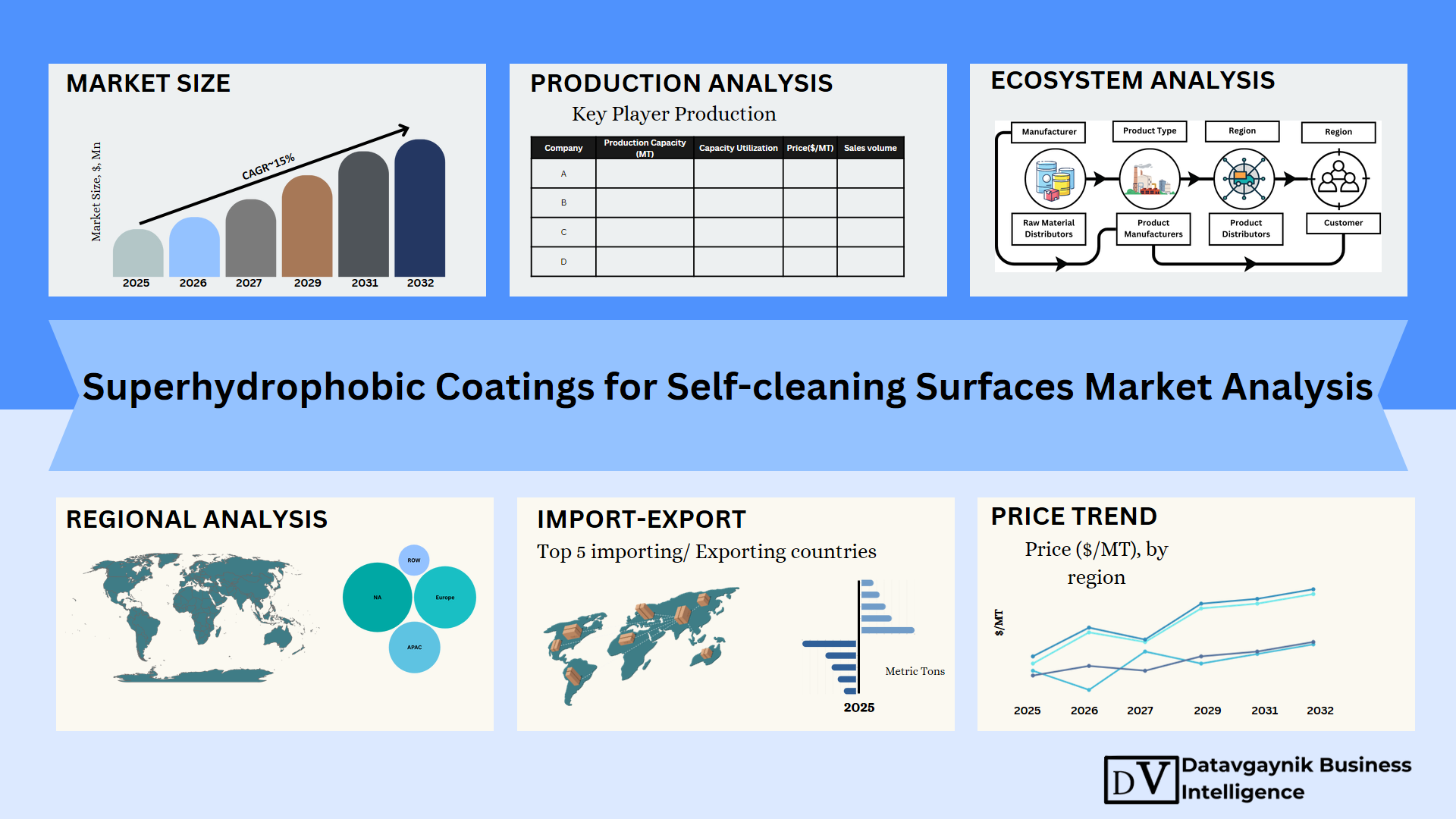
This market covers coating systems that create highly water-repellent surfaces, usually through a mix of low-surface-energy chemistry and micro/nano-scale surface texture. In practical terms, these coatings make water bead up and roll away. As droplets move, they can carry dust, mud, light oil residues, and other loose contaminants from the surface. A surface is generally treated as superhydrophobic when the water contact angle is above roughly 150° with low droplet adhesion. That technical threshold matters because ordinary hydrophobic coatings repel water, but they don’t always deliver the rolling-droplet “self-cleaning” effect buyers want.
Datavagyanik also covers related markets such as the Superhydrophobic Coatings for Solar Panels Market. Understanding these markets sheds light on emerging innovations and industry crossovers that impact the main topic.
The Superhydrophobic Coatings for Self-cleaning Surfaces Market is still a specialist coatings category in 2026, not a commodity market. Adoption is strongest where cleaning is expensive, risky, water-intensive, or operationally disruptive. This includes solar modules in dusty regions, exterior architectural glass, automotive glass, industrial equipment housings, textiles, electronics casings, marine surfaces, and selected public infrastructure assets.
The commercial logic is simple. Buyers are not paying only for water repellency. They are paying for lower maintenance frequency, better surface visibility, reduced cleaning labor, lower water usage, and longer asset uptime. For example, a solar farm in a dry region may not view the coating as a materials purchase. It may view it as a way to reduce manual washing cycles and protect output during dust-heavy months.
| Market Indicator | 2026 Estimate | 2035 Forecast | Analyst View |
| Global market size | US$132 million | US$604 million | Expansion will be led by solar, construction glass, automotive glass, and industrial assets. |
| Forecast CAGR | — | 18.4% | Growth is high because the market starts from a small base and is moving from lab-led adoption into field-tested commercial use. |
| Commercial maturity | Early commercialization | Broader specification-led adoption | The market will remain performance-sensitive. Durability will decide winning suppliers. |
| Primary buyer motive | Cleaning cost reduction | Lifecycle surface management | Customers will ask for proof under abrasion, UV, dust, heat, and chemical exposure. |
| Key formulation shift | Fluorinated and hybrid systems still present | Higher share of fluorine-free systems | Regulation and brand risk will push buyers toward safer chemistries. |
Several macro forces are shaping the market between 2026 and 2035.
First, material science is improving. Earlier superhydrophobic coatings often had one weakness: they worked well in controlled settings but degraded when scratched, rubbed, washed, or exposed outdoors. Newer systems use silica nanoparticles, silane chemistry, PDMS-based structures, ceramic-hybrid binders, sol-gel routes, and laser-textured surfaces to improve durability. Research is also moving toward fluorine-free and self-healing surfaces because traditional fluorinated chemistries face regulatory and reputational pressure. Recent technical work has specifically highlighted the practical limits of harmful fluorinated materials and poor mechanical stability in older superhydrophobic surfaces.
Second, regulation is becoming a real market filter. PFAS scrutiny is especially important because many high-performance water-repellent coatings historically relied on fluorinated chemistries. The European Commission has stated that PFAS action is moving toward a robust restriction framework while allowing strict-condition use only where critical applications lack alternatives. 3M also completed its exit from PFAS manufacturing at the end of 2025, which sends a strong signal to downstream coatings formulators and industrial buyers. This does not remove fluorinated coatings overnight. But it changes procurement behavior. Large clients will increasingly ask for PFAS declarations, substitution plans, and end-of-life safety data.
Third, production economics are improving, but not evenly. Spray-applied and dip-coated systems are easier to scale. Plasma deposition, laser texturing, and advanced multilayer coatings can deliver stronger performance but often carry higher processing costs. So, the market is splitting into two lanes. One lane serves mass surfaces such as glass, fabric, solar panels, and automotive aftermarket products. The other lane serves higher-value industrial or engineered surfaces where performance is worth the premium.
Key consumers and clients include:
- Solar module manufacturers, solar EPC companies, and utility-scale solar operators
- Architectural glass producers, façade contractors, and construction material suppliers
- Automotive OEMs, windshield suppliers, detailing brands, and fleet operators
- Electronics enclosure manufacturers and sensor housing suppliers
- Industrial equipment companies using coated metal, plastic, or composite surfaces
- Textile finishers, outdoor apparel brands, and technical fabric producers
- Marine, transport, and infrastructure maintenance companies
- Hospitals, public facilities, and commercial real estate operators for easy-clean surfaces
The Superhydrophobic Coatings for Self-cleaning Surfaces Market should therefore be read as a performance coatings opportunity, not just a nanotechnology niche. The real value will sit with suppliers that can prove coating life under field stress. Buyers will be less impressed by high contact-angle claims alone. They will want durability, optical clarity, abrasion resistance, environmental compliance, and predictable application cost.
Market Segmentation and Forecast Scope
The Superhydrophobic Coatings for Self-cleaning Surfaces Market can be segmented by coating chemistry, substrate, application, end user, and region. This structure keeps the forecast commercially useful because demand does not behave the same across solar panels, glass façades, textiles, vehicles, and industrial equipment.
By Product Type / Coating Chemistry
The product mix is moving from lab-style specialty formulations toward field-ready coating platforms. The main groups include silica-based nanocomposite coatings, fluoropolymer-based coatings, silane/siloxane coatings, PDMS-based coatings, ceramic-hybrid coatings, carbon-based coatings, and bio-inspired or fluorine-free formulations.
Silica-based nanocomposite coatings are estimated to hold around 42% share in 2026. This is the largest disclosed sub-segment because silica systems are relatively accessible, transparent in many formulations, and compatible with glass, solar, metal, and polymer surfaces. Their cost-performance balance is attractive for early commercialization.
Fluoropolymer-based systems still offer strong water repellency, but their long-term growth is constrained by PFAS-related concerns. Silane, siloxane, and PDMS-based coatings are gaining attention because they can offer hydrophobicity, UV stability, and flexibility across multiple substrates. Ceramic-hybrid coatings are more relevant where abrasion resistance matters. Carbon-based systems remain more niche and application-specific.
By Substrate
Key substrate groups include glass, metal, plastic and polymer surfaces, textiles, ceramics, painted surfaces, and composite materials.
Glass is a strategic substrate because it connects directly to solar modules, automotive glazing, building façades, skylights, display surfaces, and public infrastructure panels. Metal surfaces are important in industrial equipment, marine assets, rail, HVAC housings, and outdoor structures. Plastics and composites matter in electronics, automotive trims, sensors, and consumer goods.
The hidden complexity is adhesion. A coating that works well on laboratory glass may not hold up on painted metal, flexible plastic, or coated fabric. So, suppliers with substrate-specific primers and application protocols will have an advantage.
By Application
Major applications include architectural glass and façades, solar panels and renewable energy assets, automotive glass and exterior surfaces, industrial equipment and machinery, consumer electronics, textiles and outdoor materials, marine and transport surfaces, and public infrastructure surfaces.
Architectural glass and façade surfaces are estimated to account for around 31% of 2026 demand. This is the second disclosed sub-segment share. The reason is straightforward: exterior glass is expensive to clean, especially on high-rise buildings, airports, commercial complexes, malls, and transport hubs. Self-cleaning performance has a direct maintenance-cost argument.
The fastest-growing application is likely to be solar panels and renewable energy assets. Soiling remains a real operating issue for PV systems, especially in dry, dusty, and high-pollution locations. A 2024 study in Scientific Reports evaluated self-cleaning nano-coating performance for PV panels and focused directly on dust reduction and efficiency improvement. That said, solar adoption will depend on optical transparency, coating durability, module warranty acceptance, and long-term field data.
By End User
End users include construction and real estate, solar energy companies, automotive and mobility, industrial manufacturing, electronics, textiles and apparel, marine and logistics, and public sector infrastructure owners.
Construction and solar are the most commercially visible end users. Automotive is split between OEM specification and aftermarket treatment. Industrial buyers are more selective but can pay higher prices when coatings reduce maintenance shutdowns or contamination risk. Textile users are under stronger chemical-safety pressure, which makes fluorine-free alternatives more important.
By Region
Regional coverage includes North America, Europe, Asia Pacific, and LAMEA.
| Segmentation Dimension | Core Sub-segments | Most Strategic Area | 2026 Share Disclosure |
| Product Type | Silica nanocomposite, silane/siloxane, PDMS, fluoropolymer, ceramic-hybrid, carbon-based, fluorine-free | Fluorine-free silica/siloxane hybrids | Silica-based nanocomposite: 42% |
| Substrate | Glass, metal, plastic, textile, ceramic, painted surfaces, composites | Glass and solar cover surfaces | Not disclosed |
| Application | Architectural glass, solar panels, automotive glass, industrial equipment, electronics, textiles, marine, infrastructure | Solar panels and exterior glass | Architectural glass/facades: 31% |
| End User | Construction, solar energy, automotive, industrial, electronics, textiles, public infrastructure | Solar operators and commercial real estate | Not disclosed |
| Region | North America, Europe, Asia Pacific, LAMEA | Asia Pacific for volume; Europe for regulation-led reformulation | Not disclosed |
North America will remain important for specialty coating development, energy assets, automotive refinishing, and industrial use cases. Europe will influence formulation standards because of PFAS scrutiny and sustainability-driven procurement. Asia Pacific will carry the highest volume potential because of solar manufacturing, electronics, construction, automotive production, and infrastructure growth. LAMEA demand will be selective but attractive in solar, marine, oil and gas infrastructure, and desert-region building surfaces.
For the Superhydrophobic Coatings for Self-cleaning Surfaces Market, the strongest forecast upside sits where three conditions overlap: large exposed surface area, high cleaning cost, and acceptable coating payback. Solar farms, transport hubs, high-rise glass, and industrial outdoor equipment fit that logic well.
Market Trends and Innovation Landscape
Innovation in the Superhydrophobic Coatings for Self-cleaning Surfaces Market is moving in a practical direction. The conversation is no longer only about the highest water contact angle. Buyers now ask tougher questions. How long does it last outdoors? Does it survive abrasion? Does it remain transparent? Can it be applied at scale? Is it PFAS-free? Does it work after dust, UV, heat, cleaning chemicals, and repeated wet-dry cycles?
R&D Evolution: From “Lotus Effect” Demonstrations to Field Durability
The first wave of R&D focused on replicating the lotus-leaf effect: a rough surface combined with low surface energy. That concept still matters. But commercial R&D has moved toward durability engineering.
Newer work focuses on:
- Abrasion-resistant top layers
- Self-healing or reconfigurable surface chemistry
- Fluorine-free water repellency
- Transparent coatings for glass and solar modules
- UV-stable binders
- Sprayable and scalable coating formats
- Low-temperature curing
- Better adhesion across glass, plastic, metal, and composite surfaces
A 2024 review of nature-inspired superhydrophobic coatings noted that these surfaces can support self-cleaning, anti-corrosion, and anti-icing functions, but durability and scalable fabrication remain important practical barriers. This explains why the next phase of growth will be more engineering-led than lab-led.
Expert view: The winning coating won’t necessarily have the highest contact angle in a brochure. It will be the one that still performs after real outdoor exposure, cleaning cycles, finger abrasion, dust loading, and chemical contact.
Technology Evolution: Multi-function Surfaces Are Becoming More Valuable
Customers increasingly want coatings that do more than repel water. In solar, the coating must also preserve light transmission. In construction glass, it must remain transparent and visually acceptable. In automotive, it must avoid haze, streaking, and wiper chatter. In industrial equipment, it must resist abrasion and chemicals.
Commercial suppliers are already positioning products around these broader benefits. NEI Corporation markets hydrophobic and superhydrophobic liquid-repellent coatings for substrates such as plastics, metals, glass, fabrics, and 3D printed parts, with applications including industrial condensers and easy-clean consumer or metallic surfaces. NeverWet positions its industrial system as a two-part superhydrophobic treatment that repels water, mud, ice, and other liquids, mainly across materials such as wood, metal, concrete, and masonry. These examples show where the commercial market is going: not pure chemistry, but use-case-specific surface protection.
Material Science: Fluorine-free Chemistry Is the Defining Shift
The most important material science trend is the shift away from fluorinated dependence. Fluorinated chemistries have historically delivered strong repellency, but PFAS concerns are changing the customer conversation. The pressure is highest in Europe and consumer-facing applications, but it is spreading into global procurement.
Fluorine-free systems based on silica, siloxane, PDMS, wax-like bio-inspired structures, ceramic hybrids, and surface-textured architectures are gaining R&D attention. A 2024 study on fluorine-free, robust, and self-healing superhydrophobic surfaces specifically pointed to fluorinated-material concerns and mechanical instability as barriers to practical adoption. This is directly relevant to commercial coatings because self-cleaning surfaces often operate in exposed environments.
That said, fluorine-free does not automatically mean better. Suppliers must still prove oil repellency, durability, transparency, and adhesion. Some fluorine-free coatings perform well against water but less well against oily contaminants. So, product positioning must be honest. Water-repellent self-cleaning is not the same as universal stain-proofing.
AI and Digital Tools: Useful, But Not a Core Demand Driver Yet
AI is not a central demand driver in this market. It is not like battery management, autonomous vehicles, or semiconductor process control. Still, digital tools will support development and qualification.
The practical use cases are limited but relevant:
- Formulation screening for binder, particle, and additive combinations
- Image-based contact-angle and surface-defect analysis
- Predictive durability modeling under UV, abrasion, humidity, and dust exposure
- Solar soiling analytics to decide where coatings create the strongest payback
So, AI should be treated as an R&D accelerator, not a market-making force.
Partnerships, Announcements, and Commercial Signals
The market has not seen a large wave of blockbuster mergers. It is more fragmented. Activity is concentrated in product development, application partnerships, distribution, and compliance-led reformulation.
The clearest industry signal is the PFAS transition. 3M completed its exit from PFAS manufacturing at the end of 2025, and this has wider implications for water-repellent coatings, surface treatments, and specialty materials supply chains. For smaller coating developers, this creates both pressure and opportunity. Pressure, because customers will ask harder chemical-safety questions. Opportunity, because fluorine-free and lower-risk alternatives can gain faster consideration.
There is also stronger commercialization activity in automotive and surface-protection channels. Nasiol highlighted its advanced nano-coating and private-label opportunities at Automechanika Frankfurt 2024, showing how nano-coating suppliers are using automotive aftermarket channels to scale visibility. In industrial and building-facing uses, suppliers such as NEI Corporation and NeverWet continue to position superhydrophobic coatings around durable, easy-clean, and liquid-repellent performance rather than only technical novelty.
Expert view: By 2035, the market will likely split into two quality tiers. Low-cost sprays will remain in consumer and aftermarket channels. Higher-value engineered coatings will serve solar, industrial, façade, and transportation surfaces where failure is expensive.
The innovation landscape is therefore clear. The Superhydrophobic Coatings for Self-cleaning Surfaces Market will grow fastest where suppliers solve the durability problem and de-risk the chemistry. Performance claims alone won’t carry the category. Field data will.
Competitive Intelligence and Benchmarking
The Superhydrophobic Coatings for Self-cleaning Surfaces Market is fragmented. It has large coatings and glass companies at one end, and specialist nano-coating developers at the other. No single company controls the market. The reason is technical. A coating for architectural glass does not automatically work on solar modules, automotive paint, textiles, metal housings, or industrial equipment.
The stronger companies are not only selling water repellency. They are selling surface engineering, application know-how, durability testing, and compliance confidence.
| Company | Product Portfolio and Technology Position | Market Position |
| NEI Corporation | Offers hydrophobic and superhydrophobic liquid-repellent coatings for plastics, metals, glass, painted surfaces, fabrics, and other substrates. Its portfolio is positioned around abrasion resistance, water repellency, self-drying behavior, and easy-clean performance. | Strong specialist player in engineered nano-coatings. Best suited for industrial users, R&D buyers, and customers needing customized coating evaluation. |
| Aculon | Develops hydrophobic and superhydrophobic nano-coating treatments for metals, glass, polymers, and other surfaces. The company focuses on surface modification rather than bulk coatings. | Strong technology-focused supplier. Its position is strongest where customers need thin, application-specific surface treatments rather than conventional paint-like coatings. |
| NeverWet / Rust-Oleum | Offers superhydrophobic coating systems for industrial and consumer-facing applications. The technology is positioned around repelling water, mud, ice, and other liquids across surfaces such as metal, wood, masonry, and concrete. | Strong brand recognition in easy-apply hydrophobic coatings. More visible in consumer, DIY, maintenance, and industrial protection channels. |
| Nasiol | Supplies nano-coatings for automotive, marine, glass, textile, and surface protection use cases. Its commercial positioning leans toward detailing, private-label, and aftermarket protection channels. | Strong in automotive and consumer-facing nano-coatings. It benefits from aftermarket reach and distributor-led scale. |
| Nippon Sheet Glass / Pilkington | Provides self-cleaning glass built around dual-action coating behavior. The glass uses daylight and rain to reduce exterior cleaning needs, with strong relevance in buildings and façade applications. | Strong architectural glass player. Its value is tied to factory-coated glass rather than post-applied superhydrophobic sprays. |
| Saint-Gobain Glass | Offers self-cleaning and easy-clean glass products with transparent surface coating technologies embedded into the glass surface. The product logic is reduced cleaning frequency for hard-to-reach glazing. | Strong global building materials player. Its advantage is specification access through architects, façade contractors, and construction glass channels. |
| Cardinal Glass Industries | Provides naturally cleaner glass products using surface technologies designed to reduce dust buildup and improve rain-assisted cleaning. | Strong North American architectural glass supplier. Its position is especially relevant in residential and commercial window systems. |
NEI Corporation is one of the clearer specialist benchmarks because its commercial material is explicitly positioned as a superhydrophobic coating for several substrates including plastics, metals, glass, painted surfaces, and fabrics. This makes it a useful reference point for industrial and customized demand.
Aculon competes more as a surface chemistry platform provider. It emphasizes hydrophobic and superhydrophobic nano-coating treatments that can bond with a wide range of surfaces. That makes the company relevant where customers need coating chemistry adapted to a specific device, material, or production process.
NeverWet / Rust-Oleum is more visible in applied water-repellent coating systems. Its market strength sits in practical coating formats and brand recall. It is less positioned as a high-spec architectural glass or solar module supplier, but it has clear relevance in maintenance, outdoor surfaces, and industrial protection.
Nasiol is stronger in automotive, marine, and consumer-facing nanocoating channels. Its 2024 visibility at Automechanika Frankfurt showed how nano-coating suppliers are using automotive events to build private-label and distributor partnerships.
The glass majors sit in a different lane. Nippon Sheet Glass / Pilkington, Saint-Gobain Glass, and Cardinal Glass Industries are not pure superhydrophobic coating companies. Their main advantage is factory-applied, specification-led self-cleaning glass. Pilkington describes its self-cleaning glass as using daylight and rain to break down and wash away organic dirt. Saint-Gobain Glass positions its self-cleaning glass around lower cleaning frequency for exposed windows. Cardinal Glass states that its cleaner-glass technology reduces dust buildup and improves window maintenance economics.
Expert view: The competitive gap is not contact angle. It is proof. Suppliers that can show abrasion, UV, optical clarity, and outdoor-aging data will win more industrial and infrastructure accounts.
Regional Landscape and Adoption Outlook
Regional adoption is shaped by three factors: surface exposure, maintenance economics, and chemical regulation. Solar-heavy countries need anti-soiling coatings. Dense urban markets need low-maintenance façade glass. Automotive and electronics hubs need thin surface treatments. Europe adds another layer: regulatory pressure on fluorinated chemistry.
United States
The United States is a high-value market for specialist coatings, not the largest volume market. Demand is strongest in architectural glass, solar asset maintenance, automotive aftermarket coatings, industrial equipment, electronics, and defense-adjacent surface protection.
The U.S. has a strong ecosystem of specialty chemical suppliers, coating formulators, research labs, solar developers, and industrial maintenance companies. This helps early commercialization. Buyers are also more willing to test coatings when the return is tied to lower cleaning labor, safer maintenance, or reduced downtime.
Solar is a useful demand anchor. Renewable capacity additions in the United States rose sharply from 2023 to 2024, mainly because of rapid solar PV growth, according to the IEA. This creates a stronger addressable base for anti-soiling and self-cleaning coatings, especially in dry western and southwestern states.
Adoption outlook: Moderate to strong. The U.S. market will favor premium formulations with technical documentation, warranty support, and industrial validation.
Europe
Europe is the most regulation-sensitive market. Demand exists in construction glass, façades, solar panels, transportation, textiles, and industrial surfaces. But the big regional issue is chemistry. Buyers are already more cautious about PFAS-linked water-repellent formulations.
The European Commission has continued to move toward tighter PFAS control through a science-based restriction approach while allowing critical-use exemptions where alternatives are not available. The EU also requires member states to monitor PFAS in drinking water from January 2026, which reinforces broader scrutiny of persistent chemicals.
Europe is also a strong solar and building-glass market. The IEA reported that the European Union added nearly 85 GW of new renewable capacity in 2025, with solar PV contributing almost 70 GW. Germany and Spain were major contributors. This supports the case for self-cleaning coatings on PV glass and large building surfaces.
Adoption outlook: Strong for fluorine-free, durable, transparent coatings. Slower for formulations with unclear PFAS status.
China
China is the largest volume opportunity. It has scale in solar manufacturing, construction, electronics, industrial equipment, glass production, and transportation infrastructure. The country is also a major user of coated surfaces exposed to dust, pollution, humidity, and industrial contaminants.
Solar is the clearest growth channel. China remained the dominant solar PV market in 2024, accounting for nearly 60% of new global capacity additions, according to IEA PVPS. In 2025, China’s solar installations continued at very high scale, with industry reporting a record year and cumulative PV capacity crossing the terawatt range.
The local opportunity is not only solar. China also has high-volume consumer electronics, EVs, smart devices, public infrastructure, glass, and industrial coatings demand. That creates room for both low-cost and engineered coatings.
Adoption outlook: Very strong in volume. Pricing pressure will be intense. Local suppliers and application partners will matter.
India
India is a high-growth but cost-sensitive market. Solar, metro infrastructure, airports, commercial real estate, hospitals, automotive, and industrial equipment are the most relevant demand pools.
India’s solar capacity crossed 100 GW in January 2025 and reached 132.85 GW by November 2025, according to the Ministry of New and Renewable Energy. MNRE data also showed cumulative solar capacity above 157 GW as of May 31, 2026. That scale makes India one of the most relevant markets for anti-soiling and self-cleaning PV glass coatings.
Dust is a practical issue in many Indian solar parks. Cleaning costs, water availability, and generation losses create a clear business case. That said, adoption will depend heavily on price and payback. Coatings that need frequent reapplication may struggle unless the cost is low.
Adoption outlook: Strong long-term growth. Near-term adoption will be led by solar O&M pilots, premium façade projects, and automotive aftermarket channels.
Japan
Japan has a mature coatings and materials ecosystem. Demand is more quality-led than volume-led. Applications include architectural glass, automotive surfaces, electronics, optical devices, public infrastructure, and specialty industrial surfaces.
Japanese buyers tend to value durability, documented performance, low visual distortion, and supplier reliability. This supports higher-quality coatings, but the market will not scale as quickly as China or India.
Adoption outlook: Selective but premium. Best opportunities sit in automotive, electronics, building glass, and high-performance industrial coatings.
South Korea
South Korea is strategically important because of electronics, displays, automotive, shipbuilding, and advanced materials. Demand is likely to emerge in device housings, sensor surfaces, display-adjacent glass, automotive glazing, marine coatings, and industrial equipment.
The country’s manufacturing structure favors high-performance coatings where surface function can improve reliability, handling, cleanliness, or outdoor durability. However, suppliers must meet tight qualification standards.
Adoption outlook: Moderate to strong. Growth will be led by electronics, mobility, marine, and industrial surface protection.
Middle East
The Middle East is highly relevant for solar, glass façades, airports, commercial buildings, marine assets, and infrastructure exposed to dust, sand, salinity, and heat. Demand is not broad-based yet, but the use case is strong. Cleaning large solar and glass surfaces in dusty climates is expensive. Water is also a constraint.
Solar farms, skyscrapers, airports, rail stations, desalination-linked infrastructure, and energy facilities are logical early users. The challenge is proof under heat, UV, abrasion, and sand exposure.
Adoption outlook: High strategic relevance. Adoption will be project-led rather than mass-market.
| Region / Country | Adoption Level | Primary Demand Drivers | Market Character |
| United States | Medium-high | Solar O&M, automotive, industrial coatings, specialty materials | Premium and validation-driven |
| Europe | High | PFAS reformulation, façade glass, solar PV, sustainability procurement | Regulation-led and quality-focused |
| China | Very high | Solar scale, glass, electronics, EVs, infrastructure | Volume-led with price pressure |
| India | High growth | Solar dust control, water-saving maintenance, infrastructure | Cost-sensitive and payback-led |
| Japan | Medium | Automotive, electronics, architectural glass | Premium and specification-led |
| South Korea | Medium-high | Electronics, displays, shipbuilding, automotive | Technology-led and qualification-heavy |
| Middle East | Selective high | Solar soiling, desert dust, façade cleaning, marine exposure | Project-led and harsh-climate focused |
For the Superhydrophobic Coatings for Self-cleaning Surfaces Market, Asia Pacific will carry the largest volume upside. Europe will shape chemistry standards. The United States will remain important for specialty innovation. The Middle East will offer high-value use cases where dust, heat, and cleaning economics make the coating case easier to explain.
Recent Developments + Opportunities & Restraints
Recent Developments
| Month & Year | Development | Market Relevance |
| September 2024 | Nasiol showcased advanced nano-coatings and private-label opportunities at Automechanika Frankfurt 2024. | Shows rising commercialization of nano-coatings through automotive aftermarket, detailing, and distributor channels. |
| May 2025 | NEI Corporation updated the technical documentation for its superhydrophobic coating platform, positioning it around water repellency across plastics, metals, glass, painted surfaces, and fabrics. | Supports supplier benchmarking and shows continued product refinement in durable, application-ready coating formats. |
| July 2025 | The European Commission highlighted stronger action on PFAS, including a robust science-based restriction while allowing critical-use flexibility where alternatives are not available. | Pushes coating buyers toward PFAS declarations, safer chemistries, and fluorine-free alternatives. |
| November 2025 | India’s solar installed capacity reached 132.85 GW, up from 94.17 GW in November 2024, according to government reporting. | Expands the installed base for anti-soiling and self-cleaning coatings on PV modules. |
| January 2026 | EU member states began PFAS monitoring obligations in drinking water. | Strengthens regulatory pressure around persistent chemistries and raises customer sensitivity in coatings, textiles, glass, and surface treatments. |
Opportunities & Business Insights
- Solar anti-soiling is the strongest growth pocket
Solar operators in dusty regions have a clear reason to test self-cleaning coatings. Cleaning costs, water use, output losses, and panel-access issues all affect project economics. India, China, the Middle East, Australia, and parts of the United States are especially relevant. The strongest commercial story is not “advanced nanotechnology.” It is fewer wash cycles and more predictable energy yield.
- Fluorine-free coatings can win procurement preference
PFAS scrutiny is becoming a purchase criterion. That creates space for silica, siloxane, PDMS, ceramic-hybrid, and other fluorine-free systems. Suppliers that combine repellency with compliance documentation will move faster with European and multinational customers.
- Retrofit coatings will grow, but factory-applied systems will command trust
Aftermarket sprays and retrofit coatings can scale quickly. They are easy to demonstrate and low-risk for small buyers. But larger customers will prefer factory-applied or professionally applied systems with warranty alignment. Solar modules, façade glass, and automotive glazing will require this discipline.
Restraints
- Durability remains the main adoption barrier
Many coatings perform well when new. Fewer survive abrasion, UV, detergent exposure, dust impact, and repeated cleaning. This is the biggest reason the Superhydrophobic Coatings for Self-cleaning Surfaces Market has not scaled faster.
- Optical clarity limits use on glass and solar panels
Any coating used on solar glass, windshields, displays, or architectural glazing must avoid haze, glare, uneven wetting, and transmission losses. Even a small optical penalty can reduce buyer confidence.
- Regulatory uncertainty can slow formulation decisions
PFAS-linked formulations face more scrutiny. But alternatives may not always match performance. This creates a transition period where suppliers must balance chemistry safety, coating life, and application cost.
Expert view: The market’s next phase will be decided by proof under field conditions. Buyers will not pay a premium for water-beading videos alone. They’ll pay for coatings that reduce maintenance and still work after a year outdoors.


