

Technology-Grade Resin and Coating Demand Keeps Trimethylolpropane (TMP) Consumption Linked to Crosslinking Performance
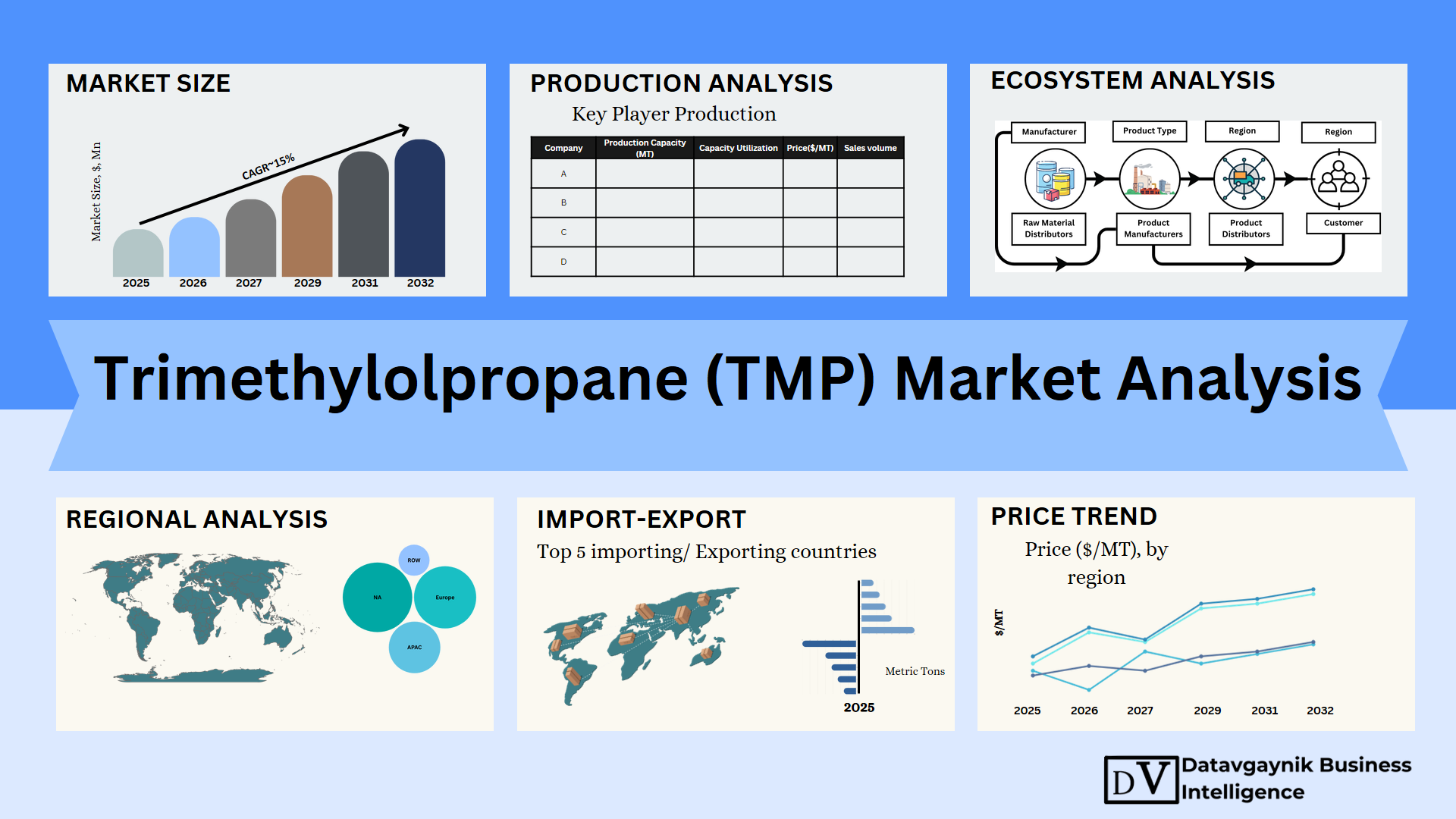
Higher-solids coatings, polyester resins, alkyd systems, polyurethane intermediates, and synthetic lubricants are keeping Trimethylolpropane (TMP) Market demand tied to crosslinking efficiency rather than bulk solvent-style consumption. The Trimethylolpropane (TMP) Market is estimated at USD 695 million in 2026 and is projected to reach USD 875 million by 2032, advancing at nearly 3.9% CAGR, supported by durable coatings, resin modification, and lubricant ester demand.
Trimethylolpropane (TMP) is a trifunctional polyol, so its consumption rises where formulators need higher molecular branching, better hardness-flexibility balance, improved chemical resistance, and lower VOC coating systems. In coatings and resin production, TMP is not bought as a filler chemical; it is selected because three hydroxyl groups improve crosslink density in alkyds, saturated polyesters, polyurethane coatings, radiation-curable acrylates, and specialty ester systems.
Demand intensity is strongest in industrial coatings, automotive refinish, coil coatings, wood coatings, synthetic lubricants, plasticizers, adhesives, and elastomers. Coatings and resin applications together account for the largest consumption base, with industrial-grade and high-purity TMP preferred where color, hydroxyl value consistency, moisture control, and acid value stability affect downstream formulation performance.
A key demand signal came in June 2025, when PPG highlighted advanced architectural metal coating systems at AIA25 in the United States, emphasizing weathering resistance, durability, and design performance in coil and metal coatings. Such coating systems indirectly support TMP demand because polyester and alkyd resin formulators use multifunctional polyols to improve film hardness, outdoor durability, and crosslinking response.
Production economics remain linked to formaldehyde and n-butyraldehyde availability, because TMP is produced through aldehyde chemistry rather than simple blending. This makes the market sensitive to oxo-alcohol chains, methanol-derived formaldehyde cost, energy use, purification yield, and regional operating rates. Producers with integrated aldehyde access and stable European, Chinese, or U.S. production networks hold stronger supply positions.
Asia Pacific remains the highest-volume demand region because China, India, South Korea, and Southeast Asia consume TMP through coatings, polyurethane systems, lubricants, plasticizers, and export-oriented resin manufacturing. Europe and North America show slower but higher-specification demand, especially in automotive coatings, industrial maintenance coatings, synthetic ester lubricants, and regulated low-VOC formulations.
The Trimethylolpropane (TMP) market scenario is therefore less about broad chemical volume growth and more about formulation substitution. Buyers increase TMP use when resin systems need higher solids, stronger film formation, better hydrolytic stability, or improved lubricant thermal performance. Demand growth remains moderate, but technical stickiness is high because substitution affects curing behavior, resin viscosity, coating durability, and customer qualification.
Technology-Driven Capacity Change Keeps TMP Supply Tied to Aldehyde Integration and Purification Control
Trimethylolpropane (TMP) production is controlled by aldehyde availability, reaction selectivity, and downstream purification rather than simple blending capacity. Commercial TMP is generally produced by reacting n-butyraldehyde with formaldehyde under alkaline condensation conditions, followed by neutralization, concentration, crystallization, drying, and flaking or molten handling. The route makes TMP supply sensitive to oxo-alcohol chains, methanol-derived formaldehyde, steam cost, wastewater load, and plant operating discipline.
Large TMP producers benefit where butyraldehyde, formaldehyde, hydrogenation, utilities, and purification are integrated inside broader aldehyde or polyol complexes. This gives suppliers better control over hydroxyl value, color, moisture, ash, and by-product salts, which matter for coating resin, polyurethane, acrylic ester, and synthetic lubricant customers. LANXESS positions TMP as a high-purity triol for coatings, resins, and polyurethanes, while Perstorp highlights use in saturated polyesters, polyurethane coatings and elastomers, radiation-curing acrylates, synthetic lubricant esters, and pigment surface treatment.
Production geography is concentrated around established aldehyde and specialty polyol sites in Europe, China, Japan, and North America. Europe has stronger high-specification TMP supply for coatings, synthetic esters, and specialty resins, but its cost base is exposed to energy, labor, and environmental compliance. China has expanded broader petrochemical and oxo-chemical capacity, which gives regional TMP buyers a larger feedstock base and stronger local sourcing options, especially for coating resin and plasticizer-related intermediates.
A recent supply-side signal came in January 2025, when the Shell-CNOOC joint venture CSPC announced an expansion of its Guangdong petrochemical complex, adding a 1.6 million-ton-per-year ethylene cracker and 320,000 tons per year of specialty chemicals targeted for completion in 2028. Although this is not a TMP unit, it reinforces South China’s integrated chemical manufacturing base, where aldehyde, solvent, resin, coating, and specialty intermediate demand is increasingly served through local petrochemical clusters.
China’s broader petrochemical expansion also affects TMP supply economics through feedstock flexibility and regional operating rates. In September 2025, Sinopec started the Tahe refining and chemical upgrade in Xinjiang, raising crude processing capacity from 5 million to 8.5 million tons per year and adding 16 refining and chemical units, including hydrocracking, catalytic reforming, ethylene, and aromatics capacity. This type of integrated project strengthens China’s upstream chemical platform, indirectly supporting downstream aldehyde and specialty intermediate competitiveness.
TMP plants usually run as continuous or semi-continuous chemical units, but final product handling often depends on customer form. Flake TMP is easier for resin and ester producers to store and dose, while molten or liquid handling can reduce packaging cost for nearby large consumers. Export shipments depend on moisture protection, bag or bulk container integrity, and consistent lot documentation because coating and lubricant buyers qualify TMP as a performance input.
Supply security therefore depends on three linked factors: n-butyraldehyde access, formaldehyde reliability, and purification yield. When oxo-feedstock prices rise, TMP producers face margin pressure because resin and coating customers resist sudden price resets. Producers with integrated feedstock supply, captive utilities, and stable crystallization quality can protect availability better than merchant suppliers buying aldehydes in tighter spot markets.
Performance-Grade Segmentation Shows TMP Demand Concentrated in Resins, Coatings, and Synthetic Ester Systems
Trimethylolpropane (TMP) demand is segmented less by basic chemical volume and more by performance role inside resin, coating, lubricant, adhesive, plasticizer, and polyurethane systems. The leading segments use TMP because its three hydroxyl groups increase branching, crosslinking response, hardness, chemical resistance, and thermal stability in downstream formulations.
Key demand segments in the Trimethylolpropane (TMP) Market include:
- By form: flakes, molten TMP, and liquid handling formats
- By grade: industrial grade, high-purity grade, low-color grade, and specialty resin-grade material
- By application: alkyd resins, saturated polyester resins, polyurethane systems, acrylic esters, synthetic lubricants, plasticizers, adhesives, and pigment treatment
- By end use: coatings, automotive, construction materials, industrial equipment, packaging, synthetic lubricant blending, and specialty chemical manufacturing
- By buying pattern: long-term qualified supply, spot chemical procurement, regional distributor supply, and direct bulk supply to resin producers
Coatings and resin production remain the largest consumption block, accounting for an estimated 45–50% of global TMP usage. Alkyd resins use TMP to improve hardness, gloss retention, and drying behavior, while saturated polyester resins depend on TMP for branching and film performance. In powder coatings and coil coatings, TMP-based resin systems are valued where surface hardness, flexibility, and chemical resistance must remain stable over long service cycles.
Polyurethane and acrylic ester applications form the second major demand cluster. TMP is used as a polyol building block in polyurethane coatings, elastomers, and radiation-curable acrylates where low dosage can change curing density and mechanical performance. UV-curable coatings and high-solids systems use TMP derivatives because lower solvent loading helps formulators meet VOC limits without losing coating strength.
Synthetic lubricant esters represent a smaller but higher-value segment. TMP esters are used in lubricants where thermal stability, low volatility, oxidation resistance, and viscosity control matter more than low raw-material cost. This segment is linked to industrial machinery, automotive fluids, aviation lubricants, compressor oils, and high-temperature operating environments. Although volumes are lower than coatings, price realization is stronger because ester producers require tighter purity and consistency.
Plasticizers, adhesives, pigment treatment, and specialty intermediates account for the remaining demand. These applications are fragmented but technically sticky. A coating additive or adhesive formulation may consume limited TMP per batch, but once the formulation is approved, switching requires reformulation, retesting, and customer approval.
A recent downstream signal came in March 2025, when Covestro reported continued investment focus in coatings and adhesives materials, with polyurethane and polycarbonate-related solutions tied to automotive, construction, electronics, and industrial applications. This supports TMP consumption indirectly because high-performance resin and coating systems continue to require multifunctional polyols and intermediates that control curing, durability, and surface performance.
Regionally, Asia Pacific leads in volume because China and India have large coating resin, plasticizer, polyurethane, and industrial chemical conversion bases. Europe and North America consume more high-specification TMP in synthetic lubricants, industrial coatings, automotive coatings, and regulated low-VOC systems. The Trimethylolpropane (TMP) market scenario therefore shows moderate volume growth but higher value retention in purity-sensitive, qualification-based applications.
Customization Premium in TMP Pricing Comes from Purity, Color Control, and Resin Qualification
Trimethylolpropane (TMP) pricing is shaped by feedstock cost, purification yield, product form, and qualification requirements in coatings, resins, polyurethane systems, and synthetic lubricant esters. Standard industrial-grade TMP follows aldehyde-chain cost movement, while low-color, high-purity, and resin-qualified material carries a premium because downstream users measure performance through hydroxyl value, moisture, ash, acid value, and color stability.
The main cost base starts with n-butyraldehyde and formaldehyde. n-Butyraldehyde is tied to oxo-chemical production, propylene availability, syngas economics, and regional plant operating rates. Formaldehyde depends on methanol cost, energy use, emission control, and local supply balance. When methanol or oxo-alcohol chains tighten, TMP producers face higher input cost before resin and coating customers accept revised contract pricing.
Energy and utilities create a second pricing layer. TMP production requires controlled condensation, neutralization, concentration, crystallization, drying, and final product handling. Steam, electricity, water treatment, and waste handling are not minor costs because by-product salts, aqueous streams, and purification losses directly affect production economics. Plants with integrated utilities and aldehyde feedstock access can absorb short-term cost swings better than merchant producers.
Product form also affects price. Flake TMP usually carries packaging, drying, moisture-protection, and handling costs, while molten supply can reduce packaging expense for nearby large-volume consumers. Buyers using TMP in alkyd resin, saturated polyester resin, polyurethane coatings, and synthetic lubricant esters generally prefer stable lot quality over the lowest available spot price because formulation instability can create larger downstream rejection costs.
TMP price components usually differ by buying condition:
- Feedstock-linked cost: n-butyraldehyde, formaldehyde, methanol, propylene, and syngas chain movement
- Processing cost: crystallization yield, drying load, filtration, wastewater treatment, and energy intensity
- Grade premium: low color, low moisture, controlled hydroxyl value, and resin-grade consistency
- Logistics cost: bagged flakes, bulk shipment, port handling, regional freight, and inventory storage
- Qualification premium: approved supplier status, coating-resin testing, lubricant ester validation, and batch documentation
Regional price gaps are visible where feedstock integration and local supply differ. China generally offers more competitive TMP availability because of broader chemical conversion capacity and export-oriented resin manufacturing. Europe and North America often see higher delivered prices due to energy, labor, environmental compliance, packaging, and qualification cost. Import-dependent buyers in Southeast Asia, Latin America, and parts of the Middle East face additional freight and currency exposure.
A relevant cost-side signal came in January 2025, when the Shell-CNOOC petrochemical expansion in Guangdong added a planned 1.6 million-ton-per-year ethylene cracker and 320,000 tons per year of specialty chemicals to strengthen South China’s integrated chemical platform. Such projects do not directly set TMP prices, but they improve regional feedstock depth and downstream specialty chemical supply, which can reduce long-term import dependence for resin and coating intermediate buyers.
Contract pricing is preferred by large resin, coating, and lubricant ester producers because TMP is formulation-qualified. Spot buying is more common among smaller converters or distributors, but spot material can face approval limits where color, moisture, and hydroxyl consistency are critical. The price-performance trade-off is therefore strict: a cheaper TMP lot can become expensive if it changes resin viscosity, coating hardness, ester yield, or customer qualification status.
Technology Leadership Separates TMP Suppliers by Feedstock Control, Purity Discipline, and Resin-Customer Qualification
Competition in the Trimethylolpropane (TMP) Market is concentrated among producers that can combine aldehyde chemistry, purification consistency, and qualified supply to coatings, resins, polyurethanes, acrylic esters, and synthetic lubricant customers. The leading supplier group includes Perstorp, LANXESS, OQ Chemicals, BASF, Mitsubishi Gas Chemical, Chang Chun Group, Baichuan Chemical Industrial, Jilin Petrochemical, Hubei Yihua, and Kosin Organics, with China-based producers holding stronger volume leverage and European suppliers retaining stronger high-specification positioning.
Perstorp remains a top-tier TMP supplier because its product range covers flakes and molten TMP for saturated polyesters, coil coatings, alkyd paints, polyurethane coatings, elastomers, radiation-curing acrylates, synthetic lubricants, rosin esters, and pigment surface treatment. This broad downstream coverage gives Perstorp an advantage with resin producers that need stable hydroxyl value, low-color material, and supply continuity across multiple coating chemistries.
LANXESS competes through high-purity TMP and long operating experience in multifunctional polyols. Its technical positioning is strongest in coatings, resins, and polyurethanes, where TMP’s trifunctional hydroxyl structure improves crosslinking, mechanical strength, flexibility, thermal stability, and chemical resistance. LANXESS also differentiates through sustainability-linked grades; its Scopeblue TMP uses 100% bio-circular n-butyraldehyde and contains 54% sustainable raw materials, supported by ISCC Plus certification.
OQ Chemicals, BASF, and Mitsubishi Gas Chemical compete through chemical-chain strength, customer relationships, and downstream intermediate portfolios. These suppliers are advantaged where TMP buyers want reliable aldehyde-chain access, technical support, and long-term supply rather than opportunistic spot purchasing. Mitsubishi Chemical’s TMP-derived methacrylate product line also shows how TMP chemistry connects into crosslinking agents, adhesives, rubber modifiers, resin modifiers, and paints.
Chinese producers such as Baichuan Chemical Industrial, Jilin Petrochemical, Hubei Yihua, Chang Chun Group, and Kosin Organics strengthen competition on volume availability and regional price competitiveness. Their advantage is strongest in Asia Pacific, where coating resin, plasticizer, polyurethane, and industrial chemical conversion capacity is large and buyers often balance cost with minimum specification compliance. For export customers, consistency, documentation, packaging quality, and batch traceability remain the main qualification filters.
Competitive position in TMP depends on four practical advantages:
- Feedstock access: stable n-butyraldehyde and formaldehyde supply reduces margin volatility.
- Purification control: color, ash, moisture, and hydroxyl value consistency protect resin performance.
- Application coverage: coatings, lubricants, polyurethanes, acrylic esters, and plasticizers reduce demand concentration risk.
- Customer approval: qualified suppliers retain business because reformulation and retesting create switching cost.
A recent competitive signal came in January 2025, when the Shell-CNOOC CSPC expansion in Guangdong added a planned 1.6 million-ton-per-year ethylene cracker and 320,000 tons per year of specialty chemicals. This reinforces China’s integrated specialty-chemical base and increases pressure on non-integrated TMP suppliers competing in Asia’s resin and coating intermediate chains.
The Trimethylolpropane (TMP) market scenario is moderately concentrated at the high-specification end but more competitive in standard industrial-grade supply. Exact company shares are not consistently disclosed, so competition is better assessed by production integration, product form, quality documentation, regional logistics, and approved-supplier status. Entry barriers are meaningful because buyers in coatings, lubricants, and polyurethane systems qualify TMP through performance testing, not only price comparison.


