

Methyl Cellulose Market Demand is Being Defined by Viscosity Control, Water Retention, and Formulation Reliability
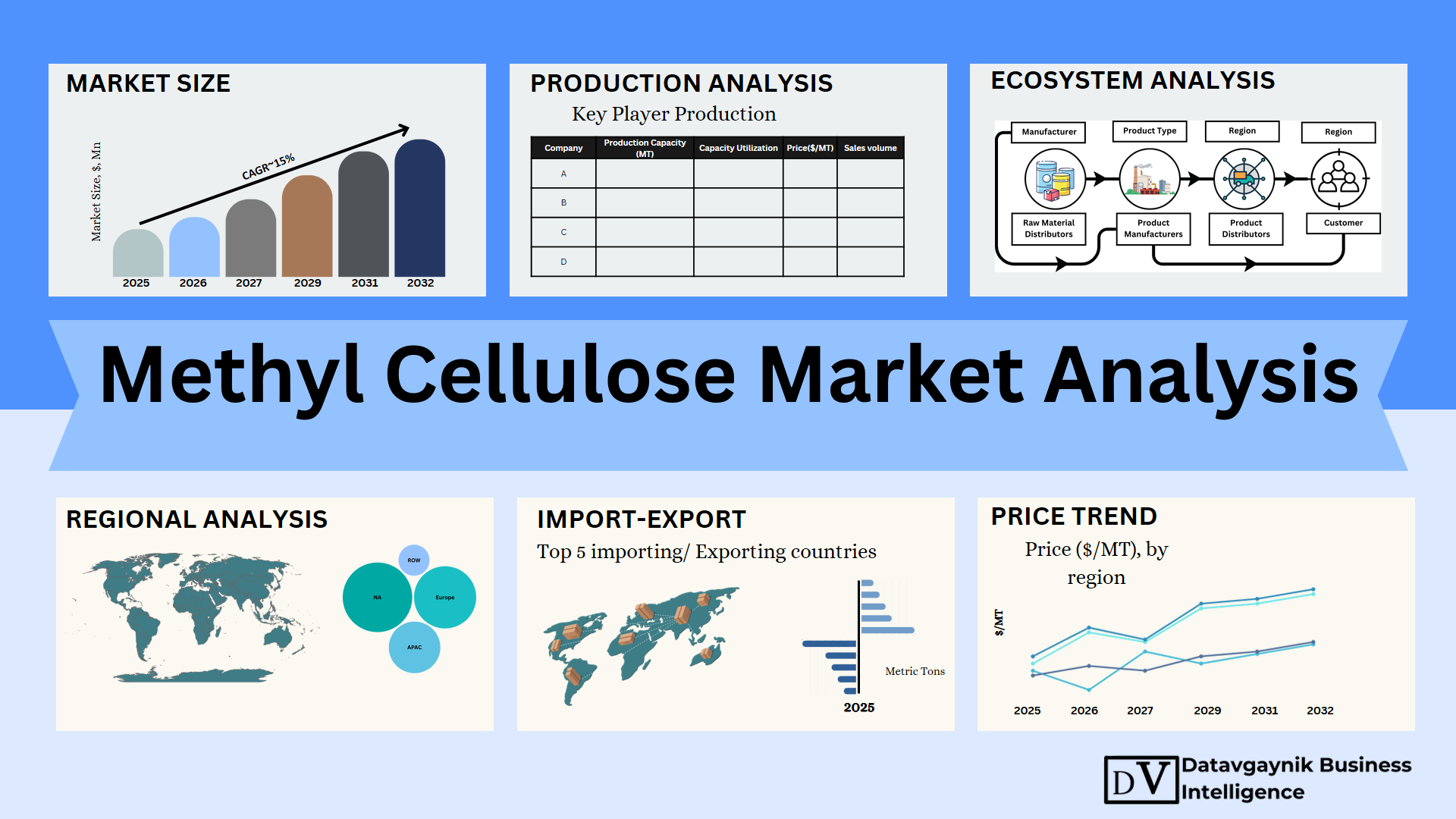
The Methyl Cellulose Market is estimated at about USD 1.87 billion in 2026, growing at a CAGR of 4.8% and projected to reach nearly USD 2.7 billion by 2034, with demand tied less to bulk chemical consumption and more to performance-sensitive use in construction materials, pharmaceutical excipients, processed foods, coatings, personal care, and specialty industrial formulations. Methyl cellulose is used where a formulation needs controlled viscosity, water retention, thermal gelation, binding, suspension stability, film formation, and consistent application behavior under changing temperature, pH, moisture, and shear conditions. Its main customer groups are dry-mix mortar producers, tile adhesive manufacturers, pharmaceutical formulators, food processors, personal-care brands, coatings companies, and specialty distributors supplying grades by viscosity, substitution level, particle size, purity, and regulatory compliance.
Performance-based demand in Methyl Cellulose Market is stronger where small dosage changes product behavior
Methyl cellulose demand is specification-driven because the product is used in low dosage but influences the entire performance profile of the final formulation. In construction dry-mix systems, cellulose ether additives are typically a minor fraction of the formulation by weight, but they determine open time, sag resistance, water retention, pumpability, surface finish, and adhesion consistency. This is why demand is stronger in tile adhesives, wall putty, skim coats, gypsum plaster, cement renders, EIFS, self-leveling compounds, and ready-mix joint compounds than in basic cement or sand-heavy applications.
Construction-grade methyl cellulose and related methyl cellulose derivatives gain preference where the buyer needs stable water retention during thin-layer application. Tile adhesive, for example, cannot dry too quickly before cement hydration is complete. If water is absorbed rapidly by the substrate, bond strength and workability decline. This makes medium- and high-viscosity grades more relevant for premium adhesives, exterior insulation systems, and repair mortars, while lower-viscosity grades are used where spreadability and easier mixing are more important than heavy thickening.
Global construction remains the largest demand signal for construction-grade material additives. Oxford Economics estimated global construction activity at USD 9.3 trillion in 2025, with recovery to USD 9.6 trillion in 2026 after a 3.8% rebound. For methyl cellulose suppliers, this means demand is not only linked to new building activity but to the conversion from site-mixed mortar to factory-made dry-mix products. The latter uses standardized additive packages, creating repeatable demand for cellulose ether grades.
India is a clear example of application-led consumption. In October 2025, the Ministry of Housing and Urban Affairs sanctioned 1.41 lakh additional houses under PMAY-U 2.0, taking total approvals under the scheme to more than 10 lakh houses. Such housing programs increase demand for wall putty, tile adhesive, plastering material, waterproofing mortar, and cement-based finishing products. These are not direct methyl cellulose procurement programs, but they expand the construction-chemicals base where methyl cellulose grades are consumed through dry-mix formulations.
Specification behavior separates construction grade, pharma grade, food grade, and industrial grade methyl cellulose
Product type behavior in the Methyl Cellulose Market is mainly defined by purity, viscosity range, gelation temperature, substitution pattern, moisture content, ash level, microbiological limits, and compliance documentation. Construction-grade material is purchased for performance per kilogram in mortar, not for pharmaceutical purity. Pharmaceutical and food grades require tighter documentation, traceability, and consistency because the buyer is dealing with regulated formulations.
Construction grade has the largest volume intensity because dry-mix mortar and tile adhesive markets consume higher tonnage. Buyers in this segment focus on viscosity stability, water retention, delayed solubility, anti-sag behavior, lump-free dispersion, and compatibility with cement, gypsum, redispersible polymer powder, starch ether, and air-entraining agents. Price sensitivity is higher in this segment because Chinese and regional suppliers have widened availability of HPMC, HEMC, and MC-type products.
Pharmaceutical grade has lower volume but higher value per kilogram. It is used as a tablet binder, coating polymer, controlled-release matrix former, capsule material, suspending agent, and viscosity modifier. The FDA Inactive Ingredient Database, updated quarterly, supports formulation confidence because once an excipient has appeared in an approved dosage form for a route of administration, it can reduce uncertainty for future drug development. This favors established excipient suppliers with strong documentation packages, multi-site supply assurance, and pharmacopeial-grade products.
Food-grade methyl cellulose is driven by thermal gelation and texture control. It is used in vegetarian and plant-based foods, bakery fillings, sauces, stabilizers, frozen foods, meat analogues, and low-fat formulations. Demand is stronger where processors need heat-set binding, moisture retention, and stable mouthfeel without animal-derived gelatin. However, food demand is more formulation-specific than construction demand because usage depends on recipe economics, clean-label positioning, and approval status by country.
Customer adoption is concentrated where failure costs are higher than additive costs
The reason methyl cellulose holds demand in premium formulations is simple: final-product failure is more expensive than the additive. In tile adhesives, failure means debonding, rework, warranty exposure, and contractor complaints. In pharma, failure means batch deviation, dissolution inconsistency, regulatory delay, and stability concerns. In food, failure means texture variation, water separation, or poor heat stability.
This makes buyer behavior conservative. Large customers rarely switch methyl cellulose suppliers based only on price. They first validate viscosity profile, substitution consistency, gelation behavior, dispersion time, and batch-to-batch performance. Construction chemical formulators may test cellulose ether grades across cement sources, sand gradation, temperature, and open-time conditions. Pharma customers require stronger audit trails and change-control discipline. Food customers focus on sensory outcome, hydration behavior, and label compatibility.
Supplier support is therefore part of the product role. Technical service teams help customers select grade, adjust dosage, troubleshoot viscosity loss, and balance methyl cellulose with other additives. Dow’s WALOCEL product documentation, for example, positions hydroxypropyl methyl cellulose for tape joint compounds, tile adhesives, and ready-mix dispersion systems, showing how suppliers sell application fit rather than only chemical identity. Lotte Fine Chemical’s MECELLOSE range is also positioned around workability and rheological behavior in construction and industrial applications.
Regional demand is strongest where construction chemicals and regulated formulation industries overlap
Asia Pacific remains the strongest regional demand center because China, India, South Korea, Japan, and Southeast Asia combine construction material consumption with large chemical-processing capacity. China has a broad cellulose ether production base and remains influential in construction-grade price competition. India’s demand is supported by housing construction, tile adhesive adoption, wall putty penetration, and the shift from traditional mortar mixing to packaged building materials.
North America and Europe are stronger in pharma, food, premium construction chemicals, and personal-care grades. Demand is less volume-led than Asia but more documentation- and compliance-led. In Europe, construction demand has been uneven, but regulated excipient and specialty formulation demand supports higher-value grades. Ashland’s Benecel cellulose ether capacity expansion at Doel, Belgium, completed with more than 50% additional capacity, was aimed at pharmaceutical, nutrition, and performance specialty applications. Shin-Etsu’s March 2025 announcement on active investment in pharmaceutical cellulose in Japan and Europe also signals that high-purity excipient supply remains a priority.
Market constraints are tied to substitution, pricing, and qualification time
The main constraint is substitution within cellulose ethers. Methyl cellulose competes with HPMC, HEMC, HEC, CMC, starch ethers, gums, and synthetic polymers depending on application. In construction, HPMC and HEMC often dominate because they provide a broader balance of water retention, workability, and cement compatibility. In food, gums, starches, pectin, gelatin, and modified cellulose alternatives compete depending on cost and label preference. In pharma, substitution is slower but qualification timelines are longer.
Pricing pressure is another constraint. Construction-grade buyers compare performance per kilogram across Chinese, Korean, Japanese, European, and Indian supply channels. When building activity weakens, formulators reduce inventory and test lower-cost grades. However, the lowest-cost product is not always acceptable because viscosity drift, poor dispersion, delayed hydration problems, or inconsistent water retention can create field failures.
The Methyl Cellulose Market therefore expands through application conversion, formulation precision, and grade validation rather than simple commodity volume growth. Demand is strongest where the product protects performance under real operating conditions: cement hydration on a hot jobsite, tablet integrity during dissolution, texture stability during heating, or viscosity control in a personal-care formulation. This is why specification reliability, technical support, and customer approval remain more important than broad chemical availability.
Segmentation in Methyl Cellulose Market is Built Around Viscosity Grade, Purity Level, and Application Risk
Segmentation in the Methyl Cellulose Market is not defined by one simple product split. Buyers select material by viscosity band, substitution chemistry, purity grade, hydration speed, gelation behavior, particle size, ash level, and compliance documentation. A construction adhesive producer may evaluate water retention and open time under cement alkalinity, while a pharmaceutical company evaluates pharmacopeial compliance, residual impurities, supplier audit readiness, and batch traceability. This separates the market into high-volume technical grades and lower-volume but higher-value regulated grades.
The broadest product segmentation includes methyl cellulose, hydroxypropyl methyl cellulose, hydroxyethyl methyl cellulose, and related cellulose ether grades used in overlapping applications. In pure methyl cellulose demand, thermal gelation is especially important because the material forms gels when heated and returns to solution when cooled. This makes it valuable in food systems, pharmaceutical controlled-release formulations, capsule alternatives, and specialty coatings. However, in construction chemicals, modified grades such as HPMC and HEMC often compete more strongly because they offer better balance between workability, water retention, cement compatibility, and application tolerance.
A practical segmentation structure for the market is:
- By product and derivative behavior
- Standard methyl cellulose for viscosity, binding, and film formation
- Hydroxypropyl methyl cellulose for construction, pharma, food, and coating use
- Hydroxyethyl methyl cellulose for cement-based dry-mix systems
- High-substitution and specialty grades for controlled release, thermal gelation, and texture control
- By grade
- Construction grade
- Pharmaceutical grade
- Food grade
- Industrial grade
- Personal-care and cosmetic grade
- By viscosity class
- Low-viscosity grades for coatings, suspensions, capsules, and easy-flow formulations
- Medium-viscosity grades for general thickening, food systems, and adhesives
- High-viscosity grades for tile adhesive, plaster, wall putty, controlled-release matrices, and high-build formulations
- By application
- Construction dry-mix and ready-to-use materials
- Pharmaceuticals and nutraceuticals
- Food and meat alternatives
- Paints, coatings, and latex systems
- Personal care, detergents, and household products
- Ceramics, textiles, and specialty industrial formulations
Construction-grade methyl cellulose and methyl cellulose derivatives represent the strongest volume pool because the dosage moves with dry-mix mortar, tile adhesive, plaster, skim coat, gypsum, and wall-putty consumption. Oxford Economics placed global construction activity at about USD 9.4 trillion in 2025 and forecast a recovery to USD 9.8 trillion in 2026. For cellulose ether suppliers, this matters because even small formulation additions translate into high repeat consumption when packaged dry-mix products replace site-mixed cement and sand.
Asia Pacific leads this consumption pattern. China remains the largest production and consumption hub for construction-grade cellulose ethers due to large dry-mix mortar output, domestic construction chemical capacity, and supplier concentration. India is moving in the same direction, although from a lower packaged-building-material base. PMAY-U 2.0 approvals in India crossed 10 lakh houses after 1,40,942 additional houses were sanctioned in October 2025. Housing programs, urban redevelopment, and tile penetration expand demand for wall finishes, tile adhesives, cement renders, and repair mortars, which indirectly increases consumption of methyl cellulose-based additives.
Pharmaceutical and food-grade segmentation behaves differently. Pharmaceutical users do not buy primarily on bulk price. They buy on compliance confidence, documentation quality, supplier history, and formulation reproducibility. The FDA Inactive Ingredient Database is updated quarterly, and excipient users track approved dosage forms, routes of administration, and maximum daily exposure references. This supports demand for established pharmaceutical-grade cellulose suppliers because excipient changes can trigger reformulation work, stability review, and regulatory risk.
Food-grade methyl cellulose is smaller in volume but increasingly relevant in plant-based meat, gluten-free bakery, sauces, fried foods, coatings, and structured protein systems. The product’s heat-induced gelation allows food processors to create binding and bite during cooking without animal gelatin. In this segment, product performance is linked to water holding, freeze-thaw stability, cooking yield, texture recovery, and label acceptability. Buyers are usually food ingredient distributors, large processors, and formulation houses rather than commodity chemical purchasers.
Regional Adoption Differs Between Construction Volume and Regulated-Grade Value
Asia Pacific is the leading regional cluster because construction-grade demand, cellulose ether production capacity, and price-sensitive industrial consumption are concentrated in China, India, South Korea, and Southeast Asia. China’s position is reinforced by domestic supply of construction-grade HPMC, MC, and HEMC products, while South Korea has a stronger position in branded cellulose ether exports through companies such as LOTTE Fine Chemical. India’s growth comes from packaged building materials, local construction chemical manufacturing, and distribution expansion into Tier 2 and Tier 3 cities.
North America is less volume-heavy than Asia Pacific but stronger in pharmaceutical, food, and premium construction applications. U.S. construction spending rose 0.4% in April 2026 and reached an annualized level of around USD 2.17 trillion, with residential spending up 0.8%. This supports repair, renovation, tile, coatings, and building-material demand even when mortgage rates affect new housing starts. For methyl cellulose suppliers, North America remains attractive because customers are more likely to require stable quality, technical assistance, regulatory documentation, and distributor-managed inventories.
Europe is a mixed market. Construction output in the euro area declined 1.2% year-on-year in March 2026, showing pressure on building-related additive demand. However, Europe remains important for pharmaceutical excipients, nutrition, personal care, and high-purity specialty grades. This creates a two-speed market: construction-linked consumption is exposed to weak building activity, while regulated-grade demand is protected by pharma manufacturing, excipient qualification, and supplier reliability requirements.
The Middle East and Latin America are more application-led than production-led. Demand is concentrated in tile adhesive, cement plaster, wall putty, paints, and packaged construction materials. Large urban projects, hotel construction, healthcare facilities, and residential developments support dry-mix consumption, but local methyl cellulose manufacturing is limited compared with Asia. Distribution and importer access are therefore more important in these regions than local production depth.
Buying Behavior is Moving Toward Tested Grades, Distributor Support, and Lower Formulation Risk
Customer buying behavior is shifting from generic thickener purchase to tested-grade procurement. Construction chemical companies are increasingly asking for grade-level recommendations by application, climate, substrate, setting time, and cement quality. Pharma and food customers are even more selective because product change can affect regulatory filings, texture, dissolution, shelf life, or sensory profile.
This creates three adoption patterns. First, large formulators prefer qualified suppliers with stable production and documentation. Second, mid-sized construction chemical producers use distributors that can provide multiple viscosity grades and small technical adjustments. Third, price-sensitive local customers test regional or Chinese-origin grades when project margins are tight. The result is a segmented market where premium suppliers defend regulated and high-performance applications, while regional suppliers compete aggressively in standard dry-mix and industrial grades.
Distribution is also application-specific. Construction-grade methyl cellulose usually moves through chemical distributors, building-material additive suppliers, and direct supply to dry-mix manufacturers. Pharma-grade material is more often sold through audited supply chains with certificates of analysis, pharmacopeial documentation, and change-control communication. Food-grade sales depend heavily on ingredient distributors that can support trials in plant-based meat, bakery, and sauces.
Competitive Structure in Methyl Cellulose Market Depends on Grade Reliability, Portfolio Depth, and Technical Access
The competitive base includes global specialty chemical companies, Asian cellulose ether manufacturers, pharmaceutical excipient suppliers, ingredient distributors, and regional construction-chemical additive suppliers. Exact market share is difficult to verify reliably because several companies report cellulose derivatives within broader specialty materials, construction additives, or pharma excipient divisions. Competitive position is better assessed by application strength, grade portfolio, manufacturing scale, regulatory documentation, customer qualification, and regional availability.
Shin-Etsu Chemical is one of the strongest suppliers in high-quality cellulose derivatives. Its METOLOSE brand covers industrial, food, personal-care, and pharmaceutical applications, while the company’s pharmaceutical cellulose business benefits from long operating history and regulated-excipient credibility. Shin-Etsu’s advantage is strongest in quality consistency, specialty grades, pharma documentation, and global customer qualification. In March 2025, the company announced active investment in pharmaceutical cellulose in Japan and Europe, including work connected to SE Tylose in Germany and the Naoetsu Plant in Japan. This strengthens its positioning in high-performance excipients rather than only construction-grade material.
Ashland is another important high-value supplier through its Benecel methylcellulose and hypromellose product range. Benecel is used in oral solid dosage forms, controlled release, tablet binding, coating, and nutrition applications. Ashland’s value is linked to pharma formulation support and custom grades designed to reduce dissolution variability. Its earlier Doel, Belgium capacity expansion increased Benecel cellulose ether capacity by more than 50%, supporting pharmaceutical, nutrition, and performance specialty applications. This type of capacity addition is important because regulated customers prefer supplier redundancy, consistent batch supply, and documented quality systems.
Dow participates through cellulose ether brands used in construction, coatings, and industrial applications, including WALOCEL and related performance additives. Dow’s advantage lies in application development, global distribution, technical literature, and customer support for building materials, paints, and ready-mix systems. In construction applications, the company’s strength is not only polymer chemistry but formulation know-how around water retention, open time, workability, and wet mortar behavior.
LOTTE Fine Chemical is a major Asian supplier with the MECELLOSE cellulose ether range. MECELLOSE is positioned for dry-mix and ready-to-use applications such as tile adhesives, plasters, renders, and latex-based systems. LOTTE’s product communication emphasizes thickening efficiency, water retention, and air entrainment, which are the exact parameters construction formulators use to compare grades. LOTTE also sells into personal care, paints, pharmaceuticals, bakery, meat, and fried-food applications, giving it broader exposure beyond cement-based systems.
SE Tylose, now part of Shin-Etsu’s cellulose platform, is relevant in Europe for Tylose cellulose ethers used in construction, coatings, personal care, ceramics, and pharma-related applications. Its European presence matters because regional buyers in regulated or specialty applications often value supply proximity, technical service, and documentation responsiveness. For European customers facing long import lead times or qualification risk, regional supply credibility can matter as much as price.
Chinese producers and regional manufacturers are highly relevant in standard construction-grade segments. They compete on price, availability, viscosity range, and distributor access. Their strength is most visible in dry-mix mortar, wall putty, tile adhesive, gypsum plaster, and general industrial thickening. However, premium pharma and high-consistency food applications still favor suppliers with stronger audit history, global documentation, and lower perceived change-control risk.
Pricing behavior reflects this split. Construction-grade methyl cellulose and related cellulose ether products are more exposed to raw material cost, energy cost, Chinese export pricing, freight, and distributor margins. Pharma and food grades command higher pricing because purity, validation, documentation, and supply assurance carry value. The margin gap between standard construction grade and regulated grade can be substantial, but switching barriers are also higher in regulated applications.
Recent developments affecting the market include:
- March 2025, Japan and Germany: Shin-Etsu Chemical announced active investment in pharmaceutical cellulose, strengthening supply capability at Japan and European operations for high-performance excipient demand.
- April 2026, United States: FDA’s Inactive Ingredient Database update cycle continued on a quarterly basis, maintaining an important reference system for excipient users assessing formulation and regulatory confidence.
- October 2025, India: MoHUA sanctioned 1,40,942 additional houses under PMAY-U 2.0, taking total approvals above 10 lakh houses and supporting downstream demand for wall finishes, tile adhesives, plasters, and construction chemical additives.
- May 2026, European Union: Eurostat reported euro area construction output down 1.2% year-on-year in March 2026, indicating weaker short-term construction-linked demand for cellulose ether additives in Europe.
- June 2026, United States: U.S. construction spending rose 0.4% in April 2026 to an annualized USD 2.17 trillion, supporting demand for repair, renovation, tile, coatings, and building-material formulations that use methyl cellulose-based additives.


