

Market Summary and Growth Forecast
The global Vanillin (Synthetic Vanilla) Market is estimated at $720 million in 2026 and is expected to reach $1,080 million by 2035, growing at a CAGR of 4.6%.
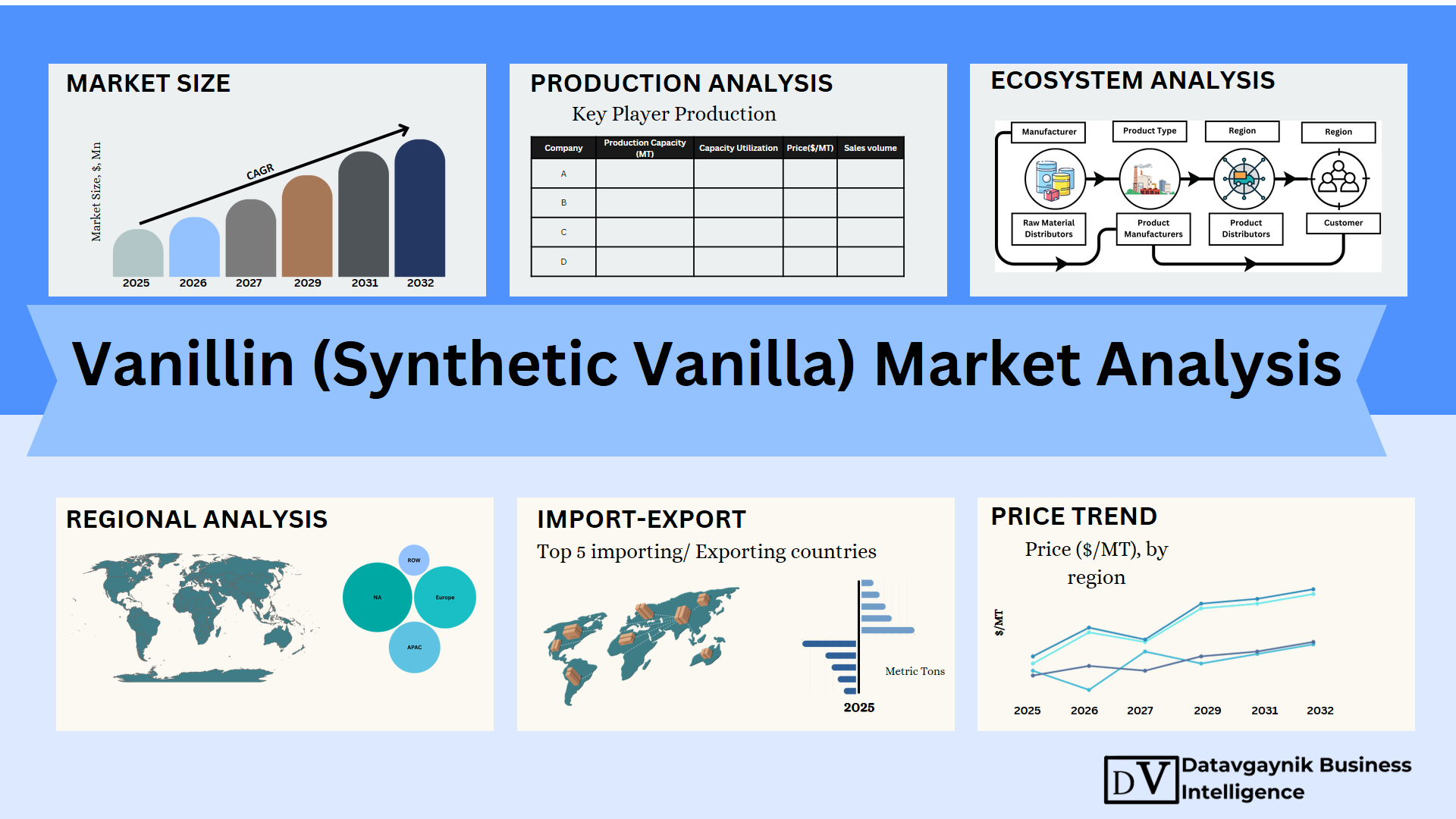
The market covers industrially produced vanillin used to deliver vanilla-like aroma and taste across food, beverages, fragrances, personal care, pharmaceuticals, animal nutrition, and selected chemical applications. It is not the same as natural vanilla extract. Synthetic vanillin is produced mainly through petrochemical and lignin-based routes, with smaller but rising interest in bio-based and fermentation-linked pathways.
Its business relevance is simple. Natural vanilla is expensive, supply-constrained, and exposed to crop volatility. Synthetic vanillin gives manufacturers a stable, scalable, and cost-controlled flavor ingredient. That makes it important for chocolate, bakery, dairy, confectionery, beverages, biscuits, ice cream, perfumes, oral care, and pharmaceutical masking agents.
For 2026–2035, the Vanillin (Synthetic Vanilla) Market will be shaped by four practical forces.
First, packaged food demand remains the volume anchor. Vanilla flavor is still one of the most widely used aroma profiles in sweet foods. Even when brands move toward “natural” labels, synthetic vanillin continues to serve mass-market products where price, consistency, and availability matter more than premium positioning.
Second, production economics are becoming more important. Chinese producers hold a strong position in cost-competitive synthetic vanillin supply. European and specialty producers remain relevant where quality, traceability, lignin-based origin, or regulatory assurance is valued. This split will keep pricing competitive but also create room for differentiated grades.
Third, clean-label pressure is changing customer behavior. Some food and beverage companies are reducing artificial flavor claims in premium lines. That said, synthetic vanillin will not disappear. It will remain embedded in mainstream products, private label foods, institutional bakery mixes, and industrial flavor systems where affordability drives formulation choices.
Fourth, bio-based vanillin is gaining strategic attention. It is still a smaller share of the market, but it may influence procurement decisions in Europe, North America, and premium personal care. The challenge is scale and price. Buyers like the sustainability story, but they rarely accept a steep cost jump unless the end product can carry a premium claim.
| Metric | Estimate / Outlook |
| Global Market Size, 2026 | $720 million |
| Projected Market Size, 2035 | $1,080 million |
| CAGR, 2026–2035 | 4.6% |
| Estimated Demand Base, 2026 | ~27,000–30,000 metric tons |
| Core Demand Driver | Packaged food and industrial flavor manufacturing |
| Strategic Growth Driver | Bio-based, lignin-derived, and traceable aroma ingredients |
Key consumers and clients include Nestlé, Mondelez International, Unilever, Mars, Danone, General Mills, PepsiCo, Coca-Cola, L’Oréal, Procter & Gamble, Haleon, Givaudan, DSM-Firmenich, IFF, Symrise, Kerry Group, and regional bakery, dairy, confectionery, beverage, fragrance, and pharmaceutical manufacturers.
The Vanillin (Synthetic Vanilla) Market is not a high-drama market. It is a formulation backbone market. Growth comes from steady consumption, wider packaged food penetration, and replacement of inconsistent natural vanilla inputs in price-sensitive applications. The premium end will talk more about naturalness and origin. The volume end will still buy on cost, safety, purity, and reliable supply.
Expert view: Synthetic vanillin will remain difficult to replace in mass-market food production. The real shift will not be away from synthetic vanillin entirely. It will be toward clearer segmentation between low-cost standard grades, traceable lignin-based grades, and higher-value bio-based grades.
Market Segmentation and Forecast Scope
The Vanillin (Synthetic Vanilla) Market can be segmented by product type, production route, application, end user, and region. This structure keeps the scope practical and non-overlapping. It also reflects how buyers actually evaluate vanillin: performance first, then origin, compliance, price, and supply reliability.
By Product Type
The market includes standard vanillin, ethyl vanillin, and specialty vanillin blends.
Standard vanillin is the largest commercial category. It is used in chocolates, bakery, dairy, beverages, biscuits, cereals, desserts, and flavor compounds. It offers the classic vanilla aroma at a manageable cost.
Ethyl vanillin is stronger and more intense than standard vanillin. It is used where formulators need a higher-impact vanilla note at lower dosage. It is common in confectionery, beverages, fragrances, and flavor systems where aroma strength matters.
Specialty blends include vanillin combinations with maltol, ethyl maltol, coumarin-free aroma systems, and other flavor enhancers. These are usually developed by flavor houses for specific customer formulations.
In 2026, standard vanillin is estimated to account for about 72% of global revenue. This share is visible because it defines the commercial center of the market. Other product splits are better kept for detailed report modeling.
By Production Route
The main production routes include guaiacol-based synthetic vanillin, lignin-based vanillin, and bio-based or fermentation-linked vanillin.
Guaiacol-based synthetic vanillin remains the mainstream route. It is cost-efficient and scalable. Most high-volume food and fragrance users depend on this supply base because it gives stable purity and predictable availability.
Lignin-based vanillin has a differentiated positioning. It is often valued for its renewable raw material association and strong aroma profile. Its scale is smaller than guaiacol-based production, but it has strategic relevance in Europe and in sustainability-led procurement.
Bio-based or fermentation-linked vanillin is the most strategic emerging route. It appeals to customers seeking natural-like or sustainability-oriented aroma ingredients. However, its broader adoption depends on cost reduction, production reliability, certification, and customer willingness to pay.
By Application
The key applications are food and beverages, fragrances and personal care, pharmaceuticals, animal nutrition, and industrial or chemical intermediates.
Food and beverages represent the main demand pool. Vanillin is used in bakery, chocolate, ice cream, dairy drinks, desserts, syrups, beverages, breakfast cereals, and processed snacks. In 2026, this application is estimated to hold around 64% of global market value.
Fragrances and personal care use vanillin for warm, sweet, creamy, and gourmand notes. It is found in perfumes, soaps, lotions, deodorants, hair care, and oral care products.
Pharmaceuticals use vanillin mainly as a flavoring and masking agent. It helps improve taste in syrups, chewables, oral formulations, and pediatric medicines.
Animal nutrition is a smaller but steady application. It is used to improve feed palatability, especially in young animal feed and specialty nutrition products.
Industrial and chemical uses include selected synthesis and intermediate applications. These remain smaller than flavor and fragrance demand.
By End User
The major end users include food and beverage manufacturers, flavor and fragrance houses, cosmetics and personal care companies, pharmaceutical companies, animal feed manufacturers, and chemical processors.
Flavor and fragrance houses are especially important because many large food and personal care companies do not buy vanillin as a standalone ingredient. They buy it inside a finished flavor or fragrance system. So, the buying power sits not only with consumer brands but also with formulators such as Givaudan, DSM-Firmenich, IFF, Symrise, Kerry Group, and other regional flavor specialists.
Food manufacturers remain the largest downstream user group. Large chocolate, biscuit, dairy, bakery, beverage, and dessert brands drive repeated demand.
Personal care and fragrance users are more value-oriented. They may accept specialty grades if the aroma profile, stability, or sustainability positioning supports a premium product.
By Region
The forecast covers North America, Europe, Asia Pacific, and LAMEA.
Asia Pacific is the largest and most supply-driven region. China plays a central role in production, exports, and price competitiveness. Demand is also rising from packaged foods, confectionery, bakery, beverages, and personal care across China, India, Southeast Asia, Japan, and South Korea.
Europe is quality- and compliance-focused. It has strong demand from flavor houses, premium food processors, fragrance companies, and sustainability-led ingredient buyers. Lignin-based and bio-based positioning has better traction here than in purely price-led markets.
North America has a mature but stable demand base. Growth is tied to processed food reformulation, premium snacks, dairy alternatives, beverages, and personal care products.
LAMEA is smaller but expanding. Growth is linked to urban retail, packaged food penetration, local confectionery, bakery production, and personal care manufacturing in Latin America, the Middle East, and parts of Africa.
The fastest-growing strategic sub-segments are expected to be bio-based vanillin, lignin-based vanillin, and personal care/fragrance applications. These do not replace the mainstream synthetic base overnight. They create higher-value pockets inside an otherwise volume-led market.
Market Trends and Innovation Landscape
The Vanillin (Synthetic Vanilla) Market is evolving through process optimization, cleaner production routes, flavor system innovation, and tighter procurement scrutiny. The product may look simple, but the market around it is becoming more segmented. Buyers now ask tougher questions on origin, residual solvents, carbon footprint, certifications, purity, odor profile, and long-term supply security.
R&D Evolution
R&D is moving in three directions.
The first is process efficiency. Producers are working on yield improvement, waste reduction, energy efficiency, and better control over impurities. This matters because vanillin is a competitive ingredient. Small improvements in production economics can protect margins when pricing is under pressure.
The second is aroma profile improvement. Standard vanillin needs to perform consistently across chocolate, dairy, bakery, beverages, and fragrance systems. Stability under heat, pH variation, and long shelf life remains important. Flavor houses are also building more complex vanilla profiles using vanillin with enhancers and modifiers.
The third is sustainable sourcing. Lignin-derived and bio-based vanillin are attracting more attention from customers that want stronger environmental positioning. This is most relevant in Europe, premium food, fine fragrance, and personal care.
Expert view: The future opportunity is not just selling more vanillin. It is selling the right vanillin into the right claim space. Cost-led synthetic grades will serve mass food. Bio-based and traceable grades will serve premium formulations.
Technology Evolution
The core technology base remains mature. Guaiacol-based synthesis is commercially established and will continue to dominate volume supply. However, producers are refining reaction control, purification, crystallization, and quality systems to improve consistency and reduce production losses.
Lignin-based production has a different value story. It connects vanillin to wood-based raw material streams and can support a more renewable positioning. The route is not as widely available as mainstream synthetic production, but it has a distinct place in the market.
Bio-based production is the most innovation-heavy area. Fermentation-linked routes and biotechnology-assisted pathways are being explored to produce vanillin from renewable feedstocks. These routes may appeal to brands looking for a more natural or sustainable claim. Still, cost parity remains a challenge. Scale-up is not easy either.
Material science is relevant in a limited but practical way. Packaging compatibility, ingredient stability, crystallization behavior, solubility, and controlled release matter for finished formulations. For example, bakery premixes need stable aroma delivery during heat processing. Personal care products need odor stability across emulsions and surfactant systems.
AI is not a core market driver here. It may support flavor formulation, demand forecasting, quality control, and process analytics. But it is not reshaping the market in the way it is reshaping drug discovery or semiconductor design. So, it should be treated as a supporting tool, not a headline trend.
Partnerships, Mergers, and Announcements
The most relevant activity is not always large-scale M&A. Much of the movement happens through supply agreements, flavor formulation partnerships, capacity upgrades, and sustainability-linked ingredient launches.
Flavor and fragrance companies are expanding vanilla-type solutions that blend synthetic vanillin, natural extracts, and aroma enhancers. This allows them to serve different price points without depending fully on expensive natural vanilla. It also gives food companies more flexibility during crop-linked vanilla price swings.
Specialty ingredient companies are promoting bio-based and traceable aroma ingredients. These announcements usually target premium food, beverage, beauty, and fragrance customers rather than the full commodity market.
Chinese and Asian producers continue to influence global price direction through scale, exports, and competitive supply. Meanwhile, European suppliers focus more on quality assurance, compliance, renewable-origin positioning, and long-term customer relationships.
Commercial Impact Through 2035
The Vanillin (Synthetic Vanilla) Market will likely split into three layers by 2035.
The first layer will be commodity synthetic vanillin, where price, purity, and supply reliability dominate.
The second layer will be differentiated synthetic and lignin-based vanillin, where customers pay for better traceability, origin story, and compliance comfort.
The third layer will be bio-based vanillin, where growth depends on brand claims, certification, and cost reduction.
This structure gives suppliers more room to position their portfolios. It also gives buyers more choices. A mass-market biscuit producer may choose standard synthetic vanillin. A premium dairy brand may test bio-based vanillin. A personal care company may prefer a softer aroma profile with documented sourcing.
Expert view: By 2035, the market will not be judged only by tonnage. It will be judged by formulation role, regulatory comfort, claim eligibility, and how well suppliers can protect customers from price and supply shocks.
Competitive Intelligence and Benchmarking
The competitive landscape is split between large aroma-chemical producers, China-based cost leaders, bio-based specialists, and flavor houses that influence downstream demand. The market is not crowded at the top. A limited group of suppliers controls meaningful capacity, while hundreds of distributors and compounders handle regional trade.
| Company | Portfolio and Positioning | Market Benchmark |
| Syensqo / Rhovanil Franchise | Strong position in high-purity vanillin used in bakery, chocolate, confectionery, dairy, beverages, vanilla sugar, and fragrance applications. The company highlights complete traceability, food safety certifications, and global production coverage for its branded vanillin range. | Premium global supplier. Strong with multinational flavor houses and large food manufacturers that need consistency, compliance, and supply assurance. |
| Borregaard | Focused on wood-based vanillin from Norway spruce. Its positioning is different from commodity guaiacol-based material. It sells into food, beverage, fragrance, personal care, and selected technical applications where renewable origin matters. | Sustainability-led specialist. Strong in Europe and premium applications. Borregaard states that its wood-based vanillin uses 100% renewable carbon and offers a major CO₂ reduction versus crude oil-based guaiacol vanillin. |
| Camlin Fine Sciences | Offers vanillin and ethyl vanillin under its aroma ingredient platform. Its Dahej facility in India is vertically integrated, from raw materials to finished aroma ingredients. | Important non-China supply option. The company states that its Dahej operation started commercial production of vanillin and ethyl vanillin with 6,000 MTPA capacity. This improves India’s role in global vanillin supply. |
| Jiaxing Zhonghua Chemical | Established China-based vanillin producer with a long operating history in aroma chemicals. Its strength is scale, upstream integration, and cost competitiveness. | One of China’s key suppliers. Strong in export markets, but exposed to trade duties in the United States and Europe. |
| Brother Enterprises / Jiangxi Brother Pharmaceutical | Active in vitamins, aroma ingredients, APIs, and related fine chemicals. Vanillin sits within its broader chemicals and ingredient portfolio. | Large China-based supplier. Competitive on scale and raw-material integration, but recent U.S. trade action has increased pressure on China-origin exports. |
| Kunshan Asia Aroma | Produces flavor and fragrance ingredients, including natural and synthetic aroma chemicals. Public company profiles show activity in natural vanillin from eugenol, vanillin from ferulic acid, and other fragrance/flavor materials. | Strategic in bio-based and natural-positioned vanillin. Also relevant because of its growing role in fermentation-derived bio-vanillin partnerships. |
| Chongqing Thrive Chemicals | Focused on vanillin, ethyl vanillin, and related derivatives. It is positioned more as a specialized Chinese aroma-chemical producer than a full global flavor house. | Smaller than the top-tier players, but relevant in ethyl vanillin and derivatives. Its manufacturing base supports price-sensitive customers and regional distributors. |
The core competitive issue is not just price. It is origin. Buyers now ask whether the product is China-origin, India-origin, Europe-origin, wood-based, fermentation-based, or mass-balance certified. This matters because trade duties, clean-label claims, and procurement risk now influence supplier selection.
Syensqo and Borregaard compete more on quality, traceability, and sustainability. Jiaxing Zhonghua Chemical, Brother Enterprises, Kunshan Asia Aroma, and Chongqing Thrive Chemicals compete through scale and manufacturing economics. Camlin Fine Sciences sits in a useful middle position. It gives buyers a scalable India-based alternative at a time when many global customers want to reduce dependence on China.
Expert view: The next phase of competition will be less about who can produce vanillin cheaply and more about who can prove supply security, regulatory comfort, and origin-based differentiation. That is where premium margins will sit.
Regional Landscape and Adoption Outlook
Regional demand is shaped by food manufacturing, fragrance use, supply access, pricing, and regulation. Asia remains the production center. Europe and the United States are becoming more selective. India is gaining relevance as an alternative supply base. Japan and South Korea are steady import-led markets. The Middle East is smaller, but useful for bakery, confectionery, and fragrance demand.
| Region / Country | Adoption Outlook | Key Market Notes |
| United States | Mature but stable demand. Growth comes from bakery, confectionery, dairy, beverages, oral care, and pharmaceutical masking applications. | The U.S. is shifting procurement behavior after trade action on China-origin vanillin. In June 2025, the U.S. Department of Commerce announced final affirmative determinations in antidumping and countervailing duty investigations on vanillin from China. The U.S. ITC later found injury to U.S. industry, leading to trade orders. |
| Europe | Quality-led and compliance-led market. Demand is strong from flavor houses, premium food, fine fragrance, cosmetics, and personal care. | Europe is one of the most important markets for traceable, wood-based, and bio-based vanillin. The EU imposed 131.1% definitive anti-dumping duties on China-origin vanillin in June 2025, which should support non-China and regional supply options. |
| China | Largest manufacturing base and major export hub. Domestic demand is also rising through packaged foods, beverages, personal care, and industrial flavor systems. | China remains the cost benchmark. Producers such as Jiaxing Zhonghua Chemical, Brother Enterprises, Kunshan Asia Aroma, and Chongqing Thrive Chemicals shape global pricing. That said, trade barriers in the U.S. and Europe may redirect more Chinese supply toward Asia, Latin America, Africa, and the Middle East. |
| India | High-growth supply and demand market. Demand is led by biscuits, bakery, confectionery, dairy products, beverages, pharma, and incense/fragrance applications. | Camlin Fine Sciences improves India’s position with its 6,000 MTPA vanillin and ethyl vanillin capacity at Dahej. This supports import substitution and gives global buyers another scalable sourcing location. |
| Japan | Mature, quality-sensitive market. Demand is stable in confectionery, bakery, dairy, ice cream, beverages, oral care, and fine fragrance. | Japan is not a major global vanillin production hub. It is more of a high-specification import market. Buyers focus on purity, documentation, odor consistency, and supplier reliability. |
| South Korea | Smaller than Japan, but strategically useful. Growth comes from cosmetics, personal care, packaged desserts, beverages, and bakery. | South Korea is import-dependent. Its beauty and fragrance ecosystem creates higher-value demand for cleaner aroma profiles and specialty grades. Standard synthetic grades remain relevant in food manufacturing. |
| Middle East | Relevant as a demand and distribution market. Growth is driven by packaged bakery, confectionery, dairy desserts, beverages, perfumes, and home fragrance. | The UAE and Saudi Arabia are the main commercial centers. The region does not have a major vanillin production base, so trade flows depend on China, Europe, India, and international distributors. |
Asia Pacific will remain the largest supply base through 2035. But supply strategy will change. Large buyers will likely avoid depending on one geography. So, China will stay critical, India will gain share, Europe will protect premium and sustainable grades, and the United States will push for diversified sourcing.
Regulation will matter most in the United States and Europe. Infrastructure matters most in China and India. Funding and innovation matter most in Europe, North America, and selected biotech clusters working on fermentation-derived vanillin.
Expert view: The biggest regional shift is procurement diversification. Food and fragrance companies are not leaving China fully. They are adding backup supply from India, Europe, and bio-based producers to reduce tariff and disruption risk.
Recent Developments + Opportunities & Restraints
Recent Developments
| Year / Month | Event | Market Impact |
| 2026 – June | ENZIDIA, Refine Biology, and Kunshan Asia Aroma announced a long-term joint development and commercialization agreement for fermentation-derived bio-vanillin. | This is important because it brings together strain development, fermentation scale-up, and market access. If successful, it may reduce the cost gap between bio-based vanillin and conventional synthetic material. |
| 2026 – March | Lallemand Bio-Ingredients introduced Hevani, a natural vanillin produced through yeast-based precision fermentation. | This strengthens the natural and bio-based vanillin segment. It also gives food and beverage companies a crop-independent ingredient with 98% purity and EU/US natural status. |
| 2025 – June | The European Commission imposed definitive anti-dumping duties of 131.1% on imports of vanillin from China. | This directly changes European sourcing economics. It supports EU and non-China suppliers, while making China-origin imports less competitive in Europe. |
| 2025 – June | The U.S. Department of Commerce announced final affirmative determinations in antidumping and countervailing duty investigations on vanillin from China. | U.S. buyers are likely to diversify sourcing. India, Europe, and non-China suppliers may benefit from this shift, especially in food-grade and fragrance-grade vanillin. |
| 2025 – June | The U.S. International Trade Commission found that imports of vanillin from China injured U.S. industry. | This cleared the way for antidumping and countervailing duty orders, tightening access for China-origin vanillin in the U.S. market. |
Opportunities and Business Insights
Emerging markets
India, Southeast Asia, Latin America, and the Middle East offer steady volume growth. Demand is tied to biscuits, bakery, confectionery, dairy, beverages, personal care, and local fragrance manufacturing. These markets still buy heavily on price, so standard synthetic vanillin will remain the main product.
Bio-based and traceable grades
Wood-based, fermentation-derived, and mass-balance vanillin can grow faster than the base market. The volume may stay smaller, but margins should be better. Premium food, personal care, and fine fragrance customers are the best targets.
Supply chain diversification
Trade duties on Chinese vanillin create room for India-based and Europe-based suppliers. Buyers may build dual-sourcing models instead of chasing the lowest price. That gives suppliers with stable quality and documentation a stronger commercial position.
Restraints
Price pressure from commodity synthetic grades
Standard vanillin is still price-sensitive. When Chinese supply is redirected into less restricted regions, pricing pressure may rise in Asia, Africa, Latin America, and the Middle East.
Clean-label pressure
Some premium food companies may reduce use of artificial flavoring claims. This does not remove synthetic vanillin from the market, but it limits its upside in high-end packaged foods.
Bio-based cost gap
Fermentation-derived and wood-based vanillin may grow, but cost remains a barrier. Many customers will test these grades only when the finished product can support a premium price.


