

Global Overview of the Alcoxylated water soluble polymer Market
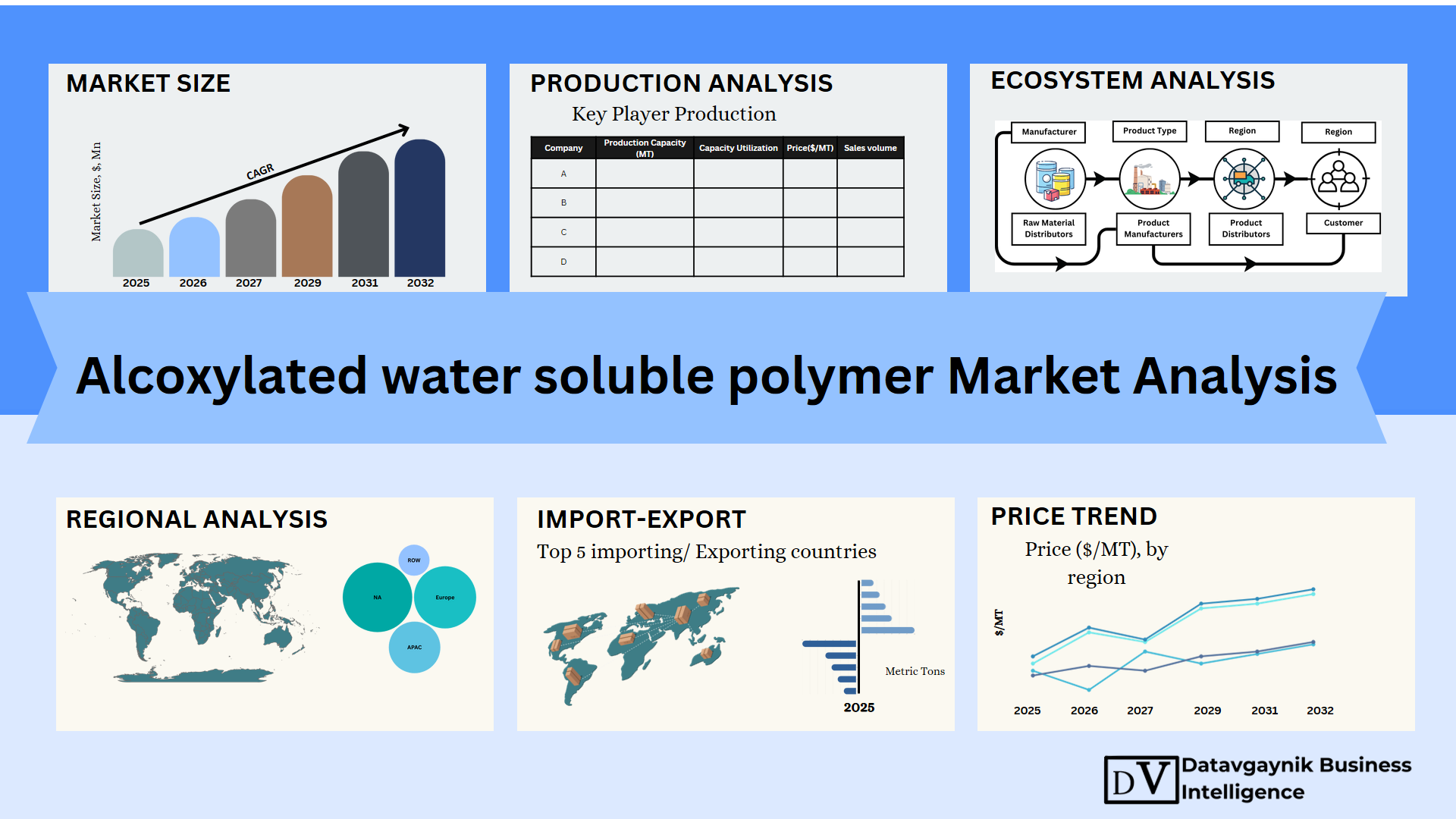
The Alcoxylated water soluble polymer Market is entering a phase of sustained, demand-led expansion as downstream industries seek higher-performing, more sustainable chemistries. Datavagyanik estimates that global consumption in this space is growing at around 6–7% annually, supported by rising use in home care, personal care, industrial cleaning, coatings, and oilfield formulations. As formulators shift from commodity additives to functional polymers that enhance rheology, dispersion, and solubility, the Alcoxylated water soluble polymer Market Size is expected to expand faster than many conventional surfactant categories. For instance, manufacturers are increasingly using these polymers to improve stability in concentrated liquid detergents and water-based coatings, which directly lifts demand across both mature and emerging markets.
Macro Demand Shifts Shaping the Alcoxylated water soluble polymer Market
Structural shifts in end-user behavior are reshaping the Alcoxylated water soluble polymer Market. Urbanization, rising disposable incomes, and premiumization of consumer products are driving higher spend on advanced detergents, personal care products, and specialty coatings. Datavagyanik notes that global home and personal care formulations are growing at 4–6% per year, and specialty blends using alcoxylated polymers are outpacing this by an estimated 1–2 percentage points. For example, as brands launch compact, high-active liquid detergents and capsule formats, they require polymers that maintain clarity, prevent phase separation, and deliver controlled release, thereby supporting accelerated growth in the Alcoxylated water soluble polymer Market across key consumer categories.
Alcoxylated water soluble polymer Market in Home and Personal Care Applications
Home and personal care remains one of the largest and fastest-maturing application clusters for the Alcoxylated water soluble polymer Market. These polymers enable multifunctional performance—such as soil release, foam stabilization, thickening, and improved mildness—in shampoos, body washes, dishwashing liquids, and fabric detergents. Datavagyanik estimates that the share of functional polymers in premium detergents has risen from roughly 15% to nearly 25% of active content over the last decade, in value terms.
As multinational FMCG companies roll out new product lines in Asia-Pacific, Latin America, and the Middle East, the Alcoxylated water soluble polymer Market is expected to capture disproportionate value from higher-priced, differentiated product formats. This direct link between formulation sophistication and polymer usage anchors long-term demand visibility in the segment.
Industrial and Institutional Cleaning Trends in the Alcoxylated water soluble polymer Market
Industrial and institutional (I&I) cleaning is another strong demand pillar for the Alcoxylated water soluble polymer Market, supported by stricter hygiene standards in healthcare, food processing, hospitality, and public infrastructure. For instance, the global I&I cleaning chemicals segment has been expanding at around 5% annually, driven by heightened awareness of sanitation and infection control. Within this, the use of high-performance polymers that enhance cleaning efficiency, reduce residue formation, and function in hard water conditions is rising steadily. Datavagyanik highlights that formulators are increasingly replacing traditional builders and phosphates with polymer-based systems, which boosts both volume and value growth in the Alcoxylated water soluble polymer Market as customers seek concentrated, easy-rinse, and low-foaming systems.
Alcoxylated water soluble polymer Market in Paints, Coatings, and Construction
The shift toward waterborne technologies in paints, coatings, and construction chemicals is a major driver for the Alcoxylated water soluble polymer Market. In architectural and industrial coatings, these polymers function as dispersants, rheology modifiers, and stabilization aids, enhancing pigment dispersion and film uniformity. With waterborne coatings now accounting for more than 60% of architectural coatings sales in several developed markets, the reliance on robust water-soluble polymer systems is increasing. Datavagyanik expects that as construction activities expand in Asia-Pacific and Africa at mid-single-digit rates, demand for water-based paints, sealants, and admixtures will continue to climb, creating a multiplier effect for the Alcoxylated water soluble polymer Market through higher polymer loadings per formulation and increased penetration of eco-friendly chemistries.
Oil, Gas, and Mining Applications Driving the Alcoxylated water soluble polymer Market
In oil, gas, and mining, process efficiency and fluid control needs are fueling growth in the Alcoxylated water soluble polymer Market. These polymers play roles in enhanced oil recovery, drilling fluids, and mineral processing, where they help manage viscosity, fluid loss, and solid suspension. For example, as unconventional oil and gas operations expand in regions such as North America and parts of Asia, operators increasingly adopt advanced polymer chemistries to optimize well performance and reduce water usage.
Datavagyanik observes that specialty chemical consumption per barrel produced is rising, and a portion of this incremental spend is flowing into the Alcoxylated water soluble polymer Market. Over the medium term, this segment is expected to support steady demand growth even as the broader energy mix transitions toward lower-carbon sources.
Regional Dynamics and Trade Flows in the Alcoxylated water soluble polymer Market
Regionally, Asia-Pacific is emerging as the demand and production hub for the Alcoxylated water soluble polymer Market, backed by strong manufacturing bases in China, India, and Southeast Asia. The region benefits from robust growth in detergents, personal care, coatings, and infrastructure, translating into higher consumption of water-soluble polymers. For instance, Datavagyanik estimates that Asia-Pacific accounts for more than 40% of global volume in several key polymer classes used in home care and coatings.
At the same time, Europe and North America retain leadership in high-value, customized grades and technology development. This creates a dynamic trade structure in the Alcoxylated water soluble polymer Market, where technology-rich regions export specialized products while importing bulk intermediates or finished formulations from cost-competitive Asian plants.
Technology, Sustainability, and Product Innovation in the Alcoxylated water soluble polymer Market
Innovation around sustainability is redefining the competitive landscape in the Alcoxylated water soluble polymer Market. Producers are investing in bio-based feedstocks, low-VOC formulations, and biodegradable or partially renewable polymers to align with regulatory pressures and brand-owner commitments. For example, several leading suppliers are piloting alcoxylated polymers derived from plant-based alcohols and ethylene oxide alternatives, targeting reduced carbon footprints without compromising performance. Datavagyanik notes that such innovation often commands price premiums of 10–20%, enhancing the value growth trajectory of the Alcoxylated water soluble polymer Market. In parallel, digital tools and advanced analytics in process control are helping manufacturers tighten quality specifications, reduce batch variability, and optimize molecular weight distributions, all of which improve customer acceptance and repeat demand.
Strategic Outlook for Stakeholders in the Alcoxylated water soluble polymer Market
Looking ahead, the strategic outlook for the Alcoxylated water soluble polymer Market is underpinned by a combination of volume growth in core applications and value growth via specialization. The Alcoxylated water soluble polymer Market Size is expected to be increasingly influenced by shifts in formulation design, sustainability criteria, and regulatory frameworks across key regions. For instance, as regulations tighten around microplastics, phosphates, and VOCs, formulators are likely to accelerate the substitution of older chemistries with high-performance, water-soluble polymers.
Datavagyanik expects that suppliers who invest in application-focused R&D, offer technical service to optimize customer formulations, and secure backward integration in key monomers will outperform the broader Alcoxylated water soluble polymer Market. Over the medium term, this could translate into share gains for innovation-led players and a clear differentiation between commodity-grade and specialized polymer producers.
Regional demand dynamics in the Alcoxylated water soluble polymer Market
The Alcoxylated water soluble polymer Market is geographically anchored by three major demand hubs: Asia-Pacific, North America, and Europe. Datavagyanik estimates that Asia-Pacific alone accounts for roughly 40–45% of global consumption, supported by rapid growth in detergents, personal care, and waterborne coatings. For instance, home and personal care revenues in large economies such as China and India have been expanding at 7–9% annually, which is significantly above the global average.
This growth is directly translating into higher polymer usage per capita and pushing the Alcoxylated water soluble polymer Market to scale up capacity in the region. North America and Europe together represent another 40% of the Alcoxylated water soluble polymer Market, with demand driven by high-performance, regulatory-compliant formulations in home care, I&I cleaning, and advanced coatings.
Asia-Pacific production footprint in the Alcoxylated water soluble polymer Market
From a manufacturing standpoint, the Alcoxylated water soluble polymer Market has seen a structural shift toward Asia-Pacific over the last decade. Datavagyanik observes that several leading multinational producers have located new plants or expansions in China, India, and Southeast Asia, leveraging cost-effective feedstocks and proximity to downstream customers. For example, ethoxylation and propoxylation units integrated with local ethylene oxide and propylene oxide supply are enabling competitive Alcoxylated water soluble polymer production clusters. As a result, Asia-Pacific now contributes an estimated 50–55% of global installed capacity. This regional production advantage is reinforcing export competitiveness and enabling local suppliers to play a larger role in the global Alcoxylated water soluble polymer Market, particularly in standard and mid-performance grades.
Mature markets and specialization in the Alcoxylated water soluble polymer Market
While Asia-Pacific leads in volume, Europe and North America retain strategic importance in the Alcoxylated water soluble polymer Market through specialization and innovation. Datavagyanik highlights that these mature markets focus on high-purity, low-residual monomer, and tailor-made grades for sensitive applications such as personal care, pharmaceuticals-related processing aids, and high-end coatings. For instance, specialty polymer grades designed for low-VOC architectural paints or sulfate-free shampoos often originate from European and North American R&D centers. This reinforces the role of these regions as technology exporters within the Alcoxylated water soluble polymer Market, even as some production is gradually relocated or duplicated in Asia to serve local customers more efficiently.
Trade flows and regional balance in the Alcoxylated water soluble polymer Market
Trade patterns in the Alcoxylated water soluble polymer Market are increasingly shaped by regional surpluses and deficits. Asia-Pacific, with its growing production base, is evolving into a net exporter for several polymer grades to Latin America, Middle East, and parts of Africa. For example, formulators in Brazil, Mexico, and South Africa are importing cost-competitive polymers from Asian plants while continuing to source highly specialized grades from Europe or North America. Datavagyanik notes that this dual sourcing strategy helps downstream users balance cost and performance. The Alcoxylated water soluble polymer Market therefore exhibits a complex trade matrix in which logistics costs, tariff regimes, and local regulatory approvals all influence sourcing decisions.
Segment-wise demand structure in the Alcoxylated water soluble polymer Market
The Alcoxylated water soluble polymer Market is segmented across home and personal care, industrial and institutional cleaning, paints and coatings, oil and gas, and other industrial applications such as textiles, paper, and adhesives. Datavagyanik estimates that home and personal care represents roughly 30–35% of total demand, followed by I&I cleaning and coatings each contributing 15–20%. For instance, the shift toward concentrated detergents and premium shampoos has increased polymer loadings per formulation by several percentage points over the last decade, reinforcing the centrality of these end uses. Oil and gas, though smaller in volume, contributes disproportionately to value in the Alcoxylated water soluble polymer Market due to the higher performance requirements and pricing of specialized products.
Value-driven niche segments in the Alcoxylated water soluble polymer Market
Within each end-use cluster, the Alcoxylated water soluble polymer Market is further fragmented into niche application segments that command distinct pricing and margin profiles. For example, polymers used as rheology modifiers in high-gloss waterborne coatings or as dispersants in advanced pigment systems are typically positioned at a premium to standard detergent-grade products. Similarly, polymers designed for enhanced oil recovery or complex drilling environments are priced significantly higher due to performance-critical specifications. Datavagyanik observes that these niches, while smaller in volume, can grow at 8–10% annually, outpacing the broader Alcoxylated water soluble polymer Market and contributing meaningfully to overall profitability.
Alcoxylated water soluble polymer Price dynamics across regions
Alcoxylated water soluble polymer Price is strongly influenced by feedstock trends in ethylene oxide, propylene oxide, and relevant alcohols, in addition to energy and logistics costs. In periods of tight supply for key feedstocks, Alcoxylated water soluble polymer Price can spike by 10–20% within a year, particularly in regions that rely heavily on imports. For instance, when crude oil and naphtha markets experience volatility, the downstream cost chain for oxides and derivatives tightens, feeding into the Alcoxylated water soluble polymer Market. Datavagyanik notes that producers in integrated complexes with captive oxide units generally show more stable Alcoxylated water soluble polymer Price Trend, while non-integrated formulators experience higher margin pressure and may pass on costs with a lag.
Short-term and medium-term Alcoxylated water soluble polymer Price Trend
In the short term, Alcoxylated water soluble polymer Price Trend tends to follow cycles in petrochemical feedstocks and regional supply-demand imbalances. For example, when new capacity comes online in Asia-Pacific, regional oversupply can temporarily soften Alcoxylated water soluble polymer Price, especially for commoditized grades used in detergents and I&I cleaning. Conversely, unplanned outages in major plants or constraints in ethylene oxide availability can reverse this trend and firm up prices. Over the medium term, Datavagyanik expects a more balanced Alcoxylated water soluble polymer Price Trend, with average annual increases in the low to mid-single-digit range as producers seek to recover higher compliance, sustainability, and innovation costs embedded in the Alcoxylated water soluble polymer Market.
Premiumization and differentiation in Alcoxylated water soluble polymer Price structures
The Alcoxylated water soluble polymer Market is also experiencing growing price differentiation between standard and specialty grades. Alcoxylated water soluble polymer Price for bio-based, low-VOC, or highly tailored products can exceed conventional grades by 15–30%, depending on the application and performance benefits delivered. For instance, a bio-based grade designed for eco-labeled household cleaners may justify a significant premium if it enables customers to meet certification requirements and charge higher retail prices. Datavagyanik highlights that this premiumization is structurally altering the Alcoxylated water soluble polymer Price Trend, with value growth increasingly decoupled from purely volume-driven dynamics.
Regional cost competitiveness and Alcoxylated water soluble polymer Price
Regional cost competitiveness remains a critical factor in the Alcoxylated water soluble polymer Market. In Asia-Pacific, lower manufacturing overheads and proximity to feedstocks often translate into more competitive Alcoxylated water soluble polymer Price levels for large-volume standard grades. By contrast, Europe and North America typically sustain higher prices, but offset this with advanced performance, tighter specifications, and regulatory support. For example, compliance with stringent environmental and safety regulations in Europe adds cost but also raises entry barriers, allowing established players to maintain firm pricing. Datavagyanik expects that as environmental regulations tighten globally, these structural factors will continue to shape regional Alcoxylated water soluble polymer Price Trend and influence investment decisions.
Strategic implications of price evolution in the Alcoxylated water soluble polymer Market
The interaction of demand growth, regional production shifts, and evolving pricing structures carries significant strategic implications for stakeholders in the Alcoxylated water soluble polymer Market. Downstream formulators must actively manage exposure to Alcoxylated water soluble polymer Price volatility through long-term contracts, diversified sourcing, and value-engineered formulations. At the same time, polymer producers need to segment their portfolios carefully, using specialization and sustainability-driven innovation to defend margins even when base commodity prices soften. Datavagyanik emphasizes that those able to anticipate shifts in Alcoxylated water soluble polymer Price Trend, align capacity expansions with regional demand hotspots, and capture growth in higher-value segments will be best positioned to consolidate share in the evolving Alcoxylated water soluble polymer Market.
Global leadership pattern in the Alcoxylated water soluble polymer Market
The Alcoxylated water soluble polymer Market is dominated by a relatively concentrated group of multinational chemical manufacturers that control a sizeable share of global capacity, technology, and customer relationships. Datavagyanik estimates that the top ten producers together command roughly 55–60% of the Alcoxylated water soluble polymer Market, with the top five suppliers alone accounting for around 40–45% of global sales. This level of concentration gives leading players strong influence over new product introductions, qualification timelines with major FMCG and coatings customers, and the pace at which sustainable chemistries penetrate the Alcoxylated water soluble polymer Market worldwide.
Tier-one multinational manufacturers in the Alcoxylated water soluble polymer Market
At the core of the Alcoxylated water soluble polymer Market are large integrated groups such as BASF, Dow, Clariant, Evonik, Croda, Lubrizol and Ashland. These companies operate world-scale ethoxylation and propoxylation assets and supply a broad range of alcoxylated surfactants, dispersants and water-soluble polymers. For instance, BASF’s portfolios marketed under names such as Lutensol, Dehypon, Sokalan and Pluriol serve laundry detergents, I&I cleaners, personal care and waterborne coatings, making BASF one of the most visible brands in the Alcoxylated water soluble polymer Market. Similarly, Dow’s well-known TERGITOL, ECOSURF and TRITON lines are widely used in home care and industrial cleaning formulations, reinforcing Dow’s strong share of the Alcoxylated water soluble polymer Market in both mature and emerging regions.
Regional specialists and emerging champions in the Alcoxylated water soluble polymer Market
Alongside these global majors, the Alcoxylated water soluble polymer Market features a rapidly growing tier of regional producers based in China, India, Southeast Asia, the Middle East and Latin America. These companies typically start with commodity alcohol ethoxylates and gradually extend into more differentiated, water-soluble polymer systems tailored to local detergent, personal care and coatings customers. For example, several Indian and Chinese manufacturers now offer custom-cut nonionic blends for liquid detergents and dishwashing liquids, helping regional brands compete more effectively. Datavagyanik observes that these emerging suppliers collectively hold roughly 35–40% of the Alcoxylated water soluble polymer Market, mainly in volume-driven, cost-sensitive segments, and their influence is expected to rise as domestic brands capture share from multinationals.
Manufacturer concentration and Alcoxylated water soluble polymer Market share distribution
From a market-structure standpoint, the Alcoxylated water soluble polymer Market shows a clear hierarchy. Datavagyanik maps the landscape into three broad tiers: top-five global leaders with individual shares in the mid-single to low-double digits; a second tier of regional or specialty players with 1–3% each of the Alcoxylated water soluble polymer Market; and a long tail of small local producers and formulators with sub-1% shares. In practical terms, this means that decisions by a handful of global leaders on capacity additions, feedstock strategy or portfolio rationalization can shift 5–10% of available supply in certain grades, altering bargaining power for buyers and redistributing Alcoxylated water soluble polymer Market share across regions and application segments.
Product portfolio strategies in the Alcoxylated water soluble polymer Market
Manufacturers differentiate themselves in the Alcoxylated water soluble polymer Market through the breadth and depth of their product lines. For instance, one major producer may focus strongly on nonionic alcohol ethoxylates for laundry and I&I cleaning, while another emphasizes complex copolymer dispersants and associative thickeners for coatings and personal care. Product families such as low-foam alcoxylated surfactants for automatic dishwashing, hydrophobically modified ethoxylated urethanes for rheology control, or block copolymers for metal cleaning create clear identity within the Alcoxylated water soluble polymer Market. Datavagyanik notes that manufacturers with both commodity backbones and high-margin specialties can better balance cycles, protecting overall Alcoxylated water soluble polymer Market share even when one end-use segment temporarily slows.
Competitive positioning and differentiation in the Alcoxylated water soluble polymer Market
Competitive advantage in the Alcoxylated water soluble polymer Market increasingly stems from three pillars: integration into oxide feedstocks, sustainability credentials and application know-how. Integrated producers with captive ethylene oxide and propylene oxide typically enjoy lower unit costs, allowing them to defend Alcoxylated water soluble polymer Market share in bulk home care and I&I grades.
At the same time, companies with strong sustainability positioning—offering bio-based alcoxylated products, low-VOC solutions and portfolios free from controversial chemistries—are gaining traction with global FMCG and coatings customers. For example, premium product lines designed to meet eco-label standards or retailer clean-label lists allow suppliers to capture above-average pricing while strengthening their role in the Alcoxylated water soluble polymer Market as strategic partners rather than transactional vendors.
Manufacturer market share by application focus in the Alcoxylated water soluble polymer Market
Datavagyanik also highlights that Alcoxylated water soluble polymer Market share varies significantly by end-use. Some manufacturers hold dominant positions in laundry liquids and fabric care through long-term relationships with leading FMCG brands, while others are over-indexed toward I&I cleaning, oilfield chemicals or coatings. For instance, a company with a strong legacy in architectural coatings may command double-digit share of the Alcoxylated water soluble polymer Market in rheology modifiers and dispersants but only a small share in home care surfactants.
This application-centric distribution of market share creates both risk and opportunity: suppliers deeply embedded in one segment benefit from high switching costs, but those with more diversified exposure can ride growth in multiple parts of the Alcoxylated water soluble polymer Market simultaneously.
Recent news, timelines and strategic moves in the Alcoxylated water soluble polymer Market
In recent years, industry developments have further reshaped the competitive landscape of the Alcoxylated water soluble polymer Market. Around 2021–2022, several leading producers announced capacity debottlenecks and brownfield expansions in North America, Europe and Asia-Pacific to relieve tightness in key alcoxylated intermediates and support growing demand from home and personal care. During 2022–2023, Datavagyanik notes a noticeable acceleration in sustainability-driven portfolio upgrades, with major companies launching new bio-based alcoxylated product lines and phasing out older, less compliant chemistries in the Alcoxylated water soluble polymer Market.
Between 2023 and 2025, emphasis has shifted toward Asia-centric investment, with new units in India, China and Southeast Asia designed to shorten supply chains and serve regional FMCG and coatings customers more efficiently. Over the same 2023–2025 period, industry alliances, formulation partnerships with major detergent and personal care brands, and selective M&A have continued to reallocate Alcoxylated water soluble polymer Market share toward producers that combine innovation, reliability of supply and deep application expertise. Collectively, these moves signal that manufacturers are actively positioning themselves for the next decade of growth in the Alcoxylated water soluble polymer Market rather than treating it as a mature, slow-change segment.
Market Scenario, Demand vs Supply, Average Product Price, Import vs Export, till 2035
- Global Alcoxylated water soluble polymer Market revenue and demand by region
- Global Alcoxylated water soluble polymer Market production and sales volume
- United States Alcoxylated water soluble polymer Market revenue size and demand by country
- Europe Alcoxylated water soluble polymer Market revenue size and demand by country
- Asia Pacific Alcoxylated water soluble polymer Market revenue size and demand by country
- Middle East & Africa Alcoxylated water soluble polymer Market revenue size and demand by country
- Latin America Alcoxylated water soluble polymer Market revenue size and demand by
- Import-export scenario – United States, Europe, APAC, Latin America, Middle East & Africa
- Average product price – United States, Europe, APAC, Latin America, Middle East & Africa
- Market player analysis, competitive scenario, market share analysis
- Business opportunity analysis
Key questions answered in the Global Alcoxylated water soluble polymer Market Analysis Report:
- What is the market size for Alcoxylated water soluble polymer in United States, Europe, APAC, Middle East & Africa, Latin America?
- What is the yearly sales volume of Alcoxylated water soluble polymer and how is the demand rising?
- Who are the top market players by market share, in each product segment?
- Which is the fastest growing business/ product segment?
- What should be the business strategies and Go to Market strategies?
The report covers Alcoxylated water soluble polymer Market revenue, Production, Sales volume, by regions, (further split into countries):
- Asia Pacific (China, Japan, South Korea, India, Indonesia, Vietnam, Rest of APAC)
- Europe (UK, Germany, France, Italy, Spain, Benelux, Poland, Rest of Europe)
- North America (United States, Canada, Mexico)
- Latin America (Brazil, Argentina, Rest of Latin America)
- Middle East & Africa
Table of Contents:
Alcoxylated Water-Soluble Polymer Market
- Introduction to Alcoxylated Water-Soluble Polymers
- Definition and Chemical Characteristics of Alcoxylated Polymers
- Mechanism of Water Solubility and Performance Enhancements
- Benefits of Alcoxylation in Polymer Applications
- Market Overview and Key Growth Drivers
- Current Market Landscape for Alcoxylated Water-Soluble Polymers
- Key Factors Driving Market Demand
- Challenges and Opportunities for Market Expansion
- Types of Alcoxylated Water-Soluble Polymers
- Classification Based on Alcoxylation Degree and Polymer Chain Length
- Variants and Functional Differences in Alcoxylated Polymers
- Innovations in Polymer Synthesis and Properties
- Applications of Alcoxylated Water-Soluble Polymers
- Role in Paints, Coatings, and Inks
- Use in Personal Care, Pharmaceuticals, and Cosmetics
- Adoption in Textile, Food, and Agricultural Industries
- Global Market Size and Forecast (2023-2035)
- Market Size Analysis and Growth Projections
- Regional Market Distribution and Demand Trends
- Long-Term Forecast for Alcoxylated Water-Soluble Polymers
- Regional Market Insights
- North America: Industrial Demand and Regulatory Landscape
- Europe: Key Market Developments and Regulatory Compliance
- Asia-Pacific: Emerging Market Growth and Opportunities
- Latin America and Middle East Market Trends
- Key Growth Drivers in Latin America
- Demand Expansion in the Middle East
- Regional Barriers to Market Growth and Opportunities
- Technological Advancements in Alcoxylated Polymers
- Innovations in Alcoxylation Technology
- Performance Enhancements and New Product Developments
- Future Technological Trends in Water-Soluble Polymer Chemistry
- Competitive Landscape and Key Market Players
- Leading Manufacturers and Market Share Distribution
- Competitive Strategies for Growth and Differentiation
- Collaborations, Mergers, and Strategic Alliances
- Manufacturing Processes and Cost Considerations
- Overview of Production Techniques for Alcoxylated Polymers
- Cost Factors Affecting Manufacturing and Efficiency
- Sustainable Manufacturing Practices and Their Impact on Costs
- Raw Materials and Sourcing
- Key Raw Materials in the Production of Alcoxylated Water-Soluble Polymers
- Sourcing Challenges and Pricing Dynamics
- Regional Variations in Raw Material Availability
- Pricing Trends and Market Profitability
- Pricing Models and Trends in the Alcoxylated Polymer Market
- Profitability Analysis and Market Dynamics
- Forecasting Pricing Trends and Influencing Factors
- Regulatory Landscape and Industry Standards
- Global and Regional Regulations Affecting Alcoxylated Polymers
- Environmental and Safety Compliance Requirements
- Impact of Regulations on Product Development and Market Access
- Sustainability and Environmental Impact
- Sustainable Solutions in Alcoxylated Polymer Production
- Biodegradable and Eco-Friendly Innovations
- Industry Movements Toward Reducing Environmental Impact
- Consumer Demand and Market Adoption
- Increasing Demand for Natural and Eco-Friendly Products
- Consumer Trends in Cosmetics, Pharmaceuticals, and Industrial Applications
- Role of Consumer Awareness in Shaping Product Offerings
- Supply Chain and Distribution Networks
- Key Distribution Channels for Alcoxylated Water-Soluble Polymers
- Logistics Challenges and Regional Distribution Variations
- Strategies for Efficient Global Distribution
- Barriers to Market Growth
- Technological Limitations and Performance Constraints
- Regulatory Challenges and Compliance Issues
- Economic Factors and Market Volatility
- Investment Opportunities and Market Potential
- Key Growth Segments and Investment Opportunities
- Emerging Market Trends and High-Growth Regions
- Risk and Return Assessment for Investors
- Market Outlook and Future Projections (2025-2035)
- Long-Term Market Growth Predictions
- Future Technological Developments and Their Impact
- Market Shifts and Potential for New Applications
- Strategic Recommendations for Industry Stakeholders
- Best Practices for Competing in the Alcoxylated Polymer Market
- Opportunities for Product Innovation and Market Expansion
- Approaches for Building Competitive Advantage and Sustainability
- Conclusion and Key Insights
- Summary of Market Insights and Opportunities
- Final Thoughts on the Future of Alcoxylated Water-Soluble Polymers
- Takeaways for Manufacturers, Distributors, and Investors
Other recently published reports:


