

Market Summary and Growth Forecast
The global Dementholised Peppermint Oil Market is valued at $455 million in 2026 and is expected to appreciate to $706 million by 2035, at a CAGR of 5.0%.
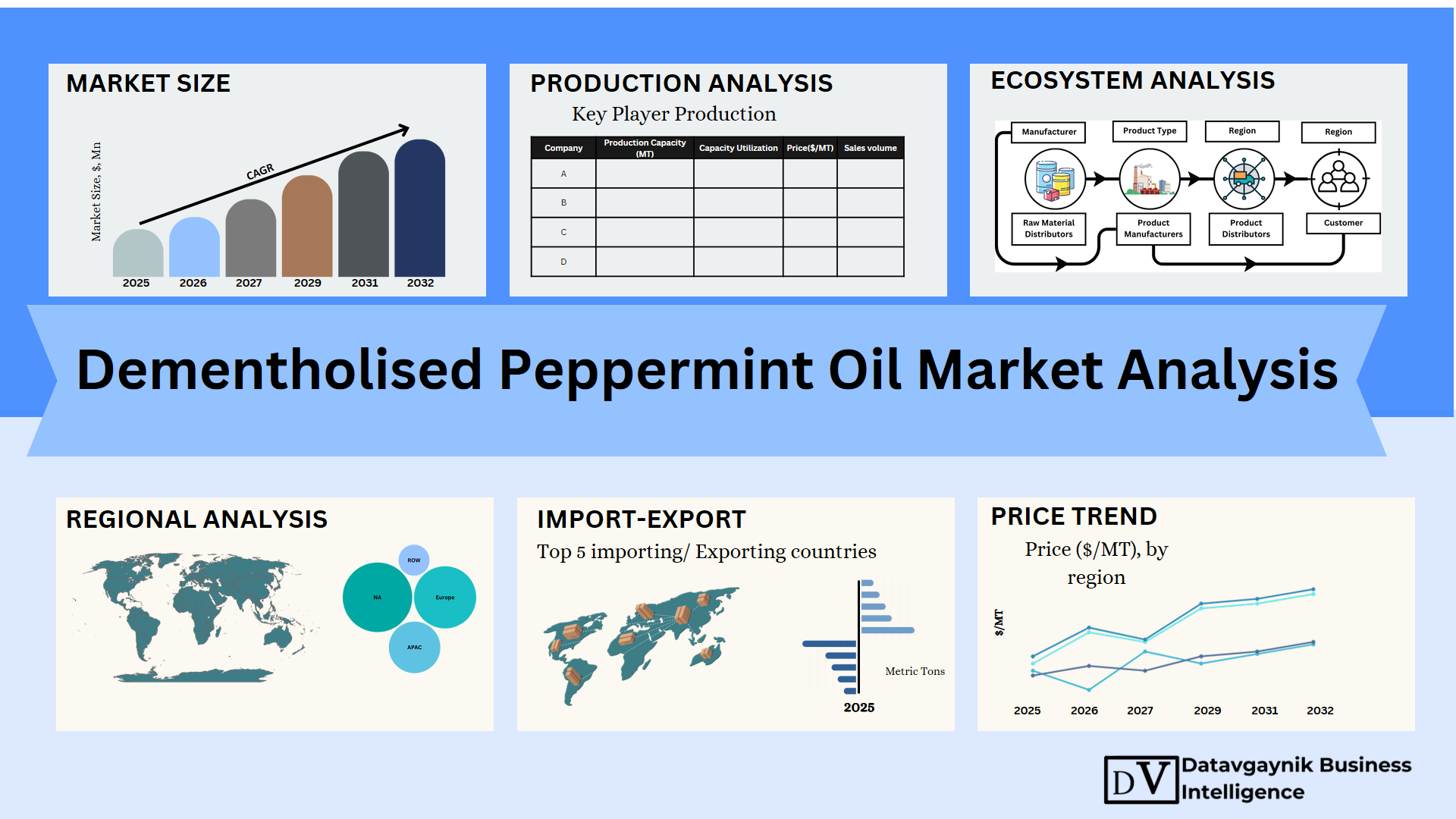
Dementholised peppermint oil is obtained after a large portion of natural menthol is separated from peppermint or mint oil. The remaining oil retains its cooling, aromatic, and flavour characteristics. It is widely used in oral-care products, confectionery, pharmaceuticals, cosmetics, fragrances, and household formulations.
The commercial value of the product lies in its balance of performance and cost. Manufacturers can obtain a stable mint profile without paying for the full menthol content of untreated oil. The ingredient also offers better formulation flexibility in products where strong cooling intensity is not required.
| Market indicator | Estimate |
| Global market size, 2026 | $455 million |
| Forecast market size, 2035 | $706 million |
| Forecast CAGR, 2026–2035 | 5.0% |
| Absolute revenue addition | $251 million |
| Leading production base | India |
| Major demand industries | Oral care, food, pharmaceuticals, personal care |
The Dementholised Peppermint Oil Market depends heavily on mint cultivation and primary oil distillation in India. Uttar Pradesh remains an important sourcing and processing area. China, the United States, and parts of Europe also participate in the wider mint-oil value chain, although their production economics and product mix differ.
Several forces will shape demand through 2035. Oral-care consumption is the most stable. Toothpaste, mouthwash, breath fresheners, and medicated dental products require familiar mint profiles and consistent sensory performance. Food demand is supported by chewing gum, confectionery, flavoured beverages, bakery products, and digestive preparations.
Production conditions will remain equally important. Mint-oil availability can change with cultivated acreage, weather, farm economics, and competing crop returns. Menthol prices also affect the commercial value of the residual oil. This creates a linked pricing structure: changes in menthol recovery economics can alter the supply and cost of dementholised oil.
Processing technology is moving toward better fraction control, lower thermal damage, and improved aroma retention. Vacuum distillation and controlled rectification help processors produce more consistent grades. Better chromatography and sensory testing also allow suppliers to manage variations in menthone, menthyl acetate, menthofuran, and residual menthol.
Regulation creates another filter. Food, pharmaceutical, and personal-care buyers increasingly require traceability, contaminant testing, allergen documentation, residual-solvent control, and compliance with applicable flavour and fragrance standards. So, suppliers with audited plants and reliable farm-level sourcing are likely to gain business from international clients.
Key consumers and clients include:
- Toothpaste and mouthwash manufacturers
- Confectionery and chewing-gum companies
- Flavour and fragrance houses
- Pharmaceutical formulators
- Cosmetic and personal-care brands
- Essential-oil blenders and distributors
- Household and wellness-product manufacturers
The Dementholised Peppermint Oil Market will therefore remain a specialised but commercially relevant part of the natural mint ecosystem. Its growth will be steady rather than aggressive, supported by recurring formulation demand and broader use of natural flavour ingredients.
Market Segmentation and Forecast Scope
The market can be assessed by product grade, application, end user, and region. These dimensions explain differences in purity, pricing, compliance requirements, and purchasing behaviour.
By Product Grade
- Food and flavour grade
- Pharmaceutical grade
- Cosmetic and fragrance grade
- Industrial and general-purpose grade
- Organic-certified grade
Food and flavour grade is estimated to account for approximately 44% of global revenue in 2026. Its lead comes from regular use in confectionery, chewing gum, beverages, oral fresheners, and flavour blends. Buyers in this segment focus on aroma stability, taste consistency, oxidation control, and food-safety documentation.
Pharmaceutical grade carries tighter specifications. It is used in topical products, digestive preparations, medicated oral-care formulations, inhalation products, and selected over-the-counter remedies. The segment commands higher average prices because of stricter testing, documentation, and impurity controls.
Cosmetic and fragrance grade supports soaps, shampoos, creams, balms, deodorants, and aromatic personal-care products. Demand is influenced by clean-label positioning and consumer interest in cooling botanical ingredients.
Organic-certified grade is expected to be the fastest-growing product category. Its current base is small, and supply remains constrained by certified cultivation, segregation, and documentation requirements. Even so, premium personal-care and natural-wellness brands are creating a viable commercial niche.
By Application
- Oral care
- Food and beverages
- Pharmaceutical preparations
- Personal care and cosmetics
- Fragrances and aromatherapy
- Household products
- Other industrial formulations
Oral care is projected to represent around 32% of the market in 2026, making it the largest disclosed application segment. Peppermint remains closely associated with freshness and cleanliness. This consumer perception supports its continued use in toothpaste, mouthwash, dental gels, breath sprays, and lozenges.
Food and beverage applications cover chewing gum, hard-boiled sweets, chocolate products, teas, syrups, flavoured water, and digestive products. Demand is broad, but formulations require close control of taste strength because dementholised oil provides aroma with a softer cooling effect than menthol-rich peppermint oil.
Pharmaceutical preparations form a smaller but strategically important segment. Product qualification cycles are longer, but approved suppliers can benefit from more stable customer relationships. Personal care also offers attractive prospects as brands expand botanical cooling and scalp-care formulations.
By End User
- Flavour and fragrance companies
- Consumer-goods manufacturers
- Pharmaceutical companies
- Food and beverage processors
- Cosmetics and personal-care manufacturers
- Contract formulators
- Ingredient distributors
Flavour and fragrance companies act as important intermediaries. They standardise natural oil, create proprietary blends, and supply finished flavour systems to consumer brands. Large consumer-goods manufacturers usually demand high consistency, audited supply chains, and multi-year supply security.
Contract formulators and regional distributors serve smaller clients that cannot purchase directly from processors. This channel is especially relevant in fragmented cosmetics, nutraceutical, and specialty-food markets.
By Region
- North America
- Europe
- Asia Pacific
- Latin America
- Middle East and Africa
Asia Pacific combines a large production base with rising domestic consumption. India is central to raw-material availability, fractionation, exports, and price formation. China, Japan, South Korea, and Southeast Asia provide additional demand from oral care, food processing, and personal care.
North America is a mature market supported by established oral-care, confectionery, flavour, and wellness industries. Buyers place strong emphasis on identity testing, safety documentation, and dependable batch quality.
Europe maintains demand for natural flavours, fragrances, and botanical personal-care ingredients. Regulatory compliance and sustainability evidence have a strong influence on supplier selection.
Latin America and the Middle East and Africa are smaller markets but offer growth through local toothpaste production, confectionery consumption, and expanding personal-care manufacturing.
Within the Dementholised Peppermint Oil Market, organic grades, traceable pharmaceutical-quality material, and customised low-menthol fractions are expected to deliver the strongest value growth through 2035.
Market Trends and Business Innovations
Improved Fractionation and Aroma Control
Processing innovation is centred on preserving the desirable aromatic profile after menthol extraction. Older methods could produce uneven residual compositions or cause the loss of volatile notes. Modern vacuum fractionation provides tighter control over temperature and pressure. This improves colour, aroma stability, and batch repeatability.
Processors are also adjusting residual menthol levels for specific applications. An oral-care formulation may require a different cooling profile from a confectionery flavour or cosmetic balm. Custom fractionation allows suppliers to move beyond commodity selling and offer application-specific grades.
Expert view: Over the next decade, consistency will matter more than simply offering a low-priced mint fraction. Buyers will reward suppliers that can reproduce the same sensory profile across crop cycles.
Analytical Testing and Digital Quality Control
Gas chromatography, mass spectrometry, optical rotation testing, and sensory evaluation are becoming more closely integrated. These tools help identify adulteration, monitor key constituents, and compare batches against customer specifications.
Digital batch records and farm-to-processing traceability are also gaining importance. Large buyers increasingly want evidence covering crop origin, processing date, storage conditions, pesticide screening, and chain of custody. This may favour organised processors over small, undocumented suppliers.
AI has limited direct relevance to the oil itself. However, analytical software and predictive tools can support crop forecasting, quality classification, and blending decisions. Their commercial role remains supportive rather than central.
Natural Formulation and Clean-Label Positioning
Consumer brands continue to use natural mint ingredients to support clean-label claims. This benefits peppermint-derived oils in food, oral care, wellness, and cosmetics. That said, natural origin does not automatically guarantee commercial acceptance. Buyers still require oxidation stability, microbial control, chemical consistency, and regulatory documentation.
The Dementholised Peppermint Oil Market is also benefiting from demand for milder mint profiles. Some formulations need a recognisable peppermint character without intense cooling. Dementholised material gives product developers more control over taste and sensory impact.
Material and Formulation Innovation
Encapsulation is gaining attention in food, pharmaceutical, and personal-care formulations. Encapsulated oil can offer improved shelf life, controlled release, reduced volatility, and better compatibility with powders or water-based systems.
Water-dispersible mint systems are another area of development. Conventional essential oils are difficult to distribute uniformly in aqueous formulations. Emulsification and carrier technologies can improve their use in mouthwash, beverages, sprays, and cosmetic products.
Sustainable packaging is also entering supplier discussions. Aluminium containers, lined drums, light-resistant packaging, and improved headspace management help protect the oil while reducing product loss.
Partnerships and Industry Consolidation
The market is influenced by consolidation among global flavour, fragrance, and ingredient businesses. The combination of DSM and Firmenich created a broader platform spanning flavours, fragrances, nutrition, and personal care. This type of integration increases demand for traceable botanical inputs that can be used across several formulation categories.
Companies such as IFF, Symrise, Givaudan, and dsm-firmenich continue to strengthen natural-ingredient sourcing, formulation support, and sustainability programs. Their activities affect supplier qualification standards across the wider mint-oil ecosystem.
At the production level, partnerships are developing between processors, farming groups, exporters, and contract-testing laboratories. These arrangements aim to secure raw material, improve agricultural practices, and provide consistent export-grade oil.
Recent industry announcements have also focused on renewable energy in processing, responsible sourcing, botanical traceability, and capacity improvements for natural ingredients. While many initiatives cover broader essential-oil portfolios, they directly influence the quality and procurement expectations applied to dementholised peppermint oil.
Expert view: The strategic shift is from selling a residual mint oil to supplying a controlled functional ingredient. Producers that combine farm access, fractionation expertise, and regulatory documentation should capture a larger share of premium demand.
This evolution will make the Dementholised Peppermint Oil Market more specification-driven. Volume will still matter, but margins will increasingly depend on purity, repeatability, traceability, and formulation support.
Competitive Intelligence and Benchmarking
Competition is fragmented between integrated mint processors, specialist essential-oil companies, and exporters. Indian suppliers hold a structural advantage because they operate close to the principal Mentha arvensis cultivation belt. International ingredient houses usually compete further downstream through purification, blending, formulation support, and global distribution.
| Company | Portfolio and market position | Competitive strength |
| MANE Kancor | Supplies dementholised peppermint oil in terpene and terpeneless grades, alongside menthol crystals, cornmint oil, menthone, mint fractions, and other natural ingredients. It occupies a strong position in value-added mint processing and international flavour supply. | Fractional-distillation capability, application support, global customer access, and compliance-oriented production |
| Hindustan Mint & Agro Products | Offers multiple grades of dementholised oil, menthol, mint derivatives, natural oils, aromatic chemicals, and spray-dried ingredients. Its market position is supported by direct access to northern India’s mint-processing ecosystem. | Broad mint portfolio, customised specifications, raw-material procurement, and service across food, oral care, cosmetics, and pharmaceuticals |
| AOS Products | Manufactures pharmaceutical, food, and cosmetic grades of dementholised mint oil. Its wider portfolio includes peppermint oil, cornmint oil, menthol, mint terpenes, essential oils, and botanical ingredients. | Flexible order volumes, export reach, documented quality systems, and customised chemical profiles |
| Aromatic and Allied Chemicals | Participates across menthol crystals, dementholised oil, peppermint fractions, natural isolates, essential oils, and botanical extracts. It positions itself as a vertically connected supplier with farmer engagement and processing expertise. | Long operating history, farm relationships, early-mint cultivation practices, and international certification |
| Arora Aromatics | Supplies dementholised peppermint oil together with natural menthol, molten menthol, peppermint oil, aromatic isolates, and other essential oils. It addresses both domestic and export-oriented ingredient buyers. | Specialisation in mint-derived products, diversified grades, and proximity to the Indian raw-material base |
| Ultra International | Operates as a producer and international distributor of essential oils, natural ingredients, and mint fractions. Its industry reporting and sourcing network provide visibility into crop conditions and buyer demand. | Global distribution, origin-level sourcing, market intelligence, and access to fragrance and flavour customers |
| Ind-Swift Laboratories | Maintains capabilities in mint derivatives alongside its pharmaceutical operations. Its historical portfolio has included dementholised oil, menthol crystals, menthone, mint terpenes, peppermint oil, and green-note isolates. | Pharmaceutical quality orientation, organised processing infrastructure, and experience serving regulated markets |
Competitive Positioning
MANE Kancor is differentiated by its position inside a larger international flavour and fragrance group. It can connect raw botanical processing with finished application development. This is valuable for multinational clients seeking fewer suppliers and stronger formulation support.
Hindustan Mint & Agro Products, AOS Products, Aromatic and Allied Chemicals, and Arora Aromatics compete more directly in Indian production and exports. Their advantages include procurement relationships, flexible specifications, shorter access to raw materials, and experience with international documentation.
Ultra International is positioned strongly in sourcing and distribution. It can aggregate natural ingredients from different origins and serve customers that need broader portfolios rather than a single mint product.
Ind-Swift Laboratories brings pharmaceutical manufacturing discipline. However, its position in dementholised oil should be assessed within its wider mint-derivatives and pharmaceutical portfolio rather than as a pure-play essential-oil business.
The most defensible suppliers are those that control four areas: raw-material access, fractional processing, analytical testing, and export compliance. Price remains important, but large buyers rarely qualify a supplier on price alone. Batch consistency and delivery reliability often decide repeat contracts.
Expert view: Competitive advantage will shift toward suppliers that can offer a defined residual-menthol range, controlled menthone content, origin traceability, and application-specific documentation in one package.
Regional Landscape and Adoption Outlook
United States
The United States is a mature consumption market. Demand comes from toothpaste, mouthwash, chewing gum, confectionery, topical remedies, nutraceuticals, fragrances, and personal-care products. The country also has domestic peppermint cultivation, particularly in the Pacific Northwest. However, lower-cost Indian cornmint fractions remain commercially relevant for high-volume formulations.
Supplier approval is rigorous. Buyers examine chemical identity, adulteration risk, pesticide residues, oxidation stability, allergens, and food or cosmetic compliance. Established flavour houses and consumer-goods manufacturers generally prefer suppliers with reliable import documentation and multi-batch consistency.
Growth through 2035 will be moderate. Natural wellness products, botanical personal care, and premium oral care will create incremental demand. Competition from synthetic menthol and reconstructed mint flavours will limit faster expansion.
Europe
Europe represents a high-value market for natural flavours, fragrances, cosmetics, pharmaceuticals, and botanical wellness products. Germany, France, the United Kingdom, Italy, Switzerland, and the Netherlands are important commercial centres. The Netherlands also functions as an entry and distribution hub for imported essential oils.
European buyers place greater weight on traceability, allergen disclosure, safety documentation, and sustainability. Products entering food and cosmetic applications must meet detailed regulatory requirements. Organic and responsibly sourced oils can earn a premium, although certification costs restrict smaller processors.
The region’s growth will come from natural personal care, premium confectionery, clean-label flavours, and pharmaceutical formulations. That said, weak consumer spending can affect discretionary fragrance and wellness categories.
China
China participates as an importer, processor, and major end-use market. Oral care, medicated products, cosmetics, confectionery, beverages, and flavour manufacturing support demand. Domestic aromatic-ingredient companies also use imported mint fractions as inputs for further standardisation and blending.
China’s large manufacturing base makes it strategically important, but price sensitivity remains high. Local buyers often compare natural dementholised oil with synthetic cooling agents and reconstructed mint systems. Premium grades have better prospects in export-oriented food, pharmaceutical, and personal-care production.
Regulatory registration, customs documentation, and food-safety compliance affect market entry. Suppliers with local distribution partners are better placed to manage qualification and smaller customer volumes.
India
India is the centre of global production and processing. Uttar Pradesh leads cultivation and primary mint-oil activity, with additional participation from Bihar, Punjab, Haryana, and other northern states. The country’s competitive advantage comes from its farm base, distillation infrastructure, menthol crystallisation capacity, technical labour, and established export network.
The domestic market is also expanding. Toothpaste, balms, cough preparations, confectionery, fragrances, and personal-care products provide recurring demand. Indian processors can serve both cost-sensitive local manufacturers and international buyers requiring pharmacopoeial or food-grade material.
The main weakness is agricultural volatility. Mint acreage competes with other crops, while heat, water availability, plant disease, and farm-gate prices influence output. Fragmented primary distillation can also create quality variation. Investment in efficient stills, controlled storage, traceability, and farmer training should improve supply reliability.
Government-supported agricultural research and aromatic-plant programs strengthen the wider ecosystem. However, future growth will depend more on processor-led farm engagement and commercial crop economics than on public funding alone.
Japan
Japan has historical importance in the natural menthol industry and remains a quality-focused consumer. Current demand is concentrated in pharmaceuticals, oral care, confectionery, cosmetics, cooling products, and specialised flavour systems.
Japanese buyers generally require tight specifications and strong documentation. Supplier qualification can take time, but approved relationships tend to be stable. Volume growth will remain limited by market maturity and population trends. Premium pharmaceutical and sensory applications offer the better opportunity.
South Korea
South Korea is a smaller but attractive market. Cosmetics, functional personal care, oral hygiene, pharmaceutical products, and flavoured consumer goods support demand. The country’s beauty industry frequently adopts cooling and botanical ingredients in scalp-care, cleansing, body-care, and wellness formulations.
Imported material usually reaches end users through ingredient distributors and formulation companies. Demand growth should exceed that of Japan, but the base remains smaller. High-purity, low-odour-variation grades will be commercially important.
Middle East
The Middle East is relevant mainly as an import and consumption market. The United Arab Emirates, Saudi Arabia, and Türkiye offer the clearest opportunities. Demand comes from confectionery, oral care, pharmaceuticals, fragrances, herbal products, and essential-oil distribution.
Dubai also operates as a re-export centre serving nearby markets. Halal documentation, stable packaging, heat-resistant logistics, and distributor relationships influence supplier selection. Regional manufacturing is developing, but most raw mint ingredients will continue to be imported.
| Region | Market role | Adoption outlook through 2035 | Primary requirement |
| United States | Major consumer and formulator | Moderate, value-led growth | Safety testing and consistency |
| Europe | Premium consumer and distribution centre | Steady growth in natural formulations | Traceability and regulatory compliance |
| China | Large processor and end-use market | Above-average volume growth | Competitive pricing and local access |
| India | Leading producer, processor, and exporter | Strongest strategic position | Farm resilience and quality control |
| Japan | Mature, specification-driven consumer | Slow but stable | High purity and documentation |
| South Korea | Cosmetics-led importer | Above-average growth from a smaller base | Application-specific grades |
| Middle East | Import and re-export market | Moderate growth | Halal compliance and distributor coverage |
Recent Developments, Opportunities and Restraints
Recent Developments
- September 2025 – Indian GST treatment for natural mint products: India’s GST Council recommended revised tax treatment covering natural menthol, menthol crystals, peppermint oil, fractionated mint oil, and related derivatives. The change is relevant to processing costs, domestic trade, and formalisation across the mint supply chain.
- August 2025 – India published updated mint-production data: Government information placed national mint output at approximately 39,000 metric tons in 2024–25, broadly unchanged from 2023–24 but above the 35,000 metric tons recorded in 2022–23. Stable national output supports processing, although local production conditions remain uneven.
- June 2025 – Climate pressure became a supply-chain priority: An industry-linked climate assessment reported that mint-oil production in Barabanki declined from roughly 11,200 metric tons in 2022–23 to 7,950 metric tons in 2024–25. The findings increased attention on water management, crop resilience, and farmer economics.
- February 2025 – Organic ingredient export promotion: APEDA participated in BIOFACH 2025 in Germany, where essential oils were included within India’s organic product presentation. The event supported export visibility for certified botanical ingredients and their processors.
Opportunities and Business Insights
- Pharmaceutical and oral-care grades: Suppliers can obtain better margins by offering narrow composition ranges, pharmacopoeial testing, and complete regulatory documentation.
- Organic and traceable oils: Premium brands increasingly want farm origin, responsible cultivation, and residue-control evidence. This creates room for organised contract farming and segregated processing.
- Customised fractions: Low-menthol, terpeneless, deodorised, encapsulated, and application-specific grades can reduce direct price competition. For example, a milder fraction can provide peppermint aroma in mouthwash without creating excessive cooling.
Market Restraints
- Mint acreage and oil yields change with weather, water availability, and competing crop returns.
- Synthetic menthol, cooling agents, and reconstructed flavours can replace natural oil in price-sensitive products.
- Composition varies by crop and processing method, increasing the cost of standardisation.
- Small processors may struggle with residue testing, traceability, certification, and export documentation.
Expert view: Supply security will be the central commercial issue. Buyers may accept moderate price premiums when a processor can guarantee crop access, consistent chemistry, and dependable shipment schedules.


