

Surging Global Energy Demands Fuel the High Voltage Ceramic Insulators Market
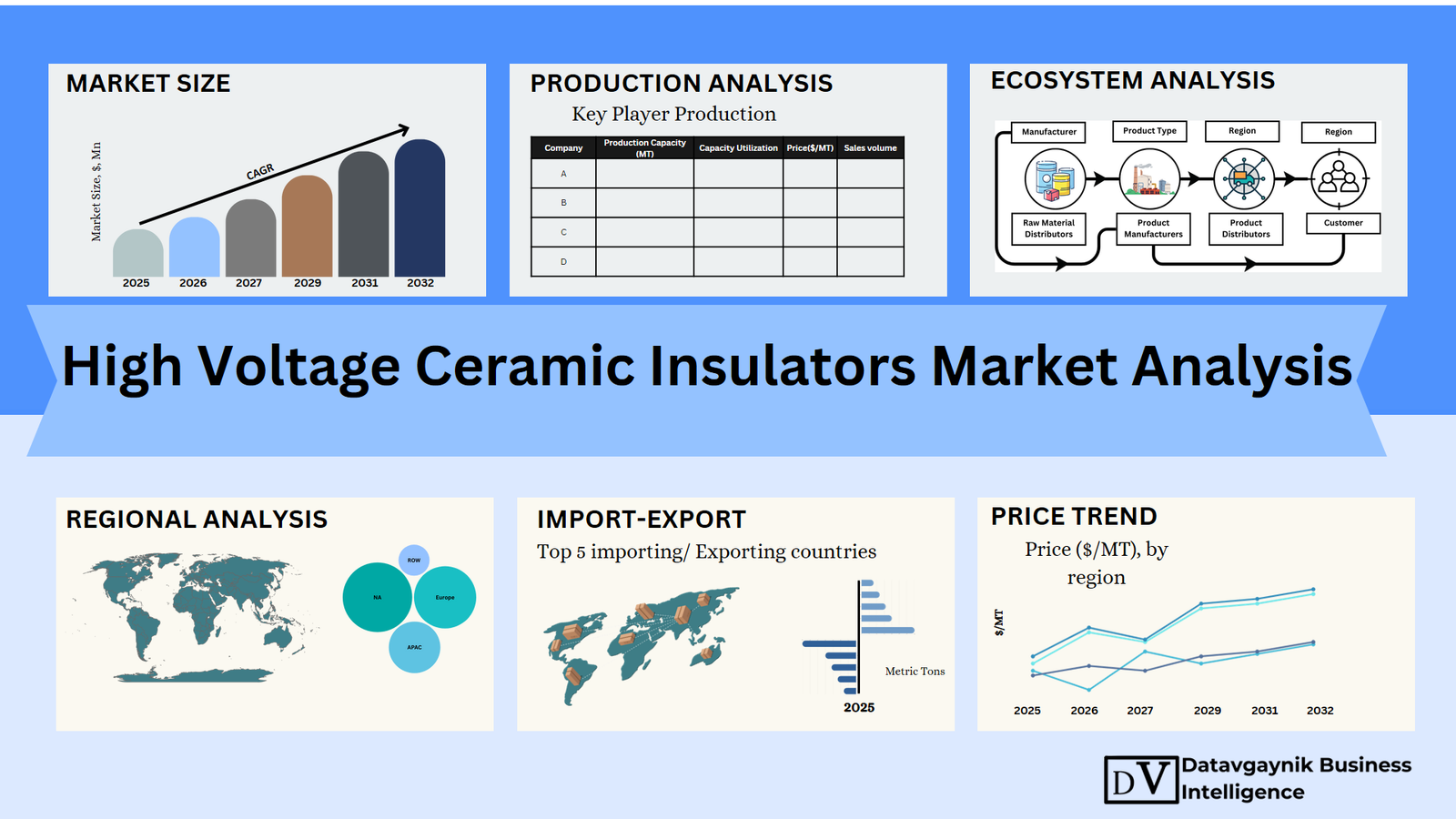
The High Voltage Ceramic Insulators Market is witnessing remarkable momentum, driven by the exponential rise in global electricity demand. For instance, global electricity consumption is expected to grow by over 2.4% annually through 2030, propelled by increasing industrialization, rapid urbanization, and the electrification of transport and heating. High voltage transmission systems are the backbone of this evolving grid landscape, and ceramic insulators play a critical role in maintaining safety, durability, and operational integrity. The High Voltage Ceramic Insulators Market Size is projected to expand significantly, with strong growth anticipated from both developing and developed economies due to sustained investments in energy infrastructure and smart grid projects.
Expanding Renewable Energy Infrastructure Bolstering High Voltage Ceramic Insulators Market
One of the most dominant trends shaping the High Voltage Ceramic Insulators Market is the surge in renewable energy projects. Wind and solar installations require extensive high-voltage transmission lines to transport power from remote generation sites to urban centers. For example, global installed wind capacity reached over 1,000 GW in 2024, and solar surpassed 1,300 GW, marking a 12% year-on-year growth. Each of these installations demands reliable and long-lasting insulators that can withstand environmental stress and voltage fluctuations. High voltage ceramic insulators are preferred in these applications due to their superior dielectric strength, long service life, and low maintenance requirements, making them indispensable components of modern power networks.
Grid Modernization Projects Accelerate the High Voltage Ceramic Insulators Market
The aging power infrastructure in key economies such as the U.S., Germany, and Japan has triggered massive investments in grid modernization. These upgrades are not limited to hardware improvements but are part of broader efforts to improve energy efficiency, reduce transmission losses, and integrate distributed energy resources. For instance, the U.S. Department of Energy allocated over $20 billion for grid modernization initiatives over the next decade. This trend is expanding the deployment of high-capacity transmission systems, directly increasing the demand in the High Voltage Ceramic Insulators Market. Ceramic insulators, with their proven performance in high-load and high-temperature environments, are central to these grid reinforcement strategies.
Urbanization and Industrial Growth Drive Demand in the High Voltage Ceramic Insulators Market
Rapid urban expansion and industrial development in emerging markets such as India, Southeast Asia, and Sub-Saharan Africa are also propelling the High Voltage Ceramic Insulators Market. With urban populations expected to grow by 2.5 billion by 2050, the need for uninterrupted power supply has never been more critical. Industrial zones, data centers, and transportation networks all rely heavily on robust high-voltage infrastructure. High voltage ceramic insulators are key to ensuring reliability across these networks, especially in regions where environmental conditions—like high humidity or pollution—demand rugged and weather-resistant solutions.
Resilience to Harsh Conditions Enhancing Adoption in the High Voltage Ceramic Insulators Market
One of the distinct advantages of ceramic insulators lies in their exceptional performance under harsh climatic conditions. From coastal corrosion to desert heat and alpine freeze, ceramic insulators offer a level of resilience that few alternatives match. For instance, in offshore wind installations in northern Europe, ceramic insulators are widely used due to their resistance to salt spray and moisture. Their low thermal expansion, high mechanical strength, and stable insulating properties over decades of service make them ideal for environments where reliability is non-negotiable. This performance advantage is translating into heightened adoption across geographies, reinforcing the strength of the High Voltage Ceramic Insulators Market.
Energy Safety and Reliability Standards Propel the High Voltage Ceramic Insulators Market
With the growing emphasis on grid reliability and worker safety, utilities are under pressure to deploy components that meet rigorous international standards. Ceramic insulators help prevent arc faults, power outages, and line-to-ground failures in high-voltage systems. These insulators have a track record of conforming to IEEE, IEC, and ANSI standards, making them the go-to choice for both new installations and retrofits. For example, in high-altitude transmission projects, ceramic insulators are preferred due to their flashover resistance and minimal maintenance requirements. These factors continue to underpin their demand in the High Voltage Ceramic Insulators Market.
Government Initiatives and Energy Policy Reforms Catalyze Market Growth
Government policies supporting renewable integration, rural electrification, and smart grid deployment are further strengthening the High Voltage Ceramic Insulators Market. For instance, India’s Revamped Distribution Sector Scheme (RDSS), with an investment outlay of $40 billion, directly supports the upgradation of power transmission infrastructure. Similarly, China’s 14th Five-Year Plan emphasizes the construction of ultra-high voltage (UHV) lines spanning thousands of kilometers. Each of these strategic initiatives increases the need for durable insulators that perform reliably over long transmission corridors. As a result, policy direction is acting as a direct catalyst for market expansion, translating into large procurement volumes and long-term contracts for ceramic insulator manufacturers.
Technological Innovations in Ceramic Materials Boosting Product Efficiency
Advancements in materials science are significantly enhancing the performance characteristics of ceramic insulators. Modern formulations incorporate additives that improve dielectric properties, reduce porosity, and increase thermal shock resistance. Moreover, automated manufacturing techniques have brought down defect rates, improved dimensional accuracy, and ensured consistency across production batches. These innovations have enabled ceramic insulators to meet the demands of UHV (Ultra High Voltage) applications exceeding 800 kV, which are becoming more common in long-distance and cross-border transmission projects. As these capabilities expand, the High Voltage Ceramic Insulators Market is capturing new application segments, particularly in smart grids and renewable-heavy regions.
Export Demand and Global Energy Interconnection Creating Cross-Border Opportunities
Global initiatives such as the Belt and Road Initiative and the ASEAN Power Grid are creating new cross-border transmission corridors, significantly impacting the High Voltage Ceramic Insulators Market. These large-scale projects require millions of insulators that can function across varied climatic zones while meeting harmonized technical standards. For example, China’s State Grid Corporation is exporting power across Asia and Europe through UHVDC lines, many of which rely on high-grade ceramic insulators. This interconnected approach is expanding the international trade of high voltage ceramic insulators, creating new revenue streams for manufacturers with global reach and diversified product portfolios.
Rise of Electrified Transportation Networks Expands Application Scope
The electrification of railways, metro systems, and electric vehicle infrastructure is another major factor accelerating the High Voltage Ceramic Insulators Market. For instance, over 75% of Europe’s rail lines are already electrified, and major markets like India are targeting 100% electrification by 2030. These transport systems require robust insulation solutions for their high-voltage overhead lines. High voltage ceramic insulators are preferred in these applications due to their structural rigidity, long operational life, and immunity to vibration and thermal cycling. The broader shift towards electric mobility is thus opening up significant new demand segments for the market.
High Voltage Ceramic Insulators Market Size Set to Expand on Back of Global Electrification Push
The High Voltage Ceramic Insulators Market Size is projected to grow at a compound annual growth rate (CAGR) exceeding 5.5% between 2025 and 2030, according to Datavagyanik estimates. This growth is attributed to a combination of policy-backed infrastructure investment, increased power demand from electrified industries, and expanding applications in smart cities and clean transportation. Emerging economies in Asia-Pacific, Latin America, and Africa are expected to be the fastest-growing markets, while North America and Europe will continue to invest in quality upgrades and technology-driven grid resilience.
Conclusion: Strategic Relevance of High Voltage Ceramic Insulators Across the Energy Spectrum
In a world rapidly moving toward electrification, grid reliability, and energy resilience, the role of high voltage ceramic insulators is not just technical—it’s strategic. From supporting renewable energy transitions to underpinning national security and economic development, ceramic insulators are mission-critical components of modern power ecosystems. The High Voltage Ceramic Insulators Market stands at the crossroads of infrastructure transformation, and its sustained growth trajectory is both inevitable and essential. With innovation, scalability, and policy support aligned, this market is poised for a decade of strong, value-driven expansion.
“Track Country-wise High Voltage Ceramic Insulators Production and Demand through our High Voltage Ceramic Insulators Production Database”
- High Voltage Ceramic Insulators production database for 30+ countries worldwide
- High Voltage Ceramic Insulators Powder sales volume for 31+ countries
- Country-wise High Voltage Ceramic Insulators production capacity and production plant mapping, production capacity utilization for 30+ manufacturers
- High Voltage Ceramic Insulators production plants and production plant capacity analysis for top manufacturers
Asia Pacific Leads Global Demand in the High Voltage Ceramic Insulators Market
The Asia Pacific region commands the largest share in the global High Voltage Ceramic Insulators Market, primarily driven by the expansive power infrastructure projects across China, India, Japan, and Southeast Asia. For instance, China alone operates over 30 ultra-high-voltage (UHV) transmission lines, many of which stretch beyond 2,000 kilometers and require millions of ceramic insulators to maintain stability under fluctuating voltage and climatic extremes. With India targeting 500 GW of renewable capacity by 2030, massive investments are being funneled into transmission infrastructure, amplifying demand for durable, low-maintenance ceramic insulators. The region’s compounded growth is sustained by population density, energy access programs, and government-backed electrification plans.
North America Shows Steady Growth in the High Voltage Ceramic Insulators Market
North America’s High Voltage Ceramic Insulators Market is exhibiting consistent expansion, supported by aging grid infrastructure and a strong pivot toward renewable energy integration. For example, over 70% of the U.S. power grid is over 25 years old. The current wave of modernization, backed by federal infrastructure bills, includes large-scale transmission projects across wind-rich central corridors. Additionally, utilities are transitioning to high-capacity lines designed to transport clean energy from production hubs to consumption centers. Ceramic insulators, with their high dielectric strength and weather resistance, are central to these upgrades. Canada’s hydropower exports to the U.S. through long-distance transmission corridors are another driver for insulator demand in the region.
Europe’s Focus on Grid Reliability and Renewables Boosts High Voltage Ceramic Insulators Market
In Europe, the High Voltage Ceramic Insulators Market is seeing a surge, driven by the continent’s aggressive targets for carbon neutrality and renewable integration. Germany’s Energiewende, France’s nuclear-replacement programs, and the U.K.’s offshore wind ambitions require robust transmission backbones. Offshore and coastal projects, particularly in the North Sea, demand ceramic insulators that can withstand salt, wind, and intense mechanical stress. For instance, Europe’s offshore wind capacity reached over 35 GW in 2024, with significant expansions underway in the Netherlands and Denmark. As high-voltage connections extend farther offshore, ceramic insulators are favored over polymer types for their proven resistance to thermal cycling and long-term durability.
Middle East and Africa Emerging as Strategic Markets in the High Voltage Ceramic Insulators Market
Middle Eastern and African nations are increasingly investing in power infrastructure to meet growing energy demands and industrial development. Saudi Arabia’s Vision 2030 and South Africa’s Integrated Resource Plan both prioritize grid expansion and renewable energy integration. In desert climates and high-altitude zones, ceramic insulators provide unmatched resistance to UV radiation, sand erosion, and extreme temperatures. The High Voltage Ceramic Insulators Market in these regions is expected to grow at over 7% CAGR through 2030 as energy access projects expand into rural areas and cross-border transmission lines become more prevalent across North and East Africa.
Latin America Shows Potential Through Renewable Integration and Cross-Border Trade
Latin America, while a smaller market in volume, is rapidly emerging as a key growth arena in the High Voltage Ceramic Insulators Market. Countries like Brazil, Chile, and Argentina are integrating solar and wind into their grids, prompting demand for long-distance transmission lines. Brazil alone added over 10 GW of new renewable capacity in 2024, much of it in remote areas requiring extensive transmission infrastructure. These lines often traverse forests, mountains, and river systems, necessitating insulators with high mechanical strength and resistance to pollution. Additionally, cross-border trade between countries, such as the interconnection between Brazil and Argentina, further stimulates regional demand for high-reliability ceramic insulators.
Global Production Landscape in the High Voltage Ceramic Insulators Market
Production of high voltage ceramic insulators is concentrated in a few technologically advanced regions. China holds the lion’s share of global manufacturing, supported by its vast raw material access, low production costs, and robust domestic demand. Leading manufacturers operate large-scale facilities equipped with advanced sintering, glazing, and quality control processes, enabling cost-effective mass production. India follows closely, with an increasing focus on exports to Africa and the Middle East, supported by competitive labor costs and rising technical capabilities.
In Europe, countries like Germany and Italy lead the production of high-performance insulators, particularly for offshore and ultra-high-voltage applications. These manufacturers prioritize technical innovation and quality certification, making them key exporters to regions with stringent safety and reliability requirements. The United States also maintains a strong domestic production base, focusing on custom, high-specification insulators designed for unique environmental and operational challenges.
Segmentation by Product Type Drives Application-Specific Growth in the High Voltage Ceramic Insulators Market
The High Voltage Ceramic Insulators Market is segmented based on product type to meet diverse application demands. Suspension-type insulators dominate the market, particularly in transmission lines exceeding 220 kV. Their modular design allows for easy scalability and high mechanical load tolerance, making them ideal for mountainous and long-span installations. For instance, in the 765 kV lines used across parts of India and the U.S., suspension insulators are essential to manage sag and vibration.
Pin-type insulators, though limited to sub-132 kV applications, continue to see adoption in suburban and industrial feeder lines due to their simplicity and cost-effectiveness. Meanwhile, shackle-type insulators are prevalent in compact urban networks where space constraints necessitate robust yet compact solutions. The rise of hybrid insulators—ceramic core with composite exterior—is also gaining traction, especially in seismic zones and coastal regions where lightweight and anti-contamination properties are prioritized.
Application Segmentation Enhancing Value Creation in the High Voltage Ceramic Insulators Market
The High Voltage Ceramic Insulators Market also segments strongly by application. Power transmission remains the largest segment, accounting for over 60% of global insulator demand. As more countries push toward renewable integration, demand for long-haul, high-voltage transmission lines continues to rise. For instance, the U.S. alone plans to add over 30,000 miles of new transmission lines by 2035. Each kilometer of these lines requires dozens of high-strength ceramic insulators.
Power distribution networks are the second-largest application, driven by rural electrification programs and urban grid extensions. Distribution systems often face exposure to pollution, tree branches, and varying load patterns, making rugged ceramic insulators the preferred choice. Additionally, railway electrification is emerging as a high-growth application segment, especially in countries like India and China, where thousands of kilometers of railway lines are being electrified annually. These systems demand insulators capable of managing both high voltage and dynamic loads due to constant vibration.
High Voltage Ceramic Insulators Price Driven by Raw Materials and Energy Costs
The High Voltage Ceramic Insulators Price is heavily influenced by raw material inputs, including high-purity alumina, clay, and feldspar. Prices are also impacted by energy-intensive manufacturing processes such as kiln firing and glazing. For instance, a surge in global natural gas prices in 2022 led to a 12% year-on-year increase in average High Voltage Ceramic Insulators Price globally. Countries relying on imported materials faced steeper price hikes, while integrated manufacturers in China and India managed to stabilize costs due to local sourcing advantages.
High Voltage Ceramic Insulators Price Trend Shows Regional Divergence
The High Voltage Ceramic Insulators Price Trend varies across regions. In Asia Pacific, economies of scale and competitive labor markets have kept prices lower, with bulk orders driving average prices to as low as $8–$10 per unit for suspension insulators. In contrast, European markets tend to command premium prices—ranging from $15 to $25 per unit—due to strict quality certifications, specialized product configurations, and higher manufacturing costs.
In North America, High Voltage Ceramic Insulators Price remains moderately high due to regulatory requirements and low competition from imports, with the average price per unit hovering around $18–$22. The market is less price-sensitive but more focused on performance metrics, lifecycle cost, and reliability. Meanwhile, emerging markets in Africa and Latin America experience higher landed costs due to import duties and transportation, pushing the local High Voltage Ceramic Insulators Price above global averages.
Future Price Trend to Reflect Material Substitution and Process Optimization
Looking ahead, the High Voltage Ceramic Insulators Price Trend is expected to remain stable with slight upward pressure from energy costs and tightening environmental regulations. However, ongoing innovations in ceramic composition, such as the use of sintering aids and low-temperature glazes, are likely to reduce energy consumption and production time. These developments may offset cost increases and bring price normalization across regions.
Furthermore, advanced quality control using AI-based defect detection and automated kilns are expected to lower labor dependence and enhance throughput. As these innovations gain adoption, particularly in Asia and Europe, they will contribute to a more competitive and cost-efficient High Voltage Ceramic Insulators Market, eventually influencing global pricing dynamics.
Conclusion: Strategic Outlook for the High Voltage Ceramic Insulators Market
The global High Voltage Ceramic Insulators Market is strategically positioned for continued growth, backed by regional expansion in energy infrastructure, technological innovation in production, and application-specific demand. Geographical diversity in both production and consumption ensures market resilience, while segmentation by product type and application adds depth to growth opportunities. Although the High Voltage Ceramic Insulators Price Trend will be shaped by raw material and energy dynamics, innovation in design and manufacturing is expected to support competitive pricing over the long term. With rising demand across sectors—from renewables to railways—the market is well-poised to deliver sustained value to stakeholders worldwide.
“High Voltage Ceramic Insulators Manufacturing Database, High Voltage Ceramic Insulators Manufacturing Capacity”
- High Voltage Ceramic Insulators top manufacturers market share for 30+ manufacturers
- Top 9 manufacturers and top 19 manufacturers of High Voltage Ceramic Insulators in North America, Europe, Asia Pacific
- Production plant capacity by manufacturers and High Voltage Ceramic Insulators production data for 30+ market players
- High Voltage Ceramic Insulators production dashboard, High Voltage Ceramic Insulators production data in excel format
Global Manufacturer Landscape in the High Voltage Ceramic Insulators Market
The High Voltage Ceramic Insulators Market is consolidated among a handful of large-scale players who dominate global production, technological advancement, and exports. These companies possess long-term supply agreements with utilities, robust R&D pipelines, and vertically integrated manufacturing systems that enable cost and quality leadership. The top five manufacturers currently command over 60% of the global market share, with the rest split between regional producers and niche players.
NGK Insulators Ltd. – Innovation-Driven Market Leader
Japan-based NGK Insulators Ltd. holds one of the largest shares in the global High Voltage Ceramic Insulators Market, estimated at over 18%. Known for its high-performance insulators used in ultra-high voltage applications, NGK’s product lines include the V-type and Long Rod insulators designed for extra long-distance and mountainous terrains. The company has consistently focused on thermal shock resistance, enhanced creepage distance, and glaze technology to ensure long service life under high humidity and pollution. With production hubs in Japan, China, and Mexico, NGK serves major grid operators across Asia-Pacific, North America, and Europe.
Hubbell Power Systems – Strong North American Presence
Hubbell Power Systems, headquartered in the United States, is a leading manufacturer with an estimated 12% global market share in the High Voltage Ceramic Insulators Market. Its Ohio Brass product line includes suspension, station post, and line post insulators widely adopted across North America. With a strong legacy in electrical grid reliability and insulation, Hubbell has also invested in automated manufacturing processes and quality control systems to reduce field failure rates and lifecycle costs. The company is also expanding its composite and hybrid insulator offerings to meet evolving utility demands in smart grid modernization.
Lapp Insulators – European Specialist in High-End Applications
Germany’s Lapp Insulators specializes in high-strength insulators for transmission systems above 400 kV and commands an estimated 10% share of the High Voltage Ceramic Insulators Market. Its product series includes LineLock long rod insulators and 550kV-class station post insulators, popular in European utilities due to their mechanical strength and pollution performance. Lapp has extensive experience in offshore grid applications and high-seismic areas, making it a preferred vendor in demanding installations. The company’s presence is strong in Germany, the U.K., France, and Scandinavia.
SEVES Group – Broad Global Footprint
The SEVES Group, based in Italy, operates one of the most diversified insulator portfolios in the market and holds around 8% share in the global High Voltage Ceramic Insulators Market. The company’s SEDIVER brand offers glass and ceramic insulators for all voltage levels, while PPC Insulators focuses on high-mechanical-load ceramic designs. SEVES exports to over 100 countries and operates manufacturing sites in Europe, Asia, and the Americas. Their long rod and cap-and-pin type ceramic insulators are widely used in desert and marine climates due to their anti-contamination performance.
China XD Electric – Fast-Growing Asian Producer
China XD Electric is rapidly expanding its footprint in the High Voltage Ceramic Insulators Market, especially in Asia and Africa, with a market share approaching 6%. The company’s product range includes suspension and pin-type ceramic insulators suited for voltage classes from 110 kV to 800 kV. China XD has benefited from China’s aggressive grid expansion and Belt and Road energy projects, exporting insulators to over 40 countries. The firm continues to invest in automation, low-defect ceramic forming, and hybrid design to improve product competitiveness and enter high-value segments in Europe and the Middle East.
Manufacturer Market Share Breakdown
- NGK Insulators Ltd. – ~18%
- Hubbell Power Systems – ~12%
- Lapp Insulators – ~10%
- SEVES Group – ~8%
- China XD Electric – ~6%
- Others (regional players, niche suppliers) – ~46%
This fragmentation in the remaining share includes regional suppliers in India, Turkey, Brazil, and South Korea, many of which serve domestic markets and price-sensitive export destinations. These players often manufacture standard pin and shackle-type insulators used in medium-voltage lines, while larger firms dominate the high-voltage and ultra-high-voltage space.
Recent Developments and Strategic Initiatives in the High Voltage Ceramic Insulators Market
The High Voltage Ceramic Insulators Market is experiencing transformative changes due to evolving energy policy, material science, and geopolitical trade dynamics. Recent developments among top players indicate a shift toward innovation, capacity expansion, and localization strategies.
- In March 2024, NGK Insulators announced the launch of a new high-contamination resistant glaze line at its Nagoya facility, targeting coastal grid upgrades across Southeast Asia and the Middle East. This move enhances their product durability in saline and industrial atmospheres.
- In November 2023, Hubbell Power Systems expanded its production facility in Tennessee to double output of 230 kV suspension insulators, supporting major U.S. transmission projects under the Grid Resilience and Innovation Partnership (GRIP) initiative.
- In July 2024, Lapp Insulators partnered with a Norwegian utility to field test their new IceShield ceramic coating on 400 kV lines. The test aims to reduce ice accretion in Arctic transmission corridors and improve winter reliability.
- SEVES Group in February 2024 completed the upgrade of its PPC Austria facility with a new tunnel kiln designed to improve energy efficiency by 30%. The move aligns with growing demand from utilities for eco-friendly supply chain practices.
- China XD Electric in April 2025 signed a multi-million-dollar deal with the Ethiopian Electric Power Corporation to supply high voltage insulators for the Grand Ethiopian Renaissance Dam transmission line, marking one of Africa’s largest power export corridors.
Conclusion: Market Positioning and Forward Strategy
The High Voltage Ceramic Insulators Market is strategically driven by a few global giants and an array of regional competitors. As demand continues to rise for ultra-reliable, high-performance ceramic insulators in a decarbonizing world, the market leaders are pushing boundaries through R&D, energy-efficient manufacturing, and specialized product development. The ability to meet region-specific performance challenges—be it desert heat, coastal salinity, or polar frost—will determine future market share shifts.
With smart grid development, offshore wind expansion, and electric mobility accelerating grid complexity, manufacturers that invest in customization, digital integration, and sustainability are expected to maintain leadership in this highly competitive global market.
“High Voltage Ceramic Insulators Production Data and High Voltage Ceramic Insulators Production Trend, High Voltage Ceramic Insulators Production Database and forecast”
- High Voltage Ceramic Insulators production database for historical years, 10 years historical data
- High Voltage Ceramic Insulators production data and forecast for next 9 years
Market Scenario, Demand vs Supply, Average Product Price, Import vs Export, till 2035
- Global High Voltage Ceramic Insulators Market revenue and demand by region
- Global High Voltage Ceramic Insulators Market production and sales volume
- United States High Voltage Ceramic Insulators Market revenue size and demand by country
- Europe High Voltage Ceramic Insulators Market revenue size and demand by country
- Asia Pacific High Voltage Ceramic Insulators Market revenue size and demand by country
- Middle East & Africa High Voltage Ceramic Insulators Market revenue size and demand by country
- Latin America High Voltage Ceramic Insulators Market revenue size and demand by
- Import-export scenario – United States, Europe, APAC, Latin America, Middle East & Africa
- Average product price – United States, Europe, APAC, Latin America, Middle East & Africa
- Market player analysis, competitive scenario, market share analysis
- Business opportunity analysis
Key questions answered in the Global High Voltage Ceramic Insulators Market Analysis Report:
- What is the market size for High Voltage Ceramic Insulators in United States, Europe, APAC, Middle East & Africa, Latin America?
- What is the yearly sales volume of High Voltage Ceramic Insulators and how is the demand rising?
- Who are the top market players by market share, in each product segment?
- Which is the fastest growing business/ product segment?
- What should be the business strategies and Go to Market strategies?
The report covers High Voltage Ceramic Insulators Market revenue, Production, Sales volume, by regions, (further split into countries):
- Asia Pacific (China, Japan, South Korea, India, Indonesia, Vietnam, Rest of APAC)
- Europe (UK, Germany, France, Italy, Spain, Benelux, Poland, Rest of Europe)
- North America (United States, Canada, Mexico)
- Latin America (Brazil, Argentina, Rest of Latin America)
- Middle East & Africa
Table of Contents:
High Voltage Ceramic Insulators Market report:
- Introduction to High Voltage Ceramic Insulators
- Overview and Importance in Electrical Systems
- Key Functions and Applications of High Voltage Ceramic Insulators
- Scope and Objectives of the Report
- Market Landscape and Dynamics
- Market Drivers and Influencing Factors
- Challenges and Restraints in the Industry
- Emerging Trends and Innovations
- Types of High Voltage Ceramic Insulators
- Pin Insulators
- Suspension Insulators
- Line Post Insulators
- Other Specialized Types
- Materials Used in High Voltage Ceramic Insulators
- Porcelain-based Insulators
- Alumina and Steatite Insulators
- Other Composite Ceramic Materials
- Applications of High Voltage Ceramic Insulators
- Power Transmission and Distribution Networks
- Electrical Substations
- Railway Electrification Systems
- High-Voltage Power Equipment
- Renewable Energy Sector (Wind and Solar Farms)
- Global Market Overview and Forecast (2020-2035)
- Market Size, Revenue, and Growth Projections
- Segment-wise and Region-wise Market Analysis
- Long-Term Market Trends and Growth Forecasts
- Regional Market Analysis
- North America: Trends, Opportunities, and Market Size
- Europe: Market Insights and Future Growth
- Asia Pacific: Key Markets, Growth Drivers, and Challenges
- Latin America: Demand, Market Potential, and Regional Overview
- Middle East & Africa: Market Trends and Forecast
- Technological Innovations and Manufacturing Advancements
- Recent Advancements in Insulator Design and Materials
- Technological Innovations in Manufacturing Processes
- Automation and Efficiency in Ceramic Insulator Production
- Competitive Landscape and Key Players
- Major Manufacturers and Suppliers in the Market
- Market Share and Competitive Analysis (2020-2025)
- Strategic Initiatives, Mergers, and Acquisitions
- Market Segmentation by Insulator Type
- High-Voltage Pin Insulators
- Suspension Insulators for Long-Distance Power Lines
- Line Post Insulators for Industrial Applications
- Niche Insulators for Specialized Uses
- Demand Analysis by Application
- Power Generation and Transmission
- Distribution Systems and Grid Infrastructure
- Transportation and Railway Electrification
- Wind and Solar Power Systems
- Pricing Trends and Cost Structure
- Cost Breakdown of High Voltage Ceramic Insulators
- Price Trends by Region and Product Type
- Factors Influencing Price Variations
- Supply Chain and Distribution Channels
- Key Suppliers of Raw Materials for Ceramic Insulators
- Distribution Networks and Channel Partners
- Supply Chain Risks and Mitigation Strategies
- Regulatory Standards and Industry Certifications
- Industry Standards for High Voltage Ceramic Insulators
- Safety and Performance Certifications
- Environmental Regulations Impacting Production and Use
- Sustainability and Environmental Impact
- Eco-Friendly Manufacturing Practices
- Recyclability of Ceramic Insulators
- Environmental Challenges and Solutions
- Impact of Renewable Energy on the High Voltage Ceramic Insulator Market
- Growing Demand for Insulators in Renewable Energy Projects
- Role of Insulators in Wind and Solar Power Installations
- Opportunities and Challenges in Renewable Energy Integration
- Future Outlook and Market Opportunities
- Growth Prospects in Developing Economies
- Technological Developments and Market Potential
- Key Market Opportunities for Stakeholders
- Investment Analysis
- Investment Trends in High Voltage Ceramic Insulators
- Market Potential for New Entrants and Investors
- Strategic Investment Opportunities
- Risk and Challenges in the High Voltage Ceramic Insulator Market
- Production and Material Sourcing Challenges
- Market Entry Barriers for New Manufacturers
- Supply Chain Vulnerabilities and Global Factors
- Key Raw Materials in High Voltage Ceramic Insulator Production
- Raw Materials Used in Ceramic Insulator Manufacturing
- Supply and Demand of Key Raw Materials
- Price Trends of Raw Materials
- Consumer Insights and Adoption Trends
- End-User Preferences and Requirements
- Market Adoption Rates by Industry
- Customer Decision-Making Factors
- Research and Development (R&D) Activities
- Ongoing Research in Ceramic Insulator Technology
- Collaborations between Industry and Academia
- Patents and Innovations in High Voltage Insulator Design
- Conclusion and Strategic Recommendations
- Summary of Key Findings
- Market Opportunities and Challenges
- Recommendations for Industry Players and Investors
Other recently published reports:


