

Rising Demand for Sustainable Alternatives Driving the Catalysts for Biorenewable Feedstocks Market
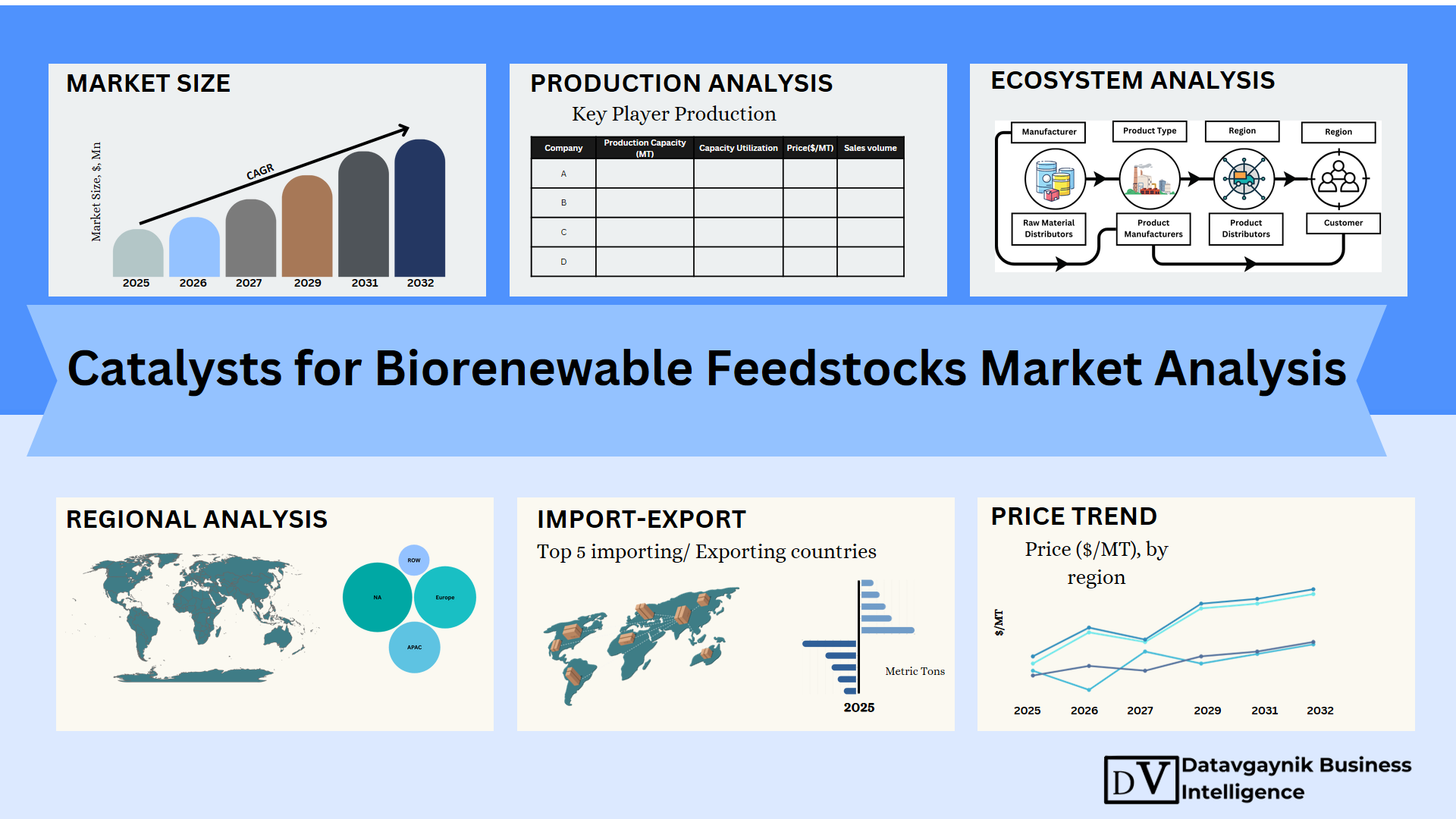
The Catalysts for Biorenewable Feedstocks Market is witnessing a transformational surge as global industries intensify their transition toward sustainable inputs and circular production models. The market is being propelled by escalating concerns over climate change, the depletion of fossil fuel reserves, and the urgent need to reduce greenhouse gas emissions. The demand for bio-based fuels and chemicals is increasing significantly—biofuels alone are projected to meet nearly 27% of global transportation fuel demand by 2050, reinforcing the demand for advanced catalytic technologies that can convert agricultural waste, forestry biomass, and other renewable feedstocks into high-value products.
Catalysts are at the heart of this shift, enabling the conversion of complex biomass into usable fuels, chemicals, and materials with higher efficiency and lower energy consumption. In this rapidly evolving space, the Catalysts for Biorenewable Feedstocks Market has emerged as a critical pillar supporting the bioeconomy, helping manufacturers transition from fossil-derived inputs to renewable alternatives.
Technological Breakthroughs Fueling Growth in the Catalysts for Biorenewable Feedstocks Market
Innovation in catalytic science has become a defining factor in shaping the Catalysts for Biorenewable Feedstocks Market. Catalysts have evolved from traditional metal-based materials to highly engineered biocatalysts and enzyme-based systems that deliver greater specificity, yield, and selectivity in bio-conversion processes. For instance, the development of solid acid catalysts for esterification reactions has significantly enhanced biodiesel production efficiency, especially when processing low-grade or waste oils.
Moreover, the advent of nano-catalysts and heteropoly acids has opened new avenues for converting lignocellulosic biomass into platform chemicals such as furfural, hydroxymethylfurfural (HMF), and levulinic acid. These intermediates are then transformed into biodegradable plastics and biofuels, positioning catalysts as the cornerstone of advanced bio-refining. As these technologies scale, the Catalysts for Biorenewable Feedstocks Market Size is expected to grow steadily, driven by increasing industrial-scale adoption.
Energy Security and Price Volatility Reinforce the Need for Catalysts for Biorenewable Feedstocks Market
Energy security has become a geopolitical priority, especially in regions heavily dependent on imported oil and gas. Countries are now investing in indigenous, renewable feedstocks to buffer against energy price shocks and supply disruptions. This trend is directly benefitting the Catalysts for Biorenewable Feedstocks Market, as biomass conversion provides a domestically sourced solution to fuel and material production.
For example, agricultural powerhouses such as the United States, Brazil, and India are turning their surplus residues into ethanol and biodiesel using catalytic cracking and hydroprocessing technologies. These conversion methods not only reduce dependence on volatile fossil fuel markets but also create local employment and reduce rural waste, further strengthening the socio-economic value proposition of the Catalysts for Biorenewable Feedstocks Market.
Climate Goals and Emissions Regulations Accelerate the Catalysts for Biorenewable Feedstocks Market Size Expansion
The global shift toward low-carbon economies has made carbon footprint reduction a strategic imperative across sectors. With more than 70 countries now committed to net-zero targets, industries are being compelled to rethink their raw material inputs and adopt cleaner technologies. This development has been a boon for the Catalysts for Biorenewable Feedstocks Market.
For instance, the airline industry is under pressure to decarbonize, and the adoption of sustainable aviation fuels (SAFs) made from biorenewable feedstocks is gaining ground. Catalysts such as hydrotreating catalysts and zeolites are instrumental in converting triglycerides and fatty acids into jet-grade hydrocarbons. As demand for SAFs is expected to grow over 10 times by 2030, the market for relevant catalytic systems is projected to experience double-digit growth.
Rising Adoption of Bio-based Plastics and Chemicals Amplifies Demand in Catalysts for Biorenewable Feedstocks Market
In the chemicals and materials space, the shift toward bio-based inputs is no longer experimental—it is strategic. Bioplastics such as PLA (polylactic acid), PHA (polyhydroxyalkanoates), and bio-PET are rapidly replacing conventional plastics across packaging, consumer goods, and automotive sectors. These materials are produced from sugar-derived intermediates that require enzymatic and acid-based catalysts during synthesis.
For instance, global bioplastics production capacity is expected to reach 7.5 million metric tons by 2027, growing at over 10% annually. Such aggressive expansion mandates an equally robust supply chain of catalytic solutions. The Catalysts for Biorenewable Feedstocks Market is aligning rapidly to support this need by developing application-specific catalyst formulations that offer higher reaction rates, product purity, and recyclability.
Consumer Preference for Green Products Underpins Growth in the Catalysts for Biorenewable Feedstocks Market
The green consumer revolution is not just a Western phenomenon—it is global. End-users, from corporate buyers to retail consumers, are demanding products that reflect sustainability, traceability, and environmental stewardship. Companies are under mounting pressure to adopt clean-label practices and eliminate petrochemical derivatives from their supply chains.
This behavior shift directly supports the Catalysts for Biorenewable Feedstocks Market. Brands across the food packaging, textile, and personal care sectors are now integrating bio-based inputs derived from starches, cellulose, and vegetable oils. These raw materials undergo catalytic processing to become functional polymers and solvents. The growing penetration of these bio-based end products has led to significant upticks in demand for enzymes, solid catalysts, and co-catalysts tailored to specific feedstocks and process technologies.
Government Policy and Incentives Accelerating Investment in Catalysts for Biorenewable Feedstocks Market
Governments around the world are implementing aggressive policy frameworks to accelerate the bioeconomy. Tax credits, feed-in tariffs, blending mandates, and green procurement policies are driving corporate investment in biofuel and bio-based material manufacturing. Such incentives are catalyzing demand for more efficient and cost-effective catalysts that can deliver the required conversion rates at industrial scale.
For instance, biofuel blending mandates in countries like the United States (Renewable Fuel Standard), Brazil, and the European Union are creating robust, predictable demand for biodiesel and ethanol production. This, in turn, is pushing catalyst manufacturers to expand capacity and improve formulation chemistry. The Catalysts for Biorenewable Feedstocks Market is evolving rapidly in response to this regulatory momentum, offering targeted solutions to meet regional compliance standards.
Emergence of the Circular Bioeconomy Redefining the Catalysts for Biorenewable Feedstocks Market Landscape
The bioeconomy is entering a new phase characterized by circularity and zero-waste manufacturing. Feedstocks are no longer limited to crop-based inputs; municipal solid waste, food scraps, and even algae are being transformed into renewable fuels and materials. Catalysts serve as the enablers in this closed-loop system, facilitating the breakdown, reformulation, and synthesis of these diverse materials.
For example, catalytic pyrolysis is being increasingly used to convert organic waste into bio-oils and syngas, which are then upgraded into high-value products. Similarly, enzymatic hydrolysis enables the breakdown of cellulose and hemicellulose into fermentable sugars. These advancements are pushing the Catalysts for Biorenewable Feedstocks Market to develop a new generation of multi-functional and feedstock-agnostic catalyst platforms.
“Track Country-wise Catalysts for Biorenewable Feedstocks Production and Demand through our Catalysts for Biorenewable Feedstocks Production Database”
- Catalysts for Biorenewable Feedstocks production database for 32+ countries worldwide
- Catalysts for Biorenewable Feedstocks sales volume for 32+ countries
- Country-wise Catalysts for Biorenewable Feedstocks production capacity, production plant mapping, production capacity utilization for 32+ manufacturers
- Catalysts for Biorenewable Feedstocks production plants and production plant capacity analysis by top manufacturers
“Track real-time Catalysts for Biorenewable Feedstocks Prices, Catalysts for Biorenewable Feedstocks price charts for 32+ countries, Catalysts for Biorenewable Feedstocks weekly price tracker and Catalysts for Biorenewable Feedstocks monthly price tracker”
- Track real-time Catalysts for Biorenewable Feedstocks prices and Catalysts for Biorenewable Feedstocks price trend in 32+ countries though our excel-based Catalysts for Biorenewable Feedstocks price charts
- Real-time Catalysts for Biorenewable Feedstocks price tracker dashboard with 32+ countries
- Complete transparency on Catalysts for Biorenewable Feedstocks price trend through our Catalysts for Biorenewable Feedstocks monthly price tracker, Catalysts for Biorenewable Feedstocks weekly price tracker
North America Driving Innovation in the Catalysts for Biorenewable Feedstocks Market
The Catalysts for Biorenewable Feedstocks Market in North America is expanding rapidly, fueled by advanced R&D capabilities, availability of diverse biomass, and clear policy direction. The United States, in particular, has been at the forefront of catalytic innovation, leveraging lignocellulosic biomass and municipal solid waste for biofuel and biochemical production. For instance, bioethanol production in the U.S. surpassed 15 billion gallons in recent years, creating consistent demand for solid acid catalysts used in cellulose hydrolysis and fermentation processes.
Canada, with its vast forestry reserves, is emerging as a major player in the Catalysts for Biorenewable Feedstocks Market. Forestry biomass, including sawdust and bark, is being catalytically converted into syngas, methanol, and biodiesel. The commercial application of gasification technologies, combined with hydrocracking catalysts, has significantly improved conversion efficiency and yield. This innovation-driven environment is positioning North America as a global leader in both catalyst development and feedstock processing infrastructure.
Europe Embracing Circular Bioeconomy in the Catalysts for Biorenewable Feedstocks Market
Europe’s leadership in environmental regulation and sustainability goals is shaping a robust Catalysts for Biorenewable Feedstocks Market. Countries like Germany, France, and the Netherlands are driving the transition toward bio-based economies by integrating advanced catalytic technologies into their industrial base. For example, Germany’s focus on biorefineries has created new markets for heterogeneous catalysts that can process mixed biomass streams into lactic acid, bioplastics, and green solvents.
France, meanwhile, has transformed fossil-based refineries into renewable processing hubs, catalytically converting used cooking oils and agricultural residues into sustainable aviation fuel. The Netherlands has capitalized on sugar beet as a major feedstock, where selective oxidation and enzymatic catalysts are employed to produce furans and polyols for the polymer industry. These targeted, feedstock-specific innovations are reshaping Europe’s Catalysts for Biorenewable Feedstocks Market at a structural level, supporting long-term policy objectives and industrial competitiveness.
Asia Pacific Catalysts for Biorenewable Feedstocks Market Gaining Momentum
In Asia Pacific, the Catalysts for Biorenewable Feedstocks Market is witnessing exponential growth, backed by massive biomass availability, emerging energy needs, and government-backed sustainability programs. China is leading the charge by integrating agricultural waste, including corn stover and rice husks, into catalytic conversion processes for biofuel and bio-based chemical production. The rapid industrialization of catalyst manufacturing in China is reducing cost pressures and making scalable solutions more accessible.
India, with its dominant agricultural sector, is focusing on enzymatic and heterogeneous catalysts for second-generation ethanol production. Programs targeting rice straw and sugarcane bagasse valorization have created strong demand for advanced biocatalysts that function under mild conditions and high-volume throughput. Japan and South Korea are investing heavily in catalytic innovation for green hydrogen and bio-polymer production, particularly using algae-based feedstocks. As a result, Asia Pacific has emerged not just as a key consumer, but also a growing supplier in the Catalysts for Biorenewable Feedstocks Market.
Latin America Tapping Agricultural Strength to Fuel Catalysts for Biorenewable Feedstocks Market
Latin America’s extensive agricultural and forestry base provides the ideal foundation for bio-feedstock conversion. Brazil, already a global leader in ethanol production, is expanding its reliance on catalytic reforming to extract more value from sugarcane residues. The country’s refineries are integrating hydroprocessing and Fischer–Tropsch synthesis to produce green diesel, increasing demand for metal-based catalysts such as cobalt and nickel.
Argentina and Colombia are also entering the Catalysts for Biorenewable Feedstocks Market by converting soybean and palm oil residues into biofuels and lubricants. These developments are stimulating local catalyst manufacturing capabilities, with increasing attention given to low-cost, regenerable catalysts that can operate under regional climatic conditions. Latin America’s growth trajectory in this market is expected to rise as countries seek to monetize biomass without compromising food security or land use.
Middle East and Africa Emerging as Strategic Importers in Catalysts for Biorenewable Feedstocks Market
While domestic production remains limited, several countries in the Middle East and Africa are ramping up imports of catalytic technologies to process agricultural and municipal waste into energy and chemicals. South Africa and Nigeria are piloting biorefinery models utilizing solid acid and enzymatic catalysts to convert local biomass into ethanol, contributing to rural electrification and energy security.
The Gulf nations are exploring Catalysts for Biorenewable Feedstocks Market opportunities to diversify their energy mix. Initiatives focused on algae cultivation and catalytic upgrading into jet fuel are underway, as they seek to leverage sunlight and seawater for bio-resource cultivation. These strategic moves are creating a pull effect for global catalyst exporters looking to enter high-potential emerging markets.
Production Trends and Technological Advancements in Catalysts for Biorenewable Feedstocks Market
The production landscape of the Catalysts for Biorenewable Feedstocks Market is shifting toward cost efficiency, recyclability, and feedstock flexibility. Manufacturers are developing modular catalyst platforms that can be fine-tuned for specific biomass types, ranging from food waste to lignin-rich materials. For example, bi-metallic catalysts incorporating molybdenum and nickel are gaining popularity in bio-oil upgrading due to their resilience in high-pressure environments and ability to handle high oxygen content in feedstocks.
Another major production trend involves immobilized enzymes for continuous-flow bioprocessing. These systems reduce catalyst consumption per cycle while maintaining yield and selectivity. The growing emphasis on catalyst recovery and regeneration is also reshaping production economics. With increasing deployment of solid catalysts that can be separated and reused, the operational cost per metric ton of processed feedstock is falling, expanding access in price-sensitive regions.
Market Segmentation Enhancing Focus in the Catalysts for Biorenewable Feedstocks Market
The Catalysts for Biorenewable Feedstocks Market is highly segmented across catalyst type, feedstock source, process technology, and end-user application, each with unique demand patterns. Homogeneous catalysts are favored for precision chemical synthesis, particularly in pharmaceutical and specialty chemical industries. Heterogeneous catalysts dominate in large-scale biomass-to-energy conversion due to ease of separation and robustness.
Enzymatic catalysts are widely used in bioethanol and bioplastics production, where reaction specificity is paramount. Biocatalysts, particularly those derived from microbial strains, are gaining traction for their low toxicity and adaptability to diverse substrates. In terms of feedstock, agricultural residues and forestry biomass remain the largest contributors, followed by food waste and algae. Each feedstock requires a tailored catalytic approach, adding complexity and innovation potential to market segmentation strategies.
Catalysts for Biorenewable Feedstocks Price Trend Reflecting Feedstock and Metal Volatility
Catalysts for Biorenewable Feedstocks Price is closely tied to the volatility of input materials, especially rare and precious metals such as palladium, ruthenium, and platinum. Fluctuations in mining output and geopolitical instability have caused spikes in these prices, impacting catalyst affordability. For instance, a surge in palladium prices led to a 12% increase in hydrocracking catalyst costs over a 12-month period.
However, manufacturers are increasingly adopting base-metal catalysts, such as iron and nickel, which are more abundant and offer competitive performance when engineered properly. This trend is helping stabilize the Catalysts for Biorenewable Feedstocks Price across applications like hydrogenation, reforming, and cracking. In enzymatic catalysis, the cost is influenced more by fermentation yields and purification efficiency, with ongoing bioprocess improvements helping reduce production costs by 15–20% in the past five years.
Regional and Application-Based Differentiation in Catalysts for Biorenewable Feedstocks Price
The Catalysts for Biorenewable Feedstocks Price varies significantly by geography and application. In Europe, strict purity standards for bio-based pharmaceuticals result in higher reliance on ultra-pure, high-cost catalysts. In contrast, the Asia Pacific market prioritizes cost-effectiveness for large-scale biofuel applications, pushing demand for recyclable solid acid catalysts that can be reused over multiple cycles.
Application-based price differentiation is also evident. Catalysts for polymer-grade chemical production, such as succinic acid and lactide, command a premium due to high-performance requirements. Meanwhile, catalysts used in gasification or pyrolysis of waste biomass are priced lower but in larger volumes, reflecting their bulk processing nature. As new application areas like green hydrogen and marine biofuels emerge, the Catalysts for Biorenewable Feedstocks Price Trend is expected to become more dynamic, shaped by both volume scalability and technological breakthroughs.
Future Outlook: Catalysts for Biorenewable Feedstocks Price Trend Moving Toward Optimization and Stability
The long-term Catalysts for Biorenewable Feedstocks Price Trend is expected to stabilize as innovation drives down input costs and enhances process efficiency. Technological integration between catalyst design, process engineering, and feedstock preprocessing is enabling more predictable performance outcomes. This convergence is allowing producers to adopt performance-based pricing models, aligning catalyst cost with yield improvement and lifecycle benefits.
At the same time, increased global production capacity, particularly in Asia and Latin America, is reducing dependence on high-cost imports and fostering regional price competitiveness. As market maturity deepens and economies of scale take hold, the Catalysts for Biorenewable Feedstocks Price will likely experience moderated fluctuations, ensuring better planning and ROI for downstream manufacturers.
“Catalysts for Biorenewable Feedstocks Manufacturing Database, Catalysts for Biorenewable Feedstocks Manufacturing Capacity”
- Catalysts for Biorenewable Feedstocks top manufacturers market share for 32+ manufacturers
- Top 12 manufacturers and top 19 manufacturers of Catalysts for Biorenewable Feedstocks in North America, Europe, Asia Pacific
- Catalysts for Biorenewable Feedstocks production plant capacity by manufacturers and Catalysts for Biorenewable Feedstocks production data for 32+ market players
- Catalysts for Biorenewable Feedstocks production dashboard, Catalysts for Biorenewable Feedstocks production data in excel format
“Catalysts for Biorenewable Feedstocks price charts, Catalysts for Biorenewable Feedstocks weekly price tracker and Catalysts for Biorenewable Feedstocks monthly price tracker”
- Factors impacting real-time Catalysts for Biorenewable Feedstocks prices in 32+ countries worldwide
- Catalysts for Biorenewable Feedstocks monthly price tracker, Catalysts for Biorenewable Feedstocks weekly price tracker
- Real-time Catalysts for Biorenewable Feedstocks price trend, Catalysts for Biorenewable Feedstocks price charts, news and updates
- Tracking Catalysts for Biorenewable Feedstocks price fluctuations
Leading Players Shaping the Catalysts for Biorenewable Feedstocks Market
The Catalysts for Biorenewable Feedstocks Market is dominated by a mix of global chemical conglomerates and specialized catalyst producers. These companies are driving innovation through proprietary technologies and strategic collaborations, shaping the market landscape across applications ranging from biofuels to bio-based polymers. Market competition is intensifying, with manufacturers competing on efficiency, selectivity, catalyst lifecycle, and adaptability to various feedstocks.
BASF SE is one of the key players in the Catalysts for Biorenewable Feedstocks Market, with a wide portfolio tailored for biomass-to-chemical conversions. The company offers product lines such as Alveri and Lutropur, which include catalysts specifically designed for esterification and hydrogenation processes in bio-refining. BASF’s presence is strong in both the European and North American markets, where it supports commercial biorefineries converting lignocellulosic and oil-based feedstocks into fuels and value-added chemicals.
Clariant AG holds a significant Catalysts for Biorenewable Feedstocks Market share with its dedicated business unit for bio-based catalysts. Clariant’s sunliquid technology, a flagship enzymatic platform, enables the conversion of agricultural residues like straw into cellulosic ethanol. The company has scaled this technology across commercial projects in Eastern Europe and Asia. Its portfolio also includes solid catalysts used in the production of bio-based polymers and intermediates.
R. Grace & Co. specializes in refining and petrochemical catalysts but has strategically diversified into renewable feedstock processing. The company’s UNIPURE series includes hydrotreating catalysts used to upgrade vegetable oils, tallow, and used cooking oils into renewable diesel. Grace’s catalysts are widely used in retrofitted refineries that now operate on renewable inputs. With the rise in sustainable aviation fuel demand, W. R. Grace’s market share in the Catalysts for Biorenewable Feedstocks Market has grown considerably.
Johnson Matthey is another major contributor, known for its expertise in precious metal-based catalysts. The company offers proprietary hydrogenation catalysts tailored for biorenewable feedstock applications, including the conversion of sugars to polyols and alcohols. Johnson Matthey’s fixed-bed reactor systems are deployed in several European biorefineries, helping customers achieve higher catalyst efficiency with lower environmental impact. The company’s focus on circular chemistry further enhances its position in the Catalysts for Biorenewable Feedstocks Market.
Shell Catalysts & Technologies, part of Shell Group, has developed integrated catalyst solutions for the production of renewable fuels. The Shell Renewable Refining Catalyst (RRC) platform supports the hydroprocessing of triglycerides and free fatty acids into diesel and jet fuel. Shell’s dual role as a producer and user of these catalysts gives it a unique competitive edge in the Catalysts for Biorenewable Feedstocks Market. The company is actively involved in scaling its in-house biorefineries using these technologies.
Haldor Topsoe (now Topsoe) is a key player with a strong footprint in Asia and Europe. The company’s HydroFlex™ catalyst line is designed for the production of renewable diesel, jet fuel, and naphtha from bio-based feedstocks. The catalysts are known for their high activity and tolerance to feedstock impurities, making them ideal for low-quality biomass. Topsoe has successfully deployed HydroFlex™ technology across more than 20 commercial-scale units, significantly strengthening its Catalysts for Biorenewable Feedstocks Market share.
DuPont, through its Danisco division, plays a prominent role in the enzymatic catalysts segment. The company offers enzyme formulations for starch hydrolysis, cellulose breakdown, and fermentation enhancement. These biocatalysts are widely used in bioethanol and bioplastic production across North America and Asia Pacific. DuPont’s emphasis on genetically optimized enzymes has improved conversion rates and lowered production costs for multiple biorenewable feedstock applications.
Novozymes is a global leader in biological catalysts and dominates the enzyme-based Catalysts for Biorenewable Feedstocks Market segment. Its portfolio includes products like Cellic CTec, specifically designed for lignocellulosic biomass conversion into fermentable sugars. Novozymes’ enzymes are widely used in second-generation ethanol plants and emerging bioplastic value chains. The company’s R&D investment in customizing enzymes for local feedstocks has allowed it to retain a dominant market position.
Catalysts for Biorenewable Feedstocks Market Share by Manufacturer
BASF SE and Clariant AG collectively account for approximately 30–35% of the Catalysts for Biorenewable Feedstocks Market share, particularly in Europe and North America. Their strong global distribution networks, technical service capabilities, and diversified catalyst offerings give them an edge in large-scale biorefinery projects.
Johnson Matthey and W. R. Grace & Co. capture around 15–20% of the market, with a strong emphasis on precious metal and hydrogenation catalysts. Their presence is more prominent in applications such as chemical intermediate production, where performance and purity are critical.
Shell Catalysts & Technologies and Topsoe have emerged as leaders in renewable fuel conversion, jointly holding close to 20% of the Catalysts for Biorenewable Feedstocks Market share. Their vertically integrated operations and focus on refinery-scale deployments position them strongly in regions pursuing aggressive decarbonization.
Enzyme-focused companies like Novozymes and DuPont dominate the biocatalyst segment, together holding more than 60% share in the enzymatic catalysis space. This sub-segment is expected to grow fastest due to increasing interest in mild-condition, sustainable catalytic alternatives.
Recent Developments in the Catalysts for Biorenewable Feedstocks Market
The Catalysts for Biorenewable Feedstocks Market has seen several important developments in recent months, highlighting both technological progress and commercial expansion.
In January 2024, Clariant successfully commissioned its second full-scale sunliquid ethanol plant in Bulgaria, expanding its reach in enzyme-based catalysis for agricultural residues.
In March 2024, Topsoe announced a collaboration with a major Southeast Asian biofuel producer to implement its HydroFlex™ technology for palm waste-to-diesel conversion, demonstrating its adaptability to regional feedstocks.
In April 2024, BASF launched a new generation of multifunctional solid acid catalysts for the synthesis of biodegradable plastic precursors, targeting the packaging and textile industries.
In May 2024, Novozymes introduced Cellic CTec7, an enhanced enzyme formulation that improves sugar conversion rates by over 20% in wheat straw and corn stover applications. This innovation is aimed at second-generation ethanol producers facing cost pressures.
Also in May 2024, W. R. Grace announced the expansion of its UNIPURE catalyst manufacturing capacity in the U.S. to meet rising demand for renewable diesel catalysts from retrofitted refineries.
Shell, in June 2024, completed a successful pilot of its RRC platform at a new biojet fuel facility in the Netherlands, showing competitive yield metrics and lifecycle cost reduction.
These developments reflect a highly dynamic Catalysts for Biorenewable Feedstocks Market, where manufacturers are racing to introduce more efficient, scalable, and sustainable solutions. With policy momentum, technological maturity, and global collaboration accelerating, the next phase of market growth will likely be driven by cross-sector partnerships and catalyst specialization tailored to feedstock diversity.
“Catalysts for Biorenewable Feedstocks Production Data and Catalysts for Biorenewable Feedstocks Production Trend, Catalysts for Biorenewable Feedstocks Production Database and forecast”
- Catalysts for Biorenewable Feedstocks production database for historical years, 12 years historical data
- Catalysts for Biorenewable Feedstocks production data and forecast for next 12 years
- Catalysts for Biorenewable Feedstocks sales volume by manufacturers
“Track Real-time Catalysts for Biorenewable Feedstocks Prices for purchase and sales contracts, Catalysts for Biorenewable Feedstocks price charts, Catalysts for Biorenewable Feedstocks weekly price tracker and Catalysts for Biorenewable Feedstocks monthly price tracker”
- Gain control on your purchase and sales contracts through our real-time Catalysts for Biorenewable Feedstocks price tracker and Catalysts for Biorenewable Feedstocks price trend analysis
- Catalysts for Biorenewable Feedstocks weekly price tracker and forecast for next four weeks
- Catalysts for Biorenewable Feedstocks monthly price tracker and forecast for next two months
Market Scenario, Demand vs Supply, Average Product Price, Import vs Export, till 2035
- Global Catalysts for Biorenewable Feedstocks Market revenue and demand by region
- Global Catalysts for Biorenewable Feedstocks Market production and sales volume
- United States Catalysts for Biorenewable Feedstocks Market revenue size and demand by country
- Europe Catalysts for Biorenewable Feedstocks Market revenue size and demand by country
- Asia Pacific Catalysts for Biorenewable Feedstocks Market revenue size and demand by country
- Middle East & Africa Catalysts for Biorenewable Feedstocks Market revenue size and demand by country
- Latin America Catalysts for Biorenewable Feedstocks Market revenue size and demand by
- Import-export scenario – United States, Europe, APAC, Latin America, Middle East & Africa
- Average product price – United States, Europe, APAC, Latin America, Middle East & Africa
- Market player analysis, competitive scenario, market share analysis
- Business opportunity analysis
Key questions answered in the Global Catalysts for Biorenewable Feedstocks Market Analysis Report:
- What is the market size for Catalysts for Biorenewable Feedstocks in United States, Europe, APAC, Middle East & Africa, Latin America?
- What is the yearly sales volume of Catalysts for Biorenewable Feedstocks and how is the demand rising?
- Who are the top market players by market share, in each product segment?
- Which is the fastest growing business/ product segment?
- What should be the business strategies and Go to Market strategies?
The report covers Catalysts for Biorenewable Feedstocks Market revenue, Production, Sales volume, by regions, (further split into countries):
- Asia Pacific (China, Japan, South Korea, India, Indonesia, Vietnam, Rest of APAC)
- Europe (UK, Germany, France, Italy, Spain, Benelux, Poland, Rest of Europe)
- North America (United States, Canada, Mexico)
- Latin America (Brazil, Argentina, Rest of Latin America)
- Middle East & Africa
Table of Contents:
Catalysts for Biorenewable Feedstocks Market:
- Introduction to Catalysts for Biorenewable Feedstocks
- Overview of Biorenewable Feedstocks and Their Importance
- Role of Catalysts in Biorenewable Feedstock Conversion
- Key Challenges in Utilizing Biorenewable Resources
- Types of Catalysts Used for Biorenewable Feedstocks
- Homogeneous vs. Heterogeneous Catalysts
- Biocatalysts: Enzymatic Approaches in Biorenewable Conversion
- Metal Catalysts: Their Role in Feedstock Transformation
- Mechanisms of Catalysis in Biorenewable Feedstock Conversion
- Catalytic Pathways for Biomass Conversion
- Role of Acid-Base Catalysis in Biofuel Production
- Catalytic Cracking and Hydrodeoxygenation Processes
- Applications of Catalysts in Biorenewable Feedstocks
- Biodiesel and Bioethanol Production
- Production of Biopolymers and Bio-based Chemicals
- Role in the Creation of Renewable Jet Fuels and Green Chemicals
- Market Overview of Catalysts for Biorenewable Feedstocks
- Current Market Landscape and Size
- Key Drivers and Trends in the Market
- Forecasts for Growth and Market Dynamics (2025-2040)
- Regional Market Insights
- North American Market for Catalysts in Biorenewables
- European Trends in Biorenewable Feedstock Catalysis
- Growth of the Catalysts Market in the Asia Pacific Region
- Market Development in Emerging Economies
- Market Segmentation by Catalyst Type
- Acidic Catalysts for Biorenewable Feedstock Conversion
- Metal and Metal Oxide Catalysts
- Hybrid and Advanced Catalysts in Green Chemistry
- Technological Advancements in Catalysis for Biorenewables
- Innovations in Catalyst Materials and Design
- Development of More Efficient, Cost-Effective Catalysts
- Use of Nanotechnology in Biorenewable Feedstock Catalysis
- Economic Impact of Catalysts in the Biorenewables Market
- Cost Structures of Catalysts for Biorenewable Processes
- Economic Implications of Scaling Up Biorenewable Production
- Pricing Trends and Market Economics for Feedstock Catalysis
- Sustainability and Environmental Impact of Biorenewable Catalysts
- Life Cycle Assessments (LCA) of Catalysts in Biorenewable Processes
- Catalysts’ Role in Reducing Greenhouse Gas Emissions
- Environmental Challenges and Benefits in Biorenewable Feedstock Conversion
- Competitive Landscape of Catalysts for Biorenewables
- Key Market Players and Their Market Share
- Competitive Strategies and Innovation Focus
- Mergers, Acquisitions, and Partnerships in the Biorenewable Catalysts Market
- Challenges in the Catalysts for Biorenewable Feedstocks Market
- Catalyst Durability and Deactivation Issues
- Supply Chain Constraints for Raw Materials
- Technical Barriers in Biorenewable Feedstock Conversion
- Regulatory Framework for Catalysts in Biorenewables
- Industry Regulations Affecting Catalyst Use in Biofuels and Chemicals
- Environmental Policies and Their Impact on Catalyst Development
- Standards and Compliance in Biorenewable Feedstock Processing
- Market Segmentation by Application
- Catalysts for Biofuel Production (Biodiesel, Bioethanol)
- Catalysts in Biochemical Manufacturing (Polymers, Solvents)
- Catalysts for Sustainable Aviation and Transport Fuels
- Investment Trends and Opportunities
- Funding and Investment Opportunities in Biorenewable Feedstock Catalysis
- Investor Outlook on Sustainable Catalysis Technologies
- Key Growth Areas for Investment in Green Catalysis
- Raw Materials and Supply Chain Analysis for Biorenewable Catalysts
- Sourcing of Raw Materials for Biorenewable Feedstock Catalysts
- Supply Chain Challenges and Key Suppliers
- Impact of Raw Material Availability on Catalyst Costs
- Consumer Preferences and Market Demand for Biorenewable Catalysts
- Demand for Sustainable, Eco-Friendly Catalysts
- Market Shifts Toward Renewable Feedstocks in Industry
- Consumer Preferences for Green and Bio-based Products
- Research and Development in Catalysis for Biorenewables
- Key Research Areas and Innovations in Catalyst Technology
- Collaborative Efforts Between Academia and Industry
- Emerging Technologies in Catalysts for Advanced Biorenewable Applications
- Case Studies in Catalytic Conversion of Biorenewable Feedstocks
- Industrial Case Studies of Biorenewable Feedstock Conversion
- Success Stories in Scaling up Catalyst Technologies
- Lessons Learned from Real-World Applications
- Future Outlook for Catalysts in Biorenewable Feedstocks
- Long-Term Market Forecasts and Trends in Biorenewables
- Technological Innovations on the Horizon
- The Role of Catalysts in Achieving Sustainable Global Energy Goals
Other recently published reports:


