

Stringent Environmental Regulations Boosting the NOx Reduction Additivese Market
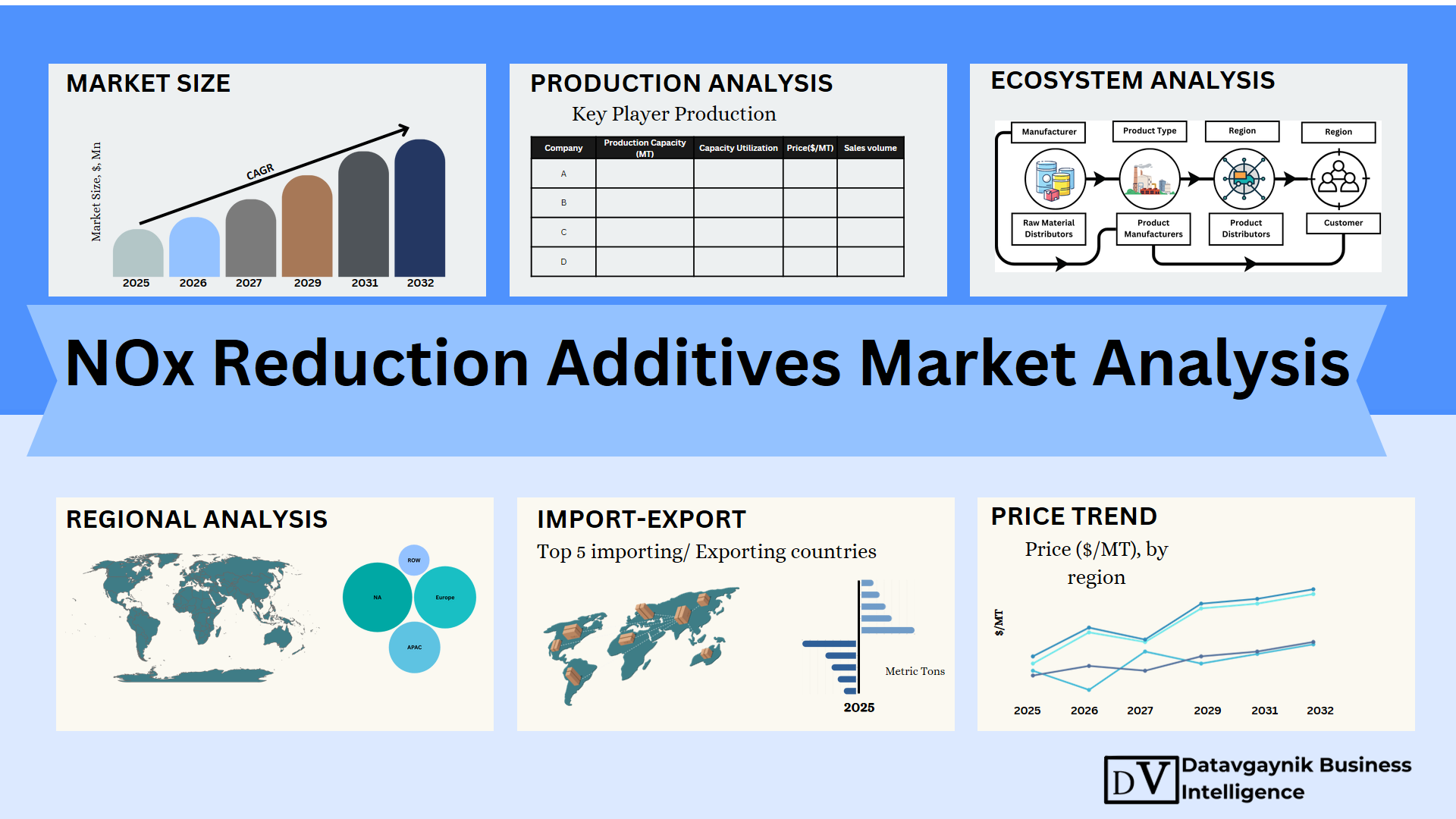
The NOx Reduction Additivese Market is experiencing strong growth fueled by increasingly strict environmental regulations worldwide. Governments across major economies have implemented tougher emission standards targeting nitrogen oxide pollutants due to their harmful impact on air quality and public health. For example, emission norms for vehicles and industrial plants have tightened sharply in regions like North America, Europe, and Asia Pacific, leading to widespread adoption of NOx reduction additives in diesel engines and industrial exhaust systems.
This regulatory environment is compelling industries to invest heavily in additives that ensure compliance while improving operational efficiency. As a result, the NOx Reduction Additivese Market is growing at a robust pace, with annual growth rates expected to surpass 8% in the coming years.
Growing Automotive Industry Propels Demand in the NOx Reduction Additivese Market
A key driver of the NOx Reduction Additivese Market is the rapid expansion of the global automotive sector, especially in developing markets. Diesel-powered commercial vehicles, trucks, and buses remain dominant in many regions due to their fuel efficiency and power output, but they emit significant levels of NOx. For example, nearly half of the commercial vehicles sold in Europe rely on diesel engines, creating an urgent need for effective NOx mitigation.
NOx reduction additives, particularly those used in Selective Catalytic Reduction (SCR) systems, have become essential in meeting stringent emission standards without sacrificing engine performance. Furthermore, the rise of hybrid vehicles that combine combustion engines with electric motors introduces new applications for these additives, further expanding market demand. The automotive segment is forecasted to contribute over 60% of the NOx Reduction Additivese Market’s revenue by 2028.
Industrial Expansion and Urbanization Driving the NOx Reduction Additivese Market
Industrialization and urban growth in Asia Pacific and emerging economies are accelerating NOx emissions, thereby propelling the NOx Reduction Additivese Market forward. Countries such as China and India are witnessing surging manufacturing output and power generation activities, which release considerable nitrogen oxides. In these regions, the increased enforcement of emissions limits in factories and power plants has pushed industries to adopt advanced NOx reduction additives as part of their pollution control strategies.
This shift is particularly pronounced in heavy industries like cement, steel, and petrochemicals, where compliance is critical to avoid penalties. The expanding industrial base coupled with stringent local regulations is expected to sustain strong growth in the NOx Reduction Additivese Market, particularly across Asia Pacific, where demand is rising at double-digit rates annually.
Technological Innovations Enhancing the NOx Reduction Additivese Market Potential
Technological advancements in NOx reduction additives are significantly enhancing the market’s prospects. Innovations in additive chemistry have improved the efficiency and durability of SCR systems, enabling better conversion of harmful NOx into harmless nitrogen and water. For example, newer aqueous urea-based additives and enhanced formulations deliver higher emission reductions at lower operating costs. These innovations are making NOx reduction additives more attractive to industries and automotive manufacturers aiming to balance environmental compliance with economic feasibility. Additionally, ongoing R&D focuses on developing additives compatible with emerging powertrain technologies, such as hybrid and alternative fuel engines, broadening the scope of the NOx Reduction Additivese Market.
Rising Diesel Vehicle Population Sustains NOx Reduction Additivese Market Growth
Despite growing electrification trends, diesel vehicles remain prevalent in many regions due to their efficiency and reliability, sustaining demand within the NOx Reduction Additivese Market. For instance, in parts of Asia and Europe, diesel vehicles still constitute a large share of commercial fleets. Diesel engines naturally produce higher NOx emissions compared to gasoline engines, making NOx reduction additives indispensable. As governments enforce stricter emission standards, fleet operators and manufacturers increasingly rely on these additives to reduce environmental impact and avoid regulatory penalties. This ongoing demand from diesel vehicles ensures a steady expansion of the NOx Reduction Additivese Market over the next decade.
Government Incentives Accelerate Adoption in the NOx Reduction Additivese Market
Government incentives and subsidies for adopting cleaner technologies play a pivotal role in boosting the NOx Reduction Additivese Market. Numerous countries offer tax breaks, grants, or subsidies for industries and transportation sectors that implement NOx reduction technologies, including additives for SCR systems. Such financial encouragement reduces the initial investment barrier, accelerating the uptake of these environmentally friendly solutions. For example, incentives in Europe and parts of Asia have catalyzed faster adoption of advanced additives among commercial vehicle operators and industrial plants. These supportive policies are expected to remain a key growth driver, helping the NOx Reduction Additivese Market scale new heights in both mature and emerging economies.
Public Awareness and Sustainability Initiatives Drive NOx Reduction Additivese Market Demand
Increasing environmental awareness among consumers and industries is another significant driver for the NOx Reduction Additivese Market. The health hazards associated with NOx pollution, such as respiratory diseases and smog, have heightened public demand for cleaner air solutions. This societal pressure motivates businesses and governments to adopt NOx reduction additives as part of broader sustainability initiatives. Many corporations now integrate NOx emissions control within their environmental, social, and governance (ESG) frameworks, recognizing the value of reducing their carbon footprint. The global shift towards sustainability is making NOx reduction additives an essential component in achieving climate targets, thereby propelling consistent growth in the market.
Regional Growth Patterns Highlight Opportunities in the NOx Reduction Additivese Market
Regionally, the NOx Reduction Additivese Market is witnessing varied but robust growth. North America benefits from mature automotive and industrial sectors with strict regulatory frameworks, maintaining steady demand. Europe leads in advanced SCR technology adoption, driven by stringent EU emission directives and strong environmental commitments. The Asia Pacific region exhibits the fastest growth rate due to rapid industrialization, urbanization, and expanding automotive production in countries like China and India. For example, Asia Pacific’s NOx reduction additives consumption is growing at a rate exceeding 10% annually, outpacing global averages. These regional dynamics create a diverse landscape for market players, enabling targeted strategies for maximum impact.
“Track Country-wise NOx Reduction Additives Production and Demand through our NOx Reduction Additives Production Database”
- NOx Reduction Additives production database for 30+ countries worldwide
- NOx Reduction Additives Powder sales volume for 31+ countries
- Country-wise NOx Reduction Additives production capacity and production plant mapping, production capacity utilization for 30+ manufacturers
- NOx Reduction Additives production plants and production plant capacity analysis for top manufacturers
Geographical Demand Dynamics in the NOx Reduction Additivese Market
The geographical demand within the NOx Reduction Additivese Market reveals distinctive growth patterns influenced by regulatory frameworks, industrialization pace, and automotive sector development. For example, North America’s NOx Reduction Additivese Market remains robust due to stringent EPA emission standards that drive widespread adoption in heavy-duty trucks and industrial machinery. The U.S., being the largest economy in the region, accounts for over 40% of the continent’s demand, with commercial vehicle fleets increasingly integrating SCR systems. Canada follows closely, with a growing emphasis on cleaner power generation plants adopting NOx additives to comply with provincial emission norms.
Europe exhibits the highest penetration rate of NOx reduction additives, with Germany, France, and the United Kingdom leading the charge. The Euro 6 and Euro 7 emission standards have made NOx reduction additives indispensable in reducing diesel engine emissions. For instance, Germany’s automotive industry, contributing nearly 20% of the country’s GDP, heavily relies on these additives to meet rigorous environmental mandates. The NOx Reduction Additivese Market in Europe is growing at an estimated CAGR of around 7.5%, supported by aggressive environmental policies and increasing fleet modernization.
Asia Pacific is the fastest-growing region in the NOx Reduction Additivese Market, spurred by rapid industrialization and urbanization. China and India dominate the demand landscape, accounting collectively for over 55% of the regional market share. China’s vehicle production, which exceeds 25 million units annually, combined with expanding coal-based power generation, significantly amplifies NOx emissions. Consequently, SCR adoption and NOx reduction additives consumption in commercial vehicles and industries are growing at double-digit rates, sometimes exceeding 12% annually. India’s NOx Reduction Additivese Market, fueled by stringent Bharat Stage VI emission norms and a booming automotive sector, is also witnessing rapid growth, with annual increases surpassing 10%.
Production Landscape Shaping the NOx Reduction Additivese Market
Production of NOx reduction additives is concentrated in regions with mature automotive and industrial bases. The United States leads global production, housing major manufacturers that specialize in urea-based additives and Diesel Exhaust Fluids (DEF), critical for SCR systems. These manufacturers have ramped up production capacity by nearly 15% in the past three years to meet growing demand from domestic and export markets. For example, large chemical companies in the Midwest and Gulf Coast regions have invested heavily in refining additive formulations to enhance emission reduction efficacy while lowering production costs.
Europe’s production hubs are primarily located in Germany, France, and Italy, where a combination of advanced chemical engineering capabilities and proximity to automotive manufacturing centers provides a strategic advantage. European producers focus on high-purity additives tailored for stringent regulatory requirements, with an emphasis on eco-friendly, low-toxicity compounds. This focus has resulted in a surge in production volumes, growing approximately 8% year-on-year, meeting rising demand from both automotive and industrial sectors.
Asia Pacific’s production footprint is expanding rapidly, particularly in China, Japan, and South Korea. China has emerged as a significant production base, leveraging its vast chemical manufacturing infrastructure to produce large volumes of NOx reduction additives domestically. This local production is crucial for mitigating high import costs and meeting the region’s surging demand. In Japan and South Korea, the emphasis is on producing advanced additives with enhanced performance for hybrid and diesel vehicles, aligning with the region’s strong automotive technology ecosystem.
Market Segmentation Fuels Strategic Growth in the NOx Reduction Additivese Market
The NOx Reduction Additivese Market segmentation by type reveals that Selective Catalytic Reduction (SCR) additives dominate, accounting for nearly 75% of total consumption. These additives, often urea-based or aqueous solutions, are integral to SCR systems, converting nitrogen oxides into harmless nitrogen and water. Their effectiveness and regulatory acceptance make them the preferred choice in automotive and industrial applications. For example, in commercial trucking fleets across North America and Europe, SCR additives are standard to meet emission regulations without compromising fuel efficiency.
Non-SCR additives, although less prevalent, serve niche applications such as lean NOx traps and ammonia slip catalysts, contributing to about 15-20% of the market. These additives find usage in specific industrial settings where SCR deployment is impractical or as complementary technologies in hybrid emission control systems. Growing interest in alternative NOx reduction technologies could expand this segment over time, providing diversification opportunities for manufacturers.
By application, the automotive segment leads demand, driven by diesel-powered vehicles and hybrid engines that require sophisticated NOx reduction additives for compliance. The industrial segment is rapidly gaining ground, fueled by tightening emission norms for power plants, refineries, and manufacturing plants, where NOx emissions from combustion processes are significant. Marine applications, though smaller in market share, are increasingly adopting NOx reduction additives due to stricter IMO Tier III maritime emission standards.
NOx Reduction Additivese Price Trend Reflects Raw Material and Regulatory Influences
The NOx Reduction Additivese Price Trend is shaped by factors such as raw material costs, production technology advancements, and regulatory pressure. Urea, the primary raw material for many NOx reduction additives, has seen price volatility over recent years, influencing overall additive pricing. For example, fluctuations in global urea supply due to agricultural demand and production disruptions have caused additive prices to vary between 5% and 10% annually. Despite these fluctuations, technological improvements in additive formulations and manufacturing efficiency have helped stabilize prices, making additives more accessible for end-users.
Increasingly stringent emission regulations globally have intensified demand, exerting upward pressure on prices due to higher-quality additive requirements. For instance, advanced SCR additives with enhanced performance and longer lifespan command premium pricing but offer superior cost savings through reduced fuel consumption and maintenance. This dynamic has led to a market bifurcation where standard additives compete heavily on price, while high-performance additives emphasize value-added benefits.
Regional Price Variations in the NOx Reduction Additivese Market
Price trends in the NOx Reduction Additivese Market differ significantly by region, influenced by production capabilities, import dependencies, and regulatory intensity. North America, with its established production infrastructure and domestic raw material availability, generally experiences more stable and competitive NOx reduction additive prices. For example, the widespread availability of urea and robust supply chains have kept additive prices within moderate ranges, facilitating consistent market growth.
Europe’s NOx Reduction Additivese Price Trend is characterized by higher average prices due to stringent quality and environmental standards, coupled with elevated production costs. The focus on premium additives tailored to complex emission control systems supports a market where customers are willing to invest more upfront for compliance and sustainability benefits. This premium pricing environment is reflected in higher per-unit additive costs compared to other regions.
In Asia Pacific, price volatility is more pronounced due to fluctuating raw material imports and rapidly evolving regulatory frameworks. Countries like China are investing heavily in local production to mitigate high import costs, which currently inflate additive prices. Meanwhile, emerging economies such as India face challenges balancing cost sensitivity with rising emission control demands, creating a dynamic price environment that is expected to stabilize as production capabilities mature.
Distribution Channels Influence NOx Reduction Additivese Price Trends and Market Reach
Distribution channels play a vital role in shaping the NOx Reduction Additivese Price Trend and overall market accessibility. Direct sales dominate the commercial vehicle and industrial segments, where large-scale users require bulk supplies and technical support for SCR system integration. This channel supports price negotiations and contract-based pricing models that can offer cost advantages to high-volume buyers.
Distributors and retailers primarily serve smaller businesses and aftermarket applications, where volume is lower, and pricing is often standardized. This channel contributes to regional price variations as additional markups and logistics costs are factored into retail prices. For instance, in emerging markets, the distributor network is expanding rapidly to increase the penetration of NOx reduction additives in smaller commercial fleets and localized industries.
Production and Supply Chain Innovations Impact NOx Reduction Additivese Price Trend
Advancements in production technology and supply chain optimization are increasingly influencing the NOx Reduction Additivese Price Trend. Automation and process improvements in chemical synthesis and formulation have reduced production costs by up to 10% in mature markets. Additionally, vertical integration strategies by major manufacturers, involving direct sourcing of raw materials like urea, have enhanced supply stability and cost control.
Innovations in packaging and logistics, such as concentrated additive solutions reducing transportation volume, also contribute to lowering total costs. These efficiencies are critical in regions with high logistics expenses, helping moderate prices and improve market competitiveness. Consequently, companies investing in these innovations gain pricing flexibility, enabling them to capture larger market shares amid growing demand.
“NOx Reduction Additives Manufacturing Database, NOx Reduction Additives Manufacturing Capacity”
- NOx Reduction Additives top manufacturers market share for 30+ manufacturers
- Top 9 manufacturers and top 19 manufacturers of NOx Reduction Additives in North America, Europe, Asia Pacific
- Production plant capacity by manufacturers and NOx Reduction Additives production data for 30+ market players
- NOx Reduction Additives production dashboard, NOx Reduction Additives production data in excel format
Leading Manufacturers in the NOx Reduction Additivese Market
The NOx Reduction Additivese Market is dominated by a select group of global manufacturers that have established themselves through technological innovation, production capacity, and strong distribution networks. These players include industry giants such as BASF SE, Yara International ASA, Evonik Industries AG, CF Industries Holdings, and Schlumberger Limited. Together, they control a significant share of the market, driving advancements in additive chemistry and expanding production capabilities to meet rising global demand.
BASF SE stands out as one of the largest manufacturers in the NOx Reduction Additivese Market. The company’s product line includes advanced urea-based additives and Diesel Exhaust Fluid (DEF) formulations designed specifically for Selective Catalytic Reduction (SCR) systems. BASF’s focus on sustainability and innovation has led to the development of additives that reduce nitrogen oxide emissions more efficiently while improving fuel economy. Their additive solutions are widely used across commercial vehicles, industrial machinery, and power generation sectors, contributing to BASF’s dominant market share.
Yara International ASA is another key player with a substantial footprint in the NOx Reduction Additivese Market. Known for its leadership in urea production, Yara supplies high-quality DEF products under brands such as AdBlue, which are globally recognized in the automotive and industrial sectors. Yara’s extensive distribution network and production capacity enable it to capture a major portion of the market share, particularly in Europe and North America. Their commitment to reducing emissions aligns with tightening environmental regulations, positioning them well for future growth.
Evonik Industries AG is prominent for its innovation-driven approach in the NOx Reduction Additivese Market. Their specialty chemicals division produces tailored additives that enhance SCR system performance. Evonik’s additive lines include high-purity urea and catalyst-compatible formulations that address specific engine and industrial requirements. By collaborating with OEMs and regulatory bodies, Evonik ensures its products meet evolving emission standards, helping maintain a competitive edge and a growing market share.
CF Industries Holdings has emerged as a significant manufacturer with its strong presence in nitrogen-based fertilizers and related chemical products. Its expansion into NOx reduction additives, particularly urea-based DEF products, complements its existing portfolio. CF Industries leverages its large-scale ammonia and urea production facilities to produce cost-effective additives that appeal to price-sensitive markets in North America and Asia. This strategic positioning allows CF Industries to gradually increase its share in the NOx Reduction Additivese Market.
Schlumberger Limited, traditionally known for oilfield services, has diversified into emission control solutions, including NOx reduction additives. Their focus is primarily on industrial and marine applications, offering specialized additives designed to meet stringent maritime emission standards. Schlumberger’s involvement in the NOx Reduction Additivese Market is marked by innovative product lines that cater to high-demand segments such as shipping and power generation, contributing to the diversification and expansion of the overall market.
NOx Reduction Additivese Market Share Distribution by Manufacturers
The market share in the NOx Reduction Additivese Market is concentrated among the top five to seven manufacturers, which collectively command approximately 65-70% of the global market. BASF SE and Yara International ASA lead this pack, each holding around 20-25% of the market share, reflecting their extensive production capacity and strong customer bases in key regions. BASF’s dominance is driven by its advanced research capabilities and wide product portfolio, while Yara’s strength lies in its well-established global distribution network and recognized brands.
Evonik Industries AG and CF Industries Holdings follow with market shares estimated between 10-15% each, supported by their focused production strategies and regional strengths. Evonik’s emphasis on specialty additives positions it strongly in premium market segments, while CF Industries targets mass-market applications with cost-effective solutions. Schlumberger and other smaller manufacturers share the remaining portion of the market, each holding between 3-7%, often specializing in niche applications such as marine or industrial emissions.
The competitive landscape is marked by ongoing innovation and strategic partnerships. Manufacturers continually invest in R&D to enhance additive efficiency, reduce production costs, and comply with tightening regulations. This dynamic competition drives steady market consolidation, with mergers and acquisitions playing a role in expanding product lines and geographic reach.
Key Product Lines and Technological Innovations by Manufacturers
BASF’s product portfolio includes the urea-based additive line called AdBlue Advance, designed to provide enhanced NOx reduction efficiency and improved SCR catalyst compatibility. This product is tailored for high-performance diesel engines and industrial processes, supporting BASF’s leadership in advanced emission control technologies. BASF also invests heavily in next-generation additives that integrate with hybrid and alternative fuel engines.
Yara’s flagship DEF product, AdBlue, remains the gold standard in the NOx Reduction Additivese Market. Available worldwide, AdBlue is formulated to strict quality standards ensuring optimal SCR system performance. Yara continues to innovate by developing formulations that reduce freezing points and improve storage stability, essential for cold climates and long-haul operations. This continuous product evolution sustains Yara’s strong market position.
Evonik’s innovative product line includes their Purinova™ range of urea-based additives, known for purity and compatibility with a wide range of SCR catalysts. Evonik focuses on additives that minimize ammonia slip and extend catalyst life, critical factors for commercial fleet operators and industrial users. Their collaborative efforts with engine manufacturers ensure product alignment with the latest emission regulations.
CF Industries’ DEF solutions are integrated within their broader nitrogen product suite, enabling competitive pricing and supply chain efficiencies. Their additives are targeted primarily at the North American market, where fleet operators seek cost-effective, reliable NOx reduction options. CF Industries is also exploring bio-based urea alternatives as part of their sustainability agenda.
Schlumberger’s Emission Control Solutions division offers specialized marine-grade additives that comply with International Maritime Organization (IMO) Tier III regulations. Their product lines include proprietary formulations optimized for heavy-duty marine engines and offshore power generation, addressing one of the fastest-growing segments in the NOx Reduction Additivese Market.
Recent Industry Developments and Market Updates
In 2024, the NOx Reduction Additivese Market saw significant momentum as regulatory bodies in Europe introduced accelerated deadlines for Euro 7 emission compliance, pushing automakers and industries to increase adoption of advanced NOx additives. This regulatory tightening has spurred investment in production capacity expansion by major manufacturers, including BASF and Yara.
In early 2025, BASF announced the commissioning of a new state-of-the-art additive manufacturing plant in Germany aimed at increasing their annual production capacity by 20%. This move is expected to enhance supply chain reliability and meet the growing demand from both automotive and industrial sectors.
Yara International expanded its distribution network in Asia Pacific in late 2024, forming strategic partnerships with regional logistics companies to improve the availability of its AdBlue product line across India and Southeast Asia. This expansion is crucial as these markets rapidly increase their diesel vehicle fleets and industrial activities requiring NOx control.
Evonik Industries launched a new Purinova™ additive formulation in mid-2024, specifically engineered for hybrid diesel-electric vehicles, reflecting the industry trend towards electrification alongside traditional combustion engines. This innovation positions Evonik favorably to capture emerging segments in the NOx Reduction Additivese Market.
CF Industries announced plans in 2025 to invest in bio-based urea additive R&D, aiming to introduce environmentally sustainable NOx reduction products by 2027. This aligns with global sustainability trends and growing demand for green chemical solutions within the market.
Schlumberger’s Emission Control Solutions division secured a multi-year supply contract with a leading global shipping company in late 2024, emphasizing the rising adoption of NOx reduction additives in maritime applications. This partnership is projected to boost Schlumberger’s market presence and highlight marine emission control as a key growth area.
“NOx Reduction Additives Production Data and NOx Reduction Additives Production Trend, NOx Reduction Additives Production Database and forecast”
- NOx Reduction Additives production database for historical years, 10 years historical data
- NOx Reduction Additives production data and forecast for next 9 years
Market Scenario, Demand vs Supply, Average Product Price, Import vs Export, till 2035
- Global NOx Reduction Additives Market revenue and demand by region
- Global NOx Reduction Additives Market production and sales volume
- United States NOx Reduction Additives Market revenue size and demand by country
- Europe NOx Reduction Additives Market revenue size and demand by country
- Asia Pacific NOx Reduction Additives Market revenue size and demand by country
- Middle East & Africa NOx Reduction Additives Market revenue size and demand by country
- Latin America NOx Reduction Additives Market revenue size and demand by
- Import-export scenario – United States, Europe, APAC, Latin America, Middle East & Africa
- Average product price – United States, Europe, APAC, Latin America, Middle East & Africa
- Market player analysis, competitive scenario, market share analysis
- Business opportunity analysis
Key questions answered in the Global NOx Reduction Additives Market Analysis Report:
- What is the market size for NOx Reduction Additives in United States, Europe, APAC, Middle East & Africa, Latin America?
- What is the yearly sales volume of NOx Reduction Additives and how is the demand rising?
- Who are the top market players by market share, in each product segment?
- Which is the fastest growing business/ product segment?
- What should be the business strategies and Go to Market strategies?
The report covers NOx Reduction Additives Market revenue, Production, Sales volume, by regions, (further split into countries):
- Asia Pacific (China, Japan, South Korea, India, Indonesia, Vietnam, Rest of APAC)
- Europe (UK, Germany, France, Italy, Spain, Benelux, Poland, Rest of Europe)
- North America (United States, Canada, Mexico)
- Latin America (Brazil, Argentina, Rest of Latin America)
- Middle East & Africa
Table of Contents:
distinctiveness:
- Introduction to NOx Reduction Additives
- Overview of NOx reduction additives and their importance
- Applications in various industries
- Key drivers influencing market demand
- NOx Reduction Additives Market Segmentation
- By type of additives (Ammonia-based, Urea-based, etc.)
- By end-use industry (Automotive, Industrial, Power Generation)
- By region (North America, Europe, Asia Pacific, etc.)
- Global NOx Reduction Additives Market Size and Forecast (2025-2040)
- Market trends and opportunities
- Growth projections by region and application
- Market Dynamics and Trends in the NOx Reduction Additives Industry
- Technological innovations and advancements
- Regulatory and environmental impacts on demand
- Shifting consumer preferences and sustainability trends
- NOx Reduction Additives Production Analysis
- Manufacturing processes and key technologies used
- Leading producers and their market strategies
- Cost structures and economies of scale in production
- NOx Reduction Additives Revenue Market Share Analysis (2025-2030)
- Revenue distribution by region and product type
- Insights into revenue growth and drivers
- NOx Reduction Additives Competitive Landscape
- Key market players and competitive positioning
- Mergers, acquisitions, and partnerships in the industry
- SWOT analysis of leading manufacturers
- Regional Analysis of the NOx Reduction Additives Market
- North America: Market size, trends, and forecasts
- Europe: Market dynamics and growth prospects
- Asia Pacific: Market potential and key drivers
- Rest of the World: Opportunities in Latin America, Middle East, and Africa
- Technological Innovations and Future Outlook
- Impact of new technologies in NOx reduction
- Research and development investments in the industry
- Emerging solutions and their market potential
- Supply Chain and Distribution Channels for NOx Reduction Additives
- Key suppliers and manufacturers in the supply chain
- Distribution networks and customer engagement
- Import-export trends and international trade dynamics
- Regulatory Landscape and Environmental Policies
- Government regulations and their impact on the market
- Emission reduction targets and compliance standards
- Future regulatory trends and their influence on NOx reduction additives
- NOx Reduction Additives Market Challenges and Barriers
- Issues in sourcing raw materials and production costs
- Environmental concerns and public perception
- Competition from alternative emission-reduction technologies
- Future Market Outlook and Forecasting
- Long-term market projections and opportunities
- Key factors driving future demand and innovation
- Strategic recommendations for stakeholders
- Market Entry Strategies and Recommendations
- Best practices for new entrants in the NOx reduction additives market
- Market expansion strategies for existing players
- Customer acquisition and retention strategies
- Conclusion: The Road Ahead for the NOx Reduction Additives Market
- Summary of key findings and insights
- Strategic guidance for businesses in the industry
Other recently published reports:


