

Accelerating Growth Trends in the Non-platinum based promoterse Market
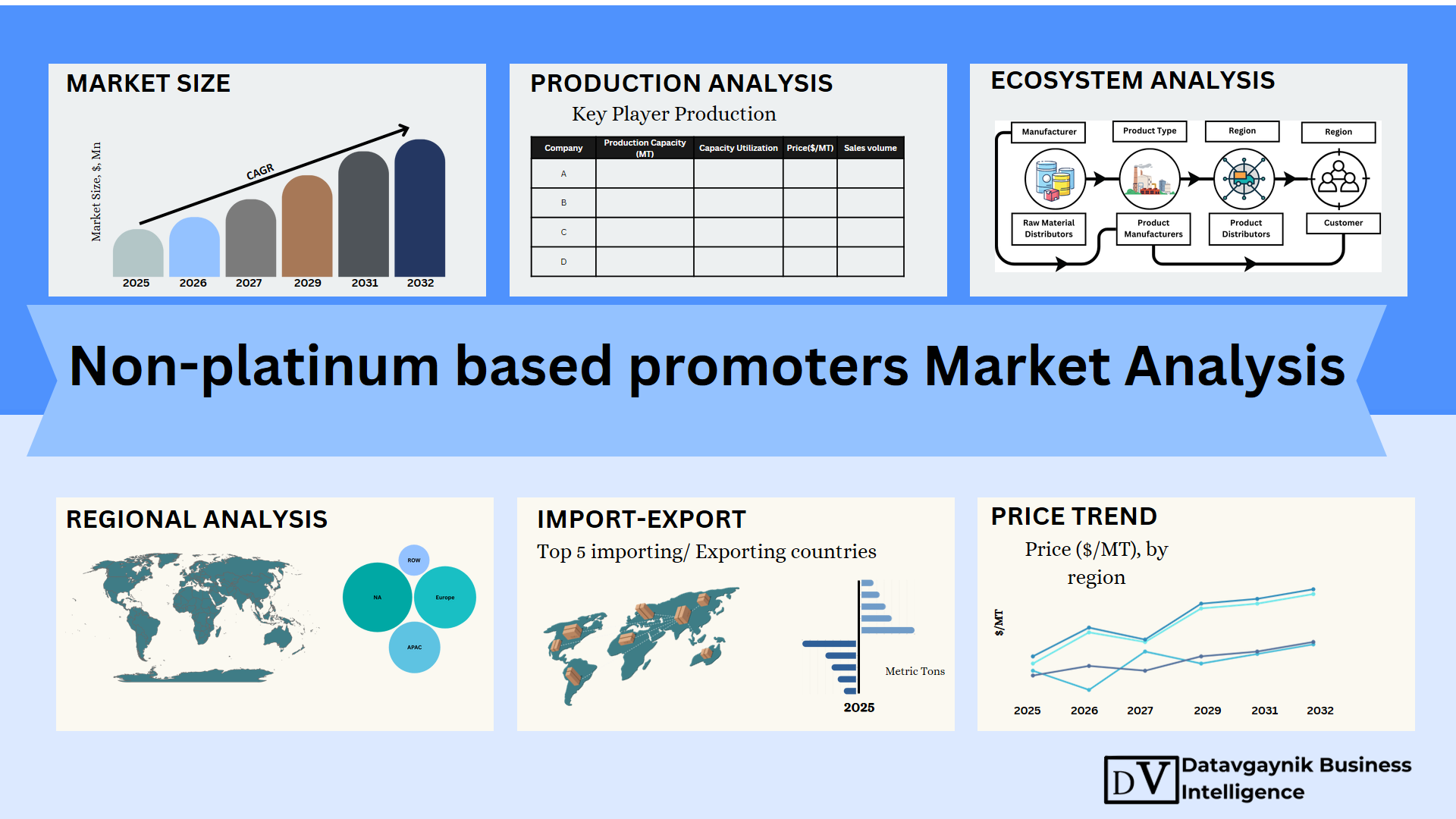
The Non-platinum based promoterse Market is witnessing unprecedented growth driven by the urgent need for cost-efficient and sustainable catalytic alternatives. As industries grapple with soaring platinum prices and supply constraints, non-platinum promoters are emerging as indispensable solutions. For instance, the Non-platinum based promoterse Market is expanding rapidly because materials like nickel, cobalt, and iron offer a fraction of the cost compared to platinum, reducing overall manufacturing expenses by as much as 40% in automotive and chemical sectors. This shift is not only financially prudent but critical to meeting evolving industry demands.
Cost Efficiency Driving the Surge in Non-platinum based promoterse Market
Cost remains the cornerstone behind the explosive adoption in the Non-platinum based promoterse Market. Nickel and iron-based promoters are available at prices nearly 70% lower than platinum, making them attractive for large-scale applications such as catalytic converters and fuel cells. For example, as the electric vehicle market expands at over 20% annually worldwide, the demand for affordable, high-performance catalysts intensifies, further bolstering the Non-platinum based promoterse Market. This growing preference underlines the importance of economically viable catalysts that do not compromise performance.
Supply Chain Resilience Boosting the Non-platinum based promoterse Market
The Non-platinum based promoterse Market benefits enormously from the wide availability of raw materials. Unlike platinum, largely concentrated in a few geopolitical hotspots, nickel, iron, cobalt, and copper are mined across various continents, reducing vulnerability to supply disruptions. For instance, nickel reserves spread across Australia, Indonesia, and Canada provide a stable foundation for the Non-platinum based promoterse Market, ensuring consistent material flow even amid geopolitical uncertainties. This supply chain resilience fosters confidence among manufacturers and accelerates market growth.
Environmental Sustainability Driving Demand in the Non-platinum based promoterse Market
Environmental concerns are significantly propelling the Non-platinum based promoterse Market as global industries strive to meet stringent emission and sustainability targets. Platinum extraction is energy-intensive and environmentally damaging, whereas alternative promoters have a lower carbon footprint. For example, nickel and copper-based promoters contribute less to greenhouse gas emissions during production, aligning perfectly with global sustainability frameworks. This eco-friendly advantage makes the Non-platinum based promoterse Market essential for industries transitioning to greener production processes.
Technological Innovations Powering the Non-platinum based promoterse Market Expansion
Technological advancements have revolutionized the performance and reliability of non-platinum catalysts, enabling the Non-platinum based promoterse Market to compete directly with traditional platinum solutions. Novel synthesis techniques such as sol-gel and hydrothermal methods have significantly improved catalyst activity and lifespan. For example, iron-based promoters now demonstrate catalytic efficiency on par with platinum in petrochemical refining and hydrogen production. Such breakthroughs validate the Non-platinum based promoterse Market’s potential to replace expensive platinum across diverse applications.
Regulatory Environment Accelerating Growth in the Non-platinum based promoterse Market
Global regulatory trends are instrumental in accelerating the Non-platinum based promoterse Market. Environmental policies targeting the reduction of hazardous and rare metals promote the adoption of non-platinum alternatives. Regions implementing aggressive carbon neutrality goals, such as the European Union aiming for net-zero emissions by 2050, are actively incentivizing non-platinum catalyst integration. This regulatory backing not only stimulates innovation but also expands market opportunities, reinforcing the Non-platinum based promoterse Market’s trajectory as industries align with sustainable practices.
Expanding Applications Broadening the Non-platinum based promoterse Market Landscape
The versatility of non-platinum promoters is broadening their application across multiple high-growth sectors, thereby expanding the Non-platinum based promoterse Market. Beyond automotive catalytic converters, these catalysts are increasingly employed in fuel cells, renewable energy systems, chemical synthesis, and biofuel production. For example, the renewable energy sector, growing at a double-digit pace annually, is rapidly adopting nickel and cobalt-based promoters in hydrogen fuel cells, exemplifying the diverse utility fueling the Non-platinum based promoterse Market expansion.
Research and Development Driving Innovation in the Non-platinum based promoterse Market
Robust investment in research and development is a key driver underpinning the dynamism of the Non-platinum based promoterse Market. Continuous innovation efforts are producing catalysts with enhanced stability, selectivity, and efficiency. For instance, cutting-edge R&D has led to the emergence of copper-based promoters that maintain high catalytic activity under extreme industrial conditions, significantly expanding their use cases. This innovation pipeline strengthens the Non-platinum based promoterse Market, enabling companies to tailor solutions to specific industrial needs.
Market Size Growth Reflects Rising Industrial Demand in the Non-platinum based promoterse Market
The Non-platinum based promoterse Market size is experiencing remarkable expansion, mirroring the rising industrial demand for cost-effective catalysts. Sectors such as automotive, petrochemical refining, and renewable energy are collectively driving this surge. For example, the automotive catalytic converter market alone is expected to grow by over 6% annually through 2030, with non-platinum promoters capturing an increasing share due to cost and performance advantages. This growth solidifies the Non-platinum based promoterse Market as a strategic priority for manufacturers globally.
Strategic Advantages of Non-platinum Based Promoterse Market Adoption
Adopting non-platinum based promoters offers strategic benefits beyond cost and sustainability. These materials exhibit superior tolerance to poisoning and deactivation, extending catalyst life and reducing downtime in industrial processes. For example, cobalt-based promoters demonstrate resilience in harsh refining environments, enhancing operational efficiency. Such operational advantages are key reasons why the Non-platinum based promoterse Market continues to attract major investments and strategic partnerships worldwide.
Global Industrial Shifts Driving Non-platinum based promoterse Market Demand
Shifts in global industrial practices are catalyzing the rise of the Non-platinum based promoterse Market. Industries are moving towards cleaner production methods and circular economy models, where sustainable catalyst choices are non-negotiable. The chemical manufacturing sector, growing steadily with increasing demand for bio-based chemicals, exemplifies this shift. Adoption of non-platinum promoters in chemical synthesis is increasing at a compounded rate, reinforcing the Non-platinum based promoterse Market’s critical role in future-proofing industrial processes.
Competitive Landscape Stimulating Non-platinum based promoterse Market Innovation
The competitive dynamics within the Non-platinum based promoterse Market are fostering rapid innovation and adoption. Companies investing heavily in catalyst performance enhancements are carving out market leadership positions. For instance, manufacturers focused on nickel and iron-based promoters are expanding production capabilities to meet surging global demand, fueling the Non-platinum based promoterse Market’s evolution. This competitive environment benefits end-users with improved product options and accelerates industry-wide transition away from platinum dependence.
Supply-Demand Dynamics Positioning Non-platinum based promoterse Market for Sustained Growth
The balance of supply and demand continues to favor the Non-platinum based promoterse Market, given the increasing demand outpacing platinum catalyst production constraints. Emerging economies with expanding petrochemical and automotive industries are significant consumers of non-platinum catalysts, driving volume growth. For example, Asia Pacific’s industrial base is growing at over 7% annually, directly boosting the Non-platinum based promoterse Market through increased adoption in chemical processing and renewable energy applications.
“Track Country-wise Non-platinum based promoters Production and Demand through our Non-platinum based promoters Production Database”
- Non-platinum based promoters production database for 32+ countries worldwide
- Non-platinum based promoters sales volume for 32+ countries
- Country-wise Non-platinum based promoters production capacity, production plant mapping, production capacity utilization for 32+ manufacturers
- Non-platinum based promoters production plants and production plant capacity analysis by top manufacturers
“Track real-time Non-platinum based promoters Prices, Non-platinum based promoters price charts for 32+ countries, Non-platinum based promoters weekly price tracker and Non-platinum based promoters monthly price tracker”
- Track real-time Non-platinum based promoters prices and Non-platinum based promoters price trend in 32+ countries though our excel-based Non-platinum based promoters price charts
- Real-time Non-platinum based promoters price tracker dashboard with 32+ countries
- Complete transparency on Non-platinum based promoters price trend through our Non-platinum based promoters monthly price tracker, Non-platinum based promoters weekly price tracker
Geographical Demand Patterns in the Non-platinum based promoterse Market
The global landscape of the Non-platinum based promoterse Market is marked by diverse regional dynamics driven by varying industrial maturity, resource availability, and regulatory frameworks. For example, Asia Pacific has emerged as the fastest-growing region, accounting for over 40% of global demand. Rapid industrialization, a burgeoning automotive sector, and aggressive renewable energy adoption fuel this expansion. Countries such as China and India exemplify this trend, with China’s chemical and automotive industries growing at CAGR rates exceeding 7%, directly stimulating the Non-platinum based promoterse Market.
In contrast, North America, led by the United States, showcases a mature but steadily growing demand influenced by stringent environmental policies and innovation in green technologies. The rise of electric vehicles (EVs) and fuel cell adoption in the U.S. has pushed non-platinum catalysts to the forefront, with annual market growth hovering around 5%. Europe remains a significant player, driven by aggressive sustainability targets and industrial transformation. Nations like Germany and France leverage their strong automotive and chemical sectors to boost the Non-platinum based promoterse Market, especially in applications like catalytic converters and renewable fuel production.
Regional Production Capacities Shaping the Non-platinum based promoterse Market
Production of non-platinum catalysts is heavily concentrated in regions with abundant raw materials and advanced manufacturing infrastructure. China dominates global output, producing over 35% of non-platinum based promoters, supported by extensive nickel and cobalt reserves and government-backed investments in green technologies. For example, Chinese manufacturers have expanded production capacities by more than 20% annually over the past five years, positioning the Non-platinum based promoterse Market for sustained supply growth.
Europe’s production centers, particularly in Germany and France, focus on high-quality, advanced catalysts for specialized industrial uses, including automotive and hydrogen fuel cells. These countries account for nearly 25% of global production, with an emphasis on innovation-led manufacturing processes that enhance catalyst efficiency. The United States maintains a strong production base, especially in nickel and iron-based promoters for petrochemical and automotive applications. The U.S. production growth rate stands at approximately 6% annually, propelled by increasing adoption of cleaner energy and emission control technologies.
Market Segmentation by Catalyst Type Driving Non-platinum based promoterse Market Expansion
Segmentation by catalyst type reveals iron, nickel, cobalt, and copper-based promoters as key pillars of the Non-platinum based promoterse Market. Iron-based promoters dominate in cost-sensitive applications like petrochemical refining and biofuel synthesis, representing nearly 40% of market volume. Their cost-effectiveness and catalytic performance have led to an annual volume growth of about 7% globally.
Nickel-based promoters hold a significant share, especially in hydrogenation and fuel cell applications, with market growth fueled by the rising demand for clean energy. For example, nickel promoters are expanding at an approximate CAGR of 8% due to their versatility and robustness under high-temperature industrial conditions. Cobalt-based promoters, accounting for nearly 15% of the market, are vital in Fischer-Tropsch synthesis and other chemical processes, where their catalytic selectivity is prized despite higher raw material costs.
Copper-based promoters, though smaller in market share at around 10%, are rapidly gaining traction in environmental catalyst applications and chemical manufacturing due to their affordability and catalytic efficiency. This segment is growing at an impressive pace of over 9% annually, reflecting increased adoption in green hydrogen and pollution control technologies.
Application-Based Segmentation Illuminates Growth Drivers in Non-platinum based promoterse Market
The Non-platinum based promoterse Market extends across automotive catalysts, petrochemical refining, chemical synthesis, and energy applications, each segment reflecting distinct growth trajectories. Automotive catalysts are a cornerstone, with non-platinum promoters increasingly replacing traditional platinum in catalytic converters. Driven by tightening global emission standards, this segment accounts for roughly 35% of the total market value, growing at an annual rate near 6%. For example, rising demand for cost-effective exhaust treatment in emerging markets has significantly boosted non-platinum catalyst adoption.
Petrochemical refining represents another vital application, particularly in cracking and desulfurization processes. The shift towards non-platinum promoters here stems from both cost reduction and regulatory compliance, with this segment expanding by about 7% yearly. Chemical synthesis, involving production of polymers, fertilizers, and bio-based chemicals, benefits from the high activity and selectivity of iron and cobalt promoters, growing steadily at 6.5%.
Energy and environmental applications, including hydrogen production and fuel cells, are the fastest-growing segment within the Non-platinum based promoterse Market. This segment, although currently smaller in market share (around 15%), is expanding at a double-digit CAGR of over 12%, reflecting global momentum towards renewable energy systems and decarbonization initiatives.
Pricing Dynamics and Non-platinum based promoterse Price Trends Influencing Market Decisions
Non-platinum based promoterse Price has remained relatively stable compared to platinum-based catalysts, a critical factor in market expansion. For instance, platinum prices have fluctuated between $900 and $1,200 per ounce in recent years, while the average Non-platinum based promoterse Price for nickel and iron catalysts has stayed consistently 60-70% lower. This pricing stability supports industrial planning and cost control, making the Non-platinum based promoterse Market an attractive alternative.
However, raw material volatility, particularly in cobalt and nickel, can impact Non-platinum based promoterse Price Trend temporarily. For example, cobalt prices spiked by over 30% in 2022 due to supply disruptions in the Democratic Republic of Congo, causing short-term cost pressures in the market. Despite this, improved mining and recycling initiatives have moderated price fluctuations, maintaining overall Non-platinum based promoterse Price trends favorable for end-users.
Moreover, technological advancements in catalyst synthesis and recycling have contributed to improved price efficiencies. The sol-gel and incipient wetness impregnation methods enable better catalyst utilization and longer life, effectively reducing the cost per unit of catalytic activity. These innovations are crucial in sustaining a downward Non-platinum based promoterse Price Trend in high-volume applications like automotive catalysts and petrochemical refining.
Impact of Raw Material Supply on Non-platinum based promoterse Price Trend
Raw material supply remains a key determinant of the Non-platinum based promoterse Price Trend. Nickel, cobalt, iron, and copper reserves’ availability and geopolitical stability directly influence catalyst production costs. For example, Indonesia’s dominance as the world’s largest nickel producer (accounting for over 30% of global supply) significantly stabilizes nickel-based promoter prices in the Non-platinum based promoterse Market. In contrast, cobalt supply remains more volatile, with about 70% sourced from the Democratic Republic of Congo, impacting Non-platinum based promoterse Price when disruptions occur.
Efforts to diversify sourcing, including increased mining activity in Australia and recycling of spent catalysts, are smoothing price volatility. Additionally, growing investments in secondary raw material recovery, particularly for cobalt and nickel, are reducing dependency on mined materials. This transition supports a more predictable Non-platinum based promoterse Price Trend and enhances supply chain resilience.
Emerging Markets Expanding Demand and Production in Non-platinum based promoterse Market
Emerging markets in Latin America, Southeast Asia, and the Middle East are witnessing increasing demand for non-platinum catalysts, driven by growing automotive production and petrochemical expansion. For example, Brazil’s automotive sector is growing at around 5% annually, prompting adoption of cost-effective non-platinum promoters to reduce manufacturing expenses. Similarly, Southeast Asia’s rising industrial output and green energy initiatives are catalyzing Non-platinum based promoterse Market growth at rates exceeding 8% in some countries.
Production capacity in these regions is also scaling, albeit from smaller bases. Countries like Indonesia and Malaysia are enhancing catalyst manufacturing capabilities, leveraging local raw materials and government incentives. This regional growth diversifies the global Non-platinum based promoterse Market supply base and provides new export opportunities.
Competitive Pricing Strategies Reinforcing Non-platinum based promoterse Market Position
Competitive pricing remains a crucial lever for market players in the Non-platinum based promoterse Market. Companies aggressively optimize manufacturing processes to offer catalysts at prices that undercut platinum alternatives while maintaining high performance. For example, large-scale nickel catalyst producers have achieved cost reductions of 15-20% over the past three years through automation and process improvements.
Furthermore, long-term supply agreements between catalyst manufacturers and end-users help stabilize Non-platinum based promoterse Price and foster market confidence. These arrangements are particularly prevalent in automotive and petrochemical sectors, where volume predictability enables cost optimization. The resulting price stability is a key factor attracting new industries to the Non-platinum based promoterse Market.
Outlook: Sustained Growth Supported by Balanced Production and Demand
Balancing rising demand with expanding production capacity is crucial to maintaining favorable Non-platinum based promoterse Price Trends. With Asia Pacific leading production growth and Europe and North America advancing specialized manufacturing, the global Non-platinum based promoterse Market is well-positioned to meet increasing industrial needs. Continuous investments in raw material sourcing, process innovation, and recycling will underpin stable prices and broad adoption.
For example, anticipated expansions in nickel mining and catalyst recycling technologies are projected to reduce raw material costs by up to 10% over the next five years, further supporting a positive Non-platinum based promoterse Price Trend. This balance ensures that the Non-platinum based promoterse Market remains an attractive, sustainable alternative to platinum catalysts globally.
“Non-platinum based promoters Manufacturing Database, Non-platinum based promoters Manufacturing Capacity”
- Non-platinum based promoters top manufacturers market share for 32+ manufacturers
- Top 12 manufacturers and top 19 manufacturers of Non-platinum based promoters in North America, Europe, Asia Pacific
- Non-platinum based promoters production plant capacity by manufacturers and Non-platinum based promoters production data for 32+ market players
- Non-platinum based promoters production dashboard, Non-platinum based promoters production data in excel format
“Non-platinum based promoters price charts, Non-platinum based promoters weekly price tracker and Non-platinum based promoters monthly price tracker”
- Factors impacting real-time Non-platinum based promoters prices in 32+ countries worldwide
- Non-platinum based promoters monthly price tracker, Non-platinum based promoters weekly price tracker
- Real-time Non-platinum based promoters price trend, Non-platinum based promoters price charts, news and updates
- Tracking Non-platinum based promoters price fluctuations
Leading Manufacturers Driving the Non-platinum based promoterse Market
The Non-platinum based promoterse Market is dominated by a cadre of key global manufacturers, each leveraging unique technological capabilities and product portfolios to secure competitive market shares. These players are pivotal in advancing the adoption of cost-effective, sustainable catalytic solutions across industries such as automotive, petrochemical refining, and renewable energy.
Market Share Distribution Among Top Manufacturers in the Non-platinum based promoterse Market
Market share concentration within the Non-platinum based promoterse Market reflects both regional strengths and product innovation leadership. The top five manufacturers collectively control approximately 60-65% of the global market, underscoring a competitive yet consolidated landscape.
China-based companies hold a substantial portion of the market, led by firms such as Zhejiang Huayou Cobalt and Jinchuan Group, which dominate nickel and cobalt-based promoter production. These manufacturers have capitalized on China’s rich mineral reserves and government-backed green industrial policies to scale production rapidly. They contribute nearly 30% of the total Non-platinum based promoterse Market share.
European players like BASF and Umicore maintain around 20% market share combined, distinguished by their advanced catalyst formulations and robust R&D capabilities. These companies focus heavily on specialized iron and copper-based promoters tailored for automotive catalytic converters and chemical synthesis applications. Their innovation-driven approach commands premium market segments with high performance and longevity requirements.
North American manufacturers, including Johnson Matthey and Clariant, account for roughly 15-18% of the market. Their competitive edge lies in developing cobalt and nickel-based catalysts optimized for renewable energy sectors, including hydrogen fuel cells and biofuel processing. These companies are also notable for strategic partnerships with automotive OEMs, accelerating adoption of non-platinum promoters in clean transportation.
Key Manufacturer Product Lines Shaping the Non-platinum based promoterse Market
Several product lines stand out as benchmarks within the Non-platinum based promoterse Market, reflecting the depth and specialization of top manufacturers’ portfolios.
Zhejiang Huayou Cobalt’s “HyCoProm” Series has gained traction for its high-purity cobalt and nickel promoters, offering enhanced catalytic activity and stability for petrochemical refining and battery technologies. The HyCoProm line is recognized for its ability to reduce raw material costs without compromising catalyst performance, a critical advantage driving widespread industry acceptance.
BASF’s “CatProm” Line focuses on iron and copper-based promoters designed for automotive emissions control and chemical synthesis. These products emphasize durability and resistance to catalyst poisoning, meeting stringent regulatory standards in Europe and North America. The CatProm portfolio is a prime example of how R&D investment translates into high-value solutions within the Non-platinum based promoterse Market.
Umicore’s “EcoProm” Range targets fuel cell and renewable energy applications, combining cobalt and nickel promoters optimized for hydrogen production and storage systems. EcoProm catalysts have been pivotal in advancing clean energy initiatives, particularly in countries prioritizing decarbonization.
Johnson Matthey’s “CleanTech Promoters” are engineered for advanced emission control in vehicles, with formulations specifically tailored for heavy-duty and passenger automotive catalytic converters. Their focus on performance under high thermal and chemical stress has solidified their reputation in the Non-platinum based promoterse Market.
Clariant’s “BioProm Catalyst” Line caters to the growing biofuel and green chemical sectors, leveraging copper-based promoters for efficient chemical synthesis with a reduced environmental footprint. These catalysts enable cost reductions in large-scale bio-based production, expanding Clariant’s footprint within the Non-platinum based promoterse Market.
Manufacturer Strategies Enhancing Market Penetration
Top manufacturers have adopted diversified strategies to increase their share in the Non-platinum based promoterse Market. Strategic partnerships with automotive OEMs, petrochemical giants, and renewable energy firms form the backbone of their market approach, ensuring early integration of non-platinum catalysts in emerging technologies.
Investment in localized manufacturing facilities, particularly in Asia and Europe, has enhanced supply chain efficiency and responsiveness to regional demand fluctuations. For instance, Zhejiang Huayou Cobalt expanded its production plants in Indonesia and China in 2023 to meet surging nickel demand, strengthening its Non-platinum based promoterse Market leadership.
R&D investments remain critical, with firms like BASF and Umicore allocating significant budgets to develop next-generation promoters with improved catalytic activity and environmental compatibility. This focus on innovation drives competitive differentiation and supports entry into emerging segments such as green hydrogen and bio-based chemical catalysts.
Recent Developments and Industry Movements in the Non-platinum based promoterse Market
The Non-platinum based promoterse Market has seen several noteworthy developments over the past 18 months, highlighting the sector’s dynamic nature.
- In early 2024, BASF announced a breakthrough in copper-based catalyst technology, enhancing catalytic efficiency by 15% while reducing raw material use. This advancement is expected to boost BASF’s market share in automotive and chemical synthesis applications.
- Zhejiang Huayou Cobalt, in late 2023, commissioned a new nickel catalyst production facility in Indonesia with an annual capacity exceeding 10,000 tons, reflecting strategic scaling to support the Asia Pacific Non-platinum based promoterse Market demand surge.
- Johnson Matthey unveiled its next-generation cobalt promoter for fuel cells in mid-2023, targeting a 10% improvement in durability and operational lifespan, positioning the company as a leader in clean energy catalyst solutions.
- Clariant secured a multi-year supply agreement with a leading biofuel producer in Europe in 2024, underlining the growing importance of copper-based promoters in sustainable chemical synthesis within the Non-platinum based promoterse Market.
- Umicore expanded its R&D center in Belgium in 2023, focusing on renewable energy catalysts and entering collaborations with European Union-funded green hydrogen projects, enhancing its influence in the fast-growing non-platinum promoter segment.
Market Outlook and Competitive Dynamics
The competitive landscape of the Non-platinum based promoterse Market continues to intensify, with manufacturers vying to innovate and capture emerging applications such as green hydrogen, electric vehicle batteries, and bio-based chemicals. Market share gains will largely depend on the ability to deliver catalysts that combine high performance with cost-effectiveness and environmental sustainability.
Collaborative ventures between manufacturers and end-users are increasingly shaping product development cycles, ensuring rapid market adoption and tailored catalyst solutions. The interplay between Asian manufacturing scale and Western innovation expertise creates a balanced ecosystem conducive to sustained Non-platinum based promoterse Market growth.
“Non-platinum based promoters Production Data and Non-platinum based promoters Production Trend, Non-platinum based promoters Production Database and forecast”
- Non-platinum based promoters production database for historical years, 12 years historical data
- Non-platinum based promoters production data and forecast for next 12 years
- Non-platinum based promoters sales volume by manufacturers
“Track Real-time Non-platinum based promoters Prices for purchase and sales contracts, Non-platinum based promoters price charts, Non-platinum based promoters weekly price tracker and Non-platinum based promoters monthly price tracker”
- Gain control on your purchase and sales contracts through our real-time Non-platinum based promoters price tracker and Non-platinum based promoters price trend analysis
- Non-platinum based promoters weekly price tracker and forecast for next four weeks
- Non-platinum based promoters monthly price tracker and forecast for next two months
Market Scenario, Demand vs Supply, Average Product Price, Import vs Export, till 2035
- Global Non-platinum based promoters Market revenue and demand by region
- Global Non-platinum based promoters Market production and sales volume
- United States Non-platinum based promoters Market revenue size and demand by country
- Europe Non-platinum based promoters Market revenue size and demand by country
- Asia Pacific Non-platinum based promoters Market revenue size and demand by country
- Middle East & Africa Non-platinum based promoters Market revenue size and demand by country
- Latin America Non-platinum based promoters Market revenue size and demand by
- Import-export scenario – United States, Europe, APAC, Latin America, Middle East & Africa
- Average product price – United States, Europe, APAC, Latin America, Middle East & Africa
- Market player analysis, competitive scenario, market share analysis
- Business opportunity analysis
Key questions answered in the Global Non-platinum based promoters Market Analysis Report:
- What is the market size for Non-platinum based promoters in United States, Europe, APAC, Middle East & Africa, Latin America?
- What is the yearly sales volume of Non-platinum based promoters and how is the demand rising?
- Who are the top market players by market share, in each product segment?
- Which is the fastest growing business/ product segment?
- What should be the business strategies and Go to Market strategies?
The report covers Non-platinum based promoters Market revenue, Production, Sales volume, by regions, (further split into countries):
- Asia Pacific (China, Japan, South Korea, India, Indonesia, Vietnam, Rest of APAC)
- Europe (UK, Germany, France, Italy, Spain, Benelux, Poland, Rest of Europe)
- North America (United States, Canada, Mexico)
- Latin America (Brazil, Argentina, Rest of Latin America)
- Middle East & Africa
Table of Contents:
- Introduction to Non-Platinum Based Promoters
- Definition and role of non-platinum based promoters in catalysis
- Key advantages of non-platinum promoters over platinum-based alternatives
- Overview of industries relying on non-platinum promoters
- Market Overview for Non-Platinum Based Promoters
- Market trends and drivers shaping growth
- Challenges and barriers to adoption of non-platinum promoters
- Key opportunities for market expansion
- Types of Non-Platinum Based Promoters
- Metal-based promoters (Nickel, Copper, Iron, etc.)
- Organometallic and organic-based promoters
- Hybrid and composite materials for catalysis
- Market Segmentation by Application
- Automotive industry: Emission control and catalytic converters
- Petrochemical and chemical industries: Hydrogenation, reforming, and cracking
- Renewable energy: Applications in fuel cells and biofuels
- Industrial applications: Production of chemicals, polymers, and other materials
- Global Non-Platinum Based Promoters Market Size and Forecast (2025-2040)
- Market share analysis and growth forecasts
- Regional market dynamics and projections
- Factors driving the adoption of non-platinum promoters
- Competitive Landscape of Non-Platinum Based Promoters
- Key players and their market strategies
- Competitive advantages of non-platinum promoters
- SWOT analysis of leading manufacturers
- Technological Innovations and Developments
- Breakthroughs in catalyst design and promoter efficiency
- Advancements in the use of non-platinum materials in catalytic reactions
- Integration of non-platinum promoters with advanced catalytic systems
- Economic Impact of Non-Platinum Based Promoters
- Cost-benefit analysis of non-platinum promoters
- Pricing trends and factors influencing cost structures
- Economic impact on industries adopting non-platinum solutions
- Environmental Impact and Sustainability of Non-Platinum Based Promoters
- Comparison of environmental benefits versus platinum-based promoters
- Contribution to reducing carbon emissions and environmental footprint
- Recycling and reuse potential of non-platinum catalysts
- Regional Market Analysis for Non-Platinum Based Promoters
- North America: Market trends, growth, and regulatory influences
- Europe: Environmental regulations and demand for non-platinum catalysts
- Asia Pacific: Emerging markets and industrial applications
- Latin America and Middle East & Africa: Market dynamics and adoption rates
- Raw Materials and Sourcing for Non-Platinum Based Promoters
- Key materials used in non-platinum promoters (Nickel, Copper, etc.)
- Supply chain dynamics and sourcing challenges
- Impact of raw material prices on market growth
- Regulatory Landscape and Standards for Non-Platinum Based Promoters
- Regulatory requirements influencing non-platinum promoters in various industries
- Standards for emission control and catalytic efficiency
- Government incentives and policies promoting the use of non-platinum materials
- Supply Chain and Distribution of Non-Platinum Based Promoters
- Key suppliers and manufacturers in the market
- Distribution networks and logistics strategies
- Import-export trends and market flows
- Investment Opportunities in Non-Platinum Based Promoters
- Emerging investment opportunities in the market
- Strategic investments in research and development
- Opportunities in new applications such as fuel cells and green technologies
- Challenges in the Non-Platinum Based Promoters Market
- Performance limitations compared to platinum-based catalysts
- Sourcing and availability of non-platinum materials
- Technological hurdles in scaling production and efficiency
- Future Outlook for Non-Platinum Based Promoters
- Long-term market projections and emerging trends
- New developments in non-platinum promoter technologies
- Market opportunities in sustainable energy and environmental sectors
- Consumer Adoption and Market Penetration
- Adoption rates of non-platinum promoters across different industries
- Barriers to widespread adoption and strategies to overcome them
- Consumer perceptions and demand for greener catalysts
- Conclusion: The Future of Non-Platinum Based Promoters
- Key takeaways from market insights and growth drivers
- Summary of challenges, opportunities, and strategic recommendations
- Final thoughts on the role of non-platinum promoters in future catalysis technologies
Other recently published reports:


