

Market Summary and Growth Forecast
The global 1,3-diphenylguanidine (DPG) Market is estimated at $198 million in 2026 and is expected to reach $292 million by 2035, growing at a CAGR of 4.4%.
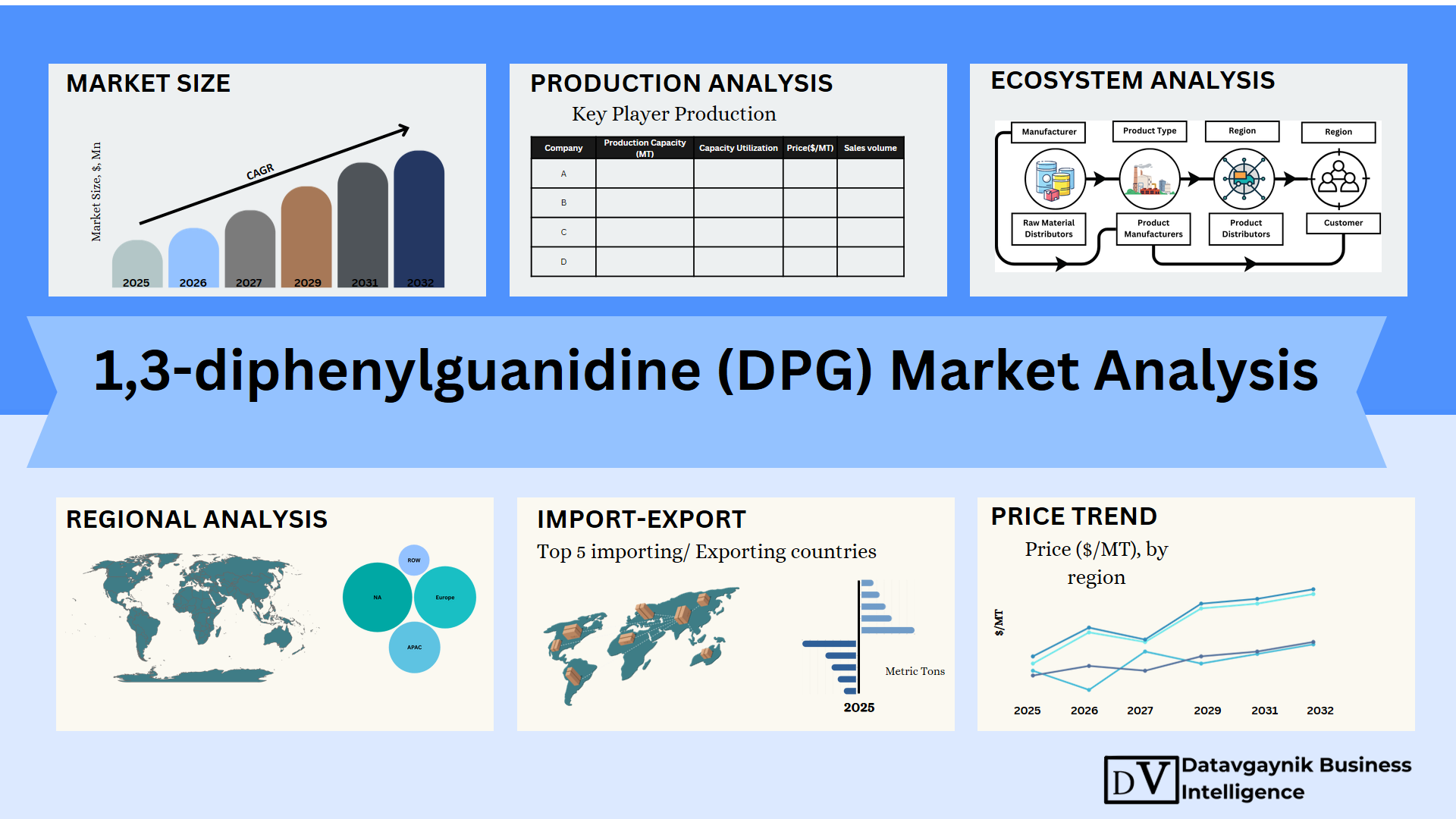
This is an analyst-derived manufacturer-level estimate. It covers DPG supplied as powder, granules and pre-dispersed grades. For formulated products, revenue is normalized to the value attributable to the active DPG content. Finished rubber compounds, tires and other downstream rubber products are excluded.
1,3-diphenylguanidine is an organic guanidine compound identified by CAS number 102-06-7. Rubber manufacturers use it mainly as a secondary vulcanization accelerator alongside thiazoles, sulfenamides and thiurams. It can also act as a primary accelerator in selected formulations. Typical loading can range from around 0.25% to 2.0% of the rubber compound, depending on polymer type and curing requirements.
The commercial importance of DPG is greater than its market value suggests. It represents a small part of total compound cost. Yet it influences cure speed, filler interaction, scorch behavior and final rubber performance. A poorly controlled accelerator package may lower productivity or create inconsistent mechanical properties. So, tire and industrial-rubber manufacturers tend to qualify suppliers carefully.
Market Forecast Snapshot
| Indicator | 2026 Estimate | 2035 Forecast |
| Global market value | US$198 million | US$292 million |
| Estimated DPG-active volume | 52,000 tonnes | 70,000 tonnes |
| Average realized value | US$3.81 per kg | US$4.17 per kg |
| Value CAGR, 2026–2035 | 4.4% | — |
| Volume CAGR | 3.4% | — |
| Largest application | Tire compounds | Tire compounds |
| Largest region | Asia Pacific | Asia Pacific |
The forecast assumes steady volume expansion rather than a sharp demand spike. Roughly three-quarters of value growth should come from higher consumption. The balance will come from inflation, tighter environmental compliance and a gradual mix shift toward low-dust or pre-dispersed grades.
Demand Structure Through 2035
Tire manufacturing will remain the central demand pool. DPG is especially relevant in cure systems using silica-filled rubber compounds. These formulations are common in passenger-car tread applications where manufacturers balance rolling resistance, wet grip and wear performance.
Replacement tires provide a relatively stable foundation. Original-equipment tire demand moves more closely with vehicle production and can be cyclical. Replacement demand is supported by the installed vehicle base, mileage and normal tire wear. For context, the U.S. Tire Manufacturers Association forecast 338.9 million tire shipments in 2026, slightly above the 2025 level. Michelin’s recent market updates also show replacement demand holding up better than several original-equipment categories.
Non-tire applications add a smaller but broad demand base. These include conveyor belts, transmission belts, hoses, seals, vibration-control components, molded rubber parts, footwear and selected latex products. NOCIL identifies tire companies and manufacturers of hoses, belts, footwear and gloves among the main customers for rubber chemicals.
Key Forces Shaping the Market
Tire-compound technology
Higher use of silica and advanced synthetic rubber supports DPG consumption in performance tire formulations. That said, each tire maker uses a proprietary cure package. Growth in silica compounds will not translate into equal growth in DPG demand because formulators are also working to lower accelerator dosage.
Regulatory and toxicological scrutiny
DPG carries harmonized European classifications including reproductive toxicity category 2 and acute oral toxicity category 4. It is also classified for skin, eye and respiratory irritation. This does not represent a general prohibition. It does raise expectations around worker protection, dust control, labeling and closed material handling.
Environmental research is another pressure point. A peer-reviewed 2025 groundwater study identified DPG as a frequently detected rubber additive and included it among compounds presenting potential ecological concern. The findings do not establish uniform global exposure. Still, they add momentum to environmental monitoring and substitution studies.
Production concentration and price competition
Asia, particularly China, holds a large part of global rubber-accelerator capacity. China Sunsine reported 117,000 tonnes of annual accelerator capacity in 2025 and projected an increase to 135,000 tonnes in 2026. These figures cover several accelerator families rather than DPG alone. Even so, they indicate the scale available to Chinese suppliers.
Oversupply across the wider rubber-chemicals industry may keep standard DPG prices competitive. NOCIL reported continued pricing pressure and intensified competition during FY2025–26. Buyers will benefit from competitive bids. Suppliers without process scale or differentiated grades may face thinner margins.
Manufacturing modernization
Leading producers are moving toward automated material handling, modern process control and improved effluent treatment. These investments reduce batch variation and occupational exposure. They also help suppliers meet the audit standards of multinational tire companies. China Sunsine and NOCIL both describe automated or continuous production initiatives across their rubber-chemical operations.
The 1,3-diphenylguanidine (DPG) Market is small by specialty-chemical standards. Still, it sits inside a high-volume and qualification-intensive supply chain. Supplier reliability matters almost as much as unit price.
Key Consumers and Commercial Clients
| Consumer Group | Representative Organizations or Buyers | Commercial Requirement |
| Global tire manufacturers | Bridgestone, Michelin, Goodyear, Pirelli, Hankook, Yokohama, Sumitomo Rubber Industries | Consistent cure behavior, global specifications and reliable supply |
| Asian tire manufacturers | ZC Rubber, Giti Tire, Sailun, Linglong Tire, Double Coin | Competitive pricing, volume availability and local technical support |
| Industrial rubber processors | Hose, belt, seal, gasket and molded-component manufacturers | Flexible lot sizes and application-specific grades |
| Rubber compounders | Custom mixers and pre-dispersed additive suppliers | Dispersion quality, low dust and dosing accuracy |
| Distributors and formulators | Regional chemical distributors and rubber-additive blenders | Inventory access, regulatory documentation and repackaging options |
The customer examples are consistent with disclosed customer relationships and end-use coverage reported by major rubber-chemical suppliers.
Market Segmentation and Forecast Scope
The 1,3-diphenylguanidine (DPG) Market should be segmented by grade, product form, application, end user and region. These dimensions explain different parts of demand and should not be merged. Grade captures chemical specification. Product form captures delivery format. Application identifies where DPG performs its technical function. End user identifies who purchases or processes it.
By Grade
Standard Technical Grade
This is the principal commercial grade for tire and general rubber processing. Buyers focus on purity consistency, melting behavior, ash content and cure response. Standard grade will retain the largest volume base because most industrial formulations do not require laboratory-grade purity.
High-Purity and Specialty Grade
This category serves tightly controlled rubber formulations, chemical synthesis and laboratory uses. Volume is limited. Pricing is higher due to additional purification, quality testing and smaller production runs.
High-purity DPG should grow faster than the overall market. The starting base is small though. It will not displace standard technical material as the main revenue pool.
By Product Form
Powder DPG
Powder remains the conventional form. It is easy to blend and widely available. Its drawbacks include dust generation, material loss and greater handling requirements.
Granulated DPG
Granules improve flow and can reduce airborne dust during transport and mixer charging. LANXESS, for example, has commercially supplied DPG in granulated form.
Pre-Dispersed or Polymer-Bound DPG
In these products, DPG is incorporated into a compatible elastomeric carrier. This improves dispersion and dosing accuracy. It is useful for automated mixing lines and applications where surface defects or local concentration variation must be minimized.
Pre-dispersed DPG is forecast to be the fastest-growing product form through 2035. Its premium price limits adoption in cost-sensitive general rubber goods. Tire plants and technical-rubber producers are more likely to absorb that premium.
By Application
Tire Vulcanization
This segment includes passenger-car, commercial-vehicle, two-wheeler and specialty tire compounds. Tire applications are estimated to account for approximately 68% of global DPG revenue in 2026.
Growth will come from replacement-tire production, expansion of Asian tire capacity and continued use of silica-filled compounds. Lower-DPG cure systems will partly offset these gains.
Industrial Rubber Goods
Applications include conveyor belts, power-transmission belts, hoses, seals, gaskets, anti-vibration products and molded engineering components. Demand is linked to automotive production, mining, construction, machinery and industrial maintenance.
Footwear and Consumer Rubber Products
DPG is used in selected soles, sheets, molded consumer products and general rubber formulations. This segment is more price-sensitive. Local compounders and regional distributors play an important role.
Latex, Adhesives and Other Specialty Uses
This category covers selected latex formulations, rubber-based adhesives and minor chemical uses. It also includes analytical and acid-standardization applications. These uses are technically diverse but collectively account for a limited part of total consumption. OECD documentation identifies rubber vulcanization as the primary use and acid standardization as a minor use.
By End User
Tire Manufacturers
These companies buy directly from approved accelerator producers or through qualified distributors. Supplier approval can involve laboratory trials, production batches and long-term consistency checks.
Non-Tire Rubber Product Manufacturers
This group includes producers of hoses, belts, seals, footwear, gloves and molded components. Purchasing is fragmented compared with the tire sector.
Rubber Compounders and Masterbatch Producers
Compounders purchase neat DPG and convert it into customized blends or pre-dispersed products. This segment is strategically important because it sits between chemical producers and smaller rubber processors.
Chemical Distributors and Specialty Formulators
Distributors serve customers that cannot purchase full-container or full-truck quantities. Their role is stronger in Latin America, the Middle East, Africa and fragmented parts of Southeast Asia.
By Region
North America
Demand is led by replacement tires, industrial rubber products and technical compounds. The market depends partly on imports. Compliance documentation and supply assurance carry significant weight in procurement decisions.
Europe
Europe is a technically demanding market. Occupational safety, chemical classification and sustainability screening have a stronger influence on product-form selection. Low-dust and pre-dispersed formats should gain share faster than standard powder.
Asia Pacific
Asia Pacific is estimated to represent approximately 61% of global market value in 2026. China is the main production and consumption center. India, Japan, South Korea and Southeast Asia add meaningful tire and industrial-rubber demand.
The region will also generate the largest absolute revenue increase through 2035. India and Southeast Asia offer supplier-diversification opportunities. China will remain critical due to its production scale.
Latin America, Middle East and Africa — LAMEA
LAMEA is a smaller market. Demand is concentrated in tire replacement, local rubber processing, mining-related belts and hoses, footwear and imported compounds. Percentage growth may be healthy in selected countries. The region will remain dependent on imported DPG and distributor inventories.
Strategic Segments to Watch
| Segmentation Dimension | Most Strategic Sub-Segment | Reason |
| Grade | High-purity and specialty grade | Better pricing and tighter customer retention |
| Product form | Pre-dispersed or polymer-bound DPG | Lower dust, better dosing and stronger margins |
| Application | Tire vulcanization | Largest addressable demand and high qualification barriers |
| End user | Rubber compounders | Route to fragmented industrial-rubber customers |
| Region | Asia Pacific | Largest production base and largest incremental demand |
Within the 1,3-diphenylguanidine (DPG) Market, the most attractive opportunity is not undifferentiated powder volume. It is compliant, low-dust material supported by formulation assistance and dependable regional supply.
Market Trends and Innovation Landscape
Innovation in the 1,3-diphenylguanidine (DPG) Market is moving in two directions at once. Producers are improving how DPG is manufactured and delivered. Rubber formulators are trying to use less of it where performance permits.
Low-DPG and DPG-Free Cure Systems
The most important R&D theme is dosage reduction. DPG performs well as a secondary accelerator in silica-rich compounds. However, its hazard classification and growing environmental profile are encouraging tire chemists to evaluate alternative cure packages.
LANXESS states that selected sulfur-donor systems can reduce or eliminate DPG in high-performance silica compounds without sacrificing key physical properties. This is commercially relevant. It confirms that substitution is technically possible in some formulations. It does not mean that a universal replacement is available for every tire or industrial-rubber compound.
The likely outcome is selective substitution. Premium tire lines and environmentally sensitive applications may reduce DPG loading first. General rubber formulations will continue using it where cost, availability and established performance remain decisive.
Expert view: DPG is unlikely to disappear from rubber curing during the forecast period. The more realistic path is lower dosage, tighter exposure control and formulation-specific replacement.
Material Science and Silica-Compound Optimization
DPG research is closely linked with silica, silane coupling agents and synthetic rubber systems. Formulators are studying how accelerator combinations affect filler dispersion, crosslink density, heat generation and rolling resistance.
The objective is not simply faster curing. Tire makers need a wider processing window and stable performance after heat aging. This favors tailored accelerator packages rather than single-chemical substitution.
Further development is expected in three areas:
- DPG dosage optimization for high-silica tread compounds
- Alternative secondary accelerators with lower hazard profiles
- Carrier systems that improve dispersion while reducing direct operator contact
These developments may reduce DPG use per tire. Yet wider penetration of advanced silica compounds can keep total demand growing.
Shift Toward Low-Dust and Pre-Dispersed Products
Loose powder is inexpensive. It is also harder to manage in highly automated plants. Granulated and polymer-bound grades reduce dust and improve feeding consistency.
This trend has direct commercial value. Better dispersion may lower reject rates. Precise dosing can also reduce compound-to-compound variation. For multinational tire producers, the added product cost is small compared with the cost of production instability.
Expert view: Product-form innovation will create a clear margin split. Commodity powder will remain exposed to Asian price competition. Low-dust and formulation-ready grades should retain stronger customer loyalty.
Cleaner and More Automated Production
Rubber-chemical plants are investing in continuous processing, automated control, solvent management, wastewater treatment and energy efficiency. These technologies are not unique to DPG. They influence the competitiveness of every major accelerator supplier.
China Sunsine reports the use of automated and continuous production processes. The company also expects total rubber-accelerator capacity to rise from 117,000 tonnes in 2025 to 135,000 tonnes in 2026.
NOCIL operates facilities with automated systems and modern control technologies. It has also continued investing in specialty rubber chemicals and manufacturing capability. Its recent disclosures point toward responsible production and technical differentiation rather than capacity additions alone.
For DPG suppliers, cleaner production will become a customer-qualification factor. Tire companies increasingly assess environmental controls, traceability and worker-safety practices during supplier audits.
Regulatory Science and Environmental Monitoring
Regulation is shifting from basic workplace classification toward broader lifecycle assessment. DPG can enter the environment through manufacturing losses and wear particles from rubber products. That makes wastewater control and end-use emissions part of the discussion.
The European classification of DPG as a suspected reproductive toxicant adds pressure for exposure reduction. Research published in 2025 has also increased attention on DPG occurrence in groundwater.
This may lead to:
- More closed charging systems at rubber plants
- Greater use of granulated or pre-dispersed grades
- Additional environmental monitoring near production sites
- Customer requests for lower residual impurities
- Accelerated testing of alternative cure systems
A rapid global ban is not the base-case assumption. The more likely scenario is rising compliance cost and gradual substitution in selected applications.
Corporate Announcements and Competitive Direction
The most visible corporate activity is centered on capacity upgrades, product diversification and manufacturing efficiency. DPG-specific mergers or large joint ventures have not defined the recent announcement cycle.
China Sunsine’s accelerator expansion may increase competitive pressure across standard rubber chemicals. Its large tire-customer network gives it a strong route to market. The company reports serving more than three-quarters of the world’s leading tire manufacturers.
NOCIL is positioning itself as a supply-diversification option outside China. Its investments in specialty products, automation and customer-facing technical support may help it compete where buyers value qualified secondary sources.
LANXESS is influencing the technology side through alternative curing systems that can lower or remove DPG from selected formulations. This creates a mixed strategic position: it supports current rubber-chemical demand while also enabling customers to reduce dependence on conventional DPG systems.
Commercial partnerships in this market are usually built through compound qualification rather than headline acquisitions. A tire producer may spend months validating a chemical supplier. Once approved, that relationship can become durable because reformulating a cure package carries technical and operational risk.
Innovation Impact Through 2035
| Trend | Direction Through 2035 | Expected Market Impact |
| DPG dosage reduction | Gradual adoption | Limits volume growth in premium formulations |
| Alternative curing systems | Application-specific expansion | Creates substitution risk but not full displacement |
| Granulated DPG | Increasing adoption | Supports safer handling and moderate price premiums |
| Pre-dispersed DPG | Fastest product-form growth | Improves margins and customer retention |
| Automated production | Becomes standard among major suppliers | Raises consistency and lowers operating risk |
| Environmental monitoring | Tightens progressively | Increases compliance and wastewater-treatment costs |
| Supplier diversification | Expands outside China | Supports India and other qualified production locations |
Expert view: The 1,3-diphenylguanidine (DPG) Market is therefore moving from a volume-led commodity model toward a more segmented structure. Standard powder will still dominate tonnage. Value growth will increasingly come from safer product forms, cleaner production and technical support.
Competitive Intelligence and Benchmarking
Competition in the DPG market is split across four groups: large rubber-accelerator producers, multinational specialty-chemical suppliers, pre-dispersed additive specialists and laboratory-grade chemical vendors.
DPG-specific revenue and production capacity are rarely disclosed. So, assigning precise company shares would create false accuracy. The benchmark below uses confirmed product availability, broader accelerator scale, product-form capability, geographic reach and technical support.
Competitive Benchmark
| Company | DPG Portfolio Position | Broader Product Coverage | Market Position and Strategic Assessment |
| China Sunsine Chemical Holdings | Industrial DPG in oil-treated powder form | Accelerators, insoluble sulfur, antioxidants and intermediate chemicals | The strongest scale-based competitor among the confirmed participants. The company reported 117,000 tonnes of annual rubber-accelerator capacity and plans to reach 135,000 tonnes in 2026. DPG-specific capacity is not disclosed. Its large manufacturing base supports competitive pricing, export availability and access to multinational tire customers. |
| LANXESS | Standard and conditioned DPG grades for tires, rubber and latex processing | Accelerators, antioxidants, processing aids, release agents and polymer-bound rubber additives | A premium technical supplier rather than a commodity-only producer. Its advantage comes from formulation expertise, regulatory documentation and established relationships with European and multinational tire companies. It is also developing cure systems that may reduce DPG consumption in selected compounds. |
| Akrochem Corporation | Powder, pelletized and polymer-bound DPG formulations | Accelerators, activators, retarders, antioxidants and chemical masterbatches | Strong in the North American compounding channel. Its position is built around product-form flexibility rather than upstream commodity scale. Polymer-bound grades address dust reduction, dosing accuracy and dispersion requirements. |
| Ningbo Actmix Rubber Chemicals | Pre-dispersed DPG concentrates in elastomer carriers | Broad portfolio of polymer-bound accelerators, curing agents and processing chemicals | A specialist in ready-to-mix and low-dust rubber additives. It competes in the higher-value part of the market where tire and technical-rubber producers pay for easier handling and consistent dispersion. It is less exposed to direct commodity-powder competition. |
| PMC Rubber Chemicals | Standard industrial DPG accelerator | Accelerators, antioxidants and other rubber-processing chemicals | A regional Indian participant serving tire, footwear and general rubber processors. Its commercial opportunity is tied to import substitution and shorter delivery times for Indian compounders. Its global reach is narrower than that of the leading Chinese and European suppliers. |
| Nurchem | Powder, oil-treated powder and granulated DPG | Accelerators, antioxidants, pre-dispersed chemicals, fillers, resins and curing agents | An export-oriented supplier with a broad catalog and flexible product formats. It is positioned between large commodity producers and regional distributors. The company’s multi-form offering is useful for customers moving away from untreated powder. |
| Tokyo Chemical Industry | High-purity crystalline DPG | Research chemicals, analytical reagents and specialty synthesis materials | A niche supplier rather than a major tire-grade volume competitor. Its role is concentrated in laboratory work, quality-control standards, formulation research and small-scale chemical synthesis. Pricing per kilogram is substantially above industrial DPG. |
Competitive Positioning by Business Model
| Competitive Tier | Representative Companies | Primary Advantage | Main Exposure |
| Industrial scale supplier | China Sunsine | Manufacturing scale and competitive export pricing | Oversupply and margin pressure |
| Premium technical supplier | LANXESS | Formulation support, documentation and customer approvals | Substitution research and higher production cost |
| Pre-dispersed specialist | Akrochem, Actmix | Low-dust handling and accurate dosing | Premium formats remain a smaller volume pool |
| Regional supplier | PMC Rubber Chemicals, Nurchem | Flexible quantities and local customer access | Limited bargaining power with global tire groups |
| High-purity niche supplier | Tokyo Chemical Industry | Purity, traceability and small-lot availability | Minimal exposure to bulk tire-grade demand |
Portfolio and Positioning Assessment
China Sunsine Chemical Holdings
The company has the strongest production economics among the benchmarked suppliers. It manufactures DPG alongside several high-volume accelerator families. This integrated portfolio lets tire customers consolidate purchases and gives the company greater production flexibility.
The main risk is price exposure. Capacity growth across China’s rubber-chemical industry can lead to aggressive bidding, particularly for standard powder. So, scale protects volume but doesn’t guarantee stronger margins.
LANXESS
LANXESS occupies the technical end of the market. It serves customers that place a high value on specification consistency, process advice and compliance support. Its rubber-additive portfolio also allows it to recommend complete cure and processing packages rather than sell DPG as a standalone chemical.
There is a strategic tension here. The company supplies DPG but also develops alternative systems that can lower its use. That said, this may strengthen customer relationships. Tire manufacturers increasingly want a supplier that can help them optimize or replace individual chemicals when regulatory requirements change.
Akrochem Corporation
Akrochem differentiates through physical form. It offers standard material as well as pelletized and polymer-bound alternatives. This is relevant for plants where powder exposure, mixer cleanliness and weighing accuracy are operational concerns.
Its strength is application support and distribution access in North America. It is not positioned as the lowest-cost global producer. Its value lies in converting commodity chemistry into a safer and easier-to-use input.
Ningbo Actmix Rubber Chemicals
Actmix focuses on pre-dispersed additives. This makes it strategically important to high-specification rubber manufacturers even though its neat DPG exposure is smaller than that of bulk producers.
The company benefits as rubber plants move toward automated weighing and closed mixing. Its competitive challenge is cost. Smaller processors may continue using powder when labor is inexpensive and dust-control requirements are less demanding.
PMC Rubber Chemicals
PMC provides India with a domestic or regional sourcing alternative. Its market position is strongest among small and mid-sized rubber processors that need local inventory, technical access and smaller order sizes.
It is unlikely to displace a major Chinese supplier on pure scale. It can compete through responsiveness, shorter lead times and relationships with India’s fragmented non-tire rubber industry.
Nurchem
Nurchem offers DPG in several physical formats. That supports both commodity buyers and customers seeking lower-dust material. Its broad rubber-chemical portfolio also gives distributors the option to source multiple additives through one supplier.
The company competes in a crowded segment. Quality consistency, regulatory files and delivery reliability will determine whether it can move beyond price-led business.
Tokyo Chemical Industry
Tokyo Chemical Industry serves a different revenue pool. Its high-purity DPG is used for analytical work, academic research, chemical synthesis and laboratory compound development.
This segment has high unit prices but low tonnage. It should not be combined with industrial accelerator demand when calculating producer shares or average market pricing.
Competitive Conclusions
The commodity segment is shaped by Chinese capacity. The higher-margin segment is shaped by physical form, technical service and qualification status.
Three capabilities will increasingly separate suppliers:
- Consistent cure performance across production batches
- Low-dust or polymer-bound delivery formats
- Complete toxicological, regulatory and traceability documentation
A customer may approve several DPG suppliers but allocate most purchases to one or two. So, qualification status creates a more durable competitive position than a temporary price discount.
NOCIL remains an important participant in the broader rubber-chemical ecosystem. However, its current public accelerator portfolio does not list DPG. It is therefore not classified here as a confirmed DPG supplier.
Regional Landscape and Adoption Outlook
Regional demand reflects three variables: tire production, industrial-rubber activity and the location of rubber-chemical capacity. China leads in both production and consumption. India offers the strongest growth case. The United States, Europe, Japan and South Korea are mature but technically demanding markets.
Regional Growth Comparison
| Market | Indicative Value CAGR, 2026–2035 | Supply Position | Adoption Outlook |
| United States | 2.7% | Import-reliant for bulk DPG; strong local formulation capability | Stable replacement-tire and industrial-rubber demand |
| Europe | 1.8% | Regional premium suppliers plus Asian imports | Slow volume growth; faster movement toward low-dust formats |
| China | 4.3% | Largest manufacturing and export base | Largest absolute increase in consumption |
| India | 6.1% | Growing domestic rubber-chemical base; continued import dependence | Fastest growth among the covered markets |
| Japan | 1.3% | Mature domestic chemical and tire ecosystem | Stable to modest demand with strict quality requirements |
| South Korea | 2.3% | Strong tire industry; regional chemical sourcing | Moderate growth led by premium and export tires |
| Middle East | 3.7% | Predominantly import-based | Small market with replacement-tire and industrial demand |
The growth rates above are analyst estimates for DPG market value. They are not published government or company forecasts.
United States
The United States has a large tire replacement market and a broad base of industrial rubber processors. The U.S. Tire Manufacturers Association projects 338.9 million tire shipments in 2026, including 286 million replacement passenger, light-truck and truck tires. Its members operate 55 tire-related manufacturing facilities across 16 states.
That creates a stable consumption base for DPG. Growth will be moderate because domestic tire output is mature. Replacement demand should perform better than original-equipment demand during periods of weaker vehicle production.
Bulk DPG is likely to remain import-dependent. Local suppliers create value by maintaining inventory, converting powder into pellets or polymer-bound forms and providing technical assistance.
Regulatory pressure is rising across the wider tire-additive system. The Environmental Protection Agency’s recent action on 6PPD does not regulate DPG. It does show that tire additives are receiving greater environmental scrutiny. DPG suppliers should expect more customer questions on exposure, leaching and product stewardship.
Public funding is not directed at DPG production. Investment comes mainly from private tire manufacturers, compounders and chemical distributors. Spending is focused on automation, dust control, environmental treatment and higher-performance tire formulations.
Europe
Europe remains an important technical market but offers limited volume expansion. Replacement consumer-tire sales declined by 2% in 2025, while the final quarter was down 5% year on year. This limits near-term growth in accelerator consumption.
Germany is the main center for technical development and specialty rubber chemistry. France, Italy, Poland, Spain and several Central European countries add meaningful tire and rubber-product production.
The European market will move more quickly toward granulated, conditioned and pre-dispersed DPG. The main reasons are worker-exposure control, plant cleanliness and REACH documentation. DPG carries a harmonized classification that includes suspected reproductive toxicity and acute oral toxicity. Its European registration remains active.
European investment is concentrated in lower-emission production, sustainable raw materials and energy-efficient tires. There is no material DPG-specific subsidy program. Public and private funding for industrial decarbonization may still help manufacturers upgrade rubber-chemical and tire-production facilities.
The region’s core opportunity is premium material rather than additional commodity tonnage.
China
China is the largest production center and the largest national consumer. Its position is supported by tire manufacturing, footwear, conveyor belts, hoses and other technical-rubber industries.
China Sunsine alone reports 117,000 tonnes of accelerator capacity, rising to 135,000 tonnes in 2026. These numbers cover several accelerators and should not be interpreted as DPG capacity. They do show the scale of China’s rubber-chemical infrastructure.
The market has two contrasting features. It generates the largest absolute demand increase, but it also faces the strongest price competition. Additional capacity can keep utilization and margins under pressure.
Environmental permits, wastewater management and workplace controls are becoming more important operating requirements. Larger producers are better placed to fund treatment systems and automated production. Smaller plants may remain competitive on price but face greater compliance risk.
Investment is mainly private or industrial-park based. Funding supports continuous processing, intermediate integration and larger-scale accelerator lines. China will remain the principal source of standard DPG exports through 2035.
India
India offers the strongest growth outlook among the covered markets. Demand is supported by tire production, replacement consumption, road freight, two-wheelers, footwear and industrial-rubber goods.
The Automotive Tyre Manufacturers’ Association represents companies responsible for more than 80% of Indian tire production. The market includes large buyers such as MRF, Apollo Tyres, CEAT, JK Tyre and Balkrishna Industries.
India also has a well-developed rubber-chemical industry. NOCIL, the country’s largest rubber-chemical manufacturer, reports more than 20 products, operations in over 40 countries and automated facilities in Navi Mumbai and Dahej. Its public product list does not currently confirm DPG. Even so, the broader manufacturing base supports local technical skills, distribution and potential future import substitution.
The opportunity is strongest in:
- Local availability of standard tire-grade DPG
- Pre-dispersed grades for organized tire plants
- Smaller packaging for non-tire rubber processors
- Alternative sourcing for customers reducing dependence on China
Direct government funding for DPG is limited. Growth is instead supported by automotive investment, chemical manufacturing infrastructure, industrial corridors and tire-sector capacity additions.
India may remain partly import-dependent during the forecast period. Still, it has the clearest opportunity to develop a larger domestic supply base.
Japan
Japan is a mature and quality-intensive market. It produced 122.36 million automotive tires in 2024, down 5.8% from the prior year. Replacement-tire sales reached 66.28 million units.
Demand comes from producers such as Bridgestone, Sumitomo Rubber Industries, Yokohama Rubber and Toyo Tire. These companies use tightly controlled compound specifications and long supplier-approval processes.
DPG volume growth will be limited. The market will favor high-purity material, stable particle characteristics and strong traceability. Japanese formulators are also active in reducing material use, improving tire efficiency and studying alternative accelerator systems.
Investment is primarily corporate R&D rather than capacity-led expansion. The commercial barrier is qualification. A new supplier may offer a lower price but still struggle to enter an approved formulation.
South Korea
South Korea has a substantial tire-manufacturing ecosystem led by Hankook Tire, Kumho Tire and Nexen Tire. Hankook Tire reports capacity of around 100 million tires annually across eight plants, while Nexen Tire has targeted more than 50 million units of capacity.
Domestic DPG demand is connected to both Korean production and compound development for overseas plants. Premium tires, larger rim sizes and electric-vehicle applications support advanced silica compounds. This maintains demand for secondary accelerators even as formulators optimize dosages.
South Korea sources rubber chemicals through domestic distributors and regional suppliers in China, Japan and other Asian markets. Supplier qualification, K-REACH documentation and consistency are more important than access to the lowest spot price.
Growth should remain moderate. The market is technically attractive but smaller than China and India.
Middle East
The Middle East is relevant as a consumption and distribution market, not as a major DPG production center. Saudi Arabia, the United Arab Emirates and Türkiye generate demand through replacement tires, industrial hoses, seals, conveyor belts and oilfield-related rubber products.
Most DPG is imported. Regional distributors hold stock and supply smaller rubber processors. Multinational tire and industrial-rubber specifications often determine purchasing standards because national chemical regulations are less harmonized than in Europe.
Demand should grow faster than in mature Western markets, though from a small base. Opportunities are concentrated in regional warehousing, smaller lot sizes and technical distribution. A dedicated large-scale DPG plant would be difficult to justify without exports or integration with a broader rubber-chemical complex.
Infrastructure, Regulation and Investment Comparison
| Region | Manufacturing Infrastructure | Regulatory Intensity | Investment Pattern |
| United States | Strong tire and compounding base; limited confirmed bulk DPG production | High and increasing | Private safety, automation and environmental capex |
| Europe | Advanced specialty chemicals and tire R&D | Highest among covered regions | Decarbonization, low-dust handling and sustainable chemistry |
| China | Largest integrated accelerator infrastructure | Moderate to high; enforcement varies by location | Capacity expansion and continuous production |
| India | Expanding tire and rubber-chemical ecosystem | Moderate and strengthening | Import substitution and automotive-linked capex |
| Japan | Mature, technologically advanced production | High | Corporate R&D and process optimization |
| South Korea | Strong tire production and global export networks | High | Premium tire and EV-compound development |
| Middle East | Limited upstream DPG production | Country-specific and less harmonized | Distribution, warehousing and downstream rubber processing |
Recent Developments, Opportunities and Restraints
Recent Developments
| Date | Development | Impact on the Market |
| November 2024 | The U.S. Environmental Protection Agency initiated a formal TSCA process concerning 6PPD, an adjacent tire additive. | This is not a DPG restriction. Still, it signals broader regulatory attention on chemicals released from tires and rubber products. DPG environmental studies may now receive closer review. |
| March 2025 | LANXESS announced a new processing additive for highly filled silica compounds and expanded its sustainable tire-additive offering. | Better silica dispersion may change accelerator-package design. It may support efficient DPG use while encouraging lower dosages in optimized compounds. |
| August 2025 | China Sunsine confirmed plans to increase total rubber-accelerator capacity from 117,000 tonnes to 135,000 tonnes by 2026. | The expansion strengthens Chinese supply availability. It may also prolong price pressure across standard accelerator grades. |
| March 2026 | The U.S. tire industry forecast 338.9 million tire shipments for 2026, up 0.7% from 2025. | A stable replacement market supports continued DPG consumption despite softer growth in some original-equipment categories. |
| July 2026 | NOCIL reported completion of a ₹250 crore brownfield rubber-chemical expansion at Dahej and continued work on an integrated specialty-chemical project. | The project is not identified as DPG capacity. It strengthens India’s broader rubber-chemical infrastructure and supports supply-chain diversification outside China. |
Opportunities and Business Insights
Low-dust and pre-dispersed DPG
Granules, pellets and polymer-bound concentrates can command a premium over untreated powder. They improve dosing, mixer cleanliness and worker protection. This is the clearest margin opportunity.
Supply diversification in India and Southeast Asia
Tire companies want qualified alternatives to concentrated Chinese supply. A producer with consistent quality, competitive cost and multinational customer approvals could secure long-term contracts.
Automation and digital process control
Closed transfer, automated weighing and real-time batch monitoring can reduce material loss and cure variation. AI is not yet a central DPG application. Conventional process analytics and automated quality control offer the more immediate return.
Market Restraints
Toxicological and environmental scrutiny
DPG’s hazard classification and growing detection in environmental studies may encourage dosage reduction, tighter handling controls and selective substitution.
Commodity oversupply
Chinese accelerator expansion can suppress prices. Small standalone producers may struggle to recover environmental and energy costs.
Lengthy customer qualification
Tire formulations are sensitive to impurity levels and cure behavior. Supplier approval can take several months. This slows market entry even when the new material is competitively priced.


