

Market Summary and Growth Forecast
The global 4D Imaging Radar Market is estimated at $1,420 million in 2026 and is expected to reach $8,950 million by 2035, growing at a CAGR of 22.7%.
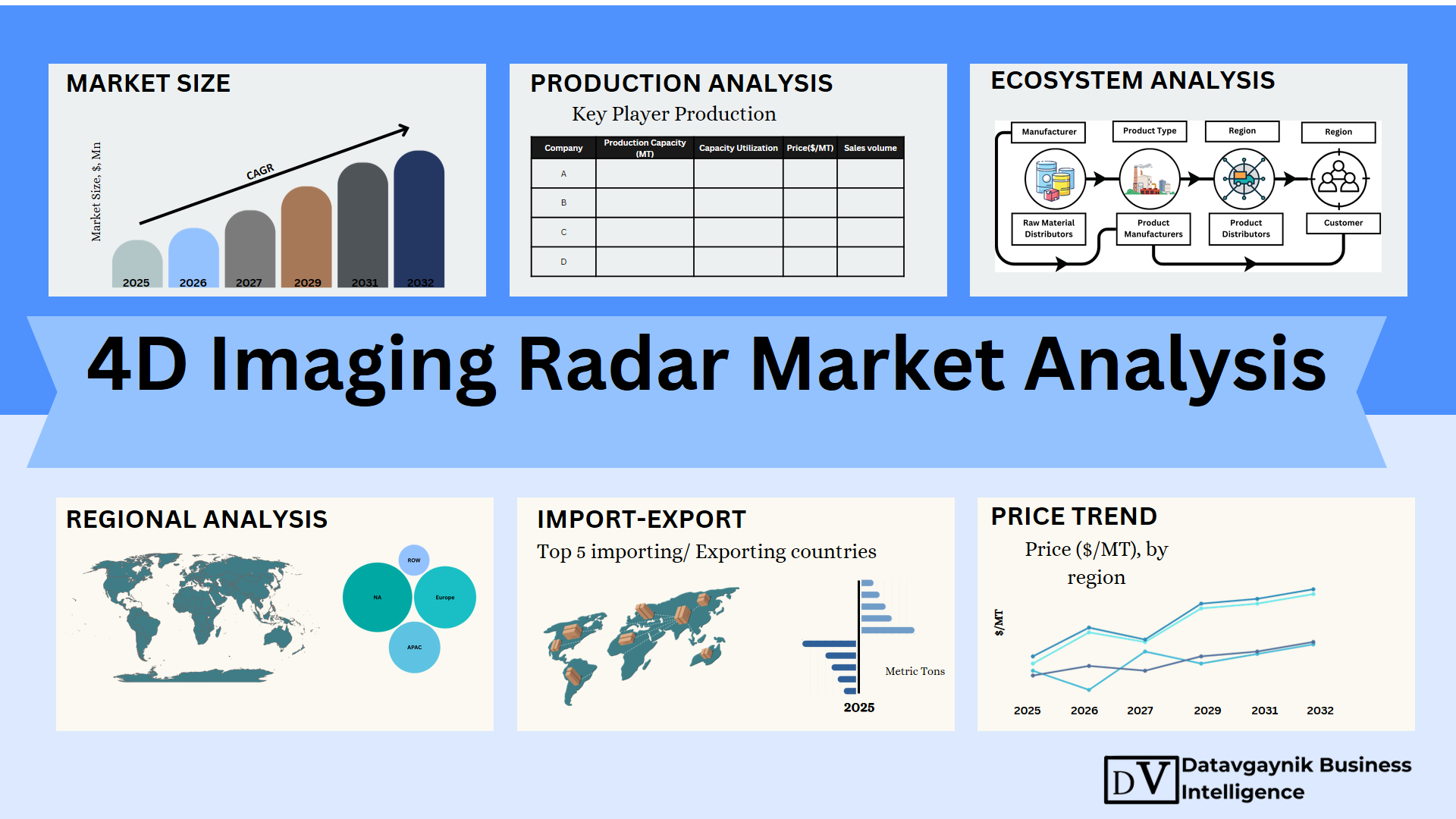
The market covers high-resolution radar systems that detect objects across range, velocity, azimuth, and elevation. This fourth dimension — elevation — is what separates 4D imaging radar from conventional automotive and industrial radar. It allows the sensor to create a richer view of the environment. Not a camera-like image, but a dense radar point cloud that helps machines understand height, distance, movement, and object structure even in fog, rain, dust, glare, or darkness.
Datavagyanik also covers related markets such as the Air Traffic Control Radar (ATC-Radar) Market. They create a more holistic picture of the ecosystem in which the primary topic exists, including technological shifts and market demands.
For 2026–2035, the business case is becoming clearer. The 4D Imaging Radar Market sits at the intersection of automated mobility, sensor fusion, software-defined vehicles, smart infrastructure, robotics, and industrial safety. Automakers are the anchor demand base today. But the use case is moving beyond cars. Warehouses, ports, drones, smart traffic systems, perimeter security, and autonomous machines are also starting to evaluate imaging radar as a dependable perception layer.
The strongest pull comes from the shift toward Level 2+, Level 3, and higher autonomy in passenger and commercial vehicles. Cameras are low-cost but sensitive to visibility. LiDAR offers strong spatial detail but remains cost-sensitive for high-volume deployment. Imaging radar sits between these two worlds. It improves object detection and free-space mapping at a more scalable cost point. That makes it attractive for OEMs that want redundancy without adding too much system cost.
Regulation also matters. Safety agencies are tightening expectations around automatic emergency braking, pedestrian detection, lane assistance, driver support, and collision avoidance. This does not mandate 4D radar directly. Still, it pushes OEMs toward better sensing stacks. In many cases, conventional radar is not enough for complex urban driving. So, 4D imaging radar becomes a practical upgrade path.
Production dynamics are also changing. Radar semiconductor suppliers are moving toward more integrated chipsets, higher channel counts, better signal processors, and software-defined radar architectures. Tier-1 suppliers are working on scalable modules that can be used across vehicle platforms. Startups are adding pressure with high-resolution radar processors and perception software. This may lower unit cost over time, but the market will remain engineering-heavy through the forecast period.
| Metric | Estimate |
| Global Market Size, 2026 | $1,420 million |
| Projected Market Size, 2035 | $8,950 million |
| CAGR, 2026–2035 | 22.7% |
| Main Demand Base | Automotive OEMs, Tier-1 suppliers, autonomous mobility firms, robotics companies, smart infrastructure operators |
| Core Commercial Use | High-resolution object detection and environmental perception |
Key consumers and clients include automotive OEMs, Tier-1 ADAS suppliers, electric vehicle manufacturers, robotaxi developers, commercial vehicle fleets, industrial automation companies, warehouse robotics providers, drone manufacturers, smart city authorities, and defense or perimeter security integrators.
The 4D Imaging Radar Market will not replace every other sensor. That is not the real story. Its stronger role is as a dependable sensing layer inside a multi-sensor architecture. In practical terms, it gives machines a better chance of seeing what cameras may miss and what lower-resolution radar cannot classify with confidence.
Market Segmentation and Forecast Scope
The 4D Imaging Radar Market can be segmented by product type, application, end user, and region. The segmentation is built around how the technology is purchased, where it is installed, and how the value is created. In this market, the hardware module is only one part of the revenue pool. Processing software, perception algorithms, integration engineering, and validation support also matter.
By Product Type
The market includes front long-range 4D imaging radar, corner and side imaging radar, short-range imaging radar, imaging radar processors, and radar perception software stacks.
Front long-range imaging radar is the most strategic product type in vehicle applications. It supports highway assist, adaptive cruise control, automated lane changes, emergency braking, and higher-speed object tracking. In 2026, front long-range systems are estimated to account for around 44% of market revenue. This is one of the few disclosed shares in this summary because it helps explain the near-term revenue base.
Corner and side imaging radar will grow faster as OEMs move toward 360-degree perception. These sensors help with cross-traffic detection, blind-zone monitoring, automated parking, urban driving support, and side-impact risk detection. This is where volume can scale quickly once automakers standardize platforms.
Software and radar perception stacks are becoming more important. The sensor itself creates data, but the value comes from interpreting that data. Object classification, tracking, clustering, and fusion with camera or LiDAR inputs are now central to differentiation.
By Application
Major applications include ADAS and autonomous driving, robotics and autonomous machines, smart traffic monitoring, industrial safety, drone navigation, security surveillance, and port or logistics automation.
ADAS and autonomous driving remain the largest application area. The reason is simple. Vehicle platforms offer the highest unit potential and the strongest safety need. In 2026, automotive ADAS and autonomous driving applications are estimated to represent around 76% of market demand. Other application shares are intentionally kept undisclosed in this summary.
Robotics and autonomous machines are still smaller, but they offer a strong long-term opportunity. Warehouses and factories need sensors that work across lighting conditions. Imaging radar can support collision avoidance, worker detection, object tracking, and machine navigation in dusty or low-light areas.
Smart infrastructure is another attractive pocket. Cities and highway operators can use imaging radar for traffic flow monitoring, incident detection, pedestrian safety, and intersection analytics. Adoption will be slower than automotive because budgets are fragmented. Still, the use case is credible.
By End User
End users include passenger vehicle OEMs, commercial vehicle manufacturers, Tier-1 automotive suppliers, autonomous mobility firms, industrial automation companies, warehouse operators, smart city agencies, and security system integrators.
Passenger vehicle OEMs lead the near-term market because radar content per vehicle is rising. Premium vehicles adopt first. Mid-market vehicles follow once module cost declines. Commercial vehicles are also a strong target because fleet operators value safety, uptime, and accident reduction. This may lead to faster adoption in trucks, buses, delivery fleets, and mining vehicles.
Tier-1 suppliers act as both customers and channel partners. They integrate radar modules into broader ADAS systems and sell them to OEMs. This makes them critical gatekeepers in the 4D Imaging Radar Market.
By Region
Regional coverage includes North America, Europe, Asia Pacific, and LAMEA.
Asia Pacific is likely to be the largest and fastest-scaling region through 2035. China, Japan, and South Korea have strong EV production, active ADAS deployment, and a supplier base that can localize radar modules quickly. China is especially important because domestic OEMs are aggressive with smart driving features.
Europe will remain a high-value region due to safety regulation, premium vehicle production, and strong Tier-1 supplier presence. North America will see demand from premium vehicles, autonomous mobility programs, commercial fleets, and technology-led sensing platforms. LAMEA will be smaller but relevant in mining, logistics, traffic monitoring, and selected security applications.
| Segmentation Dimension | Included Scope | Strategic View |
| By Product Type | Front long-range radar, corner radar, short-range radar, processors, software stacks | Front radar leads near-term revenue; corner radar scales with 360-degree perception |
| By Application | ADAS, autonomous driving, robotics, smart traffic, drones, industrial safety, security | ADAS dominates today; robotics and infrastructure build the next demand layer |
| By End User | OEMs, Tier-1 suppliers, fleets, robotics firms, city agencies, security integrators | OEMs and Tier-1s drive standardization and volume |
| By Region | North America, Europe, Asia Pacific, LAMEA | Asia Pacific grows fastest due to EV and ADAS platform activity |
The forecast scope includes new radar modules, imaging radar processors, embedded perception software, and application-specific integration revenue. It excludes conventional non-imaging radar, basic parking radar, general camera systems, LiDAR-only systems, and unrelated automotive electronics.
Market Trends and Innovation Landscape
The innovation cycle in the 4D Imaging Radar Market is moving from simple object detection toward machine perception. Earlier radar systems could detect range and speed well, but they struggled with object shape, elevation, and dense urban scenes. Newer imaging radar platforms are designed to produce richer point clouds. That gives software more data to work with.
R&D Evolution
R&D is focused on higher virtual channel counts, better antenna design, wider field-of-view coverage, and stronger signal processing. The main goal is not just to “see farther.” It is to separate objects more accurately. For example, a radar system should distinguish a pedestrian near a guardrail, a stalled vehicle under a bridge, or a small object on the road surface. These scenarios are difficult for older radar architectures.
Chip-level integration is also improving. Radar-on-chip designs, advanced RF front ends, and centralized processing are helping suppliers reduce module complexity. Over time, this can support lower costs and easier vehicle integration.
Expert view: The winning platforms will not be judged only by range. Resolution, false-positive control, thermal stability, and software compatibility will matter just as much.
Technology Evolution
The market is moving toward software-defined radar. This means radar performance can be improved through signal processing, algorithms, and over-the-air software updates rather than only through hardware redesign. Automakers like this because it fits the broader software-defined vehicle strategy.
Sensor fusion is another major trend. 4D imaging radar works best when combined with cameras, ultrasonic sensors, and in some premium platforms, LiDAR. Radar adds all-weather reliability. Cameras add visual classification. LiDAR adds spatial precision where cost allows. The stronger system is usually the fused system, not a single sensor.
There is also growing interest in centralized radar processing. Instead of each radar module doing all computation independently, future vehicle architectures may send radar data to a central compute unit. This could improve coordination across front, corner, and side sensors.
AI Integration
AI is highly relevant in this market. Radar point cloud data is complex. It needs filtering, clustering, object classification, and tracking. Machine learning models are being used to improve detection accuracy, reduce ghost objects, and support free-space estimation.
AI can also help radar systems understand patterns that are difficult to code manually. For instance, it can support classification of vulnerable road users, moving vehicles, static obstacles, and complex roadside objects. That said, AI integration must be validated carefully. Automotive safety does not tolerate black-box performance claims without testing.
Expert view: AI will not make imaging radar valuable by itself. The value comes when AI, radar physics, and safety validation work together inside a production-grade sensing stack.
Partnerships, Platform Activity, and Market Announcements
The market is seeing active collaboration between radar technology firms, semiconductor companies, Tier-1 suppliers, and automakers. Companies such as Mobileye, Arbe Robotics, Uhnder, Continental, Bosch, ZF, NXP Semiconductors, and Texas Instruments are shaping the ecosystem through radar platforms, chipsets, software stacks, and OEM-facing development programs.
Partnership activity is mainly centered on three areas. First, radar chipset and module development. Second, integration of imaging radar into ADAS platforms. Third, software validation for autonomous and semi-autonomous driving. M&A activity is more selective. Large suppliers are more likely to acquire radar software, signal processing IP, or engineering teams rather than buy every hardware startup outright.
The news flow also shows a shift in market language. Suppliers are no longer talking only about “radar sensors.” They are positioning imaging radar as part of a perception system. This matters. It means the commercial opportunity is expanding from hardware sales toward software, compute, and platform integration.
Innovation Outlook
The next wave of growth will come from radar systems that can support higher autonomy at a manageable cost. Premium vehicles will keep leading adoption. But the real volume expansion will come when mid-range EVs and mass-market ADAS platforms adopt imaging radar as a standard safety layer.
Example: A mid-priced electric SUV using front and corner 4D imaging radar could improve highway assist, cross-traffic detection, and low-visibility emergency braking without relying only on camera performance.
By 2035, the 4D Imaging Radar Market is likely to look less like a niche radar hardware market and more like a core perception technology segment. The commercial winners will be those that can offer scalable hardware, strong software, OEM-grade reliability, and clean integration with vehicle compute platforms.
Competitive Intelligence and Benchmarking
The competitive base is split between three groups: dedicated imaging radar specialists, automotive Tier-1 suppliers, and semiconductor platform providers. No single company controls the full stack yet. That is important. The market is still being shaped by design wins, validation cycles, and OEM trust.
| Company | Portfolio Position | Market Role | Strategic Reading |
| Mobileye | Imaging radar integrated with broader assisted and automated driving platforms | Full-stack ADAS and autonomy player | Strongest where radar is sold as part of a larger perception and driving system |
| Arbe Robotics | High-resolution radar chipset and perception-focused radar architecture | Specialist radar technology supplier | Strong in chipset-led partnerships and high-resolution radar differentiation |
| Valeo | Imaging radar modules integrated into automated driving sensor suites | Global Tier-1 supplier | Well positioned for OEM programs that need validated radar, camera, and LiDAR integration |
| Aptiv | Front and corner radar systems for ADAS and advanced safety | Tier-1 radar and perception supplier | Strong in scalable radar deployment across mass-market vehicle platforms |
| ZF | Imaging radar for semi-automated and highly automated driving | Tier-1 safety and chassis systems supplier | Benefits from deep OEM relationships and system integration capability |
| Uhnder | Digital radar-on-chip and high-resolution perception radar | Radar semiconductor specialist | Differentiates through digital radar architecture and interference-resilient sensing |
| NXP Semiconductors | Radar processors, RF components, and chipset platforms | Semiconductor backbone supplier | Critical enabler for radar module makers and Tier-1 radar system design |
Mobileye has a strong position because it does not treat imaging radar as a standalone component. It places radar inside a broader automated driving stack that includes compute, software, camera perception, mapping, and safety logic. This gives the company an advantage in programs where OEMs want a validated system rather than a sensor-only supplier. Its radar portfolio is aimed at high-confidence perception in difficult weather and long-range driving scenarios.
Arbe Robotics is one of the more visible pure-play names in the 4D Imaging Radar Market. The company’s strength sits in radar chipset architecture, dense point-cloud generation, and partnerships with module makers. Its market position is less about selling complete vehicles-ready systems directly to every OEM and more about enabling Tier-1s, Chinese suppliers, smart infrastructure vendors, and autonomous system developers with a high-resolution radar core.
Valeo is positioned as a production-grade Tier-1 supplier. Its advantage is OEM credibility. The company can integrate imaging radar with cameras, LiDAR, electronic control units, and validation services. That matters because automakers rarely buy advanced radar in isolation. They want it tested, packaged, validated, and fitted into a broader safety architecture.
Aptiv competes through scalable radar families for front-facing and corner sensing. Its portfolio is relevant for OEMs that want higher-resolution sensing without moving every vehicle to expensive sensor stacks. Aptiv’s market position is strongest in ADAS programs where cost, packaging, and compliance with safety rating requirements are central.
ZF brings a system-level automotive safety background. Its imaging radar activity is tied to semi-automated and highly automated vehicle functions. ZF’s strength is not only radar performance. It is the ability to place radar inside braking, steering, chassis, and ADAS control ecosystems. This supports adoption in OEM programs where integration risk must be kept low.
Uhnder focuses on digital radar architecture. Its offering is useful where interference mitigation, spoofing resistance, and dense environment sensing are important. The company is more specialist than broad-based Tier-1s, but that can be a strength in a market where radar architecture still has room for differentiation.
NXP Semiconductors is not a traditional radar module supplier. It is more of an enabling layer. Its processors and RF solutions support radar system development across multiple customers. This makes NXP important for the supply chain. As imaging radar moves toward higher channel counts and central compute, semiconductor suppliers like NXP Semiconductors become more influential in defining cost, performance, and scalability.
Expert view: The strongest competitors will be the ones that combine radar hardware, software interpretation, and OEM validation. Pure hardware performance is useful, but it is not enough to win long-cycle automotive programs.
Regional Landscape and Adoption Outlook
United States
The United States is one of the most important adoption markets because it combines safety regulation, autonomous mobility trials, commercial fleet demand, and strong semiconductor depth. The U.S. market is driven by premium vehicles, electric vehicles, robotaxi programs, trucking automation, and ADAS upgrades.
Regulation is moving in favor of better sensing. The automatic emergency braking requirement for new light vehicles by the end of this decade raises the performance bar for vehicle perception. This does not automatically mandate imaging radar. Still, it pushes OEMs toward stronger detection in day, night, vehicle, and pedestrian scenarios.
The U.S. also has strong demand from non-passenger vehicle applications. Autonomous trucks, delivery robots, off-road machinery, warehouse automation, and defense-adjacent mobility programs are credible demand pockets. Funding is available, but validation standards are tough. So adoption will be selective rather than broad in the early years.
Europe
Europe is a high-value market because of safety regulation, premium OEMs, and Tier-1 supplier strength. Germany, France, Sweden, and the Netherlands are the most relevant countries. Germany leads due to luxury vehicle production and engineering depth. France has a strong Tier-1 base. Sweden is active in radar, safety, and autonomous transport ecosystems.
Europe’s adoption is shaped by Euro NCAP protocols, automated driving regulation, and OEM commitments to higher safety ratings. The region is less likely to chase sensor count for marketing. It will focus more on validated safety outcomes. That favors suppliers with proven automotive qualification and system-level reliability.
Infrastructure support is also stronger in parts of Western Europe. Smart roads, connected mobility pilots, and public safety initiatives create openings for radar in traffic monitoring and vulnerable road user protection. That said, automotive remains the main revenue pool.
China
China is likely to be the fastest-scaling geography. The reason is straightforward. Chinese EV makers move fast, adopt smart-driving features aggressively, and are willing to introduce higher sensor content even in mid-priced models. Local Tier-1 suppliers and radar module companies are also pushing down cost.
High-growth areas include Shanghai, Shenzhen, Beijing, Guangzhou, Chongqing, and major EV manufacturing clusters. China’s adoption will be led by EV OEMs, autonomous trucking developers, robotaxi pilots, and smart traffic infrastructure projects.
The regulatory environment is supportive but cautious. Authorities want domestic smart vehicle leadership, but they are also tightening rules around autonomous driving claims, public-road testing, data handling, and over-the-air updates. This may slow some launches, but it also pushes OEMs to use more reliable sensing architectures.
China also has a strong manufacturing advantage. Localized radar assembly, antenna production, semiconductor packaging, and vehicle integration capabilities can reduce cost. This may help China become both a major demand center and a production hub for imaging radar systems.
India
India is still early in imaging radar adoption. The market will not scale at the same speed as China or Europe before 2030. Cost sensitivity remains high. Most passenger vehicles still prioritize basic safety, infotainment, fuel efficiency, and affordability.
That said, India should not be ignored. Premium vehicles, electric SUVs, commercial fleets, mining trucks, logistics vehicles, and smart infrastructure projects can create early demand. Bharat NCAP and rising consumer focus on safety will gradually support ADAS adoption. But mass-market imaging radar will need lower module prices and stronger localization.
India’s best opportunity may come from commercial use cases before broad passenger vehicle deployment. Fleet safety, highway collision avoidance, low-visibility driving, mining automation, port logistics, and industrial mobile equipment can justify higher sensor cost if the safety or productivity benefit is visible.
Japan
Japan is a mature automotive technology market with strong demand for safety, reliability, and supplier quality. Adoption will be led by automakers and Tier-1 suppliers working on advanced driver assistance, automated highway driving, and elderly-driver safety support.
Japan’s market is not purely volume-driven. It is engineering-led. OEMs will prioritize validated performance, compact module design, thermal stability, and long product life. This benefits established suppliers and semiconductor partners with automotive-grade quality systems.
Japan also has relevance in robotics and industrial automation. Imaging radar can support mobile robots, automated guided vehicles, and factory safety systems where cameras may struggle with lighting or dust.
South Korea
South Korea has a strong adoption case due to its automotive, electronics, semiconductor, and EV ecosystem. Domestic OEMs and suppliers are active in ADAS and software-defined vehicle platforms. The country also has high readiness for smart infrastructure and connected mobility.
South Korea’s advantage is system integration. The market can connect radar hardware, chips, displays, vehicle electronics, and AI software inside a compact supply chain. Adoption will likely grow in premium EVs, connected vehicles, and export-oriented vehicle platforms.
Middle East
The Middle East is relevant but not a core volume market. The best opportunities are in the UAE, Saudi Arabia, and Qatar. Demand is linked to smart city programs, autonomous shuttles, port logistics, airport ground mobility, perimeter security, and desert or low-visibility mobility use cases.
The region has funding capacity and strong smart infrastructure ambitions. But it lacks the automotive manufacturing base of Asia or Europe. So, adoption will mainly come through imported vehicles, pilot programs, infrastructure integrators, and fleet modernization projects.
| Region / Country | Adoption Level | Key Growth Drivers | Adoption Constraint |
| United States | High | AEB regulation, robotaxi trials, fleet safety, semiconductor ecosystem | Long validation cycles and regulatory scrutiny |
| Europe | High | NCAP pressure, premium OEMs, Tier-1 strength | Conservative rollout and strict safety validation |
| China | Very High | EV scale, smart-driving competition, local suppliers | Regulatory tightening around ADAS claims and data |
| India | Emerging | Premium vehicles, fleet safety, Bharat NCAP, logistics automation | High cost sensitivity |
| Japan | Moderate to High | Safety culture, OEM engineering, robotics | Slow adoption outside premium platforms |
| South Korea | High | EV ecosystem, electronics base, ADAS integration | Export-cycle dependency |
| Middle East | Selective | Smart cities, logistics, autonomous pilots, security | Limited local vehicle manufacturing |
Expert view: Asia will drive volume. Europe and the U.S. will define validation expectations. India and the Middle East will build slower but can produce attractive niche demand in fleets, infrastructure, and industrial mobility.
Yes, proceed to next section.
- Recent Developments + Opportunities & Restraints
Recent Developments
| Year / Month | Event | Market Impact |
| April 2024 | The U.S. NHTSA finalized a rule requiring automatic emergency braking on new passenger cars and light trucks from 2029. | This supports demand for stronger sensing stacks. Imaging radar can benefit where OEMs need better pedestrian and vehicle detection in poor visibility. |
| September 2024 | Mobileye announced it would end internal FMCW LiDAR development while keeping imaging radar as a strategic sensor priority. | This showed a clear shift in cost and architecture thinking. Radar is being treated as a core autonomy sensor, not a secondary backup. |
| April 2025 | HiRain Technologies launched a production-intent long-range imaging radar system powered by Arbe Robotics chipset for OEM evaluation in China. | This strengthened China’s local radar supply chain and moved high-resolution radar closer to serial vehicle programs. |
| May 2025 | Mobileye said a leading global automaker selected its imaging radar for an eyes-off, hands-off automated driving system planned for 2028. | This validated imaging radar for higher-autonomy passenger vehicles and strengthened confidence in highway Level 3 use cases. |
| May 2025 | Valeo won a major imaging radar program from a premium global automaker, with production expected to begin in 2028. | This confirmed that Tier-1 suppliers are moving imaging radar into production-grade automated driving platforms. |
Opportunities
- Mass-market ADAS upgrade
The largest opportunity is the move from basic radar to high-resolution radar in mainstream vehicles. Premium vehicles will adopt first. But the bigger prize is mid-range EVs and ICE vehicles that need better safety ratings without adding very expensive LiDAR systems.
- AI-based radar perception
AI can improve radar point-cloud filtering, object classification, free-space detection, and sensor fusion. This creates a software revenue layer. Suppliers that can offer both radar hardware and perception algorithms will have stronger pricing power.
- Non-automotive expansion
Robotics, mining vehicles, ports, smart intersections, marine safety, and industrial automation can use imaging radar where cameras are limited by dust, darkness, rain, or glare. These markets are smaller than automotive but may offer better margins.
Restraints
- High validation burden
Automotive radar must work consistently across weather, speed, object type, road geometry, and interference conditions. Validation can take years. This slows revenue conversion even after technical demos look promising.
- Cost pressure from OEMs
OEMs want better sensing, but they also want lower vehicle cost. Imaging radar suppliers will face pressure to reduce module prices while adding more software and performance.
- Competition from camera and LiDAR stacks
Some OEMs may prefer camera-heavy systems for cost reasons. Others may choose LiDAR for premium autonomy. Imaging radar must prove that it delivers the right balance of cost, reliability, and perception value.


