

Market Summary and Growth Forecast
The global Acetaldehyde Market will witness a robust CAGR of 5.2%, valued at $2.15 billion in 2026, expected to appreciate and reach $3.40 billion by 2035.
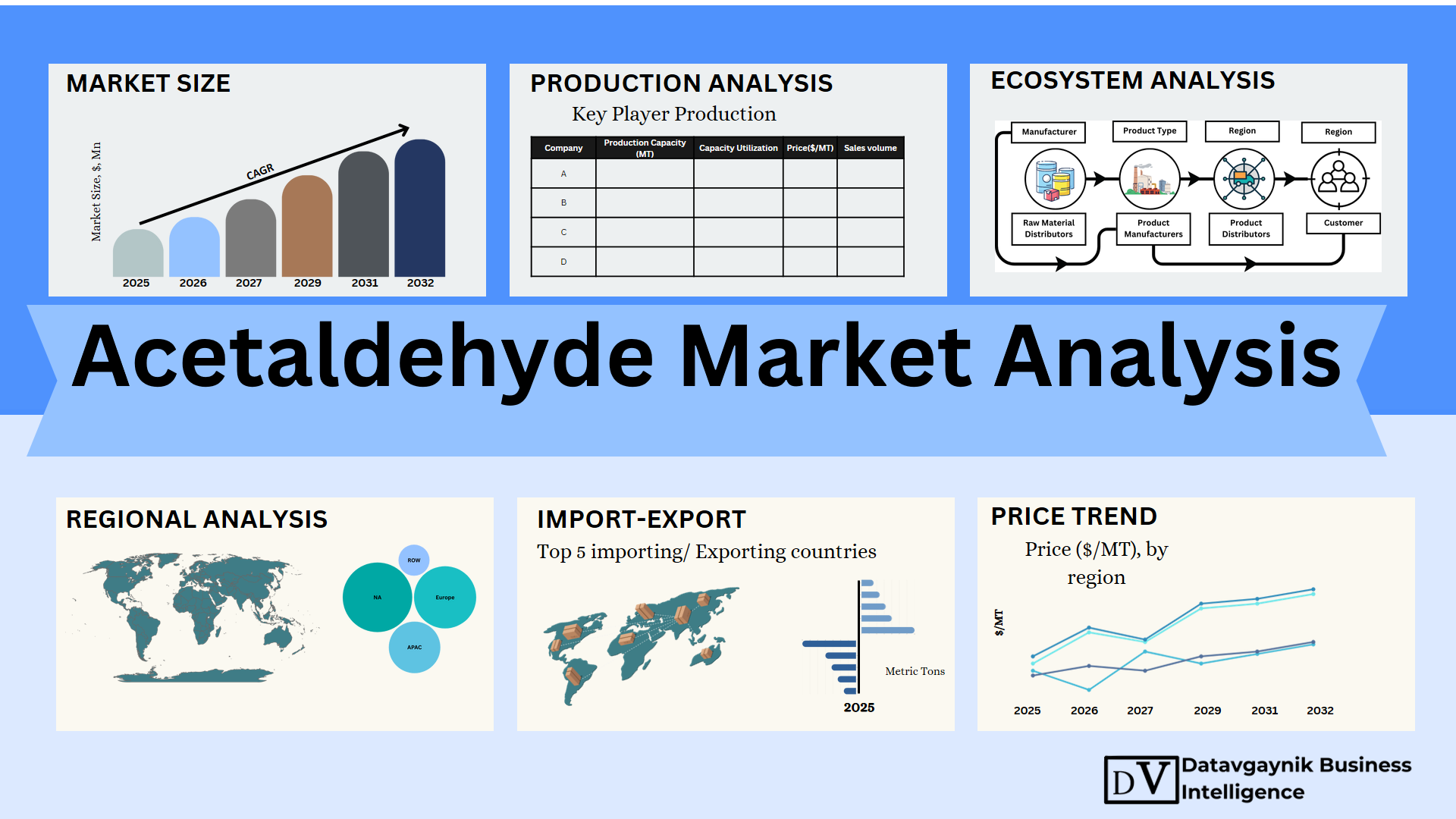
Acetaldehyde is a high-volume chemical intermediate used across acetic acid derivatives, pyridine and pyridine bases, pentaerythritol, acetate esters, food and beverage flavoring, pharmaceuticals, agrochemicals, resins, and specialty chemicals. It is not usually a consumer-facing chemical. Its relevance sits deeper in the industrial value chain. That makes demand more closely tied to downstream manufacturing cycles rather than direct retail consumption.
In 2026, the Acetaldehyde Market is positioned as a steady intermediate chemical market, not a speculative growth story. Its base demand comes from mature applications such as acetic acid, ethyl acetate, and pentaerythritol. Growth will come from selective downstream expansion in Asia Pacific, rising use in specialty synthesis, and continuing demand from coatings, adhesives, plastics, food additives, and pharmaceutical intermediates.
| Metric | Estimate |
| Global Market Size, 2026 | $2.15 billion |
| Projected Market Size, 2035 | $3.40 billion |
| CAGR, 2026–2035 | 5.2% |
| Estimated Global Volume, 2026 | 1.75 million tons |
| Projected Global Volume, 2035 | 2.45 million tons |
| Highest Demand Region, 2026 | Asia Pacific |
| Most Strategic Demand Cluster | Chemical intermediates and specialty synthesis |
The demand base is shaped by three practical forces.
First, production economics matter. Acetaldehyde can be produced through ethylene oxidation, ethanol dehydrogenation, acetylene hydration, and other route-specific processes. Ethylene-based production remains important where petrochemical integration is strong. Ethanol-based routes are gaining attention where producers want a lower-carbon or bio-based positioning. That said, cost competitiveness still decides the route in most large-volume markets. Feedstock access, energy prices, plant scale, and regional regulation all influence margin behavior.
Second, regulation is becoming harder to ignore. Acetaldehyde is classified as a hazardous chemical in many jurisdictions, with exposure limits, storage rules, and emissions controls affecting production and downstream handling. This does not remove demand. It changes the operating model. Producers need better containment, process monitoring, waste treatment, and compliance documentation. Smaller or older units may face pressure where environmental enforcement is tightening.
Third, downstream applications are shifting in quality rather than only volume. Commodity demand remains large, but the more attractive margins are linked to specialty chemicals, pharmaceutical intermediates, food-grade controlled applications, and customized synthesis. Buyers in these areas care about purity, traceability, delivery consistency, and supplier reliability. So, the market is slowly moving from basic volume supply toward differentiated grades and application-specific supply contracts.
The important point is this: acetaldehyde demand will not rise because one single application explodes. It will grow because multiple mid-sized downstream uses keep expanding at the same time. That gives the market durability but also keeps pricing sensitive to feedstock and operating costs.
The Acetaldehyde Market will also benefit from broader industrial expansion in Asia Pacific. China and India are expected to remain central to demand growth due to their large chemical manufacturing base, pharmaceutical intermediate production, agrochemical synthesis, coatings demand, and expanding domestic consumption. Europe and North America will remain important, but their role is more quality-led, compliance-led, and specialty-led rather than pure volume-led.
Key stakeholders in this market include:
- Chemical manufacturers producing acetaldehyde and downstream derivatives
- Specialty chemical companies using acetaldehyde as a synthesis intermediate
- Pharmaceutical and agrochemical producers requiring controlled intermediate supply
- Food and flavoring ingredient companies using regulated grades in approved applications
- Paints, coatings, adhesives, and resin producers linked to acetaldehyde-derived inputs
- Governments and environmental regulators overseeing emissions, worker safety, and chemical handling
- Industry associations supporting chemical safety, standards, and responsible production
- Investors and private equity groups evaluating specialty chemical capacity, feedstock integration, and margin resilience
- Logistics and storage providers handling flammable and hazardous chemical distribution
By 2035, the market should be larger, more regionalized, and more compliance-heavy. Asia Pacific will likely absorb the largest incremental volume. North America and Europe will focus more on high-purity, regulated, and specialty applications. Producers with integrated feedstock access, strong safety systems, and downstream customer relationships will be better placed than standalone suppliers exposed to raw material volatility.
So, the growth outlook is positive, but not without discipline. The Acetaldehyde Market will reward producers that can balance cost, compliance, and product consistency. Pure capacity addition will not be enough. The winning suppliers will be those that can serve both bulk chemical demand and higher-value customized applications without losing control over safety and margins.
Competitive Intelligence and Benchmarking
The competitive structure of the Acetaldehyde Market is moderately consolidated at the global supply level, but fragmented across downstream demand. Large chemical groups dominate industrial supply because acetaldehyde needs controlled production, safe storage, feedstock access, and reliable offtake relationships. Smaller suppliers and distributors usually compete in laboratory grades, food-grade supply, or regional trading rather than bulk manufacturing.
Eastman Chemical Company holds a strong position in North America, supported by its broader intermediates and specialty materials base. The company’s acetaldehyde offering is positioned around chemical reactivity, solvent compatibility, and use in condensation, addition, and polymerization reactions. Its market strength comes from quality assurance, established customer relationships, and technical familiarity with regulated chemical buyers.
Celanese Corporation is more relevant through its acetyl chain strength than through acetaldehyde alone. Its integrated value chain connects basic feedstocks with acetic acid and derivative platforms. This gives the company strong positioning across acetate esters, vinyl acetate-related chemistry, and downstream acetyl intermediates. In benchmarking terms, Celanese represents a scale-led competitor with strong feedstock and derivative integration.
Jubilant Ingrevia Limited is one of the most visible acetaldehyde producers from the bio-based ethanol route. Its position is strategically important because buyers in pharmaceuticals, flavors, fragrances, paints, resins, and specialty synthesis are increasingly asking for lower-carbon supply options. The company’s bio-route acetaldehyde gives it a differentiated story, especially for customers that want greener supply chains without changing downstream process chemistry.
Sumitomo Chemical has a strong Japanese and Asian chemical manufacturing base. Its positioning is supported by a diversified chemical portfolio and a long-standing presence in essential and green materials. For acetaldehyde customers, the company’s advantage sits in process discipline, manufacturing consistency, and access to high-specification downstream users in Japan and wider Asia.
Sekab is a specialist European player focused on bio-based acetaldehyde. Its product is positioned as a drop-in replacement for fossil-based acetaldehyde, made from bio-based ethanol. That matters in Europe, where carbon reporting, Scope 3 reduction, and traceable bio-based raw materials are becoming part of purchasing decisions. Sekab is not a pure volume leader, but it is strategically relevant in low-carbon supply.
Laxmi Organic Industries Limited is positioned around acetyl intermediates, specialty ingredients, and solvents. Its strength comes from serving pharmaceuticals, agrochemicals, coatings, pigments, food packaging, and industrial specialties. In the Indian market, this type of portfolio creates strong adjacency with acetaldehyde-linked applications, even where the company’s commercial emphasis may sit more broadly across downstream intermediates.
LCY Chemical brings relevance through its petrochemical and specialty chemical base in Taiwan and broader Asia. The company’s presence across petrochemicals, performance materials, electronic chemicals, and adjacent industrial materials gives it a regional platform for customers that need consistent supply and multi-chemical procurement relationships.
| Company | Competitive Position | Portfolio Relevance | Strategic Edge |
| Eastman Chemical Company | Strong North American supplier | Industrial acetaldehyde and specialty chemical intermediates | Quality, technical support, established industrial base |
| Celanese Corporation | Integrated acetyl chain player | Acetic acid and acetyl derivatives ecosystem | Scale and feedstock integration |
| Jubilant Ingrevia Limited | Bio-route acetaldehyde specialist | Pharma, resins, flavors, fragrances, specialty synthesis | Bio-based ethanol route and lower-carbon positioning |
| Sumitomo Chemical | Japanese high-spec chemical producer | Essential and green materials, organic intermediates | Manufacturing discipline and Asian customer access |
| Sekab | European bio-based producer | Bio acetaldehyde, bio ethyl acetate, bio acetic acid | ISCC-linked low-carbon positioning |
| Laxmi Organic Industries Limited | Indian acetyl and specialty chemicals player | Solvents, specialty ingredients, downstream chemical applications | India manufacturing base and end-market diversity |
| LCY Chemical | Asian petrochemical and specialty platform | Petrochemicals, performance materials, electronic chemicals | Regional scale and industrial customer network |
The competitive race is not only about who can make acetaldehyde at the lowest cost. Buyers now care about three things together: reliable purity, safe logistics, and whether the supplier can support sustainability reporting. That is where bio-route producers gain a sharper commercial argument, even if petrochemical routes remain cost-efficient at scale.
Regional Landscape and Adoption Outlook
Asia Pacific accounts for the largest share of acetaldehyde demand in 2026, supported by China, India, Japan, South Korea, and Southeast Asia. The region has a broad downstream base across chemicals, coatings, pharmaceuticals, agrochemicals, plastics, food ingredients, and industrial solvents. China remains the largest volume center due to its integrated chemical manufacturing base. India is smaller in absolute terms but faster-moving, supported by pharmaceuticals, crop protection chemicals, specialty intermediates, and ethanol-linked chemical production.
North America represents a mature but valuable market. Demand is linked to specialty chemicals, food and flavoring applications, coatings, resins, pharmaceuticals, and industrial intermediates. The U.S. leads the region because of its petrochemical infrastructure, chemical storage network, and strong presence of large chemical producers. Growth will remain moderate. The region’s real advantage is not volume acceleration. It is process reliability, high-purity supply, and regulated end-use adoption.
Europe is compliance-heavy and increasingly sustainability-led. Germany, France, the Netherlands, Belgium, Sweden, and the U.K. are important demand and distribution points. Bio-based acetaldehyde has a stronger argument here than in most other regions because European buyers face tighter carbon accounting and chemical classification pressure. That said, high energy cost, carbon cost, and import competition can limit new large-scale conventional capacity. Europe’s white space sits in certified bio-based supply and high-purity downstream use.
China remains the main volume engine. It has large downstream demand in acetic acid derivatives, pyridine chemistry, pentaerythritol, coatings, plastics, and agrochemical intermediates. Local production, integrated feedstock systems, and industrial clusters create cost advantages. Regulation is also becoming more structured, especially around emissions, hazardous chemical storage, and chemical park compliance. This may gradually favor larger producers over smaller standalone units.
India is one of the most strategic growth markets. The country has a strong base in pharmaceuticals, agrochemicals, dyes, coatings, and specialty chemicals. Ethanol availability also creates an interesting route for bio-based acetaldehyde. The national ethanol ecosystem is expanding rapidly, mainly driven by fuel blending policy, but the broader feedstock system can indirectly support ethanol-derived chemical value chains. India’s white space is clear: high-purity acetaldehyde, export-grade intermediates, and bio-route chemicals for customers seeking China-plus-one sourcing.
Japan is a high-specification market. Growth is not aggressive, but demand quality is strong. Users in Japan typically require stable specifications, strong documentation, and reliable delivery. Acetaldehyde adoption is linked to specialty chemical synthesis, advanced materials, pharmaceuticals, and controlled industrial uses. Japanese suppliers also have strong process discipline, which supports premium applications rather than bulk price competition.
South Korea is smaller than China and Japan in acetaldehyde demand, but it remains strategically relevant because of its petrochemical, electronics, coatings, and specialty materials ecosystem. Adoption is mostly linked to industrial intermediates and high-performance downstream applications. The country’s chemical infrastructure is advanced, but white space exists in specialty-grade imports, low-carbon inputs, and supplier diversification.
Rest of the World includes Latin America, the Middle East, Africa, and parts of Southeast Asia outside the core Asia Pacific cluster. Demand is uneven. Brazil and Mexico show stronger industrial consumption in Latin America. The Middle East has feedstock advantages but limited acetaldehyde-specific downstream depth compared with Asia. Africa remains underpenetrated, with opportunity tied to industrialization, paints, adhesives, agrochemicals, and pharmaceutical formulation growth.
| Region / Country Cluster | 2026 Adoption Position | Growth Outlook to 2035 | White Space |
| North America | Mature specialty and industrial market | Moderate | High-purity grades, safe logistics, regulated applications |
| Europe | Compliance-led and sustainability-focused | Moderate | Bio-based acetaldehyde, certified low-carbon supply |
| China | Largest volume demand center | Strong | Consolidated supply, chemical park compliance, specialty derivatives |
| India | Fast-growing specialty chemicals base | Strong to high | Bio-route supply, pharma-grade intermediates, export-oriented production |
| Japan | High-specification market | Stable to moderate | Premium grades and precision chemical applications |
| South Korea | Advanced industrial user base | Moderate | Specialty-grade imports and low-carbon sourcing |
| Rest of World | Uneven but expanding | Selective | Industrial coatings, agrochemicals, basic chemical intermediates |
By region, the market is splitting into two tracks. Asia wants scale and cost security. Europe wants lower carbon and documentation. North America wants reliability and regulatory comfort. Suppliers that can speak all three languages will have stronger contract retention.
End-User Dynamics and Use Case
End-user demand in the Acetaldehyde Market is driven mainly by chemical manufacturers, pharmaceutical intermediate producers, agrochemical companies, food and flavoring ingredient firms, coatings and resin producers, and distributors serving specialty users. The product is rarely purchased as a standalone strategic input by end consumers. It is mostly embedded inside broader synthesis chains.
Chemical intermediate producers account for the most stable demand. These buyers use acetaldehyde to produce pyridine and pyridine bases, pentaerythritol, acetate esters, peracetic acid, crotonaldehyde, and other derivatives. They usually buy on the basis of purity, price, delivery schedule, and storage safety. For bulk buyers, feedstock-linked pricing and reliable monthly allocation matter more than branding.
Pharmaceutical and agrochemical users are more selective. They may not consume the largest volumes, but they demand tighter specifications and stronger supplier documentation. Any impurity issue can disrupt downstream synthesis. So these buyers prefer suppliers with consistent quality systems, audit readiness, and export documentation.
Food, flavoring, and fragrance users operate under stricter usage limits and documentation requirements. Their volumes are smaller, but their tolerance for quality variation is low. In this segment, acetaldehyde’s value is not only chemical functionality. It is also supplier credibility.
Coatings, paints, adhesives, and resin producers are more cost-sensitive. Their demand rises and falls with construction, packaging, furniture, automotive refinishing, and industrial production cycles. These users indirectly support acetaldehyde demand through derivatives such as pentaerythritol, acetate esters, and resin intermediates.
Use case: A specialty chemical manufacturer in western India producing intermediates for agrochemical and pharmaceutical customers shifted part of its acetaldehyde procurement toward ethanol-derived supply. The objective was not just lower emissions. It also wanted better export positioning with European buyers asking for feedstock traceability. The company continued using conventional supply for cost-sensitive batches while reserving bio-route acetaldehyde for customers with sustainability documentation requirements. This dual-sourcing approach reduced customer risk without forcing a full process change.
This type of adoption pattern is likely to become more common by 2035. End users will not shift uniformly to bio-based or premium grades. They will segment procurement by customer requirement. Commodity batches will remain cost-led. Export-grade and regulated applications will become documentation-led. Sustainability-linked projects will be traceability-led.
Recent Developments + Opportunities & Restraints
Recent Developments
May 2025 — ECHA upgraded its Classification and Labelling Inventory within ECHA CHEM. This matters for acetaldehyde because European buyers and suppliers increasingly rely on transparent classification data for hazardous substances. It raises the importance of documentation, labeling accuracy, and compliance management in European chemical trade.
January 2025 — INEOS closed ethanol production at Grangemouth in the U.K. The decision reflected pressure from weak European demand, high energy costs, carbon costs, and import competition. While this is not an acetaldehyde plant closure, it is relevant because ethanol is an important feedstock route for bio-based acetaldehyde. It also signals how exposed European chemical assets remain to energy and policy economics.
August 2025 — India reported ethanol blending of 19.93% in July 2025 under the Ethanol Blended Petrol programme. This supports a broader ethanol feedstock ecosystem in India. The direct impact is stronger in fuels, but the indirect relevance for acetaldehyde is clear: larger ethanol availability can improve long-term optionality for ethanol-derived chemicals.
2025 — Jubilant Ingrevia continued positioning bio-based acetaldehyde as a lower-carbon chemical intermediate. The company highlights acetaldehyde produced from bio-based ethanol and claims materially lower carbon intensity versus petrochemical routes. This strengthens India’s role in bio-route acetaldehyde supply and supports demand from customers in pharma, resins, flavors, fragrances, and specialty chemicals.
2025 — Sekab continued marketing bio acetaldehyde as a drop-in fossil replacement for European process industries. The company positions its product as bio-ethanol based, chemically identical to fossil acetaldehyde, and supported by certification and climate documentation. This reinforces Europe’s move toward traceable low-carbon chemical inputs.
Opportunities
Emerging market demand: India, Southeast Asia, Brazil, and selected Middle Eastern markets offer room for acetaldehyde-linked downstream growth in coatings, agrochemicals, pharmaceuticals, food ingredients, and industrial solvents.
Bio-based acetaldehyde: Ethanol-derived acetaldehyde can gain share where customers need lower-carbon procurement, Scope 3 reporting support, or traceable bio-based raw materials.
Specialty-grade and regulated applications: Higher-purity acetaldehyde for pharmaceuticals, flavors, fragrances, and specialty synthesis can support better margins than commodity chemical use.
Restraints
Hazardous handling requirements: Acetaldehyde is flammable and reactive, so storage, transport, and workplace exposure controls raise operating costs.
Feedstock price volatility: Ethylene, ethanol, and energy costs can shift production economics quickly. This affects margins for both fossil and bio-route producers.
Regulatory pressure: Tighter chemical classification, emissions control, and worker safety rules may increase compliance cost, especially for older plants and smaller suppliers.
Sources: ECHA, Financial Times, Press Information Bureau of India, Jubilant Ingrevia, Sekab.


