

Market Summary and Growth Forecast
The global Acoustic Emission Monitoring Tools Market is estimated at $420 million in 2026 and is expected to reach $790 million by 2035, growing at a CAGR of 7.3%.
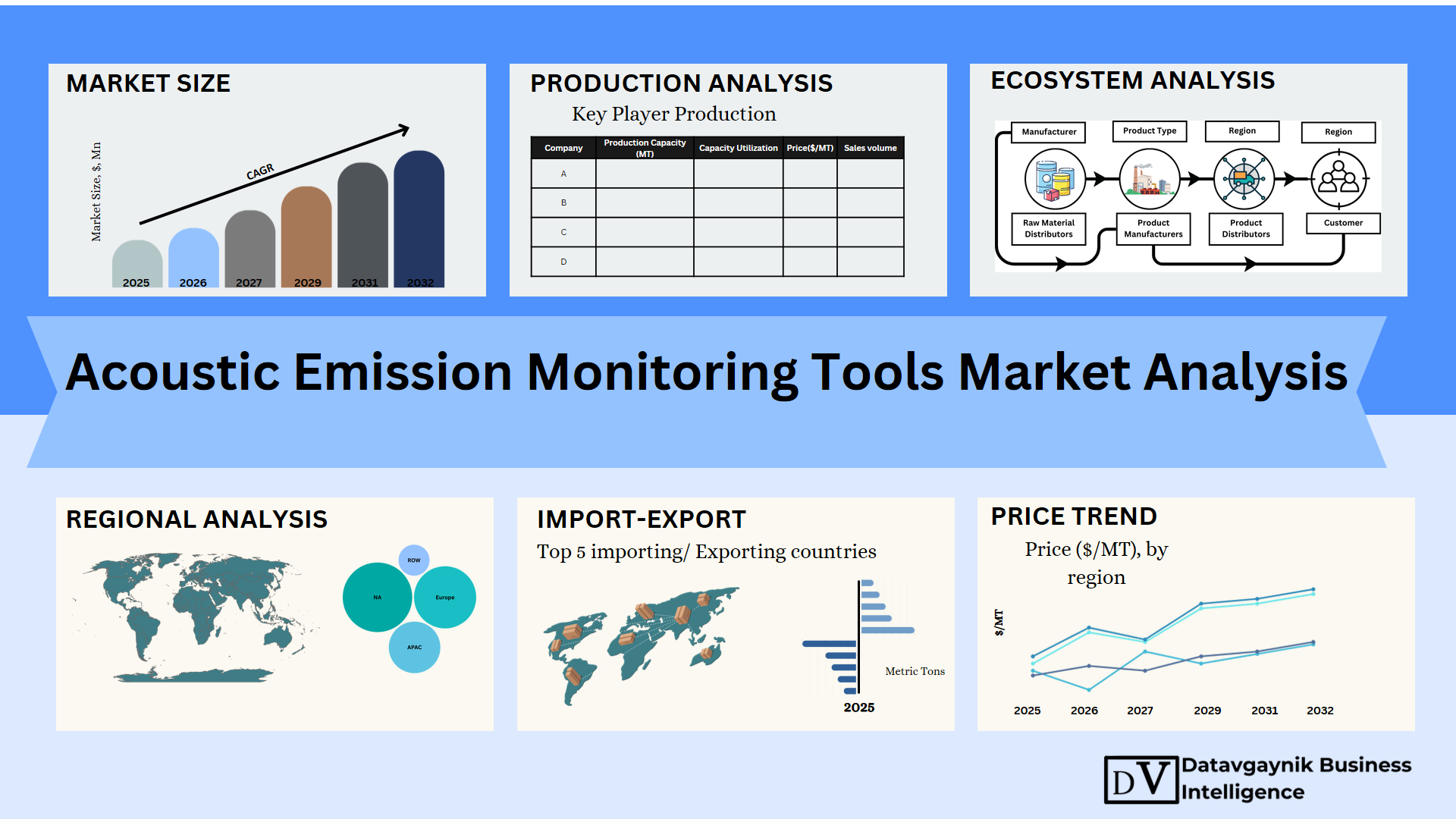
Acoustic emission monitoring tools are used to detect stress waves released by cracks, leaks, corrosion, fatigue, fiber breakage, weld defects, and other active damage mechanisms inside materials and structures. In simple terms, these tools help asset owners “listen” to materials while they are under load. That makes them useful where failure risk is expensive, dangerous, or hard to inspect visually.
The Acoustic Emission Monitoring Tools Market covers sensors, preamplifiers, signal conditioning units, multi-channel data acquisition systems, software, source-location modules, portable AE testing equipment, and fixed online monitoring systems. The market does not include generic ultrasonic testing systems, vibration monitoring tools, plant-wide asset management software, or manual inspection services unless they are directly bundled with AE-based monitoring hardware and software.
Demand is moving from periodic testing toward continuous condition monitoring. This is important. Aging pressure vessels, bridges, pipelines, refinery assets, storage tanks, composite aircraft parts, wind turbine blades, and high-value industrial machinery are all under tighter reliability pressure. Operators want early warnings instead of post-failure investigation. So, AE tools are gaining relevance in maintenance planning, safety assurance, and life-extension decisions.
Regulation also supports the market, especially in industries where pressure equipment, storage tanks, pipelines, and structural assets need periodic inspection. AE testing is not replacing every traditional non-destructive testing method. It is becoming a practical screening layer. It helps prioritize which asset needs deeper inspection first. This may reduce downtime and avoid unnecessary opening, draining, or dismantling of assets.
Technology is another strong force. AE sensors are becoming smaller, more stable, and easier to deploy. Wireless nodes, edge processing, cloud dashboards, and better noise filtering are making the tools more practical in field environments. Older AE systems required specialist interpretation. Newer systems are trying to make results clearer for maintenance teams, inspection contractors, and plant reliability managers.
From a production and supply-side view, the ecosystem remains specialized. A small group of AE sensor manufacturers, NDT equipment providers, industrial inspection firms, and software developers control most of the advanced tool supply. The market is not highly commoditized because accuracy depends on signal quality, sensor placement, calibration, waveform analysis, and real-world damage interpretation. This gives established players an advantage, especially in regulated and safety-critical applications.
Market Size Snapshot
| Metric | Estimate |
| Global market size, 2026 | $420 million |
| Projected market size, 2035 | $790 million |
| CAGR, 2026–2035 | 7.3% |
| Primary demand base | Oil & gas, power, aerospace, infrastructure, manufacturing, testing labs |
| Most strategic demand shift | From periodic inspection to continuous online monitoring |
| Core value proposition | Early fault detection, asset life extension, lower inspection downtime, safety assurance |
Key consumers and clients include oil & gas operators, petrochemical companies, power generation utilities, pipeline operators, pressure vessel owners, aerospace manufacturers, defense maintenance units, civil infrastructure agencies, rail and marine asset operators, wind energy companies, industrial OEMs, NDT service providers, and research laboratories.
The commercial logic is clear. High-risk assets need smarter monitoring. Manual inspection alone is no longer enough for many operators. The Acoustic Emission Monitoring Tools Market benefits from this shift because AE can detect active damage while the asset is operating or under controlled load. That gives decision-makers earlier visibility into failure risk. It also helps them plan inspection budgets with more confidence.
Expert view: AE monitoring will remain a specialist market, not a mass-market sensor category. But its strategic value will rise because asset owners are under pressure to extend asset life without taking more safety risk.
Competitive Intelligence and Benchmarking
The Acoustic Emission Monitoring Tools Market is served by a small set of specialized equipment suppliers, sensor manufacturers, and application-focused monitoring companies. Competition is not only about hardware price. Buyers compare signal quality, sensor reliability, channel scalability, software usability, source-location capability, field support, and compliance experience.
Competitive Benchmarking Snapshot
| Company | Portfolio Focus | Market Position |
| MISTRAS Group / Physical Acoustics | AE sensors, preamplifiers, portable systems, multi-channel monitoring platforms, permanent installations, software, and field inspection support | One of the most established global AE players with strong industrial asset integrity positioning |
| Vallen Systeme GmbH | AE sensors, preamplifiers, data acquisition units, software, accessories, and application engineering | Specialist AE instrumentation company with strong reputation in Europe, research, infrastructure, and advanced testing |
| Kistler Group | Piezoelectric AE sensors, couplers, measuring chains, and high-temperature/hazardous-area measurement components | Strong sensor and measurement technology player, especially suited for machinery, production testing, and industrial monitoring |
| Fuji Ceramics Corporation | Piezoelectric AE sensors and calibrated sensor elements | Japan-based sensor specialist with strong technical credibility in AE sensing and calibration-led applications |
| Hexagon Digital Wave | Modal AE systems for compressed gas cylinders, trailers, and pressure vessel requalification | Focused niche player with strength in compressed gas distribution and composite/metal cylinder testing |
| Qawrums Ltd. / QingCheng Ltd. | Online AE monitoring systems, AE sensors, preamplifiers, handheld/benchtop systems, cloud-linked IIoT AE solutions | China-linked supplier with growing relevance in remote unattended monitoring and cost-sensitive industrial deployments |
| QuakeLogic | AE monitoring hardware and software for testing, field monitoring, education, and industrial procurement workflows | Smaller but relevant entrant for integrated AE monitoring packages and structural/industrial sensing use cases |
MISTRAS Group / Physical Acoustics has the broadest AE footprint among the leading suppliers. Its portfolio covers permanent multi-channel systems, compact field systems, software, sensors, and accessories. That gives it a strong position where buyers want equipment plus inspection know-how, not only components. The company is well placed in oil & gas, pressure equipment, tanks, power assets, aerospace testing, and structural monitoring. Its advantage is installed base, brand trust, and service depth.
Vallen Systeme GmbH is a focused AE instrumentation supplier. Its offering spans sensors, preamplifiers, data acquisition units, software, accessories, and services. The company is especially relevant in technically demanding work such as corrosion, leakage, structural health monitoring, research, and partial discharge monitoring. Its market position is not volume-led. It is credibility-led. Buyers use Vallen where waveform quality, advanced analysis, and application support matter.
Kistler Group brings a strong piezoelectric measurement background. Its AE sensors are used for measuring acoustic emissions from machine structures, and its measuring-chain portfolio supports applications in high-temperature and hazardous areas. This makes Kistler a strong fit for production monitoring, mechanical testing, machine diagnostics, and industrial process environments where sensor durability and repeatability are critical.
Fuji Ceramics Corporation is more sensor-focused than system-focused. Its AE sensors are used across quality inspection and safety inspection of large structures. The company also highlights absolute sensitivity calibration methods, which is useful where customers need sensor consistency and traceability. Fuji’s position is strongest in Japan and in applications where piezoelectric sensor performance matters more than full-system integration.
Hexagon Digital Wave operates in a narrower but valuable lane. Its modal AE approach is built around compressed gas assets, cylinder testing, and trailer requalification. The company launched an in-situ requalification system for Type 3 gas distribution trailers in December 2024, which supports its positioning around gas distribution, hydrogen-adjacent pressure assets, and composite cylinder integrity.
Qawrums Ltd. / QingCheng Ltd. is positioned around AE systems, sensors, preamplifiers, benchtop instruments, handheld devices, and online monitoring platforms. Its RAEM system is described as an IIoT product series for unattended long-term AE monitoring, including sensors, acquisition modules, software, and cloud platform elements. This gives the company a practical role in remote monitoring, bridge monitoring, and industrial predictive maintenance projects where cost and connectivity matter.
QuakeLogic has a smaller profile but participates in AE monitoring hardware and software for technical measurement, field deployment, laboratory use, education, and industrial procurement workflows. Its value is in integrated packages rather than broad global service scale. This makes it more relevant for universities, smaller testing labs, infrastructure pilots, and project-specific monitoring deployments.
Overall, the Acoustic Emission Monitoring Tools Market is not crowded in the same way as vibration sensors or generic NDT equipment. It is concentrated around technical credibility. Established players win in regulated inspection and high-risk assets. Smaller players win where buyers need lower-cost deployment, wireless monitoring, or application-specific customization.
Expert view: The next competitive split will be between “inspection-grade AE” and “monitoring-grade AE.” Inspection-grade tools will remain specialist and compliance-heavy. Monitoring-grade tools will become more connected, software-led, and service-friendly.
Regional Landscape and Adoption Outlook
Regional adoption is shaped by three factors: asset risk, inspection culture, and budget discipline. Countries with aging pressure equipment, large infrastructure networks, petrochemical assets, aerospace programs, or strict NDT practices are more ready to adopt AE tools. Countries with lower inspection budgets still use AE selectively, mostly for tanks, pipelines, pressure vessels, and outsourced testing.
Regional Adoption Matrix
| Region / Country | Adoption Level | Core Demand Areas | Growth Outlook to 2035 |
| United States | High | Oil & gas, aerospace, bridges, pressure vessels, defense, power assets | Strong premium demand for permanent monitoring, gas storage, and infrastructure pilots |
| Europe | High | Pressure equipment, bridges, rail, aerospace, energy, industrial safety | Steady adoption supported by standards, inspection discipline, and structural health monitoring projects |
| China | Medium to High | Petrochemicals, power, bridges, manufacturing, research, industrial monitoring | Fast growth from local suppliers, infrastructure scale, and lower-cost online AE systems |
| India | Medium | Refineries, storage tanks, pressure vessels, pipelines, power, bridges | Emerging growth. Adoption improves as outsourced NDT and infrastructure monitoring expand |
| Japan | Medium to High | Manufacturing, precision testing, infrastructure, energy, research labs | Stable but specialized demand, supported by sensor expertise and quality-driven inspection culture |
| South Korea | Medium | Shipbuilding, petrochemicals, power, manufacturing, infrastructure | Moderate growth, led by heavy industry and localized NDT capability |
| Middle East | Medium | Oil & gas, LNG, refineries, tanks, pressure equipment, pipelines | Relevant for high-value energy assets, especially where shutdown avoidance matters |
United States
The United States remains one of the most attractive markets for premium AE tools. Demand comes from oil & gas assets, petrochemical facilities, aerospace testing, defense maintenance, power generation, bridges, and pressure vessel inspection. The country also has a strong base of AE equipment and service providers, including MISTRAS Group / Physical Acoustics, Hexagon Digital Wave, and QuakeLogic.
Infrastructure monitoring is becoming more practical as agencies test cloud-based and sensor-enabled platforms. A U.S. Department of Transportation case study noted that the BRACE² bridge health monitoring platform was piloted and expanded across 22 bridges in California, supporting real-time decision-making around bridge safety. This is not purely an AE case, but it signals a broader funding and adoption environment that helps structural monitoring tools, including AE, gain attention.
Europe
Europe is a mature adoption region. Germany, the United Kingdom, France, Switzerland, Italy, and the Nordics lead in different ways. Germany has strong technical depth in AE instrumentation and infrastructure monitoring. Switzerland has active structural health monitoring research. The United Kingdom and France bring energy, aerospace, rail, and inspection-service demand.
The regulatory and standards environment is also supportive. EN ISO 18081:2024 sets general principles for leak detection by acoustic emission testing, replacing the earlier 2016 version. This improves confidence in AE use for leak-related pressure-system applications.
Europe is also moving AE into bridge and prestressed concrete monitoring. In 2025, ETH Zurich reported work by Mondaic with BAM and Vallen Systeme on bridge-condition analysis using acoustic emission data. BAM also described the SimAS project as a physics-augmented digital acoustic twin for detecting wire breaks in prestressed concrete structures.
China
China is likely to be one of the fastest-growing national markets through 2035. Demand is supported by petrochemical capacity, power infrastructure, bridges, rail networks, manufacturing plants, and domestic NDT equipment production. Local suppliers such as Qawrums / QingCheng help bring AE systems into cost-sensitive projects.
China is also becoming more visible in the AE research and event ecosystem. The 7th World Conference on Acoustic Emission 2025 was held in Kunming, Yunnan, and included product showcases around acoustic emission detectors, IoT AE monitoring systems, sensors, and preamplifiers. This supports local awareness and adoption.
India
India is an emerging AE market rather than a fully mature one. Demand is strongest in refineries, petrochemicals, storage tanks, pipelines, pressure vessels, power assets, and selective infrastructure monitoring. Adoption is still uneven because many asset owners rely on visual inspection, ultrasonic testing, radiography, and outsourced NDT contractors.
That said, the direction is favorable. TÜV SÜD offers acoustic emission testing in India for pressure equipment, while Indian inspection firms are marketing AET for pressure vessels, tanks, pipelines, chemical processing, power generation, and manufacturing assets. This shows that AE is already in the field, even if penetration remains modest.
India’s biggest opportunity is not only equipment sales. It is service-led monitoring. Many industrial clients will prefer project-based AE testing before investing in permanent systems. So, NDT service providers will be a major channel for the Acoustic Emission Monitoring Tools Market in India.
Japan
Japan has a strong quality and sensor ecosystem. Adoption is supported by precision manufacturing, infrastructure maintenance, energy assets, research laboratories, and advanced materials testing. Fuji Ceramics Corporation gives Japan a credible domestic AE sensor base, especially in calibrated piezoelectric sensor applications.
The Japanese market is not likely to be the fastest by volume. It is more likely to remain high-quality and application-specific. Aerospace components, industrial machinery, infrastructure, and advanced material testing will remain important demand pockets.
South Korea
South Korea is a medium-sized but technically relevant market. Demand comes from shipbuilding, petrochemicals, power generation, manufacturing, civil infrastructure, and research. The Korean Society for Nondestructive Testing lists acoustic emission as one of its technical areas, which indicates an active professional base around AE and related acoustic techniques.
Growth will likely be led by heavy industry and outsourced inspection services. South Korea also has strong potential in ship structures, storage tanks, pressure equipment, and composite testing. The adoption curve is practical rather than aggressive.
Middle East
The Middle East is relevant because of oil & gas, LNG, petrochemicals, refineries, pipelines, above-ground storage tanks, and pressure equipment. AE testing is attractive here because asset shutdowns are expensive. If a tool can help inspect without full dismantling or long downtime, it has a clear commercial case.
TÜV SÜD provides acoustic emission testing services in the Middle East for pressure vessels and machinery, including applications such as tubes, tanks, spherical reservoirs, fibre-reinforced materials, and gas cylinders. This supports the region’s role as a service-driven AE market.
Expert view: North America and Europe will lead in premium systems. China will add the fastest incremental volume. India and the Middle East will grow through service-led adoption first, then selective permanent monitoring.
Recent Developments + Opportunities & Restraints
Recent Developments
| Year / Month | Event | Market Relevance |
| July 2024 | EN ISO 18081:2024 was published for leak detection by acoustic emission testing, replacing the earlier 2016 version. | Supports wider acceptance of AE leak-detection methods in pressure-system inspection. |
| December 2024 | Hexagon Digital Wave launched an in-situ modal AE system for requalification of Type 3 gas distribution trailers. | Expands AE relevance in compressed gas distribution and pressure asset integrity. |
| February 2025 | BAM described the SimAS project, a physics-augmented digital acoustic twin for detecting wire breaks in prestressed concrete structures. | Shows how AE is moving into digital twin and infrastructure monitoring workflows. |
| September 2025 | ETH Zurich reported that Mondaic, BAM, and Vallen Systeme were analyzing bridge condition using acoustic emission data. | Highlights AE adoption in bridge safety, prestressed concrete, and structural health monitoring. |
| 2025 | ASTM E1139/E1139M-17 was reapproved for continuous monitoring of AE from metal pressure boundaries in industrial systems. | Reinforces AE’s role in continuous pressure-boundary monitoring for vessels, piping, and industrial components. |
Opportunities and Business Insights
- Online monitoring for high-value industrial assets
The best opportunity sits in permanent and semi-permanent monitoring of tanks, pressure vessels, pipelines, bridges, composite structures, and power assets. Buyers are more willing to invest when failure risk is high and shutdown cost is visible. - AI-assisted signal triage and remote diagnostics
AE produces complex data. Software that reduces false alarms, classifies event types, and presents clearer alarm logic will gain traction. This is not about replacing NDT experts. It is about making expert time more productive. - Emerging market service models
In India, China, Southeast Asia, and the Middle East, many clients may not buy full AE systems immediately. They may start with outsourced testing. Equipment suppliers that partner with NDT service firms can capture demand without forcing large upfront purchases.
Restraints
- Specialist interpretation requirement
AE data is not always simple. Poor sensor placement, background noise, and weak calibration can lead to misleading results. This limits adoption among clients without trained personnel. - High system cost for multi-channel monitoring
Large assets often need multiple sensors, cabling or wireless nodes, data acquisition systems, software, and expert setup. The total project cost can be difficult for smaller asset owners. - Competition from established NDT methods
Ultrasonic testing, radiography, visual inspection, magnetic particle testing, and vibration monitoring are already familiar to buyers. AE has to prove where it adds value rather than simply replacing existing tools.
Expert view: The commercial sweet spot is not “AE for everything.” It is AE for assets where active damage, downtime cost, or inspection access creates a clear economic reason to monitor earlier.


