

Market Summary and Growth Forecast
The global Artificial Lift Gas Compressors Market is valued at $1,420 million in 2026 and is expected to appreciate to $2,215 million by 2035, at a CAGR of 5.1%.
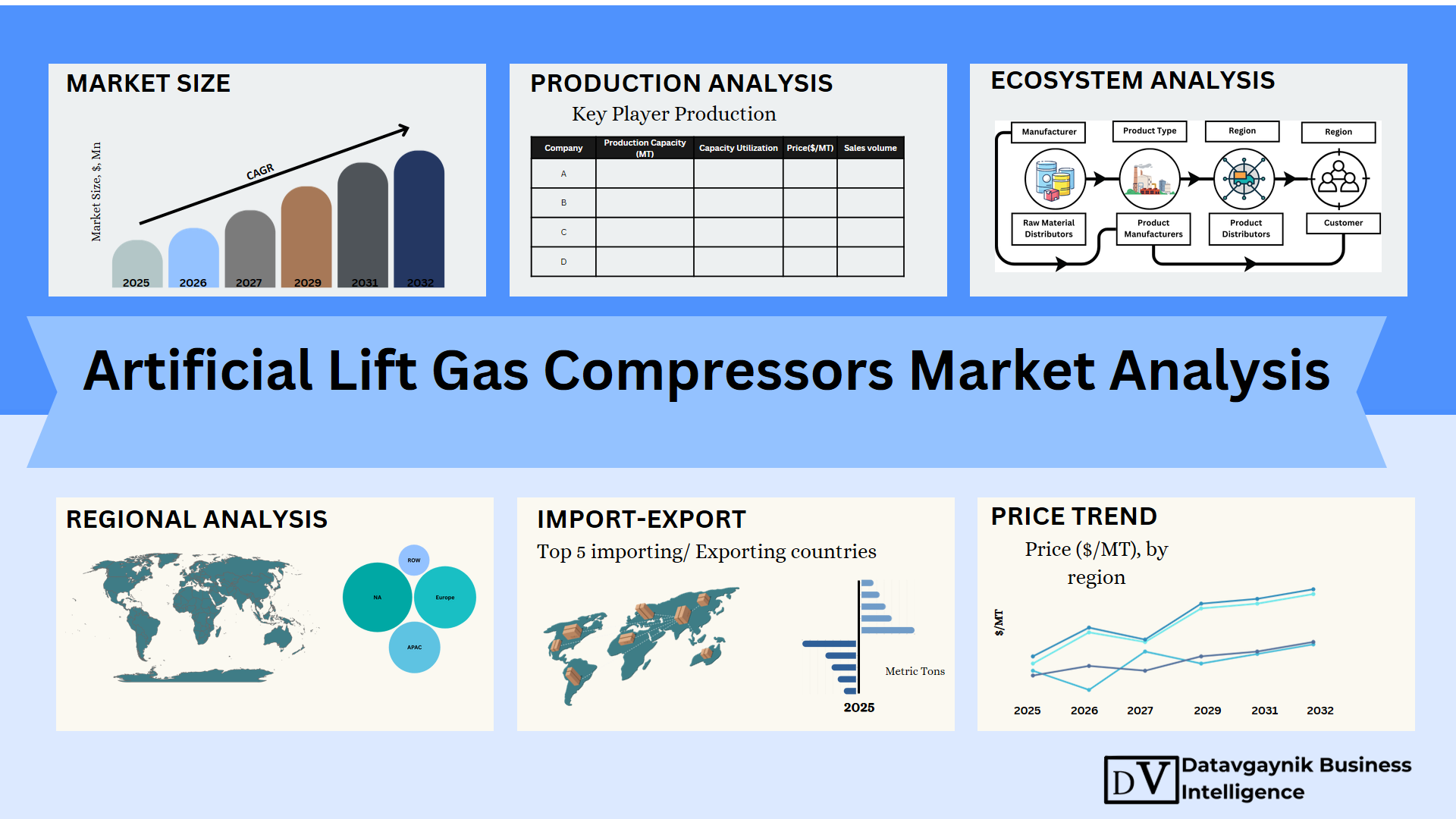
Artificial lift gas compressors raise natural gas to the pressure required for injection into producing wells. The injected gas mixes with the well fluid and reduces the density of the fluid column. This lowers hydrostatic pressure and allows oil or condensate to reach the surface at a commercially viable rate. Gas lift is particularly useful in mature wells, high-gas-to-oil-ratio fields, deviated wells and offshore developments where mechanical lifting systems can be difficult to install or maintain.
Datavagyanik also covers related markets such as the Gas Lift Equipment for Artificial Lift Market and the Subsea Gas Lift Systems Market. They create a more holistic picture of the ecosystem in which the primary topic exists, including technological shifts and market demands.
For this report, the Artificial Lift Gas Compressors Market covers:
- New and replacement compressor packages primarily used for gas-lift injection
- Reciprocating, rotary screw and centrifugal compressor systems
- Compressor skids, drivers, coolers, separators, controls and instrumentation
- Gas-lift-specific rental and contract compression
- Maintenance, refurbishment, spare parts and lifecycle services
- Digital monitoring and compressor optimization systems
The scope excludes downhole gas-lift valves and mandrels sold separately. It also excludes pipeline compression, general gas gathering, LNG compression and enhanced oil recovery gas-injection compressors that are not used for artificial lift.
Market-estimation basis
The estimate is built from upstream production spending rather than copied from published market-research databases. Global upstream oil and gas investment was approximately $570 billion in 2025. Around 40% of this spending was directed toward slowing production decline at existing fields. This is the investment pool most closely connected to artificial lift, well intervention and production-compression requirements.
| Estimate component | Calculation basis | 2026 modeled value |
| Global upstream investment reference | $570 billion | — |
| Existing-field and decline-management spending | 40% of upstream investment | $228 billion |
| Production optimization and artificial-lift addressable pool | Analyst allocation of 5.8% | $13.2 billion |
| Gas-lift-related equipment and service pool | Analyst allocation of 27% | $3.6 billion |
| Surface compression, controls, rental and aftermarket | Analyst allocation of approximately 40% | $1.42 billion |
The Artificial Lift Gas Compressors Market forecast therefore reflects both equipment sales and recurring service revenue. That distinction matters. A compressor package can remain in operation for years, but its valves, packing systems, controls, engine components and monitoring equipment require regular maintenance. Rental and contract-compression models also convert part of the industry from one-time capital expenditure into recurring operating expenditure.
Forecast indicators
| Market indicator | Estimate |
| Global market size, 2026 | $1,420 million |
| Projected market size, 2035 | $2,215 million |
| Forecast CAGR, 2026–2035 | 5.1% |
| Primary revenue source | Compressor packages and contract compression |
| Strongest demand environment | Mature oilfields and multi-well gas-lift installations |
| Strategic growth areas | Electrified compression, offshore systems and digital optimization |
Business relevance during 2026–2035
The market is not driven only by new oil production. Its larger commercial base comes from maintaining production at existing fields.
The International Energy Agency estimates that nearly 90% of annual upstream investment since 2019 has been used to offset natural field declines rather than support incremental demand growth. Without sustained investment, production from existing fields falls quickly. This creates a durable requirement for artificial lift, compression upgrades and brownfield optimization even when global oil demand growth slows.
Gas-lift compressors are also becoming more important at multi-well pads. One central compression installation can distribute injection gas across several wells. Operators can then change injection rates as reservoir pressure, water cut and gas availability evolve. This improves asset utilization and makes centralized contract compression commercially attractive.
Offshore fields represent another high-value demand pocket. Gas lift can handle high production rates without placing a mechanical pump at the bottom of every well. It also tolerates solids and gas better than several pump-based alternatives. However, offshore compressor packages require higher engineering standards, compact layouts, redundancy and corrosion protection. Their unit value is therefore materially above that of standard onshore packages.
Important market forces
Mature-field production management: Reservoir pressure declines as fields age. Gas compression enables operators to preserve well flow without drilling a replacement well. Gas lift can also be adjusted as production conditions change, giving it a practical advantage in long-life assets.
Capital discipline: Producers increasingly prioritize short-cycle production gains. A compressor upgrade or gas-allocation improvement can generate additional barrels from existing infrastructure. This is often easier to approve than a large greenfield project.
Electrification: Electric-motor-driven packages are gaining attention where grid power or field-generated electricity is available. Enerflex reports more than 3 million horsepower of electric-motor compression installed globally, while Archrock markets electric compression as a route to lower combustion emissions and reduced methane loss.
Methane regulation: Compressor seals, rod packing, blowdowns and gas-driven controls are receiving more regulatory scrutiny. The European Union’s 2024 methane regulation introduced measurement, reporting, leak-repair and venting restrictions across oil and gas operations. The US framework also places requirements on well sites and compressor stations. These rules support spending on tighter packages, electric drives, methane capture and continuous monitoring.
Gas availability: Gas lift requires a dependable injection-gas source. Projects can be constrained when produced gas has higher-value sales uses, when field compression is undersized, or when gathering infrastructure is unavailable. Operators are therefore giving more attention to gas recycling, compressor turndown and injection-allocation software.
Competition from alternative lift methods: Electric submersible pumps can offer better energy efficiency in some high-rate wells. Rod lift can be more economical in low-rate onshore production. So, gas compression demand depends on well geometry, gas availability, production rate and field economics rather than a universal technology preference.
Key consumers and clients
| Customer group | Principal buying requirement |
| National oil companies | Large brownfield programs, local service capability and long equipment life |
| Integrated oil and gas companies | Offshore reliability, emissions performance and digital integration |
| Independent exploration and production companies | Flexible rental models, rapid deployment and low operating cost |
| Offshore platform and FPSO operators | Compact footprint, redundancy and high-pressure capability |
| EPC and production-facility contractors | Packaged systems with clear performance guarantees |
| Contract-compression companies | High utilization, standardization and maintainable equipment fleets |
| Artificial-lift service providers | Compatibility between compressor controls and downhole gas-lift systems |
Analyst view: The market’s strongest commercial argument is not higher global oil consumption. It is the rising cost of allowing an existing well to decline prematurely. During 2026–2035, operators will spend more selectively, but a larger share of that spending will target measurable production recovery, energy efficiency and equipment reliability.
Market Segmentation and Forecast Scope
The segmentation of the Artificial Lift Gas Compressors Market is structured around compressor technology, lifting application, customer type and geographic demand. Only two segment shares are disclosed for 2026. The remaining shares are retained for the detailed market dataset.
By compressor type
| Segment | 2026 market position | 2026–2035 outlook | Strategic assessment |
| Reciprocating Compressors | 64% share | 4.8% CAGR | Dominant technology for high-pressure injection, variable flow and onshore multi-well applications |
| Rotary Screw Compressors | Share withheld | 5.3% CAGR | Useful for moderate-pressure, wet-gas and mobile compression duties |
| Centrifugal and Integrally Geared Compressors | Share withheld | 6.2% CAGR | Fastest-growing category in large offshore and centralized high-flow installations |
Reciprocating compressors hold the leading position because gas-lift applications often combine high discharge pressure with changing flow requirements. The technology can be staged, unloaded and reconfigured as field conditions change. It is also well supported by established maintenance networks. Ariel offers large reciprocating compressor frames that can be paired with either electric motors or natural-gas engines, reflecting the flexibility required in upstream installations.
Rotary screw compressors are suited to continuous service where suction gas conditions are unstable or where smaller, modular packages are required. They can manage wet gas more effectively than some conventional configurations. However, their use becomes less attractive at very high pressure ratios.
Centrifugal and integrally geared compressors are more relevant for large-volume offshore facilities and centralized gas-lift networks. Their growth will come from major field developments rather than broad well-by-well deployment. The category benefits from compactness and high flow capacity, but it requires more stable operating conditions and higher project engineering expenditure.
By application
| Segment | Market role | Forecast direction |
| Continuous-Flow Gas Lift | Maintains steady gas injection to reduce fluid-column density | Largest and most commercially important application |
| Intermittent Gas Lift | Injects gas in cycles to lift accumulated liquid slugs | Moderate growth in mature and lower-rate wells |
| Well Unloading and Production Restart | Initiates flow after shutdown, workover or pressure decline | Strong demand from brownfield intervention programs |
| Hybrid and Liquid-Assisted Gas Lift | Combines gas injection with liquid, jet or alternative lift methods | Fastest-developing specialist application |
| Multi-Well Gas-Lift Networks | Uses centralized compression and distribution across multiple wells | Strategic growth area for shale pads and mature field clusters |
Continuous-flow gas lift remains the foundation of the industry. Most established gas-lift wells operate continuously because the method provides smoother production and can manage relatively high liquid rates.
Intermittent gas lift is better suited to wells that cannot sustain continuous production. Gas is injected beneath an accumulated liquid slug and pushes it to the surface. The method uses less continuous gas but creates cyclic pressure and production conditions.
Well unloading and production restart is gaining commercial relevance as operators attempt to restore shut-in or underperforming wells. Portable compressors and short-duration rental packages are commonly preferred because the requirement may last only until stable production is restored.
Hybrid gas lift is the most technically dynamic area. Liquid-assisted gas lift, gas-lift and jet-pump combinations, and systems designed for later conversion to another lift method can reduce workover requirements. This may lead to more compressor systems being selected for flexible field-life strategies rather than one fixed operating condition.
By end user
| Segment | Procurement pattern | Growth assessment |
| National Oil Companies | Large tenders, long service contracts and high local-content requirements | Most strategic end-user group |
| Integrated Oil Companies | High technical specifications and emphasis on offshore reliability | Stable, technology-led demand |
| Independent E&P Operators | Rental, modular equipment and short payback periods | Sensitive to commodity prices |
| Contract-Compression Providers | Fleet standardization and high equipment utilization | Fast-growing commercial channel |
| EPC and Facility Contractors | Project-based package procurement | Linked to new platform and field-development schedules |
National oil companies will account for a rising portion of international demand. Many operate mature, large-scale assets in the Middle East, Latin America, North Africa and Asia. Their procurement decisions increasingly include emissions reporting, local maintenance and multi-year performance support.
Independent operators remain important in North American onshore fields. Their demand is more cyclical. However, they are also more willing to use rental and contract-compression structures, which reduce initial capital requirements.
Contract-compression providers are becoming more influential buyers because they aggregate demand across multiple operators. Following its acquisition of CSI Compressco, Kodiak Gas Services reported a fleet of approximately 4.3 million revenue-generating horsepower serving gathering, processing and multi-well gas-lift applications.
By region
| Region | 2026 market position | 2026–2035 outlook | Main demand centres |
| North America | 33% share | 4.2% CAGR | United States and Canada |
| Europe | Share withheld | 3.5% CAGR | Norway, United Kingdom and mature continental assets |
| Asia Pacific | Share withheld | 5.4% CAGR | China, Indonesia, Malaysia, India and Australia |
| LAMEA | Share withheld | 5.9% CAGR | Middle East, Brazil, Mexico, North Africa and West Africa |
North America leads in installed compression infrastructure and contract-compression adoption. Multi-well pads, unconventional oil production and an established service ecosystem support demand. Growth will remain slower than in emerging regions because the equipment base is already large.
Europe is a technically demanding but comparatively mature market. North Sea redevelopment, life-extension projects and methane compliance support replacement demand. New installation volumes remain limited by the region’s declining upstream activity.
Asia Pacific presents a mixed outlook. Mature fields in Indonesia and Malaysia need production optimization, while China and India continue to support domestic oil and gas output. Offshore project complexity increases the value of compressor packages even when unit volumes remain moderate.
LAMEA is forecast to grow fastest. Middle Eastern operators are investing in long-life oilfield production systems. Brazil is expanding complex offshore output. Mexico and several African producers are also attempting to improve recovery from mature assets. The region combines large national operators with fields that are technically well suited to continuous gas lift.
Use case: A mature offshore development may install one centralized compressor train with redundant capacity and route injection gas to dozens of wells. A smaller onshore operator may instead rent two modular reciprocating units for a six-well pad. Both transactions serve the same lifting function, but their pricing, service intensity and procurement cycles are very different.
Market Trends and Business Innovations
Innovation in the Artificial Lift Gas Compressors Market is shifting from basic horsepower expansion toward efficient gas allocation, lower-emission drives and integrated production control. Compressor manufacturers are still improving mechanical reliability, but the larger commercial gains increasingly come from how the compressor interacts with the full well network.
R&D and technology evolution
| Innovation area | Current development | Expected business impact |
| Closed-Loop Gas Allocation | Injection rates are automatically adjusted using pressure, flow and production data | Higher production from existing compression capacity |
| Electric-Motor Drives | Gas engines are replaced with electric motors where power is available | Lower onsite combustion emissions and reduced maintenance |
| Variable-Speed and Capacity Control | Compressor output follows real-time field demand | Less recycling, lower fuel use and better turndown |
| Modular Compression Packages | Standardized skids are transported and commissioned rapidly | Shorter deployment cycles and stronger rental economics |
| Methane Capture and Monitoring | Rod-packing emissions and blowdown gas are captured or measured | Supports compliance and retains saleable gas |
| High-Pressure Hybrid Lift | Gas lift is combined with liquid assistance, jet lift or staged conversion | Extends production across a broader section of the well lifecycle |
| Sour-Gas-Resistant Systems | Improved seals, coatings and corrosion-resistant components | Longer equipment life in H₂S and corrosive environments |
AI-enabled gas-lift optimization
AI has a practical role in this market because gas injection is an allocation problem. A field may have limited compression capacity but hundreds of wells competing for injection gas. The most profitable injection rate also changes with reservoir pressure, water production, well uptime and gas availability.
Baker Hughes offers an intelligent gas-lift optimization system that uses real-time well data, artificial intelligence and machine learning to calculate and adjust injection rates automatically.
A field deployment reported through the Society of Petroleum Engineers applied closed-loop optimization across more than 1,300 wells. The workflow generated an approximately 2.2% production uplift without changes to the installed surface or downhole equipment. This is important because it shows that software can improve the economic output of the existing compressor base rather than merely adding another monitoring layer.
Digital optimization also changes compressor sizing. Historically, operators often installed spare capacity to protect against uncertainty. Better field models can reduce that margin, direct gas toward the highest-response wells and delay capital expenditure on additional horsepower.
Expert view: AI will not replace compressor engineering. It will improve how installed horsepower is allocated. The commercial winners will be suppliers that combine reliable mechanical packages with production models, automated controls and field-level decision support.
Electrification and variable operation
Electrification is becoming one of the most visible design changes. Electric-motor-driven compressors eliminate combustion at the compressor driver and generally require less routine engine maintenance. They are especially attractive on offshore platforms with available power, electrified onshore pads and fields connected to low-cost electricity.
The practical limit is power availability. Remote oilfields may not have a stable grid. In such locations, gas engines remain the easier solution because produced gas can be used as fuel. Hybrid power systems, onsite generation and battery-supported controls may gradually narrow this gap.
Variable-frequency drives and automated capacity control also improve operating flexibility. Gas-lift requirements rarely remain constant over the life of a field. A package that can efficiently reduce speed or unload cylinders is more valuable than one that operates efficiently only near its design point. Variable capacity can also reduce gas recycling and wasted compression energy.
Methane reduction and compressor redesign
Methane compliance is moving into compressor procurement specifications. New packages increasingly include better rod-packing systems, closed-vent arrangements, electric controls and emissions-monitoring interfaces.
Archrock has developed a methane-capture system for compressor blowdown and rod-packing emissions. The company estimates that these sources can represent roughly one-third of methane emissions from an engine-driven compression package.
The US methane framework covers thousands of new sources and will extend to a much larger population of existing facilities as implementation progresses. The EU framework also requires measurement, leak detection, repair and restrictions on routine venting and flaring. This may raise the initial cost of compliant compressor packages, but it also expands demand for upgrades, monitoring equipment and aftermarket retrofits.
Modularization and contract compression
Operators increasingly want production equipment that can be installed quickly and moved when field requirements change. This supports modular skids, standardized controls and contract-compression models.
A contract provider owns and operates the compressor while the producer pays a monthly service charge. The producer avoids initial equipment expenditure and transfers maintenance responsibility. The provider benefits from recurring revenue and can redeploy the package when the contract ends.
This model is particularly effective for unconventional wells. Production declines quickly, so the required compressor size changes over time. Rental fleets allow units to be exchanged rather than permanently oversized.
High-pressure and hybrid lifting systems
Gas lift is expanding beyond conventional continuous injection. R&D is focused on deeper injection, lower-pressure well kickoff and combinations that allow the lifting method to change over the life of the well.
Liquid-assisted gas lift uses an initial liquid injection stage before gas injection. The method can reduce the compressor pressure required to unload a liquid-filled well. Hybrid gas-lift and jet-pump completions can also postpone workovers by allowing operators to switch lifting behaviour without pulling the production tubing.
These systems will remain specialist solutions. Still, they create a higher-value engineering opportunity because compressor controls, fluid handling and downhole equipment must be designed together.
Recent mergers, contracts and market announcements
| Date | Development | Market significance |
| April 1, 2024 | Kodiak Gas Services completed the acquisition of CSI Compressco | Created the largest US contract-compression fleet and expanded exposure to multi-well gas-lift applications |
| July 16, 2025 | SLB completed its acquisition of ChampionX | Combined artificial-lift hardware, production chemicals, automation and global service capabilities |
| 2025 | Weatherford secured a seven-year contract from Oxy for gas-lift completions and flow-control equipment in Oman | Demonstrated long-term gas-lift investment in a major Middle Eastern production market |
| 2024–2025 | Large-scale closed-loop optimization was demonstrated across more than 1,300 gas-lift wells | Established AI-based gas allocation as a commercially proven production tool |
The SLB–ChampionX transaction is the most strategically relevant consolidation event. ChampionX brought an extensive artificial-lift and automation portfolio, while SLB contributed global subsurface, production-system and digital capabilities. The combination strengthens the industry trend toward integrated production optimization rather than stand-alone equipment supply.
The Kodiak Gas Services–CSI Compressco combination reflects a different trend: scale in recurring contract-compression services. Larger fleets improve equipment availability, basin coverage, maintenance capability and purchasing leverage.
Weatherford’s long-term Oman contract with Oxy also shows that gas-lift spending is moving toward multi-year lifecycle relationships. Operators are not only buying individual valves or compressor components. They are purchasing continuity of production, technical support and field performance.
Expert view: By 2035, the Artificial Lift Gas Compressors Market will be less defined by the compressor frame alone. Value will migrate toward integrated packages that combine efficient drivers, emissions controls, well-performance software and long-term operating support. Hardware reliability will remain essential. But measurable production improvement will decide which suppliers capture premium margins.
Competitive Intelligence and Benchmarking
Competition in the Artificial Lift Gas Compressors Market is spread across four business models. These include compressor-frame manufacturing, package engineering, contract compression, and integrated artificial-lift services. So, competitors cannot be assessed only by equipment range. Installed fleet, field-service coverage, digital capability, pressure range, and ownership model are equally important.
Competitive benchmarking overview
| Company | Core market role | Gas-lift compressor capability | Commercial strength | Market position |
| Ariel Corporation | Reciprocating compressor-frame manufacturer | High-pressure, engine- or motor-driven configurations | Large installed base and specialist engineering | Leading compressor-frame supplier |
| Enerflex | Package integrator and contract-compression provider | Reciprocating and rotary screw packages | Design, manufacturing, installation and operation | Strong global packaged-system provider |
| Archrock | Contract-compression service provider | Gas-driven and electric gas-lift compression fleets | Recurring service model and Permian scale | Leading US contract-compression participant |
| Baker Hughes | Integrated artificial-lift and production-technology provider | Gas-lift completion equipment, controls and compressor optimization | AI, monitoring and field-level optimization | Major integrated technology supplier |
| SLB | Production, recovery and artificial-lift technology provider | Downhole gas lift, high-pressure systems and digital allocation tools | Global service network and integrated production workflows | Leading international production-optimization company |
| Weatherford | Artificial-lift equipment and well-production specialist | Conventional, specialty and digitally controlled gas-lift systems | Strong completion design and intervention capability | Established gas-lift systems competitor |
Ariel Corporation
Ariel Corporation occupies a strong position in high-pressure reciprocating compression. Its portfolio covers compact field units through larger multi-throw compressor frames. Several configurations are designed for gas-lift service, where pressure ratios, gas composition and changing well conditions require flexible cylinder arrangements.
The company’s main strength is mechanical specialization. It supplies compressor frames and cylinders that package builders combine with engines, electric motors, coolers, separators and control systems. This allows its equipment to be used across wellhead, multi-well pad and centralized gas-injection projects.
Ariel is particularly well positioned in the United States, where reciprocating compression dominates unconventional oilfield applications. Its field-production systems are also used internationally through independent packagers and service companies. However, it does not compete as a full artificial-lift contractor. It generally relies on package integrators and compression companies to provide the complete operating system.
Competitive insight: Ariel’s market influence is larger than its direct gas-lift revenue suggests. Its compressor frames sit inside packages sold, rented or operated by several other industry participants.
Enerflex
Enerflex competes through a broader packaged-equipment model. It provides reciprocating, rotary screw and process-compression systems, supported by engineering, installation, commissioning and aftermarket services. Gas lift is one of several upstream applications addressed by the company.
Its compression packages extend from small field units to engineered systems rated at several thousand horsepower. This gives the company access to onshore well pads, central production facilities, offshore installations and large gas-reinjection projects. It also offers contract-compression arrangements for small- and medium-horsepower gas-lift applications.
The company reports operating approximately 1.5 million horsepower of compression and having installed more than 10,000 compression solutions. This fleet and project history give it a strong position where operators prefer one contractor to manage package design, fabrication and lifecycle support.
Its competitive advantage is geographic reach. Enerflex can manufacture and service packages for desert, tropical, offshore and cold-weather environments. That said, gas-lift compression represents only part of its wider natural gas infrastructure business.
Archrock
Archrock is one of the most important contract-compression participants in the United States. It provides compressor capacity as a service rather than requiring producers to purchase and maintain their own packages. Its applications include gas lift, wellhead compression, gas gathering, processing and transportation.
The contract model is well suited to gas lift. Compressor requirements change as well production declines, gas-to-oil ratios increase or additional wells are connected. A producer can resize or replace rented units rather than owning equipment that becomes inefficient for the new operating condition.
Archrock has strengthened its position in large-horsepower and electric compression through acquisitions. Its purchase of a Permian-focused electric-compression provider added approximately 580,000 horsepower of assets and backlog. The subsequent acquisition of another compression fleet expanded its large-horsepower and electric-motor capability further.
The company’s main advantage is operating density in US producing basins. Technicians, spare parts and replacement units can be positioned close to the customer. Its limitation is geographic concentration, as its business is primarily tied to the United States.
Baker Hughes
Baker Hughes participates across gas-lift system design, downhole equipment, monitoring, automation and production optimization. It is more vertically integrated than a compressor-frame manufacturer. The company can evaluate the well, design the lifting system, install monitoring equipment and optimize injection rates after commissioning.
Its intelligent gas-lift platform uses live production data and machine-learning models to adjust control valves or compressor operation. The system can allocate gas according to production or financial objectives. Baker Hughes reports production improvements of up to 10% in selected deployments compared with conventional optimization methods.
The company also offers field-level software that coordinates artificial lift, chemical treatment, power use and reservoir performance. This is strategically important for large operators that manage hundreds or thousands of producing wells.
Its compressor-market position is strongest where equipment, controls and well optimization are procured together. It is less dependent on selling a stand-alone compressor package and more focused on improving the economics of the complete production system.
SLB
SLB holds a broad position in artificial lift, production systems and reservoir-to-surface optimization. Its gas-lift portfolio covers conventional and unconventional wells, continuous and intermittent production, high-pressure offshore injection and field-level gas allocation.
The company offers software that distributes limited injection gas across multiple wells according to production targets. It also supplies downhole valves, mandrels, metering systems and high-pressure configurations for deeper offshore injection.
The acquisition of ChampionX in July 2025 expanded SLB’s position in production chemicals, artificial lift, digital production and emissions monitoring. This strengthens its ability to connect compressor operation with well performance, flow assurance and field economics.
SLB’s advantage is integration. It can model the reservoir, design the well completion, optimize lift gas and monitor production through one digital environment. However, the company is not primarily a contract-compression fleet owner. Surface packages may still be supplied through compressor OEMs or engineering partners.
Weatherford
Weatherford has an established portfolio covering onshore, offshore and specialist gas-lift applications. Its offering includes system design, downhole injection equipment, monitoring, troubleshooting, automation and remedial services.
The company’s position is strongest where gas lift must be adapted to difficult well conditions. These include deep injection points, high-producing offshore wells, unconventional completions and mature wells with unstable production. Its digitally controlled systems can change injection behaviour in response to well conditions.
In one mature-field application, the company reported reducing gas injection by as much as 50% while maintaining or improving production. This illustrates the value of matching compressor output with actual well response rather than injecting gas at a fixed rate.
Weatherford also benefits from long-term Middle Eastern contracts. Its seven-year gas-lift award in Oman strengthens its position in high-value national oil company and international operator accounts.
Strategic competitive comparison
| Competitive factor | Best-positioned participants | Assessment |
| Reciprocating compressor engineering | Ariel Corporation, Enerflex | Strongest mechanical and package-design capability |
| Contract-compression scale | Archrock, Enerflex | Attractive for operators seeking lower upfront capital |
| Integrated gas-lift completion systems | SLB, Baker Hughes, Weatherford | Strong downhole, monitoring and optimization coverage |
| AI-based gas allocation | Baker Hughes, SLB | Growing advantage in large multi-well fields |
| Electric compression | Archrock, Enerflex | Important in the Permian and electrified facilities |
| Offshore and high-pressure gas lift | SLB, Weatherford, Baker Hughes | High-value engineering and service opportunity |
| North American field coverage | Archrock, Ariel Corporation | Dense service network and large installed base |
| International lifecycle support | SLB, Baker Hughes, Weatherford, Enerflex | Strong access to NOCs and offshore operators |
Expert view: Competition will increasingly occur at the system level. A mechanically reliable compressor remains essential, but operators will reward suppliers that can prove higher oil output per unit of injection gas, lower methane leakage and fewer unplanned shutdowns.
Regional Landscape and Adoption Outlook
Regional adoption varies according to oilfield maturity, availability of injection gas, installed compression infrastructure and the economics of alternative lift methods. The Artificial Lift Gas Compressors Market is strongest in regions where operators manage large numbers of mature or high-gas-to-oil-ratio wells.
Regional adoption and investment comparison
| Market | Adoption level in 2026 | Modeled CAGR, 2026–2035 | Primary demand driver | Funding and procurement model |
| United States | Very high | 4.2% | Permian multi-well pads and contract compression | Private E&P capital and monthly service contracts |
| Europe | Moderate | 3.5% | North Sea field-life extension | Operator capital, offshore service contracts and compliance spending |
| China | High | 5.6% | Stabilization of mature state-operated fields | National oil company investment and domestic procurement |
| India | Moderate | 5.8% | Mature-field recovery and lower import dependence | NOC investment, private operator capital and production-enhancement contracts |
| Japan | Low domestically | 2.6% | Overseas project engineering and equipment supply | Public-backed overseas resource development |
| South Korea | Low domestically | 3.0% | International upstream holdings and offshore engineering | State-backed overseas investment and corporate procurement |
| Middle East | High | 6.2% | Long-life mature fields and large production targets | NOC-funded projects and multi-year service agreements |
The growth rates above are analyst estimates within the previously stated $1.42 billion market model.
United States
The United States is the largest national market for gas-lift compression. Demand is concentrated in Texas and New Mexico, particularly the Permian Basin. The basin produced approximately 6.6 million barrels per day in 2025 and represented around 48% of total US crude oil production. Its marketed natural gas output reached approximately 27.6 billion cubic feet per day, partly because gas-to-oil ratios rise as wells mature.
These conditions support gas lift. Operators need to recycle or manage associated gas while sustaining liquid production from horizontal wells. Multi-well pads also allow one centralized compressor installation to serve several wells, improving equipment utilization.
The United States has the most mature contract-compression ecosystem. Archrock, Enerflex, regional providers and producer-owned fleets compete across gas-driven and electric packages. Private operators can procure compression through monthly service contracts, which lowers upfront capital and transfers maintenance responsibility.
Methane regulation is influencing package design. Federal requirements cover leak monitoring at well sites, centralized production facilities and compressor stations. This favours electric drives, closed-vent systems, improved packing, remote leak detection and automated shutdown controls.
Outlook: US market growth will be moderate rather than exceptional. However, replacement demand, electrification and larger centralized packages will keep revenue ahead of well-count growth.
Europe
European demand is concentrated in the North Sea. Norway remains the region’s largest upstream production base, while the United Kingdom offers a sizeable but declining mature-field opportunity.
Norwegian offshore production supports demand for high-reliability, space-efficient and corrosion-resistant compressor systems. Offshore installations require redundancy and strict maintenance planning because compressor downtime can affect several gas-lifted wells at once. Norwegian official data show that the continental shelf remained a major producer of oil, gas and natural gas liquids during 2025.
The UK market is more focused on field-life extension. Domestic crude oil and natural gas liquids production declined to 30.4 million tonnes in 2024, down 8.9% from 2023, reflecting the maturity of the basin. Well interventions still delivered 37.5 million barrels of oil equivalent during 2024, showing that targeted production spending can remain economic even in a declining region.
Within the European Union, the 2024 methane regulation requires improved measurement, monitoring, reporting and reduction of methane emissions in the energy sector. Compressor seals, vent systems, pneumatic controls and blowdown practices will therefore receive greater attention.
Europe will not generate the largest volume of new packages. It will, however, support premium revenue from offshore retrofits, emissions upgrades, digital monitoring and reliability services.
China
China is a strategically important growth market because several of its major oilfields have been producing for decades. Production management at Daqing, Xinjiang, Liaohe and other mature assets requires artificial lift, water management, injection systems and continuous well intervention.
CNPC reported that crude oil production increased for a sixth consecutive year in 2024. Its major fields combined new development with mature-field management. Daqing maintained production near 30 million tonnes, while Xinjiang recorded growth through tighter management of mature fields and production ramp-up in new blocks.
Procurement is led by state-owned companies, including CNPC/PetroChina, Sinopec and CNOOC. International suppliers compete in high-pressure, offshore and advanced-control applications, while local compressor manufacturers and engineering companies address standardized onshore demand.
China’s main advantage is scale. Large field clusters can support centralized compression and automated gas allocation. Local manufacturing also reduces package cost. That said, international companies face strong localization requirements and competition from domestic suppliers.
Outlook: China will favour systems that combine locally manufactured hardware with higher-value control, monitoring and optimization technology.
India
The Indian opportunity is smaller than the US, Chinese or Middle Eastern markets, but its growth rate is attractive. The country is attempting to increase domestic oil and gas production while managing ageing fields operated by ONGC, Oil India and private producers.
Oil India increased crude production to 3.458 million tonnes in financial year 2024–2025, around 2.95% above the previous year. The company stated that it continues to optimize mature fields through production-enhancement measures. It is also investing in low-pressure compressor units to reduce flaring and improve gas utilization.
Cairn Oil & Gas is applying AI, automation and real-time data to production operations as part of its effort to improve recovery from Indian assets. This supports demand for connected compressors, well surveillance and automated lift optimization.
Indian procurement will remain price-sensitive. Standardized packages, local fabrication and long maintenance contracts will therefore outperform highly customized systems in onshore projects. Offshore developments and high-pressure applications will continue to use more international technology.
Funding comes from national oil company capital expenditure, private operator investment and performance-linked production-enhancement contracts. This creates opportunities for suppliers willing to share operating responsibility rather than only sell equipment.
Japan
Japan has limited domestic oil production, so direct compressor demand is small. Its importance comes from overseas upstream investment, engineering capability and the procurement influence of Japanese energy companies.
JOGMEC provides financial and technical support to Japanese companies participating in overseas oil and natural gas projects. It is also assessing acquisition and development opportunities in countries such as Indonesia and Malaysia.
Japanese demand therefore appears mainly through overseas projects, compressor components, engineering services and operator specifications. Suppliers may sell into a Middle Eastern, Southeast Asian or African field through a Japanese project partner rather than through a domestic oilfield.
Methane-management requirements are also becoming part of overseas investment assessment. JOGMEC’s 2025 clean-energy reporting covered methane practices across major upstream projects connected with Japanese and South Korean buyers.
South Korea
Like Japan, South Korea has a limited domestic upstream base. The country’s market role is linked to international oilfield ownership, offshore construction and overseas resource security.
Korea National Oil Corporation participated in 19 overseas oil-development projects across 14 countries at the end of 2024. These projects produced approximately 136,000 barrels of oil equivalent per day.
This portfolio gives Korean companies indirect exposure to artificial-lift and compression procurement. However, purchasing decisions are usually made at the overseas operating asset rather than in the domestic Korean market.
South Korean engineering and fabrication capabilities can support offshore modules, motors, controls and compressor skids. Still, the national market should not be treated as a large stand-alone demand centre.
Middle East
The Middle East is the fastest-growing major market in the forecast. The region combines very large producing fields, long asset lives, strong national oil company balance sheets and extensive gas availability.
Middle Eastern oil and gas supply investment was expected to reach approximately $130 billion in 2025, representing around 15% of global investment. Saudi upstream oil and gas investment alone was estimated near $40 billion.
Saudi Arabia, Kuwait, Oman and the United Arab Emirates are the primary opportunity markets. Kuwait and Oman are particularly relevant for mature-field artificial lift. Baker Hughes received a multi-year artificial-lift award from Kuwait Oil Company, while Weatherford secured a seven-year gas-lift contract from Oxy in Oman.
Regional procurement increasingly includes local assembly, workforce development and in-country maintenance. Global suppliers therefore need workshops, service teams and local partners rather than an export-only strategy.
Gas availability is generally favourable. However, injection gas competes with power generation, petrochemical and LNG requirements. Efficient gas allocation will become more valuable as national operators attempt to maximize oil recovery without wasting saleable gas.
Expert view: The Middle East will generate the strongest combination of unit demand and project value through 2035. Large field networks, long contracts and local-content requirements will favour integrated suppliers with a permanent regional presence.
Recent Developments, Opportunities and Restraints
Recent developments
- July 2024 – Archrock announced the acquisition of Total Operations and Production Services. The transaction added approximately 580,000 horsepower of Permian-focused compression assets and expanded Archrock’s electric-motor-driven gas-lift capability.
- March 2025 – Archrock agreed to acquire Natural Gas Compression Systems for approximately $357 million. The acquisition expanded its large-horsepower fleet and strengthened its electric-compression offering for gas-lift and midstream applications. The transaction closed in May 2025.
- July 2025 – SLB completed its acquisition of ChampionX. The combination integrated artificial-lift equipment, production chemicals, emissions monitoring and digital production technologies within a larger global production-optimization platform.
- December 2025 – Baker Hughes received a multi-year artificial-lift award from Kuwait Oil Company. The agreement includes equipment, installation, surveillance, maintenance and automated production-optimization capabilities for established Kuwaiti fields.
- February 2026 – Weatherford disclosed a seven-year Oxy contract in Oman. The scope covers gas-lift completions and flow-control equipment, reinforcing long-term demand for gas-lift infrastructure in mature Middle Eastern assets.
Opportunities and business insights
Emerging brownfield programs: Mature fields in the Middle East, China, India, Latin America and Southeast Asia offer stronger long-term potential than many greenfield markets. These assets already have wells, gathering systems and processing infrastructure. Compression can therefore generate incremental production without requiring a complete new field development.
AI and automated gas allocation: Operators can create additional production from existing compressor capacity by directing injection gas toward wells with the best response. This opportunity is commercially attractive because it lowers the cost per incremental barrel and may delay new compressor purchases.
Electric and service-based compression: Electric-motor packages, remote monitoring and contract-compression models create recurring revenue opportunities. Producers gain lower onsite emissions and avoid large upfront equipment expenditure. Suppliers gain longer customer relationships and aftermarket revenue.
Market restraints
Competition from other lift methods: Electric submersible pumps, rod lift, progressing-cavity pumps and jet pumps may offer better economics in certain well conditions. Gas lift is not automatically the preferred method for every mature well.
Injection-gas limitations: Gas lift requires a stable gas supply and sufficient compression pressure. Gas may have a higher commercial value in sales pipelines, power generation, LNG or petrochemical production.
Capital and commodity-price sensitivity: Independent producers may postpone compressor upgrades when oil prices weaken. Large offshore and centralized systems also require long engineering and approval cycles.
Compliance and operating cost: Methane monitoring, electric infrastructure, emissions controls and specialized maintenance increase initial package cost. Smaller operators may struggle to justify premium systems unless production benefits are clearly measured.
Expert view: The most attractive opportunity is not simply selling more horsepower. It is helping operators obtain more production from each unit of compression energy and each unit of injection gas.


