

Market Summary and Growth Forecast
The global Barium Sulfate scale inhibitor for oil & gas application Market will witness a robust CAGR of 6.2%, valued at $0.72 billion in 2026, expected to appreciate and reach $1.24 billion by 2035.
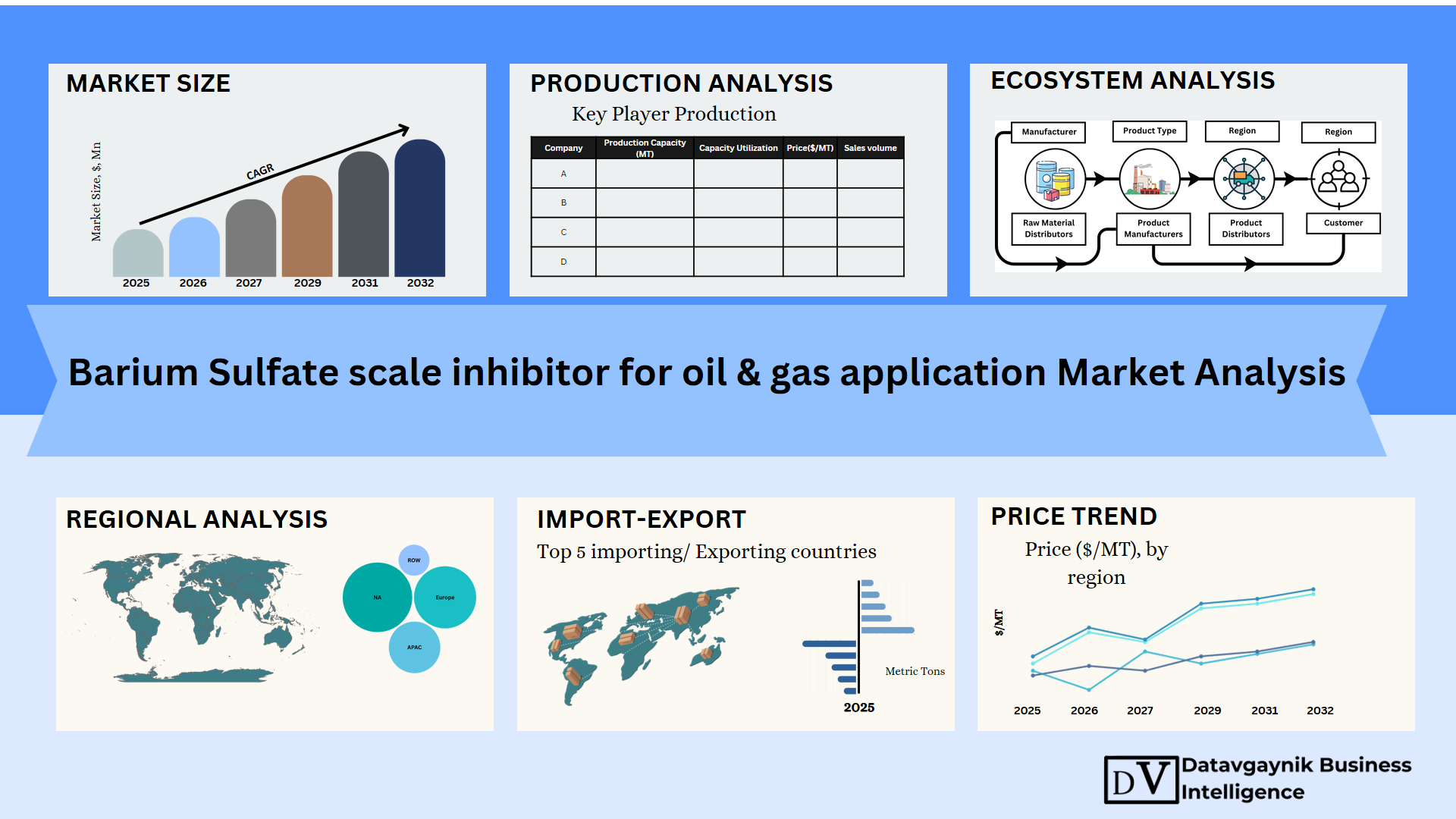
The market covers specialty chemical formulations used to prevent, delay, or control barium sulfate scale formation across oilfield production systems. These chemicals are mainly used in wells, near-wellbore zones, production tubing, subsea lines, separators, water-injection systems, and produced-water handling assets. The revenue boundary includes formulated scale inhibitor products, squeeze-treatment chemicals, continuous-injection chemicals, and high-performance blends designed for sulfate-rich and barium-rich brine environments. It excludes general oilfield chemicals, corrosion inhibitors, hydrate inhibitors, water treatment chemicals outside oilfield use, and field services not directly tied to inhibitor supply.
The strategic relevance is clear. Barium sulfate scale is one of the most difficult inorganic scales to manage in oil and gas operations. Once formed, it has very low solubility. It is harder to dissolve than calcium carbonate and many sulfate scales. That makes prevention more economical than remediation. For operators, even a small loss of flow assurance can affect production uptime, artificial lift performance, intervention frequency, and well economics.
Between 2026 and 2035, demand will be supported by four operating realities. First, many producing fields are getting older. Mature reservoirs usually bring higher water cut, more complex brine chemistry, and higher scale risk. Second, offshore and deepwater production will keep using water injection and seawater-based pressure support in several regions. This increases the chance of sulfate-rich water mixing with barium-rich formation water. Third, unconventional fields are moving toward longer laterals, higher produced-water handling, and greater attention to chemical optimization. Fourth, operators are under pressure to reduce unplanned workovers, chemical overuse, and discharge impact.
The Barium Sulfate scale inhibitor for oil & gas application Market sits at the intersection of production chemistry, asset integrity, and flow assurance. It is not a broad commodity chemical segment. Buyers are technically demanding. Products must perform under high salinity, elevated temperature, mixed-scale conditions, and changing water chemistry. In offshore fields, qualification also depends on environmental acceptability, biodegradation profile, toxicity classification, and discharge approval.
From a technology standpoint, the market is shifting from standard phosphonate-heavy chemistries toward blended inhibitor packages, polymer-modified products, and lower-dose formulations with better retention. Squeeze-treatment design is also improving. Operators want longer squeeze life, better return profiles, and fewer interventions. That matters in subsea and offshore wells where intervention costs are high.
Regulation will shape the premium end of the market. Europe is already strict on offshore chemical discharge. Other offshore basins are becoming more selective as well. This does not remove demand. Instead, it pushes buyers toward better-performing and more environmentally acceptable chemistries. The supplier able to combine field performance with regulatory acceptance will hold pricing power.
Estimated market outlook
| Metric | 2026 Estimate | 2035 Forecast | Commentary |
| Global market size | $0.72 billion | $1.24 billion | Based on formulated barium sulfate scale inhibitor product revenue only |
| CAGR | — | 6.2% | Growth driven by mature fields, offshore activity, water injection, and higher intervention avoidance |
| Volume demand index | 100 | 151 | Volume expands slower than revenue due to higher-performance formulations and premium offshore pricing |
| Average product price trend | Base year | +17–22% | Premiumization from HPHT, subsea, and greener chemistry requirements |
| Offshore share of revenue | ~46% | Not disclosed | Offshore has higher chemical qualification costs and stronger value-per-well economics |
| Squeeze-treatment share | ~39% | Not disclosed | Important where continuous injection is difficult or uneconomic |
The stakeholder map is wider than it looks. Oilfield chemical suppliers, integrated oilfield service companies, E&P operators, national oil companies, offshore regulators, chemical testing laboratories, environmental agencies, subsea equipment OEMs, water-injection system providers, and investors all influence purchasing and adoption. Industry associations and offshore chemical registration bodies also matter because chemical approval can decide whether a product is commercially usable in a given basin.
Expert insight: The market is not growing because operators are simply buying more chemicals. It is growing because water chemistry is becoming harder to manage and intervention economics are less forgiving. In high-value wells, a better inhibitor can pay for itself quickly if it prevents even one production disruption.
So, the Barium Sulfate scale inhibitor for oil & gas application Market should be viewed as a specialized flow-assurance market with steady demand, high technical barriers, and increasing formulation complexity. It will not grow in a straight line with oil production. It will grow with produced-water intensity, offshore complexity, reservoir aging, and the cost of downtime.
Market Segmentation and Forecast Scope
The Barium Sulfate scale inhibitor for oil & gas application Market can be segmented by chemical type, deployment method, field application, asset type, end user, and region. This structure reflects how the product is actually selected in the field. Buyers do not purchase only by chemistry. They buy based on water chemistry, field architecture, intervention cost, regulatory approval, and scale risk severity.
By Product Type
The market includes phosphonate-based inhibitors, polymer-based inhibitors, hybrid phosphonate-polymer blends, and environmentally improved / low-toxicity formulations.
Phosphonate-based inhibitors remain widely used because of proven performance against sulfate scales. They are familiar to operators and compatible with many squeeze-treatment designs. That said, environmental pressure is limiting their use in some offshore settings unless the formulation can pass local discharge requirements.
Polymer-based inhibitors are gaining relevance where better dispersion, improved temperature tolerance, or lower phosphorus content is required. They are often used in blended packages rather than as standalone products.
Hybrid blends are the most strategic category. They allow suppliers to tune adsorption, desorption, thermal stability, and compatibility with field brines. These products can command better margins when they are qualified for difficult offshore or HPHT wells.
Environmentally improved formulations are smaller in absolute demand today, but they are becoming more important in the North Sea, parts of Europe, and offshore projects where chemical discharge approval is difficult.
By Deployment Method
The main deployment methods are continuous injection, squeeze treatment, batch treatment, and specialized intervention-based dosing.
Continuous injection is common where chemical access is available and where constant protection is required across production systems, pipelines, and topside facilities. It is easier to monitor and adjust, but it requires infrastructure and stable logistics.
Squeeze treatment is highly relevant for downhole protection. The inhibitor is injected into the reservoir and then gradually released during production. This method is important for wells where continuous downhole injection is not practical.
Batch treatment is used for specific system risks, short campaigns, or operational clean-up cycles. It is less dominant in high-risk barium sulfate environments but still useful in selected field conditions.
In 2026, continuous injection is estimated to hold about 43% of market revenue. This is due to its routine use in production systems and surface/subsea flow assurance programs. Squeeze treatment is estimated at about 39% of revenue, supported by well-level scale control in mature offshore and waterflooded assets.
By Application
Key applications include production wells, near-wellbore protection, subsea production systems, flowlines and pipelines, water-injection systems, separators and topside equipment, and produced-water handling systems.
Production wells form the core demand pool. The economic value is high because scale deposition can restrict flow, reduce productivity, and increase intervention frequency.
Subsea systems represent the highest-value application pocket. Chemical selection is stricter, performance tolerance is lower, and remediation is expensive. So even moderate volumes can translate into strong revenue.
Water-injection systems are important because sulfate-rich injection water can trigger barium sulfate formation when it mixes with formation water. This is especially relevant in offshore waterfloods and fields using seawater injection.
Produced-water systems are gaining attention as operators recycle, reinject, or handle larger water volumes. Scaling risk does not stop at the wellhead. It moves through the production chain.
By End User
The major end users are integrated oil companies, national oil companies, independent E&P operators, offshore operators, and oilfield service companies managing chemical programs.
National oil companies are important in the Middle East, Latin America, and Asia Pacific. They often control large mature assets where water cut and scaling risk are rising.
Offshore operators are premium customers. They usually require technical validation, lab compatibility testing, field trials, and environmental documentation.
Independent E&P operators are more cost-sensitive, especially in North American onshore fields. They still buy performance products when scale risk directly affects uptime.
By Region
The regional scope includes North America, Europe, Asia Pacific, and LAMEA.
North America remains a large demand base because of high well counts, unconventional production, produced-water handling, and continuous chemical treatment programs. The region is competitive and price-sensitive, but demand is resilient.
Europe is smaller in volume but higher in regulatory complexity. Offshore chemical approval, especially in the North Sea, favors suppliers with strong environmental dossiers and proven offshore performance.
Asia Pacific is one of the most strategic growth regions. Mature offshore fields in Southeast Asia, waterflooding activity, and national energy-security priorities support demand. China, Malaysia, Indonesia, Australia, and India all create different demand pockets.
LAMEA includes the Middle East, Africa, and Latin America. The Middle East has large water-injection programs and carbonate reservoirs. Latin America has deepwater and mature-field opportunities. Africa is selective but important in offshore developments.
| Segmentation Dimension | Core Sub-Segments | Most Strategic Area | Reason |
| Product type | Phosphonate, polymer, hybrid blends, low-toxicity formulations | Hybrid blends | Better performance tuning and higher pricing potential |
| Deployment method | Continuous injection, squeeze treatment, batch treatment | Squeeze treatment | High value in offshore and downhole protection |
| Application | Wells, subsea systems, pipelines, water injection, produced water | Subsea systems | High remediation cost and strict qualification needs |
| End user | IOCs, NOCs, independents, service companies | NOCs and offshore operators | Large assets and high scaling exposure |
| Region | North America, Europe, Asia Pacific, LAMEA | Asia Pacific and LAMEA | Mature fields, water injection, and offshore activity |
The fastest-growing opportunity is likely to come from hybrid and environmentally improved inhibitor packages used in offshore, subsea, and mature waterflooded assets. These are not always the largest-volume areas, but they are commercially attractive.
Expert insight: The best suppliers will not win only by offering a stronger molecule. They will win by proving longer squeeze life, lower dose rates, better compatibility, and cleaner regulatory acceptance. That is where procurement shifts from price comparison to performance economics.
Market Trends and Innovation Landscape
The innovation landscape in the Barium Sulfate scale inhibitor for oil & gas application Market is moving toward precision chemistry. Operators are asking for inhibitors that work at lower concentration, last longer in the reservoir, tolerate harsher brines, and meet stricter environmental expectations. The old model was simple: qualify the chemical, dose it, and monitor results. The new model is more dynamic. Chemistry is being designed around field-specific water chemistry and asset constraints.
R&D Evolution
R&D is focused on four areas: stronger sulfate-scale inhibition, longer squeeze-treatment life, improved thermal stability, and lower environmental impact.
Barium sulfate is difficult because it forms a hard, dense, low-solubility scale. Once deposited, removal is expensive and often incomplete. So R&D has shifted toward prevention at the earliest stage of nucleation. Suppliers are testing inhibitor packages that interfere with crystal growth, improve dispersion, and remain active across changing brine chemistry.
Squeeze-treatment innovation is also central. Operators want better inhibitor retention and controlled release. In simple terms, the chemical needs to stay in the formation long enough to protect the well but return at a concentration high enough to prevent scale. This balance is hard to achieve in high-salinity and high-temperature reservoirs. That is why adsorption behavior, compatibility testing, and return-curve modeling are becoming more important.
Technology Evolution
The market is moving from broad chemical dosing to more engineered treatment programs. Lab testing now plays a bigger role before field deployment. Operators use dynamic tube blocking tests, static bottle tests, coreflood tests, brine compatibility studies, and produced-water monitoring to select formulations.
Digital tools are also entering the workflow, though not always as full AI systems. In practical terms, operators are using production data, ion analysis, water-cut trends, pressure changes, and chemical return data to adjust treatment schedules. This helps reduce over-dosing. It also identifies when scale risk is rising before production loss becomes visible.
AI is relevant only at the monitoring and optimization layer. It is not replacing chemistry development. Its near-term use is in predicting scale risk, optimizing inhibitor dose, and improving squeeze-treatment timing. Adoption will be strongest among large operators and service companies with integrated production chemistry platforms.
Material Science and Formulation Trends
Material science matters here because the product’s field performance depends on molecular design, adsorption behavior, brine tolerance, and interaction with rock surfaces.
The main formulation trends include:
| Innovation Area | What Is Changing | Commercial Impact |
| Hybrid inhibitor chemistry | Combining phosphonate and polymer functions in tailored blends | Better performance across mixed-scale and high-salinity conditions |
| Lower-phosphorus formulations | Reducing phosphorus load where discharge rules are strict | Better fit for offshore regulatory requirements |
| High-temperature stability | Designing inhibitors for HPHT and deeper wells | Supports premium pricing in complex reservoirs |
| Longer squeeze life | Improving retention and controlled release from reservoir rock | Reduces intervention frequency |
| Compatibility engineering | Testing against brines, corrosion inhibitors, demulsifiers, and production chemicals | Lowers field failure risk |
| Dose optimization | Using field data to reduce unnecessary chemical consumption | Improves operating cost and ESG profile |
The strongest R&D direction is not one single chemistry. It is formulation flexibility. Different reservoirs behave differently. Carbonate formations, sandstone formations, high-barium brines, sulfate-rich injection water, and mixed-scale systems all require different treatment logic.
Partnerships, M&A, and Competitive Movement
The competitive landscape is consolidating around suppliers that can combine chemistry, field service, diagnostics, and digital optimization. Large oilfield service companies have an advantage because they already manage production systems, artificial lift, intervention planning, and chemical programs.
The most important recent development is SLB’s acquisition of ChampionX, completed in 2025. This expanded SLB’s position in production chemicals and strengthens its ability to offer integrated production optimization. For scale inhibitors, the impact is indirect but meaningful. It brings chemistry closer to digital production systems, artificial lift data, and field-level service execution.
Other suppliers are moving through innovation centers, offshore chemical qualification, and closer collaboration with operators. The focus is not only on product launches. It is on field validation. A chemical that performs well in the lab still needs proof in real brines, real temperatures, and real operating cycles.
Future Impact
The next phase of the Barium Sulfate scale inhibitor for oil & gas application Market will be shaped by fewer but more capable suppliers. Customers will prefer vendors that can diagnose scale risk, design the treatment, supply the product, monitor performance, and defend the environmental profile.
Expert insight: Scale inhibition is becoming a data-backed chemistry decision. The molecule still matters. But the winning model is chemistry plus monitoring plus field proof. That may lead to fewer generic tenders and more performance-based supply agreements.
By 2035, the market will likely look more specialized than it does today. Commodity products will remain in onshore and lower-risk applications. Premium growth will sit in offshore, subsea, HPHT, mature waterfloods, and fields with strict chemical discharge rules. That is where higher-value inhibitor systems can protect production and reduce lifecycle cost.
Competitive Intelligence and Benchmarking
Competition in the Barium Sulfate scale inhibitor for oil & gas application Market is led by integrated oilfield service companies, specialty chemical suppliers, and formulation houses with strong field-testing capability. This is not a market where a catalog product wins by default. Operators ask for brine compatibility, squeeze-life evidence, field return curves, environmental documentation, and response support when wells start showing scale symptoms.
Competitive Benchmarking Snapshot
| Company | Portfolio Position | Market Position | Strategic Strength |
| SLB / ChampionX | Production chemicals, scale management, squeeze programs, digital chemical optimization | Global leader in integrated production chemistry | Strong fit for offshore, mature fields, artificial lift-linked chemical programs, and large operator accounts |
| Halliburton | Scale management, stimulation chemicals, reservoir treatment programs | Strong oilfield services player with broad well-intervention access | Deep operator relationships and strong position in North America and Middle East |
| Baker Hughes | Flow assurance chemicals, sulfate and carbonate scale control, solid and liquid inhibitor systems | Large global energy technology supplier | Good fit for offshore, completions, production systems, and integrated asset protection |
| Clariant | Oil services chemicals, scale-control formulations, squeeze-treatment support | Specialty chemical supplier with strong technical formulation profile | Strong in customized chemistry and environmentally sensitive offshore applications |
| BASF | Oilfield chemical building blocks, surfactants, polymers, flow-assurance chemistry inputs | Broad specialty chemical supplier | Strong upstream formulation support and raw-material depth |
| Innospec | Stimulation, production, midstream scale-control chemicals | Mid-sized specialty supplier with focused oilfield chemistry portfolio | Flexible formulations and attractive position in regional oilfield accounts |
| Italmatch Chemicals | Phosphonate-based scale inhibitor chemistries and formulation ingredients | Strong specialty additive supplier | High relevance in phosphonate chemistry and ingredient supply for oilfield scale-control systems |
SLB / ChampionX holds the strongest integrated position. Its advantage is not only chemistry. It combines production chemicals, field diagnostics, artificial lift knowledge, scale prediction, and digital optimization. That makes it especially relevant for operators that want fewer vendors and more accountable treatment programs. The company is well positioned in mature fields, deepwater assets, and large-scale production operations where scale risk is part of a wider flow-assurance challenge.
Halliburton competes through its well-intervention reach and production-chemistry capabilities. Its scale-management offering is relevant across sandstone, carbonate, tight gas, and shale assets. The company’s advantage is field execution. It can connect laboratory testing with stimulation, completion, and production workflows. That gives it a strong position where scale control is tied to well productivity rather than only surface-facility protection.
Baker Hughes has a strong position in flow assurance and production systems. Its scale-control portfolio is relevant for both carbonate and sulfate scale. The company also offers controlled-release and reservoir-focused systems that fit wells where long-lasting protection matters. Its strength sits in larger operator relationships, offshore engineering support, and production-system integration.
Clariant is more formulation-led. It is not positioned like a fully integrated oilfield service major, but it has technical depth in oilfield chemistry. Its strength is customized products for challenging field environments. This includes high-temperature wells, squeeze treatments, produced-water systems, and assets where environmental approval is a buying condition. Clariant’s positioning is strongest where the customer values chemical design and performance proof.
BASF is a broader chemical supplier. It does not compete only as a branded oilfield scale-inhibitor supplier in every account. Its value is in polymer chemistry, surfactants, and chemical building blocks that support oilfield formulations. In this market, BASF is best viewed as a strategic input and formulation-enabling player rather than a pure-play field chemical service provider.
Innospec operates as a focused specialty oilfield chemical supplier. Its scale-control products are used across stimulation, squeeze, continuous treatment, saltwater disposal, waterflood, and midstream systems. It is more agile than the largest service companies and can be competitive in accounts that want tailored chemistry without a full integrated-service bundle.
Italmatch Chemicals has a strong position in phosphonate and specialty additive chemistry. Its portfolio relevance comes from the chemistry backbone used in many scale-control systems. The company is better positioned as a formulation and ingredient specialist than as a broad field-service competitor. That said, its products remain important where sulfate-scale inhibition needs robust phosphonate chemistry.
Competitive Takeaway
The market is splitting into two competitive lanes. The first is integrated service-led chemical management. This favors SLB / ChampionX, Halliburton, and Baker Hughes. The second is formulation-led performance chemistry. This favors Clariant, Innospec, Italmatch Chemicals, and selected regional suppliers.
Expert insight: In high-risk barium sulfate environments, the winning vendor is usually the one that can prove field economics. A cheaper inhibitor is not cheaper if squeeze life is short or if chemical returns fall below minimum effective concentration too early.
Regional Landscape and Adoption Outlook
Regional demand is shaped by production maturity, water injection, offshore complexity, local regulation, and the technical sophistication of production-chemistry programs. High crude output alone does not automatically create high-value demand. The strongest markets are usually those with aging reservoirs, high water cut, sulfate-rich injection water, subsea assets, and expensive intervention economics.
Regional Forecast View
| Region | Estimated 2026 Share | 2035 Growth Outlook | Key Demand Drivers | Adoption Character |
| North America | 31% | Moderate to strong | Shale production, produced-water handling, mature wells, Permian scale management | High-volume, competitive, cost-sensitive |
| Europe | 15% | Moderate | North Sea offshore operations, strict offshore chemical rules, mature-field complexity | Premium, regulated, qualification-heavy |
| China | 12% | Strong | Offshore expansion, Bohai developments, waterflooding, domestic energy security | Fast-growing and increasingly technical |
| India | 4% | Moderate to strong | Mumbai offshore, mature fields, EOR and water-injection programs | Smaller base but operationally relevant |
| Japan | 2% | Low to moderate | Overseas E&P exposure, trading houses, technology procurement, specialty chemicals | Limited domestic consumption |
| South Korea | 1% | Low to moderate | Overseas upstream interests, offshore EPC, shipbuilding-linked procurement | Indirect demand rather than large domestic use |
| Rest of World | 35% | Strong | Middle East water injection, Latin American offshore, African offshore, mature assets | Large opportunity pool with mixed regulation |
North America
North America remains one of the largest demand centers. The U.S. market is driven by unconventional production, large well counts, produced-water movement, and continuous chemical treatment. The Permian Basin is the largest opportunity within the region because of its scale, water production, saltwater disposal infrastructure, and recurring need for flow-assurance chemicals.
Adoption is high but price pressure is intense. Operators often compare cost per treated barrel, cost per well, and impact on downtime. That favors suppliers that can prove lower dose rates, fewer pump failures, and better treatment intervals. SLB / ChampionX, Halliburton, Baker Hughes, and Innospec are well placed in this region.
White space exists in better produced-water analytics, predictive scale-risk models, and lower-cost continuous dosing for independent producers.
Europe
Europe is led by offshore activity in the North Sea, especially the U.K., Norway, Denmark, and the Netherlands. Growth is not volume-led. It is performance-led. The region has mature reservoirs, complex produced-water chemistry, high intervention costs, and stricter offshore chemical control.
Regulation is a major differentiator. Chemical suppliers need environmental data, biodegradation support, toxicity testing, and offshore approval readiness. This creates a premium market for compliant formulations. Lower-phosphorus, low-toxicity, and cleaner offshore chemistries have stronger commercial logic here.
White space exists in replacement of older chemistries that carry environmental pressure and in longer-life squeeze systems for mature offshore wells.
China
China is one of the most strategic growth markets. CNOOC’s offshore production base, Bohai field development, heavy-oil offshore projects, and domestic production-security agenda create demand for more sophisticated scale management. China’s demand will grow faster than Europe because the base is expanding and offshore projects continue to receive investment support.
The market also benefits from domestic chemical manufacturing depth. Local suppliers will compete more aggressively over time. International suppliers will still hold an advantage in high-temperature, subsea, and complex brine applications where field validation matters.
White space sits in offshore high-performance inhibitor packages, chemical monitoring, and localized products designed for Chinese brine chemistry.
India
India is smaller but strategically relevant. Demand is linked to ONGC-led offshore assets, Mumbai High, mature-field recovery, water injection, and enhanced oil recovery programs. India’s production base is not as large as the U.S., China, or Middle East, but scaling control remains operationally important in offshore and brownfield assets.
Procurement can be price-sensitive. That said, field performance matters when scale control supports recovery from aging reservoirs. Local formulation and imported specialty chemistry will likely coexist.
White space exists in high-temperature offshore inhibitors, water-injection compatibility testing, and technical service models designed for public-sector procurement cycles.
Japan
Japan is not a major domestic consumption market for oilfield scale inhibitors. Its relevance comes through overseas E&P investments, trading houses, engineering companies, and specialty chemical capability. Japanese entities participate in upstream projects outside Japan, especially through international partnerships.
Adoption is therefore indirect. Demand appears through overseas field procurement rather than domestic production. Japan may still contribute through chemical technology, testing standards, and procurement influence in Asian upstream projects.
White space exists in specialty chemistry partnerships and overseas project-linked chemical supply.
South Korea
South Korea has limited domestic upstream production. Its relevance comes from shipbuilding, offshore engineering, FPSO-related supply chains, and overseas E&P exposure through Korean energy companies. Local consumption of barium sulfate scale inhibitors is limited, but Korean EPC and offshore fabrication capability can influence procurement specifications for production systems.
White space exists in offshore-package integration, chemical-injection system design, and operator partnerships in Southeast Asia and the Middle East.
Rest of World
The Rest of World category is the largest opportunity pool. It includes the Middle East, Latin America, Africa, Australia, and parts of Southeast Asia. The Middle East has large water-injection programs and mature carbonate reservoirs. Latin America has high-value offshore assets in Brazil, Guyana, and Mexico. Africa has selective offshore projects where intervention costs are high.
The Middle East and Latin America should outpace the global average through 2035. Demand will be driven by production maintenance rather than only new drilling. In these regions, operators are trying to maximize recovery from large assets while keeping lifting costs under control.
Expert insight: The best regional growth is not always where the well count is highest. It is where the cost of failure is highest. Offshore Brazil, the North Sea, Bohai, and Middle Eastern waterfloods all create premium demand even when chemical volumes differ widely.
End-User Dynamics and Use Case
End-user adoption depends on production risk, intervention cost, asset life, and internal chemical-management capability. The same inhibitor can be treated as a routine consumable in one field and a critical uptime product in another.
Key End-User Groups
| End User | Adoption Pattern | Buying Criteria | Commercial Behavior |
| Integrated oil companies | Use structured chemical programs across offshore and mature assets | Performance proof, global supply, environmental approval, long squeeze life | Prefer qualified suppliers and multi-field contracts |
| National oil companies | Use inhibitors across large mature fields and waterflood programs | Cost control, reliability, local supply, technical support | Often procurement-led but performance-sensitive |
| Independent E&P operators | Use targeted treatment in shale, mature wells, and produced-water systems | Cost per well, dosage, immediate uptime benefit | More price-sensitive and faster decision cycles |
| Offshore operators | Use high-spec formulations for wells, subsea systems, and topsides | Environmental acceptability, compatibility, qualification, intervention avoidance | Pay premium when risk is high |
| Oilfield service companies | Supply, formulate, monitor, and manage treatment programs | Product breadth, lab support, field execution | Act as both supplier and technical manager |
| Midstream and produced-water handlers | Use scale control in pipelines, saltwater disposal, and water-transfer systems | Flow assurance, asset protection, cost per treated barrel | Demand practical and cost-efficient dosing programs |
Integrated oil companies often treat scale inhibition as part of a wider asset-integrity program. They are more likely to use laboratory modeling, field surveillance, and long-term supplier qualification. Offshore IOCs will pay more for products that reduce intervention risk and simplify chemical logistics.
National oil companies represent a large revenue base. Many operate mature fields with rising water cut. Their decisions are often tied to procurement rules, local content, and long-term supply contracts. That said, they will approve premium chemistry when production loss or workover risk becomes visible.
Independent E&P operators are more transactional. They need products that solve field problems quickly and economically. In shale basins, scale-control demand is linked to downhole pumps, produced water, saltwater disposal, water reuse, and completion design.
Offshore operators are the most technically demanding users. They need chemicals that work under field-specific conditions and meet discharge requirements. They also value lower treatment frequency because offshore logistics are expensive.
Realistic Use Case Scenario
An offshore operator in the North Sea was managing a mature well cluster with rising water cut and recurring sulfate-scale risk. Water analysis showed that sulfate-rich injected water was mixing with barium-rich formation water near the producing interval. Instead of increasing routine chemical dosage across the platform, the operator ran brine compatibility tests, dynamic scale-loop testing, and a squeeze-treatment design study.
The selected inhibitor package was deployed as a downhole squeeze treatment, supported by residual monitoring during production. The program aimed to extend protection life, avoid near-wellbore blockage, and reduce the need for repeated interventions. The commercial value came from fewer shutdown risks and more predictable chemical planning, not simply from lower chemical spend.
This is the typical value story for the market. The buyer is not just buying drums of inhibitor. The buyer is buying protection against production loss. In high-cost offshore wells, a technically correct inhibitor program can be more valuable than a low-priced chemical.
Recent Developments + Opportunities & Restraints
Recent Developments
| Year / Month | Event | Market Impact |
| 2025 / July | SLB completed the acquisition of ChampionX, adding production chemicals, artificial lift, digital, and emissions-related capabilities into its production portfolio. | This strengthens integrated production-chemistry competition and may accelerate bundled scale-management programs. |
| 2025 / July | Clariant highlighted a specialty squeeze scale inhibitor developed for challenging high-temperature applications. | This supports the shift toward customized squeeze-treatment chemistry for harsher reservoir conditions. |
| 2025 / September | Oilfield Chemical Series Europe focused on chemical management topics including corrosion, scale, iron sulfide, and H2S. | This reflects stronger operator attention on production-chemistry optimization and environmental performance in Europe. |
| 2025 / April–September | Cefas / OCNS updates covered offshore chemical flagging, PFAS priority-action listing, and new OSPAR HOCNF compliance timelines. | Offshore chemical suppliers face higher documentation and environmental-screening pressure. Cleaner scale-inhibitor formulations gain strategic relevance. |
| 2025 / March–2026 / May | CNOOC reported record reserves and production for 2025, with strong offshore production momentum in China. | China’s offshore growth supports demand for more advanced flow-assurance and sulfate-scale control programs. |
Opportunities
Emerging offshore and mature-field demand: The strongest upside sits in offshore China, Middle East waterfloods, Latin American deepwater assets, and aging North Sea fields. These markets need inhibitors that reduce intervention frequency and protect production.
Remote monitoring and chemical optimization: Digital production systems can improve dosage decisions, squeeze timing, and residual tracking. This is useful where over-dosing is costly or where under-dosing causes production risk.
Environmentally improved formulations: Offshore regulation is pushing buyers toward lower-toxicity, better-documented, and more acceptable chemical packages. Suppliers with strong environmental dossiers can defend premium pricing.
Restraints
Oil-price-linked spending cycles: When upstream capex weakens, operators may defer chemical optimization projects and focus only on essential treatment. This can slow premium product adoption.
Regulatory qualification burden: Offshore chemical approval can be expensive and time-consuming. Smaller suppliers may struggle with documentation, testing, and market access.
Procurement price pressure: Many onshore operators still treat scale inhibitors as consumables. That creates margin pressure unless suppliers prove clear field economics.
Expert insight: The market’s next phase will reward suppliers that connect chemistry with data and compliance. Performance alone is no longer enough. Buyers want proof, monitoring, cleaner profiles, and lower lifecycle cost.


