

Market Summary and Growth Forecast
The global Bio Plasticizers Market is valued at $1,285 million in 2026 and is expected to appreciate to $2,415 million by 2035, at a CAGR of 7.3%.
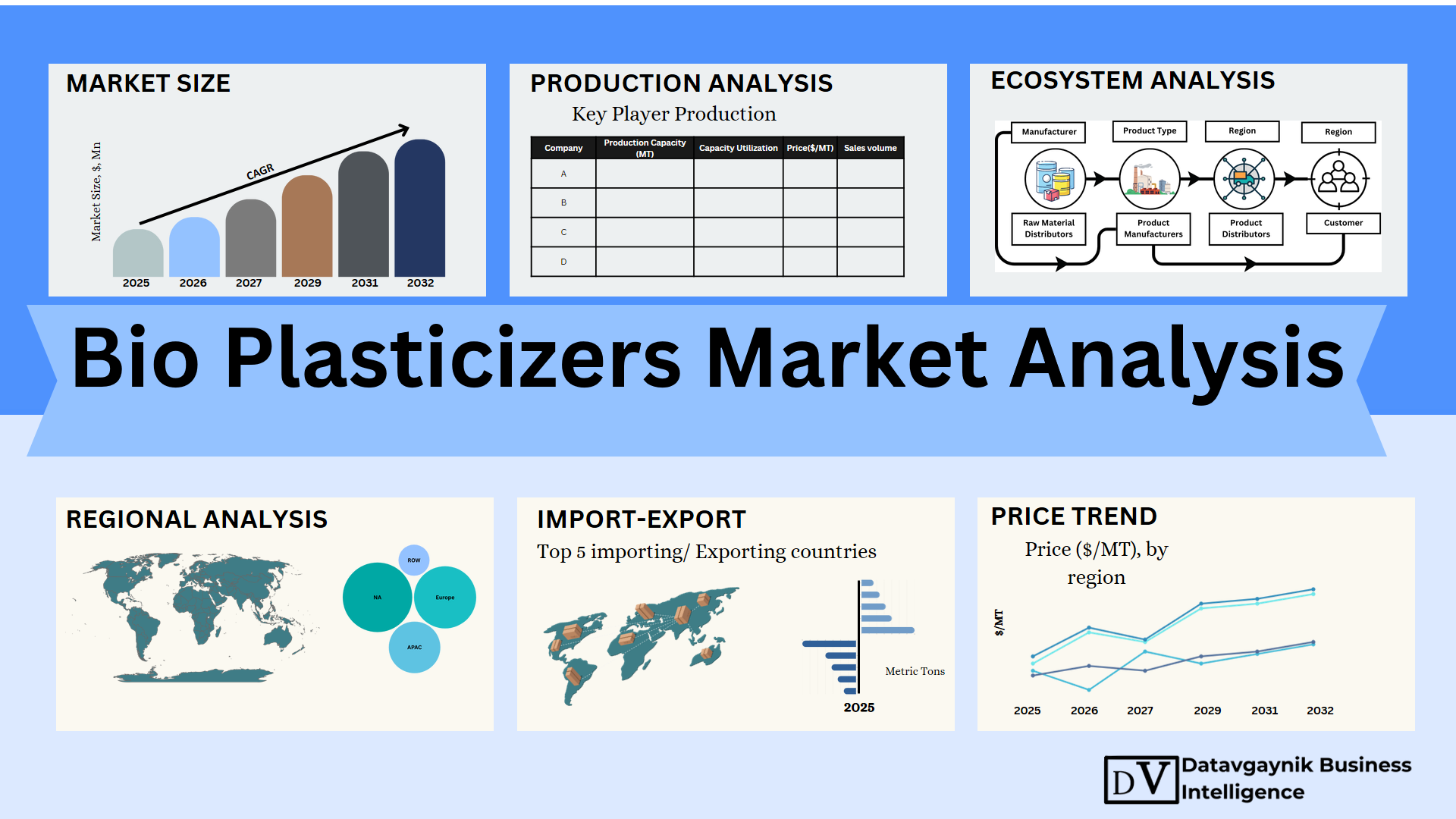
The Bio Plasticizers Market represents the growing ecosystem of renewable, bio-based additives used to improve the flexibility, durability, processability, and performance of plastic materials. These plasticizers are produced from renewable feedstocks such as vegetable oils, bio-based esters, citrates, starch derivatives, and other plant-derived raw materials. They are increasingly being adopted as alternatives to conventional petroleum-based plasticizers, especially in applications where regulatory compliance, sustainability targets, and consumer safety are becoming critical purchasing factors.
In 2026, the market landscape is shaped by the transition toward lower-carbon material solutions across packaging, healthcare, consumer goods, automotive interiors, construction materials, and flexible polymer applications. Manufacturers are focusing on replacing traditional phthalate-based additives due to stricter regulatory scrutiny in several regions. This shift is encouraging polymer producers and compounders to invest in bio-based formulations that maintain performance while improving environmental profiles.
The growth of this market is closely linked with several macro-level developments:
| Market Indicator | Estimated Value (2026) | Forecast Value (2035) |
| Global Bio Plasticizers Market Size | $1,285 million | $2,415 million |
| CAGR (2026–2035) | 7.3% | — |
| Bio-based plasticizer demand share in sustainable polymer additives | Increasing adoption across packaging and consumer applications | Expanding integration across industrial sectors |
Regulatory policies supporting safer chemical usage are among the strongest influences on market development. Regions such as Europe and North America continue to encourage the adoption of alternatives that reduce dependence on restricted chemical substances. At the same time, brand owners are under pressure to improve sustainability reporting, which indirectly increases demand for renewable additives.
Production technology is also evolving. Companies are improving esterification processes, feedstock utilization methods, and formulation techniques to achieve better compatibility with polymers such as PVC, PLA, and other flexible materials. The focus is no longer only on replacing conventional plasticizers but also on delivering equivalent or improved mechanical properties.
The main consumers and clients of bio plasticizers include:
- Flexible PVC manufacturers
- Packaging companies
- Medical device producers
- Automotive component suppliers
- Flooring and construction material manufacturers
- Consumer goods companies
- Polymer compounders and specialty chemical producers
Expert view: The next phase of market expansion will depend on how effectively producers balance sustainability goals with cost competitiveness. Bio-based additives that deliver stable performance at commercial scale are likely to gain stronger acceptance among large polymer users.
Market Segmentation and Forecast Scope
The Bio Plasticizers Market is segmented based on product type, application, end user, and region. Each segment reflects different adoption patterns, influenced by regulatory requirements, polymer compatibility, manufacturing capabilities, and sustainability priorities across industries.
By Product Type
The product landscape is primarily divided into:
- Bio-based epoxidized vegetable oils
- Citrate-based plasticizers
- Bio-based esters
- Succinic acid derivatives
- Other renewable plasticizer formulations
Among these, epoxidized vegetable oils accounted for approximately 34% of the global market share in 2026. These products continue to see strong adoption due to their availability, compatibility with PVC systems, and ability to improve thermal stability in flexible polymer applications.
Citrate-based plasticizers are gaining attention, particularly in food-contact packaging, toys, and medical applications where regulatory acceptance and lower toxicity profiles are important factors. Their growth is supported by increasing demand for safer additive solutions in consumer-facing products.
Example: Flexible packaging producers are increasingly evaluating citrate-based formulations when product safety requirements are more stringent than cost considerations.
By Application
The major application areas include:
- Flexible PVC products
- Packaging films
- Medical and healthcare products
- Automotive interiors
- Flooring and coatings
- Consumer goods
Flexible PVC remains the largest application area, representing nearly 42% share of total demand in 2026. Bio plasticizers are widely used in cables, flooring materials, synthetic leather, and flexible sheets where flexibility and long service life are required.
Packaging is emerging as one of the fastest-growing application segments. The rise of sustainable packaging initiatives among food, beverage, and personal care companies is encouraging manufacturers to explore bio-based additive solutions.
By End User
The market serves multiple industries, including:
- Packaging manufacturers
- Healthcare companies
- Automotive suppliers
- Construction material producers
- Consumer product manufacturers
- Specialty polymer processors
Packaging and healthcare industries are becoming strategic demand centers due to their stronger focus on material safety and environmental compliance. Medical applications, in particular, require plasticizers that meet strict performance and regulatory expectations.
Automotive manufacturers are also increasing interest in renewable polymer additives as vehicle producers aim to reduce material carbon footprints. Bio plasticizers are being evaluated for interior components, wire coatings, and flexible polymer parts.
By Region
The regional segmentation includes:
| Region | Market Characteristics |
| North America | Strong demand driven by sustainable material adoption, regulatory focus, and advanced polymer processing industries |
| Europe | High penetration due to chemical safety regulations and corporate sustainability commitments |
| Asia Pacific | Fastest-growing region supported by expanding manufacturing capacity and rising consumption of flexible polymers |
| LAMEA | Emerging adoption linked with industrial development and increasing environmental awareness |
Asia Pacific is projected to become the fastest-growing regional market during 2026–2035, supported by increasing polymer production, expanding packaging industries, and investments in renewable chemical manufacturing. Countries such as China, India, Japan, and South Korea are becoming important production and consumption centers.
Europe remains a highly influential market due to early adoption of sustainable additives and stricter chemical regulations. The region continues to influence global formulation strategies, especially among multinational polymer and chemical companies.
Forecast Scope Overview
| Segmentation Area | Leading Segment (2026) | Growth Outlook |
| Product Type | Epoxidized vegetable oils | Stable growth due to broad polymer compatibility |
| Application | Flexible PVC products | Largest demand contributor |
| End User | Packaging industry | Rapid adoption through sustainability initiatives |
| Region | Asia Pacific | Highest expansion potential through 2035 |
Expert view: The market opportunity is shifting from simple replacement of conventional plasticizers toward performance-driven renewable solutions. Companies that can offer consistent quality, competitive pricing, and application-specific formulations are likely to secure stronger positions.
Market Trends and Business Innovations
The Bio Plasticizers Market is moving through a phase of product refinement rather than simple substitution. Earlier adoption was mainly driven by regulatory pressure against certain conventional plasticizers. However, current market development is increasingly influenced by performance requirements, carbon reduction targets, and demand for safer materials across consumer and industrial applications.
R&D Evolution in Bio Plasticizer Development
Research activities are focused on improving the efficiency, compatibility, and cost structure of renewable plasticizer solutions. Manufacturers are investing in advanced formulation techniques to enhance properties such as flexibility retention, migration resistance, thermal stability, and polymer compatibility.
Recent R&D efforts are concentrated around:
- Improving bio-based ester production efficiency
- Developing high-performance vegetable oil derivatives
- Enhancing compatibility with PVC and other flexible polymers
- Increasing renewable carbon content in formulations
- Reducing dependence on food-based feedstocks through alternative raw materials
Companies are also exploring second-generation feedstocks, including non-food biomass sources and industrial by-products. This approach may reduce competition between industrial material demand and agricultural resources.
Material Science Advancements
Material science plays an important role in the evolution of bio plasticizers because performance remains a major factor in industrial adoption. Renewable additives must deliver similar or improved mechanical properties compared with traditional plasticizers.
Key areas of innovation include:
- Modified bio-esters with improved low-temperature flexibility
- Hybrid formulations combining multiple renewable components
- Enhanced stabilization systems for longer product life
- Improved compatibility with emerging bio-based polymers
These developments are especially relevant for applications such as medical tubing, flexible packaging, flooring materials, and automotive interiors, where durability and reliability are critical.
Example: A packaging manufacturer shifting toward renewable additives must maintain seal strength, flexibility, and shelf-life performance. This is pushing suppliers to develop application-specific bio plasticizer grades rather than one universal formulation.
Technology Integration and Manufacturing Improvements
Digital technologies are gradually supporting production optimization within the bio plasticizer ecosystem. While artificial intelligence is not yet a primary market driver, some chemical manufacturers are applying data-based process monitoring and predictive analytics to improve production efficiency.
Current technology applications include:
- Process optimization in esterification operations
- Quality monitoring through automated systems
- Supply chain planning for renewable feedstocks
- Formulation simulation for product development
These improvements may help manufacturers reduce production variability and improve commercial scalability.
Industry Partnerships and Business Developments
The market is witnessing increased collaboration between chemical producers, polymer manufacturers, packaging companies, and sustainability-focused organizations. Partnerships are becoming important because successful commercialization requires coordination across the entire value chain.
Key business developments include:
| Business Area | Industry Direction |
| Chemical producers | Expanding renewable additive portfolios |
| Polymer companies | Testing bio-based additives for flexible materials |
| Packaging manufacturers | Increasing demand for sustainable material solutions |
| Research organizations | Developing next-generation renewable feedstocks |
Leading companies active in this space include BASF SE, Avient Corporation, Eastman Chemical Company, Cargill Incorporated, Emery Oleochemicals, and LANXESS AG. These companies are focusing on portfolio expansion, application development, and sustainability-driven product innovation.
Collaborations between bio-feedstock suppliers and specialty chemical manufacturers are expected to become more common as companies seek reliable renewable raw material sources.
Expert view: The competitive advantage in the coming years will not come only from producing bio-based plasticizers. It will come from creating solutions that match industrial performance standards while offering measurable sustainability benefits.
The industry is gradually moving toward customized formulations designed for specific applications. This trend may create opportunities for specialty suppliers that can address niche requirements in healthcare, premium packaging, and advanced polymer applications.
Competitive Intelligence and Benchmarking
The competitive environment of the Bio Plasticizers Market is shaped by chemical manufacturers, renewable material specialists, and companies with strong capabilities in polymer additives. Competition is gradually shifting from basic supply availability toward formulation expertise, renewable feedstock security, and application-specific performance.
Key Market Participants
| Company | Market Position and Strategic Focus |
| BASF SE | BASF SE maintains a strong position in specialty chemicals with a broad portfolio of sustainable additive solutions. The company focuses on improving material performance, regulatory compliance, and renewable-content formulations for industrial customers. |
| Eastman Chemical Company | Eastman Chemical Company has established a strong presence in specialty materials through its focus on safer additive technologies. Its market approach emphasizes high-performance solutions for packaging, healthcare, and consumer applications. |
| Avient Corporation | Avient Corporation operates across polymer solutions and specialty materials. The company supports customers through customized formulations designed for flexibility, durability, and improved environmental performance. |
| Emery Oleochemicals | Emery Oleochemicals is recognized for its renewable chemistry capabilities. The company benefits from expertise in plant-derived raw materials and develops solutions for applications requiring improved sustainability profiles. |
| LANXESS AG | LANXESS AG focuses on specialty chemical innovation and sustainable product development. Its strategy includes expanding environmentally preferred material solutions for industrial applications. |
| Cargill Incorporated | Cargill Incorporated contributes through renewable feedstock expertise and bio-based chemistry capabilities. Its role is strengthened by access to agricultural raw material networks and sustainability-focused initiatives. |
| Matrica S.p.A. | Matrica S.p.A. operates in renewable chemical solutions and supports the transition toward bio-derived industrial materials through research and production capabilities. |
The competitive landscape is becoming more specialized. Large chemical companies benefit from global distribution networks and technical support capabilities, while renewable chemistry specialists often compete through feedstock expertise and sustainability positioning.
Expert view: Future market leadership is likely to depend on three factors: reliable renewable raw material supply, consistent product performance, and the ability to support customers during material transition programs.
Regional Landscape and Adoption Outlook
The adoption of bio plasticizers differs significantly across regions due to variations in regulations, industrial capacity, consumer awareness, and sustainability commitments.
United States
The United States represents a mature market with increasing interest from packaging, healthcare, and consumer product manufacturers. Demand is supported by corporate sustainability goals and growing preference for safer chemical alternatives.
Key factors influencing adoption:
- Strong specialty chemical manufacturing base
- Growing sustainable packaging investments
- Increasing focus on reducing dependency on restricted additives
Companies operating in the United States benefit from advanced polymer processing infrastructure and established research capabilities.
Europe
Europe remains one of the most developed markets for bio plasticizer adoption. Regulatory pressure around chemical safety and environmental performance continues to influence material selection decisions.
Important market factors include:
- Strict chemical compliance requirements
- Strong circular economy initiatives
- High adoption of renewable material strategies
Countries such as Germany, France, Italy, and the Netherlands are among the important innovation centers due to their established chemical industries.
China
China is becoming a major production and consumption center for bio-based additives. The country’s large polymer manufacturing ecosystem provides significant opportunities for market expansion.
Growth factors include:
- Expanding packaging production
- Increasing investment in sustainable manufacturing
- Government support for green industrial development
China’s advantage comes from its manufacturing scale and integrated chemical supply chain.
India
India represents a high-growth opportunity due to expanding packaging, consumer goods, and polymer processing industries.
Key adoption drivers include:
- Growing demand for sustainable materials
- Expansion of domestic chemical manufacturing
- Increasing attention toward environmentally responsible packaging
India may become an important regional production hub as companies look for diversified renewable chemical supply chains.
Japan
Japan has a strong focus on advanced materials and high-performance polymer solutions. Adoption is mainly driven by technology-oriented applications where quality and reliability are critical.
Key strengths include:
- Advanced research ecosystem
- High-quality manufacturing standards
- Strong automotive and electronics industries
South Korea
South Korea’s market development is supported by its advanced chemical sector and strong presence in electronics, automotive, and industrial materials.
Growth areas include:
- Sustainable polymer development
- Specialty material innovation
- Export-oriented chemical production
Middle East
The Middle East market is currently smaller compared with Asia Pacific, Europe, and North America. However, interest is increasing due to diversification strategies and investments in advanced materials.
Countries investing in chemical value-chain expansion may create future opportunities for renewable additive adoption.
Regional Comparison
| Region | Adoption Level | Main Growth Driver |
| Europe | High | Regulation and sustainability targets |
| North America | Medium-High | Corporate sustainability initiatives |
| China | High Growth | Manufacturing expansion |
| India | Emerging Growth | Industrial development and packaging demand |
| Japan | Advanced Adoption | Material innovation |
| South Korea | Growing | Specialty chemical expertise |
| Middle East | Emerging | Industrial diversification |
Recent Developments + Opportunities & Restraints
Recent Developments
March 2025 – BASF SE expanded its sustainability-focused chemical solutions portfolio by highlighting renewable and circular material approaches for industrial applications. The company continued promoting solutions aimed at reducing environmental impact across polymer value chains.
July 2025 – Eastman Chemical Company announced continued investment in sustainable materials development, focusing on advanced material solutions and circular economy strategies.
October 2024 – The European Union continued strengthening sustainability regulations affecting chemical materials and industrial supply chains, encouraging companies to evaluate safer additive alternatives.
February 2025 – Avient Corporation emphasized expansion of sustainable material solutions through innovation programs targeting improved environmental performance.
Opportunities
- Expansion in Sustainable Packaging
The shift toward environmentally preferred packaging materials creates opportunities for bio plasticizer suppliers. Food, personal care, and consumer goods companies are actively reviewing material choices.
- Growth in Emerging Manufacturing Economies
Countries such as India and China provide opportunities due to expanding polymer processing capacity and increasing sustainability awareness.
- Customized Application Solutions
Manufacturers developing application-specific formulations for healthcare, automotive, and premium packaging can capture higher-value opportunities.
Business Restraints
- Higher production costs compared with conventional plasticizers
- Limited availability of certain renewable feedstocks
- Need for consistent performance validation across applications
Expert view: The market opportunity is strong, but commercialization speed will depend on improving cost competitiveness while maintaining technical performance.


