

Market Summary and Growth Forecast
The global Biomass-Derived Plastics for Packaging Market is estimated at $11,850 million in 2026 and is expected to reach $35,920 million by 2035, growing at a CAGR of 13.1%.
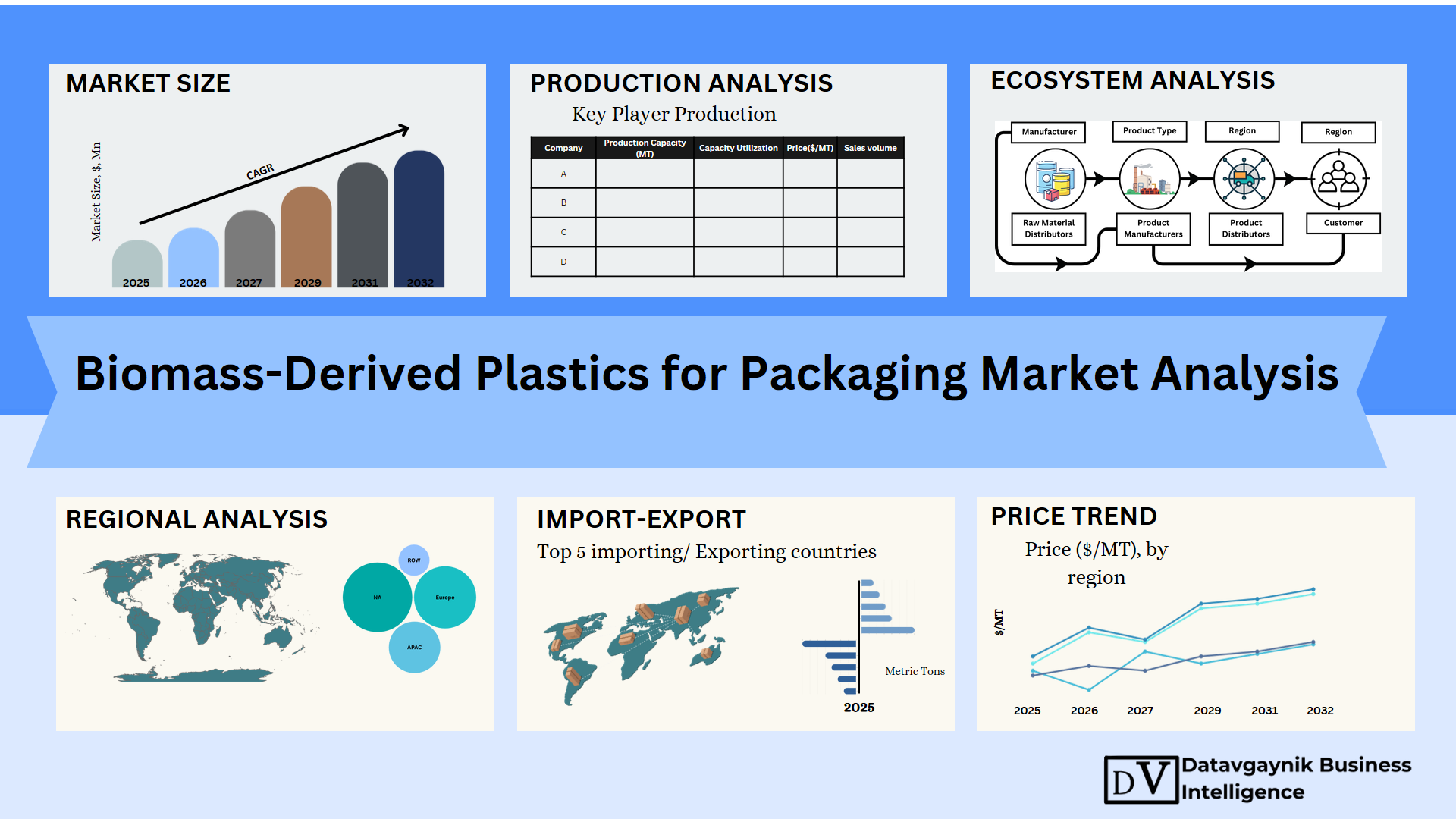
The market covers packaging-grade plastics made fully or partly from renewable biomass feedstocks such as corn sugar, sugarcane, starch, cellulose, vegetable oils, and other bio-based carbon sources. It includes PLA, PHA, starch-based plastics, bio-PE, bio-PET, cellulose-based plastics, PBS-type materials, and emerging PEF-based packaging polymers. The scope includes flexible films, trays, cups, bottles, pouches, compostable bags, liners, coatings, and thermoformed packs. It excludes paper packaging, molded fiber, glass, aluminum, and fossil-only recyclable plastics.
This is no longer a small “green alternative” category. By 2026, the Biomass-Derived Plastics for Packaging Market is becoming a strategic packaging material pool for food brands, retailers, foodservice chains, e-commerce players, and consumer goods companies. The business case is clear. Brands need lower-carbon packaging. Regulators are pushing harder on packaging waste. Consumers may not understand polymer chemistry, but they do understand excess plastic. That pressure is now moving into procurement teams.
A useful indicator comes from global bioplastics capacity data. European Bioplastics reported that global biobased plastics production capacity is forecast to rise from 2.31 million tonnes in 2025 to around 4.69 million tonnes by 2030. Packaging remains the largest application, accounting for 41.3% or about 0.95 million tonnes of global bioplastics production capacity in 2025. That gives this market a real industrial base, not just a sustainability narrative.
Regulation is the second major force. The EU’s Packaging and Packaging Waste Regulation entered into force on 11 February 2025 and will generally apply from 12 August 2026. It pushes packaging design toward recyclability, waste reduction, reuse, and clearer material accountability. This does not automatically favor every bio-based plastic. But it does reward materials that can prove lower-carbon sourcing, credible end-of-life pathways, and fit-for-purpose packaging performance.
| Market Indicator | Analyst Estimate / Scope View |
| Global market size, 2026 | $11,850 million |
| Projected market size, 2035 | $35,920 million |
| CAGR, 2026–2035 | 13.1% |
| Core revenue boundary | Packaging-grade bio-based resins, compounds, films, sheets, bottles, trays, pouches, cups, compostable bags, liners, and coatings |
| Key material families | PLA, PHA, starch blends, bio-PE, bio-PET, cellulose-based plastics, PBS-type materials, emerging PEF |
| Main buyers | Packaging converters, food and beverage brands, foodservice operators, personal care firms, retail chains, e-commerce players, nutraceutical brands, institutional procurement groups |
The strongest consumer base sits in food and beverage packaging, foodservice disposables, compostable bags, premium personal care packaging, and retail-ready flexible packaging. Large brands are not switching everything at once. That would be costly and operationally risky. Instead, they are targeting high-visibility packaging formats first: cups, trays, lids, fresh food packs, snack films, coffee capsules, labels, and lightweight bottle applications.
Expert view: The next phase won’t be won by “bio-based” claims alone. Buyers will ask three practical questions: does it run on existing packaging lines, does it meet food-contact and shelf-life requirements, and can the end-of-life route be defended under regulation? Suppliers that solve all three will capture the best margins.
Market Segmentation and Forecast Scope
The Biomass-Derived Plastics for Packaging Market can be segmented by product type, packaging format, end user, and region. This structure is more useful than a simple biodegradable versus non-biodegradable split because many biomass-derived plastics are not compostable. Bio-PE and bio-PET, for example, behave like conventional polyolefin or PET packaging after use. PLA and PHA sit closer to compostable or biodegradable pathways, depending on grade, formulation, and infrastructure.
By Product Type
PLA remains the most commercially visible material in 2026. It is used in cups, thermoformed trays, lids, coated paper applications, coffee capsules, and films. It benefits from scale, brand recognition, and reasonable processing familiarity. In this market model, PLA accounts for 36.8% of 2026 revenue, making it the leading material family.
PHA is smaller but strategically important. It offers biodegradability advantages and better fit in selected flexible and food-contact applications. The challenge is cost. Scale is still limited. That said, PHA is one of the most watched materials for the 2026–2035 period because it can address some use cases where PLA struggles.
Starch-based plastics and blends are important in compostable bags, loose-fill packaging, disposable serviceware, and low-to-medium performance flexible formats. They compete mainly where cost sensitivity is high and performance requirements are moderate.
Bio-PE and bio-PET are drop-in materials. They matter because they can use existing recycling and packaging infrastructure. For many brand owners, that is a big advantage. The downside is that they do not solve plastic persistence by themselves.
PEF is still emerging, but it deserves attention. It is a plant-based polyester positioned for bottles, films, and higher-barrier packaging. Avantium opened its FDCA flagship plant in Delfzijl in October 2024, with FDCA acting as the key building block for plant-based PEF. The company has continued phased start-up work into 2025–2026.
By Packaging Format
The market spans rigid packaging, flexible packaging, bottles, serviceware, coatings and liners, compostable bags, and specialty packaging components.
Rigid packaging has better early traction because cups, trays, containers, and lids are easier to validate than complex multilayer films. Foodservice chains also like rigid compostable formats because they are visible to consumers.
Flexible packaging is the more difficult prize. Films, wraps, sachets, and pouches require seal strength, barrier performance, heat resistance, machinability, and stable shelf life. This is why innovation is concentrated in BOPLA films, PHA blends, coated structures, and PEF-based barrier concepts.
Bottles and containers remain a strategic niche. Bio-PET has already shown drop-in compatibility. PEF could open a higher-barrier route, especially for beverages and premium liquids, but commercial scale still needs time.
By End User
Food and beverage packaging is the anchor end-use group. It represents 53.5% of 2026 revenue in this model. Demand comes from fresh food trays, beverage cups, deli packaging, confectionery wraps, dry food packs, capsules, lids, and premium branded packaging.
Foodservice and institutional buyers are also important. Quick-service restaurants, cafés, universities, airports, corporate campuses, and event operators need visible alternatives to conventional single-use plastics. Compostable serviceware and bags fit this channel when collection systems exist.
Personal care and home care use biomass-derived plastics for premium positioning. The volume is lower than food packaging, but the willingness to pay can be better.
Pharma, nutraceuticals, and healthcare-adjacent packaging remain selective. These buyers move slowly because packaging must pass stability, safety, and shelf-life requirements.
| Segmentation Dimension | Included Sub-Segments | Strategic Direction, 2026–2035 |
| By Product Type | PLA, PHA, starch blends, bio-PE, bio-PET, cellulose-based plastics, PBS-type materials, PEF | PLA leads today. PHA and PEF show stronger strategic upside. |
| By Packaging Format | Rigid packs, flexible films, bottles, trays, cups, lids, bags, coatings, liners | Flexible films and coated structures will be the harder but higher-value growth zone. |
| By End User | Food and beverage, foodservice, personal care, home care, retail, e-commerce, nutraceuticals | Food and beverage will remain the main adoption engine. Premium personal care will support margins. |
| By Region | North America, Europe, Asia Pacific, LAMEA | Europe leads regulation-led adoption. Asia Pacific gains from production scale and converter expansion. |
Regionally, Europe remains the most policy-driven market. North America is more brand-led, with strong adoption in foodservice, retail, and specialty organic packaging. Asia Pacific is the production and demand scale story, particularly through China, Japan, South Korea, Thailand, and India. LAMEA remains smaller but can grow through foodservice, export packaging, and urban retail channels.
Expert view: The fastest growth will not come from replacing every plastic pack. It will come from specific packaging formats where bio-based materials solve a visible customer or regulatory problem. Fresh food trays, compostable foodservice items, premium personal care packs, and difficult-to-recycle small films are the first real battlegrounds.
Market Trends and Innovation Landscape
The innovation story in the Biomass-Derived Plastics for Packaging Market is shifting from feedstock substitution to performance engineering. Earlier adoption was often built around a simple message: replace fossil carbon with renewable carbon. That message is still useful, but it is not enough for packaging buyers in 2026. The market now wants materials that seal well, run fast, protect products, survive distribution, and meet end-of-life rules.
R&D Evolution
R&D spending is moving into three areas: better film performance, stronger heat resistance, and clearer end-of-life positioning. PLA is a good example. It has strong clarity and a useful sustainability profile, but standard PLA can face limits in heat resistance and film processing. NatureWorks introduced Ingeo Extend 4950D in March 2025, targeting BOPLA film efficiency, faster compostability, high clarity, improved sealing, and better heat resistance for selected film structures.
PHA innovation is focused on flexibility, biodegradation behavior, and blending. PHA can improve the compostable packaging proposition, but cost and scale are still gating factors. That said, if producers can bring cost down and stabilize supply, PHA could move from niche applications into mainstream food-contact films and coated packaging.
PEF is another important innovation lane. It is not just a “bio-based PET replacement.” Its pitch is stronger barrier performance, plant-based carbon, and use in bottles, films, and specialty packaging. Avantium’s commercial FDCA plant is a major signal because FDCA is the platform molecule needed for PEF. The company has also signed packaging-related capacity agreements, including a January 2026 capacity reservation agreement with Packamama for plant-based PEF in sustainable wine packaging.
Technology Evolution
The technology base is becoming more industrial. Fermentation routes are scaling for lactic acid and PHA-type materials. Catalytic conversion routes are advancing for FDCA and PEF. Film producers are also adapting orientation, coating, sealing, and multilayer processing to make bio-based packaging more line-compatible.
Capacity expansion matters here. NatureWorks opened its fully integrated Ingeo biopolymer manufacturing facility in Thailand in April 2026, adding an integrated route from locally sourced sugarcane to lactic acid, lactide, and polymer manufacturing. This supports a more regionalized PLA supply base, especially for Asia Pacific converters and brand owners.
The market is also seeing more recycled-content thinking within bio-based packaging supply chains. TotalEnergies Corbion introduced more sustainable packaging for Luminy PLA in October 2025, including redesigned PLA bags with post-industrial recycled content. This is a small operational detail, but it matters. It shows that bio-based packaging suppliers are being pushed to address circularity within their own packaging systems too.
Material Science Direction
Material science is focused on practical packaging gaps. The most important ones are oxygen barrier, moisture barrier, heat resistance, puncture resistance, sealability, clarity, printability, compostability, and recyclability. No single bio-based plastic solves all of these.
So, the winning approach is likely to be application-specific. PLA will remain strong in clear rigid packs, serviceware, coatings, and selected films. PHA will gain where biodegradation and flexibility matter. Bio-PE and bio-PET will stay relevant where recycling compatibility is the priority. PEF may become important in higher-barrier bottles and premium film applications once supply becomes more available.
Regulation is also shaping the innovation agenda. The EU’s packaging rules are pushing companies to prove recyclability and reduce packaging waste. This creates a stricter environment for vague “eco” claims. A bio-based pack still has to show it works in real collection, recycling, composting, or reuse systems.
| Innovation Area | What Is Changing | Likely Market Impact |
| BOPLA and high-performance PLA films | Improved stretch, sealing, clarity, and heat resistance | Helps PLA move deeper into snack packs, wraps, labels, and small-format food packaging |
| PHA blends | Better flexibility and biodegradation profile | Supports compostable films, coatings, and food-contact packaging where cost permits |
| PEF commercialization | FDCA scale-up and packaging partnerships | Creates a new route for plant-based bottles and high-barrier packaging |
| Bio-based drop-in plastics | Bio-PE and bio-PET use existing polymer systems | Helps brands lower fossil-carbon content without redesigning every packaging line |
| Circularity-focused packaging design | Recyclability, compostability, and recycled-content claims face more scrutiny | Favors suppliers that can document end-of-life performance, not just feedstock origin |
Mergers and partnerships are likely to remain active. Resin producers need converters. Converters need brand commitments. Brands need regulatory comfort. No single company can build this market alone. That is why capacity reservations, co-development deals, packaging trials, and regional supply partnerships will matter as much as polymer chemistry.
Expert view: The market’s innovation filter is becoming simple. Nice material story? Good. But can it protect food, run on existing machines, pass compliance checks, and avoid confusing the waste stream? That is where commercial winners will separate from laboratory winners.
Competitive Intelligence and Benchmarking
The competitive field is split across three groups: large-scale resin producers, specialist biopolymer companies, and technology-led material innovators. No single player controls the full market. That is important. Packaging buyers usually need resin supply, compounding support, converter trials, certification help, and end-of-life guidance. The supplier that can support all of this has a better chance of winning long-term accounts.
NatureWorks holds one of the strongest positions in PLA-based packaging materials. Its portfolio is centered on plant-based PLA grades used in rigid food packaging, cups, lids, thermoformed trays, coatings, films, and foodservice items. The company’s market position is supported by long operating history, technical familiarity among converters, and a broader manufacturing footprint after its Thailand expansion. In packaging, NatureWorks is strongest where clarity, compostability claims, and food-contact processing performance matter.
TotalEnergies Corbion is another major PLA supplier with strong relevance in rigid packaging, films, labels, coatings, and serviceware. Its position is built around integrated production in Thailand, lower-carbon material positioning, and technical grades for heat resistance and conversion. The company is well placed in Europe and Asia because it can speak to both sustainability and industrial reliability. Its market role is less about niche experimentation and more about supplying scalable PLA for converters that need predictable quality.
Braskem competes differently. Its strength is bio-based polyethylene, not compostable plastic. That matters because many packaging users prefer materials that behave like conventional polyethylene and can move through established processing and recycling systems. Braskem is well positioned in bottles, flexible packaging, personal care packaging, retail bags, caps, closures, and consumer goods packs. Its strongest advantage is drop-in compatibility. The limitation is equally clear: bio-PE lowers fossil-carbon dependence, but it does not solve plastic leakage by biodegradation.
Novamont is strongest in compostable starch-based and biodegradable packaging materials. Its packaging reach includes organic waste bags, fruit and vegetable bags, food packaging films, foodservice items, and selected flexible applications. The company’s positioning is especially relevant in Europe, where organic waste collection and composting rules create a stronger pathway for compostable packaging. Novamont is not just selling plastic replacement. It is selling a system fit for food waste diversion.
Avantium is a technology-led player in PEF-related packaging materials. Its commercial relevance is still emerging, but its strategic value is high. PEF can address a different need from PLA or PHA: higher-barrier, plant-based packaging for bottles, films, and premium consumer formats. Avantium is not yet a broad-volume packaging resin supplier at the level of PLA leaders. Still, it is one of the most important companies to watch because PEF could become a premium replacement route in high-barrier applications.
CJ Biomaterials is building a position around PHA-based materials, especially where compostability, biodegradability, paper coating, and foodservice packaging are relevant. Its portfolio direction fits the current search for coatings and flexible packaging materials that move away from conventional polyethylene layers. The company’s market position is still developing, but it has strategic weight because PHA is one of the few material families with strong end-of-life differentiation.
Danimer Scientific, now under Teknor Apex ownership, brings PHA and other renewable polymer know-how into a broader compounding and materials platform. The company has been associated with biodegradable materials for films, coatings, fibers, molded items, and single-use packaging-related applications. Its near-term opportunity is practical: combine PHA chemistry with broader compound development and customer support. That could help packaging converters move from lab-scale interest to commercial trials.
| Company | Core Packaging Material Position | Packaging Strength | Market Benchmark View |
| NatureWorks | PLA-based packaging polymers | Clear rigid packs, films, cups, trays, lids | Scale leader in PLA with strong converter familiarity |
| TotalEnergies Corbion | PLA and high-performance PLA grades | Rigid packaging, films, labels, coatings, serviceware | Strong integrated supplier with low-carbon positioning |
| Braskem | Bio-based polyethylene | Flexible packaging, personal care packs, bags, bottles, closures | Best placed for drop-in bio-based packaging |
| Novamont | Compostable starch-based and biodegradable plastics | Organic waste bags, food bags, foodservice, films | Strong system fit where composting infrastructure exists |
| Avantium | PEF technology and FDCA platform | Bottles, films, high-barrier packaging | Emerging high-barrier challenger |
| CJ Biomaterials | PHA compounds and coatings | Paper coatings, foodservice, compostable packaging | Strategic PHA player with coating focus |
| Danimer Scientific / Teknor Apex | PHA and renewable polymer compounds | Films, coatings, molded packaging items | Specialty player with stronger platform potential after acquisition |
Expert view: Competitive advantage is moving beyond resin capacity. Packaging buyers want a supplier that can help them avoid failure on shelf life, line speed, labeling, certification, and waste-stream fit. That favors technically engaged suppliers over companies offering only a sustainability claim.
Regional Landscape and Adoption Outlook
Regional adoption is uneven. Europe leads on regulation and packaging compliance pressure. Asia Pacific leads on production economics and future capacity. The United States is strong in brand-led trials and state-level policy. Japan and South Korea are more disciplined but slower-moving markets where quality, certification, and corporate procurement matter. India is high-potential but infrastructure-constrained.
| Region / Country | 2026 Market Role | Adoption Outlook, 2026–2035 | Main Growth Logic |
| United States | Large brand-led adopter | Moderate to strong growth | State packaging laws, foodservice pilots, compostable packaging demand, federal procurement signals |
| Europe | Regulation-led leader | Strong growth | PPWR, composting infrastructure, EPR, retailer pressure, mature sustainability procurement |
| China | Scale-driven producer and adopter | Strong growth | Large packaging base, plastic pollution policies, e-commerce packaging pressure |
| India | Emerging high-growth market | Strong but uneven growth | Single-use plastic restrictions, food delivery, retail modernization, low-cost converter base |
| Japan | Quality-led adopter | Moderate growth | National bio-based plastic roadmap, premium packaging, corporate carbon targets |
| South Korea | Technology-led adopter | Moderate to strong growth | Biopolymer production, foodservice innovation, export-oriented packaging firms |
| Middle East | Selective emerging market | Moderate growth | UAE and GCC single-use plastic restrictions, hospitality, aviation, retail, foodservice |
United States
The United States is a large but fragmented adoption market. Demand is driven by foodservice chains, grocery retailers, premium consumer brands, organic food companies, and state-level packaging rules. California is the most influential policy market because its packaging EPR structure affects national packaging decisions. When a large brand redesigns packaging for California, the redesign often influences broader U.S. procurement.
The U.S. also has a credible institutional demand base through federal and state procurement. Bio-based purchasing programs and plastic-reduction strategies create a demand signal for certified materials. That said, composting infrastructure remains patchy. This limits the adoption of compostable plastics outside cities and states with better organics collection. So, drop-in bio-based plastics and recyclable bio-based packaging may see easier national scaling than compostable-only formats.
Europe
Europe is the strongest regulatory market. The Packaging and Packaging Waste Regulation creates a more disciplined packaging environment from 2026 onward. Packaging must be designed with recyclability, waste reduction, reuse, and compliance documentation in mind. This gives Europe a strong role in shaping the next generation of biomass-derived plastics.
Germany, France, Italy, the Netherlands, and the Nordic countries are the most important adoption zones. Italy has a stronger compostable packaging ecosystem because of its bioplastics base and organic waste management links. Germany and the Netherlands are more cautious and technically strict. France has strong pressure around single-use plastics and retail packaging. The net effect is simple: Europe will not accept weak environmental claims. Suppliers need proof.
China
China is a major scale market because of its packaging manufacturing base, e-commerce sector, food delivery volumes, and polymer conversion capacity. Demand is growing in compostable bags, foodservice items, courier packaging, and flexible packaging trials. China also has a role as a production hub for PLA and other bio-based materials.
The main constraint is not demand. It is quality differentiation and credible end-of-life execution. Lower-cost biodegradable alternatives can enter the market quickly, but global brand owners will require traceability, certifications, and stable performance. China’s strongest role through 2035 will be in scaling mid-cost packaging applications and supplying regional converters.
India
India is one of the most attractive long-term growth markets, but the adoption curve will be uneven. Food delivery, quick-service restaurants, modern retail, dairy, bakery, fresh produce, and e-commerce packaging can all support biomass-derived plastics. The national restriction on several single-use plastic items has opened space for alternatives. However, cost sensitivity is high. Composting infrastructure is still limited. Enforcement also varies by state and city.
The most realistic growth will come from compostable bags, foodservice items, carry bags, produce packaging, and premium urban retail formats. Indian converters may also become important exporters to the Middle East, Europe, and North America if they can meet certification and food-contact requirements.
Japan
Japan is a quality-led market. It is not the fastest in volume, but it is important for disciplined adoption. The country’s roadmap for bioplastics targets broader use of bio-based plastic products by 2030. Packaging adoption is strongest where material performance, brand reputation, and carbon accounting align. Retail, convenience food, beverages, personal care, and premium consumer goods are relevant channels.
Japanese buyers will likely favor materials with reliable processing, high clarity, clean documentation, and established supplier credibility. Bio-PE and bio-PET have a practical fit because they allow lower disruption in packaging systems. PLA and PHA will grow in selected foodservice and compostability-linked formats.
South Korea
South Korea’s market is supported by material science capability, large consumer brands, foodservice activity, and export-oriented packaging companies. The presence of PHA-related innovation gives the country strategic relevance beyond domestic demand. South Korean packaging players are also well placed to supply Japan, Southeast Asia, and North America with higher-spec sustainable packaging formats.
Adoption will be strongest in foodservice coatings, premium consumer packaging, films, and export-ready materials. The market will remain performance-focused. A material has to look good, run well, and meet customer compliance needs.
Middle East
The Middle East is relevant, but still selective. The UAE is the leading adoption market because of hospitality, aviation, tourism, retail, and foodservice demand. Single-use plastic restrictions in the UAE are pushing restaurants, hotels, retailers, and distributors toward compliant alternatives. Saudi Arabia is also important, but its packaging regulatory pathway has historically focused more on degradability and specific technical compliance than broad bioplastics adoption.
The region will rely heavily on imports and regional converters. India, China, Europe, and Southeast Asia can all supply this demand. Growth will be strongest in foodservice packaging, retail bags, hotel amenities, aviation catering, and premium event packaging.
Expert view: The regional story is not simply “Europe first, Asia next.” Europe sets the rules. Asia builds scale. The U.S. tests brand-led adoption. India and the Middle East create cost-sensitive volume opportunities. The winners will adapt product claims, pricing, and certification by region rather than selling one global story.
Recent Developments + Opportunities & Restraints
Recent Developments
| Year / Month | Event | Strategic Relevance |
| 2026 – April | NatureWorks opened a fully integrated PLA biopolymer facility in Thailand. | Strengthens Asian PLA supply and reduces overdependence on single-region production. |
| 2026 – January | Avantium updated the start-up plan for its FDCA flagship plant in the Netherlands, with sales expected after completion of start-up. | Supports the commercial pathway for PEF, a plant-based polymer suited to bottles and high-barrier packaging. |
| 2025 – October | CJ Biomaterials launched a PHA platform for extrusion coatings used in foodservice and food packaging applications. | Shows growing focus on replacing conventional coating layers in paper and board packaging. |
| 2025 – October | Braskem introduced new bio-based polymer grades at K 2025, including specialty bio-based polyethylene developments. | Supports broader use of drop-in bio-based materials in packaging-adjacent and hygiene-related applications. |
| 2025 – February / 2026 application phase | The EU’s new Packaging and Packaging Waste Regulation entered into force in February 2025 and applies broadly from August 2026. | Raises compliance pressure for packaging design, recyclability, waste reduction, and material accountability. |
Opportunities & Business Insights
Opportunity 1: Emerging markets can create volume, but only at the right price.
India, China, Southeast Asia, and the Middle East offer strong packaging demand. Food delivery, retail modernization, and single-use plastic restrictions are pushing buyers toward alternatives. Still, buyers will not pay a large premium in mass-market channels. Suppliers need affordable blends, local compounding, and converter partnerships.
Opportunity 2: Foodservice packaging is the fastest practical adoption lane.
Cups, trays, lids, cutlery, food containers, coatings, and compostable bags are easier to communicate to consumers than invisible flexible packaging layers. This gives restaurants, hotels, airports, and institutional buyers a clean sustainability story. The catch is collection. Compostable packaging performs commercially only when disposal systems are credible.
Opportunity 3: Productivity gains will come from processing support, not AI alone.
AI is not a core market driver here. It can help in formulation screening, quality control, demand planning, and packaging line optimization. But the bigger productivity lever is more practical: materials that run on existing extrusion, thermoforming, coating, and filling lines with fewer defects and less downtime.
Restraints
Restraint 1: Price premium remains the biggest adoption barrier.
Bio-based packaging materials are often more expensive than fossil-based alternatives. Brands may accept the premium in premium food, personal care, and visible sustainability applications. They are less willing in commodity packaging.
Restraint 2: End-of-life confusion can slow procurement.
Bio-based does not always mean biodegradable. Compostable does not always mean home-compostable. Recyclable does not always mean collected and recycled. This confusion makes legal, sustainability, and procurement teams cautious.
Restraint 3: Infrastructure gaps limit compostable packaging.
Many markets lack industrial composting capacity and clear collection systems. Without that infrastructure, compostable packaging can end up in landfill or contaminate recycling streams. This weakens the value proposition.
Expert view: The Biomass-Derived Plastics for Packaging Market will not grow evenly across all formats. It will grow where sustainability claims meet operational logic. Cost, line speed, compliance, and disposal infrastructure will decide adoption more than branding language.


