

Market Summary and Growth Forecast
The global Boron Nitride Lubricants for High-Temperature Applications Market is estimated at $178 million in 2026 and is expected to reach $323 million by 2035, growing at a CAGR of 6.8%.
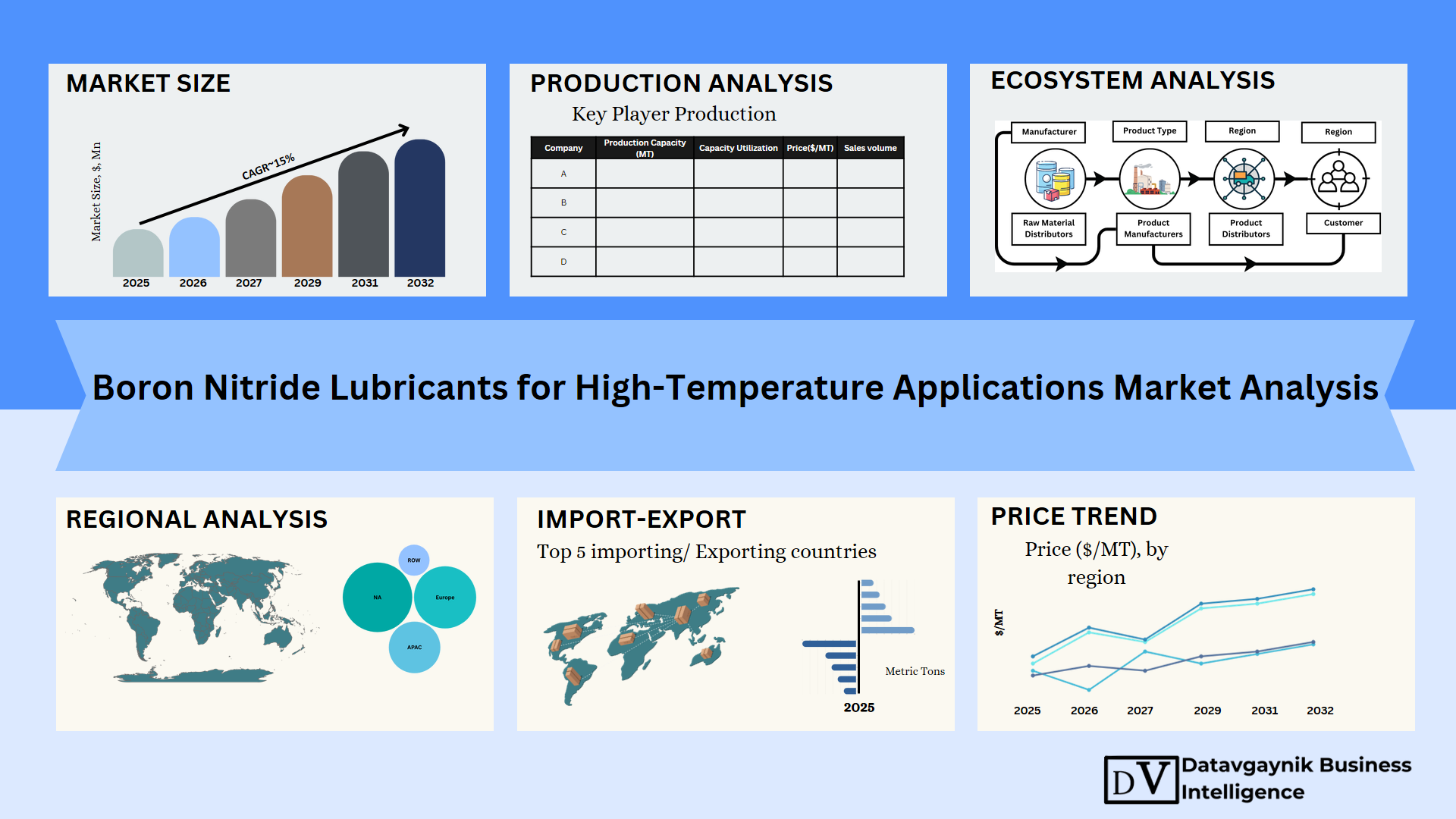
This market covers high-temperature lubricant systems based on hexagonal boron nitride, or h-BN. These include dry powders, aqueous coatings, aerosol sprays, pastes, dispersions, and release-agent formulations used where conventional oils, graphite, PTFE, silicone fluids, or molybdenum disulfide cannot hold performance under extreme heat. The core value sits in three functions: friction reduction, anti-stick release, and surface protection.
Datavagyanik also covers related markets such as the Boron Nitride Market, the Boron Nitride Nanotubes Market, and the Fluorinated Lubricants for Space Applications Market. These materials are considered in high-temperature and specialty chemical environments, where glass production, catalysis, and safety regulations influence adoption patterns.
In 2026, the market is still a specialized materials business rather than a mass-volume lubricants category. Demand is tied to hot metal processing, aluminum die casting, glass forming, ceramics, aerospace forming, specialty furnace operations, and high-temperature industrial tooling. The business case is simple. BN-based lubricants reduce die pickup, improve demolding, lower residue formation, and extend tool life. For customers, that means fewer rejected parts and less downtime.
For 2026–2035, the market should benefit from a steady shift toward cleaner and more durable release systems. Boron nitride coatings are already positioned as high-temperature protection and release materials for metal forming, aerospace, polymer engineering, and other industrial markets. Technical suppliers highlight BN’s low friction, oxidation resistance, chemical stability, and use as a lubricant additive or release agent in demanding environments.
A key material advantage is temperature stability. Some BN coating systems are marketed for use up to 1,000°C in oxidizing atmospheres and higher under vacuum or inert gas conditions. That keeps BN relevant in aluminum casting, glass forming, superplastic forming, hot pressing, and molten metal handling.
The Boron Nitride Lubricants for High-Temperature Applications Market is being shaped by four macro forces:
First, aluminum and light-metal processing is becoming more demanding. EV platforms, aerospace structures, heat exchangers, and lightweight industrial parts are increasing the need for cleaner die release and better mold protection. Global electric car sales crossed 17 million units in 2024, and IEA expected sales to exceed 20 million units in 2025. This matters because EV manufacturing uses more thermally demanding forming, casting, and battery-adjacent materials processes.
Second, foundries and metal processors are under pressure to cut scrap. BN lubricants are not bought only for lubrication. They are bought to avoid stuck parts, surface defects, die wear, and furnace contamination. In aluminum and magnesium casting, even a small reduction in rejected components can justify the higher price of BN-based release agents.
Third, coating formulation is moving toward water-based systems. Industrial buyers are more cautious about solvent exposure, VOCs, shop-floor safety, and residue. BN itself is generally valued for chemical inertness and non-staining behavior. The formulation around it is now the differentiator: dispersion stability, binder chemistry, film adhesion, sprayability, and residue control.
Fourth, supply quality is becoming more important. Customers need controlled particle size, purity, platelet morphology, and dispersion performance. Saint-Gobain’s technical notes, for example, emphasize particle morphology, suspension stability, adhesion, and consistent coverage in foundry environments. These are not cosmetic improvements. They decide whether a coating lasts one cycle or many.
Key consumers and clients include:
- Aluminum die-casting companies
- Automotive component manufacturers
- Aerospace forming and fabrication suppliers
- Glass forming and optical glass manufacturers
- Ceramic component manufacturers
- Steel and non-ferrous metal processors
- Furnace equipment users
- Specialty coating formulators
- Advanced lubricant blenders
- Industrial maintenance teams handling high-temperature tooling
In revenue terms, the market should add roughly $145 million between 2026 and 2035. Growth will not come from broad lubricant replacement. It will come from premium conversion in hot zones where normal lubricant chemistry fails. So, adoption will remain application-led. Once a plant proves lower scrap or longer die life, repeat demand becomes sticky.
| Metric | Estimate |
| Global market size, 2026 | $178 million |
| Projected market size, 2035 | $323 million |
| Forecast CAGR, 2026–2035 | 6.8% |
| Absolute growth, 2026–2035 | $145 million |
| Core demand base | Metal forming, casting, glass forming, ceramics, aerospace, furnace tooling |
| Most strategic demand theme | Cleaner high-temperature release systems for precision manufacturing |
Market Segmentation and Forecast Scope
The segmentation model for the Boron Nitride Lubricants for High-Temperature Applications Market should be built around how the material is purchased and why it is used. This is not a single-product market. A foundry buying a spray can has a very different buying pattern from an aerospace supplier using a controlled BN coating on forming tools.
By Product Type
Powder-based BN lubricants
This includes h-BN powders used directly for dry lubrication or as a functional additive in grease, paste, coating, and dispersion systems. Powder demand is strongest where formulators want control over binder selection, loading ratio, viscosity, and film behavior. It is also used by technical ceramic and lubricant companies that develop proprietary products.
Water-based BN coatings
This is the most strategic product category for industrial users. Water-based systems are easier to align with plant-level environmental and worker-safety requirements. They are used on dies, molds, refractory linings, glass tools, ceramic fixtures, and molten metal handling surfaces. In 2026, water-based BN coatings are estimated to account for 38% of market revenue. This share should rise through 2035 because customers want cleaner application and lower solvent exposure.
Solvent-based BN coatings and aerosols
These products remain useful where fast drying, convenience, thin-film coverage, or field maintenance matters. Aerosols are common in smaller batch operations, maintenance workshops, glass art and specialty forming, and precision demolding tasks. However, growth is likely to be slower than water-based coatings because large industrial buyers are more cautious about solvent systems.
BN pastes and dispersions
These are higher-value formulations used in localized lubrication points, severe thermal cycling, anti-seize applications, and controlled-contact surfaces. They are not always high-volume products, but margins can be attractive because performance requirements are specific.
By Application
Metal forming and die casting
This is the largest application cluster. It includes aluminum casting, magnesium casting, hot extrusion, forging, superplastic forming, rolling-contact tooling, and molten metal interfaces. BN coatings help prevent metal adhesion and protect molds. In 2026, metal forming and die casting are estimated to hold 44% of market revenue. This segment should remain the anchor demand pool through 2035.
Glass forming and optical glass molding
BN lubricants are used to reduce sticking, improve release, and protect mold surfaces in high-temperature glass processing. Growth is supported by precision glass, display-related components, laboratory glass, specialty optics, and technical glass products. The volume base is smaller than metal forming, but the value per application is high.
Ceramics and refractory processing
This includes ceramic setter plates, crucibles, kiln furniture, furnace tools, and refractory components that need anti-stick or protective layers. BN’s chemical inertness gives it a clear role in aggressive processing environments.
Aerospace and advanced manufacturing
Aerospace uses are more selective but strategically important. BN-based lubricants support hot forming, composite tooling support, high-temperature fixtures, and specialty metal processing. The qualification cycle is longer, but once approved, demand tends to be stable.
Industrial furnace and maintenance applications
This includes protective coatings for furnace parts, high-temperature sliding surfaces, insulation components, and equipment exposed to molten salts, slags, or glass. The buying pattern is maintenance-driven and often linked to plant reliability.
By End User
Foundries and die-casting plants
These users buy BN lubricants to protect dies, improve release, and reduce production stoppages. Aluminum die casting is especially relevant because molten aluminum can stick to tooling and shorten die life.
Automotive and EV component suppliers
Demand is tied to structural aluminum parts, battery housings, motor components, heat-management parts, and high-volume die-cast components. EV growth does not directly create BN lubricant demand in every case. Still, it increases the number of heat-intensive manufacturing routes where release agents matter.
Aerospace manufacturers
These users focus on performance stability, repeatability, and material compatibility. Price sensitivity is lower when the lubricant supports part quality or protects expensive forming tools.
Glass and ceramics manufacturers
These users need clean release, low contamination, and high thermal reliability. This group is one of the better fits for premium BN coatings.
Maintenance, repair, and operations teams
MRO demand is fragmented but consistent. It includes aerosol sprays, small-batch coatings, and specialized pastes used in plants handling hot tooling or furnace systems.
By Region
North America
North America is a premium demand region. Aerospace, defense, aluminum die casting, specialty glass, and advanced manufacturing support steady consumption. The region also has a strong base of specialty coating users and technical lubricant formulators.
Europe
Europe is driven by automotive lightweighting, aerospace, industrial ceramics, and stricter environmental expectations around plant operations. Water-based BN coatings should gain share faster here than in many other regions.
Asia Pacific
Asia Pacific is the largest and fastest-growing region. China, Japan, South Korea, and India are important demand centers because of metal processing, electronics manufacturing, industrial ceramics, automotive components, and expanding manufacturing capacity. Asia Pacific is estimated to hold 41% of global revenue in 2026.
LAMEA
LAMEA demand is smaller but improving. The Middle East has aluminum and industrial furnace exposure. Latin America contributes through foundry, automotive, mining equipment, and industrial repair applications. Africa remains a limited but long-term opportunity through industrial processing and maintenance demand.
In the Boron Nitride Lubricants for High-Temperature Applications Market, the fastest-growing pockets should be water-based BN coatings, aluminum die-casting applications, and Asia Pacific industrial users. The most strategic sub-segment is not necessarily the largest one. It is the water-based coating segment because it connects performance, safety, and sustainability in one purchase decision.
| Segmentation Dimension | Key Sub-Segments | Strategic View |
| By Product Type | Powders, water-based coatings, solvent-based coatings/aerosols, pastes/dispersions | Water-based coatings should gain share due to plant safety and cleaner processing needs |
| By Application | Metal forming, glass forming, ceramics, aerospace, furnace maintenance | Metal forming and die casting remain the largest revenue base |
| By End User | Foundries, automotive suppliers, aerospace manufacturers, glass/ceramic producers, MRO teams | Automotive and EV component suppliers create strong downstream pull |
| By Region | North America, Europe, Asia Pacific, LAMEA | Asia Pacific leads on scale and growth |
Market Trends and Innovation Landscape
Innovation in the Boron Nitride Lubricants for High-Temperature Applications Market is moving from basic BN content toward full formulation engineering. Buyers no longer ask only whether a coating contains BN. They ask how long the film lasts, whether it sprays evenly, whether it contaminates the part, and whether it can survive thermal cycling without flaking.
R&D Evolution
The main R&D direction is particle control. Suppliers are improving platelet size, agglomeration behavior, purity, surface area, and dispersion stability. This matters because BN’s lubricity comes from its layered crystal structure. If particles clump, settle, or apply unevenly, the final coating can fail early.
Saint-Gobain has highlighted the role of particle shape, size distribution, and surface characteristics in improving BN coating adhesion, suspension stability, and coverage for foundry environments. That points to where the market is heading: engineered morphology rather than commodity powder loading.
The second R&D track is binder chemistry. A BN lubricant coating has to do more than deposit white powder on a surface. It must adhere during preheating, resist thermal shock, maintain release performance, and come off predictably when the process requires cleaning. This is pushing suppliers toward hybrid water-based systems, ceramic binders, and formulations that reduce dusting.
The third R&D track is formulation customization. A BN coating for glass forming is not the same as a BN lubricant for aluminum die casting. Glass users may care more about surface cleanliness and optical defects. Foundries care about release, soldering prevention, and die life. Aerospace users care about repeatability and process qualification.
Technology Evolution
The strongest technology shift is from simple release agents to application-specific coating platforms. ZYP coatings are positioned for anti-stick and high-temperature release in glass molds and related applications up to 1,000°C, while Pyrotek’s ZYP product information points to BN coating formats including water-based, solvent-based, and aerosol products.
A second shift is toward higher-use-temperature and cleaner residue systems. Traditional graphite works in many hot environments, but it can leave dark staining and may not suit electrically sensitive or chemically reactive settings. BN is often preferred where non-staining behavior, electrical insulation, and chemical inertness matter. Saint-Gobain describes BN as low-friction, non-abrasive, oxidation-resistant, chemically stable, and useful as a release agent or lubricant additive.
A third shift is toward multi-functionality. BN lubricants are being used not only for friction control but also for anti-wetting, barrier protection, thermal stability, and surface quality control. This broader value proposition supports premium pricing.
Material Science Direction
Material science is central to this market. Hexagonal BN behaves like “white graphite” because of its layered structure. The layers can slide over one another, which creates lubricity. But unlike graphite, BN can remain useful in cleaner and more electrically insulating systems. Denka describes hexagonal boron nitride powder as offering thermal conductivity, heat and corrosion resistance, electrical insulation, and lubrication/demolding performance. It also notes BN coating agents for heat-resistant demolding of metal and glass.
The next phase is functionalized BN. Surface-treated powders can disperse better in water, binders, oils, polymers, or hybrid coating systems. This is important because poor dispersion causes settlement, clogging, uneven coating thickness, and inconsistent release. Saint-Gobain’s collaboration with Haydale Group on advanced surface chemistries for BN powders is a relevant signal. It shows that suppliers are trying to move BN from a raw particle into a more engineerable formulation ingredient.
Mergers, Partnerships, and Announcements
Recent activity is more about technical collaboration and product-line refinement than large-scale consolidation. Saint-Gobain Boron Nitride and Haydale Group entered into a collaboration to develop advanced surface chemistries for BN powders. This is important because surface modification could improve dispersion and allow BN to work more reliably in high-performance coating and lubricant systems.
Saint-Gobain Boron Nitride has also promoted newer BN coating developments, including CeraGlide Azure, as part of its boron nitride coatings portfolio. This indicates continued product-level innovation in applied coatings rather than only powder sales.
Denka continues to position BN powder and BN coating agents around heat resistance, corrosion resistance, electrical insulation, lubrication, and demolding. This supports the view that Asian suppliers will remain important in high-purity BN materials and coating-agent demand.
Expert view: The market’s next competitive edge will not be “who has BN.” It will be “who can make BN stay dispersed, apply evenly, survive heat, and release cleanly.” That is where formulation know-how becomes more valuable than raw material access.
Expert view: In the Boron Nitride Lubricants for High-Temperature Applications Market, water-based engineered coatings may become the main premium battlefield by 2030. Plants want the performance of ceramic release systems without the handling burden of older solvent-heavy products.
Use case/example: An aluminum die-casting plant using BN coating on high-wear die areas may see fewer stuck parts, cleaner casting release, and longer intervals between die cleaning. The material cost is higher than standard release agents, but the economics can work when downtime and scrap are included.
Overall, innovation is making BN lubricants more application-specific. The category is moving away from generic high-temperature lubrication and toward engineered surface management. That shift should support premium pricing across 2026–2035.
Competitive Intelligence and Benchmarking
The competitive base is concentrated around specialty ceramics companies, advanced material suppliers, and niche coating formulators. This is not a commodity lubricant market. Winning depends on boron nitride purity, dispersion stability, binder chemistry, field support, and the ability to tune coatings for aluminum, glass, ceramic, and furnace conditions.
Saint-Gobain Boron Nitride
Saint-Gobain Boron Nitride is one of the strongest benchmark players in this space. Its portfolio covers BN powders, aqueous coatings, machinable ceramics, and lubricant additives. The company’s coating line is positioned for high-temperature protection, lubrication, and release across metal forming, aerospace, polymer engineering, and refractory applications. Its BN coatings are built around high-purity BN powder and high-temperature bond phases. The company also emphasizes improved dispersion and coating consistency, which matters in automated or robotic application settings.
Its market position is premium. It competes on application engineering rather than low price. In aluminum casting, launders, ladles, graphite tooling, and refractory protection, Saint-Gobain Boron Nitride has a strong fit because customers value coating life and predictable release.
Momentive Technologies
Momentive Technologies is another important player in high-performance BN materials. Its boron nitride offering is positioned around lubrication, friction reduction, release performance, and protection against molten metal interaction. The company highlights use in metal processing, plastic and rubber processing, CMP pad additives, and protective coating applications.
Its strength sits in advanced material credibility and technical formulation support. In this market, Momentive Technologies is best placed with customers that already buy engineered ceramics, thermal materials, and specialty additives. Its position is less “foundry-only” and more cross-functional across industrial, polymer, and metal-processing users.
Denka Company Limited
Denka Company Limited supplies hexagonal boron nitride powder and BN coating agents. The company positions h-BN around thermal conductivity, heat and corrosion resistance, electrical insulation, lubrication, and demolding performance. It also notes BN coating agents for heat-resistant demolding of metal and glass.
Denka Company Limited is strategically relevant because Japan has a deep base in advanced ceramics, electronics materials, and precision manufacturing. Its market role is stronger in powders and material inputs than in mass-market finished lubricant brands. That gives it an important upstream position for formulators and OEM-qualified applications.
Henze Boron Nitride Products AG
Henze Boron Nitride Products AG is a specialist supplier focused only on boron nitride products. Its portfolio includes BN sintered products, coatings, fillers, and lubricants. The company highlights more than 30 years of specialization in hexagonal boron nitride products and manufactures from Lauben, Germany. It also states that its quality and environmental management systems are certified under ISO 9001 and ISO 14001.
Its competitive position is strong in Europe and in customized high-temperature process solutions. Henze Boron Nitride Products AG is especially relevant for customers that need tailored BN coating behavior rather than a catalog-only product. Its water- and ethanol-based BN coatings are used as release and lubricating agents at high temperatures.
ZYP Coatings / Pyrotek
ZYP Coatings is a focused BN coating supplier, while Pyrotek acts as an important channel into molten metal applications. Pyrotek describes ZYP Coatings as a world leader in boron nitride coatings and notes its specialization in paintable high-temperature ceramic refractory coatings.
Its market position is practical and application-led. In foundries, aluminum handling, glass forming, and ceramic molds, users often care about ease of application as much as chemistry. ZYP Coatings is well placed in aerosol, brushable, and paintable formats. Its aerosol BN mold-release product is positioned for thin and uniform coating at temperatures up to 1,000°C.
3M
3M participates more as a high-performance BN filler and formulation-enabling supplier than as a pure BN lubricant coating company. Its BN cooling filler portfolio is positioned around thermal conductivity, electrical insulation, high-temperature resistance, dry lubrication, and gentle processing behavior in compounding, extrusion, and injection molding.
For this market, 3M is relevant in adjacent lubricant-additive and polymer-processing routes. It has strong material science credibility and deep application engineering. Its best fit is not basic mold release. It is engineered systems where BN contributes lubricity, thermal control, and electrical insulation in one formulation.
Miller-Stephenson
Miller-Stephenson is a niche but visible player in mold-release chemistry. Its BN mold-release spray is positioned as a high-temperature dry-film aerosol with low odor, low VOC, zero outgassing, and clean release behavior. The company also emphasizes reduced fouling, cleaner parts, and improved release count per application.
Its position is strongest in application convenience. Customers that want a ready-to-use BN release spray for molds, specialty forming, composites, or lower-volume industrial use may prefer this format over bulk coatings or powder blends.
| Company | Core Product Focus | Market Position | Best-Fit Applications |
| Saint-Gobain Boron Nitride | BN powders, aqueous coatings, machinable ceramics, lubricant additives | Premium global benchmark with strong application engineering | Aluminum casting, refractory protection, aerospace, metal forming |
| Momentive Technologies | BN powders, lubricant additives, release and protective material systems | Advanced materials supplier with cross-industry reach | Metal processing, polymer processing, friction reduction |
| Denka Company Limited | h-BN powder and BN coating agents | Strong Japanese materials supplier with upstream credibility | Metal/glass demolding, electronics-linked materials, ceramics |
| Henze Boron Nitride Products AG | BN coatings, fillers, lubricants, sintered products | Specialist European supplier with customization strength | High-temperature coating, aluminum casting, specialty tooling |
| ZYP Coatings / Pyrotek | Paintable and aerosol BN coatings | Application-focused player in molten metal and mold release | Foundry, glass forming, ceramic molds, refractory surfaces |
| 3M | BN fillers and formulation additives | Strong adjacent player in engineered BN materials | Polymer processing, thermal compounds, dry lubrication additives |
| Miller-Stephenson | BN dry-film mold-release sprays | Niche high-performance release-agent supplier | Mold release, composites, specialty forming, MRO use |
The competitive benchmark is clear. Large players win on material quality and global technical support. Specialists win on process fit. For the Boron Nitride Lubricants for High-Temperature Applications Market, the strongest suppliers will be those that can combine BN purity with stable coating behavior and easy plant-level application.
Regional Landscape and Adoption Outlook
Regional adoption is tied to where high-temperature manufacturing is concentrated. The strongest demand pools are not simply the largest lubricant markets. They are regions with aluminum casting, EV manufacturing, aerospace forming, glass processing, advanced ceramics, and high-temperature industrial maintenance.
| Region / Country | Estimated 2026 Revenue Share | 2035 Growth Outlook | Main Adoption Base |
| United States | 21% | Moderate to strong | Aerospace, defense, aluminum die casting, specialty glass, industrial MRO |
| Europe | 24% | Moderate | Automotive lightweighting, aerospace, industrial ceramics, aluminum processing |
| China | 25% | Strong | EV die casting, metal processing, electronics materials, ceramics |
| India | 6% | Fast | Automotive components, aluminum foundries, industrial manufacturing, MRO |
| Japan | 9% | Stable to moderate | Precision ceramics, electronics materials, glass, high-spec manufacturing |
| South Korea | 5% | Moderate to strong | Electronics, EV supply chain, advanced materials, precision manufacturing |
| Middle East | 4% | Selective but improving | Aluminum smelting, metal processing, furnace systems, industrial maintenance |
| Other markets | 6% | Niche | Latin America, Southeast Asia, Africa, and other industrial users |
United States
The United States is a premium adoption region. Demand comes from aerospace, defense, aluminum die casting, automotive components, specialty glass, high-temperature tooling, and industrial MRO. The country has fewer low-cost foundry users than Asia, but the value per application is higher. Buyers care about repeatability, qualification, worker safety, and lower scrap.
The United States also benefits from reshoring trends in semiconductor, defense, aerospace, and advanced manufacturing. BN lubricants are not always a direct beneficiary of semiconductor spending. Still, the broader move toward high-spec materials and domestic process control improves the adoption environment.
The fastest-growing demand pockets should be aerospace forming, aluminum EV parts, and high-temperature mold release. Water-based BN coatings should gain share as plants seek cleaner release systems and lower residue.
Europe
Europe is a quality-led market. Germany, France, Italy, the United Kingdom, and the Nordic manufacturing base are the key users. Demand is supported by automotive lightweighting, aerospace, specialty glass, advanced ceramics, and aluminum processing.
Regulation matters more in Europe than in most regions. Buyers are more sensitive to VOC exposure, worker safety, sustainability documentation, and low-carbon manufacturing narratives. European industry groups have also pushed for low-carbon aluminum recognition in vehicle CO₂ regulation, which reinforces the role of aluminum in future vehicle platforms.
For BN lubricant suppliers, this means Europe will be less forgiving of weak formulation quality. Products need cleaner application, stable documentation, and consistent process performance. Germany is the most important country-level demand center because of automotive, industrial machinery, and specialty materials capacity.
China
China is the largest growth engine. Demand comes from EV manufacturing, high-pressure die casting, electronics materials, industrial ceramics, non-ferrous metal processing, and large-scale manufacturing. China’s EV and automotive export growth is important because it raises the need for aluminum structural parts and process-stable casting systems. The IEA reported that electric car sales topped 17 million globally in 2024, with China exceeding 11 million sales. In 2025, electric car sales topped 20 million globally.
This is relevant for BN lubricants because large aluminum casting cells and hot tooling systems need better release and anti-stick solutions. BN adoption is strongest where die life, part finish, and production uptime are critical.
China also has domestic BN powder suppliers and formulators. That creates price pressure. Premium imported products will still find demand in high-spec applications, but local suppliers should gain share in general-purpose release coatings.
India
India is a smaller market today, but it is one of the fastest-growing adoption regions. The base is automotive components, aluminum foundries, die casting, electrical equipment, glass, ceramics, and industrial maintenance. India’s PLI-Auto Scheme has a budgetary outlay of ₹25,938 crore for FY2022–23 to FY2026–27, aimed at advanced automotive technology products and deeper localization. As of December 2024, companies under the scheme had committed over ₹25,000 crore in capital investment.
That policy environment matters. More localized EV and advanced auto-component manufacturing should raise demand for better tooling consumables, including high-temperature release systems. That said, price sensitivity remains high. BN adoption will first expand in export-oriented foundries, EV component suppliers, and plants serving multinational customers.
Japan
Japan has a mature but technically advanced demand profile. Its strengths are high-purity materials, precision ceramics, electronics materials, glass, automotive components, and controlled manufacturing environments. The country is also home to important BN material suppliers such as Denka Company Limited.
Growth will be slower than China or India, but the market is valuable. Japanese customers are more likely to pay for purity, consistency, and long qualification cycles. BN lubricants here fit into high-performance demolding, glass processing, ceramic tooling, and specialty industrial applications.
South Korea
South Korea is a focused growth market. Demand is tied to electronics, battery supply chains, automotive components, precision ceramics, and advanced materials. The country’s industrial structure favors high-performance materials where thermal stability and contamination control matter.
The most strategic BN lubricant applications are likely in precision tooling, advanced ceramics, electronics-linked processing, and automotive component manufacturing. South Korea may not be the largest volume market, but it should remain a high-value technical adoption region.
Middle East
The Middle East is relevant mainly through aluminum, furnace operations, industrial maintenance, and metal-processing infrastructure. The Gulf region has a strong aluminum production base and growing downstream industrial activity. BN lubricants can find demand in molten metal handling, refractory protection, furnace fixtures, and foundry maintenance.
Adoption will be selective. The region is unlikely to become a broad formulation hub by 2035, but it can become a meaningful customer base for high-temperature coatings used in aluminum and industrial equipment operations.
Expert view: Asia will drive volume, but Europe and the United States will protect margins. That split matters. Suppliers should not use the same pricing or product strategy across all regions.
Expert view: India may become the most interesting “next wave” market after China. The trigger won’t be general lubricant demand. It will be export-grade casting, EV components, and process upgrades in organized manufacturing.
Recent Developments + Opportunities & Restraints
Recent Developments
| Year / Month | Event | Market Impact |
| 2026 / May | IEA reported that global electric car sales topped 20 million in 2025, equal to one in four new cars sold worldwide. | Supports long-term demand for aluminum-intensive EV components, die casting, and high-temperature release systems used in metal processing. |
| 2026 / May | ACEA and European Aluminium called for EU car and van CO₂ rules to recognize low-carbon aluminum. | Reinforces aluminum’s role in lightweight vehicle platforms, which can increase the need for cleaner mold-release and die-protection materials. |
| 2025 / October | Denka announced investment in a South Korean startup involved in boron nitride nanotube development and commercialization. | Signals continued investment in advanced BN materials. The direct lubricant impact is limited today, but it strengthens the wider BN innovation ecosystem. |
| 2025 / March | India reported strong investment momentum under the PLI-Auto Scheme, including over ₹25,000 crore committed by companies as of December 2024. | Supports localization of EV and advanced automotive manufacturing. This may raise demand for higher-performance die-release and high-temperature tooling consumables. |
| 2025 / January | Saint-Gobain Performance Ceramics & Refractories announced EcoVadis Platinum certification for its Worcester plant for 2024. | Sustainability credentials are becoming more important in specialty ceramics and refractory supply chains. This supports premium suppliers serving regulated industrial customers. |
Opportunities and Business Insights
Emerging markets
India, Southeast Asia, and parts of the Middle East offer new demand for BN lubricants as casting, automotive components, and industrial maintenance become more organized. The first buyers will be export-oriented factories and plants using automated or semi-automated casting lines.
Automation-ready coatings
BN coatings with stable viscosity, low settling, and spray consistency can gain share in plants moving toward robotic coating application. This is important because manual release-agent application creates variation. A coating that performs well in automation can reduce operator dependence and improve process control.
Cost-saving through lower scrap and downtime
The best commercial argument is not “higher temperature resistance.” It is fewer stuck parts, cleaner release, longer tool life, and shorter cleaning cycles. For foundries and glass processors, a premium BN coating can justify itself if it reduces downtime or part rejection.
Restraints
High product cost
BN lubricants cost more than graphite-based, mineral-based, silicone-based, or general mold-release options. In price-sensitive foundries, adoption can remain limited unless the user can measure scrap reduction or die-life improvement.
Application sensitivity
BN coatings are not plug-and-play in every process. Surface preparation, dilution, drying, coating thickness, spray method, and heat exposure all affect performance. Poor application can make a premium coating look weak.
Raw material and purity constraints
High-purity h-BN requires controlled manufacturing. Particle size, morphology, purity, and dispersion behavior can vary across suppliers. This creates qualification barriers, especially in aerospace, glass, and precision manufacturing.
Expert view: The next growth phase will be won at the plant floor, not in the lab alone. Suppliers that train users on dilution, spraying, drying, and reapplication will convert more accounts than suppliers selling BN chemistry alone.


