

Butylene Improvement Additives Market Trends Shaping the Global Energy Landscape
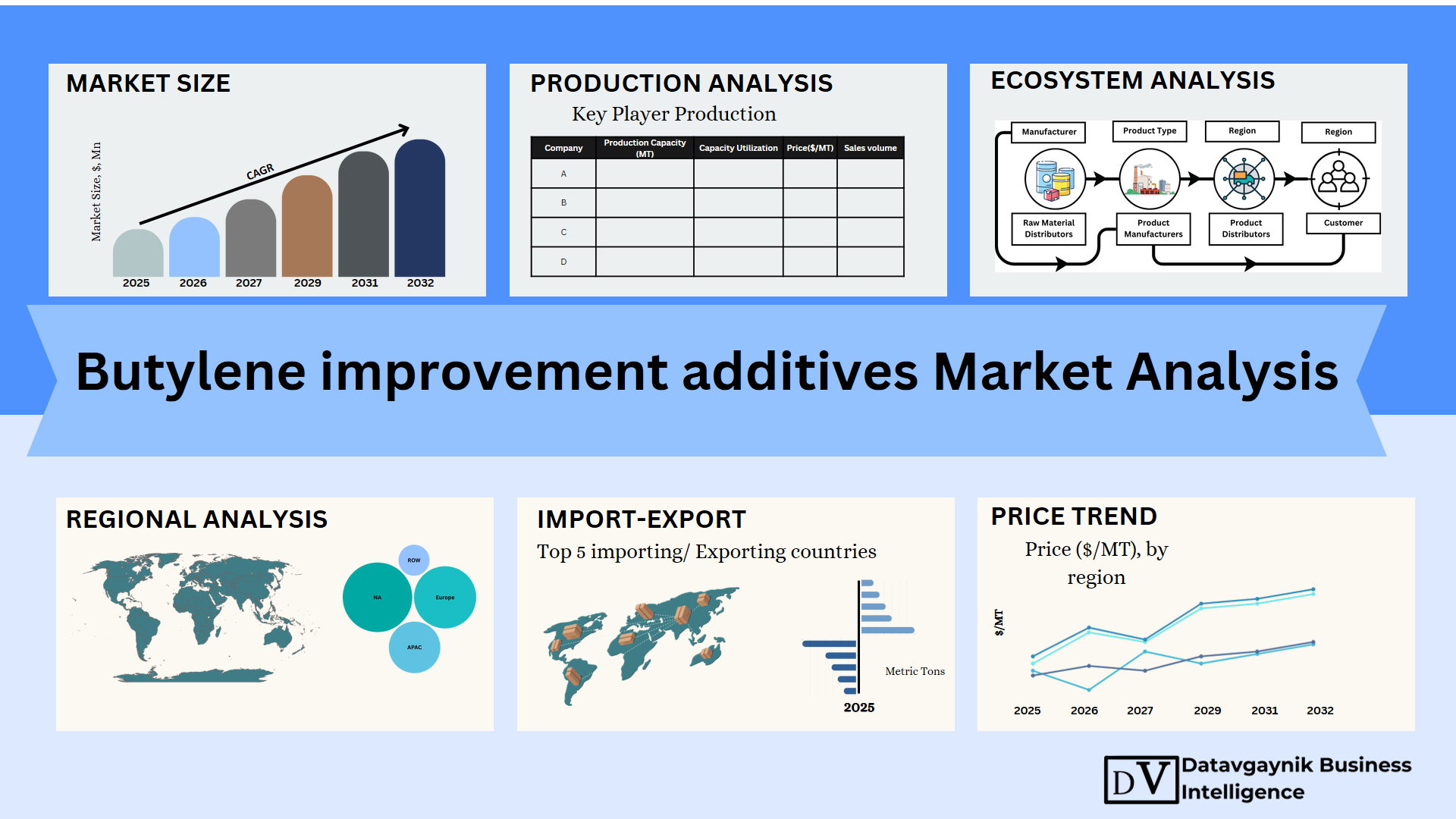
The Butylene improvement additives Market is undergoing a dynamic transformation driven by structural shifts in energy consumption, the evolution of fuel standards, and the rapid expansion of the petrochemical industry. According to Datavagyanik, one of the primary forces behind this growth is the increasing reliance on butylene as a high-value intermediate in the production of high-octane gasoline and performance-grade polymers. The global energy industry is witnessing a notable shift from conventional refining practices toward more efficient, cost-optimized, and sustainable solutions—this is where the Butylene improvement additives Market is rapidly gaining strategic importance.
Surging Demand for High-Octane Fuels Fuels the Butylene Improvement Additives Market
One of the strongest drivers of the Butylene improvement additives Market is the rising global demand for high-octane fuels. For instance, countries across Asia and Europe are progressively implementing tighter emission norms such as Euro 6 and Bharat Stage VI, which require cleaner-burning, high-performance fuels. Butylene plays a key role in the alkylation process that enhances octane levels in gasoline. Additives that improve butylene yield are, therefore, critical. Datavagyanik indicates that the consumption of high-octane fuels is projected to grow by over 4.8% annually through 2030, reinforcing the necessity for high-efficiency additives that enhance butylene output during catalytic cracking and steam cracking processes.
Petrochemical Expansion Amplifies Butylene Improvement Additives Market Size
The global petrochemical sector is expected to grow at a compound annual growth rate (CAGR) of 5.5% over the next five years, with butylene being one of the core feedstocks for downstream derivatives such as polybutylene, polypropylene, and synthetic rubbers. This sustained growth creates direct upward pressure on the Butylene improvement additives Market Size, as refiners and chemical producers look to increase output without large-scale capital expenditure. For instance, the polypropylene market alone, valued at over USD 120 billion in 2024, is forecast to reach USD 170 billion by 2030. To meet this soaring demand, refineries are increasingly integrating butylene enhancement technologies supported by specialized additives.
Process Optimization in Refineries Drives Butylene Improvement Additives Market Penetration
Refineries globally are under pressure to improve process economics by maximizing yield from existing assets. The adoption of butylene improvement additives allows refiners to increase butylene production by up to 15% without significant infrastructure upgrades. For example, in fluid catalytic cracking (FCC) units, additives improve catalyst selectivity, enhance coke management, and optimize cracking reactions to favor butylene output. According to Datavagyanik, over 70% of refiners in North America and East Asia have already started integrating butylene-focused process optimization solutions, indicating a rapid adoption curve and robust demand across established refining hubs.
Bio-Based Feedstock Integration Spurs Innovation in Butylene Improvement Additives Market
A shift toward bio-based and renewable feedstocks is catalyzing the evolution of the Butylene improvement additives Market. As nations pivot towards decarbonization and net-zero targets, refining and petrochemical sectors are exploring biomass and waste-derived feedstocks for producing butylene. These alternative sources often exhibit inconsistent chemical profiles and lower reactivity, making conventional catalysts inefficient. Butylene improvement additives are tailored to enhance conversion efficiency, stabilize feed characteristics, and reduce process variability. For instance, in bio-refining pilot projects across Scandinavia, additive usage has improved butylene yields by over 20%, highlighting the critical role of chemical innovation in sustainable fuel and chemical production.
Environmental Regulations Strengthen the Butylene Improvement Additives Market Outlook
Global mandates aimed at reducing greenhouse gas emissions and improving fuel standards are indirectly strengthening the Butylene improvement additives Market. For example, implementation of fuel sulfur caps by the International Maritime Organization (IMO) and region-specific policies like the Renewable Fuel Standard in the United States are compelling refiners to re-engineer their production processes. In this scenario, butylene yield optimization becomes not just a cost consideration but a compliance necessity. Additives that reduce coke formation, improve selectivity, and enhance catalyst life align perfectly with regulatory objectives, making them indispensable for environmentally compliant operations.
Technological Innovation Accelerates Butylene Improvement Additives Market Expansion
The ongoing R&D push to develop next-generation catalysts and specialty additives has introduced a wave of high-performance formulations in the Butylene improvement additives Market. These advanced additives are engineered to function across a wide range of operating conditions and feedstock qualities. For example, recent trials in Middle Eastern FCC units demonstrated that new additive blends could enhance butylene yield by 12% while simultaneously reducing catalyst consumption by 8%. Such performance metrics make these additives highly attractive to both emerging and established refiners. Datavagyanik notes that R&D investment in this segment is growing at 6.2% annually, with major producers prioritizing breakthroughs that enhance operational flexibility and sustainability.
Industrialization and Urbanization in Emerging Economies Fuel Butylene Improvement Additives Market Growth
Emerging markets, especially in Asia-Pacific and Latin America, are witnessing rapid industrialization, leading to soaring demand for fuels, packaging materials, and automotive products. Butylene-based derivatives like polypropylene are widely used in these sectors. For example, India’s packaging industry is expected to grow at a CAGR of 9.2% through 2028, while China’s automotive parts manufacturing is anticipated to cross USD 650 billion in the same period. These trends directly boost the consumption of butylene, necessitating higher refinery output supported by butylene improvement additives. As a result, additive manufacturers are increasingly targeting regional customization strategies to address feedstock variations and processing differences in these fast-growing markets.
Advanced Refining Technologies Bolster Butylene Improvement Additives Market Opportunities
The integration of butylene improvement additives with cutting-edge refining technologies, such as advanced FCC and steam cracking systems, is unlocking new levels of production efficiency. These technologies are engineered to convert heavy hydrocarbons into valuable lighter olefins like butylene. Additives serve as critical enablers by stabilizing reactions, improving selectivity, and ensuring catalyst longevity. For instance, in steam cracking units operated by Japanese chemical giants, new additive formulations have reduced fouling by 30% and increased throughput by 10%, underscoring their operational value. Datavagyanik projects that by 2030, over 80% of global FCC units will deploy butylene-focused additive strategies, reflecting the sector’s technological maturity and growth readiness.
Operational Efficiency Goals Strengthen the Case for Butylene Improvement Additives Market Investment
In an era where margin optimization is paramount, refiners and petrochemical producers are seeking low-capex, high-return solutions to boost profitability. Butylene improvement additives offer precisely that. For example, incorporating additives into the FCC cycle can achieve a 5–7% increase in butylene output with a payback period of less than one year. Moreover, additive-based improvements often do not require plant shutdowns or major retrofits, making them appealing from a risk-management perspective. Datavagyanik highlights that more than 60% of refineries consider additive integration a strategic lever for improving return on capital employed (ROCE), further solidifying the role of these products in long-term operational planning.
“Track Country-wise Butylene improvement additives Production and Demand through our Butylene improvement additives Production Database”
-
-
- Butylene improvement additives production database for 32+ countries worldwide
- Butylene improvement additives sales volume for 32+ countries
- Country-wise Butylene improvement additives production capacity, production plant mapping, production capacity utilization for 32+ manufacturers
- Butylene improvement additives production plants and production plant capacity analysis by top manufacturers
-
“Track real-time Butylene improvement additives Prices, Butylene improvement additives price charts for 32+ countries, Butylene improvement additives weekly price tracker and Butylene improvement additives monthly price tracker”
-
-
- Track real-time Butylene improvement additives prices and Butylene improvement additives price trend in 32+ countries though our excel-based Butylene improvement additives price charts
- Real-time Butylene improvement additives price tracker dashboard with 32+ countries
- Complete transparency on Butylene improvement additives price trend through our Butylene improvement additives monthly price tracker, Butylene improvement additives weekly price tracker
-
Asia-Pacific Dominates Global Butylene Improvement Additives Market
Asia-Pacific leads the global Butylene improvement additives Market both in consumption and production, accounting for over 40% of the total market volume. This dominance stems from the region’s accelerating industrialization, expanding petrochemical sector, and surging demand for high-octane fuels. For example, China alone contributes more than 25% of regional demand due to its massive refining infrastructure and robust manufacturing economy. The country’s increasing focus on fuel efficiency and clean energy has driven the widespread adoption of additives that improve butylene yield in fluid catalytic cracking and steam cracking processes.
In India, the rapid expansion of automotive, packaging, and consumer goods sectors has led to a surge in demand for polypropylene and synthetic rubbers—key products derived from butylene. This growing need has pushed Indian refiners to incorporate butylene improvement additives into their operations, optimizing yields while keeping production costs manageable. Across Asia-Pacific, the Butylene improvement additives Market is expected to grow at a CAGR exceeding 7.5% over the next five years, reflecting the region’s increasing focus on refining modernization and process efficiency.
North America Drives Butylene Improvement Additives Market Through Technology Leadership
North America remains a vital player in the Butylene improvement additives Market due to its advanced refining technologies, shale-driven feedstock abundance, and well-established petrochemical infrastructure. The United States, in particular, continues to set benchmarks in additive performance, with refiners regularly deploying high-efficiency formulations that boost butylene output without increasing operational overheads.
The widespread use of FCC units in U.S. refineries has created sustained demand for additives that improve catalyst activity and reaction selectivity. As a result, the region not only consumes but also exports a significant portion of global butylene improvement additives. Datavagyanik estimates that nearly 60% of FCC-based refineries in North America have adopted specialized butylene improvement additives, reflecting their critical role in enhancing yields and improving refining margins.
European Market Focuses on Sustainable Butylene Additive Solutions
Europe’s Butylene improvement additives Market is characterized by strict environmental regulations and a high level of technological innovation. Countries like Germany, France, and the Netherlands are investing heavily in bio-refining and sustainable feedstock integration. For instance, additive manufacturers in Germany have developed low-emission, energy-efficient solutions that optimize butylene production while complying with stringent EU sustainability mandates.
In France, the push for carbon neutrality has driven refiners to integrate additives that reduce coke formation, enhance catalyst life, and minimize energy consumption. As a result, Europe has become a hub for eco-friendly additive innovations, making it an attractive market for advanced butylene improvement technologies. The region’s demand is expected to grow at a steady pace of around 4% annually, with further momentum coming from government-backed green industrial initiatives.
Middle East and Africa Emerging in the Butylene Improvement Additives Market
The Butylene improvement additives Market in the Middle East and Africa is gaining traction due to significant investments in refining capacity and petrochemical expansion. Countries such as Saudi Arabia and the UAE are executing mega projects aimed at increasing their share in global fuel and polymer production. As these nations diversify beyond crude exports, refining optimization has become essential.
Additive suppliers are capitalizing on this shift by offering region-specific solutions designed to maximize butylene output from complex feedstocks. For example, newly commissioned FCC units in the Gulf Cooperation Council (GCC) countries have integrated advanced additive packages to improve reaction kinetics and throughput. This emerging market is expected to grow at over 6% CAGR, supported by favorable policy frameworks and rising demand for synthetic materials.
Latin America Shows Steady Growth in Butylene Improvement Additives Market
Latin America’s refining and petrochemical sectors are undergoing modernization, creating new opportunities in the Butylene improvement additives Market. Brazil and Mexico are leading this transformation by upgrading existing refineries and expanding capacity to meet rising domestic demand for fuels and plastic components.
In these markets, butylene improvement additives are increasingly seen as strategic tools to enhance yields, reduce feedstock waste, and improve energy efficiency. For example, Brazilian refineries have begun adopting high-performance additives in FCC processes, achieving a 10% increase in butylene yield with minimal investment. As infrastructure upgrades continue across the region, the demand for tailored additive solutions is expected to rise steadily.
Global Production Landscape of Butylene Improvement Additives Market
Production of butylene improvement additives is concentrated in regions with strong petrochemical ecosystems and advanced chemical manufacturing capabilities. Asia-Pacific leads in volume, with China, South Korea, and Japan being major production hubs. These countries benefit from integrated refining-petrochemical complexes that enable efficient additive development and deployment.
North America follows closely, especially the United States, where high R&D investment fuels continuous innovation. U.S.-based manufacturers are pioneers in catalyst-enhancing additives and have been expanding production capacity to meet global demand. In Europe, Germany and the Netherlands house several cutting-edge production facilities focused on sustainable formulations.
In recent years, production footprints have begun to diversify to include the Middle East and parts of Southeast Asia. This trend supports localized supply chains and reduces lead times in emerging markets. Globally, the Butylene improvement additives Market is experiencing a shift toward agile, regionally integrated manufacturing models that balance quality, cost, and environmental performance.
Segmentation Strategies Reshaping the Butylene Improvement Additives Market
The Butylene improvement additives Market is segmented by product type, application, end-use industry, and production technology—each contributing uniquely to overall demand trends.
By product type, catalytic additives account for the majority share. These additives enhance catalyst selectivity and cracking efficiency, directly influencing butylene yield. Non-catalytic additives and custom-formulated blends are gaining traction for their ability to address specific process bottlenecks and feedstock variations.
In terms of application, the petrochemical industry leads due to the widespread use of butylene in producing polypropylene, polybutylene, and synthetic rubbers. The refining industry follows closely, particularly in processes like alkylation and FCC where yield maximization is a top priority.
From an end-use perspective, oil & gas remains the dominant sector, but demand is also growing from packaging and automotive industries. For example, the global polypropylene packaging market is expected to reach over USD 190 billion by 2030, directly boosting the need for efficient butylene production processes supported by additives.
Technologically, the majority of demand originates from FCC units, followed by steam cracking and hydrocracking systems. As refineries diversify feedstocks to include renewables and heavier crudes, demand for robust additive performance across diverse conditions continues to increase.
Butylene Improvement Additives Price Trend and Cost Dynamics
The Butylene improvement additives Price structure varies significantly depending on raw material costs, formulation complexity, and regional production dynamics. Over the past three years, the Butylene improvement additives Price Trend has shown moderate volatility, largely influenced by feedstock price fluctuations and tightening environmental regulations.
For instance, during periods of crude oil instability, base chemical prices tend to rise, which in turn elevates additive costs. However, technological advancements have enabled the production of high-efficiency additives that require lower dosages, partially offsetting price increases. On average, the Butylene improvement additives Price has grown at a CAGR of 2.5% from 2020 to 2024, with premium eco-friendly formulations commanding higher margins.
In Asia-Pacific, localized production and scale advantages help keep prices relatively competitive, while in Europe, regulatory compliance costs contribute to higher pricing. North America sees mid-range pricing but benefits from stable raw material supply, reducing price shocks. Moving forward, the Butylene improvement additives Price Trend is expected to remain stable with a slight upward bias due to the increasing complexity of additive formulations and growing demand for sustainable solutions.
Pricing Strategies and Value Optimization in the Butylene Improvement Additives Market
Manufacturers are responding to pricing pressures by adopting value-driven strategies, such as offering performance-based pricing models and bundling additive packages with technical support services. These approaches are gaining favor, particularly among large-scale refiners who seek not just cost savings but yield optimization and compliance assurance.
For example, in North America, several suppliers have introduced pricing schemes based on performance metrics like butylene yield improvement per unit cost, allowing clients to measure ROI directly. This shift aligns with the broader market trend of moving from commodity-based pricing to outcome-based value delivery.
Datavagyanik highlights that while cost remains a key factor, buyers are increasingly willing to pay a premium for formulations that deliver operational efficiency, reduce emissions, and extend catalyst life. This indicates a maturing market where price is balanced with long-term value.
“Butylene improvement additives Manufacturing Database, Butylene improvement additives Manufacturing Capacity”
-
-
- Butylene improvement additives top manufacturers market share for 32+ manufacturers
- Top 12 manufacturers and top 19 manufacturers of Butylene improvement additives in North America, Europe, Asia Pacific
- Butylene improvement additives production plant capacity by manufacturers and Butylene improvement additives production data for 32+ market players
- Butylene improvement additives production dashboard, Butylene improvement additives production data in excel format
-
“Butylene improvement additives price charts, Butylene improvement additives weekly price tracker and Butylene improvement additives monthly price tracker”
-
-
- Factors impacting real-time Butylene improvement additives prices in 32+ countries worldwide
- Butylene improvement additives monthly price tracker, Butylene improvement additives weekly price tracker
- Real-time Butylene improvement additives price trend, Butylene improvement additives price charts, news and updates
- Tracking Butylene improvement additives price fluctuations
-
Leading Manufacturers Shaping the Butylene Improvement Additives Market
The global Butylene improvement additives Market is highly competitive and moderately consolidated, with a mix of multinational chemical corporations and specialized additive producers driving innovation and supply. These companies dominate the value chain through their integrated operations, proprietary technologies, and regional production footprints. As demand rises across refining and petrochemical sectors, the strategic positioning and market share of key players have become increasingly influential.
BASF SE Commands Strong Presence in Butylene Improvement Additives Market
BASF SE holds a significant share in the Butylene improvement additives Market, particularly in the catalytic additive segment. The company offers a wide range of refining catalysts and performance-enhancing additives under its FCC portfolio. Notable among these is the Valor additive series, designed to improve selectivity towards light olefins like butylene while maintaining overall catalyst stability. BASF’s global manufacturing network and strong research base allow it to tailor solutions to different regional feedstock qualities and regulatory requirements. The company’s share in the global market is estimated to be over 15%, making it a dominant force in the additive supply chain.
Grace Catalysts Technologies Offers Advanced Olefin Yield Boosters
R. Grace & Co. is another major player in the Butylene improvement additives Market, especially known for its high-performance catalyst systems used in FCC operations. The company’s MIDAS and ACHIEVE additive lines are specifically engineered to boost olefin production, including butylene, by optimizing cracking efficiency and coke control. Grace has a strong presence in North America and the Middle East, where refineries are constantly upgrading to meet clean fuel standards. The company’s estimated market share is around 12%, with growing penetration in Asia-Pacific through regional partnerships and technical collaborations.
Clariant Driving Sustainable Growth in Butylene Improvement Additives Market
Clariant is actively gaining ground in the Butylene improvement additives Market through its focus on sustainability and bio-refining compatibility. The company’s product range includes specialized additives for both conventional and renewable feedstocks, such as the VGuard and VMax series, which are widely used in steam cracking and FCC units. These additives are formulated to improve yield, lower emissions, and enhance feed flexibility. Clariant’s market share is currently estimated at 9–10%, with a strong emphasis on serving the European and Asian refining markets that prioritize environmental compliance.
Albemarle Corporation Maintains Technological Leadership
Albemarle is a global leader in the production of FCC catalysts and additives, including butylene-enhancing solutions. The company’s proprietary BOOST and OLEFLEX additives are designed to maximize light olefin production, particularly butylene and propylene, with enhanced catalyst selectivity and thermal stability. Albemarle serves clients across North America, Europe, and Asia, with significant production facilities and technical support networks. With an estimated 10–11% share of the global Butylene improvement additives Market, Albemarle remains a preferred supplier for refiners seeking high-performance and cost-effective solutions.
Johnson Matthey Focuses on Specialty Additive Formulations
Johnson Matthey, known for its innovation in catalyst technologies, has carved out a niche in the Butylene improvement additives Market with a portfolio of specialty additives for advanced FCC applications. The company’s HySep and FlexiCrack products are tailored for operations requiring precise control over olefin yields and process emissions. Though its market share is smaller compared to BASF or Grace, estimated at around 6–7%, Johnson Matthey holds a strong competitive position in high-specification refining markets, particularly in Western Europe and North America.
Axens Emerges as a Key Player with Custom Additive Technologies
Axens is a growing name in the Butylene improvement additives Market, particularly known for its focus on refinery process optimization and additive customization. The company has developed several proprietary additive technologies integrated with its refining process solutions, including additives used in FCC and hydrocracking units that improve butylene production efficiency. Axens’ strategic collaborations with national oil companies in Asia and the Middle East have helped it secure a growing customer base. Its global market share is estimated at around 5%, with strong prospects due to its focus on integrated refining solutions.
Shell Catalysts & Technologies Expanding Global Reach
Shell Catalysts & Technologies, a division of Shell Global Solutions, plays a dual role as both a refiner and a supplier of advanced additives. The company’s product suite includes additives specifically engineered to enhance olefin yield and butylene selectivity under high-severity operating conditions. Shell’s vertical integration allows it to deploy field-tested additive technologies quickly across its own refining operations and licensed partners, giving it a unique advantage in the global Butylene improvement additives Market. Its estimated share is around 7%, driven by internal demand and growing external sales.
Other Notable Contributors to the Butylene Improvement Additives Market
Other manufacturers such as Haldor Topsoe, Dorf Ketal, and Zeolyst International also play specialized roles in the Butylene improvement additives Market, supplying niche products that address specific refining challenges. These companies typically focus on regional customization, feedstock variability, or process-specific formulations. Though their individual market shares are smaller, collectively they account for approximately 10–12% of global demand and provide critical competitive diversity to the market.
Butylene Improvement Additives Market Share Analysis by Manufacturer
The market share landscape reveals that the top five companies—BASF, Grace, Clariant, Albemarle, and Johnson Matthey—control over 55% of the global Butylene improvement additives Market. Their dominance is attributed to strong technological capabilities, global reach, and deep integration with refinery operations. Mid-tier players such as Axens and Shell continue to gain traction through strategic partnerships and innovation in feedstock adaptability.
These market dynamics suggest a trend toward increased consolidation, where companies with strong R&D pipelines and vertically integrated operations are better positioned to capture future demand. However, regional players remain critical, especially in emerging markets where localized solutions are preferred.
Recent Developments and Industry News in the Butylene Improvement Additives Market
Several key developments have shaped the Butylene improvement additives Market in recent months, underscoring the pace of innovation and strategic activity:
- In January 2024, BASF expanded its FCC additive production capacity in Texas, aiming to meet growing demand for high-octane blending components and butylene optimization in the U.S. Gulf Coast.
- In June 2023, W. R. Grace launched a new version of its MIDAS additive, engineered for enhanced butylene yield in high-residue FCC units. Early adopters reported a 6% increase in yield with a 10% reduction in operational energy use.
- Clariant announced in March 2024 the development of a bio-based additive blend suitable for renewable feedstock applications. This innovation positions Clariant to tap into the growing segment of sustainable refining.
- In Q4 2023, Axens signed a technical services agreement with a major Southeast Asian refiner to supply its latest FCC additive package tailored to boost butylene production from light tight oil.
- Albemarle reported in November 2023 the successful trial of its BOOST-4000 additive in a Middle Eastern FCC unit, resulting in a 12% uplift in butylene yield while reducing catalyst consumption by 8%.
These recent activities point to a robust and evolving Butylene improvement additives Market, where technological advancements and strategic expansions are redefining competitive advantages. The market continues to attract significant investments in innovation, capacity expansion, and sustainability-focused formulations, setting the stage for long-term growth and market transformation.
“Butylene improvement additives Production Data and Butylene improvement additives Production Trend, Butylene improvement additives Production Database and forecast”
-
-
- Butylene improvement additives production database for historical years, 12 years historical data
- Butylene improvement additives production data and forecast for next 12 years
- Butylene improvement additives sales volume by manufacturers
-
“Track Real-time Butylene improvement additives Prices for purchase and sales contracts, Butylene improvement additives price charts, Butylene improvement additives weekly price tracker and Butylene improvement additives monthly price tracker”
-
-
- Gain control on your purchase and sales contracts through our real-time Butylene improvement additives price tracker and Butylene improvement additives price trend analysis
- Butylene improvement additives weekly price tracker and forecast for next four weeks
- Butylene improvement additives monthly price tracker and forecast for next two months
-
Market Scenario, Demand vs Supply, Average Product Price, Import vs Export, till 2035
- Global Butylene improvement additives Market revenue and demand by region
- Global Butylene improvement additives Market production and sales volume
- United States Butylene improvement additives Market revenue size and demand by country
- Europe Butylene improvement additives Market revenue size and demand by country
- Asia Pacific Butylene improvement additives Market revenue size and demand by country
- Middle East & Africa Butylene improvement additives Market revenue size and demand by country
- Latin America Butylene improvement additives Market revenue size and demand by
- Import-export scenario – United States, Europe, APAC, Latin America, Middle East & Africa
- Average product price – United States, Europe, APAC, Latin America, Middle East & Africa
- Market player analysis, competitive scenario, market share analysis
- Business opportunity analysis
Key questions answered in the Global Butylene improvement additives Market Analysis Report:
- What is the market size for Butylene improvement additives in United States, Europe, APAC, Middle East & Africa, Latin America?
- What is the yearly sales volume of Butylene improvement additives and how is the demand rising?
- Who are the top market players by market share, in each product segment?
- Which is the fastest growing business/ product segment?
- What should be the business strategies and Go to Market strategies?
The report covers Butylene improvement additives Market revenue, Production, Sales volume, by regions, (further split into countries):
- Asia Pacific (China, Japan, South Korea, India, Indonesia, Vietnam, Rest of APAC)
- Europe (UK, Germany, France, Italy, Spain, Benelux, Poland, Rest of Europe)
- North America (United States, Canada, Mexico)
- Latin America (Brazil, Argentina, Rest of Latin America)
- Middle East & Africa
Table of Contents:
Butylene Improvement Additives Market:
- Executive Summary
- Market Overview and Key Highlights
- Strategic Insights for Industry Stakeholders
- Summary of Market Growth Drivers, Challenges, and Opportunities
- Introduction to Butylene Improvement Additives
- Definition and Role in Petrochemical and Refining Processes
- Importance of Additives in Enhancing Butylene Yield
- Overview of Butylene Production Technologies
- Historical Development and Market Evolution
- Evolution of Additive Technologies in Butylene Production
- Key Milestones in Catalyst and Additive Innovations
- Shifts in Market Demand and Industry Adoption
- Types of Butylene Improvement Additives
- Classification by Additive Type: Olefin Yield Enhancers, Catalyst Modifiers, Anti-Coking Agents
- By Functional Performance: Conversion Boosters, Selectivity Enhancers
- Comparative Analysis of Additive Efficiency and Applications
- Global Butylene Improvement Additives Market Overview (2020–2040)
- Market Size, Revenue Trends, and Growth Projections
- Key Market Dynamics: Drivers, Challenges, and Opportunities
- Emerging Trends in Additive Formulations and Applications
- Key Market Drivers and Restraints
- Rising Demand for Butylene in Polymeric and Chemical Industries
- Technological Advancements in Refining and Olefin Production
- Regulatory Challenges Related to Emissions and Process Efficiency
- Technological Innovations in Butylene Improvement Additives
- Advances in Additive Chemistry and Process Optimization
- Development of Environmentally Friendly and High-Efficiency Additives
- Role of Nanotechnology in Enhancing Additive Performance
- Global Market Segmentation
- By Additive Type: Olefin Enhancers, Octane Boosters, Anti-Fouling Agents
- By Application: Fluid Catalytic Cracking (FCC), Steam Cracking, Dehydrogenation Units
- By End-Use Industry: Petrochemical Plants, Oil Refineries, Plastic Manufacturing
- Regional Market Analysis
- North America: Refining Infrastructure and Additive Demand Trends
- Europe: Regulatory Influence and Market Maturity
- Asia-Pacific: Rapid Industrial Growth and Expanding Petrochemical Sector
- Latin America: Emerging Markets and Refining Sector Opportunities
- Middle East & Africa: Growing Refinery Investments and Additive Applications
- Competitive Landscape and Market Share Analysis
- Overview of Key Market Players and Market Share Distribution
- Company Profiles, Product Portfolios, and Strategic Initiatives
- Competitive Strategies: Mergers, Acquisitions, and Partnerships
- Butylene Improvement Additives Production and Manufacturing Analysis
- Overview of Additive Production Processes
- Global Production Capacities and Facility Distribution
- Cost Structure and Process Optimization Strategies
- Supply Chain Dynamics and Value Chain Analysis
- Raw Material Sourcing and Key Suppliers
- Distribution Channels and Logistics Challenges
- Supply Chain Risks and Mitigation Strategies
- Pricing Analysis and Market Profitability
- Historical and Current Pricing Trends
- Factors Affecting Additive Pricing Across Regions
- Profitability Analysis by Additive Type and Application
- Global Trade and Export-Import Dynamics
- Major Exporting and Importing Countries for Butylene Additives
- Trade Regulations and Their Impact on Market Dynamics
- Analysis of International Trade Flows and Regional Dependencies
- Market Demand and Consumption Patterns
- Sector-Wise Demand Analysis Across Key Industries
- Consumption Trends in Emerging and Established Markets
- Growth Drivers in Butylene Production and Utilization
- End-Use Industry Insights
- Role of Additives in Enhancing Olefin Production Efficiency
- Applications in Polymer Manufacturing and Specialty Chemicals
- Use in Gasoline Blending and Refining Operations
- Environmental Impact and Sustainability Considerations
- Development of Eco-Friendly Additive Technologies
- Sustainability Practices in Additive Production
- Regulatory Compliance and Environmental Impact Reduction
- Challenges and Risk Factors in the Market
- Technological Barriers and Performance Limitations
- Raw Material Supply Constraints and Price Volatility
- Regulatory Challenges and Market Entry Barriers
- Investment Landscape and Strategic Opportunities
- Key Investment Trends in Butylene Additive Technologies
- Emerging Market Opportunities and Growth Hotspots
- Strategic Recommendations for Investors and Industry Players
- Impact of Global Events on Market Dynamics
- Impact of COVID-19 on Production and Supply Chains
- Geopolitical Factors Affecting Global Trade
- Economic Trends Influencing Market Growth and Development
- Future Outlook and Market Forecast (2025–2040)
- Long-Term Market Projections and Emerging Trends
- Innovations Shaping the Future of Butylene Additives
- Strategic Roadmap for Sustainable Growth and Market Expansion
- Research and Development Landscape
- R&D Investments and Technological Breakthroughs
- Recent Innovations in Additive Chemistry and Performance
- Role of Industry-Academia Collaborations in Driving Innovation
- Case Studies and Industry Best Practices
- Successful Implementation of Butylene Improvement Additives
- Lessons from Global Leaders in Additive Development
- Best Practices for Enhancing Refining and Olefin Yields
- Appendices
- Glossary of Technical Terms and Abbreviations
- Research Methodology and Data Sources
- List of Tables, Figures, and Charts
Other recently published reports:

