

Market Summary and Growth Forecast
The global Cargo Ship Ventilation Systems Market is estimated at $684 million in 2026 and is expected to reach $1,080 million by 2035, growing at a CAGR of 5.2%.
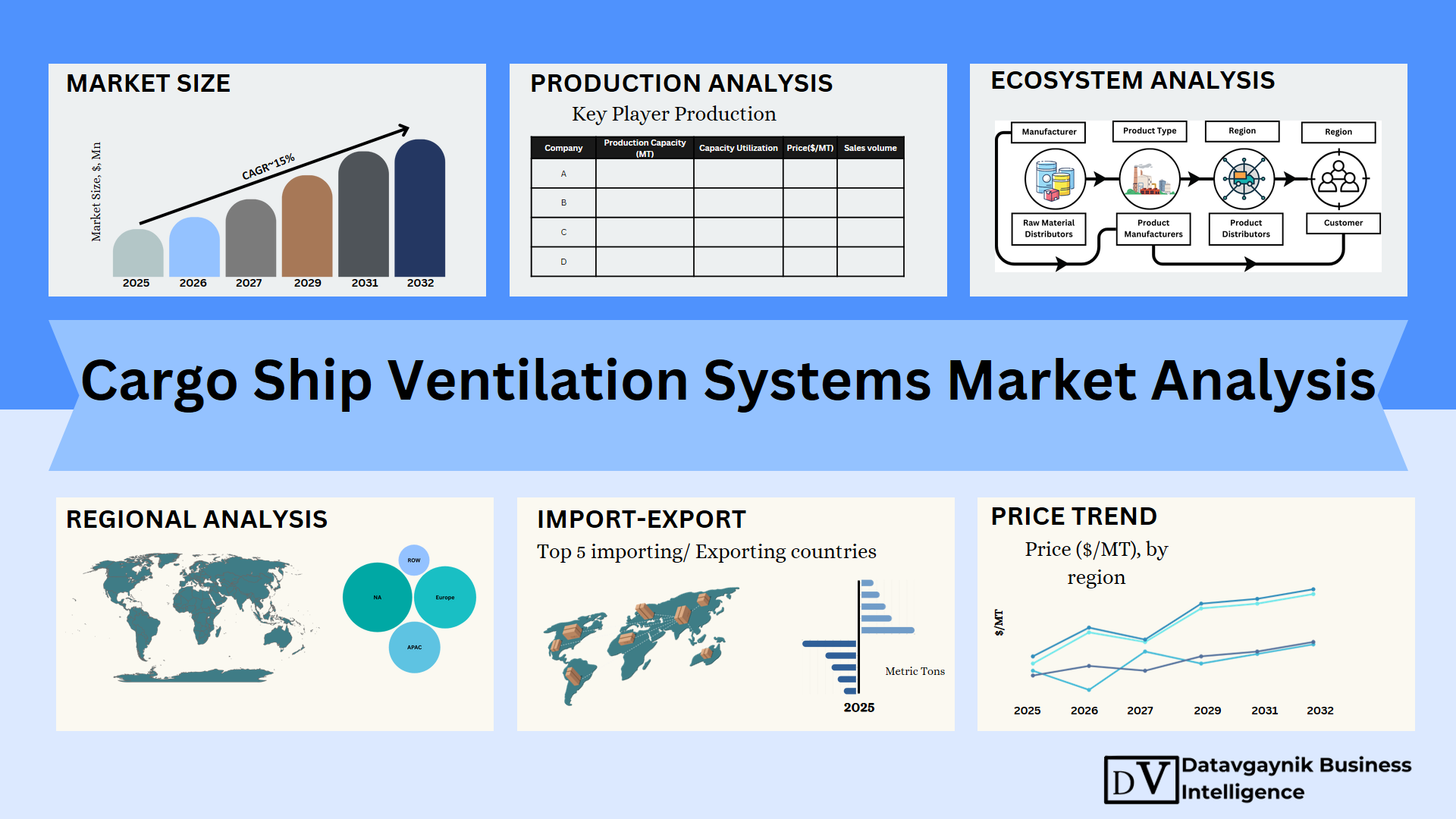
The market covers ventilation equipment and associated control systems installed across cargo holds, machinery spaces, pump rooms, vehicle decks, battery rooms, technical compartments, and other enclosed areas of commercial cargo vessels. The revenue boundary includes fans, blowers, air-handling equipment, dampers, louvers, ducting assemblies, sensors, control panels, installation, commissioning, replacement parts, and system modernization.
Datavagyanik also covers related markets such as the Cruise Ship Ventilation Systems Market. Understanding these markets sheds light on emerging innovations and industry crossovers that impact the main topic.
Complete accommodation air-conditioning systems are excluded unless the ventilation component is supplied as part of an integrated cargo-vessel package. Exhaust-gas cleaning systems, cargo refrigeration units, standalone gas detection systems, and vessel propulsion equipment are also outside the core calculation.
The business relevance of the Cargo Ship Ventilation Systems Market is moving beyond basic air circulation. Ventilation now supports four operating priorities: crew safety, cargo preservation, machinery reliability, and regulatory compliance. A poorly designed system can cause heat accumulation, condensation, corrosion, cargo deterioration, or the concentration of combustible gases. These risks become more serious on vessels carrying chemicals, fuels, vehicles, batteries, agricultural commodities, or moisture-sensitive cargo.
Core Market Forecast
| Market Indicator | Analyst Estimate |
| Global market size in 2026 | $684 million |
| Projected market size in 2035 | $1,080 million |
| Forecast CAGR, 2026–2035 | 5.2% |
| Estimated equipment revenue share in 2026 | 71% |
| Estimated installation, retrofit, and service share in 2026 | 29% |
| Primary demand source | Newbuild installations and fleet retrofits |
| Leading production and installation region | Asia Pacific |
The forecast reflects a combination of new vessel construction, mandatory replacement cycles, fleet refurbishment, and higher ventilation content per ship. Global cargo fleet expansion alone won’t determine demand. The more important factor will be the value of ventilation equipment installed on each vessel.
New ships are using more sensors, automated dampers, variable-speed drives, and compartment-specific controls. Tankers, gas carriers, vehicle carriers, and vessels prepared for alternative fuels require more complex airflow management than conventional general cargo ships. As system complexity rises, average project revenue also increases.
Technology as a Market Force
Traditional fixed-speed fans remain widely used because they are durable and relatively easy to maintain. That said, shipowners are gradually shifting toward demand-controlled ventilation. These systems adjust fan speed according to temperature, humidity, pressure, gas concentration, or equipment load.
Variable-frequency drives can reduce unnecessary power consumption during low-load operation. Electronic control panels also allow engineers to monitor fan status, motor condition, damper position, and airflow alarms from a central interface. On connected fleets, selected performance data can be transmitted to shore-based technical teams.
The transition will be gradual. Older vessels may not have the electrical architecture needed for full digital control. Retrofit economics will therefore differ by vessel age, remaining service life, operating route, and fuel cost exposure.
Regulatory and Safety Influence
Marine ventilation specifications are shaped by vessel classification rules, flag-state requirements, international fire-safety provisions, hazardous-area standards, and cargo-specific operating codes. The exact design varies by vessel type.
Engine rooms need sufficient airflow for combustion and heat removal. Pump rooms on tankers require controlled extraction to limit hazardous vapor accumulation. Ro-Ro and vehicle decks require high-capacity air exchange. Battery rooms need dedicated exhaust arrangements. Cargo holds carrying moisture-sensitive goods require airflow patterns that reduce condensation without damaging the cargo.
Fire integrity is another critical issue. Ventilation ducts passing through protected divisions may require fire-rated construction, remote shutdown capability, and approved fire or smoke dampers. These requirements raise engineering content and limit the use of low-specification industrial substitutes.
Stricter vessel efficiency targets also have an indirect effect. Ventilation fans consume auxiliary power. Shipowners looking to reduce fuel use are reviewing oversized motors, inefficient duct layouts, and systems that operate continuously at full load. So, efficiency regulations may not always prescribe a specific fan type, but they improve the commercial case for optimized airflow systems.
Shipbuilding and Production Dynamics
Cargo-vessel construction remains concentrated in major Asian shipbuilding economies. This gives shipyards in China, South Korea, and Japan considerable influence over supplier selection, technical qualification, and package pricing. European suppliers retain strong positions in engineered systems, hazardous-area applications, premium controls, and specialized vessel designs.
Ventilation systems are rarely purchased as isolated products on a newbuild. They are typically engineered around vessel layout, machinery heat load, cargo profile, class requirements, and available electrical capacity. Suppliers must coordinate with shipyards, naval architects, electrical contractors, automation providers, and class societies.
This project-based structure creates entry barriers. A supplier may have a suitable fan but still lack marine certification, corrosion protection, documentation capability, global service support, or references with major shipyards.
Production capacity is not expected to become the main market constraint through 2035. The bigger challenges will be qualified engineering labor, project execution, approved component availability, and the ability to support ships across multiple ports.
Demand Structure Through 2035
Three demand pools will shape market revenue:
- Newbuild installations
New cargo ships require complete ventilation packages. Demand is strongest where fleet renewal, fuel transition, or trade growth supports vessel orders. - Replacement and maintenance
Motors, bearings, impellers, dampers, actuators, sensors, and control components face wear from salt, vibration, heat, dust, and continuous operation. - Retrofit and efficiency upgrades
Older fixed-speed systems can be upgraded using efficient motors, variable-speed drives, new controls, improved dampers, and condition-monitoring devices.
Retrofit activity is expected to expand faster than routine replacement. Shipowners are looking for projects that reduce auxiliary power consumption without taking vessels out of service for long periods. Modular upgrades with short installation windows will therefore gain preference.
Key Consumers and Clients
The principal buyers and influencers include:
- Commercial shipowners
- Cargo fleet operators
- Ship management companies
- Newbuild shipyards
- Marine engineering, procurement, and construction contractors
- Naval architects and vessel design houses
- Tanker and gas-carrier operators
- Container shipping companies
- Bulk carrier operators
- Ro-Ro and vehicle carrier operators
- Marine equipment distributors
- Fleet maintenance and dry-dock service providers
- Classification-compliant system integrators
- Leasing companies and vessel asset owners
Shipyards account for much of the initial procurement value. However, shipowners and technical managers have greater influence over lifecycle specifications, approved brands, replacement policy, and retrofit investment.
Analyst view: The market’s strongest value pool will not come from adding more fans. It will come from making airflow measurable, controllable, and easier to maintain. Suppliers that connect rugged marine hardware with practical energy management will be better positioned through 2035.
Market Segmentation and Forecast Scope
The Cargo Ship Ventilation Systems Market is segmented by product type, ventilation mode, vessel application, vessel type, sales channel, and region. Each dimension answers a different commercial question. Product segmentation measures equipment revenue. Application segmentation identifies where the system operates. Vessel segmentation explains technical complexity. Sales-channel analysis separates newbuild demand from lifecycle spending.
The segments are structured to limit overlap. A fan is counted once under product type. Its installation area is recorded separately under application. The vessel on which it is installed is then classified under vessel type.
Segmentation Framework
| Segmentation Dimension | Included Categories | Commercial Purpose |
| By Product Type | Fans and blowers; air-handling and air-supply units; dampers and louvers; ducting and distribution assemblies; controls, sensors, and monitoring devices | Measures equipment-level revenue |
| By Ventilation Mode | Supply ventilation; exhaust ventilation; balanced supply-and-exhaust ventilation; natural or hybrid ventilation | Identifies airflow design approach |
| By Application Area | Cargo holds; engine and machinery spaces; pump and compressor rooms; Ro-Ro and vehicle decks; battery and electrical rooms; technical and auxiliary spaces | Maps demand to vessel compartments |
| By Vessel Type | Bulk carriers; container ships; tankers; general cargo ships; Ro-Ro and vehicle carriers; gas carriers; other cargo-support vessels | Measures vessel-specific demand |
| By Sales Channel | Newbuild or OEM installation; replacement and maintenance; retrofit and modernization | Separates initial and lifecycle revenue |
| By Region | North America; Europe; Asia Pacific; Latin America; Middle East and Africa | Tracks shipbuilding, ownership, and retrofit demand |
By Product Type
Fans and Blowers
This segment includes axial-flow fans, centrifugal fans, mixed-flow units, roof or deck-mounted exhaust fans, portable units, and application-specific marine blowers. Products may be supplied in standard marine construction or in corrosion-resistant, spark-resistant, explosion-protected, high-temperature, or low-noise configurations.
Fans and blowers are estimated to represent 39.6% of global revenue in 2026, making this the largest disclosed product segment. Their share is supported by the number of ventilation points installed across cargo vessels and by recurring motor, impeller, bearing, and complete-unit replacement.
Revenue growth will be moderate rather than exceptional. Basic fans are exposed to price competition. The stronger margin pool lies in engineered units built for hazardous areas, restricted spaces, high static pressure, or severe corrosive conditions.
Air-Handling and Air-Supply Units
These systems condition, filter, heat, cool, or distribute incoming air before it reaches a designated space. They are used where simple extraction is insufficient or where stable temperature, humidity, and air quality are needed.
Demand is strongest in machinery areas, electrical rooms, specialized cargo spaces, and integrated technical ventilation packages. Growth will be supported by modular construction and greater use of pre-engineered skids.
Dampers and Louvers
This category includes fire dampers, smoke dampers, gas-tight dampers, pressure-control dampers, weather louvers, closure devices, and motorized airflow-control components.
The segment is strategically important because dampers connect ventilation performance with vessel safety. Remote closure, position feedback, fire-zone isolation, and fail-safe operation are becoming more common in higher-specification ships.
Ducting and Distribution Assemblies
This segment covers marine-grade duct networks, flexible connectors, diffusers, grilles, silencers, supports, and insulated distribution components supplied as part of the ventilation package.
Ducting value depends heavily on vessel layout and installation complexity. Prefabricated duct modules can reduce shipyard labor but require accurate design data earlier in the construction process.
Controls, Sensors, and Monitoring Devices
This includes local starters, central control panels, variable-frequency drives, pressure and temperature sensors, humidity sensors, airflow switches, gas-signal interfaces, motor-condition sensors, alarms, and communication modules.
It is expected to be the fastest-growing product category through 2035. Its base remains smaller than mechanical equipment, but the value per vessel is increasing. Controls also create opportunities for software support, diagnostics, and future upgrade revenue.
By Ventilation Mode
Supply Ventilation
Supply systems introduce fresh or conditioned air into enclosed spaces. They are used where positive pressure, equipment cooling, combustion air, or controlled air distribution is needed.
Exhaust Ventilation
Exhaust systems remove heat, fumes, moisture, dust, and potentially hazardous gases. They are especially important in pump rooms, battery rooms, vehicle decks, paint or chemical storage areas, and selected cargo spaces.
Balanced Supply-and-Exhaust Ventilation
Balanced systems coordinate inlet and extraction volumes. This improves airflow control and reduces pressure instability. Adoption is increasing in machinery spaces and technically sensitive compartments.
Natural and Hybrid Ventilation
Natural ventilation uses cowls, trunks, openings, and pressure differences to move air. Hybrid designs combine natural airflow with powered assistance. These systems remain relevant in conventional cargo holds and low-complexity applications, although their performance depends more heavily on weather and vessel operating conditions.
By Application Area
Cargo Holds
Cargo-hold ventilation controls moisture, temperature, odor, and condensation. The required approach depends on the cargo. Agricultural commodities, paper, steel, timber, chemicals, and packaged consumer goods have different ventilation tolerances.
Some cargoes benefit from active air exchange. Others may be damaged if warm humid air is introduced into a cooler hold. This means control logic and crew operating procedures matter as much as fan capacity.
Engine and Machinery Spaces
These applications require high airflow volumes to manage combustion demand and heat released by engines, generators, pumps, electrical equipment, and auxiliary machinery. Reliability is crucial because ventilation failure can force equipment derating or shutdown.
This remains one of the largest application areas in unit and revenue terms. It also offers retrofit potential where legacy systems use oversized fixed-speed motors.
Pump and Compressor Rooms
Pump rooms and compressor spaces may contain flammable or harmful vapors. Systems therefore require controlled extraction, approved motors, safe component placement, and suitable airflow paths.
This is a high-specification segment with above-average equipment value. Tanker fleet renewal and alternative-fuel handling systems will support demand.
Ro-Ro and Vehicle Decks
Vehicle decks need rapid removal of exhaust gases, heat, and potentially combustible vapors. The ventilation requirement becomes more complex when electric vehicles or battery-powered cargo are carried.
Ro-Ro ventilation is expected to be among the fastest-growing application areas. Operators are reviewing airflow coverage, gas detection interfaces, emergency extraction, and fire-response procedures in enclosed vehicle decks.
Battery and Electrical Rooms
Battery rooms require dedicated ventilation to manage heat and gases generated during charging or abnormal operating conditions. Future vessel designs may include larger battery installations for auxiliary or hybrid propulsion.
Although this is a relatively small revenue category, it is strategically important. Specification standards are high and system failure can have serious safety consequences.
Technical and Auxiliary Spaces
This category includes steering gear rooms, workshops, storage spaces, thruster rooms, shaft tunnels, and other enclosed technical areas. It captures applications that do not fit the primary compartments without double counting them.
By Vessel Type
Bulk Carriers
Bulk carriers require ventilation for machinery spaces and selected cargo holds. Demand varies by cargo profile. Vessels carrying grain, coal, minerals, fertilizers, or steel products need different airflow and moisture-control strategies.
The installed system is generally less complex than that of gas carriers or chemical tankers. However, the large operating fleet creates a sizable replacement market.
Container Ships
Container vessels require substantial machinery ventilation, electrical-room cooling, and technical-space airflow. Larger ships have higher heat loads and more complex auxiliary systems.
Growth will come from fleet renewal, higher electrical equipment density, and efficiency-focused upgrades. Cargo-hold ventilation itself is less central than on conventional general cargo ships.
Tankers
Oil, product, and chemical tankers use ventilation in machinery spaces, pump rooms, compressor rooms, battery rooms, and other controlled areas. Hazardous-zone requirements raise system cost and supplier qualification standards.
Tankers are among the most attractive vessel segments from a value-per-ship perspective.
General Cargo Ships
General cargo ships carry a wide mix of packaged goods, machinery, steel, timber, project cargo, and bulk products. Ventilation systems need flexibility because cargo profiles may change between voyages.
Ro-Ro and Vehicle Carriers
This segment includes vehicle carriers and cargo vessels with enclosed roll-on/roll-off decks. High-volume mechanical ventilation is required during loading, unloading, and transit.
The segment is expected to record one of the highest growth rates due to fleet renewal and closer scrutiny of enclosed-deck fire and gas risks.
Gas Carriers
LNG, LPG, and other gas carriers use specialized ventilation around compressor rooms, machinery spaces, equipment enclosures, and hazardous areas. These ships have high technical requirements and above-average system values.
Gas carriers will remain a strategic rather than volume-led segment.
By Sales Channel
Newbuild and OEM Installation
This channel covers systems designed and installed during vessel construction. Shipyards usually control procurement, while owners, designers, and classification bodies influence the approved specification.
Asia Pacific dominates this channel because of its shipbuilding concentration. Pricing pressure is high, but suppliers benefit from complete-vessel package opportunities.
Replacement and Maintenance
This includes the replacement of fans, motors, bearings, impellers, dampers, actuators, sensors, and electrical controls during scheduled maintenance or dry-docking.
Demand is relatively stable because ventilation equipment operates in harsh conditions. Global service coverage is often more important than the lowest component price.
Retrofit and Modernization
Retrofit projects include variable-speed drives, motor upgrades, airflow redesign, control-system replacement, additional sensors, remote monitoring, and installation of new extraction points.
This is forecast to be the fastest-growing sales channel. The investment case is strongest where energy savings, safety improvement, and avoided downtime can be demonstrated together.
By Region
North America
Regional demand is supported by commercial fleet maintenance, marine equipment distribution, specialized shipbuilding, offshore-linked cargo activity, and retrofit work. The newbuild base is smaller than Asia Pacific, so aftermarket revenue carries greater weight.
Europe
Europe has a strong ecosystem of marine engineering companies, ventilation specialists, automation providers, classification organizations, and technically advanced vessel owners. The region is important for premium systems, specialized cargo vessels, and low-energy retrofit solutions.
Asia Pacific
Asia Pacific is estimated to account for 48.2% of global market revenue in 2026. The region benefits from large-scale shipbuilding activity in China, South Korea, and Japan, as well as expanding shipbuilding capabilities elsewhere in Asia.
Its revenue share is lower than its share of vessel completions because some high-value equipment is designed or supplied by European vendors. Local manufacturers are nevertheless improving their position in fans, ducting, dampers, and control panels.
Latin America
Demand is linked to bulk commodities, petroleum transport, regional cabotage, port development, and maintenance of aging fleets. Brazil is the main technical and commercial center, while other markets are served largely through distributors and international marine contractors.
Middle East and Africa
The region generates demand through tanker operations, gas shipping, dry-dock activity, port investment, and trade routes connecting Asia and Europe. The United Arab Emirates and selected Gulf countries serve as important maintenance and distribution hubs.
The forecast scope treats the Cargo Ship Ventilation Systems Market as a marine equipment and lifecycle-services business. It does not count complete vessels, propulsion systems, cargo refrigeration, scrubbers, or unrelated onboard HVAC revenue.
Analyst view: Controls and retrofit services will outgrow the mechanical equipment base. Yet suppliers shouldn’t treat hardware as a commodity. Marine approval, installation fit, repair access, and dependable service remain central to the buying decision.
Market Trends and Innovation Landscape
Innovation in the Cargo Ship Ventilation Systems Market is practical rather than experimental. Buyers want lower power consumption, safer operation, simpler maintenance, and fewer unplanned failures. A new feature must work under salt exposure, vibration, voltage fluctuation, limited connectivity, and uneven maintenance conditions. Technology that performs well in a commercial building may not survive at sea without substantial redesign.
Shift from Constant-Speed to Demand-Controlled Ventilation
Many existing cargo vessels use fans that operate at fixed speed whenever the system is active. This approach is simple, but it can waste energy when full airflow isn’t required.
Demand-controlled systems adjust ventilation using inputs such as:
- Compartment temperature
- Relative humidity
- Differential pressure
- Motor load
- Gas concentration
- Machinery operating status
- Cargo-handling mode
- Fire or emergency signals
Variable-frequency drives are central to this transition. Fan power demand falls sharply when operating speed is reduced, although actual savings depend on duct resistance, minimum air-change requirements, and operating hours.
The next stage will involve coordinated control rather than isolated fan-speed adjustment. Supply fans, exhaust fans, dampers, louvers, and gas-detection signals can be managed as one compartment-level system.
Expert view: The most credible efficiency projects will use measured airflow and operating data. A simple drive retrofit may save energy, but poorly balanced airflow can create heat or pressure problems elsewhere.
Condition Monitoring Moves Closer to the Equipment
Marine operators are beginning to monitor fan condition using vibration, bearing temperature, motor current, rotational speed, and operating-hour data. These inputs can reveal imbalance, bearing wear, obstruction, belt deterioration, or motor stress before complete failure.
The technology is particularly useful for equipment installed in difficult-to-access locations. It can also help fleet managers compare similar fans across multiple vessels.
Adoption will initially concentrate on critical and high-duty units. Low-cost auxiliary fans may still be managed through routine inspection and scheduled replacement.
Wireless sensors may be used in selected areas, but wired systems will remain common where signal reliability, hazardous-area compliance, or cybersecurity is a concern.
Limited but Relevant Use of AI and Advanced Analytics
Artificial intelligence has a supporting role in this market. It is not replacing marine ventilation engineering. Its practical use lies in pattern detection.
Algorithms can compare vibration, current, temperature, and runtime data to identify abnormal equipment behavior. They may also help estimate maintenance windows or detect inefficient operating combinations across fans and dampers.
The barriers are significant. Many fleets lack consistent historical data. Sensor quality varies. Equipment configurations differ between vessels. False alarms can reduce crew confidence in the system.
For this reason, rule-based diagnostics and threshold alarms will remain more common through the near term. More advanced models will be used where operators manage standardized fleets and have shore-based technical teams capable of reviewing the data.
Expert view: AI will create value only after basic instrumentation is in place. A fleet with unreliable sensors and incomplete maintenance records won’t gain much from an advanced predictive model.
High-Efficiency Motors and Improved Fan Geometry
R&D activity is focused on reducing electrical load without sacrificing airflow or pressure performance. Key areas include:
- Higher-efficiency marine-duty motors
- Optimized axial and centrifugal impellers
- Reduced internal turbulence
- Improved inlet and outlet geometry
- Better matching of fan curves to duct resistance
- Lower-noise blade designs
- Direct-drive arrangements with fewer wear components
- More efficient variable-speed operation
Oversizing remains common in marine projects because engineers allow safety margins and account for uncertain duct conditions. Digital airflow simulation and better system modeling can reduce excessive oversizing. However, designers will continue to retain conservative margins for critical spaces.
Noise is also receiving more attention. High-speed fans can create structural vibration and crew discomfort. Improved balancing, resilient mounts, silencers, and lower-noise impeller profiles are therefore becoming part of premium system design.
Alternative Fuels Change Ventilation Requirements
The adoption of LNG, methanol, ammonia, batteries, fuel cells, and hybrid propulsion introduces new ventilation considerations. Each fuel or energy source has a different hazard profile.
Gas-fuel preparation rooms may need controlled mechanical extraction. Methanol systems require attention to vapor behavior and leak scenarios. Ammonia introduces toxicity concerns. Battery spaces require heat management and protection against gas accumulation during abnormal events.
These changes will increase demand for compartment-specific ventilation, emergency extraction, redundant fans, gas-signal interfaces, and automated isolation dampers.
The effect will be strongest on newbuilds designed around alternative fuels. Retrofit projects will be more complex because additional ducting, power supply, fire boundaries, and safe discharge locations may be required.
Ro-Ro and Vehicle-Deck Ventilation Receives Greater Attention
Vehicle carriers face a changing cargo mix. Conventional vehicles, electric vehicles, industrial batteries, and charging equipment can coexist within enclosed decks. Ventilation alone cannot prevent every incident, but it affects heat removal, gas dilution, smoke movement, and emergency response.
System designers are examining:
- Airflow coverage between vehicle lanes
- Dead zones created by cargo arrangement
- Extraction at high and low levels
- Emergency operating modes
- Integration with gas and fire detection
- Remote damper control
- Fan survivability during abnormal conditions
- Smoke-management implications
Use case: A vehicle carrier may run ventilation at a reduced rate during normal transit, increase airflow when gas levels rise, and switch to a predefined emergency mode after a confirmed alarm. The control sequence must avoid spreading smoke or vapor into unaffected zones.
Corrosion-Resistant Materials and Protective Coatings
Material selection matters because ventilation equipment is exposed to salt, moisture, cargo dust, chemicals, and temperature variation. Common engineering choices include marine-grade aluminum, stainless steel, coated carbon steel, reinforced composite components, and corrosion-resistant fasteners.
There is no single best material. Stainless steel offers strong corrosion resistance but increases cost and weight. Aluminum is lighter but requires attention to mechanical strength and compatibility. Coated carbon steel is economical, though coating damage can accelerate local corrosion.
For hazardous spaces, material selection must also reduce spark risk. Impeller and casing combinations may be designed to avoid dangerous contact under fault conditions.
Protective coatings are improving, but surface preparation remains critical. A premium coating applied over poorly prepared metal will fail early.
Modular and Prefabricated Ventilation Packages
Shipyards are under pressure to reduce onboard installation time. This supports demand for prefabricated duct sections, fan modules, prewired control panels, packaged air-supply units, and skid-mounted ventilation assemblies.
Modularity shifts work from the vessel to a controlled manufacturing environment. It can improve quality and reduce rework. It also allows earlier testing.
The trade-off is that design information must be frozen sooner. Late vessel-layout changes can make prefabricated assemblies difficult to fit. Suppliers with strong three-dimensional design coordination and documentation capability will have an advantage.
Digital Design and Airflow Simulation
Computational airflow analysis is being used to evaluate temperature distribution, pressure, gas dilution, and potential stagnant zones. It is particularly relevant in large machinery spaces, vehicle decks, battery rooms, and unusual cargo layouts.
Digital vessel models can also improve duct routing and identify clashes before fabrication. When linked with equipment data, these models support more accurate fan selection.
Digital twins remain an emerging concept rather than a standard commercial feature. Full real-time simulation is rarely required for routine ventilation. More practical applications include system visualization, maintenance records, equipment status, and comparison of actual airflow against design assumptions.
Integration with Vessel Automation Platforms
Ventilation controls were historically supplied as local standalone panels. Newer projects increasingly connect selected signals to a vessel’s integrated automation or power-management platform.
Typical exchanged information includes:
- Fan running and fault status
- Motor current
- Damper position
- Compartment temperature
- Gas or smoke alarm input
- Emergency shutdown status
- Manual or automatic operating mode
Integration reduces the number of isolated interfaces. It also gives bridge and engine-control-room personnel better visibility. However, safety-critical functions may remain locally controlled so that they continue operating if the central network fails.
Cybersecurity becomes relevant when control panels are network-connected. Suppliers need secure communication architecture, access controls, software-version management, and clear responsibility for remote support.
Serviceability Becomes a Design Requirement
Shipowners increasingly evaluate the full lifecycle cost of ventilation equipment. A low-priced fan can become expensive if bearings are difficult to replace, spare motors are unavailable, or the vessel must modify ducting to remove the unit.
Design priorities therefore include:
- Accessible inspection panels
- Replaceable bearing assemblies
- Standardized motors
- Modular control components
- Clear spare-parts identification
- Remote troubleshooting support
- Global availability of service technicians
- Compatibility with alternative approved parts
This trend benefits suppliers with established marine service networks. It also creates opportunities for component standardization across fleet classes.
Partnerships, Consolidation, and Strategic Announcements
Strategic activity across the marine ventilation ecosystem is centered on capability expansion rather than large-scale consolidation alone. Four patterns are visible.
First, ventilation manufacturers are working more closely with ship automation companies. The objective is to combine mechanical equipment with variable-speed control, alarm management, and remote diagnostics.
Second, equipment suppliers are forming project relationships with Asian shipyards and local fabricators. A European company may retain system design and critical component supply while local partners produce ducting, supports, or selected assemblies.
Third, marine service companies are expanding through distributor agreements and regional technical partnerships. Shipowners expect support at major dry-dock and trading locations, not only near the original equipment factory.
Fourth, product announcements increasingly emphasize efficient motors, lower-noise fans, compact control panels, corrosion-resistant construction, and hazardous-area certification. The commercial message is shifting from rated airflow alone to lifecycle energy use and operational reliability.
Mergers and acquisitions are likely to remain selective. Attractive targets include regional service companies, marine control specialists, approved fan manufacturers, and businesses with strong shipyard relationships. Buyers will be looking for access to installed equipment, recurring replacement revenue, and qualified engineering teams.
Innovation Priorities Through 2035
| Innovation Area | Current Adoption | Expected Direction Through 2035 | Commercial Impact |
| Variable-speed fan control | Moderate | Broad adoption in newbuilds and selected retrofits | Lower energy use and higher control value |
| Equipment condition monitoring | Early to moderate | Expansion on critical fans | More service and diagnostic revenue |
| AI-based predictive maintenance | Early | Targeted adoption by standardized fleets | Limited near-term revenue, stronger long-term potential |
| Alternative-fuel-space ventilation | Growing | Strong newbuild demand | Higher system value per vessel |
| Modular ventilation packages | Moderate | Wider shipyard use | Reduced installation time |
| Corrosion-resistant construction | Established | Continued material and coating improvement | Longer service life |
| Integrated automation interfaces | Growing | Common on higher-specification vessels | Greater control-system content |
| Airflow simulation and digital design | Moderate | Wider use in complex spaces | Better system sizing and fewer design changes |
| Remote technical support | Growing | Broader fleet adoption | Recurring service opportunity |
The innovation pathway is evolutionary. Cargo vessels will continue to use recognizable fans, dampers, motors, and ducts. The difference will be in how these components are selected, connected, monitored, and maintained.
For the Cargo Ship Ventilation Systems Market, the most defensible growth opportunity lies at the intersection of energy efficiency and safety. Products that deliver only one of these benefits may struggle to justify premium pricing. Systems that reduce power demand while improving visibility and emergency control will have a stronger business case.
Expert view: By 2035, ventilation packages will still be mechanical at their core. Yet a larger share of project value will sit in controls, sensors, engineering, and lifecycle support. That shift may be gradual, but it changes who captures margin within the supply chain.
Competitive Intelligence and Benchmarking
Competition in the Cargo Ship Ventilation Systems Market is split between two supplier groups. The first consists of turnkey marine HVAC and ventilation integrators. These firms manage engineering, equipment selection, ducting, control systems, commissioning, and lifecycle support. The second group focuses on high-performance fans, blowers, air-handling units, and airflow-control components.
Publicly audited revenue shares aren’t available for this narrow market boundary. So, the benchmarking below evaluates marine specialization, cargo-vessel coverage, engineering depth, energy-efficiency capability, automation, and aftermarket reach. It doesn’t represent a published market-share ranking.
Competitive Benchmarking Overview
| Company | Supplier Position | Core Portfolio | Principal Competitive Strength | Strategic Limitation |
| Heinen & Hopman | Turnkey marine systems specialist | Complete ventilation packages, fans, dampers, air distribution, controls, installation, and service | Large installed base and end-to-end project responsibility | Customized projects can carry higher engineering and execution costs |
| Novenco Marine & Offshore | Premium ventilation equipment and systems supplier | Axial and centrifugal fans, air-handling systems, and complete ventilation packages | High-efficiency fan engineering and retrofit relevance | Smaller service footprint than diversified global HVAC groups |
| WITT & SOHN | Specialized marine and industrial fan manufacturer | Axial fans, centrifugal fans, silencers, and vibration-control equipment | Strong capability in engineered high-pressure and safety-critical applications | Narrower systems-integration scope |
| AERON | Turnkey HVAC-R and automation contractor | Ventilation, heating, cooling, controls, ducting, engineering, and modification services | Integrated project execution and energy-recovery expertise | Concentrated exposure to customized marine and offshore projects |
| Systemair | Diversified global ventilation manufacturer | Fans, modular air-handling units, controls, and explosion-protected systems | Manufacturing scale, standardized platforms, and international distribution | Marine is one application area within a broader portfolio |
| Woods Air Movement | Industrial and marine fan specialist | Ship fans and engineered air-movement equipment | Rugged fan technology and strong industrial airflow knowledge | Limited position in full-vessel turnkey integration |
Heinen & Hopman
Heinen & Hopman has one of the broadest marine-focused offerings among the benchmarked companies. Its merchant-vessel portfolio covers mechanical ventilation, air distribution, heating, cooling, refrigeration, fans, dampers, filtration equipment, and related control infrastructure. The company also provides design, installation, commissioning, maintenance, spare parts, and continuous technical support.
Its main advantage is total system responsibility. Shipyards can place much of the ventilation scope with one engineering partner rather than coordinate several component suppliers. The company states that its systems have been delivered to more than 20,000 vessels, giving it a substantial reference base across marine applications.
Within cargo shipping, its position is strongest in container vessels, vehicle carriers, specialized carriers, and other merchant ships requiring project-specific climate and airflow engineering. The international service network also supports replacement and retrofit revenue after the vessel leaves the original shipyard.
The commercial trade-off is cost. Turnkey engineering carries more overhead than purchasing standalone fans or dampers. So, Heinen & Hopman is best positioned where owners value integrated responsibility, documentation, lifecycle support, and lower interface risk.
Novenco Marine & Offshore
Novenco Marine & Offshore competes through energy-efficient fan technology and complete marine ventilation capability. Its offering includes axial and centrifugal air-moving equipment, air-handling systems, and associated ventilation components for newbuild and retrofit projects.
The company’s strongest position is in projects where fan efficiency matters over the vessel’s operating life. A small efficiency improvement can become commercially relevant when large fans run for thousands of hours each year. This supports adoption in engine rooms, machinery areas, vehicle decks, and other high-volume applications.
Its retrofit proposition is also credible. Older fixed-speed equipment can be replaced with better-matched fans and variable-speed operation. That said, retrofit savings depend on actual operating hours, system resistance, duct condition, and control strategy. A premium fan won’t correct an inefficient system layout by itself.
Novenco Marine & Offshore is therefore positioned above commodity fan manufacturers. Its addressable market is strongest where buyers assess lifecycle energy consumption rather than initial equipment price alone.
WITT & SOHN
WITT & SOHN is a focused manufacturer of axial and centrifugal fans for commercial shipbuilding, naval vessels, offshore applications, tunnels, and demanding industrial environments. It also has competence in noise and vibration control. The company traces its original specialization to merchant shipbuilding and supplies modular or customized fan configurations across a broad airflow and pressure range.
Its market position is strongest in high-duty applications where standard commercial fans may not satisfy marine requirements. Examples include machinery spaces, hazardous compartments, high-static-pressure duct networks, and projects requiring specific casing materials or motor arrangements.
The company is less exposed to full-vessel HVAC integration. It therefore works well as an approved equipment supplier to shipyards, ventilation contractors, and engineering companies.
This specialization can protect margins. Buyers in safety-critical marine applications tend to place greater weight on performance evidence, certification, acoustic behavior, and mechanical reliability. Price remains important, but it isn’t the only decision variable.
AERON
AERON provides complete marine HVAC-R systems and assumes responsibility from early engineering through procurement, installation, commissioning, maintenance, and modification. Its portfolio covers ventilation, cooling, heating, ducting, electrical systems, automation, energy recovery, and remote connectivity. The company serves merchant ships, ferries, offshore assets, fishing vessels, and specialized marine projects.
Its competitive position is tied to integrated engineering. The company can coordinate airflow equipment with cooling, heating, automation, and energy-management functions. This is increasingly useful on hybrid and low-emission vessels where auxiliary power use is closely reviewed.
A recently disclosed hybrid-vessel project included an energy-recovery arrangement designed to use external air or seawater as part of the cooling strategy. The project demonstrates how ventilation suppliers are moving into broader onboard energy optimization.
AERON has a particularly strong fit with technically advanced European shipbuilding projects. Its limitation is the customized nature of its work. Revenue can be project-driven and dependent on shipyard schedules, design changes, and marine construction cycles.
Systemair
Systemair brings industrial scale to the market. Its wider portfolio includes fans, modular air-handling units, air-distribution equipment, and control solutions. Selected air-handling platforms are designed for marine and offshore use, with corrosion-resistant construction and explosion-protected configurations available for demanding environments.
The company’s advantage is product breadth and standardized manufacturing. This can support shorter procurement cycles, component availability, and competitive pricing. It is relevant where shipyards or marine integrators want established equipment platforms rather than a fully customized system from one specialist.
Its relative weakness is marine concentration. Systemair serves many building and industrial markets. It may therefore depend more heavily on local marine integrators for vessel-specific engineering, certification management, commissioning, and service.
The company remains strategically relevant in air-handling equipment, industrial fans, and standardized ventilation modules. It is less likely to control the entire cargo-vessel ventilation package than a dedicated marine turnkey contractor.
Woods Air Movement
Woods Air Movement supplies ventilation equipment designed for marine and offshore environments where durability and reliability are essential. Its ship-fan capability is supported by a wider industrial air-movement portfolio.
The company is positioned primarily as an engineered equipment supplier. Its solutions fit machinery-space ventilation, technical rooms, extraction duties, and other high-volume airflow applications.
A diversified industrial background can be an advantage. Fan design knowledge from infrastructure and heavy industry can be transferred into marine applications. Still, vessel installation requires marine-specific materials, motors, certification, vibration tolerance, and corrosion protection.
Woods Air Movement is therefore most competitive when the procurement package is centered on fans rather than full HVAC integration.
Analyst Capability Matrix
The ratings below are qualitative analyst assessments based on publicly disclosed portfolios and service capabilities.
| Company | Turnkey Engineering | Marine-Fan Depth | Controls and Automation | Retrofit Capability | Global Service Reach |
| Heinen & Hopman | High | High | High | High | High |
| Novenco Marine & Offshore | High | High | Medium–High | High | Medium–High |
| WITT & SOHN | Medium | High | Medium | Medium–High | Medium |
| AERON | High | Medium–High | High | High | Medium–High |
| Systemair | Medium | High | High | Medium | High |
| Woods Air Movement | Medium | High | Medium | Medium–High | High |
The competitive structure of the Cargo Ship Ventilation Systems Market favors suppliers that combine approved mechanical equipment with engineering support. Product performance gets a company onto the vendor list. Service response, documentation, installation fit, and spare-part availability often determine whether it stays there.
Expert view: The market won’t consolidate around one universal supplier model. Large shipyards may use a turnkey integrator for the complete package while retaining approved fan and damper specialists for technically critical duties. Component manufacturers should therefore strengthen relationships with system integrators rather than compete only for direct vessel contracts.
Regional Landscape and Adoption Outlook
The geography of the Cargo Ship Ventilation Systems Market follows both vessel construction and fleet maintenance. Newbuild demand is concentrated in East Asia. Premium engineering and control technology have a stronger European base. The United States and Middle East create more demand through repair, specialized construction, upgrades, and vessel conversions.
China, South Korea, and Japan accounted for about 95% of global shipbuilding output in 2023. China delivered more than half of new ship capacity, followed by South Korea at 28.2% and Japan at 14.9%. This concentration gives Asian shipyards substantial influence over ventilation specifications, approved vendors, delivery schedules, and package pricing.
Regional Comparison
| Market | Newbuild Opportunity | Retrofit and Service Opportunity | Technology Adoption | Funding or Regulatory Influence | Outlook |
| United States | Low–Medium | High | Medium–High | High | Retrofit-led |
| Europe | Medium | High | High | High | Premium technology-led |
| China | Very High | High | Medium–High | High | Largest volume opportunity |
| India | Low but rising | Medium–High | Medium | Very High | Emerging manufacturing opportunity |
| Japan | High | High | High | High | Stable, quality-focused |
| South Korea | Very High | High | High | High | High-value vessel opportunity |
| Middle East | Low–Medium | High | Medium–High | Medium–High | Repair and conversion-led |
United States
The United States has a limited position in global commercial cargo-ship construction compared with China, South Korea, and Japan. Its opportunity is more concentrated in domestic vessels, specialized ships, coastal shipping, ship repair, government-supported projects, and fleet modernization.
This makes the addressable ventilation market different from Asia. Demand is more fragmented. Individual projects may involve replacement fans, machinery-room upgrades, duct renewal, control retrofits, or conversion work rather than complete ventilation packages for large series-built cargo ships.
In July 2024, the U.S. Maritime Administration awarded $8.75 million to 15 shipyards across 12 states for equipment modernization, productivity improvements, and workforce development. The amount is modest compared with Asian shipbuilding investment, but it supports the repair and construction infrastructure used by marine-equipment suppliers.
The federal government also identified rebuilding domestic maritime capacity as a policy objective in April 2025. However, U.S.-built commercial vessels remain costlier than many foreign-built alternatives, and public support programs have produced a limited number of large commercial financings.
The best opportunities will be in:
- Energy-efficiency retrofits
- Replacement of aging machinery-space fans
- Digital controls and condition monitoring
- Domestic cargo and support vessels
- Shipyard-standardized equipment packages
- Service coverage around major repair locations
Analyst view: U.S. growth will depend less on vessel output and more on the value of upgrades performed per ship. Suppliers should package engineering surveys, equipment, installation support, and expected energy savings under one commercial proposal.
Europe
Europe remains the main premium engineering center for marine ventilation. The Netherlands, Germany, Denmark, Norway, Finland, and the United Kingdom host established ventilation-system integrators, fan manufacturers, automation specialists, classification expertise, and marine service networks.
European suppliers are well positioned in technically demanding cargo vessels, alternative-fuel ships, vehicle carriers, specialized transport vessels, and retrofit programs. Their competitive advantage is not low-cost manufacturing. It is engineering quality, certification experience, energy optimization, and lifecycle support.
FuelEU Maritime entered full application on January 1, 2025. It requires shipping companies to monitor and progressively reduce the greenhouse-gas intensity of energy used on EU-related voyages. Ventilation equipment is not regulated as an isolated product, but auxiliary power consumption becomes more commercially visible under a stricter vessel-efficiency framework.
This supports investment in:
- Variable-speed fan operation
- Better airflow balancing
- Efficient motors
- Energy recovery
- Integrated machinery-space control
- Measured rather than assumed ventilation performance
Norway and Denmark are likely to remain early adopters of integrated and low-energy systems. The Netherlands and Germany will retain strong positions in engineering, fans, dampers, and turnkey marine HVAC. Finland has a credible base in maritime ventilation and specialized vessel technology.
Europe’s restraint is shipbuilding volume. Its yards don’t match East Asian cargo-vessel output. Suppliers therefore need export relationships with Asian shipyards to convert European design capabilities into global equipment revenue.
China
China is the market’s largest newbuild opportunity. It delivered more than 50% of global new ship capacity in 2023 and has expanded across bulk carriers, container ships, tankers, gas carriers, and alternative-fuel vessels.
China has also become a major supplier of alternative-fuel vessels. OECD analysis indicates that Chinese yards secured 68.5% of alternative-fuelled vessel orders placed in 2024. This matters because these vessels require more complex ventilation around fuel-preparation rooms, battery spaces, hazardous zones, and associated technical compartments.
Demand will remain strong across three layers:
- Complete ventilation systems for new vessels
- Locally manufactured fans, ducting, and control panels
- Imported or licensed high-specification equipment for critical applications
International suppliers face growing local competition. Basic axial fans, ducting, louvers, and standard controls can increasingly be sourced from domestic manufacturers. Overseas companies will need to defend their position through efficiency, certification, advanced control, installed references, or technology transfer.
Shipyard qualification is crucial. A technically strong product may generate little volume without approved status at major construction groups. Local engineering, documentation, installation support, and after-sales resources will therefore matter as much as the equipment itself.
Analyst view: China provides the largest volume, but not automatically the best margin. Global suppliers should protect high-value engineering and critical components while localizing fabrication and routine assembly where commercially practical.
India
India remains a small cargo-ship construction market relative to East Asia, but its policy direction has changed. The government is seeking to expand domestic shipbuilding, repair, financing, component manufacturing, and maritime skills.
In September 2025, India approved a ₹69,725 crore package for the maritime and shipbuilding ecosystem. The program includes ₹24,736 crore for shipbuilding financial assistance through March 2036, a ₹25,000 crore maritime development fund, and a shipbuilding development scheme designed to expand domestic capacity to 4.5 million gross tonnes annually.
This creates an addressable opportunity for:
- Local fan and damper manufacturing
- Marine-grade electrical motors
- Prefabricated ducting
- Control panels and automation
- Ship repair and replacement services
- Technology partnerships with European suppliers
- Training and certification services
The opportunity won’t convert immediately into large ventilation revenue. New shipyard capacity requires land, waterfront infrastructure, cranes, engineering resources, vendor qualification, skilled labor, and a stable order pipeline.
Cochin, Gujarat, Maharashtra, Tamil Nadu, and Andhra Pradesh are likely to be important maritime manufacturing and repair locations. Domestic suppliers may initially gain more traction in replacement equipment, naval-support supply chains, coastal vessels, and repair yards before competing for large international cargo-ship packages.
Expert view: India should be treated as a medium-term localization opportunity rather than an immediate substitute for China or South Korea. Component suppliers that establish local fabrication and certification capability early may benefit as the shipbuilding program matures.
Japan
Japan remains one of the three central global shipbuilding markets. It contributed 14.9% of global new ship capacity in 2023. Its industry has a broad base of shipbuilders and a strong domestic relationship between vessel owners, yards, and equipment manufacturers.
Approximately 70% of ships built in Japan during 2023 were delivered to Japanese owners. OECD analysis also highlights Japan’s position in energy-saving ship technologies and its use of the national Green Innovation Fund to support maritime development.
Japanese buyers generally prioritize reliability, long operating life, low maintenance, and proven service support. Supplier qualification can be slow. Once approved, however, vendor relationships tend to be stable.
Demand is strongest for:
- Efficient machinery-space ventilation
- Durable marine-duty fans
- Low-noise and low-vibration systems
- Equipment suitable for bulk carriers and merchant vessels
- Standardized replacement components
- Systems integrated with vessel energy-management programs
Japan’s shipbuilding structure is more diversified than South Korea’s. South Korea’s three largest builders account for more than 90% of national compensated gross tonnage, while Japanese output is distributed across a wider group.
This creates more potential customers but also increases the cost of account management and technical qualification.
South Korea
South Korea is the strongest market for high-value cargo vessels. It accounted for 28.2% of global shipbuilding output in 2023 and maintains a leading position in LNG carriers, large container ships, tankers, and technically complex vessels.
As of 2024, South Korean shipyards held more than 65% of global LNG carrier orders. These vessels require sophisticated ventilation in machinery spaces, compressor rooms, electrical rooms, and hazardous areas.
The country also has substantial public R&D support. Between 2019 and 2023, the South Korean government invested KRW 904.8 billion in shipbuilding and marine technology development.
South Korean yards expect:
- Strong technical documentation
- Reliable delivery schedules
- Integration with vessel automation
- Hazardous-area compliance
- Compact equipment layouts
- High-capacity airflow with low power consumption
- Fast engineering response during design changes
This is a difficult market for small overseas suppliers to enter independently. Local manufacturing, licensing, distribution, or engineering partnerships may be required.
The commercial potential is attractive because equipment value per vessel is high. Price pressure remains intense, though. Shipyards buy in scale and expect suppliers to support design iterations without disrupting construction schedules.
Middle East
The Middle East is relevant mainly as a repair, conversion, tanker-support, and marine-services market. The United Arab Emirates has the strongest near-term position. Saudi Arabia presents a longer-term shipbuilding and maritime-industrial opportunity.
Dubai’s Drydocks World has completed more than 9,000 repair, maintenance, and upgrade projects. Its activities include ship repair, conversions, offshore construction, newbuilding, and turnkey HVAC work.
In December 2024, the company opened a 75,000-square-metre expansion that increased fabrication capacity by 40% and total yard capacity by 25%. This creates more space for complex conversions and life-extension work where ventilation systems are frequently redesigned or replaced.
The regional opportunity includes:
- Tanker pump-room ventilation
- Explosion-protected fans
- Machinery-space cooling and extraction
- Offshore and floating-asset conversions
- Dry-dock replacement work
- Corrosion-resistant equipment
- Emergency service and spare-parts stocking
Regional heat increases the operating burden placed on machinery and technical-space ventilation. Dust and salt exposure also shorten component life if filtration and corrosion protection are inadequate.
Saudi Arabia’s industrial strategy includes the localization of commercial and naval shipbuilding. The near-term equipment market will still be smaller than the UAE repair opportunity, but the long-term potential is material if proposed maritime manufacturing infrastructure is delivered.
Regional Strategic Outlook
The Cargo Ship Ventilation Systems Market will remain geographically unbalanced.
- China offers the largest project volume.
- South Korea offers the highest concentration of technically advanced cargo vessels.
- Japan provides stable, quality-focused procurement.
- Europe leads premium engineering and energy-efficient systems.
- The United States is primarily a retrofit and specialized-vessel market.
- India is the most notable emerging shipbuilding-policy opportunity.
- The Middle East is strongest in repair, conversion, and service.
Expert view: Suppliers need two regional strategies. One for Asian newbuild programs, where cost, localization, and shipyard qualification decide volume. Another for Europe, North America, and the Middle East, where retrofit engineering and lifecycle service can produce better margins.
Recent Developments, Opportunities and Restraints
Recent Developments
October 2024 – Energy-Efficient HVAC Package Selected for Hybrid Vessels
AERON announced a contract to supply complete HVAC systems for four hybrid vessels under construction at Tersan Havyard. The package includes an energy-recovery arrangement designed to use external air or seawater for thermal management. The project illustrates how ventilation, cooling, and energy systems are becoming more closely integrated.
December 2024 – Dubai Marine Yard Expanded Conversion Capacity
Drydocks World opened a 75,000-square-metre expansion in Dubai. The project raised fabrication capacity by 40% and yard capacity by 25%. The added space supports large conversions, refurbishment work, and offshore projects that can require substantial ventilation replacement or redesign.
January 2025 – FuelEU Maritime Entered Full Application
FuelEU Maritime became applicable from January 1, 2025. Shipping companies must monitor onboard energy use and progressively reduce greenhouse-gas intensity on covered voyages. The regulation doesn’t mandate specific ventilation equipment. Still, it strengthens the financial case for lower auxiliary-power consumption, variable-speed operation, and better equipment-level energy measurement.
April 2025 – IMO Approved Draft Net-Zero Framework
The IMO’s Marine Environment Protection Committee approved the draft Net-Zero Framework in April 2025. It includes a marine-fuel standard and an emissions-pricing mechanism. Formal adoption discussions were subsequently adjourned in October 2025 and are due to continue in 2026, so the framework isn’t yet a legally adopted requirement.
The direction remains relevant to ventilation suppliers. Shipowners are placing greater scrutiny on auxiliary energy use and on ventilation arrangements for alternative fuels.
September 2025 – India Approved Major Shipbuilding Support Package
India approved a ₹69,725 crore package covering financial assistance, long-term maritime financing, shipyard capacity, component ecosystems, skills, and technology development. The measures include a ₹25,000 crore maritime development fund and financial assistance extending to 2036. This could create a new regional supplier base for fans, ducting, dampers, motors, and marine controls.
Opportunities and Business Insights
- Integrated Retrofit Packages
The strongest near-term opportunity lies in combining several improvements into one retrofit:
- High-efficiency motors
- Variable-frequency drives
- Fan replacement
- Damper automation
- Airflow and pressure sensors
- Central monitoring
- Condition-based maintenance
A component-only proposal may be difficult to justify. A package linked to measurable energy savings, safer operation, and lower maintenance carries a clearer investment case.
- Alternative-Fuel and Battery Compartments
LNG, methanol, ammonia, hydrogen-derived fuels, fuel cells, and batteries create new airflow requirements. Suppliers can gain higher project value from hazardous-area fans, redundant extraction, gas-linked controls, pressure management, and emergency ventilation modes.
The qualification burden will be high. Still, these systems are less exposed to commodity pricing than conventional cargo-hold fans.
- Localized Asian and Indian Supply Chains
China will remain the primary volume market. India provides a longer-term localization opportunity. International companies can consider local fabrication of ducting, casings, panels, and structural components while retaining control of impeller design, automation logic, certification, and system engineering.
This model can lower cost without giving away the most defensible intellectual property.
Market Restraints
Project-Specific Engineering
Ventilation systems must be matched to vessel layout, heat load, cargo type, hazardous zones, duct resistance, and class requirements. This limits full standardization and increases tendering costs.
Shipyard Pricing Pressure
Large Asian shipyards have significant purchasing leverage. Suppliers may need to absorb engineering revisions, documentation work, and schedule changes within tightly negotiated package prices.
Retrofit Installation Constraints
Older vessels have restricted access, uncertain drawings, limited electrical capacity, and narrow dry-dock windows. A technically attractive upgrade can fail commercially if installation requires excessive steelwork or vessel downtime.
Fragmented Operating Data
Remote monitoring and predictive maintenance depend on reliable sensors and consistent records. Many fleets lack standardized equipment data. So, advanced analytics may remain limited to critical fans and newer vessel classes.
Expert view: Suppliers should sell outcomes rather than isolated equipment. The most bankable proposition is a ventilation upgrade that documents reduced power consumption, improved fault visibility, and a practical installation schedule.


