

Market Summary and Growth Forecast
The global Cheese and Dairy Processing Chemicals Market will witness a robust CAGR of 5.8%, valued at $4.72 billion in 2026, expected to appreciate and reach $7.84 billion by 2035.
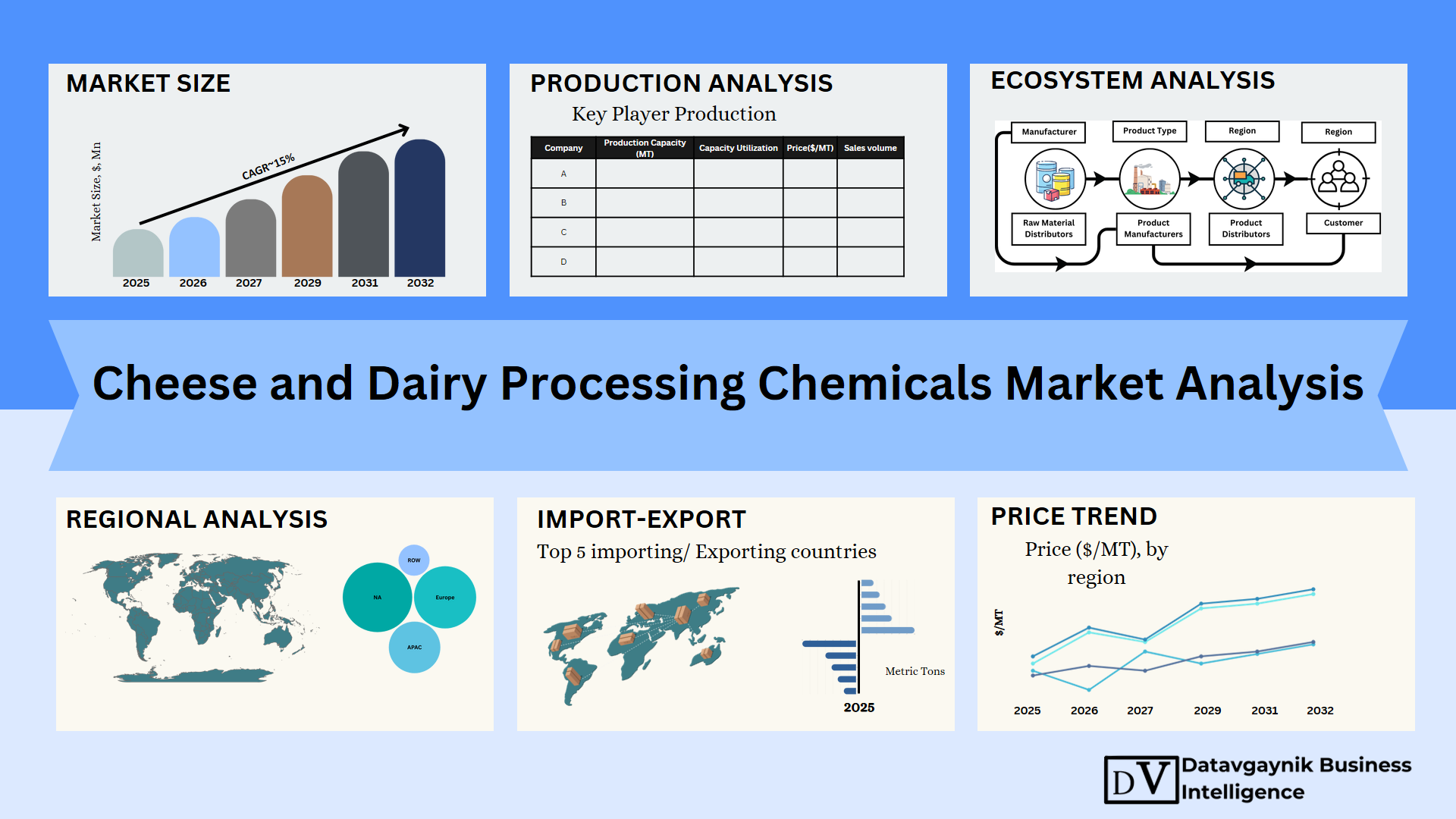
The market covers the chemical inputs, processing aids, cleaning agents, sanitizers, stabilizers, coagulants, pH regulators, anti-foaming agents, preservatives, enzymes, cultures-support chemicals, and formulation additives used across cheese, milk, yogurt, butter, cream, whey, and value-added dairy production. In simple terms, these chemicals help dairy processors maintain product consistency, improve yield, control microbial risk, extend shelf life, and keep production lines compliant with food safety standards.
By 2026, the Cheese and Dairy Processing Chemicals Market is becoming more strategic because dairy plants are no longer buying chemicals only for basic cleaning or formulation. They are using them to improve throughput, reduce product loss, meet stricter hygiene norms, and support premium dairy formats such as specialty cheese, high-protein yogurt, lactose-free dairy, clean-label dairy spreads, and shelf-stable milk products.
The market’s growth during 2026–2035 will be shaped by four clear forces. First, dairy consumption is shifting toward processed, packaged, and premium formats. That pushes chemical demand beyond conventional cleaning agents into enzymes, coagulants, stabilizers, antimicrobial systems, and specialty processing aids. Second, cheese production is rising in emerging markets, especially where quick-service restaurants, bakery chains, and packaged food companies are expanding. Third, food safety regulation is becoming tighter. Processors need validated sanitation, residue control, and contamination prevention systems. Fourth, automation in dairy plants is changing chemical usage. CIP-compatible cleaners, low-foam detergents, membrane-cleaning chemicals, and precise dosing systems are gaining more relevance.
The real shift is not only higher chemical consumption. It is smarter chemical consumption. Dairy processors want chemicals that reduce downtime, protect flavor, and work reliably across automated processing lines.
| Market Indicator | 2026 Estimate | 2035 Forecast | Analyst View |
| Global Market Size | $4.72 billion | $7.84 billion | Growth supported by cheese expansion, dairy hygiene upgrades, and specialty processing aids |
| CAGR | 5.8% | — | Moderate-to-strong growth for a mature but essential dairy supply segment |
| Cheese Processing Chemicals Share | 41% of 2026 demand | — | Cheese remains the highest-value application due to enzymes, coagulants, cultures-support systems, and yield-control chemistry |
| Cleaning & Sanitation Chemicals Share | 34% of 2026 demand | — | Core recurring demand from CIP cleaning, biofilm control, plant sanitation, and regulatory compliance |
| Asia Pacific Growth Profile | — | Fastest-growing region | Demand led by packaged dairy, mozzarella, processed cheese, UHT milk, and modern dairy plants |
Strategically, this market sits between the dairy ingredients industry, industrial hygiene sector, and food-grade specialty chemicals space. That makes it attractive for suppliers with technical service capability. A dairy plant does not simply need a chemical drum. It needs dosage advice, compatibility testing, residue validation, cleaning cycle optimization, and support during audits. This is why supplier relationships are sticky once performance is proven.
The Cheese and Dairy Processing Chemicals Market is also benefiting from plant modernization. Large processors are moving toward closed-loop systems, membrane filtration, automated pasteurization, high-capacity cheese vats, and continuous cleaning systems. These assets need chemicals that are effective at lower temperatures, safe for stainless steel and membranes, and compatible with food-contact surfaces. As energy costs remain high, processors also prefer cleaning chemicals that cut water use, shorten rinse cycles, and reduce heat requirements.
Regulation will remain a major demand anchor. Food safety audits, microbial control, allergen management, and hygiene documentation are pushing processors toward standardized chemical programs. In mature markets, chemical selection is tied closely to residue compliance and environmental discharge limits. In emerging markets, the bigger opportunity is basic modernization: replacing inconsistent manual cleaning with validated CIP and plant-wide sanitation programs.
The stakeholder base is broad. Key participants include dairy processors, cheese manufacturers, food-grade chemical suppliers, enzyme and culture companies, CIP equipment providers, OEMs, dairy plant engineering firms, food safety auditors, government food safety agencies, industry associations, private equity investors, and strategic chemical companies looking to deepen their food and beverage exposure.
From an investment lens, the most attractive pockets are not commodity alkaline cleaners or basic acids. The stronger margin areas sit in specialty coagulants, enzyme systems, membrane cleaners, low-residue sanitizers, biofilm-control solutions, clean-label-compatible processing aids, and chemical programs linked with service contracts.
Competitive Intelligence and Benchmarking
Competition in the Cheese and Dairy Processing Chemicals Market is split across three supplier groups. The first group includes hygiene and sanitation leaders supplying CIP detergents, acid cleaners, alkaline cleaners, sanitizers, membrane cleaners, lubricants, and plant-wide hygiene programs. The second group includes bioscience players supplying dairy enzymes, coagulants, cultures, ripening aids, lactose conversion systems, and texture-support solutions. The third group includes broader food ingredient companies that supply stabilizers, emulsifiers, acidity regulators, antimicrobials, and formulation chemicals.
This is not a market where price alone decides supplier strength. Dairy processors judge suppliers on audit support, application know-how, residue control, yield improvement, plant downtime reduction, and compatibility with automated lines.
| Company | Core Portfolio in Dairy Processing Chemicals | Market Positioning | Benchmark View |
| Ecolab | CIP cleaners, sanitizers, water treatment chemistry, membrane-cleaning systems, hygiene monitoring, food-contact sanitation programs | Strong in large dairy plants, multinational processors, and regulated food manufacturing sites | Positioned as a premium hygiene and water-performance partner rather than only a chemical supplier |
| Solenis / Diversey | Food and dairy hygiene chemicals, engineering-backed sanitation programs, CIP optimization, microbial control, surface hygiene, cleaning validation support | Strong in dairy, beverage, and food processing plants where hygiene reliability and technical service matter | Competitive strength comes from combining chemicals, equipment, training, and sanitation audit support |
| Novonesis | Dairy enzymes, starter cultures, cheese-ripening solutions, lactose conversion systems, biosolutions for yield, taste, texture, and process efficiency | One of the most strategic bioscience players after the combination of legacy enzyme and culture capabilities | Strong in value-added dairy and cheese where biological processing replaces purely chemical intervention |
| dsm-firmenich | Cheese coagulants, dairy cultures, enzyme systems, preservation-support solutions, texture and taste improvement tools | Strong in specialty cheese, fermented dairy, and premium dairy innovation | Well placed in clean-label dairy and cheese yield improvement where processors need technical formulation support |
| IFF | Cultures, enzymes, stabilizers, emulsifiers, texturants, antimicrobials, and dairy formulation systems | Broad food-ingredient player with strong access to global dairy brands and processed food companies | Strong in integrated formulation support rather than standalone chemical supply |
| Kerry Group | Dairy taste systems, functional ingredients, stabilizer blends, preservation-support ingredients, process aids, and application development | Strong with branded dairy, foodservice cheese, nutritional dairy, and value-added packaged formats | Strong where dairy processors need consumer-facing taste, texture, and shelf-life support together |
| AB Enzymes | Food enzymes used in dairy, lactose modification, protein processing, process efficiency, and specialty enzyme applications | Niche-to-specialist supplier with strength in enzyme-led productivity and formulation improvement | Competes well where processors want specific enzymatic functionality rather than bundled ingredient systems |
Ecolab holds a strong position in large-scale dairy sanitation because it connects chemicals with water, hygiene, monitoring, and service programs. For cheese and dairy plants, that matters because cleaning failures can affect flavor, microbial risk, production yield, and audit outcomes. Its strength is highest in automated plants with recurring CIP programs and formal food safety systems.
Solenis / Diversey competes heavily in hygiene-led dairy processing. Its advantage sits in cleaning chemistry plus engineering support. That is important for plants dealing with milk stone, protein fouling, biofilm risk, and membrane maintenance. The company is especially relevant in plants where processors want lower water use, shorter cleaning cycles, and better verification.
Novonesis is one of the most important bioscience-led players in this market. Its portfolio connects enzymes, cultures, and microbial technologies used in cheese, yogurt, fermented milk, lactose-free dairy, and whey valorization. Its position became stronger after the formation of Novonesis in 2024, creating a broader biosolutions platform across food and industrial applications.
dsm-firmenich is strong in dairy cultures, cheese coagulants, enzyme-led yield systems, and sensory improvement. Its role is not just ingredient supply. It supports processors working on cheese stretch, sliceability, bitterness control, ripening speed, and product consistency. This makes it relevant for premium cheese, processed cheese, pizza cheese, and high-value dairy categories.
IFF plays in the market through dairy cultures, enzymes, stabilizers, emulsifiers, and integrated food ingredient systems. Its strength comes from working with dairy processors that need both process functionality and finished-product performance. In practical terms, it can support a yogurt, cheese, or dairy beverage program from texture through shelf-life.
Kerry Group is stronger in application-led dairy innovation. It is more visible where cheese and dairy processors are trying to improve flavor, texture, mouthfeel, clean-label positioning, or convenience formats. It competes well in value-added dairy categories where the chemical or ingredient system must also support consumer acceptance.
AB Enzymes occupies a more specialized position. Its role is relevant in enzyme-led dairy processing where producers want better lactose management, protein modification, yield improvement, or processing efficiency. It does not compete as broadly as large hygiene or ingredient groups, but it can be important in targeted technical applications.
The competitive edge is shifting from “who sells the lowest-cost chemical” to “who can reduce plant risk and improve product economics.” That is why technical service, validation data, and process troubleshooting are becoming real differentiators.
Regional Landscape and Adoption Outlook
The regional structure of the Cheese and Dairy Processing Chemicals Market reflects dairy maturity, cheese consumption, plant automation, and food safety enforcement. Europe and North America remain high-value markets because dairy processing is mature and compliance-driven. Asia Pacific is the fastest-growing demand pool because cheese, yogurt, UHT milk, and packaged dairy are expanding from a lower base.
| Region / Country Cluster | 2026 Market Character | Adoption Outlook Through 2035 | White Space |
| North America | Mature, automated, high-compliance dairy processing base | Stable growth led by cheese, whey, high-protein dairy, plant hygiene, and membrane cleaning | Lower-chemical cleaning systems, enzyme-led yield improvement, and sustainability-linked sanitation |
| Europe | Highly regulated and innovation-heavy dairy region | Strong demand for clean-label processing aids, bio-based solutions, and energy-efficient cleaning | Small and mid-sized processors need affordable compliance and residue-control solutions |
| China | Large packaged dairy base with rising cheese and yogurt consumption | Fast adoption in UHT milk, yogurt, infant dairy, processed cheese, and automated dairy plants | Specialty cheese chemistry, premium cultures, and validated sanitation programs |
| India | Large milk base but fragmented processing structure | High growth from organized dairy, paneer, cheese, ice cream, UHT milk, and packaged curd | Huge gap in modern CIP chemicals, cold-chain hygiene, cheese coagulants, and small-plant sanitation |
| Japan | Mature, quality-focused dairy market | Moderate growth led by high-specification dairy, convenience foods, and premium cheese | Specialty cultures, clean-label stabilizers, and low-residue hygiene chemicals |
| South Korea | Advanced food manufacturing with strong processed dairy demand | Growth linked to cheese snacks, bakery cheese, foodservice mozzarella, and premium fermented dairy | Premium cheese processing aids and imported technology substitution |
| Rest of the World | Mixed maturity across Latin America, Middle East, Africa, and Southeast Asia | Growth led by dairy formalization, food safety upgrades, and packaged milk expansion | Basic hygiene chemicals, local technical service, and cost-effective enzyme systems |
North America remains one of the strongest revenue regions because cheese production is large, industrial dairy plants are highly automated, and processors operate under strict food safety systems. The United States leads demand, followed by Canada. Chemical usage is concentrated in CIP systems, membrane filtration, whey processing, cheese vats, pasteurization lines, and high-speed filling plants. The region is not the fastest by volume growth, but it is high value because suppliers sell technical programs rather than generic chemicals.
Europe has a more specialized demand profile. Germany, France, Italy, the Netherlands, Denmark, Ireland, and Poland are key dairy and cheese processing countries. European processors are more sensitive to wastewater discharge, residue limits, energy use, and clean-label formulation. So, the market leans toward bio-based processing aids, enzyme systems, mild sanitation chemistry, and chemicals that work at lower temperatures. Europe also has a strong installed base of specialty cheese producers, which supports demand for coagulants, cultures, ripening aids, pH regulators, and quality-control chemicals.
China is moving from basic dairy capacity expansion toward higher-quality processed dairy. Large dairy groups have invested in automated plants, UHT lines, yogurt plants, infant nutrition facilities, and cheese capacity. Adoption is strongest in large processors with modern facilities. Smaller regional players still represent white space for validated cleaning programs and contamination-control systems.
India is one of the most underpenetrated high-growth markets. The country has a very large milk pool but a lower share of fully organized, automated processing compared with developed markets. Demand is rising for cheese, paneer, packaged curd, flavored milk, ice cream, milk powder, and UHT milk. This supports demand for coagulants, stabilizers, acidity regulators, plant hygiene chemicals, and low-cost CIP programs. The biggest gap is not only product availability. It is training, dosage discipline, hygiene validation, and plant-level technical support.
Japan is a smaller but premium market. Processors focus on consistency, safety, convenience, and sensory quality. Adoption is stronger for specialty dairy ingredients, precision enzymes, stabilizer systems, and high-standard cleaning chemicals. Growth is modest, but margins are attractive because specifications are tight.
South Korea has strong food manufacturing infrastructure and a growing processed cheese and dairy snack ecosystem. Demand is tied to bakery chains, pizza cheese, convenience foods, premium yogurt, and functional dairy. Processors are more open to advanced enzyme systems and specialty cultures when they improve texture, shelf-life, or production consistency.
Rest of the World includes Latin America, Southeast Asia, the Middle East, and Africa. Brazil, Mexico, Argentina, Indonesia, Vietnam, Saudi Arabia, the UAE, Egypt, and South Africa are relevant demand pockets. The opportunity is practical: basic dairy sanitation, shelf-life support, cleaner processing, and affordable plant modernization. Many underserved regions still rely on inconsistent manual cleaning or low-grade chemicals, which creates room for branded suppliers with local application support.
Asia Pacific will add the most incremental demand, but Europe and North America will remain the quality benchmark. For suppliers, the winning model differs by region: service-led in mature markets, education-led in emerging markets.
End-User Dynamics and Use Case
End-user adoption differs sharply by plant size, product type, and processing sophistication. Large dairy processors buy chemicals through structured procurement programs. They prefer approved suppliers, documented residue control, technical audits, and standardized plant-wide chemical systems. Mid-sized processors are more selective. They often adopt specialty chemicals only when there is a clear production issue such as microbial failures, low cheese yield, excessive fouling, short shelf-life, or cleaning downtime. Small processors usually remain price-sensitive and depend heavily on distributor guidance.
Cheese manufacturers are the highest-value end users. They use coagulants, enzymes, starter-support systems, pH control chemicals, brine management chemicals, antimicrobials, and cleaning agents. Their buying logic is driven by yield, curd quality, moisture control, flavor development, stretch, melt, texture, and shelf-life.
Fluid milk processors rely more heavily on sanitation chemicals, membrane cleaners, anti-foam agents, stabilizers, acidity regulators, and water-treatment chemicals. For these plants, the priority is contamination prevention and processing uptime.
Yogurt and fermented dairy producers focus on culture performance, stabilizer compatibility, acidity control, sanitation, and texture consistency. They are more likely to invest in technical support because small formulation changes can affect mouthfeel and consumer acceptance.
Whey and dairy ingredient processors use membrane-cleaning chemicals, anti-foaming agents, pH regulators, protein-processing aids, and sanitation programs. Their chemical needs are linked to filtration efficiency, fouling reduction, protein recovery, and plant throughput.
Foodservice cheese and processed cheese suppliers need functionality more than tradition. They look for melt, stretch, sliceability, emulsification, stability, and repeatability. This makes them strong users of coagulants, enzymes, emulsifying salts, stabilizers, and processing aids.
Use case: A mid-sized mozzarella producer in Western India upgraded from manual alkaline cleaning to a validated CIP chemical program across cheese vats, pasteurization lines, and brine tanks. The plant also shifted to a more consistent coagulant and pH-control protocol. Within one production season, the main gain was not only cleaner equipment. The processor reduced batch variation, improved cheese stretch consistency for foodservice buyers, and lowered rejection linked to microbial deviations. This is how adoption typically happens in emerging markets: one production pain point triggers a broader chemical and process upgrade.
The main buying center includes plant heads, quality assurance teams, procurement managers, R&D teams, food safety officers, and external audit consultants. In larger companies, corporate technical teams often approve supplier panels. In smaller plants, distributors and application specialists influence the purchase more directly.
Recent Developments + Opportunities & Restraints
Recent Developments
| Year / Month | Event | Market Relevance |
| 2024, January | Novozymes and Chr. Hansen completed their combination and formed Novonesis. | This strengthened the global biosolutions base for dairy enzymes, cultures, fermentation systems, and cheese processing innovation. |
| 2025, June | dsm-firmenich highlighted recognition for a cheese coagulant innovation focused on yield, shelf-life, and cheese functionality. | This signals rising competition in high-performance cheese enzymes and coagulants, especially for mozzarella and industrial cheese applications. |
| 2025, August | dsm-firmenich announced major plant investments in India, including expansion in Kerala and a new taste facility in Gujarat. | This supports local application development for food, beverage, and dairy customers in one of the fastest-growing dairy-processing markets. |
| 2025, September | dsm-firmenich launched a next-generation all-in-one dairy culture system for semi-hard, hard, and continental-style cheese varieties. | This reflects processor demand for simplified culture systems that support safety, consistency, and cheese quality. |
| 2024–2025 | Solenis / Diversey continued positioning dairy hygiene around CIP analysis, cleaning chemistry evaluation, and food safety optimization. | This reinforces the shift from chemical supply to service-backed sanitation performance in dairy plants. |
Opportunities
Emerging market dairy formalization
India, Southeast Asia, the Middle East, and parts of Africa offer strong headroom as milk processing shifts from informal handling to packaged dairy, cheese, yogurt, UHT milk, and cold-chain-backed distribution. This creates demand for basic hygiene chemicals first, then specialty processing aids.
Automation and monitored CIP systems
Automated dairy plants need chemicals that work with controlled dosing, conductivity tracking, water reuse, temperature optimization, and cleaning validation. Suppliers that combine chemistry with monitoring and service will gain share.
Specialty cheese and value-added dairy
Mozzarella, processed cheese, high-protein yogurt, lactose-free milk, drinkable yogurt, and whey ingredients require more technical chemical systems. This raises demand for enzymes, coagulants, stabilizers, antimicrobials, pH regulators, and membrane cleaners.
Restraints
Residue and clean-label pressure
Dairy processors face pressure to reduce chemical residue risk and simplify ingredient declarations. This can restrict some preservatives, additives, and aggressive processing aids, especially in premium dairy products.
Cost sensitivity in small plants
Small and regional dairy processors often delay adoption of branded chemicals because cheaper local alternatives are available. The challenge is proving that better chemicals reduce rejection, downtime, water use, and audit risk.
Wastewater and discharge limits
High-strength alkaline and acid cleaning systems can raise wastewater treatment costs. This pushes plants toward optimized dosing, lower-temperature cleaners, and chemicals that reduce rinse load.


